Review: Black Ties (Ilbijerri Theatre Company / Te Rēhia Theatre)

Venue: Sydney Town Hall (Sydney NSW), Jan 10 – 18, 2020
Playwright: John Harvey, Tainui Tukiwaho
Director: Rachael Maza, Tainui Tukiwaho
Cast: Brendan Boney, Jack Charles, Mark Coles Smith, Mayella Dewis, Lana Garland, Laughton Kora, Tawhirangi Macpherson, Lisa Maza, Tuakoi Ohia, Brady Peeti, Tainui Tukiwaho, Dalara Williams, Dion Williams
Images by Luke Currie-Richardson

Theatre review
Love is in the air, but Hera is a Māori woman and Kane an Aboriginal man, each with strong connections to their respective families and lands. When the pair decide to marry, the place at which they choose to settle down, becomes a matter of serious contention for all their kin. As colonised peoples, Hera and Kane’s relations take with utmost seriousness, the manner in which their roots are to be planted. Each group is determined to maintain its own bloodline, and from the many conflicts that soon arise, it would appear that love may not conquer all so easily.

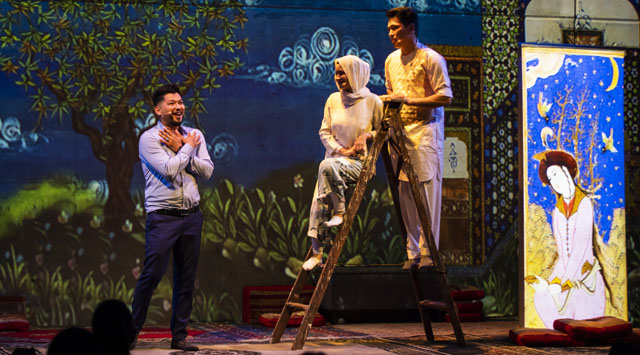
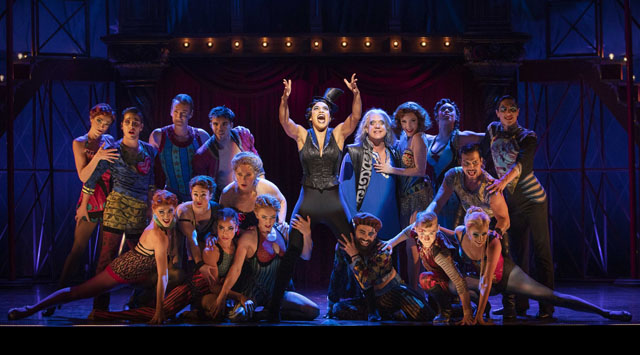
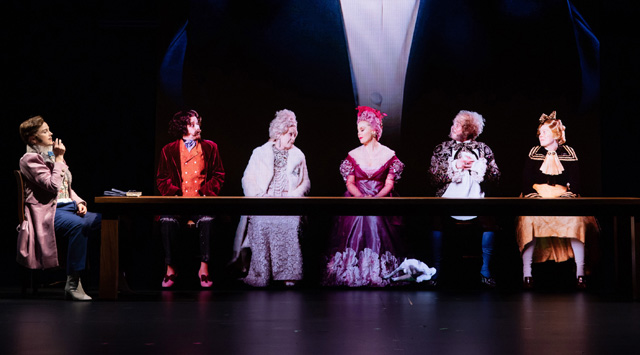
Black Ties by John Harvey and Tainui Tukiwaho tackles meaningful subjects, but does so with glorious humour. The play is endlessly amusing, impressive in its ability to balance serious with silly, for an experience that is at once poignant and hilarious. Directed by Rachel Maza and Tukiwaho, the production has a tendency to feel somewhat haphazard, but the enormity of its ambition is truly remarkable. Jacob Nash’s set design is a huge undertaking that thrills us with its capacity to surprise, effectively assisted by James Henry’s video projections that move us quickly between New Zealand and Melbourne. Live music by Brendon Boney, Mayella Dewis and Laughton Kora is consistently delightful, and a real highlight of the presentation.

Performers Mark Coles Smith and Tuakoi Ohia are the adoring couple, both very likeable, and appropriately wholesome in their depiction of the young innocents. Scene stealers include Jack Charles and Brady Peeti, who bring exquisite timing and captivating presences to this staging. Lana Garland and Lisa Maza play maternal roles, each one as strong and commanding as the other. Playwright and director Tukiwaho proves himself a compelling comic, delivering a great number of laughs as Hera’s oafish father.

We can hold firm to our cultural identities, but there must always be room for evolution and compromise. Thinking about our ancestors as monolithic is unhelpful and probably inaccurate. Allowing ourselves to progress with the times, in a manner decided upon by ourselves, and not by colonisers, is a realistic way of retaining valuable aspects of our heritage. Our only option is to adapt, and to trust in the fact that after centuries of diasporas and imperialism, we are still here.

www.ilbijerri.com.au | www.terehiatheatre.com

Review: Black Cockatoo (Ensemble Theatre)

Venue: Ensemble Theatre (Kirribilli NSW), Jan 4 – Feb 8, 2020 | Riverside Theatres (Parramatta NSW), Feb 18 – 22, 2020
Playwright: Geoffrey Atherden
Director: Wesley Enoch
Cast: Joseph Althouse, Luke Carroll, Chenoa Deemal, Aaron McGrath, Colin Smith, Dubs Yunupingu
Images by Prudence Upton

Theatre review
When Johnny ‘Unaarrimin’ Mullagh went to England in 1868 as part of Australia’s ‘First XI’, he probably never expected to become our first international cricket star. A century and a half later, his descendants probably never expected that the legend would today be so easily forgotten. Black Cockatoo by Geoffrey Atherden reintroduces the historical figure as a true Indigenous trailblazer, an Aboriginal example of black excellence that the white patriarchy of our sporting arenas seems so determined to wipe away from memory. The play has a tendency to feel overly wholesome, as though sanitised for public consumption, but its importance as cultural emblem cannot be understated.

Directed by Wesley Enoch, the show is a sincere and tender proclamation, paying tribute to Indigenous identities past and present. The complexity of black experiences as colonised peoples, is meaningfully, albeit politely, portrayed in Black Cockatoo. We see our protagonist in a state of conflict, able to recognise his privilege as star on the field, but never ignorant of injustices that befall himself and those he considers his community.

Set design by Richard Roberts establishes elegance for the production’s overall visual aesthetic, but requires greater versatility to help us imagine dramatic shifts in time and place. Lights by Trent Suidgeest and music by Steve Francis are sensitively rendered, both proving effective in conveying poignancy for the piece.

Actor Aaron McGrath is full of charm as Mullagh, dignified and beautifully nuanced in his depiction of a true blue hero. Black Cockatoo‘s narrative does not offer very much that is emotional or surprising, but McGrath makes us fall for the central character effortlessly. In the role of Lady Bardwell is the noteworthy Chenoa Deemal, who brings to the stage an august presence. Also impressive is Colin Smith as coach of the team, remarkably convincing as an ethically dubious Charles Lawrence.

Our Indigenous continue to have to navigate the absurdity of being seen as exotic on their own land. The ‘First XI’ went to England to play cricket, but often found themselves perceived as a circus act, a curiosity that robbed them of their humanity, a persisting strategy that provides legitimacy to mistreatment at the hands of colonisers. We need to hear the voices of minorities, because an understanding of their autonomy is fundamental to the betterment of all our lives. We no longer want our stories told by others. We want the right to talk about ourselves, whether or not the others are willing to listen.

www.ensemble.com.au

Review: Meet Me In St. Louis (New Theatre)

Venue: New Theatre (Newtown NSW), Dec 17 – 21, 2019
Book: Hugh Wheeler
Songs: Ralph Blane, Hugh Martin
Director: Matt Hourigan
Cast: Denzel Bruhn, Jayden Castle, Phoebe Clark, Sinead Cristaudo, Lana Domeney, Grace Driscoll, Lincoln Elliott, Amy Humphreys, Claudia Joller, Katelin Koprevic, Victoria Luxton, Alexis O’Donnell, Jared Palessen, Matthew Predny, Oliver Roach, Caitlin Shannon-Duhigg, Jerome Studdy, Andrew Symes

Theatre review
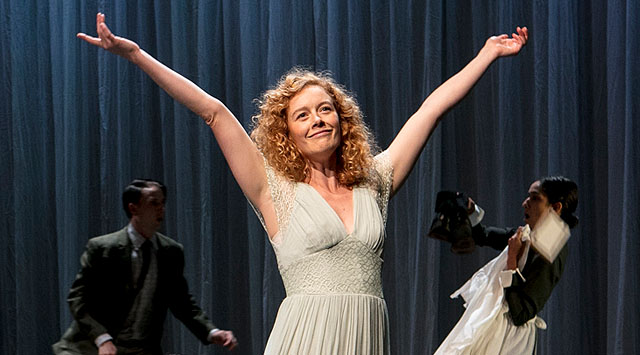
Young Esther is in love with John, the boy next door, but her family is set to move to New York as a result of her father’s recent promotion at work. It is clearly not the story of Meet Me In St. Louis that captivates, but its celebrated songs that we connect with. Based on the legendary 1944 film, this is a musical production of the most traditional kind, that holds special appeal for audiences of a conservative vein. There is nothing unpredictable or original here, only an abundance of nostalgia that many will no doubt find satisfying.

Matt Hourigan directs and choreographs, displaying considerable theatrical flair, although use of space can be more inventive. The band can sound somewhat distant, but music direction by Oscar Balle-Bowness remains a delight. Visual elements are adequately assembled, to help us imagine America at the dawn of the previous century. Performers look, comically, either too old or too young for their roles, but the quality of singing is consistently high, with leads Phoebe Clark and Matthew Predny leaving strong impressions with their vocal abilities.

“Have Yourself a Merry Little Christmas” has since become one of the most popular songs of the festive season. A deeply melancholic lyric that wistfully harks back to an idealistic past, “once again as in olden days, happy golden days of yore,” overzealous with the trust we place on old memories, and the frankly strange belief that things always used to be better, back in the day. The truth is that we have progressed in many ways, and although life is never without its challenges, to yearn for anything that might involve a regression of our existences, is simply unwise.

www.facebook.com/starkeeperproductions/

Review: Blue Christmas (New Ghosts Theatre Company)


Venue: Kings Cross Theatre (Kings Cross NSW), Dec 11 – 22, 2019
Images by Clare Hawley

Good People
Playwright: Katy Warner
Director: Lucy Clements
Cast: Clementine Anderson, Laura Djanegara, Sasha Dyer, Chika Ikogwe, Jane Watt, Emma Wright

Shandy’s Corner
Playwright: Gretel Vella
Director: Lucy Clements
Cast: Clementine Anderson, Meg Clarke, Laura Djanegara, Harriet Gordon-Anderson, Zoe Jensen, Vaishnavi Suryaprakash

Theatre review
It is Christmas time, when things come to a boiling point for two groups of women. In Katy Warner’s Good People, old friends have their holiday in Indonesia cut short by a state of emergency, as violence breaks out and tourists are corralled and confined to an airport. These Australians have witnessed the true face of poverty, and are now confronting the brutal implications of their privileged first world lives. Shandy’s Corner by Gretel Vella takes place in a women’s shelter, in first world Australia, where the consequences of our patriarchal systems are on full display, with broken individuals trying to regain their agency and a sense of dignity.

Both hour-long works are sensitively written and immensely contemplative, offering valuable perspectives on the kinds of lives we currently inhabit. Directed by Lucy Clements, the double-bill presentation grips from start to end. Good People is provocative, able to instigate meaningful conversations, while Shandy’s Corner is fabulously entertaining, with a dark humour that proves deeply satisfying. Clements injects an infectious passion into every scene, for a theatre that communicates with efficacious power.

An excellent impression is left by a very strong and cohesive cast, remarkably engaging in their delivery of two ensemble pieces, with not a single weak link. Clementine Anderson and Laura Djanegara perform in both stories, taking the opportunity to demonstrate versatility, but are especially memorable in Shandy’s Corner for their compelling portrayals of women overcoming adversity in wildly different ways. Harriet Gordon-Anderson and Emma Wright bring complex characterisations and excellent drama to the staging, intense with the emotions they convey. Funny ladies Meg Clarke and Zoe Jensen are thoroughly enjoyable in comedic roles, each actor with approaches as bold as their imaginations.

It is appropriate that the Christmas message here relates to the inherent injustices of our way of life. To respond to these plays, we can do no better than to think, “what would Jesus do?” in the face of these man-made tragedies. Christianity proclaims to be about caring for the poor and the oppressed, as it preaches in Proverbs 31:8-9, to “speak up for those who cannot speak for themselves, for the rights of all who are destitute. Speak up and judge fairly; defend the rights of the poor and needy.” When we look around us, there is little that can be construed as holy, but good art remains, and it is eternally sacred.

www.newghoststheatre.com

Review: The Last Days Of Judas Iscariot (Gamut Theatre Co)

Venue: Darlo Drama (Darlinghurst NSW), Dec 8 – 17, 2019
Playwright: Stephen Adly Guirgis
Director: Glen Hamilton
Cast: Edgar Antonio Atienza, Nicole Florio, David Hodgkins, Melinda Jensen, Erica Nelson, Stephanie Reeves, Hugo Schlanger, James Sugrue, Paula Williams, Mark J. Wilson
Images by Craig O’Regan

Theatre review
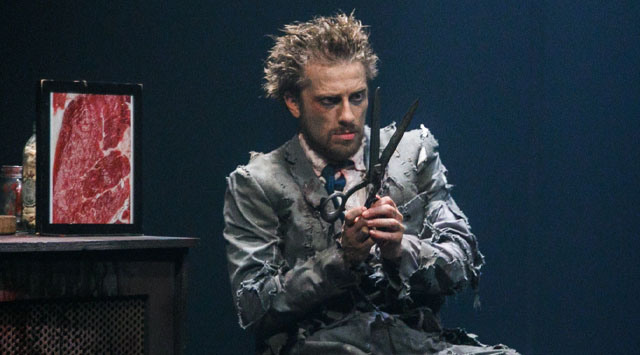
Cunningham is a lawyer in the celestial realm, working hard to get Judas out of hell. The courtroom in Stephen Adly Guirgis’ The Last Days Of Judas Iscariot, is situated in purgatory, where all things are undecided, and fates can be reversed. Themes of betrayal and regret feature prominently in this Christian story, as we imagine the fallout after Judas’ deathly kiss. It is a humorous piece, although never sacrilegious and consequently predictable, with its meditations on the ancient narrative.

Directed by Glen Hamilton, the production is faithful to Guirgis’ writing style, playful but also searingly earnest. Some scenes pack more punch than others, for a show that struggles to be consistently engaging. An ensemble of eleven take on twenty-seven roles, with varying levels of effectiveness. Stronger performers include Melinda Jensen and Stephanie Reeves, particularly memorable for their moments in drag, playing Pontius Pilate and Caiaphas the Elder respectively, both suddenly powerful with their interpretations of fossilised men.

A scene involving Cunningham in a fiery exchange with Satan, is a stand out, with actors Erica Nelson and Nicole Florio bringing vigour and authenticity to the play’s climax. James Sugrue is somewhat hesitant as Judas, but leaves a good impression with his exacting portrayal of Sigmund Freud.

However we might choose to think of Judas, has no bearing on the man himself, and can only ever be a reflection of how we regard our own lives. We rely on religion to help us turn chaos into order, so that a semblance of peace can be attained, for few of us can bear to look reality squarely in its eye. Villains allow us to think of ourselves as good, so that we may walk the earth with resilience and fortitude, but to be able to see fallibility in the self is emancipatory, and necessary in finding the capacity to love.

www.judasplay.com

Review: The Odd Couple (Ensemble Theatre)

Venue: Ensemble Theatre (Kirribilli NSW), Nov 22 – Dec 29, 2019
Playwright: Neil Simon
Director: Mark Kilmurry
Cast: Laurence Coy, Katie Fitchett, Robert Jago, James Lugton, Brian Meegan, Nicholas Papademetriou, Olivia Pigeot, Steve Rodgers
Images by Prudence Upton

Theatre review
Felix has left his wife, and is moving in with Oscar who is himself also a divorcee. The two are good friends, but also vastly different personalities, which means that their newly single lives are proving to be less harmonious than either had hoped for. Neil Simon’s The Odd Couple is over half a century old, but much of the comedy, largely based on laddish antics, still works. It would appear that the man-child trope still resonates, in fact its interest in the immature adult is probably more pertinent in our age of high tech comfort and reduced responsibilities. A pervasive and perpetual state of arrested development seems to be taking hold, and the farcical childishness of characters in Simon’s play becomes surprisingly relevant.

Energetic and entertaining, Mark Kilmurry’s crowd pleasing direction revives the work for an audience hankering for 1960s American nostalgia. Costumes and a set by designer Hugh O’Connor are effective contributions to the overall vibrancy of the production, along with Christopher Page’s lights maintaining a sense of joviality for the staging.

Actor Steve Rodgers is endearing as the fun-loving easy-going Oscar, able to turn the slob into someone disarmingly likeable. Felix the neat freak is played by Brian Meegan, who demonstrates unexpected range for the role, delivering charming humour alongside the portrayal of someone struggling with the difficulties of divorce. Stage chemistry is enjoyable, not just between the two, but also for all other members of cast. The group of eight embodies a cohesiveness that ensures solid comic timing from start to end, with Katie Fitchett and Olivia Pigeot particularly remarkable, in their ability to manufacture hilarity for scenes involving a couple of very poorly written female characters.

The success of relationships should be judged by their quality, and not in accordance with duration, yet we obsess over the number of years that people stay together, ignoring all the times those individuals may be suffering inside unhappy unions. Divorces are celebratory occasions, as they mark an end to one’s hardship, allowing them to begin again and find ways to welcome better days, that may have been elusive for considerable lengths of time. Narratives determine so much of our behaviour and emotions. If we know to make better sense of our stories, how we feel about our lives can be correspondingly improved.

www.ensemble.com.au

Review: Kasama Kita (Aya Productions)

Venue: Belvoir St Theatre (Surry Hills NSW), Nov 20 – Dec 7, 2019
Playwright: Jordan Shea
Director: Erin Taylor
Cast: Kip Chapman, Jude Gibson, Kenneth Moraleda, Monica Sayers, Teresa Tate Britten

Theatre review
It is 1974, and we follow three student nurses, as they leave the chaos of Marcos’ Philippines, for Whitlam’s newly progressive Australia. Jordan Shea’s Kasama Kita is a look at success stories of the Asian migrant experience, featuring colourful characters making unexpected and diverse journeys, in the land of their adopted country. Perhaps inevitable with its focus on adversity, Kasama Kita is however, remarkably humorous, and fascinating in its depictions of the different ways in which individuals are able to be of value to society.

The play’s unmistakable sentimentality is showcased powerfully by director Erin Taylor, who does not shy away from moments of melodrama. Its comedy too, is vigorously explored to deliver thoroughly satisfying entertainment, as it works simultaneously, on a separate quieter level, for a more heartrending result. Design aspects are fairly minimal, but the production’s subtle approach for sound and visuals, proves effective in keeping us attentive and emotionally invested.

In the role of Nancy is Monica Sayers, whose strong presence provides a sense of gravity to the model citizen narrative. Teresa Tate Britten plays the less honourable but equally impressive Cory, with excellent sass and dignity. Memorable, and very endearing, is Kenneth Moraleda who brings on the laughs as Antero, wonderfully authentic in his proud portrayal of a gay Filipino. Kip Chapman and Jude Gibson are delightful in multiple parts, both actors highly accomplished and full of conviction with all that they put on stage.

After 45 years, Nancy, Cory and Antero are still required to justify their place as Australians. Their achievements have far exceeded expectations, including their own, but their legitimacy still feels questioned, by a colonial establishment that itself struggles to be persuasive with its own validity. We can get into all kinds of discussions about prejudice and injustice, as we have done for many lifetimes, but it is evident that for as long as we do not adequately address the issue of land rights and ownership, all talk that pertains to race can only be rendered erroneous. If only 3% of Australians are Indigenous to this land, the 97% of us needs to find new ways to understand our positions here, in relation to the rightful custodians who must, for the foreseeable future, always be centred and prioritised.

www.ayaproductions.com.au

Review: The Beauty Queen Of Leenane (Sydney Theatre Company)

Venue: Roslyn Packer Theatre at Walsh Bay (Sydney NSW), Nov 18 – Dec 21, 2019
Playwright: Martin McDonagh
Director: Paige Rattray
Cast: Noni Hazlehurst, Hamish Michael, Shiv Palekar, Yael Stone
Images by Brett Boardman

Theatre review
Maureen is full of resentment, because she has to live at home to care for her incapacitated and very demanding mother Mag. After a passionate night with Pato however, Maureen starts to think of a brighter future, and in Martin McDonagh’s The Beauty Queen Of Leenane, we wonder how much of destiny is indeed predetermined, as our protagonist navigates what appears to be a new shift in luck.

The play is savage in its depictions of hard lives. Maureen and Mag are Irish women of the lower classes, and fending for themselves is nigh on impossible, as made abundantly clear in this painful story, about the compounding disadvantage of living with disability and poverty, as well as the structural sexism that functions as a major component keeping them at the bottom of the pile. McDonagh’s comedy is of the darkest variety, becoming pitch black as we approach its end.

It is a magnificently accomplished production that director Paige Rattray has assembled. Humour and drama are balanced exquisitely against dread and revulsion, for an entirely mesmerising experience at the theatre. Production design by Renée Mulder offers sensational rendering of the Folan’s home, both inside and out, for a vision of unimaginable decrepitude, reminiscent of the stuff nightmares are made of. The Beauty Queen Of Leenane is a masterpiece in the style of the modern Gothic horror; although devoid of supernatural elements, its atmosphere is unmistakably ominous.

Stunning performances by all four actors have us absolutely riveted. Maureen is played by Yael Stone who dances on a knife’s edge, in an intoxicating portrayal of a woman at the end of her tether, having us on the edge of our seats, with the psychological thrill of witnessing someone on the brink of losing her mind. Our perception of mother Mag oscillates precariously between humour and terror, as the fantastic Noni Hazlehurst masterfully manipulates her role to offer us immense entertainment.

Shiv Palekar has us amazed with his exceptional comic timing, as the puerile and very laddish neighbour Ray, able to deliver huge laughs with every one of his precise and intuitively executed punchlines. Maureen’s object of affection Pato too is a funny character, made tender and surprisingly earnest by Hamish Michael, who brings valuable sentimentality to the often brutal narrative.

Maureen’s world is a horrible existence, one that she has been taught to never leave. Poverty keeps people in their place. It works as a form of indoctrination that hopes to make large numbers feel a sense of acceptance of their stations, so that they can remain exploited for generations, if not for eternity. The two women are stuck at home, languishing and never daring to move beyond the familiar. They will not be rescued, but the rules are there ready to be broken, if only they were to choose defiance.

www.sydneytheatre.com.au

Review: Rudy & Cuthbert Too (Kings Cross Theatre)

Venue: Kings Cross Theatre (Kings Cross NSW), Nov 17 – 21, 2019
Playwrights: Toby Blome, Zelman Cressey-Gladwin
Director: Jo Turner
Cast: Toby Blome, Zelman Cressey-Gladwin
Images by Jasmin Simmons

Theatre review
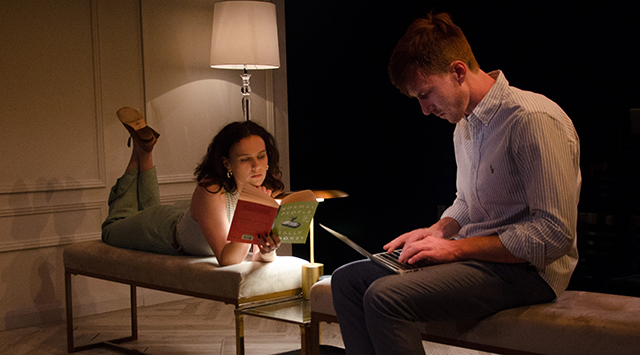
Rudy and Cuthbert are throwing a party. They consult a listicle on the internet, for ten sure-fire ways to make it a success, but it appears that information on the world wide web is not always reliable. In accordance with the top tips they had discovered, the young men work hard to make fun. Performers Toby Blome and Zelman Cressey-Gladwin, on the other hand, are effortless in their approach, for a whimsical comedy based on mime and clowning principles.

There is an unmistakable innocence in the characters, that sets the tone for the show. Having presented themselves to be devoid of agenda, other than the simple intention of having a party for their friends, we watch circumstances evolve, and observe the way things begin to happen to Rudy and Cuthbert, to arrive at an understanding that life has its way of taking you by surprise.

Directed by Jo Turner, the show is perfectly paced, to offer an experience that is deeply amusing and consistently delightful. The escalation in stakes and therefore tension, gives Rudy & Cuthbert Too an emotional dimension that is perhaps surprising for a presentation of this form. Although eccentric in style, Blome and Cressey-Gladwin have energetic presences that always maintain a firm grip over their audience. The boys make it a point to look like they are fooling around, but their irrefutable proficiency would suggest that they mean business.

Click-baits are deceptive by nature, and they take without giving anything satisfying in return. Theatre is quite the opposite. It allows us to sit in what is usually a state of passivity, while extraordinary attempts at deciphering the universe’s meanings are being offered up in earnest. Whether entertaining, informative, inspiring, or exasperating, these gifts from artists everywhere are immense, and a crucial element in determining how our civilisation does or does not flourish. There is no question that most of Australia’s art is devalued. If we could only give it as much as we do the endless pointless clicks on our phones, our extinction might just become avertible.

www.facebook.com/rudycuthbert

Review: Packer & Sons (Belvoir St Theatre)

Venue: Belvoir St Theatre (Surry Hills NSW), Nov 11 – Dec 22, 2019
Playwright: Tommy Murphy
Director: Eamon Flack
Cast: Nick Bartlett, John Gaden, Anthony Harkin, John Howard, Brandon McClelland, Josh McConville, Nate Sammut, Byron Wolffe
Images by Brett Boardman

Theatre review
It is assumed in Tommy Murphy’s Packer & Sons that we would be interested in three generations of awful men, simply because they rank amongst some of the most notorious people in the country. The play makes little effort to elicit our emotional investment in these repulsive characters, relying only on their celebrity to fascinate, as it dives straight into the nitty-gritty of their ruthless business dealings. Frank, Kerry and James Packer wield a lot of power as media moguls, and as the top one percentile their every major financial decision causes reverberations for the rest of us, yet the family shows nothing but contempt for consumers who they only seek to exploit and never to serve.

Packer & Sons seems to have an abundance of misplaced empathy for the Packer boys. James at its conclusion especially, weeps and wails as though innocent of all sins, begging for father’s approval, in an extended sequence that we can only regard with incredulity. We want to laugh at these animals, but the production is reluctant to heap scorn, expending its energy instead on the inner mechanics of the empire, as though offering something revelatory or profound.

The production is remarkably unimaginative, with too great an emphasis on a realism that works only to inform us on things that have long been public knowledge. Eamon Flack’s direction is able to convey with accuracy, dynamics between the men, which form the crux of the piece, but this focus on father-son relations is ultimately insufficiently substantial to sustain our engagement. Design elements of the presentation are accomplished, if slightly underwhelming, in their representations of some of the world’s wealthiest. The staging misses an opportunity to mock the Packer’s obsession with money and commercial success, especially in visual terms.

Actor John Howard is effective as tyrants of the dynasty, the grumpy old men Frank and Kerry, persuasive with the cunning he depicts, as the cruel instigator of chaotic discord at home and at work. Howard’s portrayal of toxic fatherhood in both roles, is a captivating feature of the show. As James and young Kerry, Josh McConville is irrepressibly vivacious. The energetic desperation that he embodies for Kerry, almost makes up for Packer & Sons‘s lacklustre drama.

Performances feel predictable, in this obvious and conservative take on a story about the patriarchy. Everything seems to be done the most convenient way, and the result is just banal. These characters are hateful, and if we are to spend any theatrical time with them, the approach should not be any less controversial than the way these assholes have always presented themselves, and prided themselves to be.

www.belvoir.com.au