Freud’s Last Session (Strange Duck Productions)

freudVenue: Theatre Royal (Sydney NSW), Aug 14 – Sep 1, 2013
Playwright: Mark St. Germain
Director: Adam Cook
Actors: Henri Szeps, Douglas Hansell

Theatre review
Theatre Royal is one of Sydney’s more beautiful theatres, usually showcasing large scale theatrical and musical productions due to its stage size and audience capacity. With just two actors and no scenic changes, Freud’s Last Session comes to Royal with extraordinary confidence. Mark Thompson’s set design is elegant, charming and effective, carefully carving out a perfectly sized performance space out of a very vast stage. It is, however, unfortunate that less attention is paid to acoustics resulting in poor volume levels for seats further back. The actors do not appear to be assisted by microphones, which is peculiar and fairly disappointing.

Henri Szeps is endearing as Sigmund Freud in his final days. His outlandish and controversial statements are presented with conviction and humour by Szeps, who presents to the audience a Freud who is unexpectedly affable. His masterful physical depiction of a feisty old man suffering from cancer is a joyful vision of experience and skill. Douglas Hansell is meticulous and detailed in his portrayal of C.S. Lewis. He delivers to the audience a sense of what London must have been like in the 1930s. Through his performance, we experience a time and place that is at once amusing and magical. The actors work well together, with a comfortable chemistry and excellent timing as a result of thorough familiarity with the material.

This is not a play with hugely dramatic moments that manipulates your emotions but its themes of religion and death are eternally fascinating, and they are dealt with with maturity, creativity and intellect. The characters see themselves as polar opposites, an atheist and a Christian, and argue engagingly about the differences in their belief systems and moralities. The play appeals to our human need to understand the afterlife and to question the existence of God, and it addresses the constant tension that resides between every point of view. Its conclusion is surprisingly universal and strangely satisfying.

www.freudslastsession.com.au

Delectable Shelter (Critical Stages/The Hayloft Project)

delectableVenue: Reginald Theatre, Seymour Centre (Sydney NSW), Aug 13 – 17, 2013
Playwright: Benedict Hardie
Director: Benedict Hardie
Actors: Andrew Broadbent, Brendan Hawke, Jolyon James, Simone Page Jones, Yesse Spence
Image by Pia Johnson

Theatre review
There are certain kinds of comedy that only appear in the theatre. They require an intimate space, and the immediacy of a live audience. Television and cinema do not generally provide the same experience, and in Australia especially, dark humour resides away from mainstream media, which continues to proliferate its benignity in service of financial voracity.

Delectable Shelter brings absurdity, big laughs and excellent entertainment to the stage, with outrageous “adult concepts”, gleeful “shock tactics”, and the most thorough use of irony imaginable. With the possible exception of one moment where two characters are locked in embrace, the play is filled with so much humour and social criticism that no space is left for sentimentality and romance. This prevents the show from appealing to wider audiences, but here is a unique and dynamic production that features wonderfully skilful  work from writer and director Benedict Hardie, who obviously isn’t concerned with catering to the masses. His Molieresque attacks on religion and the bourgeoisie are delivered with considerable wit in the form of imaginative, incisive commentary that cut with depth and precision.

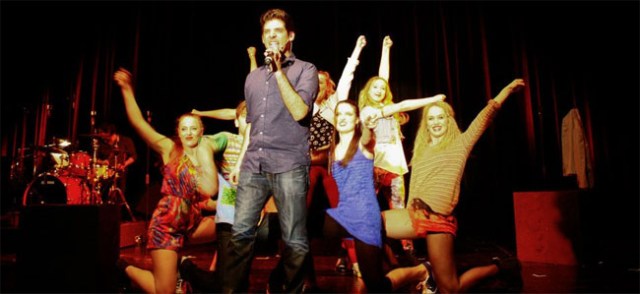
Hardie’s cast is a formidable one. Not only are they required to work with quite extreme comic material, they mark out scene changes by performing four 1980s ballads in the style of classical Bach chorales, complete with hymnal harmonies. Simone Page Jones has an outstanding singing voice and the face of an angel but surprises with her eagerness at tackling the wackiest characters, like the body-builder who attempts to provide therapy to agoraphobics, and a religious leader of the Albatross cult who exhibits the most outstanding features of today’s religious leaders. Yesse Spence is painfully delicious as Biddy, a stereotype of the uptight upper-middle class white woman who will cross her legs at all costs, but needs to be reminded to breathe. Jolyon James impresses with his comic timing and range, creating innumerable colourful characters, all distinct and all hilarious.

This is a truly funny show propelled by some very talented people and an anarchic spirit. It anthropologises aspects of modern Australian life without providing a direct political statement, although it might be construed that laughter (and a reminder to breathe) is the best medicine for the predicament that we are only now starting to realise that we are in.

www.hayloftproject.com
www.criticalstages.com.au
www.seymourcentre.com

Rosencrantz And Guildenstern Are Dead (Sydney Theatre Company)

art-hamlet-202-620x349[1]Venue: Sydney Theatre at Walsh Bay (Sydney NSW), Aug 6 – Sep 14, 2013
Playwright: Tom Stoppard
Director: Simon Phillips
Actors: Tim Minchin, Toby Schmitz, Ewen Leslie

Theatre review
Tom Stoppard’s 1966 work is embraced by many for its extraordinary wit and intellect. Sydney Theatre Company attracts vasts numbers of audiences, and it is a brave choice to present this play that many a lay person will find too wordy, philosophical, and abstract. Big chunks of text and their associated big ideas are delivered successively and quickly, and it is a challenging experience trying to keep up with every concept being discussed. However, like many great works of art, it is not only what you understand, but also what you don’t understand that makes the consumption of it necessary and worthwhile. Art inspires and elevates, even while it confuses.

From a technical perspective, the company continues to impress. Design elements are faultless, and execution of sound and lighting are perfectly honed to a fine craft. The theatre seats 900 people but it never feels too vast, even for a show like this where majority of the action involves just two actors. Performances are excellent, with Tim Minchin’s uncanny ability to blur the line between actor and role consistently outshining his counterparts. He seems so completely natural on stage, one can hardly imagine a different “real person” existing separately when the show is over. Ewen Leslie is the real showman in this production. He creates a mischievous character, infectious in his playfulness, and setting the stage alight at every entrance. After Cat On A Hot Tin Roof with Belvoir St Theatre, and the Tony Krawitz film, Dead Europe, it is thrilling to see Leslie’s departure from dark and broody roles to one that is full of vigour and hilarity.

Rosencrantz and Guildenstern Are Dead can be considered highbrow, but it’s central theme of “life and death” is universal. Playing with words, theatrical mechanisms, philosophical theories will not appeal to all, but we can relate to the existential conundrum that is the one constant in our lives. It is infinitely more satisfying to watch Rosencrantz and Guildenstern wrestling with the meaning of life, than for one to be engaged in endless self-examination. With any luck, you might even encounter ideas that could provide some level of enlightenment and make that arduous process, sometimes known as life, a bit more bearable.

www.sydneytheatre.com.au

Friday (Sydney Independent Theatre Company)

friday2Venue: Old Fitzroy Theatre (Woolloomooloo NSW), Aug 6 – 31, 2013
Playwright: Daniela Giorgi
Director: Julie Baz
Actors: Peter Hayes, Gemma Scoble, Gertraud Ingeborg, Cherilyn Price, David Ritchie, Sarah Robinson

Theatre review
Daniela Giorgi’s political satire has an unambiguous message. In its prologue and epilogue, the play talks about the importance of active participation being the only means to effect change in politics and in life. This all sounds very dry and serious, but thankfully, the play’s structure is exuberantly quick and sharp, with succinct scenes that get straight to the point. It has a gentle sense of humour that keeps the proceedings light and entertaining, but this same lightness does seem to prevent a couple of heavier scenes from taking flight emotionally.

Peter Hayes’ performance is strong as the lead character Bill, a well-meaning and left-leaning Minister for Transport with a penchant for colourful language. His depiction of a gentle giant in government is endearing and central to the empathetic effectiveness of the narrative. Cherilyn Price is eminently believable as a well worn public servant, and provides some of the most genuine and lively moments. There are good performances from other members of the cast, but many suffer from playing their roles too plainly, resulting in two-dimensional, archetypal versions of “people in government”, “media types”, or “tourists” that on occasion fail to translate with much credibility.

There are lots of characters and many different ideas, but they all add to the tale, with none allowed to slow down the pace. The story is told with crystal clarity in spite of all the frantic action, and it is to the credit of both writer and director, that the audience is always connected to the plot. Colourful and delightful diversions are introduced throughout the play, entering and exiting seamlessly. It is noteworthy that spacial and psychological transitions that happen between scene changes are established with great flair. Friday might not hold the key to the great political challenges of our times, but it does showcase those challenges well, and presents them in the guise of a great night at the theatre.

www.sitco.net.au

Dangerous Corner (The Genesian Theatre)

Dangerous Corner 1Venue: The Genesian Theatre (Sydney NSW), Jul 5 – Aug 10, 2013
Playwright: J.B. Priestley
Director: Peter Lavelle
Actors: Elizabeth MacGregor, Elinor Portch, Amy Fisher, Tom Massey, John Grinston, John Willis-Richards
Image credit: Craig O’Regan

Theatre review
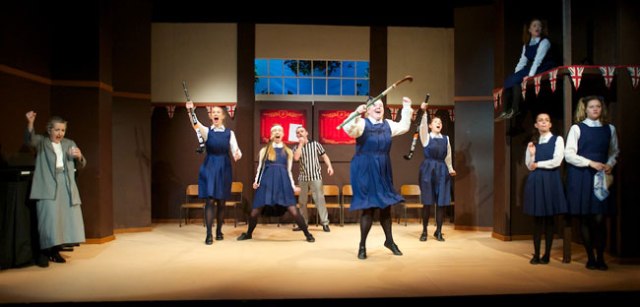
Dangerous Corner was first staged in the early 30s, and this production is faithful to that era in every way possible. Every effort is made to provide a glimpse into early twentieth century England, without any distractions in gratuitous attempts at bringing the show “up to date”. The undeniable charm of the period is experienced through costume design, acting style and of course, The Genesian Theatre itself with its wondrous vintage space. Modern theatre cultures in the last thirty years, have been intently concerned with the dismantling of live performance traditions, but in director Peter Lavelle’s vision, the proscenium arch and all that it represents is revived, honoured and adored.

Hair design is beautiful and highly accomplished. Minute details and secondary elements in a production like this play a big part in winning over its audience. Set design is effective but somewhat minimal. There are no changes and movements to the stage set pieces, so one can imagine that further ornamentation could have been introduced fairly easily to enhance the sense of luxury and wealth of the characters.

Elizabeth MacGregor plays Olwen Peel with a quiet confidence. She takes command of the stage with her effortless and exquisite physicality, gesturing and gliding from one position to another with careful and genuine intent. Her lines are delivered with superb clarity, and this is true for the entire cast who are a real treat in regard to their use of voice. Elinor Portch plays the supporting role of Freda Caplan delightfully, performing with precision even when in the background, always listening and reacting appropriately, thereby heightening the effects of her co-players’ words.

The play ends spectacularly. A surprising epilogue is presented and the audience is mesmerised. Without giving too much away, it is a great few minutes of theatre that is at once fascinating and thrilling, letting one leave the theatre with a feeling that is quite thoroughly modern.

www.genesiantheatre.com.au

The Light Box (Fat Boy Dancing / We Do Not Unhappen)

lighboxVenue: 107 Projects (Redfern NSW), Jul 10 – 28, 2013
Playwright: Natalia Savvides
Director: James Dalton
Actors: Hannah Barlow, Stephanie King, Tom Christophersen, Dean Mason

Theatre review
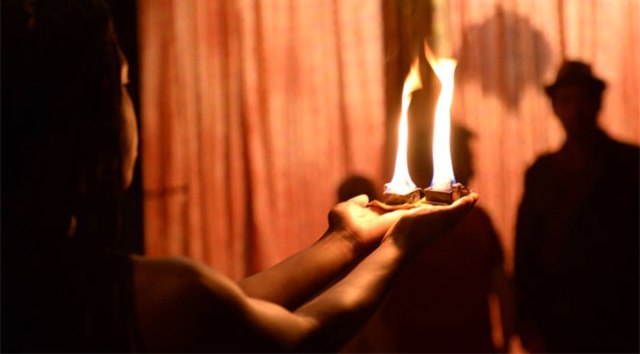
This is a story about madness and fantasy, set mainly in an asylum. The theme of insanity opens up limitless possibilities for artists, and The Light Box shows just how much is possible in the exploration of our subconscious minds. Natalia Savvides’ script alternates between reality and fantasy, but provides narrative threads that allow for logical readings of the play. Her characters are colourful and fascinating. While their stories are outlandish, they are grounded in humanity, which allows us to connect and empathise.

Director James Dalton relishes in the opportunity presented by a fantastical script, and takes flight with wondrous imagery and some of the most unhinged characterisations one is likely to see. The design elements are terrific. Sound, lighting, costumes and set are transportative, and entirely mesmerising. The production bears the aesthetic of an avant garde installation but is undoubtedly theatrical in its approach. The care taken to utilise all the potentialities of an empty space is impressive, and breathtaking.

Hannah Barlow plays a young patient Ethel, and brings to the role a beautiful fragility, but shocks us with bursts of great strength at several points. She looks like a meek wallflower but delivers high octane drama at the right moments. Stephanie King has impressive range and her performance is multi-faceted, with her comedic scenes leaving a very lasting impression. Dean Mason creates two solid characters, both intriguing and sensitive. He creates a good counterpoint to the frequently rambunctious activity on stage. Tom Christophersen plays three memorable characters, switching comfortably between several modes of performance; naturalistic, surreal, and camp. His “Man Made of Spoons” character is spectacularly funny, while maintaining a frightening aura of morbidity.

At the core of The Light Box lies an interesting story and this production tells it lovingly. More significantly, it is a feast for the senses that provides an experience only small theatres can, immersing its audience in a meticulously constructed space and speaking to it in much more than rational cerebral terms. It is theatre that goes beyond words. It is something a lot like magic.

www.fatboydancing.com

www.unhappen.org

Certain Men (Encyclopaedia Of Animals)

322708_439295692788974_1011700878_o.jpg  1000×667Venue: Bondi Pavilion Theatre (Bondi NSW), Jul 26-27
Director: Christopher Brown
Actors: Brian Davison, Michael Gwynne, Tamblyn Lord

Theatre review
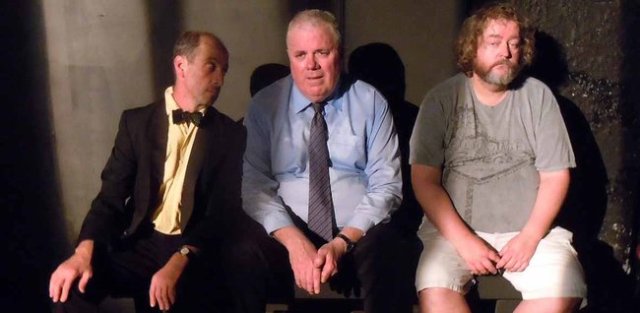
The audience is seated in a big circle, all facing inwards. The room is large, with no specific focal point and no stage. The actors constantly move around the space, and the audience finds itself in the midst of all the action, almost an intruder into the intimate setting, where three middle-aged men meet for a group therapy of sorts. This is a play about the issues that these men face, and the difficulty in expressing and articulating those issues. Certain Men is fascinating in its theatrical form, which aligns itself with psychological treatments that seek to deconstruct patterns and convention, in order to reach a breakthrough point of enlightenment.

The chemistry between the players feels solid, but the characters do not communicate well with each other. They talk about themselves, play lego, clean windows, sing, rap and dance; they try but do not form a strong connection. What takes place in this work is abstract and makes for challenging viewing, but it feels like witnessing real life. A sadness permeates these beings, and we get hints of their individual stories, but the main concern here are questions and not answers. Perhaps the intent of their therapy is only to ask, and not to conclude. In its artistic form, Certain Men seeks to create its own language. While not instantly gratifying, it is a commendable and necessary development away from theatre that is facile and obsolete, moving towards something fresh and intelligent.

www.encyclopaediaofanimals.net

Short Plays #3 (Tamarama Rock Surfers)

1010847_607684252597522_1882182589_n.jpg  960×640Venue: Bondi Pavilion Theatre (Bondi NSW), Jul 19 & 26
Playwrights: Kate Mulvany, Finegen Kruckmeyer, Kit Brookman, Phillip Kavanagh
Directors: John Kachoyan, Jessica Tuckwell, Pierce Wilcox, Jo Turner
Actors: Akos Armont, Danielle King, Yalin Ozucelik, Huw McKinnon, Joshua Anderson, Jonny Pasvolsky, Zak Ynfante

Theatre review
When writing a play, one should think of the stage and its audience. It is good to have a story, a message, or an idea, but writing for the theatre requires awareness of the various senses that are engaged in the act of “watching a play”, and also the various disciplines involved in the collaborative nature of the theatrical arts. Feast and Heart Of Glass are two of the short plays in this collection with distinct similarities. They both feature one male actor, and a great deal of verbiage. Akos Armont and Joshua Anderson are committed actors but are left on an empty stage with nothing more than pages and pages of words. Their stories are not uninteresting, but it is a tall order to perform without involving other elements of the live stage. Unfortunately, these two works come across too much like talented actors reading out chapters from great books, but this does not deliver the best theatrical experience.

Conversely, the two other plays provide dynamism and intrigue to the evening’s proceedings. Wolf imagines the last moments in the life of the boy who cried wolf.  Jonny Pasvolsky plays the wolf (in human form) with great confidence and delicious cunning. The showman delivers an entertaining yet dark performance, positioning himself somewhere between menace and comedy, while cleverly avoiding unpleasant territory in the presence of a child actor.

The Last Bell exploits the short form perfectly, Tension and intrigue is skilfully maintained throughout the piece, with the actors keeping their audience at the edge of its seat. Yalin Ozucelik’s enigmatic gravitas grounds the play. It is his character’s impending doom which is at the centre of the story, and he conveys powerfully that state of being with a minimum of words and movement. Kate Mulvany’s script bears a narrative structure that is thoughtfully designed, able to create dramatic impact without explicit details of horror, and emotional tangibility without being tediously sentimental. Really enjoyable theatre in the mystery/thriller genre.

www.bondifeast.com.au

I’m Not Pale, I’m Dead (Lydia Nicholson)

Im_Not_Pale_cropped.jpg  810×540Venue: Bondi Pavilion Theatre (Bondi NSW), Jul 26-27
Playwright: Lydia Nicholson
Actor: Lydia Nicholson

Theatre review
Lydia Nicholson is a ghost in I’m Not Pale, I’m Dead. She tells us what it’s like being dead, and what she misses about being alive. This is a simple premise, but one which provides the perfect starting point to our immortal quest for the meaning of life. Of course, there are elements in this 50 minute work that are deadly serious, but Nicholson is careful to pepper comic elements from start to finish. The contrast between the lighthearted sections and the melancholic moments gives the piece delightful texture and unpredictability. Along with its life and death “big messages”, the script is a thoroughly enjoyable and deeply moving one. The material here is wonderful, and the universality of its themes gives the script great potential to travel far and wide.

Nicholson addresses her audience directly, playing a guide of sorts to the newly-dead, only to discover that we are in fact still alive and that she is being presented with a rare opportunity to communicate with the living. As with most cases where “audience participation” is involved, a sense of ticklish glee is created, and Nicholson uses this dynamic well, keeping her audience on its toes, and establishing a good rapport from very early on. She is however, best at performing the sadder aspects of the story, especially in the passages that explore the longing she feels for the living. The intensity of that sadness is palpable, and incredibly touching.

www.bondifeast.com.au/…

Short Plays #1 (Tamarama Rock Surfers)

shorts1Venue: Bondi Pavilion Theatre (Bondi NSW), Jul 17 & 24
Playwrights: Jessica Tuckwell, Chris Summers, Mark Rogers, Nakkiah Lui
Directors: Kate Gaul, Corey McMahon, Phil Spencer, Matilda Ridgway
Actors: Sandie Eldridge, Lorna Munro, Huw McKinnon, Madeleine Levins, Simon Corfield
Image from Facebook

Theatre review
Four plays with different themes, styles and ideas, all with its own appeal. The opportunities a short play presents is manifold, but chiefly, it allows for the exploration of a single idea with minimal distraction from sub-plots, secondary characters and other auxiliary elements.

Dessert is a macabre story about marriage and death. Sandie Eldridge’s performance of a middle-aged widow impressively positions the play in a delusional psychological space but carefully presents her character with empathy and sadness.  The balance between shock value and sensitivity in this work is exquisite.Washer Woman also features a lone female character. Jessica Tuckwell’s script is poetic and abstract, and Madeleine Levins brings to the piece enough tension and drama to create a semblance of narrative to keep its audience engaged.

The Buck tackles mateship and Aussie bloke culture. The piece creates a formidable air of violence in the theatre, effectively focussing on the dark side to contemporary Australian lives. Similarly working with danger and brutality is Ideginaiety, which presents a harrowing perspective of revenge and colonialism. This is an interesting exploration into indigenous culture through a prism of metaphysicality and crime. The structure of the script and the brave choices it makes is original and powerful, and definitely warrants an extended rendering.

www.bondifeast.com.au