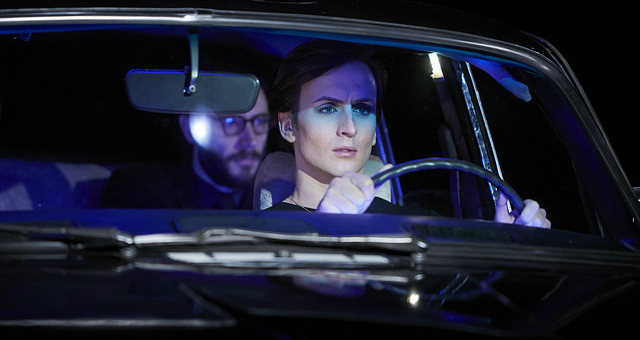
Review: Cinderella (Belvoir St Theatre)

Venue: Belvoir St Theatre (Surry Hills NSW), Nov 13 – Dec 14, 2014
Playwright: Matthew Whittet (based on an original concept by Anthea Williams)
Director: Anthea Williams
Cast: Mandy McElhinney, Matthew Whittet
Images by Brett Boardman

Theatre review
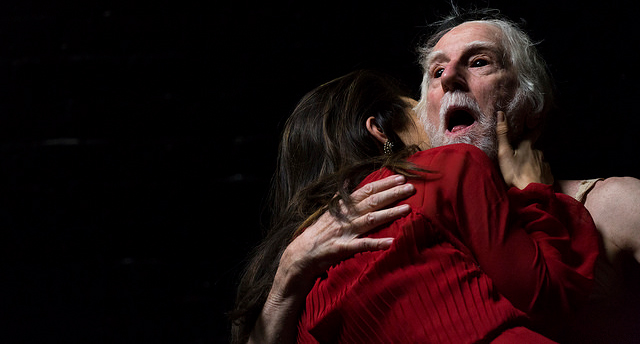
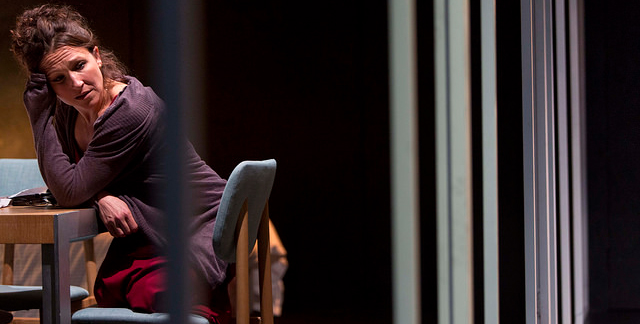
Fairy tales appeal to our basic desires. They address our need to be acknowledged and exalted, which is probably why they so often take the form of love stories. Matthew Whittet and Anthea Williams’s Cinderella is about our need for love, but it seeks to transform the fantasies and lies of Disney world, relocating it to a space of truth, lived experience, and disappointment. Its characters Ashley and Ash, are thoroughly familiar beings who remind us of ourselves and of people we meet everyday. They are strangers in the night who reach out to each other, hoping for a connection, and it is that possibility of a soul finding its other half that touches and engages us.

When both Ashleys meet, their accidental encounter is an awkward one. They are not brassy personalities, and their attempts at stretching beyond their individual comfort zones in the act of seduction becomes the comedic core of the production. The actors are brilliant comics who deliver laughs with precision, but the plot feels repetitive in its emphasis on creating jokes from that incessant awkwardness that subsumes the otherwise interesting development of character and relationship that takes place under the surface. A major tonal shift finally occurs in the last quarter of the show, bringing a breath of fresh air along with immense poignancy. The conclusion is beautifully crafted, although the depth that is eventually exposed feels sadly momentary.

The charismatic Whittet plays Ash with an attractive ease, consistently amusing his audience with a quirky instinctual approach. The actor has a slight physique and his countenance is plain, but the magnetic presence he adds to the stage assertively demands our attention, determined to entertain at every opportunity. Also enjoyable is Mandy McElhinney, who presents herself as a committed comedian, always sensitive to punchlines and timing. Her enthusiasm for creating laughter is infectious, but it also alienates us from the emotional arc of her character’s journey. We wish to dive into Ashley’s experience, but often find ourselves pushed out to observe only the funny side of scenarios. It is noteworthy that McElhinney and Whittet perform the final dark scenes with excellent and surprising intensity, leaving us wishing for more of their serious sides.

This Cinderella is an accurate and timely representation of romance in the digital age. Technology and commerce have penetrated every aspect of our lives, yet some of our notions of love and relationships are adamantly traditional and wholesome. The show looks at how we survive loneliness, and the meaning of sex and relationships in the era of dating apps and casual hook ups. The reality is unbearably grim, but it is human to shield our vulnerability with dreams. In affairs of the heart, delusions and hope are two sides of the same coin, and only the ones looking at the stars will stand a chance of fleeing the gutter.

www.belvoir.com.au

Review: A Christmas Carol (Belvoir St Theatre)

Venue: Belvoir St Theatre (Surry Hills NSW), Nov 8 – Dec 24, 2014
Playwrights: Benedict Hardie, Anne-Louise Sarks (after Charles Dickens)
Director: Anne-Louise Sarks
Cast: Kate Box, Peter Carroll, Ivan Donato, Eden Falk, Robert Menzies, Steve Rodgers, Miranda Tapsell, Ursula Yovich
Images by Brett Boardman

Theatre review
Religion provides salvation, and the most enduring stories touch us in a similar way. Benedict Hardie and Anne-Louise Sarks’ adaptation of A Christmas Carol does not include Christianity as a theme in its structure and composition, but the play uses Dickens’ tale of redemption to affect a spiritually uplifting experience for its audience. Ebenezer Scrooge’s journey from darkness to joy is an inspiring one, and this new retelling of his tale keeps focus on providing a tender optimism against the familiar backdrop of the Christmas season. The production is child-friendly, with simple characterisations and narratives, all serving to drive the basic, but important, point of happiness.

Sarks’ direction is vibrant, emotional and poignant. There is a depth to her work that prevents the show from feeling like a children’s production, but she encourages us to observe with wide-eyed wonder, as pains are taken to create a dreamlike quality with the text’s supernatural elements and colourful personalities. There is a heavy dose of playful energy that contributes to the festive atmosphere in which we find ourselves immersed (complete with overwhelming volumes of confetti snow), and performances are sensitively tuned to bridge the gap between spectators young and old. Robert Menzies is perfect as Scrooge; the man looks almost to have been born to play the role. The clarity of his trajectories and the conviction he applies to his motivations give shape to the plot, allowing us to follow his compelling evolution with palpable empathy. The ensemble is a delight, with Steve Rodgers leaving an impression as the very warm Bob Cratchit, and Miranda Tapsell stealing our hearts as the lovable Tiny Tim. Ursula Yovich’s beautiful singing voice finds opportunity to shine in the carols that feature in several scene transitions, and her tears as Mrs Cratchit are equally exquisite.

Michael Hankin’s set design is cleverly conceived and efficiently executed, with trapdoors and an elevating platform maximising theatrical effect with little fuss. Lights by Benjamin Cisterne are lively and dynamic, adding visual panache to every sequence. Mood transformations are very successfully manufactured, not only by lighting design, but also with the use of Stefan Gregory’s sound and music, which are particularly powerful in moments of mystery and surprise. The show will be remembered for several outlandish costume pieces by Mel Page, but her more subtle work is also effective and should not be overlooked.

Scrooge’s story is well-known, but it bears repeating. Its central message needs reiteration, and Belvoir’s production this Christmas time is a fresh approach that manages to connect with audiences of all ages. We need to instill in Australia’s children, a culture of theatre attendance and art appreciation, and shows like A Christmas Carol are an excellent introduction. It is entertaining, creative and meaningful, and significantly, it leaves you satisfied yet wanting more.

www.belvoir.com.au

Review: The Glass Menagerie (Belvoir St Theatre)

Venue: Belvoir St Theatre (Surry Hills NSW), Sep 20 – Nov 2, 2014
Playwright: Tennessee Williams
Director: Eamon Flack
Cast: Harry Greenwood, Luke Mullins, Pamela Rabe, Rose Riley
Images by Brett Boardman

Theatre review (originally published at Auditorium Magazine)
Tennessee Williams refers to The Glass Menagerie as a memory play. The work is semi-autobiographical, inspired by events, people and recollections from his own life. The making of art often involves the search for an understanding of the artists’ self and their immediate environment, through the expression of subjects that are familiar and intimate. Williams’ story examines the home life he had shared with an overbearing mother and a “crippled” sister. Seventy years have past since its initial staging, but their life together remains intriguing and poignant, covering timeless and universal themes that resonate with audiences today the world over. Film adaptations from India and Iran in the last decade demonstrate the wide appeal of the play’s premise and characters.

Williams’ language is romantically evocative of the American South in the 1930s, with old fashioned values that seem quaint and charming to our modern sensibilities, but that same regressiveness in attitude can prove to be harmful, as witnessed in the Wingfield family’s tribulations. Amanda has a definite, and narrow, view of the world and expects her children’s adherence to her every imagined obligation to society. It is a small mind that rules the household, and its painful repercussions are felt by all its members, including the matriarch herself. Eamon Flack’s direction is punctuated by inventive touches, but it is his effective exploration of the original’s concepts that strikes a chord.

A key feature of the production involves two large screens flanking the set, and several video cameras on tripods positioned on the periphery of the stage. Close ups of live action are periodically projected in black and white, shifting the audience between modes of theatre and cinema. This mechanism is slightly gimmicky, but it enriches the viewing experience by allowing an intrusion into more private spaces. Sean Bacon’s work on video design manages to bring elegance to the technology, finding a beautiful balance between stage and screen, rarely causing conflict or confusion for our eyes. Flack’s decision to have faces enlarged for our viewing pleasure enhances emotion and empathy for the piece, but it also brings into doubt the strength of performances that require that augmentation.

Also intensified in Flack’s direction is Tom Wingfield’s homosexuality. Before Williams’ lines are able to reveal the source of Tom’s disquiet, we observe from the very beginning, actor Luke Mullins’ purposeful flamboyance eagerly presenting an image of repressed and hidden gayness. The negation of that obsolete taboo inherent in the text, is an interesting and politically appropriate move for our times, and we are glad to see Tom, our narrator, approach us with fresh honesty. In terms of dramatic structure however, the build up of frustration and tension resulting from his gradual and inevitable disclosures is thus omitted.

Mullins is delightfully spirited in the role. He finds many opportunities for playfulness that helps maintain an electric atmosphere, regardless of moods being portrayed. The staidness of his home is placed alongside a confident showmanship that ensures entertainment in spite of the play’s many grim turns. Within the script’s shrewd treatment of secret sexuality, Mullins exercises a surprising range of nuance that conveys as much as Williams had tried to conceal.

The role of Amanda, the Wingfield mother and faded Southern belle, is played by Pamela Rabe who excels at locating authenticity in a highly dramatised character. Obsessive concern becomes comprehensible in Rabe’s depiction, thereby giving the tale its emotion and meaning. The woman’s severity leads to her own anguish, both qualities delivered by the actor with firm conviction. Amanda’s neurosis is strangely subdued at the play’s early stages, which slightly dampens the drama surrounding family dynamics, but when her hysteria sets in, its theatrical effects are quite wonderful.

Rose Riley’s interpretation of Laura is a fascinating one. Her family believes her to be disabled, but we do not see much evidence for it. The ambiguity surrounding Laura’s impairment sheds light on the changes in attitude over time that societies hold for notions of health and normalcy. Riley puts on an intense but introspective performance and her best moments occur when the camera catches her face in tight shots, revealing very strong and genuine outpouring of emotion. She is the perfect counterpoint to the loudness of her mother and brother, but a lengthy scene with a romantic interest Jim (Harry Greenwood) is unduly quiet and both actors’ subtlety leaves a blemish on an otherwise dexterously paced show.

Set design by Michael Hankin manufactures a sense of claustrophobia with the very small Wingfield home. An unbearable pressure exists together with their poverty, and their dysfunction becomes logical. The aesthetics of the production is fairly muted, with an emphasis on accuracy over theatricality, but Damien Cooper finds opportunities with his lighting design to implement instances of creative flair that add sensual and shifting textures to the plot.

Tom, like his father and his author, escapes oppression in search of a greater truth. The most significant of America’s patriotic qualities is freedom, and The Glass Menagerie gifts us a portrait of its opposite. Enslaved by archaic beliefs and antiquated values, the play’s characters endure a continuance of suffering and painful delusion. Today, the story looks to be a relic of a bygone era, but in fact, that same denial of liberty persists in our personal and social spheres, albeit in insidiousness. The play’s optimistic conclusion sees Tom taking action to remove his psychological shackles. The act seems at once desperately painful, and plainly simple.

www.belvoir.com.au

Review: Oedipus Rex (Belvoir St Theatre)

belvoirVenue: Belvoir St Theatre (Surry Hills NSW), Aug 21 – Sep 21, 2014
Dramaturg: Paul Jackson
Director: Adena Jacobs
Cast: Peter Carroll, Andrea Demetriades
Image by Pia Johnson

Theatre review
Sophocles’ Oedipus Rex is a classic tragedy remembered for its themes of fate and incest. Adena Jacobs’ sequel is a vision haunted by a blind and elderly Oedipus in throes of despair, suffering a living hell. His daughter, and sister, Antigone is his carer and companion, but the play features little conversation and no writer is credited. It is poetic and visual theatre, with influence from installation and performance art. Designer Paul Jackson’s creation is a bare clinical space that evokes the cruel agony of hospitals and bureaucratic offices. Ugly false ceiling panels with strategically positioned fluorescent tubes and halogen bulbs provide spine-chilling illumination that emphasise the horrific existence of the man who had been king. The 70-minute experimental work owes more to the paintings of Edvard Munch and Francis Bacon than it does Greek stage traditions. Meaning is created through imagery and sound, with spoken languages taking a back seat. Max Lyandvert’s involvement as composer and sound designer is not always prominent but his efforts are tremendously affecting, and when he does take centre stage, there is no hesitation to grab us by our core to deliver moments of astonishment.

The abstraction in Jacobs’ piece allows for numerous interpretations but the detailed and confronting depiction of an old man under palliative care addresses our universal mortality. The presence and sight of veteran actor Peter Carroll’s bare flesh resonates deeply. Our bodies unite us, and his vulnerable thinness is a visceral reminder of every person’s imminent and inevitable deterioration. The play’s muted narrative opens up the ways in which we can relate to Oedipus. When we no longer see him only as a man with specific circumstances, we are able to recognise more intimately the pain he embodies, and his torment speaks to us all, for true suffering requires no context to connect.

Oedipus Rex is the tour de force of a remarkable actor. Carroll’s performance is powerful and mesmerising, with more depth than any audience can deplete. There is enough drama in every fibre of his being to render narratives gratuitous. His director’s wisdom has allowed the production to strip back on storytelling and rely instead on the actor’s charisma and skill to impress upon us, the essence and soul of this artistic triumph. Carroll’s work is fearless, authentic and assertive, with a sense of traditional Asian theatre forms that focus on the craft of performance itself, rather than using it as a vehicle for saying something else. In this case, we are utterly enthralled by the man on stage, but also aware of the text’s subliminal messages. Antigone is played by Andrea Demetriades who provides solid support. The chemistry between both actors is outstanding, and the palpable trust they have harnessed is the source of many instances of frisson that occur throughout this thoroughly fascinating show.

We indulge in tragic stories because there is an intense beauty that resides in the darkness that befalls the innocent. There is an understanding that bad things can happen to good people, and as much as we strive for goodness, what results may not always be guaranteed. Life is dangerous, because it is uncertain. The ambiguity and risk in Adena Jacobs’ work puts her art in a position that challenges her audience, as well as the state of art production in our communities. Theatre often becomes too predictable and too lazy, and we need agents provocateur like Jacobs and Oedipus Rex to keep it alive.

www.belvoir.com.au

Review: Nora (Belvoir St Theatre)

belvoir1

Venue: Belvoir St Theatre (Surry Hills NSW), Aug 9 – Sep 14, 2014
Playwrights: Kit Brookman, Anne-Louise Sarks (after A Doll’s House by Henrik Ibsen)
Director: Anne-Louise Sarks
Actors: Blazey Best, Linda Cropper, Finn Dauphinee, Damien Ryan, Ava Strybosch
Image by Brett Boardman

Theatre review
It is no surprise that artists are drawn to the idea of reconstructing Henrik Ibsen’s A Doll’s House. The power of the original text and the stunning questions it poses have kept audiences debating for centuries. Kit Brookman and Anne-Louise Sarks’ updated version brings key characters to contemporary times, with the first act presenting a condensed re-telling of Ibsen’s story, and the second act continuing on from the legendary cliffhanger.

Act one is an elegant revisit that places focus on Nora, her husband Torvald and their children. It effectively communicates the anguish that could result from a life that includes only homemaking duties, and shifts Ibsen’s burden of blame away from Torvald, so that Nora’s own decisions and actions are implicated. This is an important new perspective that amplifies the play’s central theme of personal empowerment. We see Nora’s struggle and understand it to be a consequence of an individual’s poor decisions. The protagonist is no longer seen only as a victim of circumstances beyond her control, so her determination to find liberation resonates with greater complexity. Also successful is visual design of the production’s initial half. Marg Horwell’s set and Paul Jackson’s lights magically transform the stage into a middle class home with a deceptive foreboding warmth and see-through walls that indicate a sense of deficiency. The space is intimate and claustrophobic, giving us insight into a life that is visibly cosy, but oppressive under the surface.

Act two comprises mainly of a single scene, taking place only hours after Nora leaves her home. There are parallels with Ibsen’s original where Nora’s friend comes to her for help with seeking employment, but the show’s second half is largely a new invention that examines her future more closely. Unfortunately, Brookman and Sarks’ vision seems to dwell too heavily on Nora’s shock and confusion, which prevent character development and do not add enough interest to the unfolding aftermath. Also too obvious is the revelation that her responsibilities over her children must be met, regardless of the divorce. This commonplace discovery feels awkwardly trite, and it prevents drama and tension from taking hold. In 2014, we all know that there simply is no rationale for any woman to abandon everything she knows in order to cultivate a better life for herself in the Western world.

Damien Ryan’s performance as the updated Torvald is intelligently crafted. We see a man who has not been attentive to his spouse’s emotional world, but unlike his predecessor, his behaviour is not particularly undignified. He plays the familiar role of a regular modern day husband, and makes us wonder if our social conventions and expectations are enough for making a happy home life. This Torvald does not display glaring misjudgments, so we attribute guilt to him in a much more nuanced way. The dark and problematic role of Nora is played by Blazey Best who invests heavily into portraying her character’s torment. Her commitment is evident, but concluding moments reveal a less than convincing sequel to Nora’s story. Best plays her disorientation well, but that prolonged state of bewilderment seems to prevent the narrative from going somewhere more compelling and theatrical. The ultimate resolution or perhaps lack thereof, gives a feeling that the show is undercooked and prematurely unveiled.

The idea of Nora is experimental, but its spirit is less brave. It is radical in concept but not in execution. Nora’s story is about being stuck, and about the courage that is necessary for a breakthrough to occur, but the production appears to be confined by a shortage in risk and adventure. The original work ends at a point that fires up imagination. Thinking about the characters’ fates become irresistible, and their stories are brought to completion in private fantasies. Masterpieces are intimidating, and overhauling the great Ibsen’s writing looks to be as hard as building a new house that aims to improve upon a perfection that resides only in our minds.

www.belvoir.com.au

Review: Hedda Gabler (Belvoir St Theatre)

belvoir

Venue: Belvoir St Theatre (Surry Hills NSW), Jun 28 – Aug 3, 2014
Playwright: Adena Jacobs (from Henrik Ibsen)
Director: Adena Jacobs
Cast: Branden Christine, Lynette Curran, Ash Flanders, Marcus Graham, Anna Houston, Oscar Redding, Tim Walter
Images by Ellis Parrinder

Theatre review (originally published at auditoriummag.com)
Not every audience member would know what Ibsen’s story is about, but virtually everyone who enters the Belvoir Street venue would be aware, even before the show commences, that the main woman on this occasion, is played by a leading man . Gender subversion remains controversial in the twenty-first century. We all invest on a deeply personal level, gendered concepts that are applied to our daily lives, both consciously and unconsciously. Adena Jacobs’ Hedda Gabler is strange. Like the unusual casting decision, Jacobs’ work resists conventions, expectations and sometimes, comprehension. It is easy to be dismissive of Jacobs’ artistic decisions when they are unexplained and mystifying, but to paraphrase the art critic Robert Hughes, “no painting that is of any quality can be easy to understand because the value of a painting is its ability to expand one’s experience, and so if it were easy to understand, then it would fall within what you already knew.”

Within the landscape of Australian theatre, Jacobs’ creation is a valuable one that deals with issues of feminism, transgenderism, racism, and social aspirations. Before the show begins, a television set on stage plays what looks to be a telenovela. We see a wedding taking place in the soap opera, as well as familiar archetypes arguing and displaying exaggerated emotion. The stories it tells have been told thousands of times before, with unchanging dramatic arcs and predictable conclusions. Jacobs’ work reinvents dynamics and mechanisms, using a 120-year-old text as starting point. What happens to Ibsen’s characters do not change, but how they are presented is drastically overhauled. The production bears a severe and muted tone, almost rejecting any empathy from its audience. We are encouraged to observe, but feelings are sacrificed for contemplation. We react in a way that is diametrically opposed to the experience of watching bad television. Impotent passivity becomes political action.

In an environment of “strangeness”, the viewer’s mind goes into overdrive, persistently questioning artistic choices, and ceases to be a receptacle for easy entertainment. The director’s hand is prominent. Much as we ponder the enigma of Hedda, we never stop wondering what Jacobs wishes to say. Her message is not a straightforward one, which results in a play memorable for its depth and complexity, although there is no question that many would find her approach daunting. Big issues cannot be reduced into easily digestible morsels if their essence are to be retained, but battles must be chosen wisely, and some might consider the aggressively alienating nature of Jacobs’ Hedda Gabler to be self-defeating.  The conviction of her vision however, is undeniable, and the idiosyncratic style evident in this staging demonstrates an originality that must not be buried.

Dayna Morrissey’s set design provides an appropriately sterile beauty to Hedda’s world. It conveys luxurious decadence, but also a distant coolness that is reflective of her disconnection from that world. Action is kept away from the audience. We want a better understanding of the characters but they are always around the house or in the car, both located far upstage, claustrophobic and inaccessible. These people do not connect with each other, and it follows that we too are estranged. Danny Pettingill’s lights are glamorous but rarely warm. It is a cruel and chilly kind of beauty that is achieved, one that speaks volumes about Hedda’s depressive state. Costumes by David Fleischer are oddly naturalistic, especially on the male characters. Thought is put into exposing Hedda’s body rather than concealing it, which is remarkably intriguing, but its aesthetics seem an uncomfortable match against the sophistication created by set and lights.

Performances in the piece vary subtly in style and tone between actors. Each appears almost to be starring in individual shows, thereby enhancing the quality of isolation in each character. Marcus Graham is an exuberant Judge Brack. Complete with toothy grin and a Hollywood tan, Graham plays up the role’s artifice and disingenuity with flair. Brack’s falseness is cunning and understated, but also doubtless. Eilert Lovborg is played with great conviction and vigour by the effortlessly magnetic Oscar Redding. His portrayal is the most dramatic of the group, leaving a strong impression with the only truthful outpouring of emotion in the production.

Ash Flanders as Hedda Gabler is highly provocative, but does not embody his character with great authenticity. His work is quite literally a drag act, where a performer pretends to be singing, dancing or acting, while pretending also to be “the opposite sex”. His work seems to emulate legendary film actors like Greta Garbo, Marlene Dietrich and Joan Crawford, which is an interesting fit for a production that often takes stylistic cues from classic cinema. Hedda’s famed mysteriousness suits Flanders’ method, as he hides more than is revealed, but his presence lacks the allure and power of those movie stars who were able to achieve a great deal while appearing to be doing very little. Flanders is seen half naked for most of the duration, which prevents us from forgetting the contentious dimension of gender being discussed. Having a man play an Ibsen woman is a novelty at this particular point in time, but it also makes a poignant statement. Hedda is a tragic heroine created by a man, with her victimisation and subsequent demise inflicted by her playwright. The surest way for a feminist interpretation of the text is either to reconstruct it radically, or simply not to have a woman play the part at all. Maybe this is a role that makes better sense when taken on by a man.

Branden Christine is the only actor not of Caucasian appearance. She plays Berta, the maid who barely speaks but exudes a silent but impactful tension. The colour of her skin, along with the stark degraded social position she occupies is challenging, if not purposefully antagonising. The production makes several powerful statements, and the one about ethnic discrimination is unintended by Ibsen, but is central to this staging.

This is a work about freedom, and its opposite. It exposes the way people come under each other’s control, and depicts the struggle for an idealistic life in the most pessimistic manner. There is however, more than a glimmer of hope that exists in the form of the production’s transgressions. Revolution happens when oppressive structures are dismantled. Jacobs’ efforts at inventing a new theatrical language, and her interpretation of the classic text, propels theatre towards something far greater than recreation. It improves culture and political discourse. Points of comfort in our shared notions of art are the canary in a coal mine, which this production of Hedda Gabler locates and unleashes upon them, ruthless waves of disruption.

www.belvoir.com.au

Review: Brothers Wreck (Belvoir St Theatre)

belvoir

Venue: Belvoir St Theatre (Surry Hills NSW), May 24 – Jun 22, 2014
Playwright: Jada Alberts
Director: Leah Purcell
Actors: Cramer Cain, Lisa Flanagan, Rarriwuy Hick, Hunter Page-Lochard, Bjorn Stewart
Image by Brett Boardman

Theatre review
Jada Alberts’ play is about family, poverty and depression. It is also a coming-of-age story about masculinity in Australia’s Northern Territory. Alberts’ characters are lively and refreshing, with a vernacular that is rarely heard on our stages, yet it accurately reflects the way many of us speak in daily lives. The play has a charming realism. It makes the familiar seem fascinating, and regular people become interesting.

Lisa Flanagan plays Petra, a vibrant woman of substance. Flanagan’s presence is immediate and robust, and she plays her role with great precision and versatility. Her sharply confident comic timing introduces an excellent levity, and her tears leave a lasting impression. The clear highlight of the show however, is Hunter Page-Lochard’s performance as lead character Ruben. Ruben is an underprivileged young man receiving psychotherapy treatment after becoming embroiled in a traumatic event. Unable to acknowledge and verbalise his emotions, Ruben’s grief manifests in destructive behaviour, resulting in disharmony at home and discord with local authorities. Page-Lochard inhabits his character to astonishing authenticity. His use of voice, movement and facial expressions present a level of believability that is deeply impressive, and powerfully captivating . There is also a sense of drama and tension in his work that demonstrate a natural propensity for the actor to entertain and connect. Page-Lochard is interested in portraying something truthful, but is also mindful of showmanship. To find that fabulous combination in a young indigenous actor is incredibly exciting.

Direction by Leah Purcell places emphasis on the quality of performances. There is an obvious purity and sincerity in the actors’ work, and the ensemble chemistry provides a beautiful closeness to the family being depicted on stage. Purcell, like Alberts, sensitively crafts an effective realism, but the play lacks a certain theatricality to elevate it from our everyday mundanity. The script requires greater tension and suspense, and both director and playwright could experiment with more imaginative devices to engage us more creatively. A great deal of depth is established in the play’s characters and relationships, but a more adventurous approach to telling their stories would give them more dimension and dynamism.

It is important that stories like Brothers Wreck are told. We need to learn about the underclasses and they must always be given a platform to represent their perspectives, and to develop their artistry. Young men like Ruben are damaged not by nature, but by our sociopolitical dysfunctions. It is a most pressing priority for our nation, that their voices be found, and be emboldened.

www.belvoir.com.au

Review: Cain And Abel (Belvoir St Theatre / The Rabble)

rabbleVenue: Belvoir St Theatre (Surry Hills NSW), May 15 – Jun 8, 2014
Creators: Kate Davis, Emma Valente
Director: Emma Valente
Actors: Dana Miltins, Mary Helen Sassman
Image by Brett Boardman

Theatre review
In certain religious texts, Cain and Abel were the first children born of Eve, and Abel was the first human to die. The brothers’ story is one that has undergone much speculation and scrutiny, with Cain’s motives for murder being the key point of contention. In Kate Davis and Emma Valente’s subversive vision, the first children are daughters, so it is a woman who inflicts the first act of violence. They do not investigate the reasons for the infamous slaying, but explore instead, by substituting male for female, meanings and expressions of gender and its social perceptions in relation to human traits and behaviour.

This is a theatrical work that is heavily influenced by fine art. Dialogue is sparse and reliance on words to create and communicate meaning is minimal. Davis and Valente are concerned with arresting the senses and talking viscerally, resulting in a fascinating show that is almost hypnotic in its appeal. Shades of Japanese Noh theatre can be observed in the mesmerising leading ladies, Dana Miltins and Mary Helen Sassman, who work with a grave stillness that has more to do with spirituality and metaphysicality than storytelling. In this Cain And Abel, we are required to read not only with our eyes and ears, but also to engage with its energies and instincts. As an Australian work, it is distinctively original, even within the realm of experimental theatre.

Miltins performs an understated but terrifying aggression. Her Cain is not a femme fatale, as women do not exist as temptresses on this stage. In multiple scenes depicting various imagined manifestations of the fabled carnage, we are forced to witness her sister’s slaughter repeatedly, and to contemplate wildly, our own ideas about the artist’s themes, and beyond. Indeed, the abstraction of the piece resonates strongly, and in the absence of simple narratives, our personal thoughts are taken on adventurous odysseys.

Visual and sound design are not facilitators for something greater, they are integral to the theatrical experience, and executed to perfection. A main feature is an enclosed set made of clear acrylic, that allows for brutality to be contained (along with assorted offending liquids). The creation of distance provides a membrane of psychological protection, so that our minds gain enough detachment and security to indulge in meditations over the blood-letting before us.

Davis and Valente’s work is brave, iconoclastic and important. Religion is deeply rooted in many, and its unchecked authority affects every society. This disruption of the Cain and Abel story is emancipatory, because it encourages an intellectual response that is evolved and compassionate. It asks questions that matter, and it is incumbent upon us to consider them with a pure conscience.

www.belvoir.com.au | www.therabble.com.au

Review: The Government Inspector (Belvoir St Theatre / Malthouse Theatre)

rsz_12941006184_c9638e943c_bVenue: Belvoir St Theatre (Surry Hills NSW), Mar 27 – May 18, 2014
Playwrights: Simon Stone, Emily Barclay (inspired by Nikolai Gogol)
Songs: Stefan Gregory
Director: Simon Stone
Actors: Fayssal Bazzi, Mitchell Butel, Gareth Davies, Robert Menzies, Zahra Newman, Eryn Jean Norvill, Greg Stone
Images by Lisa Tomasetti

Theatre review (originally published at auditoriummag.com)
First published in 1836, Nikolai Gogol’s The Government Inspector has long been considered a masterpiece in comedy, farce, and political criticism. This co-production by Sydney’s Belvoir St Theatre and Melbourne’s Malthouse Theatre takes inspiration from Gogol’s work, but strays as far as is imaginable with drastically transformed contexts and characters, while retaining certain thematic and structural features of the original.

Simon Stone writes and directs this new version, continuing his passion for adapting and modernising eminent classics of the stage. Fresh from last year’s successful, and bloody, re-telling of August Strindberg’s Miss Julie, he once again presents an interpretation that is radical and completely surprising. This production is a “last minute” replacement for The Philadelphia Story by Philip Barry and Ellen Barry, which had been removed from its programmed slot due to unforeseen copyright issues. It is unclear how much time was available for Stone and his team to rehearse and workshop their take on The Government Inspector, but the volume of ideas and creativity it contains, more than lives up to the famed hilarity of its inceptive roots.

Adding to the theme of mistaken identities, Stone’s show takes on a layer of complexity by embracing and incorporating the experience of losing one script and gaining another. The actors play out a farce that represents their predicament, and uses the opportunity to create a work about the artistic process. Their creation comes out of their anxiety, and a need to satisfy the paying audience, so what results is a piece of theatre that is thoroughly crowd pleasing, and relentless in its pursuit of laughter.

Stone’s courage and edginess as an artist translates curiously well in this madcap comedy format. Popular culture and theatre references are utilised to great effect, but it is Stone’s liberal amount of sarcasm and irony that gives the production an air of intelligence and pointed sophistication. It is a very fine line between silliness and stupidity, but we are never lured into any realm of coarseness or vulgarity. The show plays for laughs but it doggedly rejects cheap ones.

Performances are excellent. The cast of seven might not be uniform in ability and experience, but the ensemble they have created is impressively even. The chemistry between all is stunning, and a tremendous highlight. Eryn Jean Norvill delights with a subtle approach that demonstrates preparedness and confidence. The character she creates is a familiar one, but instead of placing too much emphasis on becoming convincing, Norvill brings with her a sense of knowing, always applying a level of commentary to her actor and character selves. Her attempted defiance against a moment of sexism in the “play within a play”, is poignant and pitch perfect. Zahra Newman is the only actor with two roles, including Dolores de la Cruz, a janitor who delivers some of the biggest laughs by lampooning the thespians. In one of the show’s few political moments, the actors discuss Newman’s ethnicity being an element that provides unfair advantage in the casting process, and it is a pleasure watching her turn an uncomfortable taboo subject into something quite memorable and meaningful.

Gareth Davies is a show-stealer for the duration in which he plays a version of the misidentified inspector. More than any other in the cast, Davies’ execution of the production’s improvisational tone is most credible and exciting. The frantic energy is particularly raw and unhinged when Davies takes focus of the plot. Greg Stone’s exuberant charisma and zeal for self-deprecation quickly endears him to the crowd. His thorough grasp of the material at hand is reflected in his outstanding comic timing. A simple throwaway line about obtaining a job in an office is transformed into a biting joke about the state of the arts in Australia.

Design aspects are fairly basic, but the introduction of a revolving stage that essentially removes the need for extra time to facilitate set changes, and speeds up entrances and exits, makes for a very fast paced, dynamic affair that keeps the audience attentive, and the atmosphere persistently buoyant. No time is wasted between scenes, and we are kept laughing from beginning to end.

There is an extended musical portion in the show that could have felt extraneous, but its insertion is handled with great wit, and we not only forgive its inclusion, we actually find ourselves at new dizzying heights of outrageous comedy. The Government Inspector by Simon Stone and co-writer Emily Barclay, is an exceptionally funny show, but it cannot be denied that the political resonances in Gogol’s writing have all but disappeared. Of course, theatre does not have to be political in order to be valid or indeed meritorious, but radical adaptations of classics will always be controversial, especially when a key feature that has made something legendary is left behind.

www.belvoir.com.au

www.malthousetheatre.com.au