Review: The Drover’s Wife (Belvoir St Theatre)

belvoirVenue: Belvoir St Theatre (Surry Hills NSW), Sep 17 – Oct 16, 2016
Playwright: Leah Purcell
Director: Leticia Cáceres
Cast: Tony Cogin, Mark Coles Smith, Benedict Hardie, Will McDonald, Leah Purcell
Image by Brett Boardman

Theatre review
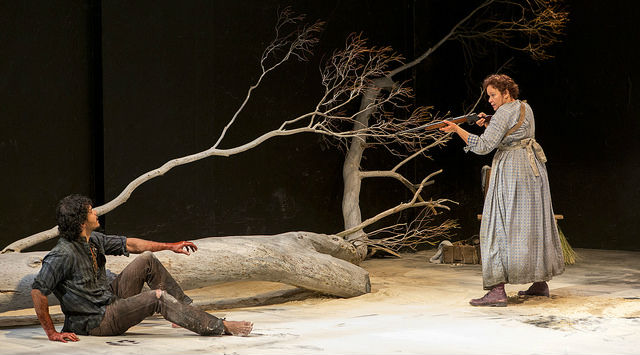
In Leah Purcell’s The Drover’s Wife, race relations in Australia are placed front and centre, and we have nowhere to hide from its confrontations. 1893 is in some ways a long time ago, but in Aboriginal terms especially, we can still think of the story as a contemporary one. The invasion is ongoing, and the carnage, although better disguised, still persists. The cruelty and brutality demonstrated in Purcell’s play is a necessary point of discussion for our nation. Turning abstract into flesh, we look into the face of horror, and any denial of responsibility is impossible. When Molly meets Yadaka, revelations are made about identity and how it is constructed or understood in Australia. We watch fanatic bigotry in action at its extremes, and relate it to what we know to happen today, and can only react with despondence and anger.

It is a powerful piece of writing, unforgiving and unrelenting in its accusations, balanced by a sensitive incorporation of grace and compassion in its depictions. What Leticia Cáceres brings to the stage as director, is cuttingly honest but with a lucid rationality that prevents us from feeling alienated by its outrage. The relationship between Molly and Yadaka is a tricky one that goes through drastic transformations, and the production’s ability to portray it with authenticity, convincing at every point, is deeply impressive and the linchpin to its success. As actor, Purcell’s formidable presence is captivating, and Mark Coles Smith, as Yadaka, is equally compelling, with a dynamic and empathetic approach that mesmerises. Tony Cogin and Benedict Hardie play a range of objectionable and revolting characters who are thoroughly disturbing, but it must be said that their work is remarkably bold, and brilliantly conceived.

A statement that promises redress is made at the play’s end, but what it represents is not an optimistic prophecy. What we have instead, is a continuing process of struggle and suffering that generations of Aboriginal people are enduring. The Drover’s Wife wants us to look at the injustices of 1893 and recognise that, although much has changed in over a hundred years, much of the same remains. A dominant foreign culture exists on this land that requires the subjugation of our native communities. European colonisation, at its very foundations, disallows any room for its oppressed to gain autonomy or sovereignty, unless we begin to acknowledge the need for a radical dismantling of systems. The damage may be severe, but we must believe that reparations are possible, and the urgency for them to occur cannot be overstated.

www.belvoir.com.au

Review: Beirut Adrenaline (Théâtre Excentrique)

excentriqueVenue: Belvoir St Theatre (Surry Hills NSW), Jul 27 – Aug 14, 2016
Playwrights: Jalie Barcilon, Hala Ghosn
Director: Anna Jahjah
Cast: Danielle Dona, Neveen Hanna, Mansoor Noor, Eli Saad, Sana’a Shaik, Delphine Vuagnoux
Image by Emma Lois

Theatre review
The play is set wartime, approximately thirty years ago in Beirut. We do not see politicians or armies, only civilians who attempt to live every day with as much normalcy as they can muster. Amidst constant worry and foreboding, every step they take becomes a heavy one, with repercussions that no one can be certain of. Their experience may now be considered a chapter of the past, but war is ever-present, and its unchanging complexion means that every story of survival, or otherwise, serves to help us reflect on the many dark events of our day.

The stress and anxiety from that state of emergency is portrayed well in Beirut Adrenaline, even though time and space is, in the play, often confused. Like the experience of trauma, the production opens with a sense of disoriented bewilderment, and we are forced into an inconvenient struggle to figure out each of its story’s where, when and who. It takes considerable time before we are able to form enough narrative coherence, but it is a worthwhile investment that ultimately does take us to a satisfying conclusion.

Neveen Hanna and Eli Saad play the bigger parts in the show, and are both affecting. We warm up to them slowly, but their efforts are fundamentally passionate, with an impressive sincerity especially moving at the climactic end. Mansoor Noor’s animated approach for his teenage character is delightful, and the confident demeanour he brings to the stage is refreshing and quite critical in adding a quality of exhilaration to its often sombre tone.

Although Beirut Adrenaline is rough around the edges, unable to provide a polished telling of its pessimistic tale, it does leave us with a truthful and evocative essence of those terrifying experiences. It is in our nature to want easy answers and impeccable solutions, but war is a beast that will forever resist our every grasp and restraint. The notion of world peace exists only in the phantasmagoric land of fairy tales and beauty queens. To find any progress, our existences must include the acknowledgement of suffering, especially of those we call our enemies.

www.theatrexcentrique.com

Review: Twelfth Night Or What You Will (Belvoir St Theatre)

belvoirVenue: Belvoir St Theatre (Surry Hills NSW), Jul 23 – Sep 4, 2016
Playwright: William Shakespeare
Director: Eamon Flack
Cast: Peter Carroll, Anita Hegh, John Howard, Lucia Mastrantone, Amber McMahon, Anthony Phelan, Keith Robinson, Damien Ryan, Nikki Shiels, Emele Ugavule
Image by Brett Boardman

Theatre review
Characters in Shakespeare’s Twelfth Night Or What You Will are drunk with infatuation. They chase after that sweet sensation of being overcome by the notion of love, obsessed with finding reciprocation from the object of their desire. It is an escape from the harsher realities of life, this frivolous respite. Taking us away from stories of war, of incarcerated children, or of religious schism. Countering the dark with light, we can go to the theatre for mirth, seeking refuge in its momentary illusions so that our souls can rest and be comforted, like a baby, safe in her mother’s womb.

The production understands the joy it has to deliver, in order that it may bear any meaning at all. Director Eamon Flack’s approach takes things back to basics, creating a show that looks and feels as if presented by a troupe of Elizabethan travelling players, who have little more than their bodies and voices to tell the story with. Flack’s experimentation with working from a script that is virtually unedited, means that we rely on the actors to make every line of dialogue count, including the many instances of “archaic nonsense” (Flack’s words) that only the scholarly would appreciate. It is a tall order, and the results are predictably mixed. The very accomplished and esteemed cast delivers three hours of wonder, amusement and laughter, along with interludes of bewilderment and boredom. Anthony Phelan’s camp humour is outrageous, completely gleeful in its tenacious need to tickle our funny bone. Keith Robinson is charming as Feste, breaking through the fourth wall for a firm connection with his audience, daring to improvise beyond Shakespeare’s words. Peter Carroll and Lucia Mastrantone impress with their energy and precision, both inventive in their surprising artistic choices.

The world can spin too fast, too manic for mere humans to cope. Retreating into the classics can help us regain composure, and with the old-fashioned Twelfth Night, we can hope to find our feet again, in everything that is placid and familiar. Tradition is valuable in the way it reminds us of what is good and time-honoured, giving us an understanding of humanity’s nature, helping us define our place in the world, but it is also the basis on which we decide what needs to change, and how we can progress and become better. Shakespeare is a past that continues to haunt us, but we can make of him what we will.

www.belvoir.com.au

Review: Back At The Dojo (Belvoir St Theatre)

belvoirVenue: Belvoir St Theatre (Surry Hills NSW), Jun 18 – Jul 17, 2016
Playwright: Lally Katz
Director: Chris Kohn
Cast: Fayssal Bazzi, Dara Clear, Catherine Davies, Harry Greenwood, Brian Lipson, Natsuko Mineghishi, Luke Mullins, Shari Sebbens
Image by Brett Boardman

Theatre review
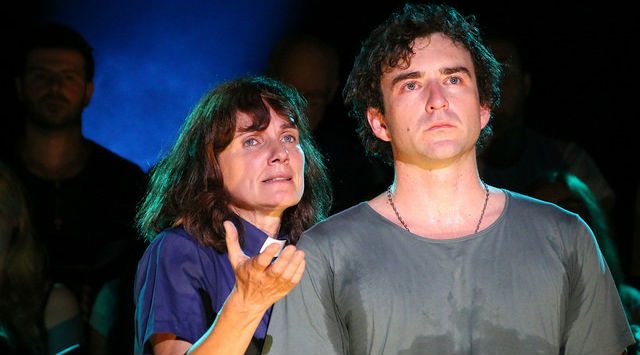
Lois lays in a hospital bed, with her husband Dan by her side waiting for her to gain consciousness. Their granddaughter Patti appears unannounced and drugged out, after disappearing for two years working on her gender transition. Dan and Patti take time to mend their bond, and in the process we witness parallels between Dan’s life in the late sixties, becoming his own man through the discovery of karate, and Patti’s own frustrations in her journey into womanhood. Back At The Dojo by Lally Katz is an emotional work, but gently so. It does not create big scenes of heightened family drama, taking its time instead to build on our involvement with its characters and their stories. Through excellent humour and a moving depiction of relationships, we gradually become invested in the people before us, although its slow burn may prove to be too demanding of some audiences. Katz’s writing is amusing and colourful, with an undeniable poetic beauty, but the play takes a long time to get to its point, resulting in a plot that can feel somewhat aimless before we arrive at its later, more poignant sequences.

The decision to cast a male actor in the role of Patti is a distasteful one that reflects a surprising callousness, given the impressive level of sensitivity evident throughout the rest of the production. Patti’s is one woman’s story, but due to the rarity of transgender representation in our theatres, it is also every trans person’s story, and no trans woman would ever want to see herself portrayed by a man, on any stage or screen. We do not see Patti’s early days in masculine expressions of gender, so to choose a male actor over a female one (trans or cis), only goes to demonstrate the production’s inability and refusal to accept Patti’s gender as she now presents. To be misgendered is one of the most appalling things any trans person could experience, and Back At The Dojo‘s misgendering, deliberate or unintentional, is an unacceptable transgression.

It must be said however, that Luke Mullins’ performance as Patti is a captivating one, and very powerful. He is obviously unable to convincingly depict the physical transformations that his character has had to endure, but there is a beautiful psychological accuracy in his work, in addition to the passionate yet nuanced drama that he sustains in every stage moment. Director Chris Kohn extracts very believable performances from all his actors. It is essentially a simple tale, with few opportunities for a more ostentatious approach, but every personality and relationship feels meticulously refined, with a palpable omnipresence of truthfulness and vulnerability that gives the show an enchanting soulful quality. The role of Dan is played by Brian Lipson, a gentle giant, full of strength and tenderness in his mesmerising interpretation of an older man dealing with immense loss, that will touch the hardest of hearts. Natsuko Mineghishi steals many scenes as the dojo Sensei, a real-life action hero with thrilling karate showmanship, lethal comic timing and a spectacular singing voice.

A profound connection exists between generations, but modern life seems to prevent many of us from experiencing and reaping its rewards. The disintegration of the family unit, and the ever rising regard for individuality means that few of us maintain significant intergenerational relationships. In Back At The Dojo, a distraught woman finds purpose and meaning by learning about her grandfather’s own obstacles in life, and by recognising her kinship responsibilities. We come to a realisation that both Patti and Dan are sinking under the weight of loneliness, and that the frailty of their existences are to be salvaged by the perennial tie that binds. They are fortunate to have one another, like we all have our own families, but how we value them is what the play brings into question.

www.belvoir.com.au

Review: The Events (Belvoir St Theatre)

belvoirstVenue: Belvoir St Theatre (Surry Hills NSW), May 12 – Jun 12, 2016
Playwright: David Greig
Director: Clare Watson
Cast: Johnny Carr, Catherine McClements, Pitt Street Singers, Wycliffe Singers
Image by Luke Cowling

Theatre review
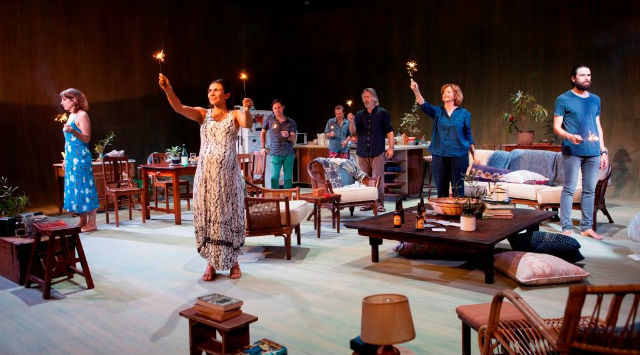
There are probably no issues more pressing than those pertaining to immigration, terrorism and mass shootings. Trying to make sense of these realities has become an everyday fixation in many of our lives, and David Greig’s The Events is a timely and sensitive expression of those concerns. Claire is a priest and choir leader whose life and faith is shattered by a traumatic incident that transforms the complexion of all that she knows. Fractured and struggling to find coherence, Greg’s writing is a reflection of the protagonist’s state of being. The play is not an easy ride, but it provides valuable insight for all of us who are part of this contemporary and complicated discussion on nationhood and security.

The play’s structure lends itself to intrigue and tension, which director Clare Watson manufactures well, but its restrained emotional dimension prevents the show from creating the same resonances that we have come to expect when dealing with its themes. There is no shortage of television coverage on these matters, and they are almost without exception, full of cheap sentimentality and irrational fear, which The Events does not replicate, but what it delivers instead can feel underwhelming and uncomfortably tepid. Perhaps its intention is to guide viewership to a more cognitive response for its deliberations, which is a challenging task that it accomplishes at varying degrees.

Catherine McClements is impressive with the thorough authenticity she introduces to the stage, and the ease with which she is able to convey the magnitude and intricacy of Claire’s psychological condition. The aforementioned disinclination for melodrama is disappointing, but understandable. The actor tells the story well, and we learn all there is to know about her character and the circumstances, even if we are not engaged on a more emotive level. Johnny Carr plays a variety of roles opposite the leading lady, engrossing but not always distinct (probably a comment on Claire’s disillusionment with the world), with an energetic approach that we rely on for a propulsive sense of momentum.

Claire has the strength to move forward but she needs time. When disasters strike, we can try to forge ahead in blindness but the scars and stains they leave behind do not disappear without effort. In The Events, we are urged, in times of trouble, to humanise individuals when all our instincts want is for perpetrators of violence to become demonised. It is a story about forgiveness, the truth of its emancipatory effects and the difficulty of its embrace. The problems we face are hard, they may even be thought of as insurmountable, but life persists in spite of it all and we must negotiate its good and its evil the best we know how.

www.belvoir.com.au

Review: The Great Fire (Belvoir St Theatre)

belvoirVenue: Belvoir St Theatre (Surry Hills NSW), Apr 2 – May 8, 2016
Playwright: Kit Brookman
Director: Eamon Flack
Cast: Sarah Armanious, Peter Carroll, Lynette Curran, Eden Falk, Sandy Gore, Shelly Lauman, Marcus McKenzie, Geoff Morrell, Yalin Ozucelik, Genevieve Picot
Image by Brett Boardman

Theatre review
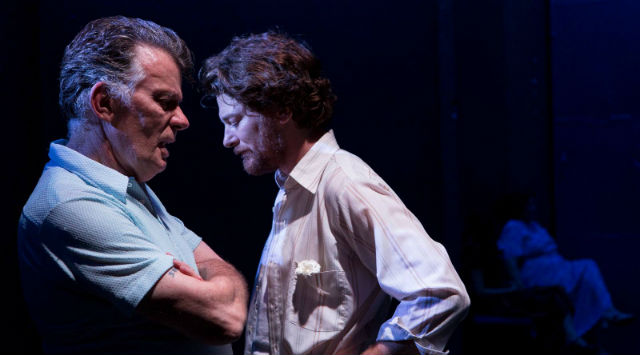
For many people, having children is considered natural and something that does not require questioning. In Kit Brookman’s The Great Fire, we see the complications that arise, not when toddlers are misbehaving, but when children become adults and their struggles can no longer be quelled by their parents. Judith and Patrick are affluent Australians of the baby boomer generation, with a strong marriage and three grown children. The couple is in their 60s and is beginning to contemplate their autumn years. Unlike their own parents, Judith and Patrick do not have the luxury of only considering their own needs. Their children might be adults, but they are not yet financially independent.

The Great Fire is about one family’s woes, but also an experience shared by many. For what seems to be the first time in human history, apron strings have become hard to sever. With the aggressive growth of capitalism occurring at the same time as baby boomers having children, much of the world has now evolved into a new economy where the chasm between the haves and have-nots is larger than ever. Judith and Patrick never foresaw that their offspring would find it hard to make a living, and certainly never expected their retirement plans to include their children’s well-being, but the current state of the world is no longer offering the same opportunities. The younger generation is brought up in the image of their parents, and they find themselves lost in this new social system, where no one is guaranteed an income, and where building careers is a privilege increasingly out of reach.

The story is not an easy one to articulate. We are perhaps too close and too new to its concepts, and unable to see the forest for the trees. Brookman’s script contains many ideas, observations and philosophies, all relevant to contemporary life, and even though it is admirable that the work feels uncompromised, it is not always focused enough for dramatics to work effectively. The plot is long and meandering, often with enjoyable moments but also overly complicated and overladen by details. Nevertheless, characters and their narratives are authentic, and we recognise their individual challenges easily and intimately. Direction by Eamon Flack brings attention to the wider social aspects of the family drama. We are not left indulging in bourgeois pettiness, but are asked to consider the play’s bigger contexts, which affect us all. The Great Fire takes its time to get to the point, but the poignancy at its end is deeply satisfying.

Production design is accomplished with quiet elegance, and Michael Hankin’s set is undeniably beautiful. Sound and lights are gently executed, making their presence felt without drawing undue attention. There is excellent chemistry in performances that makes us believe in the play’s complex family dynamics. Genevieve Picot brings a warm and organic instinct to her portrayal of Judith, while Peter Carroll and Yalin Ozucelik leave strong impressions in their powerful and prominent stage moments. It is not a simple piece to communicate, but the actors convince us of its core messages.

The characters in The Great Fire do not live in poverty, but their struggles are real. Like most of us, they have obligations that need to be met, but resources always seem to lag behind. We may have learned life lessons from our parents, but we do not always realise that the skills they had acquired for their lives may no longer be sufficient for dealing with ours. When we bring children into the world, optimism can overwhelm and blind us from the cold face of reality, and how much protection a parent can afford seems always to be a difficult question. The pursuit of prosperity is linked to what our planet can give. There is no end to how much we want, but the planet is finite, and we feel very close to that limit.

www.belvoir.com.au

Review: The Blind Giant Is Dancing (Belvoir St Theatre)

belvoirVenue: Belvoir St Theatre (Surry Hills NSW), Feb 13 – Mar 20, 2016
Playwright: Stephen Sewell
Director: Eamon Flack
Cast: Michael Denkha, Ivan Donato, Andrew Henry, Emma Jackson, Russell Kiefel, Genevieve Lemon, Geoff Morrell, Zahra Newman, Dan Spielman, Yael Stone, Ben Wood
Image by Brett Boardman

Theatre review
Stephen Sewell’s The Blind Giant Is Dancing premièred in 1983, long before the internet and social media had become a central part of how we understand and engage in politics. Armchair activism had yet to be discovered, and participation in our country’s big issues required more than clicks on neglected polls and petitions, or furious rants of 140 characters. If any action was to be taken, we had to put money where our mouths were, and the stakes were much higher than risking the closure of troll accounts on Twitter.

The play looks at how the working class was embroiled with trade unions and other organisations in a fight for protecting their rights, at a watershed period where capitalism’s subsumption of the economy was fiercely under way. We watch the moral descent of an idealist in Allen Fitzgerald as he climbs the ladders of power, observing the seemingly inevitable corruption that occurs as an individual finds their way into positions of power. It is a deeply pessimistic and cynical statement about the world that director Eamon Flack has successfully transposed to twenty-first century Australia. Industrial relations continue to be a key issue, and we are probably more aware than ever before, about the vulnerabilities of our democracy. The details in The Blind Giant Is Dancing might be outdated, but its concepts are resolutely relevant, and its ideology remains powerful.

With its zealous political dissections, aficionados would probably find the work irresistible, but there is much in the production that appeals to the layperson. Its central concern regarding tensions between the personal and the political, are fluently expressed, especially in scenes that move the plot into realms of the domestic. Allen’s personal life allows us to relate to his story more intimately, as he negotiates abstract principles and beliefs, against the real matter of daily life. The conflicts that arise from trying to put into being, imagined and utopian ideals for larger social contexts, prove to be problematic as we witness those precepts failing in the Fitzgerald household. It is his broken relationships with family and lovers that we empathise with, and the meanings behind that destruction, which are most poignant.

Dan Spielman is convincing as Allen, with a commanding stage presence that places him comfortably at the centre of all our attention. He connects well with the audience from the start, and we stay compelled until the bitter end. His portrayal of the complex role is intelligent, confident, and quite affecting. Although disappointing, we see his flaws and misjudgements as human, and Spielman’s honesty as a performer helps us realise the accuracy of the grim situation in which we find his character. The role of Louise is played by Yael Stone, sensitive and intricate, with excellent conviction behind the fiery personality being depicted. Louise is perhaps not as well-written a character as her male counterparts, but Stone’s ability to locate emotional authenticity assists with our all-important suspension of disbelief to make her narrative work.

This is a production of high quality, polished and consistently thoughtful. The cast does a marvellous job in creating a succession of explosive scenes that grips us for its entirety (the three-hour duration whizzes past), and the designers impress with adventurous and effective work. Sound design by Steve Toulmin in particular, provides an epic grandeur, recalling period drama pieces of a similar ilk that trace the familiarly ominous ascension of political figures.

The Blind Giant Is Dancing warns us of many things, but provides no solutions. The darkness of its revelations feel real and in spite of their grave severity, we are offered no recourse. What happens after the curtain call is anybody’s guess, and also a crucial estimation about the utility of theatre. The show interrogates all our personal lives, and after receiving its indictments, the process will continue in each individual beyond that evening of attendance. If an artist is unable to produce the answers, the best they can do is to ask the questions, boldly and fervently. What we wish to happen thereafter can only then be, a question of hope.

www.belvoir.com.au

Review: Perch (The Leaps / Belvoir St Theatre)

perchVenue: Belvoir St Theatre (Surry Hills NSW), Feb 9 – 21, 2016
Playwrights: Brian Carbee, Sarah Carradine
Director: Sarah Carradine
Cast: Brian Carbee
Image by Phyllis Photography

Theatre review
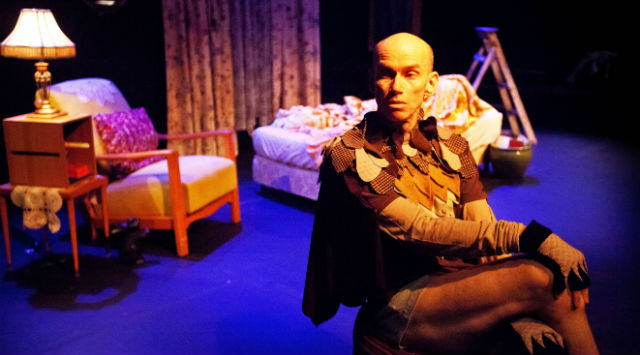
Brian Carbee plays two characters in Perch; an owl and a human. Their relationship is strange to say the least, and even though the poetic script does not engage in a conventional sense, it provides impetus for a show that utilises the considerable talents of its performer, revealing not only the wealth of experience Carbee possesses as a dancer, but also the eccentric and idiosyncratic qualities he bears as an artist accomplished in the realm of movement based art.

It feels as though the roles he inhabits are but conduit for an expression of self. We might not achieve a great understanding of what is being created on stage, there is certainly no doubt as to the kind of person involved in the creative process before our eyes. The work is about the artist’s presence, and it is his skill, flair and fluency that captivates. It is Carbee’s very own humanness that is the object of our appreciation, and the surreality of all the action he manufactures is the looking glass through which we are able to read, and feel, the existence of a living, breathing sentient being exposed to our audienceship.

Perch is a work about the camp sensibility and its manifestations in physical and verbal forms. Carbee portrays an overt flamboyance that simultaneously obfuscates and indicates the truths that are at play on his stage. Identity is explored through the creation of false otherness, almost as though reaching for exaggerated and illusory entities is key to the discovery of authenticity. When we define our alter egos, we give shape and meaning to ourselves, and because facing the self is exasperating, we luxuriate in something else, something seemingly separate that can tell us everything that we need to know about the universe that lies within.

www.theleaps.orgwww.belvoir.com.au

Review: Jasper Jones (Belvoir St Theatre)

belvoirVenue: Belvoir St Theatre (Surry Hills NSW), Jan 2 – Feb 7, 2016
Playwright: Kate Mulvany (based on the novel by Craig Silvey)
Director: Anne-Louise Sarks
Cast: Tom Conroy, Kate Mulvany, Matilda Ridgway, Steve Rodgers, Guy Simon, Charles Wu
Image by Lisa Tomasetti

Theatre review
Laura is found dead, and although not wrapped in plastic, the stories in her town of Corrigan bear many similarities to those at David Lynch’s Twin Peaks. Burgeoning adolescence, secret lovers, hidden sanctuaries, sexual abuse and a creepy man that holds the key to mysteries. Jasper Jones acknowledges the debt it owes to Harper Lee’s To Kill A Mockingbird and Truman Capote’s In Cold Blood, and there is certainly more than a sense of familiarity in the way Laura’s murder is explored, but the play provides a fresh look at Australia’s own troubled experience of race relations, which remains under-represented in our artistic landscape. Unlike the Americans for example, we have shied away from the truths of our racism, both historical and current, so works such as Jasper Jones that place attention on our indigenous and immigrant cultures are deeply important, not only for the development of our theatrical heritage, but also for a wider benefit to society in general. Healing can only come from understanding, and the ugly sides of our histories must be recognised if we are to find meaningful progress as a unified nation.

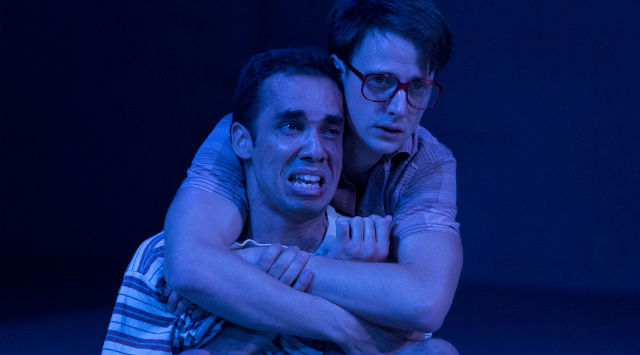
Kate Mulvany’s witty and highly amusing script portrays a small rural community that is familiar on the surface, but surprising and dark underneath. It is concerned with the duality of the Australian memory of a friendly, unpretentious past, and the cruel prejudice suffered by refugees and Aboriginal peoples through the years. Under Anne-Louise Sarks’ direction, characters in the show are idiosyncratically palpable, and every scene is replete with dramatic and comedic tension. Sarks’ show excels in keeping us engaged and emotionally invested, but the central issue of its title role’s adversities seem underwhelming. Jasper is an Aboriginal teenager accused of Laura’s murder, but his struggles do not provide the strongest resonances in the piece. We are distracted by other more pleasurable details in the plot, and like in real life, tend to overlook the serious plight of our country’s first peoples. Jasper Jones is entertaining, dynamic and extremely likeable, but its gravity is not sufficiently manifested, resulting in a production that is not as thought-provoking as it should be.

Playing 14-year-old Charlie is (adult actor) Tom Conroy, who depicts purity with incredible accuracy and charm. His performance is entirely believable, and we follow his coming-of-age journey with tremendous interest. Conroy provides the anchor on this stage, with an endearing nature that ensures that we care for his town and all that happens in it. Equally captivating is Charles Wu as Jeffrey, a young son of Vietnamese immigrants and Charlie’s best friend. The actor displays splendid humour, and a natural exuberance that injects energy with every entrance. His irresistible comedy ranges from subtle to slapstick, but no matter his approach, we greet it with uncurbed laughter.

There is much to love in Jasper Jones (including Michael Hankin’s versatile set and Matt Scott’s tender lighting design), but it involves subject matter that requires greater impact. We talk about social injustices frequently, and we become blasé about them, if only as a defence mechanism against issues that seem insurmountable, so stories need to pack considerable punch to have real effect. Jasper’s suffering in 1965 cannot be divorced from his ethnicity, and fifty years on, we have to examine the nature of that prejudice and continue to seek a solution to that preposterous violation of Aboriginal communities that refuses to go away. No single play can bring about a complete revolution, but every attempt should bring us closer.

www.belvoir.com.au

Review: They’ve Already Won (Belvoir St Theatre)

theyvealreadywonVenue: Belvoir St Theatre (Surry Hills NSW), Dec 8 – 20, 2015
Playwrights: Harriet Gillies, Pierce Wilcox
Directors: Harriet Gillies, Pierce Wilcox
Cast: Harriet Gillies, Pierce Wilcox
Image by Mitch Lee

Theatre review
Art can find a way to represent the state of our collective consciousness as it stands, so that we may achieve an understanding of life, while remaining embroiled within. They’ve Already Won is about the now, and how individuals in societies such as ours, deal with the new face of media and its pervasiveness. It explores the interactivity of technology, and exposes the nature of our participation in the digital world, with all its anxieties and intellectual challenges.

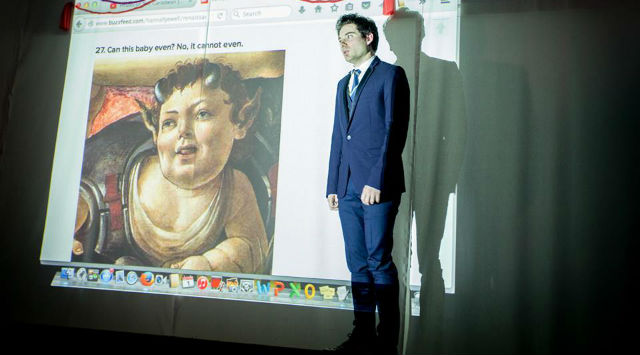
As barriers to information and truth begin to crumble, we are forced to encounter pessimism like never before. Harriet Gillies and Pierce Wilcox’s play is about the way we respond to this incessant profusion of bad news arriving through all our screens, and how it dominates and shapes our culture as it stands today. The show addresses us directly, beginning almost like a lecture with Gillies orchestrating visual projections and sound cues, and Wilcox gesturing to illustrate their assertions, but thankfully, things turns increasingly fluid in style as they proceed. The work is beautifully considered and idiosyncratic, with rich content that will ring true and provoke. There are unusual and refreshing modes of expression in its staging, with a string of amusing scenes and surprising concepts. Execution of ideas could be more polished, but the production is ultimately an impressive one that offers a generous serving of food for thought.

They’ve Already Won can be seen as a political work, but it also allows us to be apathetic. It accurately reflects the confusion of modern life, revealing to us that the more we know, the less we know what to do. It is a feeling of helplessness that co-exists with a passion for betterment, an everyday duality that pulls in different directions. We can leave the show determined to be unfazed, but reality is tumultuous and we will be moved regardless.

www.belvoir.com.au