Review: Mars: An Interplanetary Cabaret (The Old 505 Theatre)

Venue: The Old 505 Theatre (Newtown NSW), Jul 30 – Aug 3, 2019
Music: Chelsea Needham
Lyrics: Ang Collins
Director: Andrew McInnes
Cast: Monika Pieprzyk, Amelia Campbell, Tom Matthews, Jacob Mclean, Jack Richardson, Kieran Clancy-Lowe
Images by Zac Jay

Theatre review
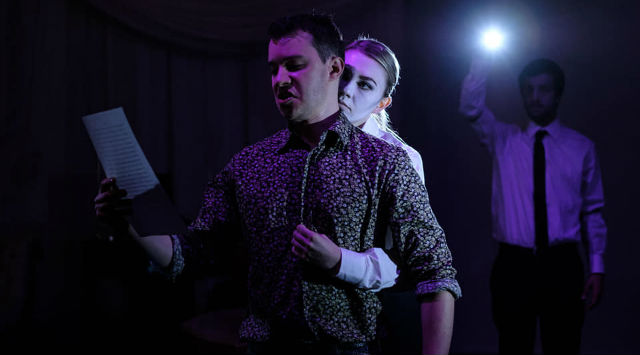
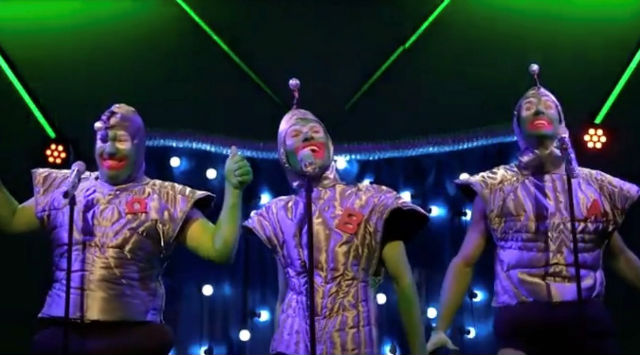
Three Martians have landed, in a spaceship called Incel 9, because apparently, earth girls are easy. The male of that species have had to travel an enormous distance, after women on Mars had wised up to their misogynistic nonsense. Earthlings however, are being protected by Space Cops, who in Mars: An Interplanetary Cabaret, happen to be two women impervious to the sleazy tricks of pickup artists. Written by Ang Collins and Chelsea Needham, this fun-filled work features kooky characters and humorous songs, for a surprisingly wholesome style of entertainment that often feels like a contemporary take on the pantomime form. A show about dirty boys with no dirty jokes, Mars is a remarkably refreshing experience.

Directed by Andrew McInnes, the comedy balances flamboyance with irony, allowing its very broad approach to communicate at somewhat unexpected levels of nuance. The visual style is appropriately lo-fi, with Lucy McCullough’s production design and Tom Houghton’s lights, establishing a lot of playful charm to keep us engaged. Some of the singing is of questionable quality, but the cast is likeable, and they present a well-rehearsed staging that impresses with its verve and spirit of inventiveness. Tom Matthews and Jack Richardson are the more disciplined performers of the group, able to contribute a sheen of professionalism with their vocal and physical polish, although the general lack of refinement remains a major component of Mars‘ appeal.

It is appropriate for our current political climate, to talk as though men are from Mars, women are from, well, Earth. A new generation of feminists have declared that poor behaviour is not acceptable, and that the toxic culture of “boys will be boys” must be changed. We talk of the young as being overly fragile, but it is evident that they are on a mission to make the world a kinder place, that people should not be required to have the fortitude to put up with all manner of bullshit. We should no longer have to laugh along with “casually racist” jokes, just as we should no longer fabricate any reason to blame victims of sexual assault. Those who find this shift in codes of conduct frustrating, are on the wrong side of history.

www.old505theatre.com

Review: Van De Maar Papers (Ratcatch / The Old 505 Theatre)

Venue: The Old 505 Theatre (Newtown NSW), Jul 9 – 20, 2019
Playwright: Alexander Lee-Rekers
Director: Camilla Turnbull
Cast: Melissa Hume, Jessie Lancaster, Tom Matthews, Lucy Miller, Nathalie Murray, Terry Serio, Sophie Strykowski, Simon Thomson
Images by Clare Hawley

Theatre review
A man of extraordinary wealth and influence has died, leaving behind a secret manuscript that he wishes to get published, now that he is no longer here to face the critics. The family however, will have to suffer the consequences of a book that could well destroy the family name. Alexander Lee-Rekers’ Van De Maar Papers is concerned with ambition. Levi Van De Maar, the deceased, had wanted to achieve something that he only saw possible after leaving this mortal coil. His wife Christine has her own priorities of self-preservation, as does Frank, a nephew trying to make his own mark in a world that only sees him as a surname.

Lee-Rekers’ writing is often fascinating, with an idiosyncratic humour that keeps us amused. The production can however feel too serious and slow, with director Camilla Turnbull placing emphasis on conveying psychological accuracy, and comedic impulses made somewhat secondary. Lucy Miller and Simon Thomson play the main surviving Van De Maars, both actors believable if slightly too subtle in their approach. The role of unscrupulous publisher Ron Huck is depicted with an enjoyable theatricality by Terry Serio, whose relentless vibrancy is a real asset for the show. At times, he seems to be the only one who is in on the joke with the audience.

The obsession with money and status in Van De Maar Papers encourages us to question our own values. Juxtaposed against the inevitability of death, we are struck by the intensity with which the shallow and the materialistic can overwhelm and determine every course of action. We know with absolute certainty the brevity of existence, yet we submit to meaningless pursuits, letting the appetite to outdo one another, take over the entirety of our being. There are better things to do than to invest in keeping up with neighbours; the tricky thing is to be able to identify that which will be truly fulfilling, and stick with it.

www.old505theatre.com

Review: Normal (The Uncertainty Principle / The Old 505 Theatre)

Venue: The Old 505 Theatre (Newtown NSW), May 29 – Jun 15, 2019
Playwright: Katie Pollock
Director: Anthony Skuse
Cast: Chika Ikogwe, Alexandra Morgan, Cecilia Morrow, Finley Penrose
Images by James Balian

Theatre review
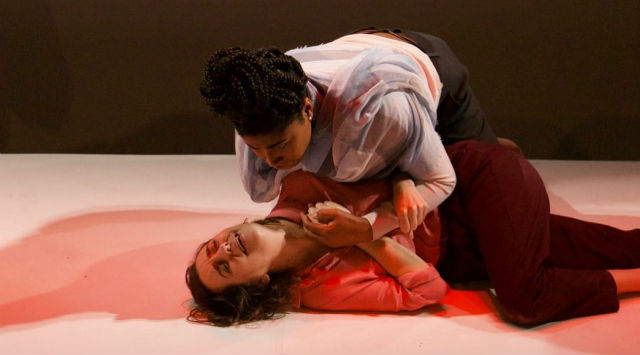
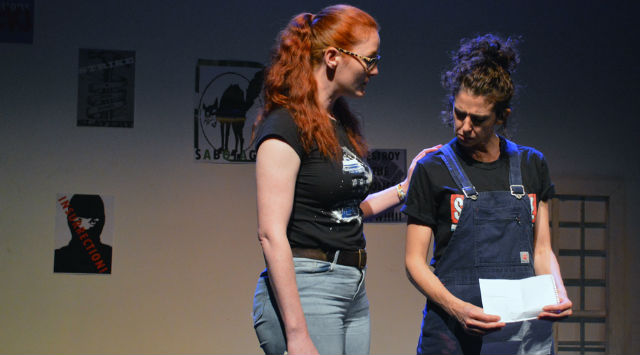
Teenager Poppy’s eyes begin to twitch one day, and before too long her entire being spasms, to the extent that she passes out in public without warning. It appears a disease has taken hold, one of a mysterious nature that compels all around her to formulate narratives, to impose judgement upon the young woman’s body. When the same symptoms are seen in her school friends, this spreading of an unexplained phenomenon, fractures Poppy’s community, with people seeing only difference of opinion, and not what binds them together. Katie Pollock’s Normal is an intriguing work, because it allows for ambiguity, even though its expressions are passionate. Poppy’s resistance of definition, of not wanting to be pinned down, is a tale about female bodily integrity. It refuses to fit into a structure that would make us comfortable, for its autonomy comes before our conventional stipulations.

Normal‘s politics are never obvious, but director Anthony Skuse makes sure that it speaks with an incontrovertible urgency. The ensemble of four conspire to deliver something quite intense, with Alexandra Morgan’s turn as Poppy bringing a satisfying mix of youthful innocence and exuberance to the play. Chika Ikogwe is wonderful in a variety of roles, always a striking presence, yet marvellously persuasive with her naturalistic style of presentation. Cecilia Morrow and Finley Penrose too are effective in the show, both infectious with their zeal and conviction.

The production is cleverly designed, with Kelsey Lee’s lights monitoring proceedings through a combined sense of dynamism and sensitivity, and her set providing an elegant visual cohesion to the many short scenes that comprise the plot. Sound by Cluny Edwards is imaginative, with a distinctive kooky edge, able to facilitate unexpected dimensions for the story and its characters.

One of the most dangerous things that could happen to society as we know it, is for women to reject any attempts to control our bodies. The radical notion that we can do what we want with our lives and with our corporeality, goes against so much of what constitutes the fundamental building blocks of what we are. Old religions and other old patriarchies require our subjugation and capitulation, so to have women take charge of our own destinies, can only mean devastation to life as we know it, which is absolutely a future to look forward to.

www.old505theatre.com

Review: Frida Kahlo: Viva La Vida (Théâtre Excentrique / The Old 505 Theatre)

Venue: The Old 505 Theatre (Newtown NSW), Apr 23 – May 4, 2019
Playwright: Humberto Robles (adapted by Gaël Le Cornec and Luis Benkard)
Director: Anna Jahjah
Cast: Kate Bookallil
Images by Mansoor Noor

Theatre review
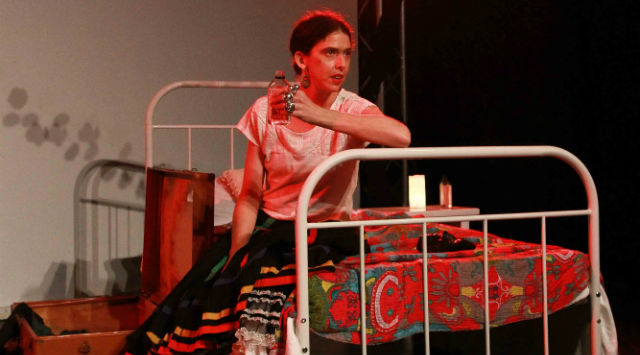
Frida Kahlo contracted polio at six, and at eighteen, a traffic accident further injured her body, causing a lifetime of excruciating pain, that would inform all of her work and legacy. In Humberto Robles’ one-woman play Frida Kahlo: Viva La Vida, we see Kahlo trapped at home, alone with her thoughts and the constant state of torture that her body must endure. She talks about art, love, business and politics, offering an opportunity for her legions of admirers to feel as though at close quarters with the Mexican icon.

Performed by Kate Bookallil, whose jovial presence imbues the show with warmth, insisting that audiences regard Kahlo’s story with only open hearts. Her exuberance conveys a lightness to the character that has a tendency to ameliorate some of Kahlo’s struggles, but we engage with her nonetheless, always caring about our protagonist, and hang on to every word she says. Director Anna Jahjah’s spirited approach makes for a playful show, appropriately colourful, especially with its visual manifestations. There could be greater tonal shifts, for a more segmented presentation to help us better absorb the text, but Frida Kahlo: Viva La Vida‘s strong statements about resilience and perseverance, bears an appeal that is universal.

Kahlo’s defiance is inspiring, powerful, and beautifully transcendent. We see her fighting to the death, and understand the depths of our individual capacities for hardship. Life is not fair. Although Kahlo did experience success late in life, she never had the privilege to see with her own eyes, the extent to which her work has reached, and touched, women everywhere. Our collective admiration would have empowered her in ways we can only imagine. We are all queens, when we raise each other up, and stay connected in mutual succour. If we are determined to leave no one behind, what we can achieve will truly be unprecedented.

www.theatrexcentrique.com

Review: Ajax (Burning House / The Old 505 Theatre)

Venue: The Old 505 Theatre (Newtown NSW), Apr 23 – May 4, 2019
Playwright: Sophocles (adapted by Jonothan Graffam, Robert Johnson)
Director: Robert Johnson
Cast: Leikny Middleton, Chad O’Brien, Seton Pollock, Michelle Robertson
Images by Mansoor Noor

Theatre review
When we meet Ajax, the revered warrior is in a state of disillusion, confused not only by bloodshed from endless battles, but also by the futility of his ambitions. Jonothan Graffam and Robert Johnson’s adaptation of Ajax attempts to reinstate relevance, in transporting Sophocles’s story by millennia to the present day. Its spirit is still in that conspicuous style of the classic Greek tragedy, but its brevity can cause a deficiency, as we try to construct meaningful narratives from its abbreviations.

Director Robert Johnson does good work with atmosphere; there is a certain level of sophistication to how the production looks and sounds, perhaps as a result of the simplicity evident in his approach. A very substantial portion of the show consists of monologues by the eponym, and on this occasion, Seton Pollock plays Ajax, covered in blood, and in a lot of anguish. It is a performance that begins with meters in the red, and stays there the whole time. His conviction is admirable, but that unwavering delivery of hyper intensity, quickly turns alienating.

Mythology sends our women and men to war. When our young go seeking glory, it is our stories that determine where they choose to find it. So much of myth making today, is about defending ourselves from those who want to corrupt and destroy our hitherto unsullied way of life. Our refusal to understand those who are conveniently classed other, and our insistence on seeing ourselves as being inculpable and above reproach, are the fundamentals on which we build national identity, and the justification for many lives lost. It is certain that defence is necessary, for evil is real, but peace must be found in many more ways that through the sacrifice of our brave souls.

www.burninghousetheatre.com

Review: The Divorce Party (Life After Productions / The Old 505 Theatre)

Venue: The Old 505 Theatre (Newtown NSW), Mar 12 – 16, 2019
Playwright: Liz Hobart
Director: Alexander Lee-Rekers
Cast: Meg Clarke, Badaidilaga Maftuh-Flynn, Ariadne Sgouros, Alexander Stylianou
Images by Clare Hawley

Theatre review
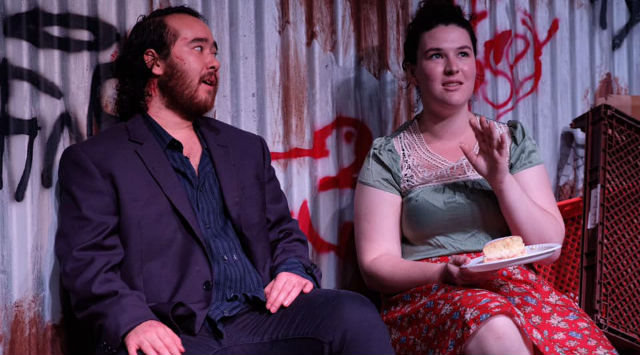
We are in a car park behind a restaurant with four attendees of a divorce party, taking a cigarette break from the unusual festivities. Liz Hobart’s The Divorce Party is a curious work, structured like a puzzle to involve our participation in figuring out the stories therein. Although mildly intriguing, the play’s deliberate abstruseness never pays off. Barely an hour long, we lose interest early in the piece, and by the time its mysteries are revealed, none of it is able to cause a stir.

Set design by Damien Egan however, is charming with its accuracy in depicting contemporary Australian life, complete with push bin and bad graffiti. The actors demonstrate adequate familiarity with their individual roles, even if their collaboration feels incohesive. Ariadne Sgouros and Alexander Stylianou bring energy at every opportunity, and succeed in creating momentary stimuli for the piece. Meg Clarke has little to work with in terms of storyline, but manages to build a character of some authenticity. A very subtle performance by Badaidilaga Maftuh-Flynn helps create an enigmatic, if slightly too sombre, quality for his role.

With the proliferation of divorces, it is perhaps not entirely surprising that some people might want to commemorate the event. What was once a catalyst for vehement disapproval from all quarters, is now an ordinary part of life. When a relationship ends, it often means that suffering too, begins to find relief, so it does make sense that celebration is in order. As long as people wish to get married, there needs to be a liberal attitude towards divorce. Nobody should be tethered to any misery, and we should all know to walk out, if the heart so desires.

www.old505theatre.com

Review: Seed Bomb (Subtlenuance / The Old 505 Theatre)

Venue: The Old 505 Theatre (Newtown NSW), Mar 5 – 9, 2019
Playwright: Daniela Giorgi
Director: Paul Gilchrist
Cast: Matthew Abotomey, Kate Bookallil, Lindsey Chapman, Sonya Kerr, Julian Ramundi
Image by Matthew Abotomey

Theatre review
Kat dreams of moving out to the country, so that she can escape the ugly rat race of city life. Upon meeting guerrilla gardeners Gridlock and Pax however, her mind changes, as she begins involvement in a political movement that helps her feel an integral part of community. Daniela Giorgi’s Seed Bomb talks about the responsibility of individuals, in an environment where the power to influence our own destinies, is routinely made to feel diminished. Kat discovers that she is not helpless in her home, and to leave it for greener pastures is in some ways a selfish act.

Giorgi’s benevolent writing is idealistic but not naive. Although its didacticism has a tendency to turn obvious, the immediacy of its concerns bear a pertinence that keeps us engaged, with Kat’s awakening bringing a sense of hope to our humdrum passivity. Directed by Paul Gilchrist, the show is tender and earnest, insufficiently dynamic but certainly authentic with its representations. Actor Sonya Kerr is particularly genuine in her convincing portrayal of Kat, our mild-mannered protagonist who learns to carve her own niche in micro activism.

Other cast members are similarly accomplished. Matthew Abotomey and Kate Bookallil bring conviction to their roles as provocateurs of the piece, both distinct and specific with their respective interpretations of the modern social justice warrior. Excellent comedy by a very cheeky Lindsey Chapman, who plays an ignorant financial adviser, leaves a lasting impression. The frustrations of Kat’s partner Toby are conveyed persuasively by Julian Ramundi, whose depiction of the one left behind, serves as caution against political apathy.

Whether we like it or not, to exist is to be political. We can choose either to participate or withdraw, but there is never neutrality in any of our decisions. Everything we say and do, causes reverberations, like dominoes toppling in all directions. Kat does not become radical, but her new awareness of things beneath the surface, has sparked a fundamental shift in how she behaves. We can never be sure if knowledge will necessarily improve lives; after all, ignorance is bliss. There is however, no possibility for reversal, once the truth is out. This is only the beginning of Kat’s story, what is to follow is a test of our optimism and faith.

www.subtlenuance.com

Review: All My Sleep And Waking (Apocalypse Theatre Company)

Venue: Old 505 Theatre (Newtown NSW), Nov 28 – Dec 22, 2018
Playwright: Mary Rachel Brown
Director: Dino Dimitriadis
Cast: Di Adams, Angela Bauer, Alex Beauman, Richard Sydenham
Images by Robert Catto

Theatre review
Anne has to confront very complicated feelings about her father. As his death approaches, all that had resulted from a troubled family life must finally be attended to. Together with Maria and Peter, the three siblings must get each other through this difficult time, and perhaps work towards a resolution for decades of psychological damage. All My Sleep And Walking by Mary Rachel Brown is a study of broken homes, staggeringly authentic in its observations, and admirably honest with its intentions. Although not a pessimistic work, the play’s realistic rendering of a daughter’s struggle, and of delicate family dynamics, is a refreshing alternative to stories of this nature that always seem determined to be improbably uplifting. Here, just to be able to encounter the unvarnished truth, proves powerful enough to satisfy.

Directed by Dino Dimitriadis, the production is deliciously taut, with meticulous attention on interactions between characters that delivers some very gripping drama. Anne is played by Di Adams, whose work is imbued with integrity, for a very believable, albeit overly serious, portrait of fortification and incredible stoicism. As Maria, Angela Bauer offers an emotional counterbalance, fabulously intense yet astutely humorous, for an outstanding performance that has us mesmerised. Richard Sydenham is delightful as Peter, with quirky mannerisms that prove endearing, and impressive nuance for every line that he dispenses. Anne’s son Josh, is played by a persuasive Alex Beauman whose relaxed naturalism adds valuable dimension to our experience of the show.

Maybe one’s father never did his best, or maybe his best was simply not good enough. Either way, regardless of his intentions, one has to suffer the consequences of an unsatisfactory parenthood, whilst imagining perfect fathers abound in every other household. Self preservation requires that Anne takes on merciless strategies; she vilifies him brutally and spares no thought for his feelings, even as he is ravaged by cancer. The degree of hurt that she suffers is palpable, and from our vantage point, forgiveness would do her a great deal of good, but that is of course, easier said that done. Anne can only access what is available to her, and when we want more for her, we reveal our inability to understand the devastation she has to bear. The miracle lies instead, in her own abilities as a mother. We watch her son grow into a stable and secure adult, and are awestruck by the incredible breaking of a curse.

www.apocalypsetheatrecompany.com

Review: Blame Traffic (The Old 505 Theatre)

Venue: Old 505 Theatre (Newtown NSW), Nov 13 – 24, 2018
Playwright: Michael Andrew Collins
Director: Michael Andrew Collins
Cast: Violette Ayad, Nic English, Emma O’Sullivan, Mary Soudi, Alex Stylianou
Theatre review
Insurance investigator Lilian’s frustrating encounters with a blue Mercedes, over several days on the streets of Sydney, has stoked her occupational resolve. She finds herself secretly trailing the mystery man, trying to formulate an explanation for the latter’s shockingly poor driving etiquette. Blame Traffic by Michael Andrew Collins features a series of fractured scenes that gradually merge into an integrated, and satisfying, narrative. Collins’ playful dialogue ensures that each sequence is full of amusement, and the intrigue that he constructs, is a consistent pleasure, and the play’s strongest quality.

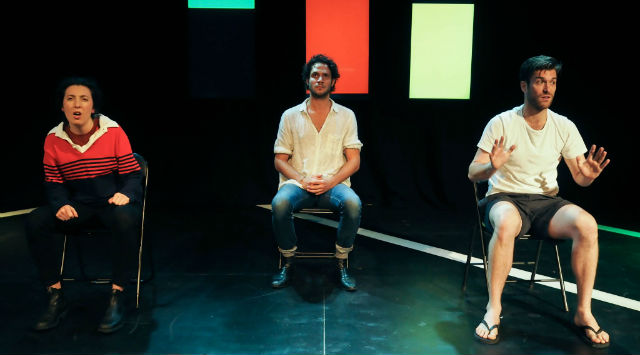
In lieu of realistic settings for many of Blame Traffic‘s on-road scenarios, the production takes a minimal but effective approach, with chairs and three sliding monitors, to convey its oscillating range of times and spaces. Designer Patrick James Howe keeps things slick and restrained, for unobtrusive solutions that provide surprising impact. Collins’ direction of the piece is taut, with an air of urgency that has us absorbed for its entire hour.

An energetic and rigorous ensemble takes us through the fast-paced action. Emma O’Sullivan shines in both her roles; she turns a very strange Jacquie convincing, whilst endearing us with her quirky characteristics, and as Dion, the actor’s interpretation of a young Italian-Australian is simply hilarious. Dion’s uncle Zio is played by Nic English, whose honest impulses make him a riveting presence. Violette Ayad and Alex Stylianou provide the fireworks with their partnership, in a segment memorable for its scintillating chemistry, both performers taking the opportunity to demonstrate their impressive skill and natural talent. Also wonderful is Mary Soudi who brings a thoughtful complexity to her part of Sarah.

Although not particularly provocative, Blame Traffic is an entertaining work of theatre, that uses the bane of our city’s daily existence as catalyst for its storytelling. We see people interspersed but connected, each heading in their own obstinate directions, occasionally stopping to think of others. Individualism and independence are highly valued in our metropolis; we believe in the freedom that allows people to live to their full personal potentials, regardless of tradition and conventions. It is also clear that Sydney is not an entirely selfish city, even if we do feel like we dwell inside bubbles that only seem to ever grow smaller. Our roads converge every day, allowing our trajectories to meet, at places like the theatre, where we congregate as one, to figure out the people we are, and the people we want to be.

www.facebook.com/twentysevensix

Review: Whose Uterus Is it Anyway? (The Old 505 Theatre)

Venue: Old 505 Theatre (Newtown NSW), Oct 30 – Nov 10, 2018
Playwright: Georgie Adamson
Director: Eve Beck
Cast: Toby Blome, Alexandra Morgan, Finn Murphy, Chelsea Needham, Annie Stafford
Images by Jasmin Simmons

Theatre review
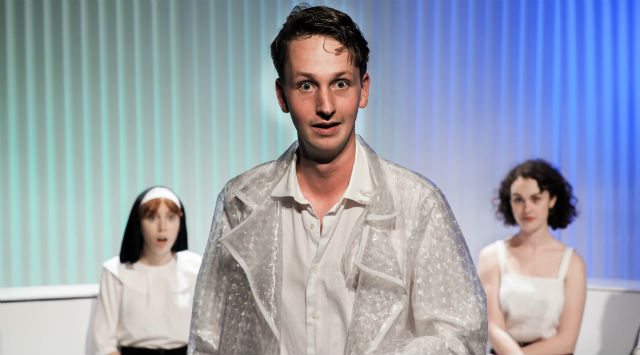
It is a game show in the reality competition style, involving the infliction of humiliation and abuse for the benefit of a television audience. In this case, contestants are made to jump through hoops before they are awarded the reproductive health care that they require. George Adamson’s Whose Uterus Is It Anyway? is an indictment of the way bodies of women and trans men are controlled, relegated to a lower class, when they deviate from unreasonably strict norms. When a uterus is not being used for procreation, society sees fit that its owner is put through a process of castigation, as enacted here by a white man in a stylised lab coat, playing the role of game show host, manipulating scenarios and exercising his power, to ridicule his subjects.

Ideas in the play are fresh and exciting, assembled with an enjoyable quirky humour. Its writing could be further refined for a more satisfying plot structure, but its unique approach makes for a show that is at once pertinent and amusing. Eve Beck’s direction for the piece contains appropriately subversive measures, and although its comedy proves slightly inconsistent, there is no doubting the production’s ability to have us firmly engage with its stimulating themes. Martin Kinnane’s lights and Camille Ostrowsky’s set design provide dynamism to a visual aesthetic that conveys effectively, the sinister quality of institutionalised medicine and media. Alex Lee-Rekers is detailed with his work on sound, helping us navigate the many subtle tonal and emotional shifts of the show.

An excellent cast brings to life the theatrical and substantive absurdity of Whose Uterus Is It Anyway?. Toby Blome is captivating as the central authority figure, and as four additional subsidiary characters, his efforts are just as compelling. Alexandra Morgan and Annie Stafford are funny women, both exuberant and incisive with their delivery. Finn Murphy and Chelsea Needham dial up the poignancy factor, for some genuinely moving moments that give the staging a crucial quotient of gravity.

As evidenced in Lysistrata’s fabled sex strike, societies have always been petrified of women using their bodies for anything other than gestation. The impulse to reproduce has fuelled an unquenchable thirst to control our bodies, and as a consequence all of how we exist is dictated in accordance with that sense of ownership and entitlement. Three women in the play, along with a trans man, have made decisions for themselves, but it is clear that their bodies are being held hostage, by traditions and systems that struggle to acknowledge our independence. If our subjugation stems from sex and babies, it would only make sense that a revolution can be precipitated by a radical rethink of our identities in those terms. We should define ourselves in creative and courageous ways, rejecting labels and responsibilities when required, not only to live with greater integrity, but to forge a better, more equitable future.

www.biteprod.com.au