Review: Tuesday (Sign Of The Acorn / 25A Belvoir)

Venue: Belvoir St Theatre (Surry Hills NSW), Feb 6 – 23, 2019
Playwright: Louris van de Geer
Director: Nell Ranney
Cast: Frances Duca, Duncan Fellows, Tom Anson Mesker, Bridie McKim
Images by Clare Hawley

Theatre review
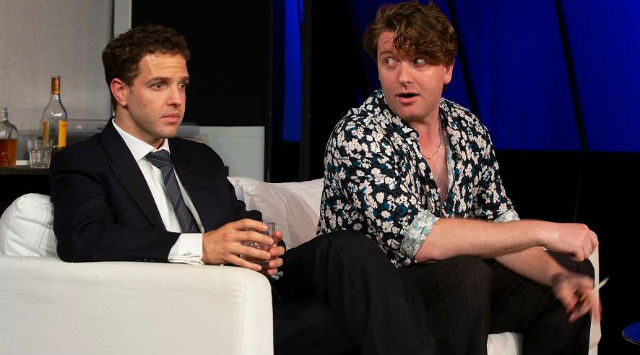
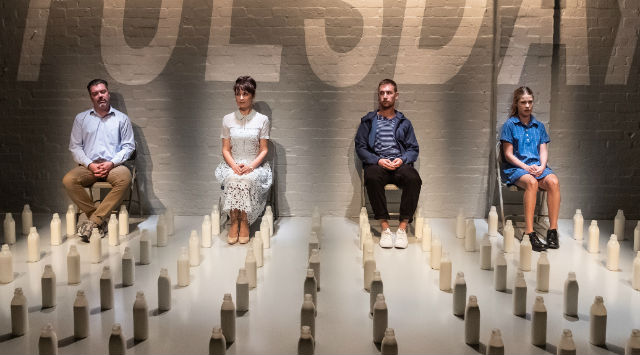
Four people in a supermarket, isolated in their own lanes, doing what are probably the most banal of activities, in the most mundane of places. In Louris van de Gerr’s Tuesday, we see ourselves on the most prosaic day of the week, caught up in private thoughts that reveal our truest, most unflattering selves. Structured as four interwoven monologues, these Australians do not interact with each other, but they exhibit common characteristics that serve to represent our identity. They may be of different genders and generations, but what we see in Tuesday are scared white people, filled with anxiety and aggression, completely self-obsessed even at a moment of catastrophe.

Van de Gerr’s writing is astonishingly detailed in its observations, thus able to connect in a way that feels intimate and authentic. Its disarming sarcasm makes for scintillating humour, and along with a subtle but cleverly structured narrative drive, Tuesday proves to be terrifically satisfying. Director Nell Ranney’s emphasis on tension and gravity from the get go, creates a powerful work of theatre that delivers incessant ironic laughter, as well as an undeniable sense of poignancy in its microscopic scrutiny into the everyday.

The production is designed exceedingly well. Isabel Hudson’s precarious placement of full uncapped bottles of milk, in perfect straight rows, insists that our bodies seize up in their presence, in fear of any accidents that might happen. Martin Kinnane’s quiet rendering of lights gives support to that mood of ubiquitous and impending horror, without ever drawing attention to itself. Sound design by Clare Hennessy is a marvellous achievement, heavily relied upon to convey every fluctuating degree of funny and frightening, for a highly sophisticated blend of comedy, drama and thriller.

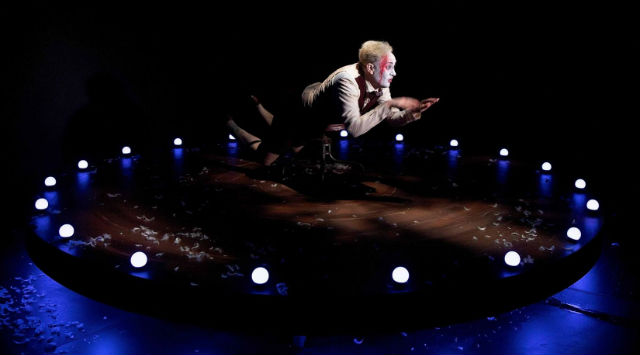
A splendid ensemble comprising impressive measures of intelligence and creativity, takes us on an exercise in intuitive storytelling, riveting from beginning to end. Frances Duca fascinates us by combining poetic gestures with incisive speech, to emulate and comment on the sad housewife archetype. Equally memorable is Duncan Fellows’ interpretation of the pathetic but still respectable low-rung shop manager, hilarious in his naive perception of the world. Bridie McKim plays a mischievous schoolgirl, painfully accurate and unfettered in her spirited depiction of mindless rebelliousness. Tom Anson Mesker’s controlled and complex portrayal of masculinity at its puerile best and toxic worst, encourages us to examine the little irritations and provocations that can pervade our lives, pretending to be normalised, only to explode spectacularly when you least expect it.

The characters in Tuesday are consumed by annoyance, yet there is no evidence of anything serious actually happening within their personal realms. They are people who have no concerns about food and shelter, but are far away from any semblance of peace or contentment. In Australia, we have everything, in fact we have a great deal more than we need, yet we are endlessly restless, and increasingly selfish, always obsessing over issues like border defence and protectionism, without ever intending to be properly informed about the world beyond our shores. It is easy to see the crazy in others, but to understand one’s own madness is quite another thing.

www.facebook.com/SignoftheAcorn | www.belvoir.com.au

Review: My Night With Reg (New Theatre)

Venue: New Theatre (Newtown NSW), Feb 5 – Mar 9, 2019
Playwright: Kevin Elyot
Director: Alice Livingstone
Cast: Michael Brindley, Steve Corner, Nick Curnow, James Gordon, Steven Ljubovic, John-Paul Santucci
Images by Bob Seary

Theatre review
In Kevin Elyot’s My Night With Reg, we meet a group of London gays, in the throes of the 1980s AIDS crisis. Just as a new post-Stonewall liberation had begun to inform the way these men were able to live, a dark period of oppression again descends upon them, threatening to quash any promise of a bright future for the community. The play portrays the intimate world of traumatised individuals, all suffering from the reverberations of a then mysterious killer disease, whilst demonstrating the undying vibrancy of an irrepressibly spirited band of brothers.

It is a sentimental piece, oddly apolitical, with an authenticity that today represents not just an enjoyable sense of nostalgia, but also provides opportunity for a valuable historical study of a society not long past. Elyot’s jokes are as funny as they would have been at their 1994 premiere, but his sorrowful expressions are less resonant, with the advent of significant medical advancement, so many years after the fact.

An endearing cast presents a heartfelt production, directed by Alice Livingstone who orchestrates an entertaining 95-minute exploration into queer identities, from the perspective of middle-class white gay communities of the time. Some of the acting is lacking in precision, and sensitive moments deflate as a result, but the show delivers sufficient poignancy for it to be an ultimately satisfying experience. Comedic roles in My Night With Reg leave the strongest impressions, with Steve Corner’s outrageously lascivious turn as Benny particularly delightful, diligently balanced with some very surprising vulnerability that proves affecting. Also memorable is Steven Ljubovic, whose quintessential rendering of cabin crew Daniel, is unapologetically camp, complete with one-liners that are simply irresistible.

There certainly are more relevant queer stories to tell for 2019, but to forget those who had fought hard for today’s freedoms, would be unconscionable. From living underground to nuptial vows, the journey for LGBTQI rights was (and in many other places, remains to be) long and arduous. My Night With Reg does not explicitly show external forces of subjugation, but the limitations and compromises to how we had lived, are clear. Having emerged triumphant, it is important that we know to value and to take advantage of these new liberties, and to revisit tales of our past, for a reminder of today’s privilege, is key.

www.newtheatre.org.au

Review: The Other Side Of 25 (Bontom Productions)

Venue: Old 505 Theatre (Newtown NSW), Feb 5 – 9, 2019
Playwright: Becca Hurd
Director: Ellen Wiltshire
Cast: Becca Hurd
Images by Jasmin Simmons

Theatre review
Amory is 27 and pregnant, but tells us that babies are not her bag. Life is taking her on a journey, and she believes that to fall pregnant, is to take a pause from her meaningful experience of something much greater. Becca Hurd’s The Other Side Of 25 is indeed about the meaning of life, and quite accurately, its protagonist discovers that there is little as wonderful about existence, as it is to be of service to loved ones. It is soon revealed that Amory is surrogate, on behalf of her sister who has a medical condition that causes problems with child-bearing.

The one-woman show format compels its playwright to make deeply personal revelations that in turn, inspire our own reflections on big questions surrounding convention and inventiveness, the mundane and the sacred, ephemerality and legacy. Its unpretentious honesty allows a deceptively simple story to be told, in a style that is strikingly casual, by director Ellen Wiltshire who catches us unawares with the philosophies that the show contains. Hurd herself performs the piece, with a disarming immediacy that makes us imagine that everything must be autobiographical. Her instinct for the stage insists on our undivided attention, and we follow her every progression in relaying Amory’s story.

When we stop to think about procreation, the amount of reasons that can dissuade an individual from taking the plunge can be daunting. Amory’s decision to carry her sister’s baby is one of logic, but the vast majority of pregnancies occur in a space of emotion and intuition. We can delude ourselves into thinking that we have complete understanding about our individual paths in the world, but in a moment of control being usurped, Amory finds herself unwittingly transported. What was once a hindrance, turns in a flash, into something to be cherished above all else.

www.bontom.com.au

Review: The Rise & Fall Of Little Voice (Darlinghurst Theatre Company)

Venue: Eternity Playhouse (Darlinghurst NSW), Feb 1 – 24, 2019
Playwright: Jim Cartwright
Director: Shaun Rennie
Cast: Kip Chapman, Joseph Del Re, Geraldine Hakewill, Caroline O’Connor, Bishanyia Vincent, Charles Wu
Images by Robert Catto

Theatre review
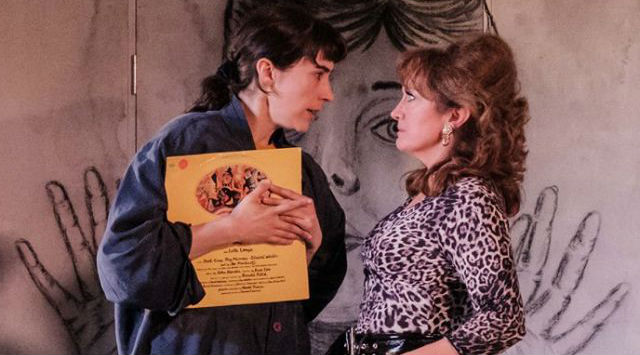
Little Voice is the name of a young woman who spends her days and nights cooped up in a bedroom, listening to old records left behind by a father who had gone too soon. Her mother Mari too, has been unable to get over that death, hitting the bottle hard, and neglecting her all her responsibilities at home and in life. When it is discovered that Little Voice has an extraordinary ability to mimic the torch singers whom she obsesses over, we wonder if commercial success can finally lift the women out of their perpetual state of mourning.

In Jim Cartwright’s The Rise & Fall Of Little Voice, colourful personalities deliver an amusing plot, buoyed by witty dialogue and the alluring promise of spiritual transformation. Actor Caroline O’Connor is scintillating as Mari, a lost but energetic soul, determined to find a man to rescue her from misery. O’Connor’s magnetism is the highlight of the piece, detailed and humorous; she keeps us totally engrossed. Geraldine Hakewill plays the eponymous role with an admirable intensity, particularly charming in her impersonations of Judy Garland, Marilyn Monroe and Billie Holiday, but it is arguable if her narrative arc is conveyed with sufficient power, for the show to sing with poignancy.

Ray Say is a pivotal character, the dastardly male who brings out the worst of Mari, and the best of Little Voice. Performed by an irrepressible Joseph Del Re, who makes his part vibrant yet surprisingly authentic, with a confident presence that never fails to secure our undivided attention. Also captivating is Kip Chapman, who takes on jester duties as Lou Boo, a club manager of disrepute, brilliantly quirky and very funny. Bishanyia Vincent and Charles Wu shine in their quiet roles (as Sadie and Billy, respectively), both tugging at our heartstrings with gentle restraint.

It is a sumptuously designed production. Isabel Hudson’s striking set cleverly addresses the play’s various requirements for locations, memorable for the use of obsolete audio tape in its rendition of a tinselled backdrop. Lights by Trent Suidgeest are often spectacular, appropriately splashy in this tale of show business and poverty. Sound design is thoroughly explored by Kingsley Reeve, who makes rich and enjoyable, the show’s important auditory dimensions. All these immense talents are brought to an elegant harmony by director Shaun Rennie, for a show that is perhaps less than the sum of its parts, but he does manage to create a consistently entertaining night of theatre, out of a lightweight piece of nostalgic writing.

We find it hard to be moved by Little Voice’s final realisation that she needs courage, because this revelation is of course, no revelation at all. It is true that a woman needs to learn how to roar, in a place that routinely robs you of your worth, but revenge is not the essence of Little Voice’s story. We become great, not because of bad men (or women), but in spite of them. The talents that she possesses had always existed, and to give her nemesis any credit for her burgeoning, is simply uninspired storytelling. The playwright insists that Little Voice is nothing without her father, her talent agent and her love interest. We know otherwise.

www.darlinghursttheatre.com

Review: Dorian Gray Naked (Popinjay Productions)

Venue: Limelight on Oxford (Darlinghurst NSW), Jan 30 – Feb 16, 2019
Libretto: Melvyn Morrow
Music: Dion Condack
Director: Melvyn Morrow
Cast: Blake Appelqvist

Theatre review
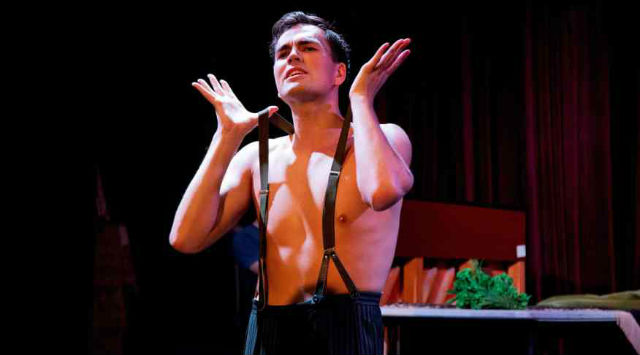
A fictional character provides the inside scoop on his author Oscar Wilde, in Melvyn Morrow’s Dorian Gray Naked. Resurrected to speculate on the inner workings of a novel, from a time when homosexuality was an abomination that would render entire existences underground and secret, Dorian the Adonis/Narcissus of queer literature offers a revised perspective for our comparatively liberated times.

Imaginative and appropriately flamboyant, Morrow waxes lyrical about what might have been. Together with Dion Condack’s music, Dorian Gray Naked paints a melancholic and often abstract picture, about artistic creation, highly sentimental but insufficiently witty. Performer Blake Appelqvist’s affected approach, punctuated by incessant sharp inhales, executed like DIY sound effects, can be alienating, but his presence is a strong one that fills the room effortlessly. It is basically a one-man show, but with Condack positioned onstage, passionate on the piano, interplay between the two men are inevitable in this exploration of gay culture and history.

Choreographer Nathan Mark Wright uses exaggerated body shapes to make a statement about camp, and to disrupt the meanings of masculinity in Wilde’s suspicious narrative of heterosexual love. The effect is skin deep, but it reveals an aspect of gayness that is obsessive about surface. Although Dorian Gray Naked is thorough with its reinventions and fabrications, it seems incapable of reaching greater emotional or psychological depths that will achieve meaningful resonance. It remains mainly a cerebral experience, and for some, that could be enough.

www.limelightonoxford.com.au

Review: Intersection 2019: Arrival (ATYP)

Venue: SBW Stables Theatre (Darlinghurst NSW), Jan 30 – Feb 16, 2019
Playwrights: Georgie Adamson, Joshua Allen, Grace Chapple, Hannah Cockroft, Sasha Dyer, Meg Goodfellow, Flynn Hall, Jasper Lee—Lindsay, Brooke Murray, Emma Skalicky
Director: Sophie Kelly
Cast: Marvin Adler, Teodora Avramovic, Salem Barrett-Brown, Bebe Bettencourt, Toby Blume, Apsara Lindeman, Ryan Hodson, Kelly Nguyen, Grace Stamnas, Sophie Strykowski, Harry Winsome, Emma Wright
Images by Tracey Schramm

Theatre review
To arrive, implies a destination, an end to travels, but at the conclusion of every journey, if conclusions exist at all, are inevitable new beginnings. In Arrival, we witness young people undertaking an act of emergence, one that is propulsive rather than stagnant. Ten short plays present them as a force to be reckoned with, full of hope and exhilaration, in an event that will no doubt provide inspiration to the young and young-at-heart.

The material is light, almost blithe in attitude, that director Sophie Kelly uses to her advantage in cultivating an irresistible vivacity for a show that keeps us wanting more. Set design by Tyler Ray Hawkins is attractive and sophisticated, cleverly utilising abstract patterns to stoke our imagination. Martin Kinnane’s lights are called upon to inject drama, highly effective in enhancing all that the cast aim to unfurls on stage.

Performers Teodora Avramovic and Sophie Stykowski are especially memorable in Flynn Hall’s Fish Fingers, a cheeky piece about teenage masturbation and self-discovery in a carnal sense. The pair’s extraordinary chemistry, along with their confident timing, deliver some very big laughs, in a joyful display of promising new talent. Georgie Adamson’s Real Dry is a refreshing take on a classic lesbian story, featuring BeBe Bettencourt and Kelly Nguyen, who offer a sensitive and intelligent interpretation of girls experiencing crushes. It is noteworthy that queerness is represented beautifully in the production, to reflect a new evolution in the understanding of human sexuality that Sydney youth has so readily embraced.

We may not be able to find anything radical in these works, but the energy derived from each of these artists’ optimism is palpable. There is a quality of bravery that shines through, even if things can feel somewhat contained and safe. It is clear that our affluence in this lucky country compels an overprotection of ourselves, especially our young. Art, like most things of significance, can only be accomplished with risk, which is perhaps the hardest of all to teach.

www.atyp.com.au

Review: Are You Listening Now? (Fixed Foot Productions)

Venue: Old 505 Theatre (Newtown NSW), Jan 29 – Feb 2, 2019
Playwright: Xavier Coy
Director: Ed Wightman
Cast: Martin Bell, Xavier Coy, Fiona Mahl, Emily J Stewart
Images by Becky Matthews

Theatre review
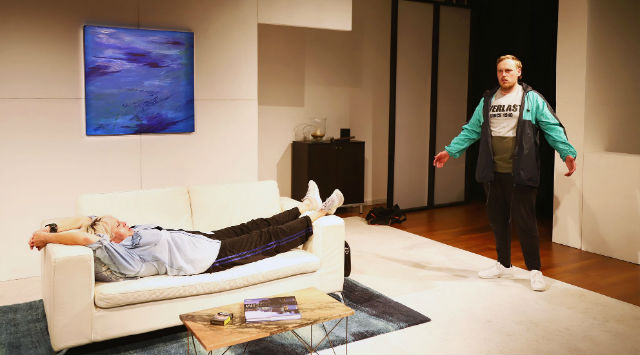
Mez and Gaz are intruders in a 6-million-dollar house, with intentions not only to burgle but also to teach the affluent homeowners a lesson. Even though Xavier Coy’s Are You Listening Now? makes its point about wealth distribution with no concern for subtlety, the message is nonetheless an important one. By embedding plenty of comedy and drama, the writer ensures his play to be an amusing one, and laughing about class is certainly a worthwhile activity, at these times of unprecedented prosperity for the top end of town.

Directed by Ed Wightman, the staging is energetic, with a high level of intensity fortifying the hour-long piece. Coy himself performs the role of Gaz, adept at delivering laughs in his portrayal of a surprising innocent. His criminal mentor Mez is played by Fiona Mahl, who in her strongest moments, can prove impressively convincing. Emily J Stewart is riveting as Claudia, one-half of the rich couple under siege, a persuasive presence who brings much needed nuance to the production. Multimillionaire Charles is a predictable personality that Martin Bell is able to make believable, for a familiar portrayal of Sydney-style privilege.

It is sometimes surprising to observe the degree to which Australia has embraced neo-liberalism. For generations we have prided ourselves on our egalitarianism, but it appears that greed is truly indomitable. The moral at the centre of Are You Listening Now? is timeless and pertinent; money is a complex beast that if left unchallenged, will inflict harm and turn us inhumane. Mez’s refusal to obey rules that are designed to subjugate her, is admirable, but without compatriots joining her rebellion, we see that a one-woman movement can amount to nothing more than empty gestures.

www.facebook.com/fixedfootproductions

Review: Brown Skin Girl (Black Birds / Old Fitz Theatre)

Venue: Old Fitzroy Theatre (Woolloomooloo NSW), Jan 29 – Feb 9, 2019
Playwrights: Ayeesha Ash, Emily Havea, Angela Nica
Director: Ayeesha Ash
Cast: Ayeesha Ash, Emily Havea, Angela Nica

Theatre review
Three mixed-race women offer their perspectives as young Australians living while brown. In Brown Skin Girl, creators Ayeesha Ash, Emily Havea and Angela Nica are themselves on stage, delivering autobiographical accounts of challenges faced by women of colour, on a land that although never was ceded to white colonists, has had to struggle with racism since the very dawn of European invasion. The work arises from dark experiences, but it is a passionate and brilliantly joyful encounter that results, featuring anecdotes, observations and sheer poetry that aim not only to bring light to what is normally repressed, it proves to be immensely uplifting, especially for those of similar backgrounds.

The women have fathers who are African-American and Cherokee, Grenadian, and Tongan, so their appearance makes them a target, of constantly being othered in a society that never fails to exert its whiteness, no matter how much we call out its illegitimacy. This absurdity is effectively transposed into comedy, and the show is uproariously funny, with all its subversive and critical denunciation of the prejudices being perpetuated on people of colour. Ash, Havea and Nica are extremely appealing personalities, warm and effervescent, charming even when dispensing their most cutting beratements. Their chemistry is honed to perfection, on a stage replete with fiery, feminine confidence.

As people of colour, we need to be the ones to lead this nation’s discussions on race. The project of dismantling white supremacy in our spaces and structures, simply cannot be left to the powerful. We need to remember that there is little incentive for them to change the way things are, even as they profess a seemingly genuine desire to help better our communities. We must stop being fearful of radical thought and action, and at the same time, learn to manipulate these broken systems to our advantage. This will require our coming together, our refusal to be kept apart by a white patriarchy that benefits from our fractured and dispersed existences. Brown Skin Girl is a rare moment in Australian theatre, that does not imagine a white audience; it dares to speak to its own, and for once, the minorities in the audience feels seen. This is the beginning of empowerment, where hopes can begin to turn into reality.

www.black-birds.net

Review: The Iliad Out Loud (Sport For Jove Theatre)

Venue: Belvoir St Theatre (Surry Hills NSW), Jan 23 – 27, 2019
Playwright: William Zappa
Director: William Zappa
Cast: Blazey Best, Heather Mitchell, Socratis Otto, William Zappa
Images by Lisa Tomasetti, Jamie Williams

Theatre review
Homer’s ancient poem is adapted and abridged in William Zappa’s The Iliad Out Loud, first for radio, and now for the stage. This iteration of the epic stretches across three parts, each three hours long, presented by four actors and two musicians, in the form of a staged reading. It takes after what is believed to have happened in 8th century BC, when the original was performed, to be heard and not read. Zappa’s text can easily be repackaged as a novel, and often we wonder if that would have been a better format, especially during the very many drawn out battling sequences, which require only visualisation and no analysis on our part.

This condensation of events would likely be more rewarding for those who are already fans of the story. A thrilling ride for some can prove an ordeal for others, as the production routinely rushes past character development to cover significant occurrences. Without sufficient background understanding of personalities, we struggle to resonate with their trials and tribulations in all the warfare, that Zappa so exhaustively conveys.

Michael Askill and Hamed Sadehi are musicians and stars of the show, a two-man band that makes a real art form of their accompaniment. In the absence of more conventional theatrical imagery, Askill and Sadehi pull out all the stops to stoke our imagination, adding infinite colour to the pages of words being dispensed. Lighting by Matt Cox too, is inspired, with a series of elegant transformations to illumination, helping guide us through states of emotion.

Zappa is an outstanding reader, full of dynamism on his stage, holding our attention with extraordinary ease, effortless in sharing his immense enthusiasm for a seminal work of his heritage. It is a confident cast that travels with us on this journey, impressive in their detailed familiarity with every twist and turn of the 9 hours.

The warring men blame their behaviour alternately, on one woman Helen, or on the gods Zeus and his ilk. Their inability to face their own culpability in all the conflict, feels an accurate reflection of every war in every era. It may not be true that women are never in favour of such brutality, but it is certain that none of these atrocities can ever be perpetrated without men. All the war heroes in Iliad can be thought of as good guys, and our continual inclination to excuse them of the horrors that they choose to enact, reveals, at least in part, why we remain in a perpetual cycle of bloodshed.

www.sportforjove.com.au

Review: Herringbone (Squabbalogic Independent Music Theatre)

Venue: Kings Cross Theatre (Kings Cross NSW), Jan 18 – Feb 2, 2019
Playwright: Tom Cone
Music: Skip Kennon
Lyrics: Ellen Fitzhugh
Directors: Jay James-Moody, Michael Ralph
Cast: Jay James-Moody
Images by David Hooley

Theatre review
It was 1929, at the dawn of the Great Depression when eight-year-old George was assigned to be star of the stage, and bread winner at home. Billed as “a vaudevillian ghost story”, Tom Cone’s Herringbone tells the fantastical tale of George’s possession by a poltergeist named Lou who returns, determined to resume his prematurely terminated acting career. Wonderfully imaginative, with a flamboyant and quirky sensibility that transports us to realms of fascinating awe, the show also includes songs in a nostalgic style inspired by the era, all of them full of charm, certain to delight.

Jay James-Moody alone plays all ten of Herringbone‘s different characters, enthralling for the entire 90-minute duration. We witness superhuman talent, along with extraordinary skill and conviction, as the consummate storyteller takes us to the farthest reaches of what theatrical magic can achieve. His technical abilities prove as moving as the palpable love he has for the art form, so clearly discernible on this stage. James-Moody (who also co-directs) allows himself to be completely vulnerable, so that we can come in contact not only with the humanity of the piece, but also the staggeringly delicate nature of live performance. Creating theatre, especially at this intimate scale, is to fly without a safety net, and when we see the work soaring, the inspiration that it provides is incomparable.

Choreography by co-director Michael Ralph is thoroughly inventive, with a jubilant spirit that makes the experience an uplifting one (in spite of its dark themes). Adding to the visual splendour is Benjamin Brockman’s lights, extravagantly conceived to deliver luscious and dramatic imagery, much of which lingers on well after curtain call. Three musicians, Natalya Aynsley, Amanda Jenkins and Tom McCracken, electrify the space with their passionate interpretations of the score, having us impressed by their detailed and tight performance, no doubt due in large part to musical direction by Benjamin Kiehne.

Musical theatre is big business, and as such, much of what we see can tend to be predictable and formulaic. Even if there is undeniable professionalism on display, all the money in the world can never guarantee that our soul is touched by a production. Commerce is always risk averse, and by the same token, it can often be fearful of ingenuity and all things ephemeral, ingredients that great art can never do without. Herringbone has a little bit to say about how we care for children, but it is the very application of artistry, and the collaboration of disciplines, that makes this show so exquisite.

www.squabbalogic.com.au