Review: Silent Night (Darlinghurst Theatre Company)

Venue: Eternity Playhouse (Darlinghurst NSW), Nov 10 – Dec 10, 2017
Playwright: Mary Rachel Brown
Director: Glynn Nicholas
Cast: Amanda Bishop, Richard Sydenham, Aaron Glenane, Michael Denkha
Image by Brett Boardman

Theatre review
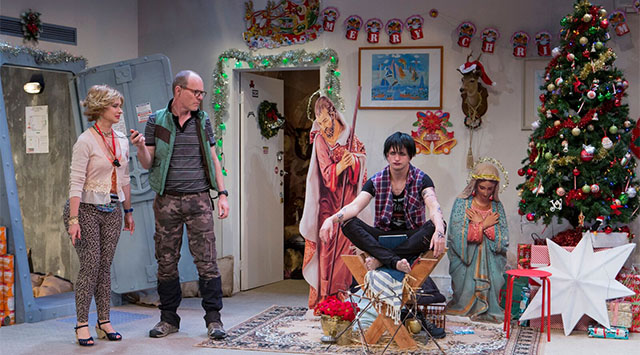
It is Christmas in the suburbs of Sydney, and the Lickfolds are freaking out, because of course, there is just so much to be done. In Silent Night by Mary Rachel Brown, we take a look at our behaviour during what is meant to be the most sacred time of the year. We may not be a religiously homogeneous nation, but the silly season of December insists that we all act at a surprising degree of uniformity.

Australians take Christmas seriously, but rarely for the right reasons. In the Lickfold household, an occasion for charity and goodwill is turned into an opportunity for exacerbated narcissism and magnified paranoia. Anne wants at all costs, to win her neighbourhood’s annual competition for the best decorated house and yard. Her husband Bill’s doomsday preparations are at fever pitch, fuelled by the incessant talk of diversity, in politically correct representations of Jesus’ birth on rooftops, and other places. Their son Rodney is determined to get in the way of everything; even at Christmas time, he refuses to share his parents’ attention with anyone, God included.

It is a moralistic tale, predictable in its messaging although imaginatively conceived. Clever ideas abound in Brown’s play, but they are not presented well. Its comedy is relentlessly laboured in the first half, and when things get serious later on, its dialogue turns confusing. Director Glynn Nicholas makes sure that we know when punchlines are delivered, but moments of genuine laughter are few and far between. There is no doubting the grace and spirit that motivate the creation of Silent Night, but intentions on their own are rarely insufficient.

Production design is competently rendered, as are performances from the cast of four. Energy and conviction are delivered in spades; we see the actors work hard, and their determination to keep us engaged is, to some extent, effective. Richard Sydenham impresses as Bill, animated and precise in his approach, able to communicate a hint of complexity that is absent from other characters.

It is true that Christmas makes our ugly sides more pronounced. When we compare our lives to the best of the Bible’s stories, we can only see beings contemptible and profane. All the wasteful decadence and hollow frivolity that inevitably take over our celebrations of that sacred dawn, expose our values to be no more than utterly dismal. We are not bad people, but when we are careless, there is little than can differentiate us from the scum of the earth.

www.darlinghursttheatre.com

Review: Three Sisters (Sydney Theatre Company)

Venue: Sydney Opera House (Sydney NSW), Nov 6 – Dec 16, 2017
Playwright: Anton Chekhov (adapted by Andrew Upton)
Director: Kip Williams
Cast: Alison Bell, Peter Carroll, Callan Colley, Miranda Daughtry, Harry Greenwood, Melita Jurisic, Brandon McClelland, Eryn Jean Norvill, Rahel Romahn, Chris Ryan, Nikki Shiels, Mark Leonard Winter, Anthony Brandon Wong, Charles Wu
Images by Brett Boardman

Theatre review
The existential angst in Chekhov’s Three Sisters is timeless; the need to understand what we are here for, and how we can find happiness, are fundamentally human and eternal. Once again, we see Olga, Irina, Masha and all their friends babble on for three hours, about how hard it is to do life. Andrew Upton’s adaptation gives the play a slight refresh, but it is a predictably faithful rendering that takes on the burden of the original’s dreariness, as it ruminates on the tedium of the bourgeoisie.

As is characteristic of director Kip Williams’ style, the show is presented with remarkable polish and an impressive elegance. Alice Babidge’s set design establishes an inescapable air of glamour for the production’s minimalist aesthetic, while Nick Schlieper’s delicate lights bring sumptuous beauty to proceedings. Music by The Sweats and sound by Nate Edmondson help us locate the contemporary relevance in Chekhov’s story, whilst retaining its intrinsic sense of Russian austerity.

It comes as no surprise that this is yet another dry and dreary rendition of Three Sisters. For all the reverence associate with the play, it is at its core, a work about the lifelessness of the privileged. The point is its stasis, that nothing happens for years, and that these women are mysteriously incapable of taking meaningful action.

Williams is inventive in the first half, introducing energy wherever possible, but the depressive quality of the text proves insurmountable. Although some of the flourishes can be distracting and excessive, there is no denying our appreciation for the effort put into injecting animation and comedy, derived from the sheer desire to see some theatricality.

Actor Miranda Daughtry is memorable as Irina, with explosive emotions that are both captivating and genuine. The cast understandably adopts an extravagantly declarative approach to performance, but Daughtry’s way of connecting with her audience is particularly truthful. Alison Bell’s droll humour as Olga shines a light on the often neglected irony in Chekhov’s writing, and Eryn Jean Norvill’s exaggerated comedy as Masha is similarly delightful. We are glad to be spared too much bleakness, but it is arguable if these interpretations are effective, in helping us absorb the philosophies in Chekhov and Upton’s writing.

There always seems to be a Chekhov play on a stage in Australia somewhere. We are so much like the sisters, understanding the concept of progress but unable to extricate ourselves from the old and deficient. We may not be able to create anything without being informed by tradition, but this Three Sisters draws attention to the parts of us that refuse to move on, that are rigid in their worship of a conceptual “home”, undeviating from sacred points of origin. These parts of us that are backward and regressive must be interrogated, if not demolished.

www.sydneytheatre.com.au

Review: Plastic (The Old 505 Theatre)

Venue: Old 505 Theatre (Newtown NSW), Oct 31 – Nov 18, 2017
Playwright: Mark Rogers
Director: Sanja Simic
Cast: Nick Bartlett, Hannah Goodwin, Harry McGee, Douglas Niebling, Michelle Ny
Image by Carly Young

Theatre review
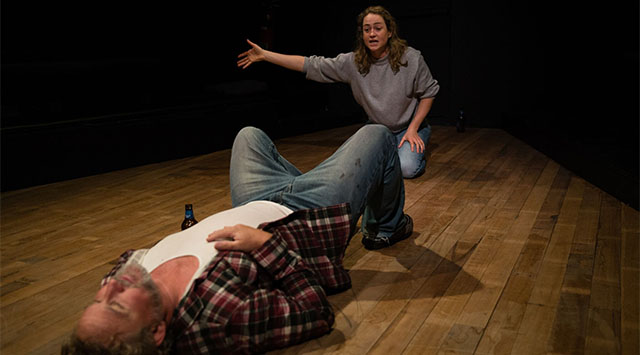
When we first meet Franz, he seems nice enough. A young scientist excited for the opportunity to discover wonderful things about the universe, he soon gets absorbed into the big machine of corporations, academia and the fourth estate, and idealism turns corrupt, as the golden boy attempts to carve out a name for himself in Mark Rogers’ Plastic.

Having little more than Franz’s personal reputation and career at stake, the context is admittedly dry, but although not a particularly moving story, Plastic is written with remarkable inventiveness and nuance. Its dialogue is consistently amusing, and the playwright’s theatrical flair concocts a range of characters that come readily to life on stage.

Sanja Simic’s exacting and energetic direction makes for a marvellously captivating show. We may not care very much for Franz’s predicament, but we find ourselves nonetheless fascinated, and thoroughly entertained by the production’s clever presentation of sequences that reveal its plot.

The spirited cast of five has a whale of a time, and we go along gleefully with their infectious exuberance. Their work is impressively well-rehearsed, and each actor demonstrates a thrilling sense of passionate conviction, along with an arresting fastidiousness required of the script. The charming Nick Bartlett keeps us attentive to Franz’s narrative even as the character proves himself to have few redeeming features. The roles are not particularly likeable, but there is no resisting the charm offensive from these players.

We often worry about our art being stifled by commercial forces, but in Plastic, we see that things are no different for those working in the field of science. Instead of discovering and cultivating the best that one has to offer the world, individuals pursue only things that promise reward and glory. With our eye on the prize, as it were, we lose sight of the bigger picture, and of greater possibilities. Innovation pertains to that which is yet unknown, but if we focus only on results already predetermined, progress will forever be suppressed.

www.bodysnatcherstheatre.com

Review: Paper Doll (Old Fitz Theatre)

Venue: Old Fitzroy Theatre (Woolloomooloo NSW), Nov 7 – 18, 2017
Playwright: Katy Warner
Director: Lucy Clements
Cast: Martin Ashley-Jones, Lucy Goleby
Image by Kate Williams

Theatre review
At its most fundamental, theatre is an instrument that wishes to get us together, and have us find consensus, or at least to gain valuable awareness on issues of relevance. We share space and come to an understanding of what each other thinks, when we laugh together, or when we hear people gasp in demonstration of their disapproval or outrage.

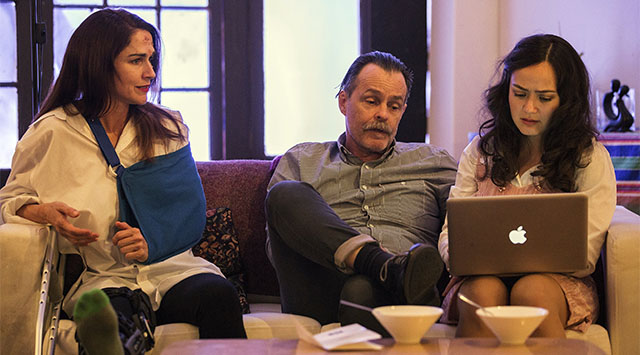
Katy Warner’s Paper Doll is a topical work about sexual predation and paedophilia, depicting a grown woman meeting her abuser, years after the fact. Dialogue is well crafted, but the work takes a safe approach, rarely controversial in how the subject is handled. The plot and its characters offer little that is new to how we regard the matter, although individuals who might be personally affected, would probably identify more palpable qualities.

Director Lucy Clements’ obvious attempts at manufacturing dramatic tension vary in effectiveness. The show has many captivating moments, but can at times feel laboured, in its efforts at creating something theatrical out of a quiet piece of writing. Both performers are strong personalities, with impressive stage presences. Lucy Goleby’s intensity dictates the tone of proceedings, while Martin Ashley-Jones brings a more organic interpretation that reads with a better sense of authenticity. We may not always be convinced of the action on stage, but the production makes all of its assertions crystal clear.

In representing the zeitgeist’s hot topics, a conundrum exists when our minds are already made up before entering the auditorium. There can only be one way of considering issues surrounding rape, and unless the production takes exceptional risks, the chances of it being less than predictable, are close to none. Paper Dolls is careful to say all the right things, but we have heard it all too many times before, and it is not fair to expect fabricated controversy where none is permitted. We want our art to be inventive, but it seems that not everything can be talked about in unexpected ways.

www.redlineproductions.com.au

Review: Time Stands Still (Eclipse Productions)

Venue: Tap Gallery (Surry Hills NSW), Nov 1 – 25, 2017
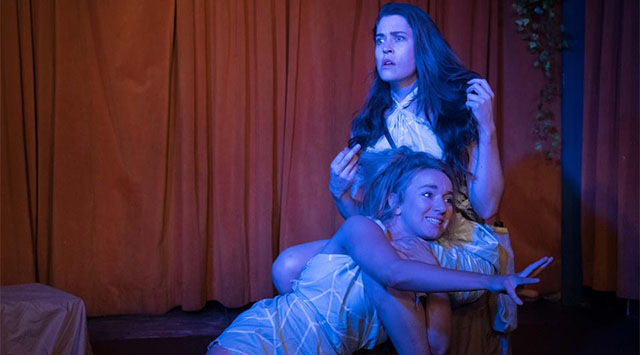
Playwright: Donald Margulies
Director: Claudia Barrie
Cast: Laura Dejanegara, Matt Minto, Terry Serio, Emily J Stewart
Image by Katie Barget

Theatre review
After sustaining serious injuries in Iraq, Sarah returns to Brooklyn, under the care of her partner James. For the first time, the independent woman turns reliant, and we watch the nature of their relationship go through a gradual but drastic change.

Donald Margulies’ Time Stands Still examines the meaning of modern living for some of the more fortunate people of our times. The action is situated in a New York apartment, where its inhabitants engage in degrees of introspection, never having to worry about money, food or shelter. The play oscillates between concerns that are admittedly frivolous, with international issues that are unquestionably serious. It discusses responsibilities of the world’s rich, as other parts of the globe engulf in flames and disaster, while simultaneously worrying about the dwindling relevance of marriage and monogamy.

The production places its audience quite literally inside Sarah and James’ home. The intimate setting exposes us to the frequently caustic energy that seethes between its characters, although a greater sense of polish for the set, would improve the story’s ability to focus on its concerns regarding class and privilege. Claudia Barrie’s direction is strong for the piece; we are constantly reminded of its deeper resonances even when people are squabbling over the pettier things in life.

Leading lady Emily J Stewart is full of conviction, and effective in providing a quality of heightened sentimentality to the show, although her Sarah seems too persistently vulnerable, with an overemphasis on her role’s fragility, that can interfere with the play’s celebration of female autonomy. Matt Minto is persuasive as James, the journalist determined to retreat from the rough business of war correspondence. The actor is beautifully nuanced in his portrayal of a man struggling to dominate his household. Supporting players Laura Dejanegara and Terry Serio are both delightful and dynamic, adding charming effervescence with every appearance.

Guilt means nothing if it is not an intermediary emotion that leads to proactive action. With the proliferation of information technology, big business sells us news stories about terrible things happening near and far, and we live in a state of constantly feeling bad as a result of this new capitalism. Disaster porn is lucrative, and we pay for it with money and with languishing in sadness, wondering who is left to go and solve the problems.

www.eclipseproductions.com.au

Review: Hijacked Rabbit (Jackrabbit Theatre)

Venue: Blood Moon Theatre (Potts Point NSW), Oct 31 – Nov 11, 2017
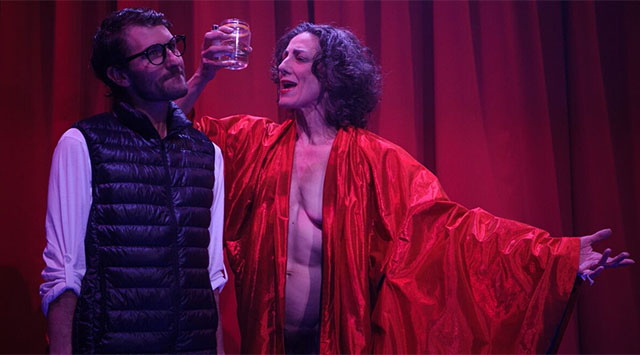
Playwrights: Emma O’Sullivan, James Sweeny, Lincoln Vickery, Jane Watt
Directors: Michael Abercromby, Charlotte Devenport, Lincoln Vickery
Cast: Michael Abercromby, Elle Harris, Zoe Jensen, Emma O’Sullivan, Adam Sollis, Seamus Quinn, Jane Watt
Image by Clare Hawley

Theatre review
Hijacked Rabbit features 4 separate hour-long comedies, each with its own style and characteristics. The plays are individually surprising, although some are funnier than others, and not all are equally meaningful. A matter of personal taste would determine how an audience member responds to the varying comedic approaches, but this is an amusing collection of ideas, presented with infectious enthusiasm.

The one-woman piece Gate 64, written and performed by Jane Watt, sees Winnie, who resides at an airport, talking to her captive crowd, comprised of passengers awaiting a delayed flight. Exploring delusions and memories, fantasies and hopes, Watt demonstrates impressive talent in both artistic capacities. As playwright, she is witty and gently profound, and as actor, she is simultaneously sensitive and daring, tremendously likeable as a result of the extraordinary vulnerability she brings to the role.

Watt again appears in Orange Is The New Crack by James Sweeny, accompanied by equally funny players Michael Abercromby and Zoe Jensen, for some excellent scenes of hilarious tomfoolery. It is this accomplished trio that takes us through the delightfully messy story from ancient times, of sugar-peddling women, their junkies and other dependants.

Although not always executed with finesse, the plays prove themselves to be fantastically imagined. Hit by Lincoln Vickery is a dynamic, fast-paced story about hit men and gay love. It’s Mars Time by Emma O’Sullivan is inspired by the troubles of our times, and the desire to flee this anguished existence.

Each segment of Hijacked Rabbit offers moments of brilliance, and we are enchanted whenever a glimmer of genius is revealed, within these rambunctious, jaunty proceedings. It is the raw talent on show that has us excited, and on this occasion, proves itself to be more than satisfactory.

www.jackrabbittheatre.com

Review: Merciless Gods (Little Ones Theatre)

Venue: SBW Stables Theatre (Kings Cross NSW), Nov 1 – 25, 2017
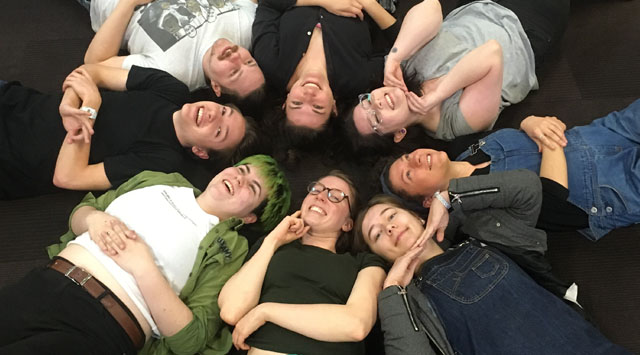
Playwright: Dan Giovannoni (based on the book by Christos Tsiolkas)
Director: Stephen Nicolazzo
Cast: Paul Blenheim, Brigid Gallacher, Sapidah Kian, Peter Paltos, Charles Purcell, Jennifer Vuletic
Image by Sarah Walker

Theatre review
Art can reshape lives. It provides new perspectives and an accompanying freedom, so that we are able to imagine a way of being that is better, than what had been available before. Christos Tsiolkas’ books might have a penchant for all things gloomy, but their refusal to adhere to dominant myths of our culture, helps us define an Australia that is more authentic, and certainly more inclusive, than paradigms that persist in spite of their diminishing relevance. We all want to belong, it is only human to wish for acceptance.

In Merciless Gods, eight short plays, adapted by Don Giovannoni from Tsiolkas’ book of the same name, explore the bleaker recesses of our psyche, paying particular focus to universal concepts of family, violence and sex. The writing is lyrical, faithful to Tsiolkas’ own renowned style, though dialogue can sometimes sound stilted through its translation of forms.

Operatically evocative, the work involves huge emotions and flamboyantly devised contexts. Six powerful performers are called upon to manufacture a rhapsodic sense of theatricality, in the absence of more extravagant manoeuvres by director Stephen Nicolazzo, who approaches the show with a misplaced and redundant restraint. Merciless Gods contains a spirit that feels boundless, and very wild, yet the staging is adamant in its preference for abstinence, and presumably, good taste.

Actor Jennifer Vuletic is unforgettable in two of the stories, converting the literary into intimate moments thrilling and visceral, through her sensational portrayals of contrasting parental types. We meet Dan the benevolent father, just as his light dims into the unknown thereafter, and we meet the phenomenal Lisbeth, an evil mother whose destructive darkness, threatens to outlive us all.

There is no good, without the bad. In Merciless Gods, we encounter them both, with little judgement, only an acceptance of their inevitability. The exotic creatures resist our moralising, and reveal to us instead, with brutal honesty, the unrelenting imperfections of our humanity. Rendered immediately recognisable, our ugliness demands to be owned, but what happens after the curtains fall, is that eternal battle between hope and hopelessness, with neither emerging the decisive victor.

www.littleonestheatre.com.au

Review: Ghosts Of Glebe (Jetpack Theatre Collective)

Venue: Streets of Glebe (Glebe NSW), Oct 31 – Nov 11, 2017
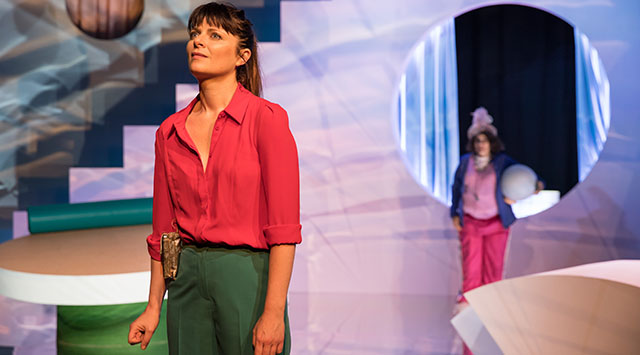
Curators: Emilia Higgs, Kirsty McGuire
Cast: Gabby Florek, Nicole Archer, Chloe Leathlan-Higson, Kipp Carina, Tim McNaught and Elliot Ulm

Theatre review
The entire experience is disguised as a “ghost tour”, and we quickly forget that our tickets had originally been acquired, for a theatre production. Ghosts Of Glebe works best when we submit to the fantasy, and actively participate in the creation of its narrative. The more we are able to behave and react like tourists, the greater its results.

We walk the streets of Glebe, rich with a history of murders, accidental deaths, and spooky stories. The spine tingles, in spite of our better judgement. Things get eerie, when our minds fail to decipher fiction from reality, but we relieve the tension when the inevitable sense of awkwardness starts to make us giggle.

It is a well-conceived production, although less eventful sections of the plot do feel lacking in imagination. There is wondrous use of space; Glebe at night is beautiful, and the theatricality that is wrapped around its topography, is highly enjoyable, if unconventionally brief.

Theatre is group activity, but in the West, we are used to it being the most passive of adventures. Ghosts Of Glebe offers an opportunity for our involvement to go slightly beyond the usual “sit back and wait”, and like in the rest of life, it is when we are willing to put in the effort, that the rewards become even more gratifying.

www.jetpacktheatre.com

Review: Atlantis (Belvoir St Theatre)

Venue: Belvoir St Theatre (Surry Hills NSW), Oct 28 – Nov 26, 2017
Playwright: Lally Katz
Director: Rosemary Myers
Cast: Paula Arundell, Lucia Mastrantone, Amber McMahon, Hazem Shammas, Matthew Whittet
Images by Daniel Boud

Theatre review
Lally Katz’s Atlantis is an autobiographical fantasy. It sprouts from the personal and authentic, then leads to something entirely imaginary. Lally, the protagonist, is consumed by anxiety, when at 35, she finds herself single and childless. We follow her on an odyssey that takes her from Sydney, to the USA’s east coast; an eventful, wacky journey that comprises a string of amusing characters and incidents. Lally goes through many discoveries, fuelled by a desperate search for love, or at least a husband and a baby.

It is not a quest that all will find persuasive. The deliberately silly scenes in Atlantis are certainly a lot of whimsical fun, but the central disquiet that motivates all the action seems too trivial, perhaps even narcissistic, to allow us to invest in a meaningful way. Through the plot, Lally comes in contact with more worthy concepts, of climate change, of poverty and of mortality, but they affect her only momentarily. We can all see that her problems diminish in significance as time passes, but nonetheless, Lally persists. She must find a man to fall pregnant with, or she simply cannot go on.

Amber McMahon plays a juvenile, although very likeable, version of the playwright. As though in a pantomime, McMahon’s exaggerated effervescence proves to be captivating, as she keeps us attentive through the highs and lows of Lally’s stories. The production is unquestionably humorous, directed by Rosemary Myers with a relentless sprightliness that offers entertainment and laughter, even when the narrative turns tiresome. Four other actors are called upon to perform a big roster of small roles, and they are all remarkable. The infinite versatility of the ensemble astounds us, with what they are able to achieve through sheer inventiveness. Also noteworthy are Damien Cooper’s lights and Jonathan Oxlade’s set, creating exciting images full of colour and movement, increasingly mesmerising as the show turns hopelessly hallucinatory.

Like in all our lives, the promise of a utopia propels the action in Atlantis. We need to believe in something, like that pot of gold at the end of a rainbow, in order that we can set ourselves in motion, so that we can fill time with meaning. Lally Katz does so much in the play, through all its scenes of mischievous adventure, but we see her being neglectful of each moment, keeping her mind focused instead on a puerile objective. When there is joy surrounding us, we must take notice and take pleasure in it. Better days will come, but understanding that they have a propensity to surprise us, and learning to see the signs that wish to evolve us, is how we can experience the magical unpredictability of this existence.

www.belvoir.com.au

Review: Give Me Your Love (Seymour Centre)

Venue: Seymour Centre (Chippendale NSW), Oct 31 – Nov 4, 2017
Playwright: Jon Haynes, David Woods
Director: Jon Haynes, David Woods
Cast: Jon Haynes, David Woods

Theatre review
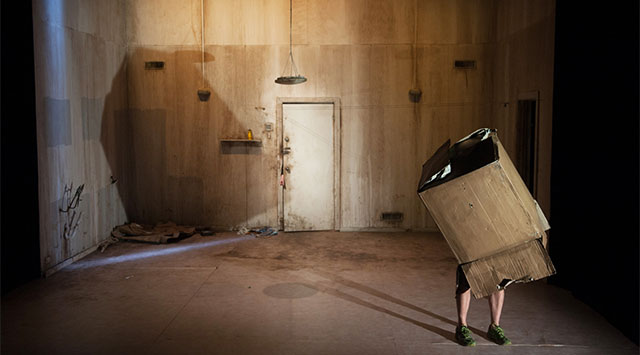
Not only is Zach trapped in his room, he has resolved to stay inside a cardboard box, never to emerge. Jon Haynes and David Woods’ Give Me Your Love portrays life after war, for a Welsh soldier suffering from Post Traumatic Stress Disorder. Although wildly imagined, the work never deviates from a sense of authenticity in the way it discusses mental illness. The comedy is clearly outlandish in style, but the scope of its concerns remains faithful to a sense of accuracy, and urgency, in its depiction of a veiled but serious social problem.

It is an enormously witty show, and fantastically inventive, not only with its clever dialogue, but also in the sheer theatricality of what it presents. Jacob Williams’ set design is viscerally affecting, powerfully evocative of spaces in and around our protagonist. Zach’s tattered box is wielded masterfully by Woods, like an oversized mask. In his best moments, we connect in a profound way to the agony being explored, and reach a decent understanding of the difficult psychology and emotions, as experienced by those who live with PTSD. We can see that Zach is being ridiculous, but in quite an inexplicable way, we know what it feels like, to persist with behaviour that makes no sense.

Give Me Your Love relies on our universal need for empathy. The audience is introduced to an extraordinary set of circumstances, but the storytelling touches us intimately, and we recognise Zach’s dysfunction to be fundamentally human. It is also about sacrifice, personal and communal, inevitable and unfortunate. Life does not permit anyone to go through it unscathed. Damage will be done, but it is when we learn to heal the wounded, that we can begin to regain some control.

www.ridiculusmus.com