Review: Romeo And Juliet (Bell Shakespeare)

bellshakespeareVenue: Sydney Opera House (Sydney NSW), Feb 20 – Mar 27, 2016
Playwright: William Shakespeare
Director: Peter Evans
Cast: Cramer Cain, Justin Stewart Cotta, Michelle Doake, Michael Gupta, Angie Milliken, Kelly Paterniti, Hazem Shammas, Tom Stokes, Damien Strouthos, Jacob Warner, Alex Williams
Image by Daniel Boud

Theatre review
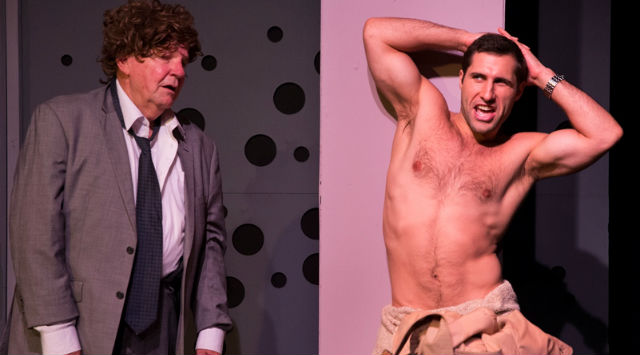
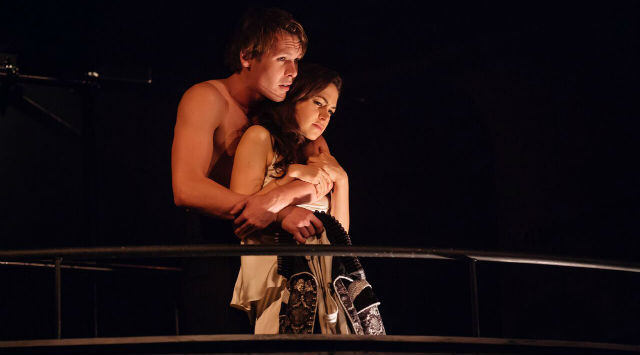
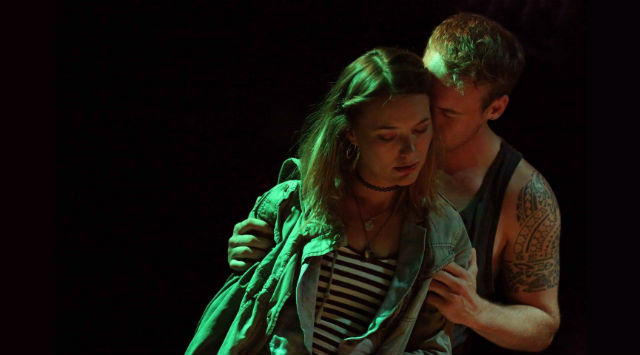
Youth is wasted on the young, but romance is best experienced at a tender age. Shakespeare’s Romeo And Juliet is the most romantic of stories, which by the same token, would mean that it is a play that can seem completely ludicrous to some. A pair of teenagers meet at a party, decide to get married hours later and over the next few days go through hell and high water to stop their families from prying them apart. Human attraction and the sexual impulse are often mysterious, but instantly recognisable when present. In Peter Evans’ iteration, we see an abundance of sophistication and polish, but chemistry is in scarcity.

The production’s first half sees several energetic performers providing effective comedy and lively interaction. Notable supporting players include Michelle Doake and Damien Strouthos who delight with flamboyant theatrics that help us engage with nuances of the plot, while delivering surprising swells of laughter. Stars of the show Kelly Paterniti and Alex Williams bring passion to the narrative, but we are never quite convinced enough about the relationship to invest our emotion into their dilemma. In the tragic second half, an unravelling seems to occur, and we become even less involved in the lovers’ plight despite their catastrophic fate. Kelly Ryall does marvellous work with music, and even though wonderfully executed throughout, does not help the concluding melodrama take flight, and the greatest of love stories leaves us cold.

Juliet and Romeo are in love with strangers. Like many things in life, their connection defies logic but are indisputably real. Something magical happens between the two, but we are not privy to it. They are overwhelmed and moved to extremes, while we observe with slight curiosity, wondering how it is that innocent love can fade without warning. Time does strange things to people, but we must be there to witness its power. Our protagonists have seen little, but we can find solace in the fact that they had only ever experienced purity, if nothing much else.

www.bellshakespeare.com.au

Review: Little Shop Of Horrors (Luckiest Productions / Tinderbox Productions)

Venue: Hayes Theatre Co (Potts Point NSW), Feb 18 – Mar 19, 2016
Book & Lyrics: Howard Ashman
Music: Alan Menken
Director: Dean Bryant
Choreography: Andrew Hallsworth
Musical Direction: Andrew Worboys
Cast: Angelique Cassimatis, Tyler Coppin, Esther Hannaford, Brent Hill, Scott Johnson, Dash Kruck, Josie Lane, Kuki Tipoki, Chloe Zuel
Images by Jeff Busby

Theatre review
When Roger Corman’s original film of Little Shop Of Horrors appeared in 1960, it was seen mainly as a science fiction comedy about aliens from outer space invading planet earth, a popular genre believed to represent the USA’s anxieties about the spread of communism in the middle of the twentieth century. By the time of its evolution into an off-Broadway musical in 1982, and the many subsequent revivals, Little Shop Of Horrors had taken on greater poignancy. It is now ironically a story about the horrors of capitalism, and the insatiable voracity of money. Seymour’s sacrifices for fame and fortune begin cautiously but they are soon beyond his control, and Audrey II literally takes on a life of its own to usurp much more than Seymour had ever intended. It is debatable if economies anywhere were ever as innocent in purpose as our protagonist, but Audrey II is a clear and unexaggerated parallel for the seemingly incessant threats of financial crises that we are warned about in the daily news.

Dean Bryant’s vision for this 2016 staging is wildly imagined and beautifully realised. There is great sophistication to be found alongside his exuberant showmanship, offering a night of sensational entertainment, the quality of which is admittedly rare. Bryant’s boldness in attitude meets with the material’s unbridled extravagance for a production that enchants and excites. Although fundamentally a very dark tale, its theatrical executions here aim for a wide appeal, ensuring that musical enthusiasts and general audiences alike would be equally captivated. Aided by a phenomenal team of designers (most remarkably Owen Phillips’ set and puppetry by Erth Visual & Physical Inc), the show is a visual feast resulting from daring dreams and big ambitions that the intimate space has very clearly failed to hamper.

Thoughtful casting brings together a group of vivacious personalities who fire up the stage with vibrant humour and immense energy. There are bigger voices to be found in the industry for sure, but prioritising characterisations over technical ability pays off in spades. Brent Hill is an endearing Seymour, with a convincing purity that connects well with his audience. Leading lady Esther Hannaford’s comic timing is outstanding, and the Audrey that she manifests is a real and irresistible joy. It is a coupling that we cannot resist championing for, and that ensures the plot’s effectiveness from start to end. Supporting players Angelique Cassimatis, Tyler Coppin and Scott Johnson too, leave excellent impressions with brilliantly funny performances in their respective roles. It must be noted that sound designer Jeremy Silver’s achievements in finding the perfect sonic balance for the show is quite an accomplishment, helping the ensemble provide an engrossing and exhilarating experience that will prove to be unforgettable.

Revisiting classics is always a tricky exercise. Having to live up to standards set by two classic films and innumerable stage adaptations, is without a doubt a formidable task, but this version of Little Shop Of Horrors is quite possibly the best rendition that this generation can hope to see, and maybe for several years thereafter. It exceeds not just expectations, but also our fantasies of what the show could possibly look like before our own eyes. The artists have created a work of great spirit and surprising poignancy, and along with a good deal of wonderful singing and dancing, this is a show that will have you suddenly falling in love with musical theatre all over again.

www.hayestheatre.com.au

Review: The Ritz (New Theatre)

newtheatreVenue: New Theatre (Newtown NSW), Feb 16 – Mar 5, 2016
Playwright: Terrence McNally
Director: David Marshall-Martin
Cast: Les Asmussen, Meagan Caratti, Samuel Christopher, Jarryd Clancy, Ricci Costa, John Edwards, John Farndale, Lisa Franey, Ivan Hui, William Koutsoukis, Adam Kovarik, Rosane McNamara, Marty O’Neill, David Ross, James Smithers, Barton Williams
Photography © Bob Seary

Theatre review
It may be argued that there was only a small window of time in LGBT history, when stories were being published and told in theatres about vibrant queer experiences. The emergence of the gay rights movement alongside the sexual revolution of late 1960’s opened the doors to artistic expression that began to take queer lives out of the closet, but before much momentum was able to be achieved, the AIDS epidemic of the early 1980’s signalled the return of oppressive powers, and although LGBT stories continued to be produced, they were turned much darker to reflect the sombre times of death and community destruction.

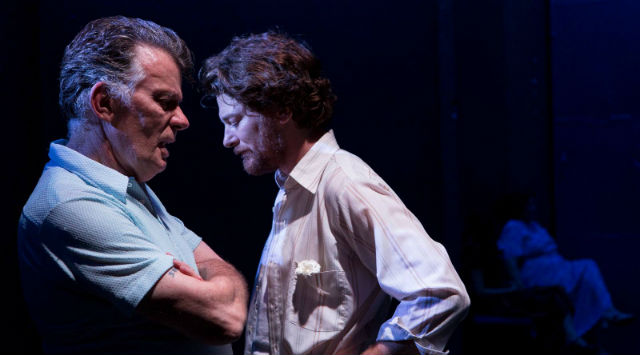
Terrence McNally’s The Ritz first appeared on Broadway in 1975, and although its protagonist Proclo is heterosexual, the action takes place in a gay bathhouse in Manhattan, with a host of vivacious gay men providing the core structure to its narrative, along with an endless stream of campy punchlines. Their proud and exuberant sexuality is its central appeal, in fact Proclo’s story is almost ancillary, existing only as an excuse for the rambunctious humour to unfold. The infamy of pre-AIDS bathhouse culture finds itself represented here in all its shame-free glory, in the form of a classic American farce (admittedly not to everyone’s tastes), complete with accents, stereotypes and show tunes.

Director David Marshall-Martin brings to the production a potent nostalgia that many will appreciate, and an energetic madcap style of comedy perfect for the script. The old-fashioned quality of the show takes some getting used to, but it does get increasingly charming through the course of the evening, aided by the bawdiness of the writing that Marshall-Martin is able to present with a surprising edginess, despite its use-by date.

Leading man Les Asmussen is an endearing and effervescent presence, with an ability to communicate and connect with his audience effortlessly. The actor’s strong instincts ensures that on-stage chemistry is consistently buoyant, and his generous nature as a performer keeps us engrossed. Similarly engaging is Samuel Christopher in the role of Chris, an extremely flamboyant character who has a joke ready for every situation. Christopher’s comedic skills are a highlight of the show, leaving a lasting impression with bold choices and immaculate timing. Also very funny is Meagan Caratti, who embraces the boisterous tone of the show to deliver some of its biggest laughs. Her passionate commitment is paralleled by an emotional warmth that allows her character Googie to become one of the more believable personalities in this outlandish presentation.

The style of The Ritz might not be innovative, but the portrayal of unbridled joy by its community of gay men is refreshing. We might be in a new century, but we remain burdened by the darkest days of AIDS and its indelible negative impact on sexual freedoms. The rampant sex and promiscuity of The Ritz was a result of emancipation that was meant to be celebratory. Its intention was to welcome a new era of equality and acceptance, but we now look at those behaviour as an archaic oddity. It is a vision of pride that we have lost, replaced by something less assertive, maybe even slightly ordinary.

www.newtheatre.org.au

Review: The Blind Giant Is Dancing (Belvoir St Theatre)

belvoirVenue: Belvoir St Theatre (Surry Hills NSW), Feb 13 – Mar 20, 2016
Playwright: Stephen Sewell
Director: Eamon Flack
Cast: Michael Denkha, Ivan Donato, Andrew Henry, Emma Jackson, Russell Kiefel, Genevieve Lemon, Geoff Morrell, Zahra Newman, Dan Spielman, Yael Stone, Ben Wood
Image by Brett Boardman

Theatre review
Stephen Sewell’s The Blind Giant Is Dancing premièred in 1983, long before the internet and social media had become a central part of how we understand and engage in politics. Armchair activism had yet to be discovered, and participation in our country’s big issues required more than clicks on neglected polls and petitions, or furious rants of 140 characters. If any action was to be taken, we had to put money where our mouths were, and the stakes were much higher than risking the closure of troll accounts on Twitter.

The play looks at how the working class was embroiled with trade unions and other organisations in a fight for protecting their rights, at a watershed period where capitalism’s subsumption of the economy was fiercely under way. We watch the moral descent of an idealist in Allen Fitzgerald as he climbs the ladders of power, observing the seemingly inevitable corruption that occurs as an individual finds their way into positions of power. It is a deeply pessimistic and cynical statement about the world that director Eamon Flack has successfully transposed to twenty-first century Australia. Industrial relations continue to be a key issue, and we are probably more aware than ever before, about the vulnerabilities of our democracy. The details in The Blind Giant Is Dancing might be outdated, but its concepts are resolutely relevant, and its ideology remains powerful.

With its zealous political dissections, aficionados would probably find the work irresistible, but there is much in the production that appeals to the layperson. Its central concern regarding tensions between the personal and the political, are fluently expressed, especially in scenes that move the plot into realms of the domestic. Allen’s personal life allows us to relate to his story more intimately, as he negotiates abstract principles and beliefs, against the real matter of daily life. The conflicts that arise from trying to put into being, imagined and utopian ideals for larger social contexts, prove to be problematic as we witness those precepts failing in the Fitzgerald household. It is his broken relationships with family and lovers that we empathise with, and the meanings behind that destruction, which are most poignant.

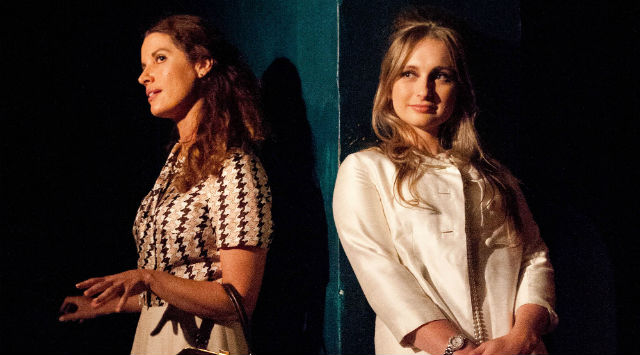
Dan Spielman is convincing as Allen, with a commanding stage presence that places him comfortably at the centre of all our attention. He connects well with the audience from the start, and we stay compelled until the bitter end. His portrayal of the complex role is intelligent, confident, and quite affecting. Although disappointing, we see his flaws and misjudgements as human, and Spielman’s honesty as a performer helps us realise the accuracy of the grim situation in which we find his character. The role of Louise is played by Yael Stone, sensitive and intricate, with excellent conviction behind the fiery personality being depicted. Louise is perhaps not as well-written a character as her male counterparts, but Stone’s ability to locate emotional authenticity assists with our all-important suspension of disbelief to make her narrative work.

This is a production of high quality, polished and consistently thoughtful. The cast does a marvellous job in creating a succession of explosive scenes that grips us for its entirety (the three-hour duration whizzes past), and the designers impress with adventurous and effective work. Sound design by Steve Toulmin in particular, provides an epic grandeur, recalling period drama pieces of a similar ilk that trace the familiarly ominous ascension of political figures.

The Blind Giant Is Dancing warns us of many things, but provides no solutions. The darkness of its revelations feel real and in spite of their grave severity, we are offered no recourse. What happens after the curtain call is anybody’s guess, and also a crucial estimation about the utility of theatre. The show interrogates all our personal lives, and after receiving its indictments, the process will continue in each individual beyond that evening of attendance. If an artist is unable to produce the answers, the best they can do is to ask the questions, boldly and fervently. What we wish to happen thereafter can only then be, a question of hope.

www.belvoir.com.au

Review: The Punter’s Siren (Blood Moon Theatre)

blancmangeVenue: Blood Moon Theatre (Potts Point NSW), Feb 17 – Mar 4, 2016
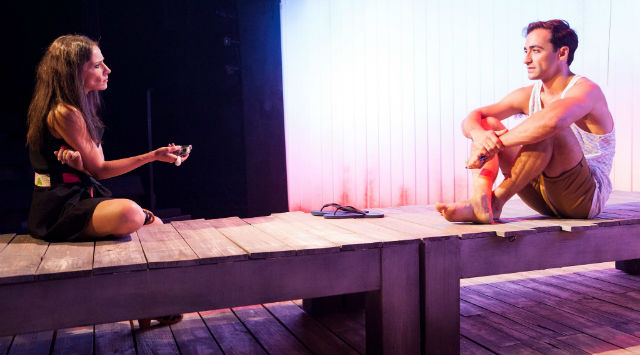
Playwright: Gina Schien
Director: Stephen Carnell
Cast: Jacqui Robson, Laura Viskovich
Image by Phyllis Wong

Theatre review
Originally conceived as a one-woman play, Gina Schien’s The Punter’s Siren is presented here with an additional actor giving life to the monologue’s secondary character. Instead of letting the protagonist evoke our imagination, the siren is literally materialised on stage by Laura Viskovich, who although says little, is a formidable presence. This creative touch by director Stephen Carnell represents a meaningful gesture that gives power to the play’s sexuality, as though coming out of the closet, its homosexuality lies not only in words, it is irrefutably in existence.

Jacqui Robson’s 50 minutes on stage as Helen, the punter, is scintillating. There are moments where our attention struggles to find focus with an ancillary actor by her side, but her energetic precision never fails to keep us on track with her narrative, engrossed and atingle with excitement. Robson delivers moment after moment of splendid comedy, ranging from subtle impulses that take us by surprise, to loud displays of humorous passion. Her tenacity is relentless, and although the ride she takes us on is ultimately a predictable one, it is full of amusement and exhilarating joy.

The sole driving force of Helen’s story is lust. In Schien’s play, a woman’s libido takes centre stage and its temperament is an aggressive one. Undisguised, unadorned and unashamed, it is her wild desire that gives propulsion to every action in The Punter’s Siren, forcing us to confront the anomaly of its honesty, and we are left wondering what it is about our culture that insists on keeping the universal and everyday truth about strong feminine sexuality, veiled and concealed. Immodesty is star of the show and we are thrilled.

www.facebook.com/bloodmoontheatre

Review: Ladies Day (Griffin Theatre Company)

griffinVenue: SBW Stables Theatre (Kings Cross NSW), Feb 5 – Mar 26, 2016
Playwright: Alana Valentine
Director: Darren Yap
Cast: Matthew Backer, Wade Briggs, Lucia Mastrantone, Elan Zavelsky
Image by Brett Boardman

Theatre review
It is not a promising start to the play. There is a lot of old-fashioned talk about “how gays have different lives from straights”, “how many shades of gay are there”, and “look, there’s a gay man enjoying himself in a dress in a country town”. We are reminded that Priscilla happened 22 years ago and that things have thankfully moved on a considerable amount. Alana Valentine’s Ladies Day does however, take a turn for the better when its central concern begins to take shape. Sexual assault is a tricky subject for art because it can seem to lack complexity, and making work about the topic can often feel somewhat obvious, as if preaching to the choir, but Valentine’s script finds surprising nuance, and provides new insight to help us gain a deeper understanding of the victim’s experience. The structure of the play can be further refined, but there are strong elements to be found. For every scene that feels excessively derivative, we discover riveting moments in later sections where its superficial conceits are shed to reveal the devastating honesty that lies beneath.

Darren Yap’s direction gives the production an enjoyable texture with sensitive and regular transformations in atmosphere, and its amplified emotions make for a compelling dynamic range that keeps us attentive. Sound and music by Max Lambert and Roger Lock add great drama to the piece, and quirky interludes of song give the show its character. All four actors contribute powerful performances, with Lucia Mastrantone’s incredible vulnerability leaving the greatest impression. Through her depiction of suffering, we observe that it is often the strength that emerges from pain that is truly moving. Mastrantone is passionate, articulate but also subtle, elevating her relatively simple roles into something altogether more substantial. Similarly compelling is Elan Zavelsky as the sad and bitter Rodney, with a quiet intensity and meaningful introspection that keeps us captivated. Strangely miscast as a man past his prime, the clearly attractive and youthful Zavelsky’s depiction of desperation is nevertheless committed and very accurate.

It might not be very elegant at Ladies Day, but its concluding moral is a surprising, sobering one. At the theatre, we tell the truth through fabrications because our minds can prefer them over facts. We are receptive to stories if they are told well, regardless of how veracities are achieved. From the storyteller perspective too, it is often through analogy and metaphor that truths can be better portrayed, especially when actualities evade expression. Facts are hard to capture, but our humanity can hear the truth ringing no matter what guise it takes.

www.griffintheatre.com.au

Review: Alpha (Old Fitzroy Theatre)

oldfitzVenue: Old Fitzroy Theatre (Woolloomooloo NSW), Feb 9 – 20, 2016
Created and performed by: Tamara Natt, Sebastian Robinson
Director: Sebastian Robinson

Theatre review
Tamara Natt and Sebastian Robinson meet in Alpha, a juncture at which poetry and physical theatre are combined to explore two queer identities and their place in the world. Along with the electric guitar and vocal accompaniment of Milla O’Sullivan, rhymes and rhythm are the key currency of the piece. Natt and Robinson’s bodies and voices fill the stage to connect with dormant sensibilities of the audience, making us look and hear with parts of our selves seldom employed, to discover the alternatives of our parochial existence, and to look beyond the fences we erect.

Natt and Robinson alternate between vulnerable and defensive in what they choose to present. We are drawn in and pushed away, as the piece fluctuates between impenetrability and its desire to excite. Gender and sexuality are often brought into discussion, with the subversion of female/male and gay/straight binaries taking centre stage. It offers new things as well as concepts that might be described as derivative, but it comes as no surprise that tried and tested elements should feel more effective. Like any work that rejects narrative, Alpha can be challenging to the more logical inclinations of our minds, but both performers are charismatic and spirited, with a tenacious grit that keeps us seduced.

We are not used to shows of this type, because we only allow poetry to be a cursory presence in our lives. We can make sense of it, but we prefer meanings pre-packaged and ready-made for our cultural consumption. We want to remain idle in audienceship, and leave creativity to the artists, but this distinction can be disrupted when artists find courage to prioritise their authenticity over the need to accommodate conventions. In Alpha, investment of the self is required for any significant interpretation to occur, and it is the installation of a universal I as first person that gives it purpose.

www.oldfitztheatre.com

Review: The Girlie Show (Tunks Productions / The Old 505 Theatre)

tunksVenue: The Old 505 Theatre (Newtown NSW), Feb 18 – 22, 2014
Playwright: Wayne Tunks
Director: Wayne Tunks
Cast: Campbell Briggs, Thomas G Burt, Adam Carr, Mat Glessing, Prudence Holloway, Chantel Leseberg, Jack Marsden, Jacinta Moses, Tasha O’Brien, Billie Scott, Wayne Tunks
Image by Isobel Markus-Dunworth

Theatre review
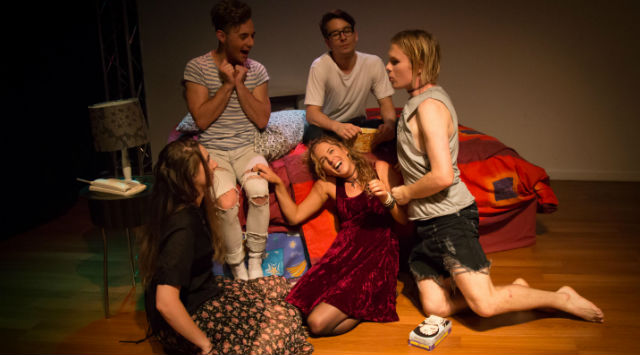
The play takes place in the early 90’s, following the coming-of-age stories of five young Sydneysiders. It all begins when they meet at the front of a queue for tickets to a Madonna concert, and united by their common passion for the pop star, the group becomes fast friends. We then trace each individual’s growth in the few months leading up to the event, and witness them overcoming challenges, supported by the new-found friendships, and the strength of character inspired by their fearless leader (the “creamy smooth pop icon goddess”, Madonna). This sounds tongue-in-cheek, but Wayne Tunks’ The Girlie Show is an earnest tribute with a somewhat middle-of-the-road approach; not cool enough, but not cheesey enough either. Its familiar narratives feel authentic, and although put together with little sophistication, the production’s honest sentimentality does provide moments of poignancy.

The show is kept buoyant by strong performances from the likes of Billie Scott, energetic but with a dorky style of humour that works well within its context of zealous fandom. Along with effective comic timing, Scott’s ability to portray genuine emotionality brings a charming pathos to some of the more melodramatic scenes. Also memorable is Jacinta Moses in a range of maternal roles, simultaneously sensitive and strong, Moses is powerful in her scenes, showcasing excellent conviction and versatility.

Most of the play is about the gay and lesbian coming out experience, and harks back to a time when stories of this nature were prevalent and indeed, all the rage. The Girlie Show takes on that tradition, and even though it does not extend beyond the predictable scope of the genre, there is little doubt that there remains a need for these narratives to be made. In looking back at our youth, we can find the purity that is perhaps lost from today, and it is that purity that must be recalled in order that we may live in compassion, if we allow it to thaw out what was scared and cold.

www.tunks.com.au

Review: Arcadia (Sydney Theatre Company)

stcVenue: Sydney Opera House (Sydney NSW), Feb 8 – Apr 2, 2016
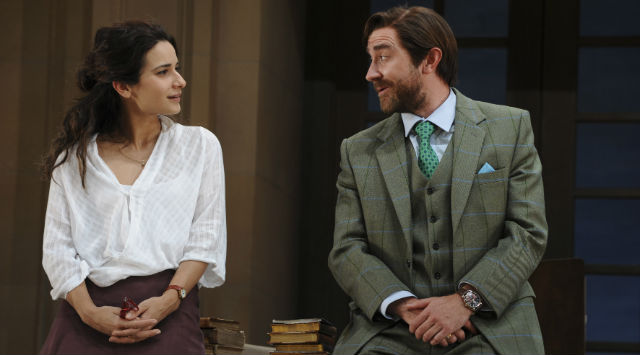
Playwright: Tom Stoppard
Director: Richard Cottrell
Cast: Blazey Best, Ryan Corr, Honey Debelle, Andrea Demetriades, Jonathan Elsom, Georgia Flood, Julian Garner, Glenn Hazeldine, Josh McConville, Will McDonald, Michael Sheasby, Justin Smith
Image by Heidrun Löhr

Theatre review
Strong societies encourage each of their individuals to reach the greatest of their potential. Geniuses do not exist in vacuums; even though the uniqueness of their abilities easily becomes a source of isolation or detachment, they are part of communities that need to recognise the exceptional advantages they bring to the progress of our civilisations. In theatre, a conundrum exists with writers like Tom Stoppard. To produce a play such as his Arcadia, a team of highly accomplished talents must be employed in order that the density of his writing gets the best chance of finding elucidation, but that would necessitate considerable box office takings (at a time when government funding for the arts continues to plummet). Bringing Arcadia to the masses is a strange proposition. We are used to mindless sentimental tosh drawing in the crowds, but getting throngs into the Sydney Opera House for a night of intense intellectual exchange is, to put it mildly, ambitious.

Many will appreciate director Richard Cottrell’s sophisticated and vibrant take on the text, but there will be no shortage of viewers finding themselves entirely befuddled for its three-hour duration. The play is about mathematics, chaos theory, the second law of thermodynamics and English landscape gardens in the early 19th century, quite a different set of interests from what we encounter in Australia’s everyday media. Perhaps this is an indication that the public is actually capable of ingesting more than sporting scandals and partisan politics, but more realistically, this is a case of either seriously overestimating our cultural climate, or a very daring effort at lifting our game.

Art must challenge, but when it does, it often alienates. Cottrell’s show is energetic and seductive. Its jaunty rhythm and charismatic personalities are engaging but whether they make Stoppard’s subject matter enticing, is debatable. We are impressed by the passion depicted on stage. Some audiences might be able to get involved with the idiosyncratic obsessions of Arcadia‘s characters, but more are likely to be swept along by the cast’s incontrovertible thespian devotion.

Key roles are marvellously performed with an infectious glee that for the most part, keep us within the action of the play. Andrea Demetriades is sensational as Hannah Jarvis, completely convincing and natural in her approach, and irresistibly compelling. What she presents is a model for the kind of acting that forbids the detection of any divergence between actor and character. Her conflation of the two seems effortless, yet there is no denying the theatricality that allows her to communicate intentions and emotions with brilliant clarity. Similarly delightful is Josh McConville as Bernard Nightingale, deliciously pompous and shrewdly sardonic, playing the role as an effective archetype but with a solid authenticity to keep us convinced and endeared.

Stoppard and his characters strive for a mastery of their domains. They locate and identify pieces to puzzles that will form a finished and satisfying picture to intellectual pursuits that inevitably become more complex as processes develop. Watching Arcadia asks of us that same commitment of attention and effort. It is not easy-going for the vast majority, but we can certainly jump back into the action whenever we find ourselves in moments of confusion, to continue on that chase for meaning. As a contender in the popularity contest that is the live theatre industry, this show is unlikely to be a crowd favourite, but as inhabitants of this city, we must hold deep gratitude that programming of this calibre exists, and is available to more than the privileged few.

www.sydneytheatre.com.au

Review: Year Of The Family (Tooth And Sinew Theatre)

toothsinewVenue: Kings Cross Theatre Kings Cross NSW), Feb 10 – 20, 2016
Playwright: Anthony Neilson
Director: Richard Hilliar
Cast: Peter-William Jamieson, Brendan Miles, Brooke Ryan, Nicole Wineberg, David Woodland

Theatre review
Human sexuality is a fascinating subject. Each individual’s bedroom inclinations vary as widely as the way we eat our food. No two appetites are exactly the same, yet we think of sex as a universal experience, and its taboo nature means that we rarely discuss its nitty-gritty at depth, choosing instead to imagine simple paradigms that would apply to every person. In Anthony Neilson’s Year Of The Family, sex is anything but normative. Its characters indulge in secret intimacies, and as we observe the functioning of each libido, connections are made with the unfolding dysfunctions of their family lives. Neilson appropriates the theatrical quality of that relationship between family and sex for a text that is tragic, comedic, and many shades in between, to reveal the repercussions that can occur as a result of familial breakdowns. His writing is playful and dynamic, but also surprisingly delicate. It broaches difficult subjects, but refuses to be exploitative or sensationalist.

Richard Hilliar’s powerful direction brings intensity to a staging that seeks to simultaneously entertain and provoke. There is an adventurous streak reflected in the clever use of space, especially in scene transitions (with the help of Liam O’Keefe’s very effective lighting design), along with a relentless and captivating energy to his creation that makes for compelling viewing. Hilliar’s sensitivity to dramatic tension is the production’s greatest strength, and the results are very satisfying indeed.

The cast is uniformly lively and focussed, but some roles are interpreted with more resonance than others. Brendan Miles provides intrigue and an appropriate restraint to the mysterious Henry. It is an understated, and literally quiet, performance that offers a counterpoint to the other larger than life parts, but Miles leaves a strong impression with the presence and precision he brings to the stage. As the manic Felicity, Nicole Wineberg is responsible for the more euphoric portions of the show. The actor presents a wildness that alternates between comical and terrifying, and provides the production with its delightful yet volatile spirit, but the role could benefit from greater emotional complexity.

The people in the play are troubled. They are trapped in heartache, unable to be released from the past. They form their own re-enactments of broken histories in cathartic attempts to move forward, but are as yet unsuccessful. Nevertheless they continue to strive, even if wallowing is part of the process. It is fact that we do not choose our families, but debatable whether we can be free of them. There is little happiness in Year Of The Family, but it is us who must decide where and how the matter of choice figures in their respective narratives, and then in our own lives, reflect on the ways we are entrapped, voluntarily or otherwise.

www.toothandsinew.com