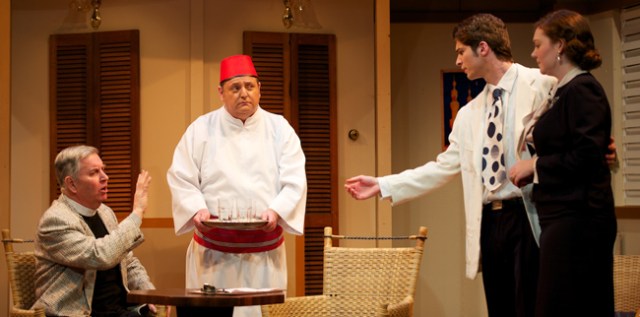
Murder On The Nile (The Genesian Theatre)

murderonthenileVenue: The Genesian Theatre (Sydney NSW), Aug 25 – Oct 5, 2013
Playwright: Agatha Christie
Director: Nanette Frew
Actors: Michael Barnacoat, Lilianna Komljenovic, Lachlan McNabb, Martin Estridge, Ros Richards
Image by Mark Banks

Theatre review
The power of an Agatha Christie work lies in its intrigue and suspense. The way her tales unfold is eminently captivating and beloved by audiences across generations and continents. The Genesian Theatre’s production of Murder On The Nile tells a witty and compelling story set on a cruise liner in Egypt, with colourful characters that retain their appeal 76 years after inception.

Design elements are basic but charming. The set is evocative of 1930s art deco, and effectively conveys a sense of languid luxury that is romantically nostalgic. Lighting is simple but elegant, never drawing attention upon itself, but efficient in its servitude to the play.

The director and players are mindful that clarity is key in the performance of Christie’s murder mystery. While some actors appear slightly miscast, they are all able to communicate the plot perfectly, so that the drama and tension inherent in the play are actualised on stage to great effect. Michael Barnacoat plays Canon Pennyfather with good commitment and excellent diction, giving crucial lengthy speeches in a manner that is highly engaging. Martin Estridge and Ros Richards are crowd favourites, playing eccentric characters with great aplomb, dominating the funniest moments in the show.

The Genesian has always been reliable in delivering great entertainment, and Murder On The Nile is no exception. Some things never change, and this much loved theatre company is thankfully one of them.
www.genesiantheatre.com.au

Jerusalem (New Theatre)

New TheatreVenue: New Theatre (Newtown NSW), Aug 21 – Sep 14, 2013
Playwright: Jez Butterworth
Director: Helen Tonkin
Actors: Nicholas Eadie, Jeremy Waters, Peter Nettell, Emma Louise, Peter McAllum
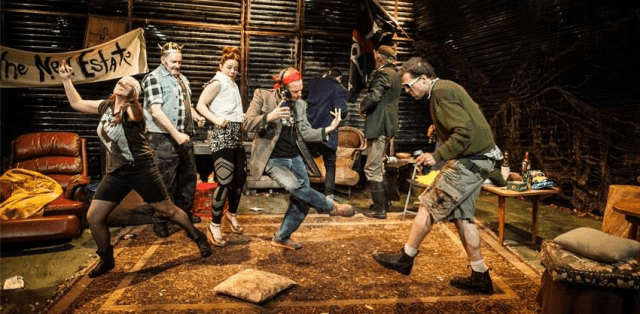
Image by Matthias Engesser

Theatre review
Upon entering the theatre, one is immediately struck by the power of the production design. Set design in particular is a highlight of this production. Tom Bannerman’s conversion of the stage into a dramatically evocative backdrop is absolutely essential to the storytelling. The creation of five different entrances is intelligent, and along with lighting, mood is established long before the first actor appears.

Nicholas Eadie is charismatic in the lead role. He brings variety to his performance, which provides entertainment and also creates a character that is multi-faceted and mysterious. He does however, have inconsistencies with the accent in his speech that could be distracting for some audiences. Jeremy Waters is a delightful actor, full of vigour and presence. He plays Ginger with great flair, equally confident with comic as well as dramatic moments. Peter Nettell is scarily convincing in his portrayal of Wesley. It is a very committed and genuine performance that leaves a lasting impression in spite of the part being a smaller one.

At the heart of Jerusalem is a tale about land rights and commercialism. It has interesting parallels with contemporary Australian issues involving our Aboriginal communities and how they are situated within the economy. This English play makes arguments about territorial ownership in relation to ancestry and money, and how these tensions manifest socially. If Butterworth’s ideas had been applied to a more localised context, their impact could have been even greater. Instead, the show is left intact and unmodified from its foreignness, which gives it an eccentric and exotic quality, but it demands more from the audience, as its cultural specificity is at times challenging and complicated.

www.newtheatre.org.au

Double Think (Force Majeure)

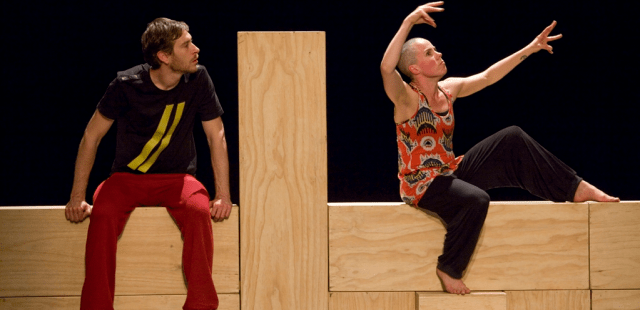
Double_Think_5104__bg.jpg  1024×683Venue: Reginald Theatre, Seymour Centre (Sydney NSW), Aug 21 – 24, 2013
Choreographer: Byron Perry
Music: Luke Smiles
Dancers: Kirstie McCracken, Lee Serle

Theatre review
In Force Majeure’s Double Think, the space of dance theatre is explored to its fullest extent and possibilities. The company pushes aggressively at the boundaries of dance and music, introducing concepts from all aspects to dismantle and to re-create a form of performance that is about dance, but not the way we know it. The use of inanimate objects and its relationship with light, for example, or the substitution of music for silence and speech, open up ways for the presentation of a kind of show that is not only fresh and unusual, but also seductive, communicative and intellectual. It is the ultimate application of talent and opportunity that one witnesses in this production.

Dancers Kirstie McCracken and Lee Serle are about a foot apart in height, but their symbiotic closeness delivers a sense of divinity and awe that gives their performance a feeling of sublime magic. Their ability to portray one being in two bodies, with unimaginable unison can only be a result of discipline, coloured by blood, sweat and tears. There are breathtaking sections where they display superhuman memory with the most intricate and lengthy choreography, astonishing their audience with the seemingly infinite capacities of their bodies and minds. It is noteworthy also, that both, but especially Serle, have the ability to reach out and connect with a crowd like true entertainers, rather than lofty professional dancers who tend to be more detached in their approach.

Production values are very accomplished, and thoroughly enjoyable. Lighting design is crucial in physical theatre, and Benjamin Cisterne’s work here is a triumph. The final sequence in which the dancers move very quickly in very dim light creating images that the eyes perceive but the brain fails to comprehend, is probably going to be an effect copied by many in the future. Choreographer Byron Perry has his fingerprints all over this creation. Nothing has escaped his attention, and we are beneficiary of his wonderful vision.

www.forcemajeure.com.au

A Feat Incomplete (Old 505 Theatre)

afeatincomplete1Venue: Old 505 Theatre (Surry Hills NSW), Aug 21 – 25, 2013
Playwright: Erica J Brennan, David Buckley
Actors: Erica J Brennan, David Buckley

Theatre review
This is an honest and simple work that meditates on the nature of theatre creation. It deconstructs both form and content to get to the core of what it means to make a work for the theatre. It is the process of stripping down, rather than building up, that characterises this piece.

The run time is fairly short, which keeps the delivery of ideas sharp and fresh, and thankfully prevents things from being too drawn out and self indulgent, which is a fate that tends to befall many experimental theatre practitioners. There is however, a lack of elegance in the visual elements of the production. Aside from Brennan’s red eyes and horns, and Buckley’s nudity, more work could have been put into the execution of design aspects.

Attention is placed instead on the relationship between author and muse, resulting in charming sequences that explore love and intimacy, as well as the mystical space between “dreaming and death”. The artists also deal with the notion of “story” and the tension that exists in relation to narrative structures and lack thereof, in the creation of their art. A Feat Incomplete is brave in its conscious resistance against conventions of storytelling. This is a risky undertaking that can easily lead to an overly alienating experience, but both artists give performances that fascinate and intrigue.

www.venue505.com/theatre

The Merchant Of Venice (Sydney Shakespeare Company)

Sydney Shakespeare CompanyVenue: TAP Gallery (Darlinghurst NSW), Aug 7 – 24, 2013
Playwright: William Shakespeare
Director: Steven Hopley
Actors: Mark Lee, Lizzie Schebesta, Anthony Campanella, Alex Nicholas
Image by Rob Studdert

Theatre review
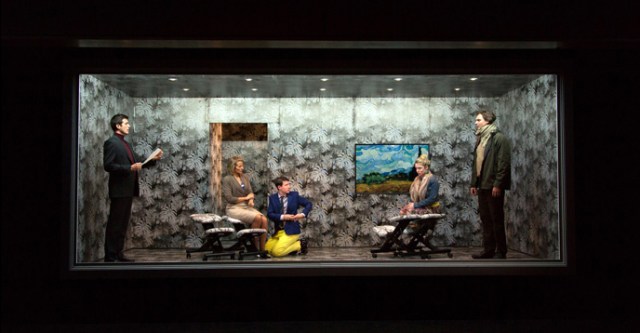
In the modern age of advanced technology and new media, our attention spans continue to diminish at alarming rates. The prospect of sitting through any film or play that runs over 90 minutes can spell torture, but director Steven Hopley’s production makes three hours shrink into just a few blinks of an eye. It is true that time flies when you’re having fun. The Merchant Of Venice is mostly a comedy, and the cast makes full use of comic opportunities, unafraid to explore with silliness and to play for laughs. It can be argued that some of the players are engaged mainly for their ability to make us laugh, and this a decision we are grateful for.

The stand-out actors however, are the ones who excel with the drama they bring to the show. Mark Lee is by far the most accomplished of the group, and is enthralling as Shylock. Lee’s level of focus and conviction in his role brings a level of dignity to the “problematic villain” created by Shakespeare 4 centuries ago. This is an intense and disciplined performance that lifts the entire production, giving it a surprisingly polished gleam. Lizzie Schebesta brings youth and gravitas simultaneously, providing credibility to the otherwise frivolous central love story. Her strong presence holds its own within the male-dominated group, and her Portia impresses as an unexpected feminist figure (as much as the Shakespearean text could allow). Anthony Campanella plays the secondary role of Antonio, but he impresses from the start with excellent command of his lines, somehow able to make every word ring with clarity and truth.

Antonio however, has an awkward relationship with Portia’s fiancé Bassanio, The closeness of these characters is overplayed with a palpable sexual chemistry. This does not lend to the overall balance of the play, especially at its conclusion where all’s well that ends well and Bassanio and Portia are overjoyed at being together at last, with Antonio forgotten in the background. Another matter of disquiet is the handling of the anti-semitic nature of Shakespeare’s work. This production is faithful to its original vision, which does not sit well with contemporary Australian audiences and is a genuine quandary. This issue lingers on after the play has concluded, and one is left with quite shocking ideas of racial prejudice to ponder over, which of course, is never a bad thing.

www.sydneyshakespearecompany.com

Freud’s Last Session (Strange Duck Productions)

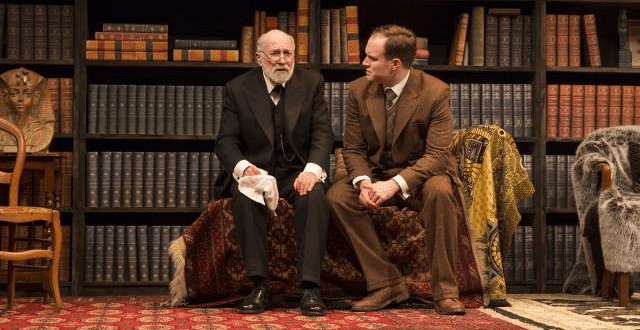
freudVenue: Theatre Royal (Sydney NSW), Aug 14 – Sep 1, 2013
Playwright: Mark St. Germain
Director: Adam Cook
Actors: Henri Szeps, Douglas Hansell

Theatre review
Theatre Royal is one of Sydney’s more beautiful theatres, usually showcasing large scale theatrical and musical productions due to its stage size and audience capacity. With just two actors and no scenic changes, Freud’s Last Session comes to Royal with extraordinary confidence. Mark Thompson’s set design is elegant, charming and effective, carefully carving out a perfectly sized performance space out of a very vast stage. It is, however, unfortunate that less attention is paid to acoustics resulting in poor volume levels for seats further back. The actors do not appear to be assisted by microphones, which is peculiar and fairly disappointing.

Henri Szeps is endearing as Sigmund Freud in his final days. His outlandish and controversial statements are presented with conviction and humour by Szeps, who presents to the audience a Freud who is unexpectedly affable. His masterful physical depiction of a feisty old man suffering from cancer is a joyful vision of experience and skill. Douglas Hansell is meticulous and detailed in his portrayal of C.S. Lewis. He delivers to the audience a sense of what London must have been like in the 1930s. Through his performance, we experience a time and place that is at once amusing and magical. The actors work well together, with a comfortable chemistry and excellent timing as a result of thorough familiarity with the material.

This is not a play with hugely dramatic moments that manipulates your emotions but its themes of religion and death are eternally fascinating, and they are dealt with with maturity, creativity and intellect. The characters see themselves as polar opposites, an atheist and a Christian, and argue engagingly about the differences in their belief systems and moralities. The play appeals to our human need to understand the afterlife and to question the existence of God, and it addresses the constant tension that resides between every point of view. Its conclusion is surprisingly universal and strangely satisfying.

www.freudslastsession.com.au

Delectable Shelter (Critical Stages/The Hayloft Project)

delectableVenue: Reginald Theatre, Seymour Centre (Sydney NSW), Aug 13 – 17, 2013
Playwright: Benedict Hardie
Director: Benedict Hardie
Actors: Andrew Broadbent, Brendan Hawke, Jolyon James, Simone Page Jones, Yesse Spence
Image by Pia Johnson

Theatre review
There are certain kinds of comedy that only appear in the theatre. They require an intimate space, and the immediacy of a live audience. Television and cinema do not generally provide the same experience, and in Australia especially, dark humour resides away from mainstream media, which continues to proliferate its benignity in service of financial voracity.

Delectable Shelter brings absurdity, big laughs and excellent entertainment to the stage, with outrageous “adult concepts”, gleeful “shock tactics”, and the most thorough use of irony imaginable. With the possible exception of one moment where two characters are locked in embrace, the play is filled with so much humour and social criticism that no space is left for sentimentality and romance. This prevents the show from appealing to wider audiences, but here is a unique and dynamic production that features wonderfully skilful  work from writer and director Benedict Hardie, who obviously isn’t concerned with catering to the masses. His Molieresque attacks on religion and the bourgeoisie are delivered with considerable wit in the form of imaginative, incisive commentary that cut with depth and precision.

Hardie’s cast is a formidable one. Not only are they required to work with quite extreme comic material, they mark out scene changes by performing four 1980s ballads in the style of classical Bach chorales, complete with hymnal harmonies. Simone Page Jones has an outstanding singing voice and the face of an angel but surprises with her eagerness at tackling the wackiest characters, like the body-builder who attempts to provide therapy to agoraphobics, and a religious leader of the Albatross cult who exhibits the most outstanding features of today’s religious leaders. Yesse Spence is painfully delicious as Biddy, a stereotype of the uptight upper-middle class white woman who will cross her legs at all costs, but needs to be reminded to breathe. Jolyon James impresses with his comic timing and range, creating innumerable colourful characters, all distinct and all hilarious.

This is a truly funny show propelled by some very talented people and an anarchic spirit. It anthropologises aspects of modern Australian life without providing a direct political statement, although it might be construed that laughter (and a reminder to breathe) is the best medicine for the predicament that we are only now starting to realise that we are in.

www.hayloftproject.com
www.criticalstages.com.au
www.seymourcentre.com

Rosencrantz And Guildenstern Are Dead (Sydney Theatre Company)

art-hamlet-202-620x349[1]Venue: Sydney Theatre at Walsh Bay (Sydney NSW), Aug 6 – Sep 14, 2013
Playwright: Tom Stoppard
Director: Simon Phillips
Actors: Tim Minchin, Toby Schmitz, Ewen Leslie

Theatre review
Tom Stoppard’s 1966 work is embraced by many for its extraordinary wit and intellect. Sydney Theatre Company attracts vasts numbers of audiences, and it is a brave choice to present this play that many a lay person will find too wordy, philosophical, and abstract. Big chunks of text and their associated big ideas are delivered successively and quickly, and it is a challenging experience trying to keep up with every concept being discussed. However, like many great works of art, it is not only what you understand, but also what you don’t understand that makes the consumption of it necessary and worthwhile. Art inspires and elevates, even while it confuses.

From a technical perspective, the company continues to impress. Design elements are faultless, and execution of sound and lighting are perfectly honed to a fine craft. The theatre seats 900 people but it never feels too vast, even for a show like this where majority of the action involves just two actors. Performances are excellent, with Tim Minchin’s uncanny ability to blur the line between actor and role consistently outshining his counterparts. He seems so completely natural on stage, one can hardly imagine a different “real person” existing separately when the show is over. Ewen Leslie is the real showman in this production. He creates a mischievous character, infectious in his playfulness, and setting the stage alight at every entrance. After Cat On A Hot Tin Roof with Belvoir St Theatre, and the Tony Krawitz film, Dead Europe, it is thrilling to see Leslie’s departure from dark and broody roles to one that is full of vigour and hilarity.

Rosencrantz and Guildenstern Are Dead can be considered highbrow, but it’s central theme of “life and death” is universal. Playing with words, theatrical mechanisms, philosophical theories will not appeal to all, but we can relate to the existential conundrum that is the one constant in our lives. It is infinitely more satisfying to watch Rosencrantz and Guildenstern wrestling with the meaning of life, than for one to be engaged in endless self-examination. With any luck, you might even encounter ideas that could provide some level of enlightenment and make that arduous process, sometimes known as life, a bit more bearable.

www.sydneytheatre.com.au

Friday (Sydney Independent Theatre Company)

friday2Venue: Old Fitzroy Theatre (Woolloomooloo NSW), Aug 6 – 31, 2013
Playwright: Daniela Giorgi
Director: Julie Baz
Actors: Peter Hayes, Gemma Scoble, Gertraud Ingeborg, Cherilyn Price, David Ritchie, Sarah Robinson

Theatre review
Daniela Giorgi’s political satire has an unambiguous message. In its prologue and epilogue, the play talks about the importance of active participation being the only means to effect change in politics and in life. This all sounds very dry and serious, but thankfully, the play’s structure is exuberantly quick and sharp, with succinct scenes that get straight to the point. It has a gentle sense of humour that keeps the proceedings light and entertaining, but this same lightness does seem to prevent a couple of heavier scenes from taking flight emotionally.

Peter Hayes’ performance is strong as the lead character Bill, a well-meaning and left-leaning Minister for Transport with a penchant for colourful language. His depiction of a gentle giant in government is endearing and central to the empathetic effectiveness of the narrative. Cherilyn Price is eminently believable as a well worn public servant, and provides some of the most genuine and lively moments. There are good performances from other members of the cast, but many suffer from playing their roles too plainly, resulting in two-dimensional, archetypal versions of “people in government”, “media types”, or “tourists” that on occasion fail to translate with much credibility.

There are lots of characters and many different ideas, but they all add to the tale, with none allowed to slow down the pace. The story is told with crystal clarity in spite of all the frantic action, and it is to the credit of both writer and director, that the audience is always connected to the plot. Colourful and delightful diversions are introduced throughout the play, entering and exiting seamlessly. It is noteworthy that spacial and psychological transitions that happen between scene changes are established with great flair. Friday might not hold the key to the great political challenges of our times, but it does showcase those challenges well, and presents them in the guise of a great night at the theatre.

www.sitco.net.au

Underbelly Arts Festival (Underbelly Arts)

tableauvivantVenue: Cockatoo Island (Cockatoo Island NSW), Aug 3 – 4, 2013
Executive Director: Jain Moralee
Artistic Director: Eliza Sarlos

Festival review
This is the second festival by Underbelly Arts on Cockatoo Island. Something like 30 works, with over 100 artists, presented over 2 days in a series of warehouse-like spaces of varying sizes. While a printed guide helps with navigation, it is the stumbling around and feeling lost amidst a world of art that is the most charming feature of this festival experience. An infectious sense of daring and freedom is at every corner you turn, where yet another confounding work awaits your attention.

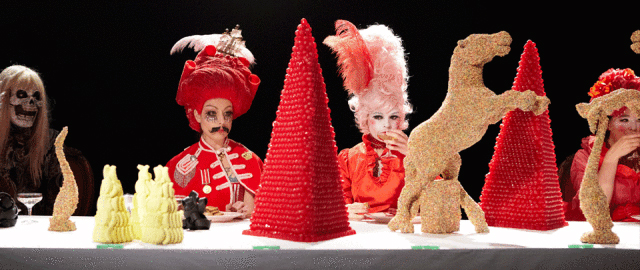
Many of the “projects” incorporate a performative element, which involve periodic start times (such as Tableau Vivant by Penelope Benton and Alexandra Chapman, pictured above), but unless one is highly organised and determined, it is more likely to simply enter the action randomly at varying stages of progress. This isn’t a concern as none of the work seem to depend on conventional narrative, although they often do make you think, “what did I miss?”

One unusual case is “I Met You in a City That Isn’t on the Map” by Sydney collective, we do not unhappen. The work has a definite start and end point, but it allows for entry through the day, much like a theme-park ride. Participants choose one of four different experiences and are provided simple instructions before entering what appears to be an apocalyptic world. From what can be perceived among all the chaos, depending on your chosen journey, people are required to be demolishing buildings (made of cardboard boxes), renovating the city, guiding a blindfolded friend through all the convolution, or simply walking through with headphones that provide calming new-age type music. At exit point, yellow chalk in miniature human form are handed out, and their fates become entirely dependent on their possessor. With its level of viewer engagement and ambition, this work was a definite highlight of the festival.

“Virtual Reality” by Greg Pritchard and The Ronalds explores reality tv, digital communication and technological evolution with a simple installation that allows viewers to communicate with the four people appearing on individual screens, presumably away from the island. An interesting aspect of this project is the involvement of artists who reside in regional locales, and their ability to present their work in any city with the omnipresence of the internet. “Nothing to See Here” by Catherine Ryan and Amy Spiers, works with technology playfully to wipe out the Sydney Harbour Bridge from view, conjuring ideas of migration and ancestry in Australia.

A one-hour debate was held, “Debate: Love vs Art” with proponents on each side arguing the case for each. They work humorously and brightly on separating the two and then pushing the case for their side, but it gets gradually clearer over the duration, that indeed the two are one, and neither can stand alone. It is both expression of love (or art), and experience of art (or love) that “makes the world go round”, giving us energy for life. It is a “chicken or egg” question, but luckily the universe delivers cake and lets you eat it too.

www.underbellyarts.com.au