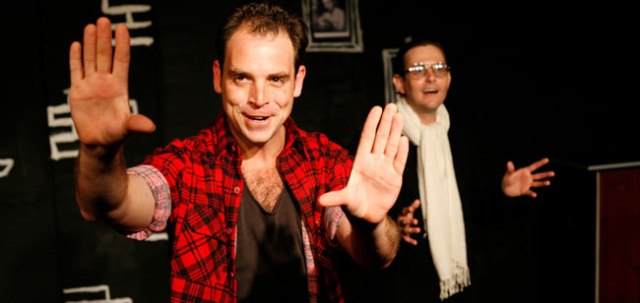
A Sign Of The Times (The Follies Company)

signofthetimesVenue: NIDA Parade Theatres (Kensington NSW), Sep 11 – 21, 2013
Playwright: Stephen Helper
Director: Stephen Helper
Actors: Scott Irwin

Theatre review (of preview performance, Sep 11)
One does not go to the theatre expecting the earth to move or a spiritual experience to take place, but a hope always exists in approaching the unknown darkness of a pre-show stage, that just maybe, tonight is going to be special. If once upon a time, you had seen an artist’s work that had overcome you and instilled a life long love for the arts, an unconscious yearning exists for that moment to recur. A Sign Of The Times is not perfect, but it is a play that can shake you to your core.

Like all great works of art, Stephen Helper’s script is about life. It is also about depression, and the obstacles we face that are so challenging that they stop us in our tracks and seem to be completely insurmountable. At these moments of stagnation, the mind goes into overdrive, and this is where the play starts. It features a lone character, performed by Scott Irwin , who delves into every cerebral space with themes like love, literature, poetry, mathematics, science, history, and a whole lot of philosophy. Irwin is perfectly cast as a man overflowing with palpable sadness. This is not a quality that he acts out explicitly but something that seems to manifest in his very being. Irwin’s performance is thoughtful and mature, and we benefit from him taking time with all his lines, many of which are dense and intellectual. He plays the character with tremendous, authentic and heavy emotion, but always careful to pay reverence to Helper’s words.

Helper’s direction is adventurous and dynamic. In contrast to the stasis of life in the play, Helper is effective at varying stage action to prevent anything from turning too severe or dull.  Lighting and sound together, play an important part of the story, and both are very accomplished indeed. Moments of silence are also introduced with powerful effect, and it is in those moments that the character is at his most vulnerable and the theatre feels most intimate.

A Sign Of The Times isn’t always an easy ride, but the journey into excavating the fundamental truths of life cannot be. There is a depth in Helper and Irwin’s work that is rare and incredibly moving. We understand that devastation and salvation make for good drama, but it is the way they portray these experiences, with dignity, bravery and truth, that has created something that shines bright, and eternal, like a diamond.
www.facebook.com/TheFolliesCompany

Happy As Larry (Shaun Parker & Company)

happyaslarryVenue: Everest Theatre, Seymour Centre (Sydney NSW), Sep 10 – 14, 2013
Director & Choreographer: Shaun Parker
Music: Nick Wales, Bree van Reyk
Dancers: Timothy Ohl, Josh Mu, Marnie Palomares, Jana Castillo, Joshua Thomson

Theatre review
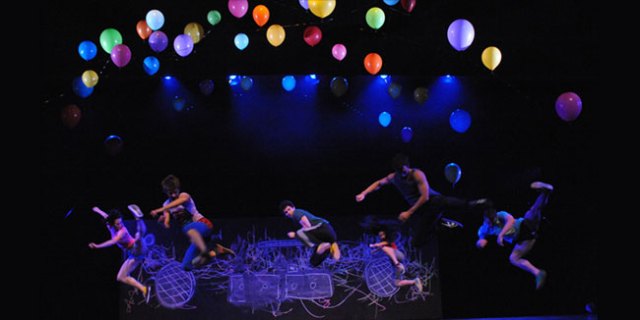
Dance culture frequently situates itself in tradition and times past, but Shaun Parker & Company’s is a culture that grounds itself firmly in the here and now. Everything about their look, sound and feel stands for a contemporary aesthetic that is not usually seen in the theatre but in other media, especially on film and television. It is a more accurate representation of modern day Australia than those of lofty and more prominent groups, and the company should also be commended for its efforts at showcasing ethnic and gender diversity.

The dancers have a physical carriage that sets them apart from other professional dancers who tend to be from balletic backgrounds. There is a b-boy/breakdance sensibility that permeates this crew, even though their work is much more varied than that single genre reference might suggest. In fact, it seems to be an ambition of the work to encompass as many dance forms as possible, which provides the show with variety and freshness, and extremely high entertainment value.

Dancer Josh Mu stands out in a memorable sequence that fuses the opposing styles of breakdance with lyrical. Mu is able to be equally powerful in these divergent forms, and the fluidity in his blending of both is completely arresting. Other dancers are less technically brilliant in their abilities, but all are athletic and authentic in their approach. It is also noteworthy that this is a group that places some emphasis on acting and facial expressions, which is always a crowd-pleasing feature.

The invention of a big black rotating box (picture a shipping container) in the middle of the stage is genius. By simply introducing countless options for entrances and exits, the choreography quickly becomes layered and complex. The mobility of the box also removes predictability by altering the stage and performance space, creating a show that continually surprises. It is a matter of contention when considering where “direction” starts and “choreography” ends, but Shaun Parker is undoubtedly strong at both. His work seeks to use dance as a communicative medium, and his point of view comes across with clarity and conviction.

www.shaunparkercompany.com

Any Womb Will Do (King Street Theatre)

anywombwilldo1Venue: King Street Theatre (Newtown NSW), Sep 8 – 23, 2013
Playwright: Gavin Roach
Director: Gavin Roach
Actor: Gavin Roach

Theatre review
Gavin Roach is an important voice in Australian theatre. He writes from the perspective of a gay man from Generation Y, and frequently appears on stage as a representation of young men of his community. Even though politics does not seem to feature as an obvious theme in his plays, Roach is a crucial presence in our theatrical landscape in terms of the way his work resonates for sexual minorities, which in itself is political action.

In Any Womb Will Do, the premise of child-bearing for a single gay man is explored. The show is presented in the most simple fashion, a one act monologue with no scene changes, and without lighting and sound effects. Roach is seen simply to be in his lounge room, talking to us about the issues he faces in trying to become a father. His performance begins with a campy and humorous tone, which the audience enjoys and reacts favourably almost like at a stand up show. Roach’s confidence and charm allows him to win the crowd over instantaneously, creating an air of ease and comfort in the theatre. As the play progresses, he switches gear to a more melancholic mode, where unfortunately his command of the space slowly fades. The characterisation becomes less believable and the story’s pathos fails to connect.

Nevertheless, this is an interesting work that addresses real concerns of queer communities as societies the world over progress and become more inclusive. As same-sex marriage becomes de rigueur in many countries, it only follows that family structures are re-examined, and with every other progressive idea, the theatre is where the process begins.

www.facebook.com/gavindanielroach
http://2013.sydneyfringe.com/…

Who Do You See? (Duck Duck Goose Theatre Company)

whodoyousee1Venue: King Street Theatre (Newtown NSW), Sep 8 – 23, 2013
Playwright: Gavin Roach
Director: Sarah Vickery
Actors: David Griffiths, Emma Jones, Suz Mawer, Jack Michel, Christian O’Connor

Theatre review
It is a brave decision to stage a play entirely in the dark, for what is a play without its visual aspect? Who Do You See? engages only your aural senses, which is an undoubtedly unusual exercise, but it also proves to be a challenging one. Five actors recite sections of the play pertaining to their individual characters, but these are not first-person narratives. They refer to their characters by name, rather than “I”. As a result, the experience is similar to that of listening to an audio book with narration by different voices, and quite extensive but subtle sound effects. One therefore wonders if this production would have worked equally well as an audio recording, and whether having the audience physically present at the venue is necessary.

Similar to the experience of reading, this production engages the imagination much more than a conventional staging would. The evocative title demands that the audience questions the assumptions they make in their own visualisations. We play with identity markers like ethnicity, height, weight, age, and clothing, trying to decide which versions of our imagined characters are accurate or appropriate. At the end of the show, lights are finally turned up and we get to see the actors. If the actors are different from what you had imagined them to look like, what does that say about your beliefs and prejudices?

www.facebook.com/ddgtheatre
http://2013.sydneyfringe.com/…

Miss Julie (Belvoir St Theatre)

757094-1f162f2e-1050-11e3-92bf-1ac22055d80e[1]Venue: Belvoir St Theatre (Surry Hills NSW), Aug 24 – Oct 6, 2013
Playwright: Simon Stone after August Strindberg
Director: Leticia Cáceres
Actors: Taylor Ferguson, Brendan Cowell, Blazey Best

Theatre review
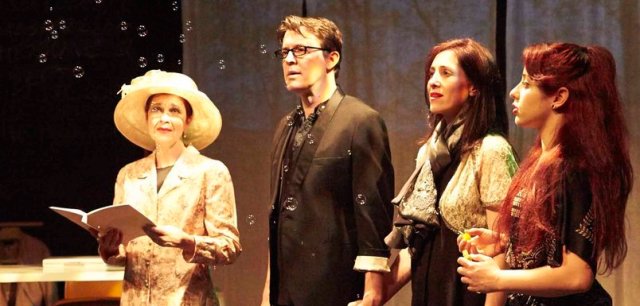
Belvoir’s production of Miss Julie is a radical update of the Strindberg classic. It relocates the characters to modern day Australia, drastically changing its form, language, and ideology. Key plot developments are retained, ensuring that the excitement and drama of the original are utilised to their full potential. Importantly, the political unsavouriness inherent in Strindberg’s pre-feminist 1888 work undergoes thorough subversion, giving rise to a new creation that re-imagines a powerful story, and uses it to make a statement that is representative of our times. It is a feminist act to revamp the work, but the political message contained in this new production is thankfully more ambiguous and sophisticated.

Brendan Cowell does exceedingly well by quickly establishing the play in its time and space with a familiar Aussie bloke caricature from his very entrance. He performs the charming larrikin with gusto, and is immediately likable as well as extraordinarily funny. This man has charisma in spades and isn’t afraid to use it, which is appropriate for the role of a man who is caught between two women. Miss Julie traverses very dark territory, and Cowell’s comic presence serves well to keep the tone humorous, although there are a few points that could have been more impactful if things were allowed to go more serious and grave.

Taylor Ferguson plays the 16 year-old Julie with an enthralling character development that could surprise any seasoned theatre-goer. The role showcases her versatility and courage as a young actor, and the play relies solely on her strengths to introduce a sense of believability and empathy. While her Julie is not the most endearing character to behold, the effect she has on her audience is deep and enduring.

Director Leticia Cáceres and playwright Simon Stone have created this new Miss Julie with a young, revolutionary voice. Their work is fiercely contemporary and fearlessly dramatic. The politics of the story is not immediately evident, but it is the reconstruction of works in the “misogyny cannon” (Cáceres’ words) that is relevant, and one can only hope that they return to that cannon and disrupts it again one play at a time.

www.belvoir.com.au

Lifeforce: The Mother Of All Journeys (King Street Theatre)

rsz__wp_5900_bubblesmed_Venue: King Street Theatre (Newtown NSW), Sep 6 – 21, 2013
Songs, book and lyrics: Joanne Weinberg
Director: Lisa Freshwater
Choreographer: Christopher Horsey
Actors: Natalie Lotkin, Tyran Parke, Monique Salle, Meredity O’Reilly, Charlotte Kerr, Christopher Horsey

Theatre review
Without an orchestra or band to perform a prologue, the show starts off clunky and stilted. It is a shock to the ears when characters replace conversation with big rousing musical numbers, especially when irony and comedy are not yet introduced at that early stage. Thankfully, by the time of the third song, things begin to fall into place, and Lifeforce unfurls its magic, telling a story with themes that are deep and universal. Its story isn’t a particularly interesting or unusual one, but the emotions it communicates and the ideas it explores have a profundity that elevates the musical genre from mere entertainment.

This is a demanding show for the small cast. Without support from a chorus, stage hands and elaborate sets, these six performers are required to take us on their journey, relying only on their skill and talent. Leading lady Natalie Lotkin’s confident voice is beautiful, and provides an emotional truth that gives the show a feel of authenticity. Tyran Parke demonstrates outstanding abilities both as a vocalist and actor, with a performance that is simultaneously entertaining and moving. Monique Salle gives her roles a sense of light and liveliness. Her voice is the brightest in the group, and accompanied with a keen sense of comedy, she owns some of the show’s most memorable moments.

Lisa Freshwater’s direction is accomplished. She treats her story with reverence, and imbues her characters with dignity. Freshwater’s emphasis on truthful character development allows its audience to engage and to empathise with those characters. There are instances in the production, however, where comic elements could have been played up more as the tone tends to get overly serious. From a structural perspective, the work misses the opportunity for a stronger surprise ending that could have taken the show to a more emotional conclusion. This is unfortunate and slightly bewildering.

Themes of family and parenthood when taken seriously, never fail to connect. In the case of Lifeforce, we are served an earnest and thoughtful tale of motherhood in several forms. Along with clever song-writing and beautiful singing (King St Theatre’s cosy acoustics are the perfect showcase for a small musical), this is a show that aims for the heart and never misses its mark.

www.facebook.com/lifeforcethemusical
http://2013.sydneyfringe.com/…

Empire: Terror On The High Seas (Tamarama Rock Surfers)

1173881_628047743894506_803955022_n[1]Venue: Bondi Pavilion Theatre (Bondi NSW), Aug 29 – Sep 28, 2013
Playwright: Toby Schmitz
Director: Leland Kean
Actors: Anthony Gooley, Ella Scott Lynch, Billie Rose Prichard, Nathan Lovejoy, Anthony Gee

Theatre review
Empire: Terror On The High Seas is a murder mystery set on an ocean liner in the late 1920s, but it owes little to the world of Agatha Christie’s writing. Instead, Toby Schmitz’s script is evocative of improvisational jazz music and the work of William S. Burroughs, with a structure that lends itself to a plot that unfolds mesmerisingly, but also freely goes away on lyrical tangents as though the story takes a break to feed an opiate habit at suitable intervals.

This is a big cast, with the participation of just under 20 actors. Performances are consistently good, with even the smaller roles excelling at creating an impression. Leading man Anthony Gooley is spellbinding as an unorthodox writer of sorts, on a journey grappling with personal issues including his concept of setting poetry to the stage. Gooley skilfully creates an endearing character who surprises with dramatic turns that are deliciously outlandish. Nathan Lovejoy steals the first half of the show with an exquisite flamboyance. His stage presence is irrepressible and he rules the stage with perfect comic timing at the show’s lighter sections. Ella Scott Lynch’s creation of a wild, gutsy flapper provides some of the most entertaining moments, and her stage husband Anthony Gee is memorable with a high energy performance that is manic and menacingly intense.

Leland Kean’s direction is thorough and meticulous. His vision comes through distinctly from his players who obviously understand their captain’s destination and purposes. Kean does not shy away from shock value, but he is simultaneously elegant in his approach. There are explicit scenes of debauchery and murder but his show is an aesthetically stylish one. Costumes and set are cleverly and beautifully designed. Sound is outstanding by being omnipresent and crucial to the fluid machinations of the storytelling, but is never distracting.

This is an artistic work that takes many poetic licenses and while it does not always communicate clearly, it takes its audience on its trip and triumphantly weaves through styles and genres, ending up with a theatrical narrative that is gripping, fascinating, and utterly fabulous.

www.rocksurfers.org

Les Illuminations (Sydney Dance Company)

816436-les-illuminations[1]Venue: Sydney Opera House (Sydney NSW), Aug 28 – 31, 2013
Choreographer: Rafael Bonachela
Music: Benjamin Britten
Musicians: Sydney Symphony Orchestra
Vocalist: Katie Noonan
Dancers: Sydney Dance Company

Theatre review
Rafael Bonachela’s latest work with the Sydney Dance Company is set to the music of Benjamin Britten from the 1930s. Bonachela’s immense respect for the music has produced a work that is sensitive to the audience’s aural experience, where the dancers are never allowed to overwhelm or contradict Britten’s essence. It is a successful meeting of creative art forms, but the music is kept paramount.

If beauty is ever a theme in theatre, Les Illuminations embraces it wholeheartedly. Eight dancers perform with a variety of moods and energies, but ultimately all the nuances they bring to the stage dissolve into fleeting moments, for what remains in the aftermath is a sense of sublime beauty. In part 1, Bernhard Knauer embodies a certain lightness and delivers a dream-like quality to the dance. The effortlessness he displays is delightful, and representative of Bonachela’s style, which is chiefly of a sensual nature, rather than giving prominence to technical athleticism. Janessa Dufty impresses as always with her magnetic presence and supreme confidence. Her performance style is characterised by strength and freedom, with a quality that is exceptionally alluring. In part 2, Thomas Bradley’s androgyny is important to the reading of Bonachela’s work, which in this instance, will be remembered for featuring multiple pas de deux sequences. A queer influence gives “partner work” texture, elevating gender dynamics from mere romance to more interesting ideas, and more complex notions of relationships and love.

Katie Noonan’s voice in the classical space is a marvellous revelation. Her singing comes to us with a transportative other-worldliness. It is perfect. Memorable segments of the show involve the dancers engaging us and each other, but with minimal movement. Our eyes and ears are seduced into a state of rapture, with Noonan’s timber ringing as though in dreams of purity and beauty, as though suspended in time.

www.sydneydancecompany.com

Spring Comedy Double Bill (Blancmange Productions)

summerofbloodVenue: TAP Gallery (Darlinghurst NSW), Aug 27 – Sep 7, 2013

Brad Checks In
Playwright: Paula Noble
Director: Steven Tait
Actors: Chris Miller, Sam Smith, Katherine Shearer, Laura Holmes, Jim Gosden, Katrina Rautenberg

Summer Of Blood
Playwright: Robert Armstrong
Director: Stephen Carnell
Actors: Brennan Muhoberac, Chris Miller, Katherine Shearer, Laura Holmes, Jim Gosden

Theatre review
Two comedies that have very little in common thematically are staged successively over 3 hours. Both are structured almost like film scripts with numerous scene changes and emphasis on character development. Four of the actors appear in both shows, displaying range by taking on drastically different roles.

Brad Checks In deals with relationships in the modern era of online social networking. It is a familiar premise that many would easily relate to, but the play strangely features a central character entwined in a web with three women’s affections, without establishing or explaining his appeal. There are however, enjoyable performances, including Katherine Shearer’s Di who is dynamic and mischievous, and the only female character who was not entirely defined in terms of her relationship with the main character Brad. Sam Smith plays a womanising cad with charm and humour with a more naturalistic approach that contrasts well with the rest of the cast.

Summer Of Blood showcases a cast of manic characters, with frequently funny results. Laura Holmes delivers the biggest laughs with her confident comedic abilities. Chris Miller’s exhilarating performance is crucial to the liveliness of the play, setting the bar for his co-actors in terms of energy levels. Brennan Muhoberac is utterly convincing as an adult virgin who becomes increasingly tainted by greed. Director Stephen Carnell uses film effectively and relevantly, interplaying with live action in a memorable section of the play. Film geeks will relish in the facts and trivia introduced into the script, with references ranging from Alfred Hitchcock to Mary Harron. This is a satisfying, albeit messy romp about genre film, and the aspirations of people in the B-movie industry, but audiences will remember it for the schlocky blood letting, colourful characters and the many laughs it delivers.

www.facebook.com/…

Fred (Old 505 Theatre)

lisachappellVenue: Old 505 Theatre (Surry Hills NSW), Aug 28 – Sep 8, 2013
Playwright: Lisa Chappell
Director: Christopher Stollery
Actor: Lisa Chappell

Theatre review
One woman in an ugly costume, one chair, no set, no props, no “multimedia” elements. This is bare bones theatre that relies squarely on performance, writing and direction. The fact that Fred works so successfully is a real testament to the talent and hard work that Lisa Chappell and Christopher Stollery have put into their craft. This show is relentlessly dark, but also extremely funny. It strikes a balance between the horrific and the hilarious, creating an emotional effect that is painfully unsettling but entirely entrancing.

Chappell’s skill as an actor is exceptional. The thoroughness at which she maps out the frequent and dramatic changes in tone of performance and psychological states is the highlight of this production. Her ability to portray the insanity of being lost in an agonising and devastating memory in one second, and flicking back in an instant to frivolous silliness, is sublime. Also impressive, is that the audience is only ever allowed to see the character, Deidre on stage. The actor, Lisa, is perfectly hidden from view, even though she is right in front of your eyes, expertly casting her magic over a spellbound crowd. Her director Stollery provides a creative and critical “third eye”, and together, they have spawned a one-woman tour de force that is unmissable.

Equally noteworthy is Chappell’s script. Her work explores some of the most morbid crevices of the human imagination, but her storytelling stubbornly remains in the realm of jokes and laughter. This is a perfect (and intense) representation of trauma, mental illness and the human instinct for survival. While the play concludes abruptly, it does so with good reason. It might disrupt the audience’s sentimental response to the character in question, but it is in the awakening from the fantasy into stone cold sober reality that the truth hits home.

www.venue505.com/theatre