Review: The Norman Conquests (Ensemble Theatre)

Venue: Ensemble Theatre (Kirribilli NSW), Nov 2, 2018 – Jan 12, 2019
Playwright: Alan Ayckbourn
Director: Mark Kilmurry
Cast: Danielle Carter, Rachel Gordon, Brian Meegan, Sam O’Sullivan, Yalin Ozucelik, Matilda Ridgway
Images by Prudence Upton

Theatre review
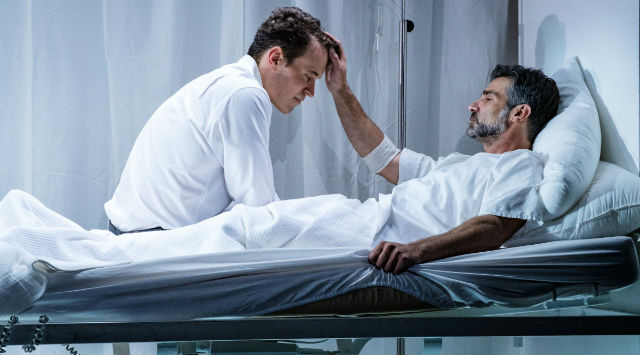
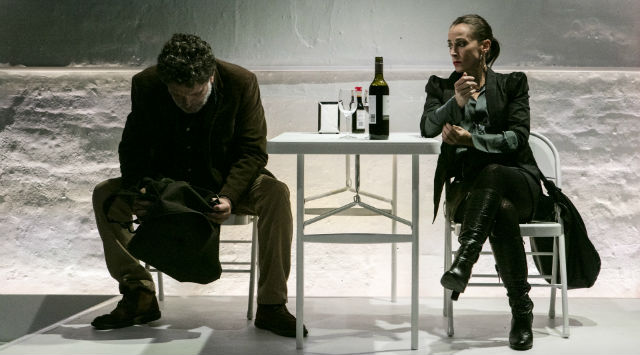
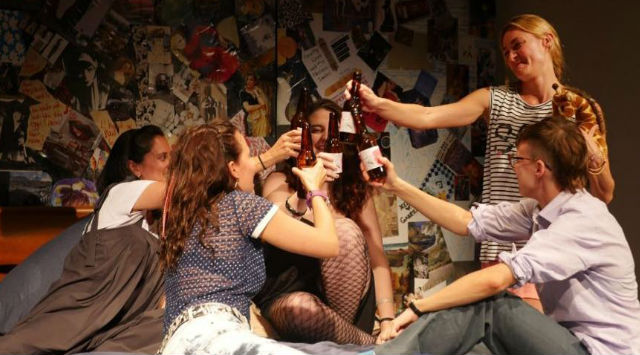
Ruth’s husband is having dalliances with her sister and her sister-in-law. These extramarital trysts with Norman are at least momentarily pleasurable, but it comes as no surprise that there is pandemonium when the cat is out of the bag. Alan Ayckbourn’s trilogy The Norman Conquests takes place in a weekend, with each instalment encompassing the action at a specific area of the family’s country home. Table Manners occurs in the dining hall, Living Together in the living room, and Round And Round The Garden in the garden. They form a cohesive whole, but each part stands alone, for this intricate 1973 comedy about the meaning of marriage, at a time of sexual liberation as Britain emerges from the swinging sixties.

Its humour is of a classic style, with 45-year-old jokes likely to divide audiences, but at the heart of the piece is Ruth’s surprising permissiveness, still refreshing by today’s standards. Her reluctance to see the affairs as necessarily catastrophic, but more of an annoyance, leads us to a progressive evaluation of monogamy, still relevant to how we conceive of relationships and marriages today. This revival, directed by Mark Kilmurry, is bright and bubbly, a compelling jaunt back in time that is surprisingly resonant, even if its language is obviously outdated.

The characters may sound like the past, but they are made to feel current, by an excellent, and tireless, uniformly captivating cast. Yalin Ozucelik gives Norman an appropriate sex appeal, cleverly depicting that familiar blend of naivety and cunning, to convey the ambiguously deceptive quality of men who love too many. Matilda Ridgway is a marvellously complex Annie, the aforementioned sister, richly imagined with veraciously human conflicts, clearly presented for a personality sensual and intelligent. Ruth is played by Rachel Gordon, wonderfully vivacious and highly sophisticated, for an exemplary portrait of a woman with an open mind, unafraid to set her own rules.

When Ruth declares that she does not own her husband, we are urged to re-examine sexual relationships, and perhaps define them anew. In letting our loved ones go, we in turn disallow ourselves from ever being enslaved. Love, however, can make free people want to be bound. To have and to hold is a divine notion, but life without freedom is abhorrent, just as life without love is unbearable. In every intimate connection, whether fleeting or longstanding, delicate negotiations are required; traditional prescriptive methods, when adopted unquestioned, rarely deliver satisfactory results. Congress between organic beings can never be completely predictable, for every entity is different and in constant flux. We just need to make sure that nobody gets hurt, although it seems always to be easier said than done.

www.ensemble.com.au

Review: A Cheery Soul (Sydney Theatre Company)

Venue: Sydney Opera House (Sydney NSW), Nov 5 – Dec 15, 2018
Playwright: Patrick White
Director: Kip Williams
Cast: Emma Harvie, Anita Hegh, Jay James-Moody, Brandon McClelland, Tara Morice, Sarah Peirse, Monica Sayers, Shari Sebbens, Nikki Shiels, Bruce Spence, Anthony Taufa
Images by Daniel Boud

Theatre review
Miss Docker is an inconvenient older lady. Living in the suburbs, her presence is a constant source of irritation to all and sundry, even though she goes out of her trying way to be a useful member of community. Possessing neither great discernible talent, nor satisfactory social skills, her good intentions prove inadequate, and having gone past an ascribed use-by date, exclusion is her daily reality.

Critical of the Australian middle classes, Patrick White’s A Cheery Soul takes aim at our parochial values, and that strange sense of fear resulting from our insecure colonial identity, one that corrupts the way we are with one another. Additionally, the play is a study of how women are devalued, through its depictions of a character who has failed to fulfil her destiny of wife and mother, in a society determined to disallow her from deviating from its narrow definitions of womanhood.

White’s signature incorporation of poetry and abstraction have a tendency to dilute the drama in his narratives, and although director Kip Williams does well to introduce a generous and robust scale of theatricality that is quite dazzling, the show oscillates regularly between entertaining and challenging, for an experience that feels, ultimately, not much more than moderately rewarding. Nevertheless, it is noteworthy that live video is an inventive and memorable device here, with Williams and set designer Elizabeth Gadsby demonstrating an admirable meeting of the minds for a very effective use of the medium.

Actor Sarah Peirse brings a charming and familiar eccentricity to Docker that conveys a valuable realism for the piece, but it is arguable if the protagonist is on this occasion, sufficiently appealing for us to be firmly engaged with the plot. Reverend Wakeman is played by Brandon McClelland, whose flamboyant approach offers wonderful moments of intensity that add texture to a persistently sad story. Ensemble work is strong in the production, with sequences featuring the cast performing as a haunting chorus especially beautiful.

When scared little people make up the majority, it is the imaginative and the adventurous who are ostracised. Still in our psyche, an outpost of the old British Empire, we remain consumed by anxiety, always thinking ourselves deficient, desperate to be as good as everyone else in faraway fantasised Europe. We behave as though neglected and orphaned, consequently responding by always choosing to embrace the ordinary, in a constant state of keeping up with the Joneses, and irrational in our fear of all things different and unexpected. There is little value in living by replicating, even though it gives an impression of social cohesion, conformity holds us back from progress and deprives us of compassion. In A Cheery Soul we see that to love thy neighbour can be easy, if only we learned to step of our own way.

www.sydneytheatre.com.au

5 Questions with Phoebe Grainer and Jill Nguyen

Phoebe Grainer

Jill Nguyen: What kind of legacy do you want to leave behind as an artist, actor, writer? How do you want to be remembered?
Phoebe Grainer: I don’t care for words like legacy or how I want to be remembered. I want to live my life creating work and doing things that are meaningful, that I am empowering and uplifting my mob, the Kuku Djungan people and other Indigenous and non-Indigenous communities.

What was the first play that captivated you and in some way defined you?
When I was in high school up in Broome, I went and seen a rehearsal of a play called Jandamarra. I’m not sure how I found out about it or even if I was allowed to go watch but I was there. Jandamarra is a legend of the the Bunuba people up that way, he is a warrior and a leader who defends his country, his mob. When I saw this rehearsal, all Aboriginal cast, talking language. It was beautiful. I had never seen anything like it. I just remember thinking wow, I want to do that.

What’s been the biggest learning lesson so far in your journey with The Serpent’s Teeth?
I think it’s been a reminder of how hard you need to work for things you want to do.

Favourite pre, during and post rehearsal snacks?
I have been eating so much Thai fried rice and chicken nuggets!

As an Indigenous Australian artist, what advice can you give for the next generation of young Indigenous people who want to pursue creative dreams?
Speak to the old people, Elders, your grandparents and parents. Culture is important and we need to keep it strong. Always know why you do the things you do, creatively, professionally and in everyday life, give back to your community. Critically think about the world. Know that you can do the things that you want to do.

Jill Nguyen

Phoebe Grainer: What was your experience like growing up as a Vietnamese-Australian woman in Melbourne?
Jill Nguyen: As a kid, I never felt that different to anyone else. The inner west of Melbourne where I grew up was super diverse, which was wonderful. Asian, black, white, everyone. It wasn’t until I went to university at 18, that I was quite shocked by how little some people knew about Asians in general. I did do Arts at Melbourne Uni, which was pretty white. I’ve experienced racism of all kinds, ranging from subtle to downright overt, and it’s only made me more resilient. In saying that, I am so lucky to have grown up in Melbourne. It’s my home.

How did you get into acting?
After 3 years of higher education, working full time at the bank and travelling overseas for a year and having my soul crushed in between, I came to my senses and decided to follow my dream. I started taking acting classes 2 years ago and I haven’t looked back since! I just jumped into the deep end and worked really, really, really hard to get myself out there. It doesn’t happen overnight.

Who did you look up to on your journey to becoming an actor?
Honestly, I didn’t have too many Asian females to look up to, but I always loved Marilyn Monroe a lot. In recent years, I have felt really empowered by Gong Li, Michelle Yeoh and Gemma Chan, all power houses in their own right. They light my fire.

Has the Vietnamese-Australian community reacted to your work, if so how? And how has the wider Australian community reacted to your work?
I guess my journey has just begun in some ways and I’m really excited for Viets all over the world to see my work. I was recently cast in Justin Kurzel’s True History Of The Kelly Gang, as Molly Kane. I act alongside Nicholas Hoult, George McKay and Thomasin McKenzie. I’m hoping a young and impressionable Vietnamese girl sees me in this feature and somehow has the confidence to follow her dreams too.

What does it mean for you to be a woman of colour in the arts?
It means everything to me. When people say things like “oh race doesn’t matter”, I feel an invisible slap in the face. Well, of course it matters. My heritage is Vietnamese, Chinese. I’m not going to run away from that. People of colour have been historically marginalised, purely based on the colour of their skin. I think my presence and contribution to the arts in film or theatre is political in its’ own right. I won’t stop creating, fighting and hustling. For so long, the realm of the art world and film, in the western world has been exclusively white, male dominated and right now, is the best time to change it up, completely. I feel a sense of solidarity with other women of colour artists too.

Phoebe Grainer and Jill Nguyen can be seen in The Serpent’s Teeth by Daniel Keene.
Dates: 9 – 24 Nov, 2018
Venue: Kings Cross Theatre

5 Questions with Violette Ayad and Mary Soudi

Violette Ayad

Mary Soudi: What’s your favourite part about playing Lilian (Lilo)?
Violette Ayad: I love that I got to name this character myself. In fleshing out the character, the director and I decided that we wanted her to have a name that was a little ambiguous in relation to her cultural background. A name that could belong to someone from a Middle Eastern background (like myself), but was not specifically Middle Eastern (much like my own name). So, I named her after one of my aunties, Lilian, who everyone in the family calls ‘Lilo’ for short.

What’s something that has really surprised you during the creation of Blame Traffic?
The ease with which we’ve moved from reading and workshopping the script to finding the scenes on the floor. It has been a real reminder that when the time is taken to get the script, the foundation, right, everything else can be built on that with clarity and specificity. Part of the joy of having a writer who is also the director was that we could stop and identify problems in the script, and fix them in the script, rather than trying to gloss over them in the performance of it.

What main idea do you think will stay in the minds of audience members in the hours/days after they see the show?
I’d like to think that people’s responses to this play are very varied based on their own experiences of coincidence and serendipity in their lives. But ultimately, I would love everyone to consider a little deeper the amazing moments of chance and luck that make up life. In a world that moves further away from institutional religion every day, finding joy in these chaotic and random encounters feels like a pretty comforting way to live.

What’s your craziest traffic-related experience?
Oh, so many. I was one of those terrible young drivers you always fear is around the corner. I got my license in West Australia before the introduction of the mandatory L plate waiting period and with only 25 driving hours required. This is terrible, but I once lost 4 demerits and $600 in a 24-hour period when I was 19. Find me in the foyer and I will tell you how. Don’t worry, I don’t own a car in Sydney or drive very often, and definitely take road safety more seriously now that I’m older.

Why are you passionate about this production?
This production began as a way to bring together all of my favourite class mates and friends from the training institutions I’d studied at, and show the world how it’s done! Every decision in this production represents what I love seeing and what I believe in. At the core, we have a well-written story that engages the heart and mind equally. Add to that a cast of incredibly different performers that share an ability to contribute, generously, to a whole production, beyond their own specific part. And finally, a contemporary and innovative design team, making funky beats and a simple, but beautiful, stage design.

Mary Soudi

Violette Ayad: What is your favourite thing about the Blame Traffic script?
Mary Soudi: The humour that’s sprinkled throughout it! One scene in particular cracks me up every single time – I won’t reveal it, but I will say that Emma O’Sullivan plays a teenage boy behind a wheel of a car, and it is just so, so hilarious. 

What makes this project so exciting for you?
I’m excited by this project because I think Michael is one of the brightest young writers in Australia, and Blame Traffic is his best work yet. Being able to bring this brilliant story of his to life alongside so many brilliant creative minds is pretty darn magical.

Having just finished the Bell Shakespeare tour of The Players, how much driving do you think you’ve done in the past year?
Probably a billion hours. Those long drives were the best way to see this gorgeous country and fully take in just how huge it is. And I must say, I’ve truly surprised myself with my ability to park a giant Kia Carnival (mini-van/small spaceship) in so many cramped little parking lots all around Australia. Believe in yourself, folks!

What have been the benefits of working with people you’ve trained with?
Is there anything better than making art with your favourite humans? Knowing each other inside and out is a huge benefit, because after all the years we’re trained together we end up knowing exactly where each other’s creative genius lies, and can bring it out of each other. And all the endless love and tomfoolery!

Without giving anything away, what do you think is a moment people will really respond to in the play? 
A gorgeous moment of realness between a boy and his uncle, where self-doubt transforms into self-belief. Come see it to find out what I’m talking about!

Violette Ayad and Mary Soudi can be seen in Blame Traffic by Michael Andrew Collins.
Dates: 13 – 24 Nov, 2018
Venue: Old 505 Theatre

5 Questions with Alex Mau and Olivier Rahmé

Alex Mau

Olivier Rahmé: If you could play any one role in the show, which one would it be?
Alex Mau: Queenie, of course! Who doesn’t want to play a blonde? Queenie is such a wonderful, three-dimensional female role, something we could do with more of in theatre! When the party is lit, Queenie is living her best life, sassing it up with her BFF Kate, throwing shade at the grand dame Dolores and killing it with her signature dance move, the “Black Bottom”. Come dawn, Queenie breaks it down with the most poignant and touching ballads in the show, alongside the gorgeous hunk Black. Queenie has so much light and shade, it would be so amazing to play her but, fortunately for you, I won’t be doing that and, instead, you’ll have triple threat and all-round superstar, Georgina Walker, portraying this once-in-a-lifetime role!

Which role excites you most in the rehearsal room? Why?
The director! I am in awe of how our director, Alexander Andrews, always does unique and refreshing takes on classics, such as Little Triangle’s inaugural production of Sunday In The Park with George and its sophomore production of Merrily We Roll Along. He encourages the cast to bring themselves to the characters, creating really interesting and fully-developed interpretations of characters that could otherwise be simple caricatures. I couldn’t stress enough than audiences should see this production of The Wild Party – not only is it a rarely produced musical in Australian theatre, you’ll definitely want to see what Alexander Andrews does with this amazing material!

What’s a funny/crazy/interesting thing you’ve picked up on in the rehearsal room?
The Chorines are like the bubbly and hilarious Greek Chorus of The Wild Party (portrayed by Victoria Luxton, Matilda Moran, Sophie Perkins, Jordan Warren & Rosalie Neumair). Being incredible dancers, our fabulous choreographer, Madison Lee, has given them heaps of intense and electric choreography that it feels like they’re doing full-body workouts throughout the entire show! It’s crazy how effortlessly they smash that chorey and then go on to belt those group numbers like they eat dissonant harmonies for breakfast – #goals. Keep an eye out for what I think is one of their funniest dance moves (in the spirit of 1920s vaudeville), which I would describe as a cross between the spread eagle from Chicago and squats in the air – yes, I can see you trying to picture it, but you’ll just have to come and see it for yourself!

What is the wildest party you’ve ever been too?
What happens at The Wild Party, stays at The Wild Party.

What do you think the audience’s reaction to The Wild Party will be?
Michael John LaChiusa (composer and lyricist for The Wild Party) is well-known for writing complex theatre scores so I think audiences will be expecting some very challenging, intellectual theatre. Alexander Andrews has taken an interesting and refreshing interpretation of bringing out and focusing on the human connections between the characters so, while the music is still technically difficult (which, as a pianist, I love!), I think audiences will be surprised by the humanity and rawness of the story and the characters. Prepare for side-splitting laughter and tear-jerking moments, it’s gonna be a WILD PARTY!

Olivier Rahmé

Alex Mau: Describe The Wild Party in five words?
Olivier Rahmé: Hilarious. Crazy. Shocking. Thrilling. Eye-opening.

What drew you to The Wild Party and why should people see it?
A lot of my friends have worked with Little Triangle before, so I was thrilled, humbled and so excited to be a part of such a reputable company. People should come to the show because of the impact a show like this can have on you – that’s what I love about theatre. As actors we hope the audience members gain something from the performance; to leave with something to think about & to be impacted. I truly believe The Wild Party succeeds in doing this.

What surprised you most about The Wild Party and what do you think will surprise audiences the most?
I love how meaty some of the roles are and how the actor has so much to play with. The script offers a lot and doesn’t box any character into being one thing. Many of us show all sorts of colour, which I love. I think the audience will be surprised by the level of talent – So. Many. BEAUTIFUL. Actors! And the voices are really shown off. My hat goes off to the production team for their casting.

Tell us a little about your character Eddie and how your approach to the character has changed over time.
When I first started reacting to the energies the other actors were giving me and read the script, I thought… Eddie is awful. What an awful man. Perfect. I can do that! But exploring his journey more and trying to figure out why Eddie does some of the things he does, I’ve now realised; Eddie isn’t a bad person. He is a defeated person who does a horrific and unforgivable thing. He struggles a lot with his identity and doesn’t quite know how to be happy – constantly masking his unhappiness and failures by blaming how life turned out on his beautiful wife Mae (Emily Hart). Sidenote: Emily’s belt may or may not be a solid and definite reason you need to see this show).

Tell us a little about the most challenging thing about the role.
The most challenging this I find is the final scene with Eddie towards the end of the show when he abuses everybody both verbally and physically. Emotionally and physically this section is exhausting for me as the actor. I definitely feel my body and mind tiring out after a few runs of this scene!

Alex Mau is répétiteur/pianist and Olivier Rahmé plays Eddie in The Wild Party, the musical.
Dates: 15 – 24 Nov, 2018
Venue: Seymour Centre

Review: Whose Uterus Is it Anyway? (The Old 505 Theatre)

Venue: Old 505 Theatre (Newtown NSW), Oct 30 – Nov 10, 2018
Playwright: Georgie Adamson
Director: Eve Beck
Cast: Toby Blome, Alexandra Morgan, Finn Murphy, Chelsea Needham, Annie Stafford
Images by Jasmin Simmons

Theatre review
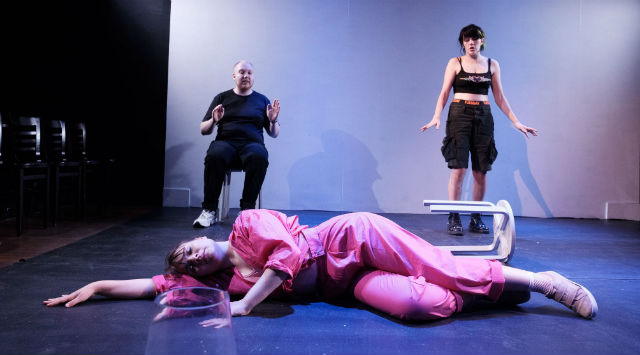
It is a game show in the reality competition style, involving the infliction of humiliation and abuse for the benefit of a television audience. In this case, contestants are made to jump through hoops before they are awarded the reproductive health care that they require. George Adamson’s Whose Uterus Is It Anyway? is an indictment of the way bodies of women and trans men are controlled, relegated to a lower class, when they deviate from unreasonably strict norms. When a uterus is not being used for procreation, society sees fit that its owner is put through a process of castigation, as enacted here by a white man in a stylised lab coat, playing the role of game show host, manipulating scenarios and exercising his power, to ridicule his subjects.

Ideas in the play are fresh and exciting, assembled with an enjoyable quirky humour. Its writing could be further refined for a more satisfying plot structure, but its unique approach makes for a show that is at once pertinent and amusing. Eve Beck’s direction for the piece contains appropriately subversive measures, and although its comedy proves slightly inconsistent, there is no doubting the production’s ability to have us firmly engage with its stimulating themes. Martin Kinnane’s lights and Camille Ostrowsky’s set design provide dynamism to a visual aesthetic that conveys effectively, the sinister quality of institutionalised medicine and media. Alex Lee-Rekers is detailed with his work on sound, helping us navigate the many subtle tonal and emotional shifts of the show.

An excellent cast brings to life the theatrical and substantive absurdity of Whose Uterus Is It Anyway?. Toby Blome is captivating as the central authority figure, and as four additional subsidiary characters, his efforts are just as compelling. Alexandra Morgan and Annie Stafford are funny women, both exuberant and incisive with their delivery. Finn Murphy and Chelsea Needham dial up the poignancy factor, for some genuinely moving moments that give the staging a crucial quotient of gravity.

As evidenced in Lysistrata’s fabled sex strike, societies have always been petrified of women using their bodies for anything other than gestation. The impulse to reproduce has fuelled an unquenchable thirst to control our bodies, and as a consequence all of how we exist is dictated in accordance with that sense of ownership and entitlement. Three women in the play, along with a trans man, have made decisions for themselves, but it is clear that their bodies are being held hostage, by traditions and systems that struggle to acknowledge our independence. If our subjugation stems from sex and babies, it would only make sense that a revolution can be precipitated by a radical rethink of our identities in those terms. We should define ourselves in creative and courageous ways, rejecting labels and responsibilities when required, not only to live with greater integrity, but to forge a better, more equitable future.

www.biteprod.com.au

Review: Madiba (State Theatre)

Venue: State Theatre (Sydney NSW), Nov 1 – 18, 2018
Book: Jean-Pierre Hadida, Alicia Sebrien
Author & Composer: Jean-Pierre Hadida
Additional Material: Lunik Grio, Emmanuelle Sebrien
Directors: Pierre-Yves Duchesne, Dennis Watkins
Cast: Courtney Bell, Barry Conrad, David Denis, Blake Erickson, Perci Moeketsi, Ruva Ngwenya, Tim ‘Timomatic’ Omaji, Madeline Perrone, Tarisai Vushe
Images by Serge Thomann

Theatre review
Known as Father of the Nation, South Africa’s Nelson Mandela served 27 years in prison, for activities opposing apartheid. In the musical Madiba, we see his personal struggles, and the inspiration he had provided, and continues to provide, for racial reconciliation in the region and around the world. Mandela’s heroic aura is unwavering as the centrepiece of a production that unfortunately, never quite lives up to the man’s eminence.

The writing manages to establish coherence for a timeline that stretches fifty years, but it is insufficiently rousing, for themes that one expects to be much more intrinsically emotional. The minimalist approach to visual design proves a challenge for the large stage, with lights that get absorbed by heavy curtains before adequate illumination can be provided to performers.

It is however, an excellent cast that presents the musical, with Perci Moeketsi effortlessly convincing as Mandela, an affable presence who reminds us of the warm personality so often seen in the media. Brilliant dancing by David Denis, Tim ‘Timomatic’ Omaji and a very spirited ensemble, has us thoroughly mesmerised. Barry Conrad, Ruva Ngwenya and Tarisai Vushe thrill us with their singing, making full use of the opportunity to showcase their extraordinary vocal talents.

When Noah emerged from his ark after the great flood, a rainbow of peace appeared in the sky, signifying a new beginning. The dream of a rainbow nation in post-apartheid South Africa, is a vision about inclusivity, for a future in which black and white are no longer divided. Now five years after Mandela’s passing, white supremacy can be seen trying again to rear its ugly head, everywhere from Europe and America, to Africa and Australia. The project of decolonisation is a huge undertaking, an extremely difficult exercise that often seems doomed to failure, but forces determined to defeat fascism can never be crushed. We remember the sacrifices made by Mandela and his country, and the progress they were able to attain under onerous circumstances, and use them as motivation, for all the battles that lie ahead.

wwww.madibamusical.com.au

Review: Freud’s Last Session (Clock & Spiel Productions)

Venue: Seymour Centre (Chippendale NSW), Oct 30 – Nov 10, 2018
Playwright: Mark St. Germain
Director: Hailey McQueen
Cast: Yannick Lawry, Nicholas Papademetriou
Images by Alison Lee Rubie

Theatre review
Two men, one atheist and one Christian have an intelligent, and civilised, discussion about the existence of God, in Mark St. Germain’s Freud’s Last Session. A fictional account of Sigmund Freud, approaching the end of life, inviting C.S. Lewis in for a meeting, presumably to help allay inevitable fears of impending death. Everything they talk about is relevant, even fundamental to our very being, but these are ideas we have tossed around in our minds many times, with decisions settled for each individual years ago. Some might be able to see new light on old questions and find the play intellectually stimulating, but for most, the best it can offer is an opportunity to hear the other side of arguments, within its stringently binary presentation of truths.

It is a polished production, with Hailey McQueen’s direction giving the theological themes an elegant and balanced focus. Tyler Ray Hawkins’ work on set decoration is noteworthy for its visual flair, cleverly manufacturing a sense of vibrant theatricality whilst maintaining realism in Freud’s office. Both actors deliver solid performances, with Nicholas Papademetriou particularly convincing as the ailing psychoanalyst, accurate in his portrayal of a legendary figure in his last days, but in a manner that is charmingly playful, to have us engaged and entertained. Lewis is played by Yannick Lawry, appropriately uptight, with an energetic presence that keeps things lively for his audience.

Life is mysterious, so there is no surprise that we often respond by embracing ideas that pertain to the supernatural. Science is in the business of demystification, but our nature seems not to permit an end to human interrogations; for every answer we discover, further questions will arise. The world is determined to be unknowable, yet we desire only to thrive on certainty. God may or may not exist, but if we agree that our time on earth is real, it should then follow that our emphasis must always be concerned with the here and now. The truth however is that, whatever we think is holy up above, has served to divide us. We see ourselves doing unspeakably cruel things to one another in the name of God, yet are unable to disown religious doctrines, refusing to acknowledge the harm that it can cause. The world has never been without Gods, so to imagine ourselves as entirely secular, although an appealing idea, is probably futile. The next best thing would be to trust that each of us can learn to be better persons with each passing day, no matter how ridiculous our personal beliefs.

www.clockandspielproductions.com

Review: Degenerate Art (Old Fitz Theatre)

Venue: Old Fitzroy Theatre (Woolloomooloo NSW), Oct 17 – Nov 4, 2018
Playwright: Toby Schmitz
Director: Toby Schmitz
Cast: Septimus Caton, Guy Edmonds, Giles Gartrell-Mills, Henry Nixon, Megan O’Connell, Rupert Reid, Toby Schmitz
Images by John Mamaras

Theatre review
If it were a painting, Toby Schmitz’s Degenerate Art would comprise a thousand tiny brush strokes, too detailed and too intricate, but they collude to present broad strokes that are imperiously forceful, certain to make an impact. Like other bad boy artists of renown such as Adam Cullen and Damien Hirst, the work is brash and obnoxious, replete with evidence of genius, but unlike white box museums that allow us to glance, gasp and swiftly walk past, Schmitz’s 100 minutes of grandiose cocky art, holds us hostage in our overly snug seats, intimidating us into thinking that some very big meaning lies behind all that is being waxed lyrical in the playwright’s very many excessive diatribes.

The play is ostensibly about Hitler’s relationship with art, and the ironic and incongruous phenomenon of fascist attitudes always seeming to surround the dissemination and consumption of art. We see prominent Nazi figures of the time, arguing over art like any healthy society should, but the way these white men cannot help but escalate their competition of penis extensions into acts of violence, is despicable and telling. Visually sumptuous, the staging is provided a glossy glamour by Alexander Berlage’s diligent lighting design. Schmitz assembles a testosterone fest that begins desirous but eventually turns shrill, with shouty blokes intent on asserting their importance, a reminder that art cannot help but imitate real life.

Although little room for nuance, Degenerate Art is a showcase for some remarkable performances, and the rhapsodic peacocking of its six male actors proves to be truly impressive. Megan O’Connell too, is an effective and memorable narrator, despite never really being able to overcome looking like an afterthought. It is frustrating that we are still being subjected to groups of white men talking about Nazism. To some, it might make sense that white male villains can only be played by white men, but for others, this is completely counter-intuitive, and a lazy, even irresponsible way of getting into discussions about fascism. Actions speak louder than words, especially when the words are deafening.

www.redlineproductions.com.au

Review: Pramkicker (Vox Theatre)

Venue: Chippen Street Theatre (Chippendale NSW), Oct 24 – Nov 3, 2018
Playwright: Sadie Hasler
Director: Linda Nicholls-Gidley
Cast: Cecilia Morrow, Vaishnavi Suryaprakash
Images by Jasmin Simmons

Theatre review
Jude is attending anger management support groups, as punishment for having, amongst other things, kicked a pram at a coffee shop. Her sister Suse is assigned to be her companion for this remedial process, and together they fall deep into discussions about motherhood, and in Jude’s case, the rejection of it. Sadie Hasler’s Pramkicker is a marvellously written work about the modern woman, and the choices she is able to make for herself. Using the experience of childbearing as a springboard, we delve into philosophical, as well as practical, ruminations about all that is expected of women, in order that we may examine the freedoms we do and do not have, in defining existence for ourselves.

Dialogue in Pramkicker is deliciously witty, with some truly scintillating perspectives of life that are brutally honest but rarely disclosed. The characters go through wonderful transformations during the course of the play, for deeply beautiful depictions of sisterhood and of female sovereignty. Emotionally robust, the show takes us from ecstatic laughter to exquisite poignancy. Directed by Linda Nicholls-Gidley whose imaginative and sensitive use of space, generates for the staging a variety of dimensions that engage with us effectively at different mental states. A faster pace would deliver a greater sense of exhilaration to accompany its outrageous conversations, but it is doubtless that this is a production that packs a punch.

Actor Cecilia Morrow is powerful as Jude, with an excellent sense of conviction that befits the role’s very appealing dauntlessness. Suse is portrayed with great authenticity by Vaishnavi Suryaprakash, charismatic with a hint of innocence, perfect for the part of younger sister. Jointly, the pair establishes an extraordinary chemistry that forms the soul of the production, and we find ourselves hopelessly enamoured, and invested in their stories.

For eons, we have been told that it is our duty to procreate. Jude is one of increasing numbers, who has refused that responsibility, and in place of parenthood, she has to find meaning for her own life, in ways that are not prescribed and preordained. We see her in moments of confusion, not fully able to grapple with the enormity, of having accepted this radical freedom. With no tethers to ascertain her identity, it becomes a conscious effort to be who she wants to be, and we see that things could have been easier if she had just gone with rules of the normal playbook. Independence is not for the faint of heart, but it is the only option for those who cannot settle for anything less.

www.voxtheatre.com.au