5 Questions with Elouise Eftos and Deborah Faye Lee

Elouise Eftos

Deborah Faye Lee: Joseph K is arrested for an unspecified crime. If you were Joseph K, what would that crime be?
Elouise Eftos: Oh god there’s so many things I could be arrested for… playing music too loudly, being too loud in general, being too extra (not sure why that’s a crime though to be honest, if anything that should be rewarded). Probably my worst offence is laughing at my own jokes though… that’s pretty bad.

You’re a stand up comedian, in addition to being an actor. How has your knack for comedy helped when working on this show?
Honestly being a comedian actually makes you super critical of what is and isn’t funny and for me personally it’s made me look at every little bit of a joke or gag so intricately (maybe sometimes too much) that it’s been really helpful with a lot of elements within my performance. From the timing, the set ups, just even the inflection in my voice, and how that can change everything in a scene. I think being a stand up comedian in the acting world really helps you when you’ve got an audience watching, I’m excited and a little nervous to see what jokes or moments do land (and especially what doesn’t land at all). Doing stand up makes you realise that your favourite jokes might not work every night or a moment you didn’t think was funny at all might get an unexpected laugh. I think that makes you extremely resilient and quick on your feet, which is so important in the realm of acting. Live theatre is so exhilarating because anything can happen and I think stand up comedy is the same in that sense, if something goes wrong the best actors and comedians can make it seem like it was all planned and part of the show, which isn’t easy to do but definitely easier with time.

What’s your current obsession… please don’t say it’s dolls?!
Oh god, no doll obsession here I promise. I don’t know if this is that current because I’ve had this obsession for quite a while, but I am obsessed with Disco: the music, the dancing, the fashion. I can’t getenough! I would pay a lot of money to go back in time and attend Studio 54. Also if anyone is having a disco themed party anytime soon I’ve got a gold glomesh dress ready to wear so please invite me… please.

Who are some of the actor/comedians you look up to?
I have so many favourite actors & comedians that I could take up more than half of Suzy’s blog, so I’ll try and keep it short. One actor that is finally on my radar is Phoebe Waller-Bridge. I was very late to the party and just finished watching Fleabag and it is so fantastic. Would love to work with her one day or be her one day, she literally does it all, creating, writing and starring in her own projects and is so unapologetically funny. Also Natasha Leggero, Chelsea Peretti & Amy Schumer are three very unapologetic women who actually changed my view of stand up comedy completely and I think they all inspired me to write/finally get up and do my first 5 minute set.

What makes this production of Joseph K worth watching?
Apart from the fact that the script is so well written and such a great modern adaption of Franz Kafka’s The Trial, our cast is also such a talented and hilarious bunch of people that it would be a shame for anyone to miss us all play a myriad of wild and colourful characters (with multiple different UK accents). It’s a very funny show but with very dark moments that reflect our current issues (state control being my favourite), so you’ll laugh, cry and maybe get extremely freaked out, but I promise it’s worth it!

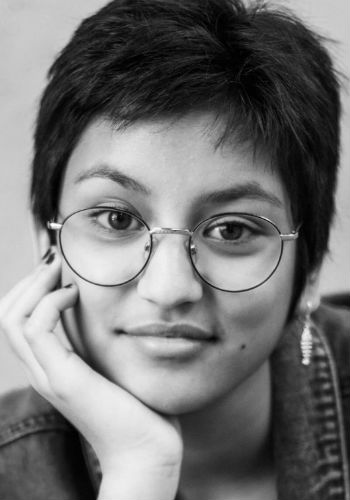
Deborah Faye Lee

Elouise Eftos: You play a very strong female role in the play, what similarities did you find you had with your character Wendy?
Deborah Faye Lee: Part of Wendy’s strength is that she is unafraid to stand up and speak out, not just for herself but for others in her community. We do share certain similarities in that sense. She is also unrelenting in her pursuit of what she wants, even if the odds are against her.

If you could play any of the other playful characters in the cast, who would you choose and why?
It’s a tough one but I think it’ll come down to Joseph K, Ian Huld or Rose. Joseph K, because it’ll be such an adventure having to juggle all the other characters for the entire show whilst going through the ups and downs in his journey, which are a lot… that would be such a challenge! Ian Huld and Rose have such iconic lines which always puts a smile on my face. That would be so much fun.

Do you have any pre show rituals I should know about before opening night?
I like to have clear headspace before I go on. So after getting my makeup done, I usually pack my dressing table and make sure it’s neat and clear. I tend to not listen to any music and also try not to look at my phone from about the half hour call.

Your character gets to travel to NYC for business, where would you like to be flown over to for work?
That’ll be such a luxury! It’s a hard one between Portugal and Spain. But I’d love to be flown to Barcelona in spring. You would get lots of daylight so that gives you more time to explore the rich culture, architecture and savour that glorious food. It’s every foodie’s dream!

Now I assume you’ve never been arrested but if you were, what would your crime be?
Ha! A group of schoolmates and I were previously rounded up by the police for trespassing. We snuck into a compound and were playing one of those haunted houses type of thing. People were concerned after hearing lots of screaming coming from where we were. There was a bit of chase from the police too, so that was quite an experience! But to answer your question, I’m known to have a weird fascination with potatoes so my crime would probably be something related to that. FYI apparently it’s an offence to be in possession of more than 50kg of potatoes in WA!

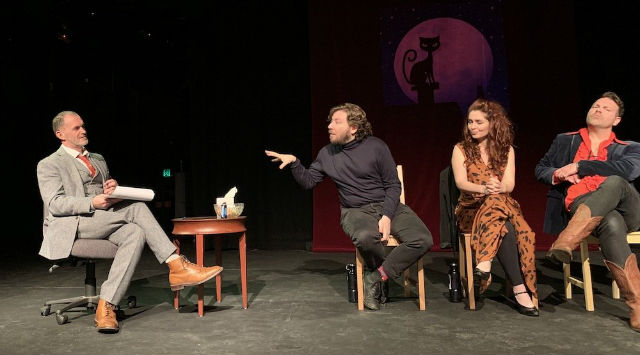
Elouise Eftos and Deborah Faye Lee can be seen in Joseph K, by Tom Basden.
Dates: 1 – 18 May, 2019
Venue: Limelight on Oxford

Review: Cat On A Hot Tin Roof (Sydney Theatre Company)

Venue: Roslyn Packer Theatre at Walsh Bay (Sydney NSW), Apr 29 – Jun 8, 2019
Playwright: Tennessee Williams
Director: Kip Williams
Cast: Addison Bourke, Tristan Bowes, Peter Carroll, Harry Greenwood, Emily Harriss, Jye McCallum, Josh McConville, Zahra Newman, Pamela Rabe, Holly Simon, Nikki Shiels, Lila Artemise Tapper, Arie Trajcevski, Hugo Weaving, Anthony Brandon Wong, Jerra Wright-Smith
Images by Daniel Boud

Theatre review
Characters in Tennesse Williams’ Cat On A Hot Tin Roof suffer immense anguish. Regardless of where they happen to reside in the hierarchy of their social order, powerful or powerless, Maggie, Brick and Big Daddy are each unable to escape a torturous existence. A result perhaps of the family’s wealth, or maybe the American deep south in 1950s had truly been indiscriminately stifling, or life is simply unbearable no matter one’s choices and orientations; the beauty of Williams’ play is that it explains little. In its exhaustive excavations of human emotion however, we identify the truths of our beings at their deepest, but Williams leaves us to draw our own conclusions, on the causes of, and the resolutions for, all the pain that inevitably befalls us.

There is a lot that is sublime in director Kip Williams’ vision. A momentary glimpse of sitting Vice President Mike Pence on Brick’s television set, is a powerful suggestion of the play’s timelessness. Oppressive aspects of Western values, rooted in white patriarchy, is the undercurrent disquiet that drives the action. The production manifests a sense of hopelessness appropriate to the playwright’s pessimism, one that is masochistically gratifying, as is typical of classic melodrama, but also undeniably thought-provoking.

Brick and Maggie’s bedroom is sleek and modern in style, with dark colours and hard edges representing a masculine space in which Maggie’s lack of status is evident. Designed by David Fleischer, the stage is visually seductive, but arguably ineffectual with invisible doors, for a play that repeatedly involves itself with notions of intrusion. Stefan Gregory’s music takes its cues from film noir, nostalgically evocative and very pleasurable. Lights by Nick Schlieper are cold, almost menacing in their depiction of emotional torment. The many instances of fireworks in Act II are controversially manufactured, each time overwhelming our senses for several seconds, with their cacophonous, and repetitive, disruptions into Brick and Big Daddy’s long confrontation.

Actor Zahra Newman is entirely splendid as Maggie, dejected but determined, a broken woman hanging on to the little that she has, to turn a living hell into something coherent. Newman’s extraordinary instinct and artistic inventiveness, along with an uncompromising vigour, make Act I of Cat On A Hot Tin Roof a personal tour de force that has us hopelessly exhilarated. Big Daddy is masterfully performed by Hugo Weaving, who although brings to the role nothing that is unexpected, demonstrates his unparalleled stage presence and a searing conviction that absolutely captivates. The exaggerated theatricality he employs is riveting, with a psychological accuracy that allows us to perceive complicated dimensions of human nature, as we luxuriate in the sumptuousness of his delivery. Also very resonant, is Harry Greenwood as Brick, who overcomes his physical dissimilarity to the character, for a convincing portrayal of a defeated man who retreats into self-abuse. Greenwood’s approach is restrained by comparison, but he adds dynamism and texture to how the story is conveyed, on what is often a very loud stage.

Brick’s indulgence in alcoholism looks as though he is willing himself to die. Maggie on the other hand, who has much less to live for, can be seen maniacally scrambling for survival at every moment. Those are the extremes of how we can be, when facing the worst. The people in Cat On A Hot Tin Roof are all left to their own devices. Although under one roof, this is a family whose bonds are weak, with relationships built on mendacious foundations (the word “mendacity” is mentioned multiple times). Unable to locate anything honest and real, what they have can only feel empty; distracted by material riches, it is loneliness that is left unnoticed and festering. We see no love in this household, and realise that no peace or happiness could ever come their way.

www.sydneytheatre.com.au

Review: Sensitive Guys (Cross Pollinate Productions)

Venue: Kings Cross Theatre (Kings Cross NSW), Apr 30 – May 11, 2019
Playwright: MJ Kaufman
Director: Blazey Best
Cast: Natasha Cheng, Nancy Denis, Alex Malone, Shell McKenzie, Samm Ward
Images by Clare Hawley
Theatre review
We meet two small groups of students at an American college. One is a Men’s Peer Education Group, and the other a Survivor Support Group comprised of women victims of sexual assault. MJ Kaufman’s 2018 play Sensitive Guys looks at young men grappling with sexual politics, at a time when boundaries seem to be shifting, as the traditionally subjugated learn to push back against injustices of many kinds. In the story are what we might term woke men, but we discover that thoughts and actions do not necessarily correspond, for those who claim to know better. There is excellent humour in Kaufman’s writing, and although didactic in nature, its clarity of intention makes for a political work that feels immediate and digestible.

It is a passionate production, cohesively designed by an efficacious team of creatives, to facilitate a simple depiction of contemporary concerns. Directed by Blazey Best, the show offers an accurate representation of our hopes and anxieties as they stand today, in relation to the development of discussions around sexual misconduct. The show is a consolidation and reiteration of recent ideas from the Twitterverse, no longer fresh but still pertinent. An excellent ensemble of five actors deliver a well-rehearsed performance, earnest but also comical, able to keep us amused as they take on the responsibility of expounding some valuable lessons.

The young men in Sensitive Guys have much to unlearn; their understanding of sex and gender is revealed to be more damaging than they had ever imagined. There is a pleasure in watching bad boys flagellate themselves on stage. We want to see them punished, as well as see them become better people. The moral of this story is incredibly basic, but the truth is that we keep imparting to our children, old values that are harmful to many and beneficial to few. How we teach masculinity and femininity must come under scrutiny, as do our reasons for insisting on those binaries.

www.crosspollinate.com.au

5 Questions with James Elazzi and Aanisa Vylet

James Elazzi

Aanisa Vylet: What story does Lady Tabouli share with its audience, and who is Lady Tabouli?
James Elazzi: Lady Tabouli is a story about what it means to come to terms with the past, how the past can mould who we are as adults and how every single person we meet plays a part in our journey, right up to today. Lady Tabouli is freedom, within all the characters in my play. It is the protagonist but is also all the people that are related to him. It is a knock on effect. Lady Tabouli is a celebration, it is hope, it is healing the pain of yesterday to finally reaching a state of liberation. To live in our truth, or try our best to live life like that.

What inspired you to create this story?
My inspiration for Lady Tabouli is derived from the people around me. It’s inspired by people that I love and it is my love letter to them. It’s inspired by those trailblazers that did not accept what was expected of them. It’s about standing up for our right to be happy. But with happiness and freedom, there is a price to pay. Are you willing to pay this price? I’m inspired by those who do not live their lives in other people’s shadows. Brave, strong people that have been broken, but have healed and learned from their mistakes.

When did you realize that you were a writer?
I’ve been a writer ever since I knew how to write. I’ve only recently had the courage to share my stories with the world, I hope to allow change through storytelling. I want to represent my community and where I come from in a clearer light. To write about the complexities that exist within my community,

As an artist of colour living in Western Sydney, what would you like to see more of in our greater artistic community?
Different perspectives, different storytelling, migrant stories, stories about women that have broken the mould and persevered. I want to see all types of Australians on the stage.

What is the best advice that you have been given?
Every single rule can be broken. Never fear to have a voice and a to need to be heard. That change is never ending and our journey never ceases until we cease to breathe.

Aanisa Vylet

James Elazzi: Tell me a little about your new play Sauvage.
Aanisa Vylet: Sauvage is a myth that I have created about the patriarchy. The seed for this play began in 2015. I was living in Barcelona and I asked myself… who am I as a storyteller… beyond my religious background, my culture and my socialization? That question led me to create a myth. In doing so, I have found a sense of freedom that I could only imagine, not only as a storyteller, but as a woman. The play has been a joy to create. We look forward to sharing this joy and the many layers of this wild myth with you.

What inspires you to write?
The deep sense to fulfill a “need”.

What would you like to see more of on Australian stages?
More scratch performances and safe, supported spaces for artists to experiment.
A richer landscape of theatrical forms.
More Australian feminist theatre and practitioners.
More focus on the “spirit” of the work.
More Australian plays that do more than to sate our audience’s wants… I want more plays that know how to tap into what we need.
(I could say much more but, I will keep my answer short…)

What type of writers inspire you?
Ones that admit to having their own kind of genius and their own kind of foolery.

Things that you believe are essential in the world of writing.
The right to process. We demand our right to process, a process which allows us and our work to evolve.
Artist dates / processes of silliness and play.
A healthy personal life.
Coffee.

James Elazzi and Aanisa Vylet present new work at Batch Festival, by Griffin Theatre Co.
Dates: 25 Apr – 11 May, 2019
Venue: SBW Stables Theatre

5 Questions with Deng Deng and Alice Keohavong

Deng Deng

Alice Keohavong: So, who is Deng?
Deng Deng: I am a Sudanese born actor and writer who came to Australia in 2002 along with my family. I’m the eldest of seven children. I graduated from Trinity Catholic College in 2011 and also from the Academy of Film, Theatre and Television.

What drew you to Blood On The Cat’s Neck?
I was drawn by the storyline more than anything else. I do love the idea of an alien who is here to learn from humanity and exploring what makes us who we are, whether it be good or bad. Plus I also love anything sci-fi.

What has been a highlight of your acting career?
To this day the biggest highlight of my career is performing at the Sydney Opera House. Even though it wasn’t on the main centre stage, being able to perform there has been by far the best and most amazing part of my acting career. I remember coming down the steps of the Opera House and having the biggest smile on my face, ever since nothing has come close to this feeling.

What has been an influential piece of advice you’ve received?
Make your own work. I know that waiting around can be annoying at times – I think especially in this industry – but making my own work (whether it be short films or writing) has kept me busy and I never have nothing to do. It helps me stay motivated in my everyday life or last least as active as I can be, so I believe that’s the best advice that I have been given.

What would you like to tell/warn/promote to people about Montague Basement?
If you have an opportunity to work with them, do it. I’m not saying this because I’m doing this play now, it’s because of who they are as people. They care about this industry. I love the amount of work and time they put into their work, and caring. I know that these are people I can see myself working with again.

Alice Keohavong

Deng Deng: What drew you to this industry?
Alice Keohavong: As a child, I had (still do) an overactive imagination. I was constantly entertaining myself with made-up stories. In high school, when I found myself surrounded by a community of people who loved telling stories and weren’t afraid to be silly, fun and human, I was hooked. I’ve also always been fascinated by people and trying to understand why we do the things we do… I was either going to be an actor or a psychologist…

What is your favourite production so far and why?
A stand out for me has a lot to do with nostalgic reasons. I was in high school and saw The Pillowman at Belvoir. Growing up, I didn’t have many opportunities to experience theatre and whenever I did, it was always an event and forced upon us by school. This show was an extra curricular activity our drama teacher proposed and one of the first I went to outside of school hours, surrounded friends who were also keen to experience it. This is one of many reasons why I’m so grateful for the wonderful teacher we had. The show had me spellbound… and here I am.

Which are you more drawn towards theatre or screen?
Both for different reasons. I love the thrill of immediacy with theatre. I love that the medium is so transient and I enjoy the sense of community you build through the rehearsal process. With screen work, I love the naked intimacy you can get. You feel quite bare and vulnerable in a very different way.

What’s the most enjoyable part of any rehearsals process?
The first dress run. After all the weeks of hard work, you and your new family are thrown together with all the other elements of the show, and you get to see what the hell it is you’ve actually made. It is frightening and adrenalin-pumping and I love it.

Tell me something about Alice that people don’t know about?
I hate watermelon. I mean, I HATE the stuff. Why. Why would you eat that? Watermelon smelling bubble bath? Sure. Watermelon earrings? Cute. Just please don’t put that thing into my mouth.

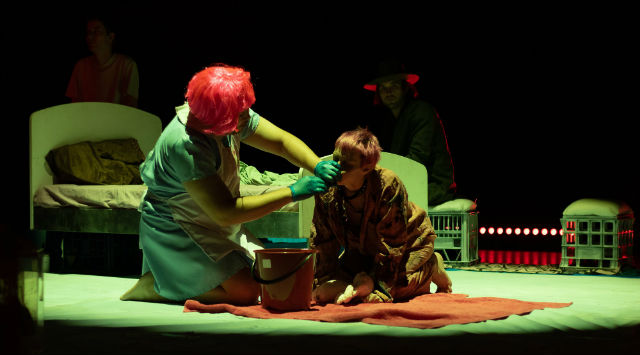
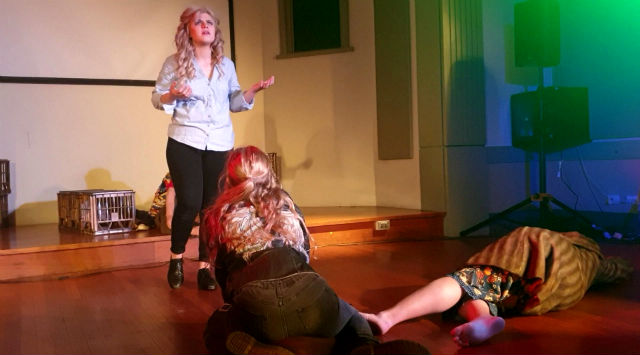
Deng Deng and Alice Keohavong can be seen in Blood On The Cat’s Neck, by Rainer Werner Fassbinder.
Dates: 22 May – 1 June, 2019
Venue: Kings Cross Theatre

Review: Pygmalion (New Theatre)

Venue: New Theatre (Newtown NSW), Apr 23 – May 25, 2019
Playwright: George Bernard Shaw
Director: Deborah Mulhall
Cast: Colleen Cook, Steve Corner, Tiffany Hoy, Lisa Kelly, Emilia Kriketos, Natasha McDonald, Mark Norton, Robert Snars, Shan-Ree Tan, Sean Taylor, Vitas Varnas, Emma Wright, Tricia Youlden
Images by Bob Seary

Theatre review
The most gratifying aspect of Eliza Doolittle’s story is her refusal to be content with a life of misery, no matter what form it takes. Whether an impoverished flower girl, or a faux aristocrat, she is compelled to break free of shackles, as soon as she identifies an opportunity to do so. George Bernard Shaw’s Pygmalion talks about independence, and dares to place a feminine figure at the centre of speculations, in a work that tries to unpack the implications of class in British society, along with twentieth century notions of personal autonomy. Having coincided with the suffragette movement of the 1910’s, Pygmalion can be seen as a remnant of early feminism, with a female lead determined to discover the conditions for freedom, even if the playwright does put her through an unyielding series of torturous circumstances.

It is a wordy script, that Deborah Mulhall tries to overcome as director, by injecting speed and energy into its rendering. There are no indulgent pauses and few languid moments of sentimentality, resulting in a show full of vim and vigour. Intellectual complexities are occasionally compromised, in the absence of space for meaningful rumination, but the production holds our attention adequately for the duration, perhaps trusting that we would attain some degree of poignancy in the hours thereafter. Mulhall’s steampunk costumes, although well executed, are a curious addition, for a narrative not of any science-fiction or fantasy genre. Tom Bannerman’s remarkable set design is stylish, and cleverly conceived to facilitate dynamic stage action.

Actor Emma Wright is a strong Eliza, playful but firm in her interpretation of the classic role. Technically accomplished, yet an instinctual presence and emotionally rich, Wright’s modern approach is a wonderfully refreshing take of that familiar persona. An impassioned Steve Corner elevates the Henry Higgins character, to someone much more vulnerable than is conventionally depicted, for unexpected layers to the story that prove highly rewarding. Colonel Pickering is less surprising, but nonetheless effectively portrayed by Shan-Ree Tan, who impresses with one of the more sturdy performances from its supporting cast.

At the end, we understand that Eliza wants to be her own person, unbeholden to anyone. We also realise that in England a hundred years ago, spaces for women to thrive independently are not yet widely established. Eliza’s fate was not an optimistic one. With the passage of time, we certainly feel more able to operate in accordance with our individual sovereign wishes. Women are gainfully employed like never before, in areas of work unimaginable a century ago, and access continues to widen as we persist with the dismantlement of barriers. Progress is undeniable. If only we would stop our prejudice and judgement on women who look and sound different.

www.newtheatre.org.au

Review: Frida Kahlo: Viva La Vida (Théâtre Excentrique / The Old 505 Theatre)

Venue: The Old 505 Theatre (Newtown NSW), Apr 23 – May 4, 2019
Playwright: Humberto Robles (adapted by Gaël Le Cornec and Luis Benkard)
Director: Anna Jahjah
Cast: Kate Bookallil
Images by Mansoor Noor

Theatre review
Frida Kahlo contracted polio at six, and at eighteen, a traffic accident further injured her body, causing a lifetime of excruciating pain, that would inform all of her work and legacy. In Humberto Robles’ one-woman play Frida Kahlo: Viva La Vida, we see Kahlo trapped at home, alone with her thoughts and the constant state of torture that her body must endure. She talks about art, love, business and politics, offering an opportunity for her legions of admirers to feel as though at close quarters with the Mexican icon.

Performed by Kate Bookallil, whose jovial presence imbues the show with warmth, insisting that audiences regard Kahlo’s story with only open hearts. Her exuberance conveys a lightness to the character that has a tendency to ameliorate some of Kahlo’s struggles, but we engage with her nonetheless, always caring about our protagonist, and hang on to every word she says. Director Anna Jahjah’s spirited approach makes for a playful show, appropriately colourful, especially with its visual manifestations. There could be greater tonal shifts, for a more segmented presentation to help us better absorb the text, but Frida Kahlo: Viva La Vida‘s strong statements about resilience and perseverance, bears an appeal that is universal.

Kahlo’s defiance is inspiring, powerful, and beautifully transcendent. We see her fighting to the death, and understand the depths of our individual capacities for hardship. Life is not fair. Although Kahlo did experience success late in life, she never had the privilege to see with her own eyes, the extent to which her work has reached, and touched, women everywhere. Our collective admiration would have empowered her in ways we can only imagine. We are all queens, when we raise each other up, and stay connected in mutual succour. If we are determined to leave no one behind, what we can achieve will truly be unprecedented.

www.theatrexcentrique.com

Review: Ajax (Burning House / The Old 505 Theatre)

Venue: The Old 505 Theatre (Newtown NSW), Apr 23 – May 4, 2019
Playwright: Sophocles (adapted by Jonothan Graffam, Robert Johnson)
Director: Robert Johnson
Cast: Leikny Middleton, Chad O’Brien, Seton Pollock, Michelle Robertson
Images by Mansoor Noor

Theatre review
When we meet Ajax, the revered warrior is in a state of disillusion, confused not only by bloodshed from endless battles, but also by the futility of his ambitions. Jonothan Graffam and Robert Johnson’s adaptation of Ajax attempts to reinstate relevance, in transporting Sophocles’s story by millennia to the present day. Its spirit is still in that conspicuous style of the classic Greek tragedy, but its brevity can cause a deficiency, as we try to construct meaningful narratives from its abbreviations.

Director Robert Johnson does good work with atmosphere; there is a certain level of sophistication to how the production looks and sounds, perhaps as a result of the simplicity evident in his approach. A very substantial portion of the show consists of monologues by the eponym, and on this occasion, Seton Pollock plays Ajax, covered in blood, and in a lot of anguish. It is a performance that begins with meters in the red, and stays there the whole time. His conviction is admirable, but that unwavering delivery of hyper intensity, quickly turns alienating.

Mythology sends our women and men to war. When our young go seeking glory, it is our stories that determine where they choose to find it. So much of myth making today, is about defending ourselves from those who want to corrupt and destroy our hitherto unsullied way of life. Our refusal to understand those who are conveniently classed other, and our insistence on seeing ourselves as being inculpable and above reproach, are the fundamentals on which we build national identity, and the justification for many lives lost. It is certain that defence is necessary, for evil is real, but peace must be found in many more ways that through the sacrifice of our brave souls.

www.burninghousetheatre.com

Review: Rabbit Hole (Chippen Street Theatre)

Venue: Chippen Street Theatre (Chippendale NSW), Apr 18 – 27, 2019
Playwright: David Lindsay-Abaire
Director: Christie Koppe
Cast: Alison Chambers, Rachel Giddens, Peter-William Jamieson, Imogen Morgan, Sam Wallace

Images by Benjamin Ryan
Theatre review
We meet Becca and Howie just months after the death of their small child. It is disconcerting that Becca seems unable to mourn her loss in a predictable way, and we wonder how her strategy of avoidance is going to pan out. David Lindsay-Abaire’s Rabbit Hole talks about the complex nature of grief, and the different things people have to do, in response to trauma. Positioned next to her husband’s more obvious approach, Becca looks frighteningly detached, refusing to speak of her pain, and only occasionally able to acknowledge the calamity that had befallen her home.

It is an energetic show, with a good amount of dramatic intensity, established by director Christie Koppe, to keep us engaged. Imogen Morgan portrays Becca as an animated personality but also, appropriately, emotionally stunted. The coldness of her exterior is articulated well by Morgan, but the true depths of Becca’s sorrow is often missing as a result. Her denial of her own suffering, is a fundamental ingredient of the story, but when the audience loses contact with that sense of torment, the show accordingly loses its sense of authenticity.

Howie the husband is played by Peter-William Jamieson, who delivers a convincing interpretation of bereavement inside his personal suburban living hell. The charming Alison Chambers is a genuine presence that makes everything she does for Becca’s mother, Nat, seem natural and believable. Rachel Giddens and Sam Wallace are compelling performers, both able to secure our attention whenever their supporting parts take centre stage.

Theatre about trauma is mesmerising. We gawk at people and their suffering, hoping to find salvation for our own unresolved troubles, even if only via a distant proxy. There is something liberating about Rabbit Hole‘s contrasting representations of the mourning experience. We are individuals who navigate the world in different ways, absorbing shocks as we go along, trying to stay in one piece until the inevitable end. It is naive to want to leave this existence unscathed, but to start each morning hopeful for a good day, whatever that may look like, must surely be a reasonable expectation, no matter one’s circumstances.

www.chippenstreet.com | www.facebook.com/RabbitHole2019

Review: Alice In Slasherland (Last One Standing Theatre Company)

Venue: Old Fitzroy Theatre (Woolloomooloo NSW), Apr 18 – May 11, 2019
Playwright: Qui Nguyen
Director: Rachel Kerry
Cast: Justin Amankwah, Jack Angwin, Josh McElroy, Bardiya McKinnon, Mia Morrissey, Laura Murphy, Stella Ye
Images by Robert Catto

Theatre review
Lewis is a regular American teenager, who finds his town suddenly overwhelmed by Lucifer and other spirits of the underworld. With people being slaughtered everywhere, Lewis and his friends have to fight their way to survival. Qui Nguyen’s Alice In Slasherland bears all the hallmarks of a B-grade horror flick; an outlandish storyline, predictable characters and lots of blood and gore, along with a very healthy dose of kitsch and bad taste humour that makes the show more than a little tongue-in-cheek in its references to genre.

The production is messy, but also intentionally trashy. Like every low-budget movie ever made, we can identify all the flaws in this staging of Alice In Slasherland, but its imperfections do not preclude us from enjoying the silly fun that it so passionately delivers. Director Rachel Kerry’s vision for the staging is wonderfully vivid, but her ideas are almost never executed to perfection. The cast is remarkable for being able to embrace the clumsiness of their show, to convey a sense of humour that quite miraculously, works with, or perhaps against, the many technical improficiencies. Alice In Slasherland‘s horror aspects do almost nothing for us, but its comedy is certainly a joy.

Actor Bardiya McKinnonis is a spirited Lewis, appropriately over-the-top with the terror that he depicts. The eponymous Alice is played by Stella Ye, who meets the physical demands of the supernatural being, with a persuasive and dynamic athleticism. Lucifer is a vampy creature, as interpreted by Laura Murphy, whose capacity for camp seems to know no bounds. Her musical theatre abilities prove refreshing in a show that cares little about polish. Justin Amankwah is puppeteer for Edgar the bear, barely two feet tall, but huge in personality, thanks to Amankwah’s beautiful animation and extraordinary voice work.

Depending on one’s own tastes, there is a kind of self-deprecating humour to Alice In Slasherland that can be highly amusing. We vacillate between laughing at it, and laughing with it, trusting that none is expected to take any of this seriously. Over the coming weeks, the production will no doubt lose some of its raw edge, but as long as we can all be encouraged to remain playful for the duration, it would mean a job well done.

www.lastonestandingtheatreco.com | www.redlineproductions.com.au