5 Questions with Tariro Mavondo and Jayna Patel

Tariro Mavondo

Jayna Patel: Do you have any pre-show rituals or routines?
Tariro Mavondo: Yes I do. My rituals usually differ depending on what the role I’m playing requires, for instance if it is a highly physical role I will do an intensive physical as well as vocal warm up. I always do a 15-30 min movement yogic sequence to get me into my body and out of my head as well as a set of personal affirmations and 10-15 min breathing meditation. A ritual for a while now has been to brush my teeth before every show to cleanse the day and enter the theatrical space of imagination, possibilities and wonder. I’m partial to candles, dim lights and soft music in my dressing room  and maybe one or two hard hitting tracks too.

If you were to recast the play with celebrities, who would you cast as who?
In line with Adena’s casting because I think she nailed it I would cast Frances McDormand in the principal role of Titus, Vanessa Williams as Tamora, Danai Gurira as Aaron, Peter Dinklage as Saturninus, Travis Fimmel as Bassianus/Marcus double, and I’d still cast Jayna, Tony and Grace because y’all stars in my eyes!

If you had the chance to have dinner with William Shakespeare, what would you ask him?
I’m interested in the theory of Emilia Bassano a black woman who was one of the first professional females writer’s in Elizabethan England having wrote his plays and the theory of her being the dark lady he refer to in his sonnets so I’d probably ask him about that. I’d also put on my best hip hop artists and ask him if he digs it because my guess is he’d be really into it!

Your purple hair for this show is so bold and beautiful! Is there anything you wouldn’t do to your hair for a show?
Thank you! Yeah I’m loving the vibrancy and vitality of wearing purple hair. I have done many things to my hair for the screen and stage there really isn’t anything I wouldn’t do I don’t think. Although my preference is keep it as natural looking as possible and not wear wigs that are closer to European hair if the character doesn’t require that. Black hair has a complete politic of its own and reclaiming the nappy kinky coil look when I can is important to me.

What’s your favourite kind of pie? (excluding Chiron & Demetrius flavour)
I don’t eat very much meat so I’d probably pick a sweet dessert pie – anything with apple. Apple and rhubarb or blueberry. Apple pie is probably my favourite winter dessert I’m also largely dairy free but cream on my apple pie is a must, haha definitely my guilty pleasure!

Jayna Patel

Tariro Mavondo: What has been your favourite part of making Titus Andronicus? And why? 
Jayna Patel: I love Adena’s style of theatre making because it is a collaborative process, and as a young person who often has no say in what goes on to the stage (and sometimes in life!) it’s really refreshing and empowering to have been able to contribute.

You often wear cool political t-shirts and musical theatre t-shirts, what’s your favourite? And why? 
My favourite t-shirt says ‘anti-colonial, anti- capitalist, for climate justice’ because I’m a climate activist who’s frankly quite scared for the future of the planet given the current environmental and political situation – I love being able to express my views & send an important message using what I wear! 

What drew you to wanting to work on Titus?
It’s a pretty funny story actually. Before I was sent this offer I had no idea what Titus Andronicus was, in fact I wasn’t too fond of any Shakespeare at the time! But my mum came to me and said “oh hey, there’s this Shakespeare play thing going on, and they want a 15 year old to audition, do you wanna give it a go?” and i said “sure why not!” So I hear that I actually got in and I’m stoked, and then my dad says “isn’t that Shakespeare’s most violent play?” and the excitement began there…

As your first main stage gig at the Opera House how are you feeling? And how are you managing the school load as well?
The first day we got into the venue, I was buzzing with excitement/nerves and I haven’t stopped! I cannot wait to hit the stage with this amazing team of artist and creatives. And as for school work… uh, let’s just say hopefully none of my teachers are reading this article!

Catch Tariro Mavondo and Jayna Patel in Titus Andronicus, by William Shakespeare.
Dates: 27 Aug – 22 Sep, 2019
Venue: Sydney Opera House

Review: Affliction (The Sydney Fringe)

Venue: Legs On The Wall (Lilyfield NSW), Sep 7 – 8, 2019
Playwright: Lauren Orrell
Director: Steve Le Marquand
Cast: Jack Berry, Martelle Hammer, James Hartley, Deborah Jones, Isaro Kayitesi, Lauren Orrell, Luke Townson
Images by Isaro Kayitesi

Theatre review
Lucy is 12 years old, with mental health issues requiring professional medical care, but she tries to secretly tame elements of paranoia and psychosis, afraid of repercussions if the truth of her condition is made known. Lauren Orrell’s Affliction reveals the stigma surrounding mental illness, and the ignorance that still exists in relation to the subject. It offers a valuable glimpse into personal experiences that are too often hidden, allowing us to gain a better understanding of those challenges. The play is sometimes educational in tone, but its best moments are humorous in an absurdist style, with an irony that is smart and satisfying.

Directed by Steve Le Marquand, the production is macabre but surprisingly colourful in its explorations of some very dark ideas. A more intimate environment would allow us greater engagement with the characters, but the vastness of space is otherwise visually appealing. A video interlude by Marianne Khoo brings an unexpected dimension to the story, and an additional opportunity for twisted laughs that many will find enjoyable. Music by Clare Heuston offers excellent tension to some very theatrical scenes of psychological turmoil.

Playwright Orrell is also star of the show, convincing in her portrayal of a troubled child, strong not only with the emotions she is able to express, but also with the sheer physicality that she presents on stage. A grotesque nurse Doreen, is played by James Hartley whose comedic chops prove to be highly amusing. It is a small part that leaves us wanting much more. Deborah Jones is fabulous in her various roles, impressive with the range of monstrous personalities she is able to embody so effortlessly.

Affliction can feel pessimistic, but its creator makes a powerful and positive statement, about overcoming adversity with this ambitious work. Orrell talks openly about her own struggles with mental health, and to see her channelling those frustrations into art is most reassuring. We see a woman rejecting cultural impositions, choosing instead to define her own life, and to build her own identity, from what she sees to be authentic and meaningful. Disadvantage can sink us, but more than likely, the human spirit can see us swimming our way to the top.

www.catchmydisease.weebly.com

Review: Marisol (The Sydney Fringe)

Venue: Erskineville Town Hall(Erskineville NSW), Sep 3 – 7, 2019
Playwright: José Rivera
Director: Erin Louise Cotton
Cast: Chloe Baldacchino, Isabelle Fredericks, Sarah Maguire, Elizabeth Nicholls, Simon Thomson, Matthew Vautin

Theatre review
Marisol Perez is informed by her guardian angel that there is a revolt in the heavens. God is old and senile, no longer able to serve the universe, and a struggle for power is now under way. This means that earthlings are for the moment, no longer protected by the divine, and in José Rivera’s Marisol, it appears that when left to our own devices, we can only devolve into chaos and violence. The writing is surreal, and although approaching 30 years old, its apocalyptic sensibility seems more relevant than ever.

The production is at its most gratifying when actors are able to embody the play’s bizarre qualities, and approach the performance with an unabashed extravagance, whether dramatic or comedic. Matthew Vautin and Elizabeth Nicholls have strong moments on stage, both able to convey the dehumanised madness of the play’s dystopian vision. The eponymous role is taken on by Chloe Baldacchino, who brings a delicate timidness that can seem out of place. Director Erin Louise Cotton shows us the utter confusion of a world abandoned by all that is celestial, but without communicating anything particularly powerful with the text, Marisol leaves us with little more than an empty nihilism.

When we once again feel as if everything is going to hell in a handbasket, and the pessimism cripples us from being able to take any meaningful action that would make this world better, it is perhaps useful to indulge momentarily in delusions, that there are higher beings in the ether who have a greater purpose beyond our comprehension. It is one thing to feel disappointed with the way things are, but quite a lot worse when we turn hopeless, thinking that life is absolutely meaningless. The truth is that we know nothing outside of our tiny individual existences, but dreaming up gods and deities has always proven to be useful in making the human experience at least tolerable. We manifest the divine in our image and imagination, relating to them as separate superior entities, but actually, we can only ever pray to the sacred that resides within.

www.gradco.studio

Review: Nine (Seymour Centre)

Venue: Seymour Centre (Chippendale NSW), Sep 5 – 14, 2019
Book: Arthur Kopit
Music & Lyrics: Maury Yeston
Director: Alexander Andrews
Cast: Maddison Burton, Sophia Charters, Phoebe Clark, Kelly Goddard, Ellyn Gwillim, Amy Humphrey, Tayla Jarrett, Tisha Kelemen, Katelin Koprivec, Michele Lansdown, Andy Leonard, Victoria Luxton, Matilda Moran, Sarah Murr, Sophie Perkins, Caitlin Rose, Petronella van Tienen, Megan Walshe
Images by Blake Condon

Theatre review
Guido Contini is caving under pressure, unable to start work on another film, after the failure of his last three efforts. Instead his mind wanders, and in the 1982 musical Nine, we see him obsess over all the women he has loved, as though longing for one of them to turn into a muse and solve his writer’s block. An old-fashioned work, with a male protagonist placed firmly at the centre, surrounded by innumerable women often looking disposable, Nine however still boasts some of the finest melodies in the Broadway canon, with Maury Yeston’s songs remaining as stirring as they had always been.

Director Alexander Andrews assembles all the parts proficiently, and his production bears a level of polish that almost glosses over the regressive nature of its gender representations. Antonio Fernandez’s energetic musical direction, Madison Lee’s imaginative choreography, and James Wallis’ multifaceted lighting design, all combine to deliver an enjoyable, if slightly too traditional, musical extravaganza.

A cast full of conviction, determined to bring vibrancy to the stage, with Andy Leonard in the leading role, offering nuance in his acting, but not quite satisfactory in terms of vocal requirements for several of his songs. The quality of singing is in general slightly disappointing, although it must be noted that the “Folies Bergeres” number is performed with remarkable wit, by Katelin Koprivex as Stephanie and Michele Landsown as La Fleur, both impressive with the vigour they introduce for their memorable scene.

Writing can date, but theatre must always be made for now. Some works need a greater attempt at innovation, so that they can speak more resonantly with audiences of the time, and Nine is certainly an example of how a relic should be updated to match conversations of the day. Many will find it jarring to see so many women on this stage serving no other purpose than to facilitate the narrative of a man in delusion. For many others though, the sheer pleasure of hearing these splendid songs, is more than enough to make up for its political faux pas.

www.littletriangle.com.au

Review: Matriarch (Jinda Productions)

Venue: The Old 505 Theatre (Newtown NSW), Sep 3 – 7, 2019
Playwrights: Sandy Greenwood, Lauren Jarrett, Oliver V. Cowley
Director: Jasmin Sheppard
Cast: Sandy Greenwood
Images by Seiya Taguchi

Theatre review
Sandy Greenwood is a Koori woman deeply invested in her cultural heritage. In her one-woman show Matriarch, we learn that the experience of inter-generational trauma, makes it almost impossible for an individual like Greenwood to live without an intimate understanding of historical events that have affected her family. Greenwood’s story reaches back to her great-grandmother and beyond, involving Aboriginal women from three clans who had to battle unfathomable hardship, through colonisation, massacres and stolen generations, to raise children and to preserve bloodlines.

At just over an hour, the material we encounter is at once refreshing, and extraordinarily rich. The text of Matriarch often utilises slang and dialect unique to this land, and the voices that Greenwood channels in her portrayals of these marvellous mothers, are truly sublime. We witness their triumphs and their challenges, share in their humour and feel tremendous sadness for the injustices imposed upon them. Greenwood’s performance is relentlessly powerful. Her physical discipline, and her emotional range, insist that we are engaged and moved, by her honest expressions about life for Indigenous peoples in Australia.

Directed by Jasmin Sheppard, the show is both poignant and consistently entertaining. Every moment is given accurate focus, so that the audience responds precisely as the artists intend. Music by Sean Ryan enhances a sense of cultural specificity to the production, helpful in transporting us to regional locales that are so fundamental in the weaving of narratives about belonging and about land.

Before we can properly move forward, we need to own up completely to all the atrocities that have been committed in this process of colonisation. Problems cannot be adequately fixed, if the truth of these problems are not wholly revealed. The continual denial of responsibility, total or partial, means that those in power can only ever try to mend the surface of these issues. The passage of time means that the roots of our ills can only grow deeper. Indigenous voices must be listened to, and obeyed, right now.

www.jindaproductions.wordpress.com

Review: The Last Wife (Ensemble Theatre)

Venue: Ensemble Theatre (Kirribilli NSW), Aug 30 – Sep 29, 2019
Playwright: Kate Hennig
Director: Mark Kilmurry
Cast: Emma Chelsey, Emma Harvie, Simon London, Nikki Shiels, Bishanyia Vincent, Ben Wood
Images by Phil Erbacher

Theatre review
In Kate Hennig’s The Last Wife, we watch Catherine Parr make the most of an unfortunate situation when she is forced to marry King Henry VIII. Not content with being wallflower and figurehead, she finds ways to be useful, trying to place herself in a position of power, with mixed results, but hugely instrumental in the reinstatement of princesses Mary and Elizabeth to the line of succession. The play imagines its characters with contemporary sensibilities and a corresponding modern language, each one is given a sense of cheeky sass that renders an entertaining immediacy for their storytelling. Not quite an entirely feminist reckoning of the past, The Last Wife is English history from a new perspective, the reframe of which provides a richer understanding of what had happened, and more importantly, of how women continue to have to navigate the patriarchy.

Directed by Mark Kilmurry, the production emphasises dynamics in these legendary relationships, able to impress upon us the intimate family problems of the royals, that bear reverberations that continue to affect us today. Its discussions about gender politics however, feel rudimentary, as do design elements that are at best adequate. Work on sound (uncredited) in particular is disappointing, often discordant with stage action, and lacking in elegance with how its cues are executed.

Actor Nikki Shiels’ portrayal of the queen is delicate, and although successful with the naturalism she introduces to the show, her Catherine Parr seldom exudes enough power for the narrative to really affect or inspire. The king is played by Ben Wood, whose irrepressible comic impulses prove enjoyable. While the two have a comfortable chemistry as lovers, they lack a cohesion in styles that would help us achieve a deeper appreciation of nuances in their scenes together. A young Elizabeth, the future queen, is made thoroughly enamouring by Emma Harvie, whose immaculate timing and exquisite charm, offer a generous sprinkling of star quality in the support role.

In every tragic victim, an alternate story can likely be written about their strength and ingenuity. Old tales about sad women reflect our conditioned need to see women languish. We are accustomed to an acceptance of women’s suffering, and we have learned to think of her pain as inevitable, as though there is beauty in that resignation. In The Last Wife, we see the women around Henry VIII exercise their autonomy whenever conditions permitted. We have for centuries, made lemonade from the lemons that are given. Adversity figures in many of our experiences, but the accompanying resilience and resourcefulness that get us through hardship need to propel us to something beyond survival.

www.ensemble.com.au

Review: Chorus (Old Fitz Theatre)

Venue: Old Fitzroy Theatre (Woolloomooloo NSW), Aug 28 – Sep 21, 2019
Playwright: Ang Collins
Director: Clemence Williams
Cast: Jack Crumlin, Madelaine Osborn, Nicole Pingon, Ella Prince, Eliza Scott, Chemon Theys
Images by Phil Erbacher

Theatre review
Agamemnon is a pop star enjoying considerable success, but like the mythical king she has named herself after, accomplishments come at a very high price. Ang Collins’ Chorus talks a little about stardom, but is more concerned about a motherhood that never lived up to its promises. The play’s purposeful juxtaposition with the Greek legend also prompts us to think about gendered differences in the way we discuss morality, and how we are more permissive of one gender over the other, especially in matters pertaining to parenthood. It is a powerful context that Collins has formulated, with intriguing characters and exciting dialogue delivering an enjoyable theatrical experience. The story’s climax does however feel slightly underwhelming, due in part to the writing’s subtle approach. In preventing itself from turning exploitative, Chorus unfortunately loses some of its drama when we arrive at the crucial moment of revelation.

Performances are strong, with Ella Prince an appropriately assertive presence in the main role, bringing a wrathful intensity to a personality who has some very serious issues in need of resolution. Chemon Theys is memorable as love interest Cass, and persuasive in her portrayal of an unapologetic Instagram celebrity. The baby’s father is played by Jack Crumlin, marvellously complex and authentic with the emotions he depicts as the deeply conflicted Chris.

Much pleasure is derived from the cast’s wonderfully tight ensemble work, inspired by traditional Greek theatre, but given a contemporary twist, complete with live video projections by Sarah Hadley, that magnify the sense of grandeur introduced by the chorus as stage device. Emma White’s set design is elegant in its minimalism. Lights by Veronique Bennett are dynamic, able to add a hint of extravagance to proceedings. As director and sound designer, Clemence Williams’ sensual calibration of atmosphere makes for an absorbing production that holds us captive for the entire duration.

Agamemnon has every right to reject being defined as a mother, but this does not absolve her of responsibilities. We can be persuaded that love cannot be forced, but not doing one’s best to care for their offspring, is surely unequivocally immoral. We should all be encouraged to dream big, and we should learn to better celebrate those who dare to go out on a limb. Life turns hollow, when one is held back by fear and doubt. To be held back by duty however, is quite another thing.

www.bontom.com.au | www.redlineproductions.com.au

Review: Titus Andronicus (Bell Shakespeare)

Venue: Sydney Opera House (Sydney NSW), Aug 27 – Sep 27, 2019
Playwright: William Shakespeare
Director: Adena Jacobs
Cast: Melita Jurisic, Tariro Mavondo, Jane Montgomery Griffiths, Jayna Patel, Josh Price, Tony Ray Ray, Daniel Schlusser, Grace Truman, Catherine Văn-Davies
Images by Brett Boardman

Theatre review
War is said to have ended, but the violence of man bears a momentum that cannot be halted. Shakespeare’s Titus Andronicus involves bloody revenge between feuding parties, a cyclical phenomenon too powerful it seems, for any single human to defy. More than a fixation on murder, the play draws us into its morbid, almost fetishistic preoccupation with rape, amputation, infanticide and cannibalism. It is that pornographic quality that makes Titus Andronicus one of Shakespeare’s least celebrated work, but exploiting this weakness, it appears, can deliver surprising results.

Under Adena Jacobs’ direction, this ultramodern staging removes all the charade of having to relay a narrative, choosing instead to delve right into the dark obsessions that Shakespeare had rightly identified to be a seductive force behind his storytelling. A tale about kings and queens is constructed to mask the titillation derived from the representation of destruction, blood and gore. Jacobs’ show rids itself of pretence, in order that we may come in direct confrontation with some of our ugliest realities. We have to decide what is pleasurable and what is objectionable, acknowledge the disturbing overlaps, and perhaps most importantly, evaluate our peculiar attraction to horror. If we can understand the appeal of witnessing the grotesque in our art, there must surely be correlations with real world harm that can be identified and demystified.

Flamboyantly macabre, Jacobs’ version of Titus Andronicus is avant-garde theatre at its most enthralling. Every scene a spectacle, as intriguing as they are outrageous. Shakespeare’s characters are portrayed to be as bizarre as they truly are, and in ridding the wolf of sheep’s clothing, we get closer to the essence of these people and of our shared inglorious humanity. Designer Eugyeene Teh does extraordinary work with sets, props and costumes, exhilarating with the freedom he expresses through the manifestation of some very wild visions. Video projections are a crucial element of the production, and Verity Hampson’s ability to seamlessly incorporate live and pre-recorded material with everything else that is demanded of our senses, makes for a series of multimedia juxtapositions that prove to be thoroughly, and unusually, satisfying. Sound design by Max Lyandvert forms a direct link with our nervous system, able to control our visceral responses with tremendous detail, in accordance with the shifting tensions being dramatically rendered.

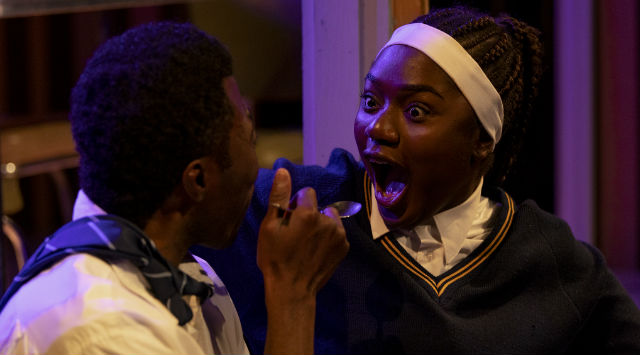
An entirely splendid cast of performers, each one daring, inventive and spirited, present an experimental venture the degree of which is rarely seen on the big stages in Sydney. Playing Titus is Jane Montgomery Griffiths, whose unfailing emotional intensity provides a dependable anchor for us to navigate the feverishly chaotic action. The maternal quality she brings to the role prevents us from conveniently dismissing violence as par for the course in this story about warriors. Instead, we are compelled to connect with the moral dimensions that accompany each brutal thought and deed. Young actor Grace Truman leaves a marvellous impression with her conviction and focus, demonstrating herself to be an irresistible presence at the tender age of fifteen. Some of the show’s more extreme moments of performative transgression come from a radiant Catherine Văn-Davies, who uses her body to make statements about defilement in a way that is simultaneously vulnerable and defiant. In a piece that talks about people going too far, the inspired Văn-Davies certainly pushes the envelope in terms of what we have come to expect, of artistic establishments that tend to be obstinately conservative.

Amongst all the gruesome atrocities of Titus Andronicus, is something that feels like a transcendent beauty. It is clear that carnage has an alluring power; there is a part of us that loves the dark, that our capacity for cruelty, whether sadistic or masochistic, is undeniable. As audience, we are caught between knowing what is right, and wanting to see the worst. Artists are on hand to engage our imagination, sometimes for a discussion, and sometimes for catharsis. On this occasion, what we witness often seems strange, but its immense resonance demands that we look deeper, so that we find points of recognition within, that we come face to face with aspects of the self that are too hideous to address.

www.bellshakespeare.com.au

Review: Avalanche: A Love Story (Sydney Theatre Company)

Venue: Roslyn Packer Theatre at Walsh Bay (Sydney NSW), Aug 29 – Sep 14, 2019
Playwright: Julia Leigh
Director: Anne-Louise Sarks
Cast: Maxine Peake (with Jethro Jensen, Amy Wahhab)
Images by The Other Richard

Theatre review
Humans have an inexhaustible capacity for obsession. As individuals, we see the world in infinitely different ways, and each of us has our own private passions that can easily be seen as meaningless or bizarre by others. What is of fundamental importance to one, can be interpreted as totally nonsensical by another, yet we all cling on to these idiosyncrasies, often letting them consume and define us.

In the case of Julia Leigh’s Avalanche: A Love Story, an unnamed protagonist spends years absolutely absorbed by the notion of having to bear a child, and subjects herself to expensive and traumatising IVF treatments in hope of falling pregnant. She sacrifices relationships and a prestigious career in film making, to devote all her energies and resources, into the seemingly uncontrollable urge to have a baby. The play comprises scene after scene of one woman’s deep disappointments, and her inability to extricate herself from a suffering that only ever looks to be self-imposed. We watch in amazement, her persistence with this pipe dream, but certainly not all of us will be able to muster up the empathy that the playwright is intent on appealing to.

At best, the show is an honest and painful examination of experiences many have shared, but at its worst, Avalanche: A Love Story is a melodramatic and highly indulgent study of rich people’s problems, manifestly unaware of the way it opens itself to ridicule. The very skilful Anne-Louise Sarks brings, as director, an atmospheric intensity that almost has us forgetting, that the story requires our emotions invest in a kind of torment that can only befall the privileged.

There is no question that the production is adroitly assembled. Everything is considered, purposeful and remarkably polished, with not a hair out of place. Marg Horwell’s spectacular set design is unforgettable. Lizzie Powell’s lights and Stefan Gregory’s sounds are incredibly delicate in their rendering of a woman’s very genuine struggles. The contentious nature of this subject matter notwithstanding, the creative forces have no doubt accomplished a work of theatre replete with technical brilliance.

Maxine Peake too, is precise and inspired as performer of this 75 minute monologue. She holds our attention throughout, and convinces even the most sceptical, of the profound sorrow being expressed on stage. Her efforts are detailed and sensitive, always aiming to communicate at a level of uncompromising accuracy.

It is unlikely that Avalanche: A Love Story can preach beyond those already converted. The character’s anguish is undeniable, but the more that we delve into that narrative of grief, the more we question her choices. A woman can make any choice she so desires, but whether her need for sympathy as a result can ever be satisfied, is quite another matter.

www.sydneytheatre.com.au

5 Questions with Idam Sondhi and Nicole Wineberg

Idam Sondhi

Nicole Wineberg: You play 4 characters, 3 of which are puppets… what’s that like?
Idam Sondhi: It’s both a great challenge and rewarding playing several characters. 3 of which are puppets – it’s something I’ve never done. However, the nature of the play and the amount of time we got to improvise and try different things out was very liberating. The time allowed me to get comfortable in the skin and souls of our fabric friends.

Why is U.B.U relevant to today’s audiences?
U.B.U touches upon some extremely important issues which effect each individual on this planet. Our environment is sacred and a home we often take for granted. U.B.U deals with the repercussions of neglect which are caused by human tendencies such as greed, power and money. We need to have more self awareness and work at getting better and sharing vital knowledge to the future generation at restoring what’s broken about our environment. It takes each and everyone one of us to make a change and take care of the planet.

Is U.B.U just potty humour or is there something in there for the more discerning of tastes?
U.B.U is for everyone! It allows us to self-reflect and does it in a tasteful way (even though all the flavours might not taste good). It’s theatre you’ve never seen before!

What’s your favourite character and line in the play?
I love all the characters so much! Especially because we explored each one individually! But Bob and Bill (the royal twins) have a special place in my heart – played wonderfully by Shane and Rachel. My favourite line is “grotty, snotty, spottibots!” You will only know what that means if you come and watch the play!

Could you please sum up our version of U.B.U in 5 words?
Grotesque, truthful, hilarious, experiential, memorable!

Nicole Wineberg

Idam Sondhi: Tell us a bit about your character.
She’s a princess who has never faced anything resembling hardship who then is thrust into a horrible situation by Ubu and his followers. She also has a really good wig. The Sansa Stark of white privilege! 

What was it like being part on an ensemble cast like this?
Exciting, entertaining, terrifying and educational, all rolled into one spicy burrito. It was invigorating working with a group of people who were so willing to look foolish and grotesque for the sake of storytelling and humour.

What should people take away from the messages in U.B.U?
a) Take climate change seriously and do something about it! It doesn’t matter how little or insignificant it is, just make a start and commit to making a change!
b) There’s a fart joke to suit every taste!

What was your most memorable moment during the rehearsal process?
It was actually the audition process! We were stunned with the sheer amount of talent and weirdness Sydney actors have! The stuff we saw will haunt us till the day we die, that’s for sure!

If you could eat any dish every day for the rest of your life what would it be and why?
A medley of deep fried potato: your standard hand-cut chip, crinkle-cut and shoestring fries, gems and wedges. Delish. If you have to ask why, you’re an idiot.

Catch Idam Sondhi and Nicole Wineberg in U.B.U A Cautionary Tale Of Catastrophe, by Richard Hilliar.
Dates: 10 – 21 Sep, 2019
Venue: Kings Cross Theatre