Review: Everybody (Cross Pollinate Productions)

Venue: Kings Cross Theatre (Kings Cross NSW), Mar 6 – 21, 2020
Playwright: Branden Jacobs-Jenkins
Director: Gabriel Fancourt
Cast: Kate Bookallil, Caitlin Burley, Annie Byron, Giles Gartrell-Mills, Isaro Kayitesi, Mansoor Noor, Kate Skinner, Samm Ward and Michael Wood
Images by Clare Hawley

Theatre review
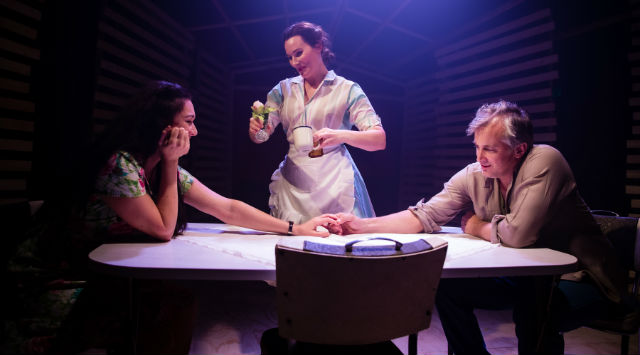
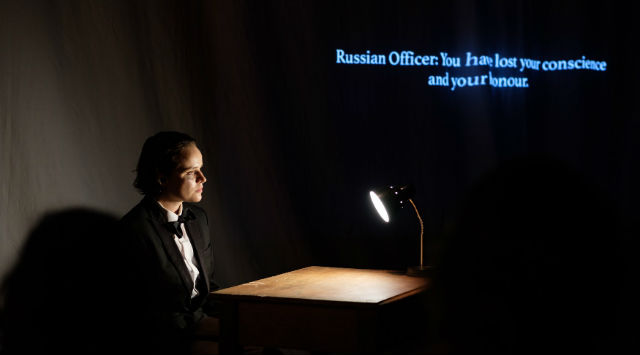
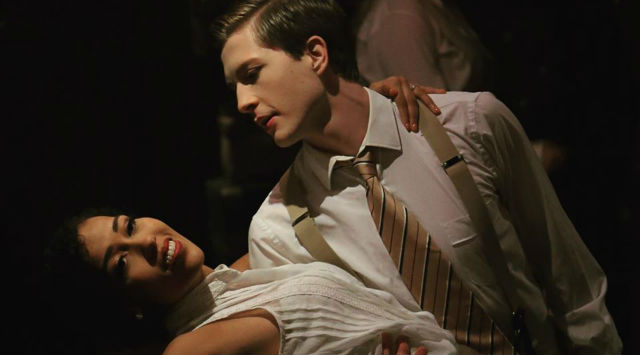
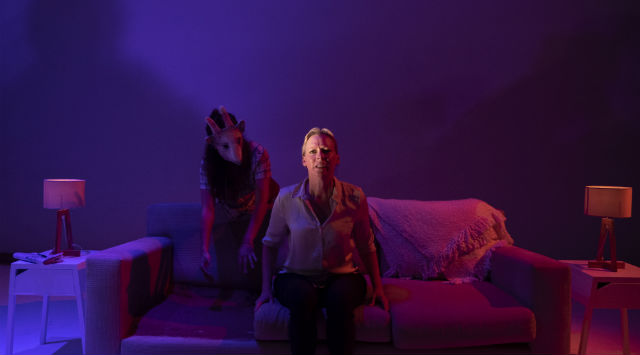
The idea is to think of that one thing you can take with you, when you die. Everybody by Branden Jacobs-Jenkins talks about the most common of denominators. A woman named Death has come knocking, and is asking Everybody to bring along one other, to meet their maker. It is worth pointing out that Everybody is played by any one of five actors, determined at each performance by lottery. As we watch ourselves shuffle off this mortal coil, leaving behind all things material, we are urged to consider a certain distillation of being, that occurs in the final hour, and come to a conclusion of what it is that might accompany the departure of each spirit.

It is a cleverly structure play, featuring thought-provoking and immensely enjoyable dialogue. Its raison d’etre may ultimately feel somewhat prosaic, but the journey Everybody takes us on, is a very satisfying one. Dynamic work by lighting designer Morgan Moroney and sound designer Felicity Giles, ensure that the production is consistently energetic and vibrant. Set design by Stephanie Dunlop makes effective use of space, with a simple solution that keeps us all engaged with every stage activity.

Gabriel Fancourt’s direction delivers a show that entertains from start to finish, able to position a compelling sense of theatricality alongside earnest explorations of the text’s philosophy. A charming cast, including five brave performers who allow a nightly act of chance decide their fate, collaborate on a presentation unique to the live form. When playing the part of Everybody, Isaro Kayitesi is tremendously impressive, with a glorious combination of vulnerability, complexity and authenticity, that she renders with apparent ease. Giles Gartrell-Mills is our usher, comfortably authoritative in the role, but also disarming with a sincerity that he exudes quite naturally. Death is a comical character when portrayed by Annie Byron, whose unremitting joviality brings splendid contrast to the grim notions that she embodies.

God is omnipresent in Jacobs-Jenkins’ writing, but Nature scarcely gets a mention. In 2020, it is our natural world and environment that has become a major factor in how we conceive of mortality and the future. Perhaps God has all along been indivisible from Nature, yet so many of our minds have learned to have them separated. There is a lot of truth in saying that we create God in our image (and vice versa), and for those of us who think of God and Nature as different, this must be the day of reckoning, the final opportunity for us to come to grips with the fact that it is us who are at the mercy of Mother Earth.

www.crosspollinate.com.au

Review: The Bridges Of Madison County (Hayes Theatre)

Venue: Hayes Theatre Co (Potts Point NSW), Mar 6 – Apr 5, 2020
Book: Marsha Norman (based on the novel by Robert James Waller)
Music & Lyrics: Jason Robert Brown
Director: Neil Gooding
Cast: Michael Beckley, Anton Berezin, Beth Daly, Kate Maree Hoolihan, Zoe Ioannou, Katie McKee, Ian Stenlake, Grady Swithenbank
Images by Grant Leslie

Theatre review
When we encounter Francesca, she is a housewife in 1960s Iowa, with 2 kids and a husband, seemingly happy to be on a farm living the simple life. A fortuitous meeting with photographer Robert however, reveals that she does want more. The Bridges of Madison County is one of the most famous of American romances, a novella by Robert James Waller that has sold over 60 million copies since its initial publication in 1992. Francesca’s struggles about fulfilling her duties as wife and mother, are presented as completely incongruent with what might be a greater happiness. For a moment, she experiences exhilaration with Robert, but must weigh the consequences should she dare to follow her heart.

This musical version, first created in 2013, features strong songwriting by Jason Robert Brown, but its individual numbers, although delightful, do not necessarily add up to a satisfying plot for the show. Direction by Neil Gooding is able to suffuse a sense of intensity to the emotions being depicted, but the general pace for its storytelling is unsatisfying. Design and technical aspects of the production are on the whole accomplished, with Phoebe Pilcher’s work on lights noteworthy for bringing valuable flamboyance to the staging.

Performer Kate Maree Hoolihan plays a very sentimental Francesca. Her interpretation tends to be simplistic, but proves ultimately to be a moving one. Ian Stenlake looks every bit the National Geographer photographer and love interest Robert, but some of his singing at crucial points are not quite up to scratch. Although evident that the couple works hard to find chemistry, the attraction between the two is never really convincing. Beth Daly and Michael Beckley however are memorable as Marge and Charlie, quirky neighbours who bring occasional but very needed humour to the staging.

In the song “Almost Real”, we hear Francesca talk about her relationship with Chiara, her sister in Naples, who “would open her legs just as easy as speaking.” In her efforts to separate herself from that negative perspective of a free woman, Francesca spends her life doing what she thinks is the right thing, but it is clear that all she does is dedicate herself to being a subject of conformity. Although an indisputably credible character, the writers of Bridges refuse to allow Francesca the gratification she craves, and deserves. We are made to think that to be a good mother, Francesca simply has to give herself up, and that we must all realise, is a lie.

www.goodingproductions.com

5 Questions with Jack Walton and Sheree Zellner

Jack Walton

Sheree Zellner: When friends ask you, “What is Distorted about,” what do you tell them?
Jack Walton: When I think about Distorted I often see it as is a fractured story about fractured people. We get to glimpse into key stages of people’s deepest relationships as well as witness the most isolated moments in their lives. So much of the play is flavoured with this brilliantly witty humour but then you get to have these beautiful, intimate moments of just living with these people as they go though things like addiction, mental health, pregnancy and loneliness.

What is the most surprising thing you’ve discovered about yourself through playing the role of Alex?
I feel like there’s a new discovery after each run but what sticks out to me is just how much I value the key people around me. When I think about the people I’m closest there’s a bond that I also see Alex discover with his girlfriend where they each allow their best and worst versions of themselves be presented to one another which creates all kinds of drama but it’s also the kind of relationship that you don’t always fully appreciate until it’s at risk of being taken away.

Without giving too much away, what is your favourite scene or character from Distorted and why?
There’s a great scene near the middle of the play where my character and Poppy Lynch’s character have this wild screaming match. It’s hilarious because what they’re arguing about is so ridiculous and off topic but under the surface we start to see a new side to their relationship. That’s definitely the scene I feel most free in as well, there’s no point where you can hide from the audience so you just have to dive into it head first.

What do you think people will take away with them after seeing Distorted?
Each character in the play has some surface level identity. Some kind of stereotype that people would attach to them passing by on the street. I think what’s so great about Distorted is that it gives the audience a chance to see the humanity that lies below these assumptions. You suddenly have more empathy for people when you get to see their story in front of you. So in short, if there’s anything an audience could take away from this show I hope it’s some version of empathy.

What was your initial reaction after we did our first full run of Distorted?
I was exhausted! I have most of my scenes with one other actor so I didn’t actually get to meet most of the cast until we all came together for our first run. Having not rehearsed with everyone in the room before that point I was really impressed with how everything slotted into place. Usually doing a first run of any production is pretty bumpy but because this play moves at a such lightning pace everyone was switched on and ready to pounce onto whatever cues were thrown at them. There was a great sense of achievement after that run.

Sheree Zellner

Jack Walton: Distorted has such a distinctly energised writing style. How does it feel to perform something that is always so active?
Sheree Zellner: I love the energetic style of Xavier Coy’s writing, really keeps us on our toes, there’s always something happening onstage and off, it’s a great lesson in keeping the ball in the air at all times. For my 62 year old brain that’s got to be a good thing! Thankfully I love to be challenged and there’s always Berocca… Seriously though, because the writing is so energised, it informs our performances naturally, so it’s like getting caught in a theatrical vortex.

What do you find exciting about playing with new works?
Being involved from the ground up is so satisfying because we are the first ones to put our stamp on these characters. We’re not following in others footsteps, we’re making the first forays into the lives of our characters and everything we experience as actors in creating these characters is completely original. For an actor that’s pure gold, we’re a very fortunate ensemble.

Why do you think people value relationships so intensely?
Generally speaking I’d say that it’s about connection. I think it’s something we’re always looking for in every aspect of our lives, at home, at work, on social media. Connection can bring out the best and worst of humanity and I think we see that very clearly in Distorted. This play really shows all aspects of how we connect, the lengths we go to for connection and the lengths we go to when we want to avoid connection because it’s too painful. Our director Richard Hilliar has been instrumental in bringing those connections, or lack thereof, into sharper focus. He’s been so unwaveringly supportive, we’re all very thankful for that.

What have you found most challenging about rehearsing Distorted?
Ha ha, how long have you got! Well let me see… firstly my character Louise is a bit of a hot mess and her way of coping with her issues is not something I’m familiar with at all on a personal level. Let’s just say that the research was very interesting! Then of course, as an actor I have to find my way of playing that, of inhabiting her world and her views. Also as an older actor I have to keep my focus laser sharp for every second of this play, whether onstage or off. I’ve got notes pinned to walls everywhere so I don’t forget anything!

This play has changed a lot since we got the initial script. How has your view of your character changed/developed?
It’s changed so much since the initial script, but one thing was very clear to me after that first table read, which is that I was going to have to just surrender to each development. After deciding on backstories to suit, Xavier then reworked all the scenes incorporating the original scenes, but adapting them to suit and expanding exponentially on our characters, as did Richard in the rehearsal room. The changes and developments just kind of happened, and my views about my own character Louise became a part of the whole ‘surrender’ philosophy. Looking back I am amazed by the process and how much I’ve learned from it. This season of Distorted is going to be a wild ride, that much I do know!

Jack Walton and Sheree Zellner can be seen in Distorted, by Xavier Coy.
Dates: 10 – 22 Mar, 2020
Venue: Old 505 Theatre
Review: Good Mourning (The Old 505 Theatre)

Venue: The Old 505 Theatre (Newtown NSW), Mar 3 – 8, 2020
Playwright: Sonia Dodd
Director: Hannah Armstrong
Cast: Gabrielle Aubrey, Coen Lourigan, Madelaine Osborn, Ben Rodwell

Theatre review
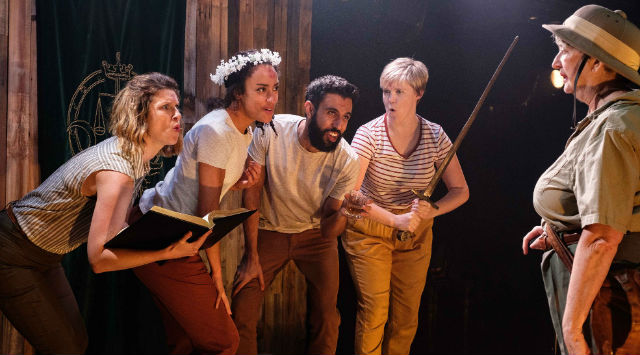
Told from the perspective of an 8 year-old, Good Mourning by Sonia Dodd is about a young family dealing with the impending death of a parent. The four children have to grapple with a diagnosis that can only be described as traumatic; their father has advanced cancer with only three months to live. It is however not a grim story that we discover. The family finds uplifting ways to spend their remaining time together, cherishing their precious days and doing what children do best, to find the light under any circumstance.

At just forty minutes or so, Dodd’s writing is concise but satisfying, with an honesty that circumvents sentimentality, for a discussion on grief that always feels authentic. Hannah Armstrong directs this story based on her own experiences, inventive and effervescent in style, surprising us with the optimism and entertainment she is able to provide. Also noteworthy are Rhys Mendham’s efforts with lighting design, successful at providing consistent visual variation to a very bare stage.

The ensemble is charming and well-rehearsed, beautifully cohesive with all that they present. Gabrielle Aubrey, Coen Lourigan, Madelaine Osborn and Ben Rodwell play a range of characters, each one spirited and cleverly imagined. Their portrayal of the children’s innocence is especially effective, able to tell a sad story without excessive despondency, thereby encouraging us to think about death and mourning in a healthy manner. The very definition of life means that we must encounter loss. Learning to cope is essential, and knowing how to live with vibrancy after saying goodbye, is crucial.

www.old505theatre.com

Review: Hamlet (Bell Shakespeare)

Venue: Sydney Opera House (Sydney NSW), Feb 29 – Apr 4, 2020
Playwright: William Shakespeare
Director: Peter Evans
Cast: Jeremi Campese, Tony Cogin, Jack Crumlin, James Evans, Harriet Gordon-Anderson, James Lugton, Jane Mahady, Lisa McCune, Robert Menzies, Aanisa Vylet, Sophie Wilde
Images by Brett Boardman

Theatre review
Having very recently lost his father, the young prince is understandably grief-stricken. Hamlet obsesses over his mother’s quick remarriage to the new King Claudius, almost as a form of distraction, but when the ghost of the dead king arrives to reveal that it was his own brother Claudius who had killed him, Hamlet becomes overwhelmed with fury. More than a revenge story, Shakespeare’s Hamlet examines the meaning of death, from the vantage point of a man obsessed with bereavement.

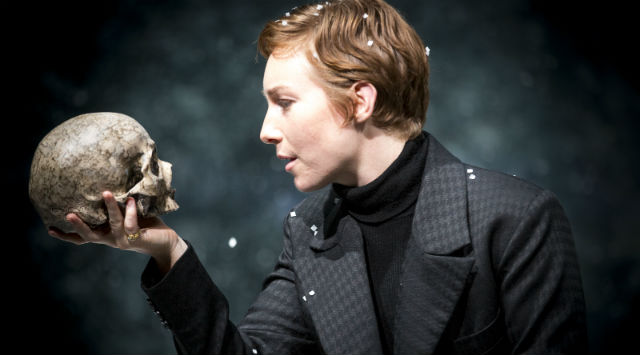
It is a handsome production, with Benjamin Cisterne’s lights giving a glamorous finish to the staging, and designer Anna Tregloan’s 1960’s costumes adding a sense of whimsy. Tregloan’s cyclorama depicts a beautiful Danish snowscape, but an awkward house-shaped frame sits centre stage, doing little more than to confuse with its lack of purpose. Video projections by Laura Turner helps us empathise with Hamlet’s tragic circumstances, as does Max Lyandvert’s restrained music compositions.

Director Peter Evans’ conservative style may not deliver anything unexpected, but his rendition is likely to appeal to fans of Shakespeare who favour a more conventional approach. Actor Harriet Gordon-Anderson is insufficiently charismatic as the lead, but displays clear dedication to her craft. What she offers as the Danish prince is not always convincing, due in part to her slight stature, although there is no questioning her conviction and focus for the role. The two problematic women in Hamlet, Gertrude and Ophelia, are played by Lisa McCune and Sophie Wilde respectively, both performers able to convey a certain level of power and integrity, in spite of Shakespeare’s intentions to portray them as useless. Robert Menzies leaves a strong impression as Polonius, animated and entertaining as the court’s chief counsellor.

In the twenty-first century, it is easy to take issue with the representation of women in Shakespeare’s work. We are far less likely to accept as reasonable, the extremely unbalanced way in which gender is expressed in his oeuvre. The current trend of placing women actors in key male roles does, to some extent, soften the blow of insults to half of humankind, but the strategy is rarely if ever, able to comprehensively address the gender problem that figures so centrally in all of Shakespeare’s narratives.

www.bellshakespeare.com.au

5 Questions with Eddie Orton and Tim Walker

Eddie Orton

Tim Walker: The show is a very physical piece of theatre. What has been the most difficult skill you’ve had to learn and which scares you the most?
Eddie Orton: I’ve had some experience with dance and played lots of sport in the past which helped with picking up the skills, especially the acrobatics. The hardest one to learn and master is probably a two high, with you standing on my shoulders. Once you’re up it’s fine, it’s the timing that’s difficult

We’ve worked together in the past, performing Shakespeare in pubs, these are vastly different shows, have you learnt something new about me?
They are certainly super different shows. I’ve learnt that you’re actually a good actor. Haha sorry. I joke. I’ve learnt that you’re an extremely proficient acrobat, both as a flyer and a base. I didn’t know that last year.

When we began rehearsals Shane presented us with over 10,000 pages of research, were there things that surprised you or shocked you?
All of it is shocking to be blunt. You think you have an understanding of Australia’s history but I was very naive. The lack of police action and the sheer volume of cases that are still unsolved is deeply shocking.

We have a couple of school shows throughout this season, why do you think it’s important for young people to learn about this part of Australian history?
It needs to be recognised because I think it’s a part of Australian history that is largely forgotten and ignored. We think we know everything about our history but we don’t. This is not just a problem for the past, it’s a problem for today.

What’s next for Eddie Orton?
Next up is something which I’m not allowed to talk about yet, but I’m very excited about it.

Tim Walker

Eddie Orton: What’s something no one knows about Tim Walker?
Tim Walker: I was once an impromptu stand-in for Neil Gallagher of Oasis. We had similar hair apparently so he and I exchanged shirts and I drove Mischa Barton of The OC around in a 50’s cab while he went to the pub for a feed.

What’s the most difficult part of the show physically for you?
Haha can I say rehearsal? No probably the two high with you. As you say it’s in the timing. I’m excited to do it in front of an audience with even less space to work with haha.

How does movement and physical theatre inform this work?
One of the things that really shocked me in the research was how graphic and horrific the violence was. We felt it was necessary to find a language outside of text that informs this whilst acknowledging the sensitivity of violence for audience members. What we’ve created is a physical language, that abstracts the violence, whilst remaining true to the intention of the verbatim text.

Why do you think it’s important that these stories be heard now?
This show isn’t just about history. It’s also about hope for the future. About how important recognition and acknowledgement are for healing. We know there are thousands of people who have never spoken about their experience with hate crimes and the parliamentary enquiry into these hate crimes has been reopened. The Aids Council of New South Wales are actually still calling for submissions from people affected by hate crimes up until 28th February. We are having an event co-hosted with ACON, post show on Sunday February 23rd and we hope the show will encourage people to make these submissions.

What’s next for Tim Walker?
Well last year I received a small commission to make a few of my own projects. I’ve just finished post production on a short film I wrote and about to start pre on my next one which I’m excited about!

Eddie Orton and Tim Walker can be seen in Our Blood Runs In The Street.
Dates: 19 Feb – 21 Mar, 2020
Venue: Old Fitz Theatre

Review: Artslab: Behind Closed Doors (Shopfront Arts Co-op)

Venue: 107 (Redfern NSW), Feb 26 – Mar 1, 2020
Images by Clare Hawley

Stalls
Playwrights: Lana Filies, Lily Hensby
Devised and performed by: Lana Filies, Olivia Harris, Lily Hensby, Cara Severino

Little Jokes In Times Of War
Written, directed and performed by: Charlotte Salusinszky

Stripped
Written, directed and performed by: Luke Standish

Theatre review
Artslab: Behind Closed Doors features five works, three of which are in the theatrical form. Created by young emerging artists, they combine to offer a refreshing experience, even if style and tone are extremely varied from one to another.

Stalls is a collaboration between Lana Filies and Lily Hensby, exploring toilet humour with a feminist approach, inspired by the concept of an idealised woman that allows no capacity for the most basic of all bodily functions, defecation. The performance is devised by the writers, along with additional cast members Olivia Harris and Cara Severino, for a riotously funny show that stridently rejects notions of sugar and spice and all things nice. Chemistry between the four is joyous, for an effervescent thirty minutes that entertains from an unmistakably political perspective.

Charlotte Salusinszky goes in search of her Hungarian roots in Little Jokes In Times Of War, and unearths a story of inter-generational trauma through an examination of her grandmother’s life. Salusinszky’s almost psychic impulses function as a mode of connection with her family history, inspiring a sort of time travel, going back to locate ancestral meanings, so that she can find, and crystallise, herself in the process. It is a rich text that comes to be, and the artist’s remarkable proficiency on stage, as performer and director, is a revelation.

The thoughts of an erotic stripper are documented in Luke Standish’s Stripped, a poetic and melancholic look at one man’s experience of employment in the adult industry. It is, appropriately, a predominantly physical presentation, but made abstract in a way that reveals, more than anything, the subject’s emotional state. Even at just half an hour, Stripped is repetitive, unable to provide significant elucidation beyond the predictable and obvious, but its imagery is compelling, whether Standish chooses to be clothed or not.

We live full lives behind closed doors, but it is what can be shown to others, that determines so much of identity. Art is most valuable when it lifts the veil on that which lays dormant. Art helps us know ourselves, and as narcissistic humans, that promise of reaching deeper into our own truths, is a huge thrill. Theatre furthers that mission, by coalescing truth into consensus, so that when we sit side by side in a darkened room, something magnanimous unites us, if and when the magic happens.

www.shopfront.org.au

Review: Hello Again (The Factory Theatre)

Venue: The Factory Theatre (Marrickville NSW), Feb 20 – 28, 2020
Words & Music: Michael John LaChiusa (after La Ronde by Arthur Schnitzler)
Director: Jerome Studdy
Cast: Denzel Bruhn, Lyndon Carney, Grace Driscoll, Stacey Gay, Charlie Hollands, Brendan McRae, Kate O’Sullivan, Anna-May Parnell, Harrison Vaughan, Emelie Woods
Image by Junior Jin

Theatre review
When first staged in 1920, La Ronde by Arthur Schnitzler remained a scandalous work even though it had taken 23 years to go from initial publication to a theatre in Vienna. It dared to depict progressive sexuality as somewhat natural, and certainly spoke about promiscuity as as a phenomenon far less reprehensible than was the convention. A century later, there is little left in the work that feels even naughty, thankfully as a result of substantial advancements over time, in attitudes about sex.

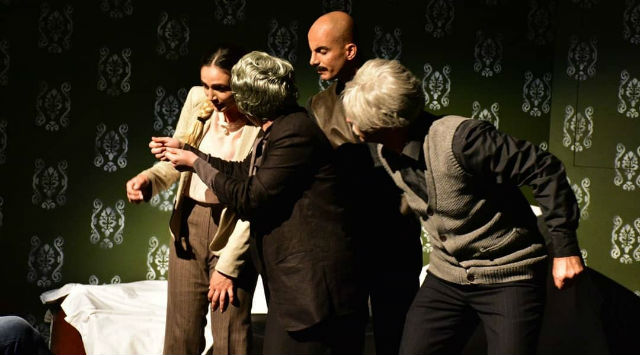
Michael John LaChiusa’s Hello Again is a 1993 reiteration that transforms the ten dialogues from Schnitlzer’s original, into songs for the musical format. LaChiusa’s music is often experimental and infrequently melodic, with lyrics that now seem unsophisticated and lacking in wit. Each chapter takes us through the decades of the twentieth century, but direction by Jerome Studdy never makes that at all clear. The production feels rough around the edges, admittedly clumsy at points, but an enthusiastic cast almost holds everything together. Without microphones, the acoustically challenged auditorium proves demanding of those with smaller voices, but it must be said that the ambition of all involved is admirable.

La Ronde is about class as much as it is about sex. It represents an effort to look at humans at our most vulnerable and essential, stripped of all ornamentation and pretence, trying to understand ourselves at what should be our purest. Using sex as a common unifying mechanism, and hypocrisy as a theme through which we can access notions of manufactured identity, Schnitzler urges us to be honest, in the belief that truth will set us free.

www.facebook.com/HatTrickProductions

Review: Veronica’s Room (Flight Path Theatre)

Venue: Flight Path Theatre (Marrickville NSW), Feb 26 – Mar 1, 2020
Playwright: Ira Levin
Director: Ehsan Aliverdi
Cast: Parisa Mansuri, Hamed Masteri, Shiva Mokri, Arash Salehi

Theatre review
At the beginning of Ira Levin’s Veronica’s Room, a young woman is locked in a room by an older couple. She insists that her name is Susan, even though those who hold the key say that she is Veronica. The suspenseful mystery keeps us guessing, as its characters feud with parallel narratives. We vacillate between wondering if the story is about mental illness, or a strange tale of entrapment and gaslighting.

It is an entertaining work, featuring an appropriate dimension of eerie supernaturality rendered by director and lighting designer Ehsan Aliverdi, who fills the show with flamboyant gestures that give the experience a delicious theatricality. Performed entirely in Farsi (with English surtitles), the cast brings exceptional energy to the piece, for a passionate staging that has us absolutely mesmerised.

Actor Parisa Mansuri plays the young woman, with an emotional complexity and intensity that makes the central riddle even more captivating. Shiva Mokri and Arash Salehi take on a bizarre range of roles, each one compelling and intriguing. Both performers are powerful presences that impress with a sense of fastidiousness to their approach. A fourth character is brought to extravagant life by Hamed Masteri, whose gradual escalation to a state of lunacy is a joy to watch.

Ira Levin’s women may not feel realistic, but it remains a pleasure that they occupy central positions in his play. It is true that women can be naive, and women can be evil, as represented in Veronica’s Room, but we are also resourceful and strong. Although Levin has put on paper something that is truly fascinating, we should question his choices, especially if we believe that humans have become more sophisticated as a species, half a century on from the play’s original staging. Fiction always allows us to manipulate outcomes, and how we choose to see ourselves, is entirely in our hands.

www.nomadartgroup.com | www.flightpaththeatre.org

Review: Pit (The Old 505 Theatre)

Venue: The Old 505 Theatre (Newtown NSW), Feb 25 – Mar 1, 2020
Playwright: Jackson Used
Director: Mikala Westall
Cast: Tony Barea, Margarita Gershkovich, Briony Williams
Images by Morgan Moroney

Theatre review
Bridget’s only daughter has been abducted. Needless to say, the aftermath is traumatic, and as we see in Jackson Used’s Pit, a constant state of disorientation and pain. One can attempt to find ways to move on, but there is no escaping the all-consuming damage that must result from an incident like this. Bridget tries on every kind of survival mechanism, none of which proves satisfactory, and we must confront the idea that when things go this bad, no solution can exist. It becomes a case of sink or swim, and we see that the remaining hope is about resilience and spirit, even if all they do is to keep a person breathing.

Direction by Mikala Westall is often imaginative, although a bolder approach is necessary for a more dramatic experience. Actor Briony Williams does most of the heavy lifting, focused and purposeful in the lead role. Tony Barea plays the lost girl’s father Serge, a surprising performance that has us won over at the end. Margarita Gershkovich provides sturdy support in a number of smaller parts, able to engage the audience without causing distraction from the central plot and character.

The emotions displayed on stage can feel slightly restrained, but theatre should not ask of its makers, thorough authenticity under all circumstances. What Bridget has to go through, is beyond inhumane, and no actor should have to take on anywhere near that level of torment. There are techniques however, that can help the show convey greater intensity, so that we may come closer to the reality being rendered, even if bells and whistles, smoke and mirrors are how we can get there.

www.old505theatre.com