Review: When The Rain Stops Falling (New Theatre)


Venue: New Theatre (Newtown NSW), Mar 17 – Apr 18, 2015
Playwright: Andrew Bovell
Director: Rachel Chant
Cast: Olivia Brown, Tom Conroy, Peter McAllum, Hailey McQueen, Renae Small, Helen Tonkin, David Woodland
Photography © Bob Seary (top gallery) / Benjamin Brockman (bottom gallery)

Theatre review
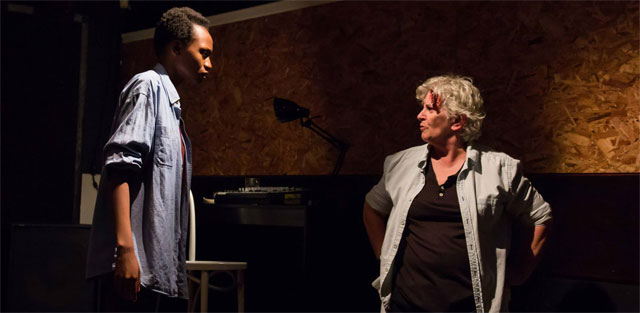
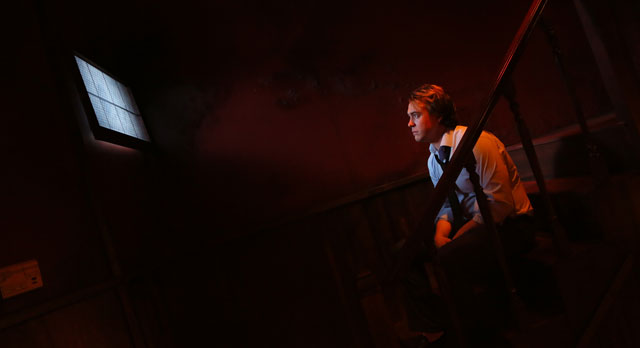
Upon entering the auditorium, the rumbling sounds of a tropical monsoon emanates from the stage to greet us. Without characters and narratives, we sit listening, surrendering to the voluntary effects that our physical selves cannot help but react with. Emotions surface, seemingly for no rhyme or reason. The art that we experience changes us, without letting us know how and why. A delicious melancholy, like a calm sadness, washes over. When the story begins, we are already hypnotised. Andrew Bovell’s When The Rain Stops Falling is a play about family ties and the challenges that can be passed on from one generation to the next. Personal anguish and relational discordance affect the development of children, and we see the inevitable inheritance of wounds that result from flawed parents and imperfect parenting. Bovell’s poetic use of language and his liberal approach to plot construction, make for an intriguing script that is dramatically unpredictable and achingly beautiful. Its outstanding storytelling connects with every person’s complex feelings about home, and appeals to our thirst for a brand of theatre that is deeply moving.

Direction of the piece is provided by Rachel Chant, who impresses with an extraordinarily deft hand at emotive expression. Our senses are captivated for the entire two-hour duration, by her sensitive and adventurous exploration of sound and sight, along with an inventive use of the cast’s physical and spiritual presence in the space, to create a quality of pathos that is intensely lyrical but never melodramatic. Chant succeeds in reaching us through atmospherics and narrative, enveloping us both consciously and unconsciously, so that our attention is steered carefully through every twist and turn of the play. Excellent work is achieved in establishing a singular vision through an evidently trusting collaboration with every actor and designer of the production, although one bizarre blemish does exist in the unexplained transformation of character Gabrielle’s speech accent, which goes from a broad Australian voice to an unmistakably British one with the passage of time.

The ensemble of seven is uniformly arresting, each with their own distinctive presentation styles, but all are able to find for the piece, an exacting cohesion in tone and pace. Tom Conroy is thoroughly convincing, giving a performance memorable for its heartbreaking vulnerability and almost unbelievable simplicity. Conroy’s pared-down approach is a refreshing one, filled with subtleties that reveal just enough, and also, everything. The stoic Elizabeth is played by Helen Tonkin who mesmerises in extended sequences of Butoh-esque silence, with unwavering concentration and a painful depiction of inner struggle and sorrow. Suffering is also portrayed brilliantly by Peter McAllum, whose moments of quiet authenticity turn a small role into a profoundly meaningful one.

Hailey McQueen’s naturalistic interpretation of her role is solid and elegant, but a decision to downplay a crucial scene of confrontation is questionable. Similarly, David Woodland’s performance is most compelling, but an opportunity to erupt with greater wildness is foregone perhaps unwisely. The play is rich with regret, despair and longing, qualities that tend to be dark and heavy, and even though its sombre beauty is unquestionably enthralling, a hint of brutality would provide a greater sense of theatricality, .

From a design perspective, the creative team is a formidable one. Tom Bannerman and Martelle Hunt’s set carves out modern shapes that delineate spaces quietly but efficiently. Its hard lines and sparseness represent the chilling emptiness that is at the centre of much of the text, and ensures that the audience is affected accordingly. Lights by Benjamin Brockman provide spacial transformations and emotional cues, constantly evolving on stage to manufacture shifts in time and space, and to reflect fluctuating states of minds, and hearts. It is a rare occurrence to have the sound design of a non-musical theatre production steal the thunder, but Nate Edmondson and Alistair Wallace’s partnership is a clear triumph. Their work is original, surprising and experimental, but always effective and often powerful. It is omnipresent, but never distracting. There is an accuracy to the way the sound of When The Rain Stops Falling parallels, or perhaps determines, the stage action that makes the show inexorably involving and at many points, sublimely devastating.

There is a masochistic pleasure in witnessing the secrets of broken families unravel. We are relieved that our own private pains are shared, and we gain a sense of redemption from the realisation of that universality. At the theatre, we are never alone. With good plays, we can gain insight, and think of impending rainbows.

www.newtheatre.org.au

Review: Fallout (Smoking Gum Theatre)

smokinggum1Venue: Exchange Hotel (Balmain NSW), Mar 18 – 27, 2015
Playwright: Lauren Pearce
Director: Finn Davis
Actors: Michele Conyngham, Ian Ferrington, Jim Fishwick, Louise Harding, Moreblessing Maturure, Patrick Trumper

Theatre review
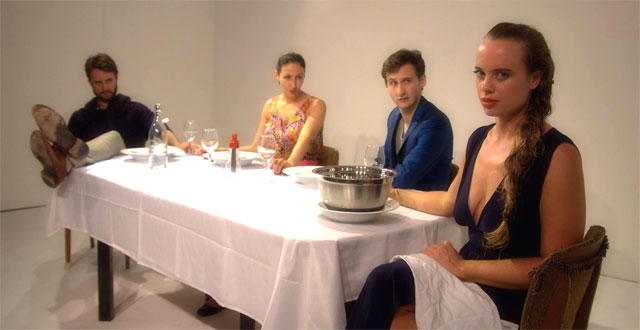
It is admirably audacious that artists go out on a limb, almost as part of their job description, to experiment in public and to risk failure in spectacular style for all to see. The nature of theatre as a commercial experience requires that strict deadlines are to be adhered to, so that a show has to have at least a semblance of readiness on its advertised opening night. Smoking Gum Theatre’s Fallout needs, among other things, more time in its creative process. Lauren Pearce makes her debut with an apocalyptic script, ambitious with big ideas, but her characters are not sufficiently formed, and its structure is not yet settled.

Most things can be said to have room for improvement, especially in art where nothing is perfect, but Fallout is a distance away from being able to communicate its intentions. Direction by Finn Davis does not deviate from the writing, and he show signs of an adventurous spirit in the way he choreographs physical movement for the piece. Performances are apprehensively grounded. It is a very quiet approach that shows little inventiveness, but actors Moreblessing Maturure and Patrick Trumper demonstrate good focus and conviction. Design is a challenge in the makeshift venue, and the creative team’s efforts are evident especially Angela Toomey’s video projections, which add a touch of polish to the production.

Outside of our education institutions, young artists have to brave the same conditions as all other theatre practitioners. Any paying audience will have expectations, and it can be a cruel world for those who achieve less than desired. Fortunately, it is rarely a dramatic case of sink or swim, because the factor of time is crucial to all artistic practice. It is the body of work over the expanse of a career that matters, and it is longevity and tenacity of the last persons standing that will make an impact.

www.smokinggumtheatre.com

Review: The Big Funk (Suspicious Woman Productions)

suspiciouswomanVenue: TAP Gallery (Darlinghurst NSW), Mar 11 – 21, 2015
Playwright: John Patrick Shanley
Director: Michael Dean
Cast: Michael Drysdale, Jasper Garner-Gore, Alixandra Kupcik, Jess Loudon, Bali Padda

Theatre review
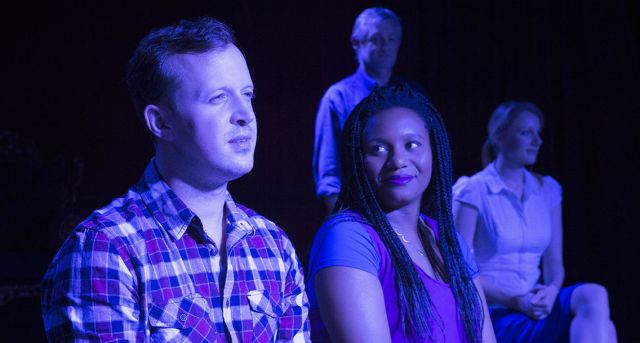
Philosophy and theatre are bosom buddies. Theatre means little without an attitude that is intent on questioning the nature of things, and philosophy becomes significantly more meaningful when brought to flesh beyond the realm of ink and paper. John Patrick Shanley’s The Big Funk looks at life with wonderment and passion. The writer’s words are powerful and his ideas are exciting, with an abstraction at its core that disallows narrative and simple logic from diluting its sophisticated concepts. The play positions itself outside of real life, examining it at a distance, always extricating itself when it becomes too involved in drama and emotions. There is a great deal of intellectualism to enjoy, but what a viewer can garner here, as is for every piece of complex work of art, depends largely on their own worldview and mental capacities.

Michael Dean’s direction adds a playful dimension to the piece, with an eagerness for creating a lively theatre that locates all the physical and interactive potentialities in Shanley’s writing, turning a cerebral text into an effervescent stage experience. Dean does well at introducing some elucidation to the often convoluted existential reflections of characters in The Big Funk, but much of their rumination remains out of reach. Original thought is rarely easy, and we should probably not expect to be able to absorb everything from a single encounter of a dense script, especially when presented at a jaunty pace. Nevertheless, moments of resonance occur throughout the production, and although inconsistent, they are often effective and poignant.

Performances are thoughtful and well-crafted, with excellent chemistry between all members of cast. Alixandra Kupcik is memorable for her vulnerability, and Jasper Garner-Gore for his exuberant and authentic presence, but both are to be lauded for their extremely confident approach to their prolonged sequences of nudity at Sydney’s most intimate venue. Annabel Blackman does solid work as designer, with a set that does very much with very little, and elegant costuming that helps with characterisations and storytelling. Lights and sound, however, do not contribute sufficiently to manufacturing ambience that would live up to the extravagant surrealism and absurdity of contexts being explored.

We live in a world filled with uncertainty and angst, but life is how we choose to interpret and understand it, and in The Big Funk, we are encouraged to reflect upon the way we think about our environment and how we interact with it. It is important that life has a sense of meaning, and Shanley is right in saying that each person should determine their own relationship with their own existence, without the burden of inheritance and baggage. There is a way to make rules and to establish codes from one’s own consciousness, to provide guidance for our days on this earth but it is the ambiguous and tricky hazard of the human conscience that we need to be mindful of.

www.suspiciouswomanproductions.com

Review: And Now To Bed (Subtlenuance Theatre)

subtlenuanceVenue: Kings Cross Hotel (Kings Cross NSW), Mar 11 – 22, 2015
Playwrights: Con Nats, Donna Abela, Mark Langham, Sarah Carradine, Margaret Davis, Melissa Lee Speyer, Katie Pollock
Director: Paul Gilchrist
Cast: Paul Armstrong, Shauntelle Benjamin, Erica Brennan, Richard Cornally, Jennie Dibley, Edric Hong, Eleanor Stankiewicz

Theatre review
Sex can reveal all of a person, but awareness of its machinations and psychological implications for any individual is rarely a thorough one. We let our sexualities be, because, contrary to Freudian theories, knowing too much can sometimes be destructive, as pleasures can fade away when they come under excessive scrutiny. Also, it is in our nature to guard our privacies, and self-preservation dictates that we rarely articulate what it is that turns us on. And Now To Bed features seven actors performing their own biographies. Each is teamed up with a writer who creates a text out of their understanding of each subject and their sexual lives. The actor-writer relationship should be an intimate one, but there is no telling how secrets are handled in this process. There are vivid moments, but much of the writing is coy. We cannot be sure if it is the subject or the author who maintains a sense of non-disclosure, but talking about sex requires that we are frank about things, or the purpose is defeated. There is beautiful writing to be found in every segment, but those who choose to be obscure or abstract do not leave the same impression as the ones who confront us more directly. Like in sex, art is at its most meaningful when people connect.

Shauntelle Benjamin and Donna Abela’s partnership is a powerful one. Their explicit depiction of sex acts exposes not only the brutality many people are capable of, but also the quality of masochism that resides in many of our experiences. Benjamin’s enthusiasm for the stage reflects the workings of libido, and its ferocious honesty. Her portrayal highlights the uniqueness that resides in each person, with an idiosyncrasy that rejects notions of simple and universal understandings of sexuality. Jennie Dibley and Margaret Davis create a romantic narrative that traverses decades. Dibley’s maturity in attitude brings to her not unusual story, an unorthodox emotional dimension that encompasses forgiveness and kindness, in place of melancholic drama. We observe the healing quality of time, and a surprising purity that can come with age. Even though there seems a deliberate rejection of angst and sorrow in Dibley’s work, she remains a delightful actor with an endearing and captivating authenticity.

Direction is provided by Paul Gilchrist who is faithful to each of the pieces, allowing his collaborative artists divergent contexts that are required for their individualistic modes of expression. Consequently, the program is colourful in tone, and pluralistic in its approach to the theme of discussion. Gilchrist’s sensitivity to the material can be seen in the confident cast of actors who all bring a warm earnestness to what they are willing to share. The production is eighty minutes long, with segments that would appeal to different tastes, but there is a somewhat bizarre lack of erotic energy indicating an exploration of sex that is a lot about the head, and very little about the body. Talking about sex in public is difficult, for very good reason. Our reluctance to go in too deep is understandable, for only a select few would see the appeal of such vulnerable divulgences, and fortunately for us, they tend to be artists.

www.subtlenuance.com

Review: This House Is Mine (Milk Crate Theatre)

Venue: Eternity Playhouse (Darlinghurst NSW), Mar 12 – 22, 2015
Playwright: Maree Freeman
Director: Paige Rattray
Cast: Chris Barwick, Veronica Flynn, Contessa Treffone, John McDonnell, Fabiola Meza, Matthias Nudl, Rach Williams
Images by Patrick Boland

Theatre review
Milk Crate Theatre works with artists who have experienced homelessness and social marginalisation. In Maree Freeman’s This House Is Mine, stories about mental illness and homelessness are woven together from a series of collaborative exercises that reveal the concerns and states of mind of the participants. Each narrative rings with authenticity, and even though many of the circumstances might be unfamiliar to general audiences, we can all connect with the emotions being portrayed.

The work features a cast that excels in bringing to the stage a sense of vulnerability that gives the production an unusual dramatic texture. Performances are all deeply touching, and often thought-provoking. Also affecting are pre-recorded interviews that tell of experiences that are rarely shared. We are informed of societal issues that require addressing, especially in the field of medical support, and hearing testimony from those in our community who rarely have a public voice, is profound, and important.

Sean Bacon and Sarah Emery’s beautiful video work is projected throughout the show’s duration, adding abstract dimensions to the unfolding action. The delicate nature of their visuals is a reflection of the fragile humanity that is This House Is Mine‘s main interest. In the presence of disadvantage, our privileged backgrounds seem conspicuous, and standing next to the powerlessness of its characters, our ability to influence change becomes apparent.

www.milkcratetheatre.com

Review: Freak Winds (Old Fitz Theatre / Red Line Productions)

redline3Venue: Old Fitzroy Theatre (Woolloomooloo NSW), Mar 10 – Apr 11, 2015

Playwright: Marshall Napier
Director: Marshall Napier
Cast: Anna Bamford, Marshall Napier, Ben O’Toole
Image by Tim Levy

Theatre review
Marshall Napier’s very Hitchcockian Freak Winds has all the suspenseful intrigue, perverse humour and subversive eroticism that keeps an audience simultaneously repelled and seduced by its story. Unlike Hitchock, Napier’s work is of the twenty-first century, with much less censorial restrictions, so what we get is an update for the genre and style. It does not resort to gore and constant bloodletting, but it delivers thrills and creates tension with a rather more explicit incorporation of sex, murder and terror. Napier’s lines are quirky and cheekily controversial, and the structure of his play is unpredictable, with an edgy sense of danger at every turn.

Direction of the piece is sharp and dramatic, with beguiling characters that feel enigmatic, but always able to reveal just enough for their plot to work its magic on the audience. Aside from a couple of unexplained touches like the mysterious appearance of a wheelchair at the start of Act 2, and a bizarre moment involving a red light at the conclusion, Napier shows himself to be a director with an untameable creative flair and a knack for conveying complex, multi-dimensional narratives that could be read in a variety of ways by different viewers. His style is elegant, but brave. There is no hesitation in exploring absurdist territory when appropriate, and a distinct eagerness to tantalize with taboo subjects that really satisfies (except for the unveiling of a disappointingly modest dildo after quite a substantial build up).

Ben O’Toole plays Henry, a young and ambitious insurance salesman in the middle of a living nightmare. The role is comparatively simple, but O’Toole works through it aggressively, with an energy that can only be described as exuberant. His entertaining performance is a necessary contrast to the mysterious and somber quality of the show’s other elements, and the actor leaves a strong impression characterised by excellent commitment and passion. In the role of the very creepy Ernest is Napier himself, who brings experience and an intelligence that keeps us on our toes. His work is efficient, often impactful without needing to push very hard at all, but the performer’s eyes seem to always evade our gaze, rejecting our appetite for the truth in Earnest’s world. The play’s third character is Myra, thoroughly weird and unquestionably mad. Anna Bamford is feisty enough for the part, but her interpretation feels repetitive where we expect extremes coming from all sides. Nevertheless, the unorthodox and precarious sexual atmosphere created by Bamford’s chemistry with her cohorts is an unexpected delight for any theatrical space.

Freak Winds is beautifully designed by a creative team that has addressed every aspect of sight and sound with good taste and sensitivity. Nate Edmondson’s sound design rumbles beneath our feet to taunt us into a space of horror, and along with Alexander Berlage’s lights, the small venue is dissected into a hundred different spots, adventurously explored in all their possibilities. The highly effective set and costumes by Lisa Mimmocchi provide a strong context with immediate visual signifiers that help tell the story almost on a subconscious level, from curtains up to the very bitter end.

Freak Winds‘ macabre comedy mixes with spine-tingling gothic influences and dark erotica to spawn an unusual piece of theatre, yet scary tales seem to have been with humanity since time immemorial, existing in different forms in all our cultures. They remind us of our mortality, and of the arbitrary membrane that keeps us separate from harm. We rely on rules and regulations, laws and legislation, but mostly, we count on the kindness of strangers so that we can live unhindered or protected, but all it takes is one person losing their mind for catastrophe to engulf another, such is the fragility of our existence.

www.oldfitztheatre.com

5 Questions with Ben O’Toole‏

benotooleWhat is your favourite swear word?
Favourite swear word is definitely cunt. Great word.

What are you wearing?
At the moment I’m wearing jeans and thongs with a t-shirt, but in the show my character wears a suit the whole time. Insurance salesman style.

What is love?
Love is a chemical imbalance in the brain, brought upon typically by another person. Pretty magic really.

What was the last show you saw, and how many stars do you give it?
The last show I saw was Cock at the Old Fitz, and I would give that show a 4 stars. Brilliant stuff.

Is your new show going to be any good?
I should hope so!

Ben O’Toole‏ is appearing in Freak Winds by Marshall Napier.
Show dates: 10 Mar – 11 Apr, 2015
Show venue: The Old Fitzroy Hotel

5 Questions with Shauntelle Benjamin

shauntellebenjaminWhat is your favourite swear word?
That word starting with ‘C’ that most people don’t like. Women need to start reclaiming it.

What are you wearing?
Awkwardly, a uniform that says I work with kids. And a psychology text book casually under one arm.

What is love?
Baby don’t hurt me? Ok, maybe a little.

What was the last show you saw, and how many stars do you give it?
The Book Of Mormon or Matilda. They both get all my stars. Delightfully written, and fantastically executed pieces of work.

Is your new show going to be any good?
I’m aiming for The Book Of Mormon seriousness with Matilda clarity. It’s going to be wonderful.

Shauntelle Benjamin is appearing in And Now To Bed, from Subtlenuance Theatre.
Show dates: 11 – 22 Mar, 2015
Show venue: Kings Cross Hotel

Review: My Mother And Other Catastrophes (Pop Up Theatre)

20150307_193636Venue: Gleebooks (Glebe NSW), Mar 7 & 14, 2015
Playwright: Rivka Hartman
Director: Rivka Hartman
Cast: Florette Cohen, John Grinston, Elaine Hudson, Taylor Owynns, Anne Tenney, Madeleine Withington

Theatre review
This staged reading of Rivka Hartman’s My Mother And Other Catastrophes is deeply revelatory of Hartman’s inner world, with several broad themes brought into focus through the filter of personal and lived experience. Hartman discusses the Jewish diaspora from an Australian perspective, the inter-generational transference of tradition through motherhood, and the karmic effects of catastrophes that seem to endure an eternity. The play does not break new ground, but it is in the nature of storytelling that what remains relevant, will always resurface. Where suffering remains, old stories never fade, although they may take on new forms, morphing with the times. Hartman’s script is not quite feminist theatre of the militant variety, but it certainly features strong and interesting women expressing their vulnerabilities, flaws and triumphs.

The structure of the work is swift and sharp, never overly self indulgent. Its anti-chronological timeline keeps things unpredictable and engaging, and encourages rumination about the evolutionary, as well as the repetitive, nature of how people live. We question what it means to be free, even though the script is not convincingly optimistic. Hatman’s words are charming and witty, but there is little variance between characters to create distinctions in speech styles and patterns. They seem to share one voice, which is reasonable for a show about one family, but more dramatic effect might be achieved if each character’s use of language demonstrates greater juxtaposition with each other.

Creative work exploring the Holocaust rarely provide new insights, but they are almost always poignant. Hartman creates vivid and emotional imagery from her stage directions, narrated by Taylor Owynns, and also through the lines of 117 year old survivor Gitl, performed with extraordinary gravity by Elaine Hudson. Indeed, the dark side of My Mother And Other Catastrophes is captivating, because its universality allows us to connect with it almost spontaneously, but its comedy is less compelling. It truly is a significant thing, to find humour when days are tough, and it is the belief that laughter can exist no matter how dire the circumstance, that helps keep our humanity perpetuating.

www.stickytickets.com.au/popuptheatre

Review: Queen Bette (G.bod Theatre / The Old 505 Theatre)

Venue: Old 505 Theatre (Surry Hills NSW), Feb 25 – Mar 15, 2015
Devised by: Jeanette Cronin, Peter Mountford
Director: Peter Mountford
Cast: Jeanette Cronin
Images by Richard Hedger

Theatre review
Heroes are worshiped for their exceptional lives and for their extensive contributions to society. Legends persist through the passage of time, especially when they are trailblazers who provide inspiration and guidance, showing us extraordinary ways to be. Examining how someone leaves a mark on the world, is how we can come to find the meaning of life, for their legacies hold the key to our existential angst. Queen Bette is a biographical tribute to one of the greatest screen sirens of the Hollywood golden age, Bette Davis. The text draws material from Davis’ autobiography and from various interviews she had given, not intending to give an in-depth account of sordid gossip, but to depict a great talent, her brilliant career, and an incredibly formidable drive. Davis’ outspokenness allows for the play’s devisors to assemble a script that is vibrant, funny, and tremendously expressive, and the largely chronological plot is a sensible mechanism to satisfy our need for creating a sense of coherence from fragments of a very big life.

In Jeanette Cronin’s company, the show’s 60 minutes go by in a flash. The performer’s work is more exciting and engaging than anyone can hope for in a role this iconic, and like Queen Bette Davis herself, Cronin’s ability to have us fall in love simultaneously with both actor and character, is sublime. We feel as though suspended in time, watching her genius in action, with all its technical proficiencies, emotional astuteness and physical splendour. Her mastery turns the audience into putty in her hands, captivated and gleeful at every twist and turn she introduces to the theatrical experience that we are subject to. Direction by Peter Mountford is dynamically paced, with unexpected stylistic changes developing between scenes to keep us attentive and fascinated. There is a conscious use of Davis’ words to spark activity, colour and energy on stage, so that the work is more than just the recitation of her admittedly engrossing speeches. Interesting perspectives and commentary are added to the star’s history, and a seemingly endless range of variance is achieved in the creation of her presence, so that we come into contact with a Bette Davis who evolves before our eyes, and who is always capable of surprising us.

Queen Bette may be about a departed film idol, but it keeps its sentimentality firmly in check. There is little intrusion into the personal, only revealing very key events, or situations that have an impact on her work. What we see are her professional achievements, how she had attained them and her basking in many moments of glory. It is not the whole story, but it is how we want to remember a role model, and how we want to tell stories so that there is a basis for emulation, or at least, an indication of our human spirit’s magnitude. Women like Davis, and Cronin, help us envision what success looks like, and their magnificence is a reminder that we too, can be brighter and better. We too can be sovereign.

www.gbodtheatre.com