5 Questions with Cecelia Peters and Jessica Arthur

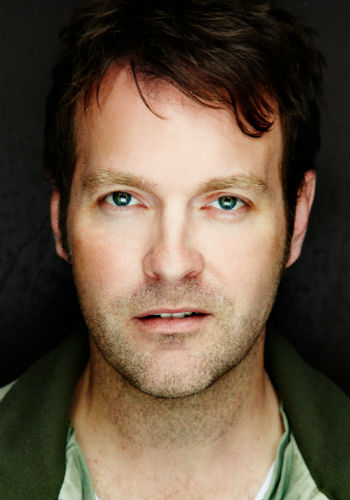
Cecelia Peters

Cecelia Peters

Jessica Arthur: What is your ultimate Sugar fantasy (think Homer Simpson in sugar land or Willy Wonka’s Chocolate factory).
Cecelia Peters: The Dalai Lama, José Gonzalez and myself in a hotel room – stay with me – We order an abundance of raw vegan treats from room service (yes I’m one of the ‘kale people’. I also don’t want to offend the Dalai Lama and I’m not sure of José’s dietary requirements) and sit on the balcony, play music, slowly eat yummy goodness, and smile and everything is perfect. The end.

What is the most embarrassing thing you did as a teenager? or what is your guilty pleasure?
I feel as though the teen years are about embarrassing yourself on a daily basis and then learning to manage the urge to hide in bed all day. Or maybe that was just me. Does that answer the question?

A typical question, always a goodie – which three people, dead or alive, would you invite to a dinner party and why them in particular?
There are so many inspirational people I would want to invite (mainly to show off how intellectually gifted I am). However, above all I’d want the table banter to be brilliant so I would say, purely for entertainment reasons, Amy Schumer, Dorothy Parker and Ella Fitzgerald.

What is some golden acting advice you’ve been given that you always keep in mind?
Whilst I was at WAAPA I worked with an Irish director called Patrick sutton. He understood my impulses more than I did. He said to me “Cece. You can’t ever switch off on stage: you’re not the kind of actor who can get away with it. You have to keep the ball in the air, don’t let it drop, or it falls flat.” I guess because it wasn’t some passed down line from the hundreds of acting methods that it just stayed with me. So simple. Don’t let the ball drop.

A song lyric that you live by.
“Twerk hard, play hard,” by the Internet.

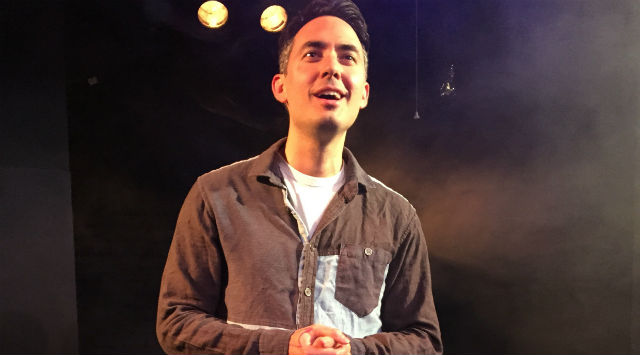
Jessica Arthur

Jessica Arthur

Cecelia Peters: Favourite city judging by its art scene?
Jessica Arthur: Favourite city art-scene-wise definitely has to be Vienna. I spent my days in the Museumsquartier and nights at the theatre. My favourite place was the Leopold Museum where I fell in love with my favourite artist Egon Schiele. I also couch-surfed with some hippy, bridge dancing, juggling to tango music, dumpster diving folk so Vienna takes the sweet Austrian cake for me.

Who’s your favourite feminist at the moment?
My friend just gave me How To Be A Woman by Caitlin Moran. I am only a few chapters in but she is a true contemporary feminist and also HILARIOUS. Also I must mention my two buddies Katie Cawthorne and Laura Lethlean who I have co-founded The Anchor theatre company with. We have a group on facebook where we share feminist articles and they will both forever be my favourite feminists!

Where’s your happy place in Sydney ? Do you have one?
My happy place in Sydney is more like a happy moment. That moment is when you’re coming out of the City Circle tunnel and you get that always remarkable view of Circular Quay from the train. As a Melbournian in Sydney it always astounds me and it will never get old. (I must also give a shout out to Satellite cafe in Newtown because they have great coffee and it is such a chill place to meet up with friends).

Do you get ESP with your twin brother?
Sadly no, but we can have full conversations where only a few knowing looks and very little words are required.

Favourite show this year thus far?
Kill The Messenger at Belvoir because of what it did as a piece of theatre. In my mind, theatre should say something and spark thought to the extent that you leave the theatre and think about what you saw for days after. The content of Kill The Messenger did that for me and continues to do so months after viewing it.

Jessica Arthur is directing Cecelia Peters in The Sugar Syndrome by Lucy Prebble.
Dates: 15 – 30 June, 2015
Venue: District 01
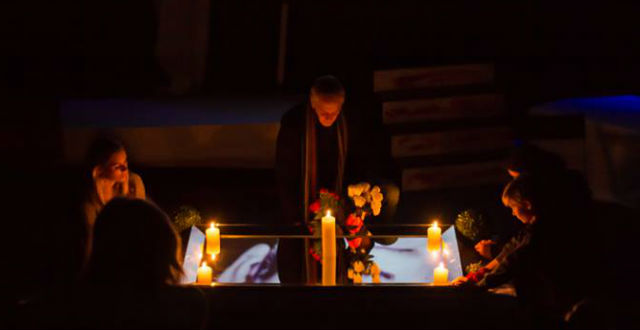
Review: Beyond The Neck (Emu Productions / Epicentre Theatre Company)

kstVenue: King Street Theatre (Newtown NSW), May 28 – Jun 13, 2015
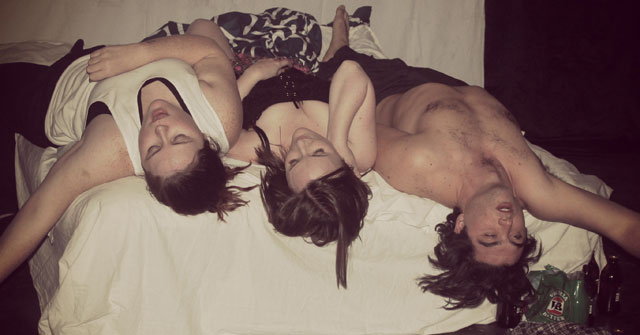
Playwright: Tom Holloway
Director: Markus Weber
Cast: Dana Brierley, Jessica Hobden, David Ritchie, Brayden Sim
Image by Thomas Adams

Theatre review
Not a day goes by that we do not hear about terrorism. The fear of being attacked by enemies is reinforced by our government and media fervidly, but the truth of our experience shows that it is not external forces that have caused us greatest harm, but those within that we consider to be neighbours. The “Martin Place Siege” of just half a year ago shocked the entire nation, and brought back memories of the horrific “Port Arthur Massacre” of 1996, where 35 people were killed and 23 wounded. Tom Holloway’s Beyond The Neck is an expression of a deep grief that is inflicted upon a community after a catastrophe of that magnitude. The play’s intent is to heal, and to explore the nature of emotional and psychological trauma.

The four-actor cast performs most of the piece in individual monologues, with several moments of very brief interaction. Not all are well prepared, in fact some appear to be quite unready for the production, but Dana Brierley and Jessica Hobden work well to portray their characters with a degree of passion and accuracy. There is a misplaced flavour of melodrama to their intensity, but they help to bring variance to the energy on stage.

Music is played fairly loudly in the background for most of the duration, and is almost always a distraction. The mood it creates is often contrary to what the actors try to achieve, and the audience is prevented from connecting meaningfully with the stories being told. Set design seems unnecessarily busy and visually confusing, with levels and colours that do not contribute to the poignancy of the play.

The production is a timely one, considering our interest in the subject matter. Many of us have strong feelings about events of mass terror, and an opportunity for catharsis is undoubtedly welcome, but on this occasion there is insufficient clarity in the execution of its purpose. The issues we face are complex and a lot more is required for those things to begin to make sense.

www.kingstreettheatre.com.au | www.epicentretheatre.org.au/

Review: Love (Shut The Front Door)

shutthefrontdoorVenue: PACT Theatre (Erskineville NSW), June 2 – 6, 2015

Playwright: Patricia Cornelius
Director: Sean O’Riordan
Cast: Kimberly Kelly, Ebony Halliday, Ford Sarhan

Theatre review
Art can tackle any subject matter, but when it ventures into the more obscure parts of life, artist and viewer must both find a way of communication that achieves some level of resonance. Patricia Cornelius’ Love features three young drug addicts and their aimless existences. Nothing they experience is more than fleeting pleasures, except for the romantic love that they may, or may not, have found. Cornelius’ use of language is an interesting exploration into the speech of young Australians from the low rungs of life’s echelon. They speak plainly, but their words do not express depth of thought and emotion. The best they can manage is frustration, which is perhaps a true representation of youth. For many theatregoers, the characters’ lives are distant and objectionable, and although Sean O’Riordan’s direction translates plot lines well, we struggle to find any common ground. Horrible things happen but finding empathy is challenging.

The performers begin the piece with insufficient passion, but eventually find their feet to portray more genuine sentiments in the latter half. The play is about love and romance, but we are rarely able to be convinced of the relationships on stage, which unfortunately makes the production quite precarious at many points. Ford Sarhan provides good support as Lenny, with a natural comic ability that can deliver laughs at will. Even though the actor can feel like the show’s saving grace, his style of performance does not always find cohesion with his colleagues, and the tone he introduces, although delightful, seems to run contrary to intentions of the text. Leading ladies Kimberly Kelly and Ebony Halliday are less charming, but both manage to provide strong focus and poignancy at the end.

For some, the only thing worth living for are the relationships they foster. Those less fortunate might have nothing but a string of pointless moments interrupted only by emptiness. Creating a life with meaning does not come easy, but with education and age, enlightenment is always within reach for those of us in the developed world. Love asks us to think of the young and how we treat them. Our prejudices are put to test, but converting fundamental beliefs is a difficult task, and compassion proves not to come spontaneously in all cases.

www.facebook.com/shutthefrontdoortheatre

Review: Venus In Fur (Darlinghurst Theatre Company)

darlo1Venue: Eternity Playhouse (Darlinghurst NSW), May 29 – Jul 5, 2015
Playwright: David Ives
Director: Grace Barnes
Cast: Anna Houston, Gareth Reeves
Image by Helen White

Theatre review
The bedroom is not for thinking about politics, if sexual pleasures are to be had. This statement reveals the wealth of meanings that are embedded into our desires and the way we satisfy them. David Ives’ Venus In Fur is a brilliant exploration into the manifestations of our sexualities, and an examination of impulses that might run contrary to our intentions and the kinds of people we wish ourselves to be. The quality of autonomous irrepressibility of our sexual appetites often betray the public personae we convey to the world. Ives’ writing is supremely complex, but truthfully so. It is highly intellectual but never pretentious or overly academic. It is a rare articulation of the way our problematic sexual selves resist suppression and tempering, and it looks at the implications of those deeper meanings that our sex seem to express. Through a context of sado-masochism, the play investigates the chasm between private and social, how we are able, or unable, to understand our true selves, and the impact that sex can have on the rest of one’s life. Also, Venus In Fur is some of the wittiest and most outrageously entertaining theatre one can ever wish to experience.

Direction by Grace Barnes is completely masterful, with a firm grasp on all the script’s themes that constantly and unpredictably fluctuate, thus representing the inconvenient and devious ways human nature can manifest. Barnes’ work pays attention to the most minute of nuances, and turns them into poignant, sometimes formidable statements, but she also creates flamboyant sequences of theatricality that are nothing short of edge-of-your-seat stuff. There are loud political messages being said here, and there is a delicious assertiveness that accompanies them, even (or maybe, especially) if they do come into conflict with one another. When art wants to get at the truth of something, the results are often antagonistic, and in this case, the incessant exposure of our humanly contradictions is exciting and at times, rapturously so. It is an acknowledgement of all our strengths and weaknesses, and a celebration of our determined exertion to become better.

Anna Houston is magnificent as Vanda, an enigmatic character written so vast, she seems destined to embody all of womanhood. It is an impossible idea, but Houston’s work is boundlessly passionate and versatile, and she exceeds all requirements of the hugely demanding text. The actor is dynamic at every moment, always keeping us entertained with a bold comic sensibility, and challenging our mental capacities with a range of subtexts so acerbic and provocative, that we cannot help but be entranced. The wildness of her approach is informed by a powerful impetus that can be emotional, political, or libidinous, depending on what she wishes to portray. Houston is a captivating performer full of drama and depth, perfectly formed for this show, and the kind who can shine in any other role on any stage. Her colleague Gareth Reeves is less vibrant in the role of Thomas, but equally solid and compelling. Reeves’ depiction of sexism from a male perspective is honest and surprisingly delicate. The authenticity of his work is key to the show’s intellectual effectiveness. The presentation of sexism as convoluted and inextricable gives the production an immense feeling of texture and an impression of interminable layers that plays on our minds relentlessly. Reeves’ commitment and focus gives the show an air of confidence, which allows us to lose ourselves in the plot, and let the players take us on a ride of extremes.

Design elements are understated but necessarily so. Sound and lights contribute greatly to psychological dimensions that are always in play. Aside from a few thunderous roars and purposefully abrupt light changes, Sian James-Holland (lighting designer) and Jessica James-Moody (composer and sound designer) work quietly to add to tensions and atmosphere without drawing attention to themselves. Realistic costume design by Mel Page also serves plot and characters beautifully without too much embellishment, although some fetishistic leather items do seem to have an ebullient effect on some members of the audience.

Telling stories about the other, inevitably makes one an easy target for criticism. Men writing plays about the subjugation of women can never escape chastisement, but an artist stepping into a minefield provides opportunities to reflect on the worst and most rarely visited recesses of our being. David Ives’s perspectives are unique and refreshing in contemporary discourse on issues of gender and sex. It takes a lot of sophistication to get into discussions that flow erratically like experimental jazz music, but Venus In Fur‘s consistent resonances assure us of the validity of its many controversial ideas. There are few things more valuable in art than its analysis of repressed or forbidden subjects, especially when they address the fundamentals of all human life, like love, sex, and the struggle for who gets to be on top.

www.darlinghursttheatre.com

5 Questions with Katy Curtain and David Woodland

Katy Curtain

Katy Curtain

David Woodland: If you were to kill someone, how would you do it?
Katy Curtain: I’m not sure, but I know how I’d get rid of the body? If you’ve seen Breaking Bad, you can probably guess where my head’s at…

What was the last show you wished you were in?
I remember having really strong performance envy when I saw La Soiree a while back. It just looked like constant joy. But if I were in it, I wouldn’t be able to watch it, so win win.

If you had to make everyone read one book, what would it be?
Lying by Sam Harris, because it’s a life changer that could improve human behaviour en masse, and it’s conveniently teeny tiny! It fully fleshes out how white lies are most destructive to the person telling them. The way it explores thoughts and behaviour is fascinating.

What fictional television world would you like to spend a week in?
The Sopranos! That part of the world has always captivated me! And a week would be the perfect amount of time to eat my weight in Italian-American food, revel in the accent and indulge in the novelty of gang life before actually having to prove my loyalty.

When you were a child, what did you want to be?
Pat Rafter’s pregnant wife. I saw her on TV all the time when he was playing. She was filmed crying in the crowd one of the times he won the US Open, and I can’t remember if she was pregnant or if I just thought it would be a cooler story if she was. Anyway, I shoved a basketball up my top, made myself cry and walked around like her for a day. I was 7, so I can probably count it as my first acting credit.

David Woodland

David Woodland

Katy Curtain: What’s the best theatre experience you’ve had in Sydney?
David Woodland: As a performer or audience member? Working with Brevity as a performer is definitely up there with the best. The experience of Wittenberg was something that I was extremely proud to be a part of. It challenged me as a performer, and was just a killer script. As an audience member…this is a hard question…I see more indie theatre over main stage, and many experiences stick out in both. But I will say that at the moment there has been a lot of great independent works going on all over Sydney. I can’t pick an overall best, but Phaedra (Lies, Lies and Propaganda) blew my mind.

What would you do with 8 million dollars?
Probably put it with the other eight and not tell anyone… oh shit!

Who is your hero?
I have many influences. In every part of my life, I am influenced by certain people to a degree but ultimately, we are in this alone. So at the risk of sounding conceited, I think that you have to be your own hero. I think that you have to believe and trust that you can be whatever you want to be. That you do not need to rely on anyone to bring you success and happiness but yourself. This is not to say that you don’t need help along the way, but the buck stops with you. This is your game.

Or I could just say Han Solo.

What was your most unrealistic childhood expectation?
That if I held the LP of The Best Of ABBA on a certain angle, I might be able to see up Agnetha’s dress.

What is the most visited website in your browser history (excluding day to day Google, Facebook, email and banking)?
Probably dictionary.com. I didn’t do very well at school. The answer to the previous question and the fact that I asked my year eleven English teacher if there was a country called Latin (not my finest hour) may possibly be a reason for this?

Katy Curtain and David Woodland will be appearing in Being Norwegian by David Greig.
Dates: 9 – 21 June, 2015
Venue: The Old Fitz Theatre

Review: This Boy’s In Love (Red Line Productions)

TBIL 1Venue: Old Fitzroy Theatre (Woolloomooloo NSW), May 26 – 31, 2015
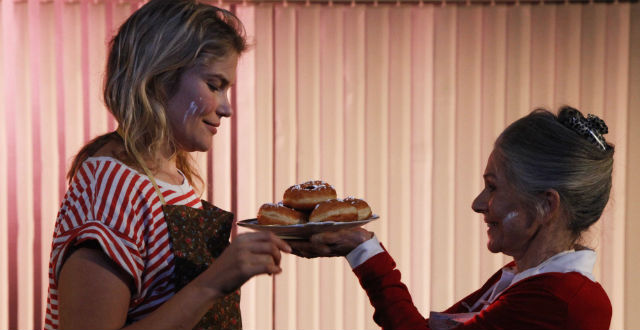
Playwright: Adriano Cappelletta
Director: Johann Walraven
Cast: Adriano Cappelletta
Musical Director: Daryl Wallis

Theatre review
With any luck, Adriano Cappelletta’s This Boy’s In Love is going to be the last great play about gay life in Australia before same-sex marriage is made legal. Ado’s experiences and perspective as a gay man in Sydney are beautifully, and extremely honestly, documented in this one-man show reflecting life for thousands of individuals from a city in its final throes of inequality and bigotry. Ado is hungry for love like everyone else, but his desires face obstacles unique to metropolitan gay lives. Emerging from periods of oppression and persecution, Ado’s community suffers from dysfunctions, tragic and funny, many of which are fluently articulated in the work.

The piece breaks from conventional monologue formats to provide a theatre that is full of variety, in order to engage, entertain and indeed, educate. It takes frequent detours into sub-genres like cabaret, stand up and dance, and adopts hints of the absurd, so that its ninety minute duration never loses a moment of vibrancy. Director Johann Walraven identifies brilliantly, the many nuances in the text to create moments of surprising poignancy, and to make us fall for the protagonist more and more as the show progresses. As its performer, Cappelletta is generous in spirit, and unbelievably warm, striking a rapport with his crowd so solid, that we cannot help but be enthralled. The level of dynamism in his work is astounding at points, and we get completely absorbed into all his stories, silly or serious.

This Boy’s In Love is as perfect as a monologue can get for small theatre. The only way one can envision this production improved, is with greater investment and imagination into its design elements. Technical enhancements can make the show even stronger, but with what this team is able to assemble, it conveys its intentions perfectly. Love is hard to define. It can mean many different things, but starving anyone of it is cruel and certainly evil. For centuries, love has been defined in narrow heteronormative and religious forms, and in that process, many of us have suffered senselessly. Times have changed, and everyday, more are able to find emancipation. May the day come when sexual bigotry of all kinds in all places be eradicated.

www.oldfitztheatre.com

Review: Neighbourhood Watch (Illuminate Educate)

illuminateVenue: Bondi Pavilion Theatre (Bondi NSW), May 28 – Jun 6, 2015
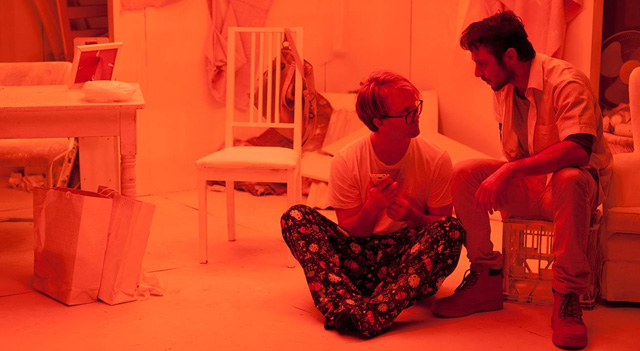
Playwright: Lally Katz
Director: Susanna Dowling
Cast: Skyler Ellis, Gertraud Ingeborg, Steven Kreamer, Odile Le Clezio, Andrew Lindqvist, Linden Wilkinson, Anne Wilson

Theatre review
In Lally Katz’s Neighbourhood Watch, two women find a special but unexpected connection, and their bond helps them grow into individually stronger persons. The relationship gives their lives greater meaning, and their story is a reminder that the social aspects of our being is crucial to the way we evolve and progress. Ana and Catherine are women who have needed time to find independence and self-worth, and Katz’s writing makes no bones about using them to inspire girls and women. We often define ourselves in relation to men, in fiction as well as in reality, and the play brings focus to how we let that transpire, and then how we can find emancipation.

Direction of the work by Susanna Dowling is very polite. There is a quietness to the production that hinders the wit of the writing, but although energy levels are low, its main characters are vivid enough for the audience to absorb all that the show wishes to impart. The play is set in many different locations, so scene changes are tricky, and not always handled with enough elegance. Spacial use requires greater inventiveness to prevent distractions and plot confusion. On a brighter note, music is beautifully utilised in the production, with composer Steven Kreamer’s work adding a sophisticated and emotional dimension to proceedings

Lead characters are performed well, although disappointingly restrained. The story is about intimacy, but there is insufficient vivacity between personalities, and they never feel close enough for the narrative to become poignant. Ana is played by Gertraud Ingebors, whose dry sense of humour charms the audience. Her work is convincing and evocative, but the actor seems to have trouble finding enough chemistry with colleagues. Anne Wilson is a likeable Catherine, with a warm and tender presence, but some of her depictions of heavier emotions call for greater authenticity. Like Wilson, Skyler Ellis is immediately endearing in the supporting role of Ken. The part is considerably lightweight by comparison, but Ellis steps up to the mark at every opportunity to showcase his excellent comedic abilities.

The characters in the story connect, but the production feels distant. There is enough lucidity for everything to make sense, but in a cool and slightly detached manner. The shattered dreams and broken hearts in Neighbourhood Watch do not translate with great passion and urgency. Although we hear the message, we want also to understand how it feels to be the people on stage. The live medium of theatre bears the right circumstances to affect its captive audience like no other art form can, and it needs to use that rare and uniquely exciting proximity to spark something visceral, so that its revelations can impress even deeper.

www.illuminateeducate.com.au

Review: Shivered (Mad March Hare Theatre Company)

madmarchVenue: PACT Theatre (Erskineville NSW), May 7 – 30, 2015
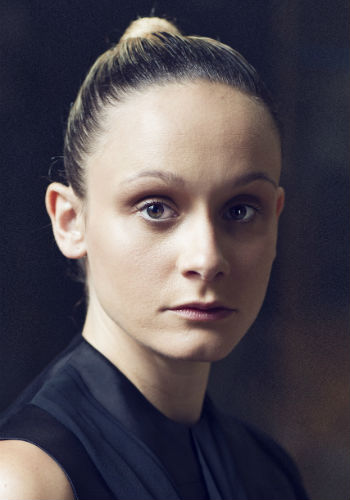
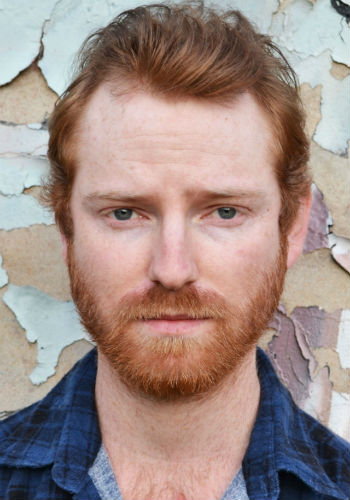
Playwright: Philip Ridley
Director: Claudia Barrie
Cast: Josh Anderson, Joseph Del Re, Rhonda Doyl, Libby Fleming, Andrew Johnston, Brendan Miles, Liam Nunan

Theatre review
Illusory contours “are perceived where there is no physical luminance, colour or texture difference,” referring to our ability to see things that are not actually there. In the case of Philip Ridley’s Shivered, we form narratives and create meanings from a series of scenes that do not immediately relate to each other, almost as though in a state of delusion. Our human nature is explored not only in the stories being told, but also in the way the audience is encouraged to makes sense of all that is put on stage. Looking at our propensity to interpret events in a way that never strays far from “cause and effect”, it is an examination of logic, which the play suggests is sometimes insufficient, and indeed, futile. Ridley’s work deals with many of the worst things in life, and makes us wonder if we can ever think of our darkest moments as inevitable, and the ethical implications of being embroiled in disappointments and disasters that we do not have direct control over.

These are big philosophical considerations, but individual scenes are melodramatic, almost operatic, in nature. Director Claudia Barrie invests heavily into that duality of intellect and emotion, with a fierce dedication to her stagecraft, and her work here is effective on both those levels. We get caught up in intense family drama not unlike those favoured by tabloid journalism, but the work is unrelenting in placing us at a conceptual distance so that we are always analysing the catastrophic consequences from an abstract perspective, in addition to experiencing the anguish that is being performed. The text is an edgy one, and Barrie takes great care in having Ridley’s words articulated with excellent clarity, but with all the taboo subjects involved, the production often feels tame in its expression when compared to the controversies being discussed.

Light and set design by Benjamin Brockman delivers a sophisticated space that is able to portray abstraction or realism as required, sometimes simultaneously. It accommodates the haphazard timeline of the plot beautifully, and the starkness of his aesthetic matches the brutality of Ridley’s writing very well, but at over two hours, scene transitions become repetitive and predictable later in the piece. The economy of technology Brockman experiments with, though slightly restrictive, is a success story that signals a significant evolution in lighting for Sydney stages.

The cast is detailed and powerful. Every character in the show touches us, despite the outrageous contexts we find them in. Libby Fleming alternates between quite campy humour and palpable rawness, for an enthralling performance that is as fascinating as it is moving. Her impressive ability to portray depths of despair provides a solid core of empathy that keep us anxiously attentive. The connection Fleming establishes with her sons in the play is the crucial ingredient that secures the gravity for its various threads of turmoil. Also wonderfully engaging is Liam Nunan whose presentational style effervesces with extravagance, but with a surprisingly convincing focus that keeps us engaged. Josh Anderson plays the damaged young Ryan with quiet sensitivity, but the threatening intensity he produces teeters close to eruption, and we are fascinated by the complexity he consistently works into his role.

There are horrors around us, and they are by nature absurd, for if they were fathomable, they would also be preventable. Humanity necessitates that we make sense of things, but life often insists on defying logic to demonstrate its dominance over humans. Life is hard, but we are resilient. All the characters in Shivered struggle, and their persistence with survival means that in order to overcome, they have to figure things out, whether possible or not. No one in the play gives up, and that is the moral of the story.

www.madmarchtheatreco.com

5 Questions with Cloé Fournier and Ryan McGoldrick

cloefournier

Cloé Fournier

Ryan McGoldrick: How have you found working in the arts in Australia compared to France?
Cloé Fournier: I must say I really started my professional career here in Australia. But in general, I feel like in Australia we have a quarter of the time to develop a work, a lot less funding too as well. But, somehow, Australian artists make it work. At the end of the day, it is hard everywhere. The main difference would be in the work process and how people interact with each other. In France, we are very direct. If something is shit or if you are not doing what is asked of you, the person will just tell you it is crap. Blunt, cut throat but straight to the point. Here, it is much more polite. People are more encouraging or perhaps not as honest!

Dining [Uns]-table deals with family relationships, how do you approach including personal material in your work?
I am very interested in social behaviours and specifically human interactions. I guess that is one of the reasons I started developing this work. I often use my personal experience when I start working on a project. Then it expends but somehow I need a personal connection to the subject matter to deliver an honest work. I also think there is always something tragic present in every family story. And I like to make fun of everything that is not necessarily funny.

When did you start dancing and what made you want to make a career out of it?
From what Mum told me, I came home one day and simply said to her that I wanted to enrol in dance classes. I have no recollection on why and Mum never pushed me to become a dancer. She was far from the “ballet mum” stereotype. I was 4. I never stopped. I did not choose to make a career out of dance. The truth is I just wanted to dance so I made it happen. But it now goes beyond. I have other interests such as theatre and technology. Dance is always present in the work I create but not in its purest form.

What interests you in audience participation in performance?
The challenge, the thrill of having to improvise every night depending on who your audience is.

Who are you tipping to win the flag this year? (AFL)
Unless the players decide to play naked, I really do not care about AFL!

ryanmcgoldrick

Ryan McGoldrick

Cloé Fournier: You used to dance. In a bathtub. In public. Naked. Myth or Reality?
Ryan McGoldrick: ‘Dancing’ might be a stretch, but I did spend some time bathing with other actors in the lounge room of an ex-nunnery-turned-sharehouse in Marrickville for a sell-out season at Woodcourt Art Theatre. Yah. Reality. #freethearts

What is the best memory you have of your childhood?
Playing soccer on crisp, wintery Saturday mornings.

How does the use of technology influence your daily life?
I’m a news junkie, so I’m quite attached to my digital news subscriptions.

Do you identify as an “Arty-Nerd” specimen?
Yes. I was living a lie for so many years, but now I’m finally at peace with it, and it feels great.

With the big news about the change of funding for the Arts, do you think we are mad to be artists?
Nope.

Why should I come to see your show? (OMG, that’s six questions! #rebels – Suzy)
Because I’ve got a fucking great story to tell you.

Afterglow – 2 emerging performance makers, 2 new works, 2 weeks.
The Great Speckled Bird by Ryan McGoldrick 17 – 20 June, 2015
Dining [Uns]-Table by Cloé Fournier 24 – 27 June, 2015
Show venue: PACT Theatre

Review: Educating Rita (Ensemble Theatre)

ensembleVenue: Ensemble Theatre (Kirribilli NSW), May 21 – Jun 28, 2015
Playwright: Willy Russell
Director: Mark Kilmurry
Cast: Catherine McGraffin, Mark Kilmurry
Image by Clare Hawley

Theatre review
Willy Russell’s Educating Rita makes a case for aspirations, but not in capitalistic terms or in the form of the all too common middle-class pipe dream. He talks about the importance of culture and choice in all our lives, and suggests that the greatest value of life resides in the active pursuit of self-betterment. The very act of finding greater meanings and knowledge, is the key to enriching one’s existence. The effectiveness of Russell’s narrative relies on the obstructions that we face, especially repressive forces in our surrounds that hold us back and prevalent apathetic attitudes of our communities. Frank is an alcoholic, who is all but resigned from hopes, dreams and ambitions. He has removed the clock from his office wall and hides it along with the secret bottles of booze that occupy the back of bookshelves, so that he can deny the fact that time is passing him by, while he drinks his days away. Through his education of Rita, we observe all that Frank has to offer the world, but he does not acknowledge his own talents, and lets himself flounder and descend towards oblivion.

Direction of the work by Mark Kilmurry is beautifully executed, and very moving. Both characters are engaging and solidly established, so that we feel an instant familiarity that helps us become quickly invested in their stories. Kilmurry has created an environment where both actors collaborate intimately with little ego in the way of storytelling, and what they present often resonates with extraordinary authenticity, and we relate to the play from very personal and deep perspectives. As a performer, Kilmurry is lively and multifarious. His work is vivid, with remarkable clarity in intention and expression, but his character evolution as Frank is insufficiently dramatic in latter scenes for tensions to sustain beyond the show’s very exciting first half. Catherine McGraffin is an effervescent Rita, with the right variety and amount of charisma to let her role translate powerfully and emotionally. Through her heartfelt approach to the material at hand, we are able to examine our own lives, and to think about the parallels between Rita’s experiences and the choices we have made for ourselves. McGraffin’s intuitive and unrestrained style of performance takes hold of our empathy at will, but Rita’s progression later in the piece becomes unnecessarily subdued, resulting in the play seeming to lose steam over time.

Rita’s thirst for knowledge and her eagerness to lift the veil on secrets of the big, wide world is an inspiration, and Frank’s tragedy is a cautionary tale perhaps, of the increasingly parochial ways we live. Interaction with culture requires broad minds, but affluent societies are complacent. We spend time and energy chasing pleasures, but neglect the more challenging and meaningful parts of life. As we make our communities more wealthy and stable, interesting ideas become dangerous and we shut them out. It is difficult to be progressive in 2015 Australia, where fear is becoming a virtue, and we become increasingly protective against enemies real and imagined. The theatre might be a safe and sometimes conservative space where risky thoughts are contained, but at least they (theatre and risky thoughts) are both still thriving, and patrons can always leave with some degree of choice as to the freedoms they will allow themselves.

www.ensemble.com.au