Review: Mothers And Sons (Ensemble Theatre)

ensembleVenue: Ensemble Theatre (Kirribilli NSW), Aug 21 – Sep 27, 2015
Playwright: Terrence McNally
Director: Sandra Bates
Cast: Tim Draxl, Thomas Fisher, Jason Langley, Anne Tenney
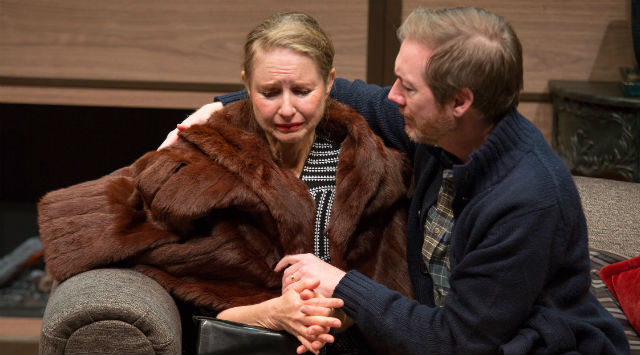
Image by Clare Hawley

Theatre review
In Mothers And Sons, Terrence McNally uses the simplest of stories to present a range of thoughtful and provocative themes that are relevant to both our contemporary concerns, and to perennial troubles of human nature. Katharine comes to visit an impossibly perfect gay couple, Cal and Will, at their apartment in Manhattan. Andre (Katharine’s son and Cal’s previous partner) had died of AIDS 20 years ago, and it is only now that Katharine decides to pick up the pieces, and to find resolution with demons of the past that continue to haunt her. McNally’s writing is emotional, intelligently meaningful, and striking in its lyrical beauty. There is also an engaging humour in its dry wit and dark comedy that underscore the tormented relationships being dissected.

Sandra Bates’ direction of the piece explores with sensitivity, the many social issues and personal afflictions characteristic of the play. There is a deliberate gravitas that gives the production its integrity, and whether dealing with intimate matters like resentment and regret, or wider subjects of kinship and homophobia, Bates is able to give them all a reverential emphasis that encourages its audience to handle with care. The play tends however, to be too serious in tone, especially at its early stages, where our encounter with personalities require a lighter touch.

Played by Anne Tenney, Katharine is a staunch figure, a mean old woman whose incessant use of the word “hate” reveals as much about herself as it does her pessimistic view of, well, everything. Tenney’s portrayal is psychologically convincing and ultimately a moving one, but the comical eccentricities of her character’s melancholic despair are not embraced with enough power. The actor delivers a few laughs over the course of the show, but the exuberance of the text is frequently downplayed to accommodate a more literal interpretation of Katharine’s depressed experience of the world. Jason Langley is an extremely gentle Cal, very amiable and authentic, but insufficiently agitated in his tensions with Katharine, and often too subtle with his passion for his gay rights and lovers. Both actors create together, a stunning final scene of breathtaking sentimentality, but the arduous journey towards the play’s conclusion could be managed with greater, and more entertaining, turbulence. Adding a dimension of liveliness to proceedings is Tim Draxl in the supporting role of Cal’s husband Will. Draxl sustains an impressive energy through sequences of shifting temperaments, and is relied upon to provide breaths of fresh air at each entrance, to a very restrained stage.

We all feel the trajectory of time and the way it moves things forward, with or without our selves. Katharine is deeply unhappy, but she refuses to accept the transformations that occur around her, and withdraws from participating in the joys of life that are easily within reach. The feelings of being hard done-by are familiar to everyone, and Mothers And Sons illustrates with excellent clarity, the anguish of being enslaved by one’s own obstinacy. It also persuades us on the changing nature of the family unit; how we conceive of same-sex marriages and the bearing of children within those unions. A woman unable to reconcile her homophobia with her son’s sexuality punishes much more than herself. Hate tries to contaminate its environment, and often it succeeds, but truth and the human conscience has a way of defeating its poison, even if the process needs to drudge through generations of struggle and wasted lives.
www.ensemble.com.au

Review: Kaleidoscope (Theatre21)

theatre21Venue: M2 Gallery (Surry Hills NSW), Aug 19 – 23, 2015
Playwright: Charlie O’Grady
Director: Finn Davis
Cast: Harry Winsome
Image by Alex Smiles

Theatre review
Gabriel is a young trans man who has been transitioning for four years, but who still finds it hard to leave his home for the big wide world in the mornings. On the day of our encounter, he struggles in front of a mirror for 90 minutes, and we witness how difficult it is for him to do the most basic of things; to get dressed and exit his front door. Stories about transgender experiences are not hard to come by, especially at this very point in time, as mainstream consciousness gains awareness of issues surrounding trans people, but Charlie O’Grady’s Kaleidoscope is an articulate and exceptionally insightful expression of the realities of trans youth at our specific day and age. The tale remains one characterised by pain and conflict, but it is an au courant representation of the continual evolution of ideologies and language in the discussion of gender. O’Grady’s script is sensitive, powerful, cerebral, emotional, and very repetitive. It takes pains to describe Gabriel’s entrapment with circular and recurring motifs that can frustrate its audience, but it serves to depict the persistent turbulence that Gabriel goes through with every breath of his life. Early sections of the play are overtly didactic, which is probably helpful for most viewers who are unfamiliar with the climate under examination, although a greater sense of sophistication with tone could make things more palatable.

Staging of the work is straightforward, but excessively so. Gabriel is in his bedroom, speaking into the mirror for over an hour, and virtually nothing changes. The monologue format is a challenging beast, not just for those on stage, but also for an audience that needs more than a fascinating subject, especially when the show runs for more than several minutes. We need definite transformations of scenes so that our senses can stay engaged, and we need to feel clear shifts in the character’s journey so that we can stay connected. Kaleidoscope however, delivers a long and continuous oration that, although very coherent and truthful, often proves to be too unvarying for our attention to stay intimate with. Harry Winsome’s performance is a solid one, and he impresses with the fluency of his lines, never stumbling over the extremely extensive and demanding strands of words. The emotions he conveys can seem intense and forceful, but they rarely translate with sufficient depth and authenticity to captivate; we hear his thoughts objectively, without being able to relate with his sentimentalities truthfully.

Gabriel is at war with the world, and with himself. He thinks that his story is about finding acceptance in the world, but it is clear that the biggest hurdle to his own happiness is himself. On many levels, the play is a universal one. We all come into adulthood with doubt and challenges, and finding permission to live freely is never easy. Gabriel obsesses over his reflection, thinking that it is the gaze of others that oppresses him, but like anyone, he must come to realise that the only affirmation worth receiving is from himself, and until he stops waiting for consent to arrive from without, can he allow his own emancipation to occur.

www.facebook.com/Theatre21Australia

Review: The Tempest (Bell Shakespeare)

bellshakespeare
Venue: Sydney Opera House (Sydney NSW), Aug 19 – Sep 18, 2015
Playwright: William Shakespeare
Director: John Bell
Cast: Robert Alexander, Matthew Backer, Felix Gentle, Brian Lipson, Arky Michael, Hazem Shammas, Maeliosa Stafford, Damien Strouthos, Eloise Winestock
Image by Prudence Upton

Theatre review
Shakespeare’s fantastical masterpiece The Tempest, with all its mystique and magic, is almost an allegory for the transportative and imaginary qualities of the world of theatre. On Prospero’s island, anything can happen, and on the stage, it is precisely that boundless unpredictability that makes it a special, and for many, sacred space. Whether it is the stories of everyday that are being presented, or manifesting scenarios beyond the wildest of dreams, theatre has the ability to provide something extraordinary to all its participants.

Like Prospero abandoning the magical arts at the play’s end, John Bell directs his last production with this rendition of The Tempest. The cast he has amassed is an impressive one, and Bell’s extensive acting background is clear to see, in the fascinating and intricate characters being brought to life. Every player is detailed, energetic and palpably present, yet the resultant show is oddly placid. Themes of the text fail to resonate. Ideas such as the distinctions we draw between nations, between nature and civilisation, between freedom and confinement, struggle to find illumination, even though their presences in modern life remain relevant. Exoticism is explored well in the show, but its sense of adventurous fantasy is not always established with sufficient dynamism. Music by Alan John and sound design by Nate Edmondson are outstanding features; helping to drive the production through atmospheric transformations and exquisite moments of ethereality. Less successful are its visual elements that seem to lack whimsy and ambition. The story being told is celestial and outlandish, but what we see is staid and dated. Even exits and entrances are awkwardly managed to accommodate the inconvenient access to stage wings of the uninspired set.

Prospero is played by Brian Lipson, whose nuanced and vibrant performance provides sustenance for the entire plot, and whose sharp focus keeps us compelled. The production suffers from an overall lack of poignancy, but Lipson depicts emotions with gravitas and complexity that assist with some level of audience identification. Arky Michael and Hazem Shammas are a show-stealing couple whose mischievous antics are a persistent source of amusement. They create some of the most memorable sequences with brilliantly broad comedic interpretations of their dual roles (Michael plays Sebastian and Trinculo, and Shammas is Antonio and Stephano), captivating us with what looks to be an updated, and improved, Laurel and Hardy act.

The story is about kingdoms, sorcery, and heavenly creatures, but the show does not bear the majesty of the famed text. With its delicate and sincere approach, it is easy to be disappointed by the production’s simplicity, even though the thoroughness of its thespian executions are evident. William Shakespeare’s imagination is a genius that is unparalleled, and it seems that our meagre capacities in the dark auditorium requires greater facilitation, in order to achieve the same vision he had intended.

www.bellshakespeare.com.au

5 Questions with Leah Landau and Rhiannon Newton

Leah Landau

Leah Landau

Rhiannon Newton: Do you remember the first flicker of an idea for Summer Bone and can you explain it?
Leah Landau: The first flicker of Summer Bone came in an image of a plump, ripe orange hanging from a tree. The weight, colour and abundance of the fruit reminded me of a woman who is constantly pregnant. I bought some oranges and experimented with the weight of the fruit, and then stuffing the orange with another orange. I also buried them. I found there was a type of violence in burying perfectly made natural food. I went back and forth between oranges and improvising in the studio, and Summer Bone was born.

What’s your favourite thing about the work?
I like how each section of the work requires a particular attention. Although the dance is improvised and changes each night, there are some very clear methods and instructions. Some of these instructions are impossible to do, and I enjoy working with the movement complexity that comes from that.

What’s the background of the title Summer Bone?
I wanted a title that insinuated freshness, but had something hard in the middle. Some alternative titles included Mountain Dance, The Prairie, The Harvest or my favourite Womb Salad which thankfully didn’t make the cut.

Any plans for your time in Sydney?
I’ll be catching up with family and friends – and definitely heading to the beach!

Is there something in Summer Bone that you feel like you are, or will be solving, or continuing in your next piece?
Part of my research for Summer Bone was looking at deep time and how the Earth was formed. I created a practice of writing how the universe started in four minutes, then repeating this three times.

I’m interested in how different beginnings form under pressure, and will continue this in my next work, The Space Hour which has its first development in October at Arts House, Melbourne. It’s a group experience/performance that takes place on the journey from Earth to a new planet, re-imagining a third space of performance between now and the future.

Rhiannon Newton

Rhiannon Newton

Leah Landau: When did you first fall in love?
Rhiannon Newton: I think I fall in love a lot – particularly when I’m travelling, but not necessarily with people. I think I fall in love with beautiful, generous, awesome things – things, moments or places that are phenomenal and unexplainable. I don’t know when I first fell in love, I probably should say my boyfriend – I remember loving my cat a lot, I think I almost choked it once because I hugged it so tightly.

What’s one work you wished you made?
If I’d made it I don’t think I would love it so much, but there’s a couple of works that have really stayed with me, even though I saw them years ago the images and feelings from them are still very vivid and visceral. One of them would probably be a work I just saw in Avignon by Eszter Salamon called Monument 0. It was a really intense study of war dances from cultures that have been at war in the past 100 years – it was a quite political work that was still really grounded in dance – I hope it comes to Australia at some point.

What’s the most pleasurable thing about performing Assemblies For One Body?
I think the fact that it’s a very different dance each time I perform it. The work has a strict structure that I meet each night with improvised dancing, so there’s a bit of thrill, or surprise as I go through the work and watch it become something that I can’t really predict. Because there’s a lot of repetition in the work too it can be very gruelling physically, so this openness in the dancing gives me respite and a bit of delight, as well as helping me to make it through the tougher parts.

If you had ten people performing Assemblies For One Body, what would it look like?
I would love to do it with 10 people! To begin with it would be like 10 people dancing really chaotically and then, over the duration of each section it would become gradually more ordered. By the end each of the 10 people would be caught in their own little one second loop of material, traced from the very first dance they did.

What’s the next piece you’re working on?
I am just starting to work on a new solo – I think it might be called Doing Dancing. I’m still working with repetition – it has kind of become an automatic part of how I think about choreography and dancing and the world – but Im trying to approach repetition more as a means of growing something, rather than combatting the ephemerality of dancing. I’m not sure what it will look like yet, but I think where Assemblies For One Body is kind of like a machine this next solo will be more like a plant or a creature.

Leah Landau and Rhiannon Newton are presenting their works in

Review: LKY (Metropolitan Productions)

lkymusicalVenue: Marina Bay Sands (Singapore), Jul 21 – Aug 16, 2015
Book: Tony Petito
Story: Meira Chand
Music: Dick Lee
Lyrics: Stephen Clark
Director: Steven Dexter
Cast: Sharon Au, Benjamin Chow, Radhi Khalid, Vester Ng, Adrian Pang, Dayal Gian Singh, Sebastian Tan

Theatre review
Propaganda involves the telling of lies, usually by governments, to influence a population toward its own conception of an endorsed attitude. Aside from the always contentious nature of that sense of an approved and absolute outcome, what constitutes the nature of lies, and truth, are always ambiguous. There is no doubt that the achievements of Singapore’s legendary founding father, Lee Kuan Yew remains a stunning accomplishment, but the stories surrounding the man, like those of every other personality of such enormous fame, are enigmatic, sometimes tenuously so, and constantly debated over. In LKY, attempts at interpreting historical events leading up to the independence of Singapore, are understandably moderate. In the face of ever-conflicting memories and dissenting opinions of a shared past, the musical is careful to depict the country’s biography with sufficient heterogeneity to provide an impression of diversity in order that the work does not translate with a conceited Disney-like quality of convenient idealism, but it does predictably, take the last word, ultimately adhering to dominant ideologies of “what must have been”.

It is clear at every stage of the plot that no surprises will have an opportunity to rear its ugly head, which results in storytelling that suffers from a lack of dramatic tension, although the component of sentimentality is certainly not in shortage. Music by Dick Lee is expertly created not only to deliver the compelling emotional power equivalent to that of any successful mainstream musical, it uses patriotic sensibilities to manufacture irresistibly rousing tunes that takes hold of its audience with a level of conviction impossible to deny. Steven Dexter’s sophisticated direction ensures a captivatingly energetic show, with thoughtful and dynamic use of space that fascinates our senses at all times (brilliantly visualised by designers, Gabriel Chan on lights, and sets by Takis), and with distinct and coherent characters who help the often complex narrative flow with swift and graceful efficiency.

The mammoth task of encapsulating Lee’s extraordinarily active life over a twenty year period is less elegantly developed. Although Tony Petito’s book is not overly reductive of the period, its many renderings of significant moments in Singapore’s 50’s and 60’s are fleeting and, without the luxury of time for deeper political dissection, those crucial milestones become confusing for an audiences that are unlikely to be aficionados of political history. Also disappointing is the show’s inability to humanise its subjects, with an air of mythology persisting in its representation of an impossibly earnest host of personalities.

Adrian Pang stars as Lee, in a performance full of polish, but with no room for edge. Pang’s work is confident and accomplished, and in spite of an ordinary singing voice, provides a gravity to his clearly simplified role, which prevents the production from turning too lightweight. Without allowing a more multi-dimensional character to form, our affiliation with the icon is kept distant. Revealing no flaws, we are prevented from relating to Lee with greater closeness, and may even begin to regard his story in the production with some level of suspicion. Lee’s wife Kwa Geok Choo is the only feminine presence in a cast of more than 20. It is deeply unfortunate that women are eradicated from this important tale of nation building, and even though Kwa is shown to be highly intelligent, her role symbolises scarce more than a supportive and painfully traditional woman behind the great leader. Performed by Sharon Au, the part is virtually inconsequential to the show’s narratives, but due to her brief appearances in many key sequences, it is a memorable one. As with the title role, Kwa is written with a woeful blandness that the actor evidently finds challenging for creating anything substantial. There is a marked absence of authenticity in the woman being portrayed, but the two leads demonstrate a comfortable chemistry that delivers an ultimately convincing wife and husband pairing.

Stronger in voice, and in charisma, is Benjamin Chow as Lim Chin Siong, Lee’s adversary in the piece, who has the advantage of being attributed both light and dark qualities, thereby allowing a more nuanced approach than others. Chow manifests a commanding physicality that confirms his character’s leadership qualities, and his construction of a passionate figure of politics has a magnificence that frequently overshadows the comparatively mild “goody two shoes” version of Lee on this particular occasion. It must be noted also, that Radhi Khalid as Tunku Abdul Rahman, and Dayal Gian Singh as S. Rajaratnam are important features in a too frequently monoethnic perspective of early Singapore.

Every nation’s identity requires its own heroes and myths. The arbitrariness of borders are made material through the weaving of histories and legends, so that meaning and values can be manufactured for the hope of unifying peoples. Tensions always exist in the pursuit of common ideologies, because truth is always multifarious. In art, all things are possible but truth is fundamental. In LKY, the truths that we see are valid, but they do not offer fresh perspectives and serve only to reinforce the status quo. Mozart is played worldwide every minute, and Shakespeare is re-staged every day. The repetition of stories is central to being human, for the need to shape our understanding of the world never ceases, but artists have the responsibility to contribute something beyond common knowledge, especially in the making of something that is more than familiar.

www.metroprod.com

Review: The Women (New Theatre)

Venue: New Theatre (Newtown NSW), Aug 11 – Sep 12, 2015
Playwright: Clare Boothe Luce
Director: Deborah Jones
Cast: Heidi Baleisis, Melissa Burgess , Kailey Higgins, Jordan Keyes-Liley, Celia Kelly, Susan M Kennedy, Jess Loudon, Emma Louise, Joy Miller, Nell Nakkan, Lauren Orrell, Alexandra Plim, Jade Potts, Eleanor Ryan, Annie Schofield, Helen Stuart , Vola Vandere, Sandy Velini
Photography © Bob Seary

Theatre review
The play first appeared in 1936, with film versions following in 1939 and in 2008. Clare Boothe Luce’s The Women features a big roster of characters, all female, but it does not fit conveniently into notions of feminism. Arriving several years before the first World War, the play embraces life in the post-Great Depression era, reflecting no concern for big social issues of the day. Girls grew up to become heterosexual wives, and success was measured by her ability to keep a happy home. By today’s standards, the stakes in the play are incredibly low, but Boothe Luce’s exaggerations of domestic upheaval remains amusing, even though much of its regressive politics are undoubtedly irritating, notwithstanding its many outspoken and bold characters.

Direction by Deborah Jones pays homage to films and stars of the era, with outlandish performances and vaudeville humour pitched at an ideal where bigger is better. It is a welcome revisit to an almost forgotten style of theatre that proves to be unexpectedly refreshing and often very funny indeed. The production is not completely successful at bringing clarity to all depictions of characters and narratives, but every sequence is entertaining, with impressive power from a cast that is determined to play hard.

The very enthusiastic Jessica Loudon is Sylvia Fowler, a shallow and narcissistic troublemaker who fans every flame only to feign agony when lives are burnt to ashes. Loudon’s brand of brazen sass is a seductive combination of Mae West and Lucille Ball, and her persistently vibrant presence is an infectious one, which grabs our attention and demands that we engage in the party, of which she is the scintillating life of. Also outstanding is Helen Stuart who plays Mary Haines, the jilted misérables. It is not a particularly attractive role, but the actor brings grace and a beautiful authenticity to her depiction of heartbreak, desperation and betrayal that can only be met with empathy. Her focus needs greater tenacity, but she makes us believe, and understand, the far-flung world of privilege that she inhabits. Jade Potts plays a smaller role but leaves an excellent impression with a charming portrayal of a feisty and intelligent young girl.

It must be remarked upon that although the production makes the wise decision of not casting black women in the roles of servants, actors who are not of Caucasian appearance, are noticeably absent from the very large group of 18. We must celebrate a production that features talented women of all ages and sizes, but monoethnicity at this particular juncture of time and space, is an uncomfortable issue that requires attention.

In The Women, characters are split into madonnas and whores, and all of them are defined against unseen men who wield control over their emotions and destinies. We have, thankfully, evolved far enough to be able to recognise its many archaic and disappointing representations of womanhood, but the production needs to acknowledge more distinctly, this distance created by feminist developments over the decades, for a more meaningful approach to the text, and potentially, for greater comic effect. We have travelled a great distance from “there’s only one tragedy for a woman; losing her man!” of Boothe Luce’s script, and although it is certainly true that social equity remains a struggle, we can at least be grateful to be able to quote instead, the immortal Joan Crawford’s words in Mommie Dearest, “Don’t fuck with me, fellas. This ain’t my first time at the rodeo.”

www.newtheatre.org.au

Review: Ruby Moon (Samsonite Productions)

samsoniteproductionsVenue: The Factory Theatre (Marrickville NSW), Aug 12 – 23, 2015
Playwright: Matt Cameron
Director: Johann Walraven
Cast: Pash Julian, Samantha Lee
Image by Jacob Strong

Theatre review
Matt Cameron’s Ruby Moon is a dark exploration into the human condition at extraordinarily difficult times. The Moon family experiences a profound loss, and we witness the manifestations that follow, in psychological and behavioural terms. Cameron’s writing is morbidly fascinating and very entertaining, with an unusual approach to the way we express bereavement. The script finds a beautiful balance between humour and anguish that allows for a thoroughly amusing theatrical experience in spite of its undeniable gravity. The strange dialogue and quirky characters are brilliantly constructed for a unique experience that can still engage our emotions.

Direction of the work by Johann Walraven brings an intrigue to the stage that befits the mysterious nature of Cameron’s play, and the unpredictability of the plot is successfully preserved in this incarnation. There are good attempts at offbeat comedy, but the haunting qualities of the text are not sufficiently explored. Design aspects are elegantly executed but they need to be pushed further for a stronger gothic feel to take hold that will help to provide greater drama. Also lacking in drama are its performances, which present insufficiently, the fundamental elements of sorrow and desperation that should feature prominently in the trauma that the Moons go through. However, both players Pash Julian and Samantha Lee show good focus, and demonstrate ability at versatility in the wide range of characters they inhabit.

The dark side of humanity is full of potential for any artist to create work that would communicate with satisfying depth, but we all have a special familiarity with personal pain that disallows any hint of falseness or inaccuracy when theatre decides to confront those inner demons. Ruby Moon is at its best when we catch glimpses of the unbelievable horrors that life is capable of delivering, but its lighter sections are also charming enough to retain our attention at other times, even if we do hanker for the nightmares to continue more powerfully for everyone concerned.

www.samsoniteproductions.com

5 Questions with Nicole Shostak and Philippe Klaus

Nicole Shostak

Nicole Shostak

Philippe Klaus: Nicole, you do a lot of character voices for cartoons. How does that compare to being a 3D live ‘human’ in the play Flame Peas?
Nicole Shostak: Griffin, our director, describes the play Flame Peas like a live action Simpsons episode and it definitely has that energy to it! Studio recording for animation is super physical so it’s not all that different in that domain. Valencia (my character) has a lot of hilarious punchlines in the play sound like they are straight out of an animation geared for adults. What’s more exciting in the show, is that we have each other and the audience to play off. The audience changes from night to night and playing with their energy is very fun. You don’t get that audience buzz in animation recordings. You can make the sound engineer laugh, and then you know you’re on the money.

Flame Peas sounds more like a recipe than a show. If you had to make a recipe by that name, what would you put in?
Peas, garlic, onion, pesto. Sautee peas for 2 mins in saucepan, then slide peas and onion individually onto a baby wooden skewer. Slowly toast skewer over an open fire (like a marshmallow) until lightly browned. Conveniently there is an open fireplace of sorts at the Old Fitz in the front bar.

Any favourite moments in the show?
The epic Flame Peas (Flame Trees) extravaganza song is a highlight because its so highly improvised and feels fresh every night. I love counting real money on stage; there is such gravity to that action, and I can feel the audience watching me meticulously.

How much does the show change from night to night?
The show really is like a 4 hander! The audience’s presence and responsiveness changes the pace and energy of the show. With a responsive audience, it is like a stand up comedy act with the audience laughing every three or four lines. With a pensive audience, it plays energy can become darker, more absurd, and therefore for us, it has a Pinteresque feel. It is also interesting to see the varying responses from younger and older demographics.

You did some training in Russia. Do we see that influence here in Flame Peas?
Griffin and I both spent time in Russia during WAAPA, so there is definitely a Russian influence in our theatre making. The show is like a series of etudes (studies) in various combinations of the three characters. We talked a lot about keeping the energy light, like bubbly champagne, regardless of the darker reality of these characters. There is a lightness and plasticity in performance we witnessed from Russian actors, so in our shows development, starting with lightness lead us into playfulness and then we could explore a wider range of sensibilities for our characters. We also discussed some secret quotes from Stanislavski’s diary. Finally, there many Chekhovian references in our play, especially from The Seagull.

Philippe Klaus

Philippe Klaus

Nicole Shostak: Philippe, what is a Flame Pea?
Philippe Klaus: It’s a Western Australian flower, and in its plural form, flame peas, it’s also a pun on Flame Trees by Cold Chisel. It’s a very apt title for the show. If you see it you’ll think “that’s so dumb AND smart.”

You’ve worked with some Australian icons like Toni Collette and John Jarratt ; what’s it like reuniting with your WAAPA classmates?
A lot less intimidating. But they were both very nice to me and people are just people no matter how iconic they are. As for going back to WAAPA classmates, it was great because we have a shorthand and don’t offend each other easily.

How has being a writer on Flame Peas changed your perspective on playwrights?
It made me think about how hard writing for other people must be. It’s one thing to write for yourself or for actors you know well but handing it over to a group of strangers who can interpret it any way they like…that’s brave. Playwrights must feel like they’re always putting their babies up for adoption.

What is your character’s dream job? What is your dream job? Are they similar?
My character aspires to being a highbrow composer and he’s deeply narcissistic. I can say that without judgment because I relate to that kind of vanity. My own dreams aren’t very concrete. I want to tell good stories, but I don’t mind what they’re about or what medium it is. I’m not much of a planner.

You play the piano upside down in the show. How does that differ to playing the piano the right side up?
Playing upside down is just like playing the right way up except you can’t see the keys and your range is a little limited. And all the blood rushes to your head. It’s more of a ‘sometime’ activity.

Nicole Shostak and Philippe Klaus are writers and performers for Flame Peas .
Dates: 4 – 15 August, 2015
Venue: The Old Fitz Theatre

5 Questions with Fiona Hallenan-Barker and Benjamin Brockman

Fiona Hallenan-Barker

Fiona Hallenan-Barker

Benjamin Brockman: Tell me a bit about yourself?
Fiona Hallenan-Barker: My name is Fiona and I’m a theatre-holic… I am a freelance theatre director, part-time theatre programmer, graduate of Theatre Nepean and Victorian College of Arts, dramaturg, producer, teacher, photographer, arts advocate, wife to a classical archaeologist and co-owner of a cavoodle named Kubrick.

How did you come to be here?
I had worked with Mad March Hare a couple of years ago on fantastic project at The Old 505 Theatre called Still by Jane Bodie. My co-director Emma Louise and I have worked together many times before; the latest was when I directed Philip Ridley’s Piranha Heights for the Spare Room. Ridley is a brilliant writer and a very generous artist. Meeting him in London, seeing his work there and talking about his aesthetic, I became an even bigger fan. He has a tremendous body of work: The Pitchfork Disney, The Fastest Clock in the Universe, Vincent River, Mercury Fur, Radiant Vermin, Shivered and so many more plays and films. His kids’ books are tremendous too. So, of course I jumped at the chance to come on-board this beautiful, one-woman show.

In every show that you have done is there a reoccurring item, why?
Oh, the bed thing. Yes, I always seem to work with beds – I also never work with black-outs or clocks on stage (for obvious reasons). Beds are fantastic to work with as they are so meaningful in a range of contexts from domestic, to clinical, to public anonymous spaces. Of the 20 or so productions I have directed, only one or two haven’t had a bed; in the laboratory with actors they provide a safe area for violent, physical exploration as well. When Emma and I started delving into Dark Vanilla Jungle, one of the first things we talked about was having a bed; so, yes, we can guarantee that it will feature in this production too.

If you could pick one song that would form the soundtrack of your life, what would it be, and why?
That’s a good one, like most theatre makers my soundtrack to life is very much about the music used in each show, so it’s a very eclectic mix. In Dark Vanilla Jungle Philip Ridley wrote the lyrics to a beautiful song by Dreamskin Candle called Ladybird Fist. It is a beautiful, gentle Laura Marling-esque type melody with some amazing lyrics that are pure Ridley:

My lovers hands hold me close at night.
….His warm embrace fills my dark with light.
…But I have seen his fist sometimes and that fist is speckled in red
For red is the colour of love he said
Now kiss my ladybird fist, sweet love…

Have a listen on iTunes. Or – even better – come along to the show.

On a scale of 1 to 10 (1 being the lowest 10 being the highest) how awesomely easy are you to work with?
Obviously a 10 out of 10, hang on, we haven’t even gone into tech week yet so maybe a 7 at this point. But my dog did eat your shoes in one of our design meetings so that’s at least an 8. Okay, how about 10 out of 10 for the overall project. You know Ben, we have the potential to go all the way to 11 if you will reconsider a revolve, live animals, and some pyro….

Benjamin Brockman

Benjamin Brockman

Fiona Hallenan-Barker: As one of Sydney’s most prolific designers, what have you been working on recently?
Benjamin Brockman: Prolific? Ha, in other words ‘a whore’! To answer this question I had to look at my website (www.benjaminbrockmandesigns.com shameless plug) and I counted that so far I have done 17 shows this year and so it is hard to remember what was when. But recently I lit Great Island at 107 Project on 24 hours’ notice; that was a blast (when in doubt add strobe lights). I then lit Detroit at Darlinghurst Theatre Company which I really enjoyed as I got to play with projection as a light source. Finally, Space Cats about a week ago was a showing of a new cabaret/musical about sexually depraved cats from outer space. Coming up I have The Aliens at the Old Fitz (August), Dark Vanilla Jungle and a tour of Vampire Lesbians Of Sodom to Melbourne.

What is your signature item (and no, it can’t be a gel colour)
What! I can’t pick a colour? Well if I could pick a colour it would be Lee 139 which is Primary Green. I am notorious for trying to sneak green into my shows whereever I can. But since I cannot pick a colour, I have to say I am a really big user and collector of gobos – which are a mixture of metal or glass discs that go in to lights to create texture or images with light. Not many can understand my love of gobos but they just add some much texture to light, giving a heightened sense of movement and a really easy way to give a sense of location. You have an outside scene? Just add cloud gobos!

How do you translate yours and the creative team’s vision of the play into the physical space in Philip Ridley’s world?
This is a hard one. When reading a play often I come up with one image that speaks to me the most and through discussion with other people it helps me to develop the ideas. We then settle on something after hours of arguing and scrunched up paper. I am much better when taking about ideas with others because it helps me to come up with new ones and I also like working with people and directors who are open to discussion from all departments rather than being dictated to on what someone wants. If you have more than one brilliant mind in the room – use them. That then leads to references and then it is just a case of starting to research and start sourcing materials to fill the design that we have come up with. Within budget, of course.

Favourite line from Dark Vanilla Jungle and why?
Page 15 “Where am I now?…The light is so bright. I… I am laying on something cold.” Basically this line inspired me to come up with the design we have created.

What is your Concert of Shame? (ie are you going to shock us all by revealing you have seen Justin Bieber live three times?)
I am a religious watcher of Dance Moms. Each week I tune in to watch little girls get yelled at by Abby Lee Miller – and I love it! I have no shame…

Fiona Hallenan-Barker and Benjamin Brockman’s next show is Dark Vanilla Jungle by Philip Ridley, presenting as part of Sydney Fringe 2015.
Dates: 1 – 12 Sep, 2015
Venue: The Old 505 Theatre

Review: The Present (Sydney Theatre Company)

Venue: Roslyn Packer Theatre at Walsh Bay (Sydney NSW), Aug 4 – Sep 19, 2015
Playwright: Andrew Upton (after Anton Chekhov’s Platonov)
Director: John Crowley
Cast: Anna Bamford, Cate Blanchett, Andrew Buchanan, David Downer, Eamon Farren, Martin Jacobs, Jacqueline McKenzie, Brandon McClelland, Marshall Napier, Susan Prior, Richard Roxburgh, Chris Ryan, Toby Schmitz
Images by Lisa Tomasetti

Theatre review
What is now known to be Anton Chekhov’s Platonov, was an unpublished manuscript discovered a decade after the playwright’s 1904 death. His sister had called it “a long play without a title”, and it remains an obscure component of the master’s oeuvre. Andrew Upton’s The Present is an adaptation of the aforementioned work by the young Chekhov, and is significantly transformed from its original manifestation. The play is now updated, with events moved to the mid 1990’s, and its structure and language thoroughly altered to address our sensibilities in the early twenty-first century.

The play reads like a tribute to Chekhov, with his distinctively dry sense of humour and his legacy in Russian realism featuring prominently in its style and tone, but The Present is much more powerful and immediately provocative than its predecessor. Act One begins with Anna Petrovna firing a pistol into the audience, an act of aggression that warns us of the exhilarating ride that is to follow. Scenes are short and sharp, with vibrant characters full of intriguing quirk engaging in intense dialogue. Even in its early moments before “shit went down” (Upton’s words), tension is palpable and we always sense that an eruption is imminent. In fact, the play is repeatedly explosive, and at three hours, its ability to keep us on the edge of our seats is a remarkable achievement.

Directing the production is John Crowley, who introduces a wild and ferocious energy to the typically Chekhovian setting of gentries, then enforcing an air of restraint over its characters to create a sense of agonising oppression, that threatens to burst at the seams with every hint of conflict and confrontation. Crowley’s astounding ability to sustain the very satisfying comedy of the production throughout its increasingly disastrous and painful chain of revelations, creates a rare viewing response that is strangely potent. The tragicomedy manages to elicit feelings that alternate between mirthfulness and dread, almost to reflect the complexity of lived experience, and surprises us with the unexpected sensation of having these seemingly incompatible emotions co-exist singularly.

The philosophical aspects of The Present are undeniable, but they are presented with subtlety and benevolence, frequently through metaphor and symbolism not unlike Chekhov’s preferred mode of expression. Often with a playful, but ultimately poignant approach, we are urged to consider its universal themes from a personal perspective. Love and loss, honesty and delusion, hope and despair, all become resonant dichotomies, no matter our distance from the Russian summer of 1993. Design elements of the show are elegant and fairly minimal, but space is dutifully manipulated to frame performance and to aide the projection of its actors’ work, so that our attention falls squarely on their unbelievably nuanced portrayals. There are no distractions from what the play wishes to convey, but its central construct of materialism versus truth, might be a bitter pill for some regardless of the clarity at which the message is laid on stage.

Cate Blanchett attacks her role, and the tenets of the text, with a forceful conviction that can only emerge from the extremely talented. The star’s undisguisable passion for her craft is a coherent match for the determination and fortitude of Anna, a woman coming very close to the end of her tether. Her portrayal of drunken and unhinged abandonment in Act Two is sheer theatrical delight, and a beautiful blend of studied precision with courageous impulse. Blanchett’s incredible allure keeps us spellbound, and she uses it to deliver the many thoughtful intentions of the play, which we absorb with enthusiastic acquiescence. Mikhail, the self-loathing cad brimming with regret, is played by the equally stellar Richard Roxburgh, with magnificent comedic aplomb. His flawless timing and uncanny capacity to intuit his audience’s temperament at all times, ensures that we are fascinated, entertained, shocked and moved, at his will. Roxburgh amuses us with outrageous frivolity, while lucidly communicating his character’s experiences and troubles at impressive depth. We identify intimately with Mikhail’s destruction, and the actor’s work leaves us wanting for nothing.

Questioning life, is not a daily preoccupation for many, but it is the business of artists to investigate and challenge the way we view our world, and then present to us, all that they discover. Andrew Upton’s The Present is concerned with contemporary life, and the choices we make as individuals. It is interested in the definitions of fulfilment, success and happiness, and Upton gifts us with the urgent encouragement for the pursuit of enlightenment while time rushes past. Life is meaningless without death, and while the end is always nigh, it is the now that must be cherished, and it is in the now that we must find redemption.

www.sydneytheatre.com.au