Review: Death And The Maiden (Sydney Theatre Company / Melbourne Theatre Company)

sydneytheatrecoVenue: Wharf 1 Sydney Theatre Company (Walsh Bay NSW), Aug 28 – Oct 17, 2015
Playwright: Ariel Dorfman
Director: Leticia Cáceres
Cast: Eugene Gilfedder, Steve Mouzakis, Susie Porter
Image by Jeff Busby

Theatre review
Paulina resides in the space of terror. Captured, tortured, and raped; not only have the fractures in her world endured 15 years since the devastating event, her thirst for revenge is becoming an increasingly uncontrollable force that drives her to the extremities of Ariel Dorfman’s Death And The Maiden. Paulina was blindfolded during her ordeal but remembers the voice of her rapist, and during a chance encounter one night, she identifies a kindly, mild-mannered man Roberto to be the perpetrator, and proceeds to keep him captive in her home. Stripped and tied to a chair, Roberto is threatened by Paulina’s revolver and her accusations, but maintains his innocence. Paulina fluctuates between demanding a confession and wanting his life, but we are never sure if Roberto is in fact the right man. Dorfman’s work is dramatic and tense, with an undeniable political emphasis. Inspired by Chile’s progression from totalitarianism to democracy in the 1980’s, difficult questions about finding justice for victims of the state are explored. In an Australian context, the most direct association one could make would involve the continuing mistreatment of our Indigenous communities, but there are no obvious adaptations in the production that attempt to find a more specific point of relevance for its audience.

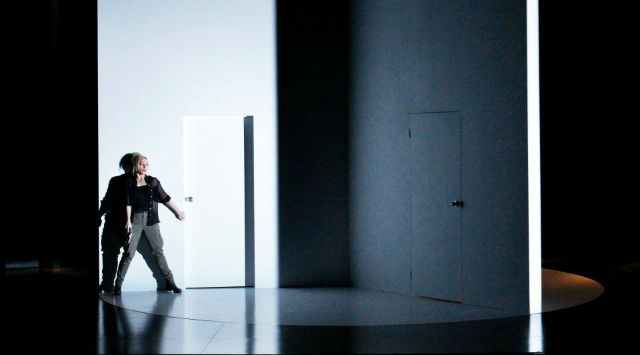
Scenic and lighting design by Nick Schilieper reduces the space and concentrates the action efficiently onto a small stage, so that nothing distracts us from the show’s intimate sequences. The leanness of its appearance however, conveys only a monotonously cold atmosphere. Correspondingly, Leticia Cáceres’ work as director seems to pay fastidious attention only to performances by its three players. The production feels insufficiently ambitious in scope, eschewing a bolder use of space that could have assisted us in relating to the unfolding plot better, by depicting either the oppressiveness of Paulina’s home and mental state, or a wider and more identifiable political and social environment. Composer and sound designer The Sweats excels in his control over atmosphere and scene transitions. He introduces a sophistication, along with a sense of drama to a staging that is often too minimalist in its overall style.

Leading lady Susie Porter presents a likeable and convincing Paulina. Porter’s cerebral portrayal gives integrity to the story being told, and her gracious presence keeps us firmly on her character’s side, but her performance is ultimately a tepid one that lacks a certain operatic quality required for the production to engage more powerfully. Porter’s interpretation is one steeped in depression, where a more dynamic madness would allow the narrative’s controversial aspects greater potency, and therefore elicit a more robust response from its audience. The actor’s work comes across psychologically accurate and very thoughtful, but the Latin American text asks for a fire that may only exist beyond rationality, which itself (being rational or not) is after all, one of its chief concerns. In the role of Paulina’s husband Gerardo, is Steve Mouzakis, who takes every opportunity to raise temperatures in the theatre. It is a smaller part but one that moves through different emotional phases, and the performer brings a spirited passion to each of them, reflecting an impressive conviction that viewers can no doubt appreciate. Eugene Gilfedder makes an interesting villain of Roberto. Probably not quite as charismatic as Porter, and therefore tilting the adversarial balance slightly off between duelling characters, but nonetheless an intriguing personality. He keeps us guessing, which is central to the play’s effectiveness, and provides fine tension at its concluding moments.

Death And The Maiden contains poignant moments of philosophy and drama, but at 25 years old, its resonances require translation. We are certainly no strangers to concepts of political upheaval, war and terror, but what we view to be tangible threats have changed. In spite of the production’s success at achieving a good level of believability, the play feels distant. We are reminded that our concerns have evolved, and although we often consider our civilisations to have improved, the fact remains that the things that haunt us never go away; they only take the form of something else. The fears in the play are different from ours today, but the vulnerabilities we share are interminable, and it is that darkness that Paulina needs to release with indomitable fury.

www.sydneytheatre.com.au | www.mtc.com.au/

Review: Moondance – Isotopic Reflections‏ (De Quincey Co)

Venue: Erskineville Village Anglican Church (Erskineville NSW), September 4 – 19, 2015
Choreography: Tess de Quincey
Video Animation: Samuel James
Photography: Vsevolod Vlaskine
Sound: Vic McEwan
Cast: Tess de Quincey
Images by Vsevolod Vlaskine

Theatre review
We face the far end of the church. There are two narrow stained glass windows, and the central double doors are painted white, as is the wall on which it sits. A video is projected onto the entirety of that surface, composed of photography created from the moon’s light, the beautiful images we see are completely abstract, monochromatic blobs and scribbles that could mean nothing or everything, with sound that is more cinematic than musical, atmospheric and visceral in its transmission. A person emerges in a long, white hooded raincoat, devoid of gender, ethnicity and age, Tess de Quincey performs the majority of the piece with her back to us. She responds and reacts, attempting to understand her relationship with the imagery before her, and we ponder the connection between dancer and photography, human and moon.

Our appreciation of the work does not occur immediately. It is all too strange and silent, and we feel lost in the bareness of its audacious start. Every visual and aural element conspires to move our awareness away from everyday mundanity, and in time, we are unknowingly hypnotised. A meditative quality sets in, captivating our senses, but perhaps more importantly, our minds. We go through periods of thought, trying to create meaning in the sight of dancer against photographic patterns, and we go through periods of release, allowing our senses to experience things as they are, without the interference of logic. It is an unusual pleasure, emerging from the idiosyncrasy of de Quincey’s presence, drawing us in to share in her perspective of the world. In the show’s best moments, time stands still, and we fear for it to end. We want the indulgence to go on, and we want to luxuriate in the sense of elevation it provides, lulled away from our usual petty concerns, into a space of hallucinatory ethereality and eternal bliss.

Lunar tributes have existed since time immemorial. Life on earth is meaningful only when we reach beyond, for the stars and moon. We cannot understand ourselves only from within; humanity requires that we look outside to make sense of what we go through on this planet. Whether sending rockets to Mars or dancing our bodies, art must think of infinity, in order to locate significance, value, or magic. To be human, is to move beyond corporeality, sometimes towards the far reaches of the ether, even if only in our heads.

www.dequinceyco.net

5 Questions with William Erimya and Patrick Magee

William Erimya

William Erimya

Patrick Magee: Have you ever solved a crime in real life?
Will Erimya: I haven’t solved any major crimes, though I am so close to solving who the Zodiac Killer is. I like solving mysteries around the house, like the case of the misplaced keys, why are all these lights on and who ate all the food.

You have the finest beard and moustache the world has ever seen. Who is your facial hair hero?
I’m very hairy and it just grows with out any warning. I admire Super Mario and Craig David’s facial hairs.

Do you prefer doing scripted or improvised shows?
I like both, but I tend to prefer improvised shows. There’s no greater thrill than doing a wholly improvised show. You get such a great adrenaline rush.

What is your comedy secret?
There’s no secret. But, just in case every month I perform a sacred blood ritual at the altar of Kalgar the Everliving. Just in case.

Lastly, shag-marry-kill with Sherlock, Watson and Moriarty?
Shag: Sherlock – you can’t tie him down to a long term relationship, plus you’d always be second fiddle to solving crimes. Marry: Watson – he’s a doctor, so he’s a bit more stable and probably very well off. Kill: Moriarty – he’s a bad guy. So I’d kill him, without a doubt, no questions asked, shoot first still won’t ask questions.

Patrick Magee

Patrick Magee

Will Erimya: In real life who do you identify with more, Sherlock or Watson?
Patrick Magee: Probably Sherlock, because like him I am an arrogant genius with a crippling cocaine habit.

What is your favorite Sherlock Holmes book/mystery?
Out of the Conan Doyle stories I have a soft spot for A Scandal In Bohemia and The Problem Of Thor Bridge, although you can’t go past The Adventure Of The Lion’s Mane, where the murderer is (spoiler alert) a jellyfish that Holmes bashes to death with a rock. I also really like Nicholas Meyer’s The Seven-Per-Cent Solution, which is all about Holmes kicking his cocaine habit with the help of Sigmund Freud.

What made you want to do comedy?
I got tricked into it by an old gypsy woman and I’ve been looking for an out ever since. I’m doing The Game Is Afoot so I can pretend to be a cool action hero instead of a dumb comedian.

How would you get away with a crime?
I’d probably just confess to it in a kind of sarcastic voice so people wouldn’t take me seriously.

Have you ever committed a crime?
Not really. I’m the Zodiac Killer, but that was ages ago so I don’t know if it still counts.

William Erimya and Patrick Magee will be appearing in The Game is Afoot: An Improvised Sherlock Holmes Mystery, part of Sydney Fringe 2015.
Dates: 9 – 13 September, 2015
Venue: The Factory Theatre

Review: Dark Vanilla Jungle (Mad March Hare Theatre Company)

madmarchVenue: Old 505 Theatre (Surry Hills NSW), Sep 1 -12, 2015
Playwright: Philip Ridley
Directors: Fiona Hallenan-Barker & Emma Louise
Cast: Claudia Barrie
Image by Daina Marie Photography

Theatre review
Finding a way to accurately articulate the problems that our societies face is never easy. We can come up with convenient sound bites that attempt to encapsulate what it is that we mean, but we risk trivialising issues through the abstractions that inevitably come with semantic abbreviations. Philip Ridley’s Dark Vanilla Jungle does the opposite. In his deeply harrowing one-woman play, teenager Andrea is the lightning rod at which our failures as a modern community converge. In its oppressive 90 minute duration, we are presented a life experienced through endless days of horror, none of which are due to any fault of Andrea’s own. Her innocence is the target of every evil that walks the planet, while all that is good lays comatose and unable to provide any protection. The story is about sexism, capitalism and poverty, the disintegration of community, and the dissolution of humanity that is occurring in our contemporary lives. It is raw, unflinchingly cruel, and devastating, but it is important.

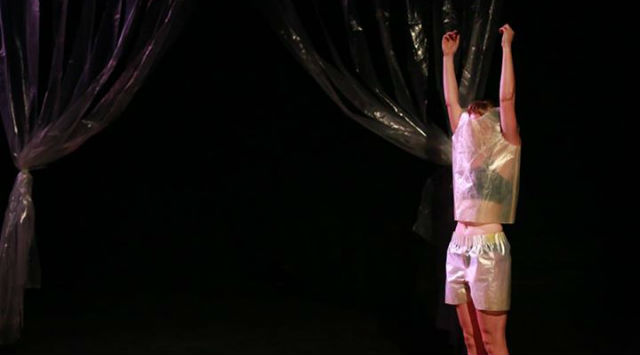
Under the direction of Fiona Hallenan-Barker and Emma Louise, the production becomes an exercise in the depiction of pain. We are an audience numbed by the 24-hour news cycle, calloused by images of dead children appearing alongside idiot billionaires running for office. The need to communicate trauma is urgent in Dark Vanilla Jungle, and its persistence overwhelms our natural impulse to evade its barrage of very dark emotions. The long script is subtly broken up into sections presented with astute tonal variations that keep us engaged, and the gradual revelations in its narrative are handled with a finesse that provide just enough shock value so that their gravity is communicated without being unduly sensationalist or distracting. The use of a clear plastic curtain separating us from the action builds a sentimental and cerebral distance that may encourage more analysis in the viewing experience, but the sacrifice in terms of an opportunity for more emotional involvement is perhaps too great. The show is an undeniably intense one, but the plot structure requires greater care in its second half to sustain its power. After some unbelievably harsh details are divulged, the play falls into a disappointing slump, which it eventually does recover from, but the flaw is an apparent one in an otherwise extremely accomplished rendition of a very difficult text.

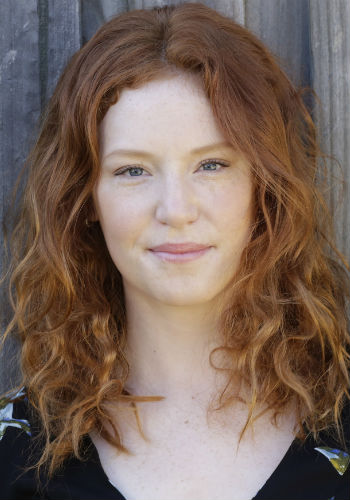
Claudia Barrie’s astounding performance as Andrea impresses with a savage depth that is rarely encountered. Her fearlessness in embodying such a degree of gruesome atrocity gives us nowhere to hide, and we can only respond with compassion. The earthly complexity she manufactures, together with the portrayal of her character’s fundamental pureness, gives Andrea a palpable authenticity that we connect closely and immediately with. We are angered by her torment and wish to protect her, and this instinct makes us examine stories like hers, and other injustices of our world, with renewed resolve and passion. Even in the darkest winters of the Antarctica, flowers are poised to bloom. Life is resilient beyond our conception, but our neglect of the disadvantaged is a transgression that needs to be rescinded at this moment.

www.madmarchtheatreco.com

Review: 6 Degrees Of Ned Kelly (Melita Rowston’s Shit Tourism)

melitarowstonVenue: Erskineville Town Hall (Erskineville NSW), Sep 2 – 6, 2015
Playwright: Melita Rowston
Director: Melita Rowston
Cast: Melita Rowston

Theatre review
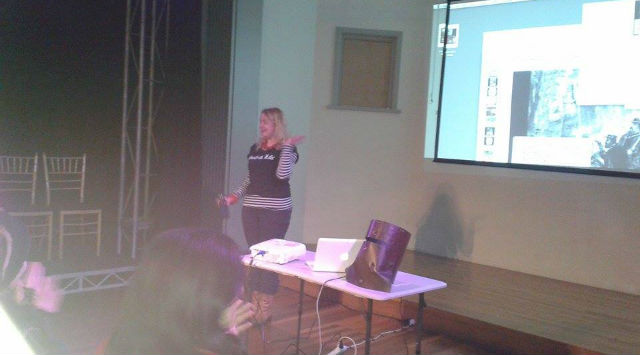
The persistence of Ned Kelly’s legend in the consciousness of many Australians is symptomatic of the anti-authoritarian culture that we have inherited, since the dawn of European settlement. We are highly suspicious of governments and law enforcers, so it follows that myths about outlaws bear an eternal appeal. Melita Rowston’s 6 Degrees Of Ned Kelly is an exploration of her ties to that distinguished history, and an exercise in defining and aligning herself with an underdog characterised by his famed qualities of integrity and struggle. Rowston’s presentation takes the form of a relatively straightforward talk, with the support of a very well assembled slideshow. Her research is incredibly extensive, and the tales that she spins are surprising and fascinating, with fresh approaches to the Ned Kelly mystique that reveal how he remains relevant today.

Rowston’s presence is often tentative and nervous, but she relies on a warm enthusiasm to attain a comfortable connection with her audience, and the environment she creates is unquestionably inviting and accessible. We are not required to be aficionados, or indeed fans, of the Kelly gang, for we can all relate to the stories about family, and to that intuitive longing for a meaningful affiliation with the land on which we reside. Modernity has a propensity to keep people apart, and Rowston’s preoccupation with finding personal links that converge at a point of unity, is an admirable one. Fashion comes and goes, but the stuff that inspires us to be true and good, will resist annihilation.

www.melitarowston.com

Review: The Book Club (Ensemble Theatre)

ensembleVenue: Ensemble Theatre (Kirribilli NSW), Aug 26 – Oct 3, 2015

Playwright: Roger Hall (adapted by Rodney Fisher)
Director: Rodney Fisher
Cast: Amanda Muggleton
Image by Tom Blunt

Theatre review (of a preview performance)
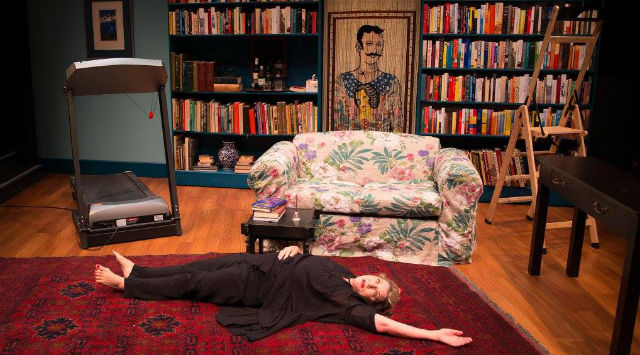
The Book Club by Roger Hall takes a light-hearted look at the follies of a middle aged, middle class Australian woman, who without the stresses of a career or financial uncertainty, occupies her time by indulging in love affairs with books and sex. It is a joyful life, and while her story is mostly inconsequential, it does offer a refreshing way of looking at marriage in contemporary times. Traditional notions of monogamy and fidelity persist, but what actually happens in secret is anybody’s guess. Husbands and books are entirely different things but the effort required to remain faithful to either, can be equally onerous under certain circumstances.

Hall’s script has several disparate focuses, and runs at approximately 90 minutes, which is a longer duration than most monologues can sustain. This production by director Rodney Fisher struggles to establish a comfortable plot trajectory, and the play takes a lot of time before getting to the crux of its own existence, but it is fortunately able to deliver more than a few laughs along the way to keep us entertained. Star of the show Amanda Muggleton is an exuberant and affable presence as Deb, with a natural innate ability to charm as the sole performer of the piece, but on the occasion of this final preview before opening night, it is clear that further rehearsal time is required. In sections of the play where the actor is confident, the rhythms and nuances she creates are completely delightful, but in her many unsure moments, tensions are lost and concentration proves challenging. There were 5 requests for line prompts, which demonstrate quite obviously the prematurity of the work, and we are prevented from engaging with the show at any valuable depth.

Marriage and art are constantly under scrutiny. There is an idea of success that we apply not only from within but that we also invite from the public. Our social nature means that we crave approval for the things we do, no matter how personal, and we want things to always work out. When writing a book, the process can be intensely insular, but ultimately, the finished product goes out into the big wide world, and the author opens themselves to criticisms of all kinds. In a marriage, a couple works in private to find harmony and happiness together, and then present to society the best image of unity they can muster. Not every book will be deemed a success, and not every day in married life is perfect, but it is in the doing, not the accolades, that true meaning is found, successful or not.

www.ensemble.com.au

5 Questions with Gabrielle Scawthorn and Aaron Glenane

Gabrielle Scawthorn

Gabrielle Scawthorn

Aaron Glenane: In Fourplay, Tom describes Alice as strong, driven, unpretentious and classic. What are 5 qualities that sum you up?
Gabrielle Scawthorn: It is hard to strike an appropriate balance of confidence and self deprecation when answering this. You inevitably sound like a Debbie Downer or a Bell End so I turned to my nearest and dearest and asked for one each from them. They say the following;
Hugo (partner): Vivacious
Rob (brother): Assertive
Stephen (Papa): Determined
Teghan (best friend): Filthy
Qiao (my local dumpling supplier): Loyal

Alice is most excited to tell Tom about a breakthrough she has at work. What is the most exciting news you’ve ever told someone?
When I was 17, mid completing my year 12 exams, I got selected for a TV show on Channel V. The camera crews came to my house to break the news of my acceptance, the same night I wasn’t allowed to go to a school dance because I had to cram for a history exam the following Monday. After I got the news I ceased all study and went to the school dance to inform my history teacher I would not be doing the exam on Monday because I was moving to Sydney the next day to party and interview rockstars. She took it very well but asked me to stop drinking at school dances.

You’re very proud of your amazing red hair. Who is your most inspirational red head?
William Wallace.

You’ve mentioned having a few A-list encounters. What is your favourite “star struck” story?
Thank you for this leading question Aaron. (I think Aaron has heard this story roughly 4.5 times). There’s no easy way to say this. I straddled Dame Helen Mirren. I was seeing a show on Broadway and on the way to my seat I was straddling everyone so they didn’t have to get up and mid straddle on one particular lap I looked up and Helen Mirren was between my legs! My seat was right next to hers! I brokered a conversation by saying “I’m so sorry to bother you but seeing as I have already straddled you”, the dame was on game and replied, “Yes, we’re already friends aren’t we?”. Then we watched the show together in perfect harmony.

Alice is on a search for true love and connection. What is your definition of love?
Love is when you meet someone that you can take off all the shit we have to wear publicly to get through a day, all the bravado, all the expectation of what we’re “meant to be” and instead you just be and really get to know someone and once disclosing your true self that other person accepts and reciprocates your offering of absolute authenticity and looks forward to waking up to you. That to me is love… and payment upfront.

Aaron Glenane

Aaron Glenane

In Fourplay, Alice says, that you can tell a lot about a person from where they live. Aaron list three things that are currently in your living space that sum you up.
The plant on my bedside table because I need a bit of nature nearby. There’s a poster of James Dean on my wall saying “Dream as if you’ll live forever, live as if you’ll die today.” The photo frame of my family back home in Victoria.

List three things that are currently in your living space that sum you up perfectly but you wouldn’t necessarily want people to know about.
I have a pair of Where’s Wally underwear. In my DVD collection I own The Notebook…which I bought! I have a “groin guard” which I use at Krav Maga training. But, to the untrained eye it could be misconstrued as something else entirely.

You have often put yourself in a similar acting calibre as Daniel Day Lewis, when off of the screen he is a shoe cobbler. What obscure profession could you see yourself in?
Hahaha I wouldn’t dare say I was in the same league! I’d lose my mind if I was in the same film as him. He’s a master. My first job was being the waterboy for the local basketball team in Ballarat. Maybe the Cleveland Cavs have a vacant position alongside Matthew Dellavedova.

You question Alice’s smoking. What’s your worst habit/vice?
My worst habit is “wishful thinking with the ticket inspectors” and “wishful thinking with how much petrol I’ve got left in the tank.” They kind of speak for themselves don’t they.

Alice asks if you have ever cracked a joke? Aaron what’s your best joke?
An actress, a costumer and a stage manager found an old bottle in a pile of junk backstage. The actress rubbed it against her sleeve, and poof! A genie appeared.
“You got me fair and square,” the genie said. “So you each get one wish.”
“I want a world tour in a starring role,” the actress declared.
“Granted,” said the genie, and poof! The actress was off on her tour.
“I want a yacht and unlimited funds to cruise the exotic ports of the world,” wished the costumer.
“Granted,” said the genie, and poof! The costumer was off on his cruise.
The stage manager rubbed his chin, thought for a minute and said, “I want them back after lunch.”

Gabrielle Scawthorn and Aaron Glenane are the stars of Ride & Fourplay by Jane Bodie.
Dates: 4 September – 4 October, 2015
Venue: Eternity Playhouse

5 Questions with Nick Barkla and Justin Stewart Cotta

Nick Barkla

Nick Barkla

Justin Stewart Cotta: Who is your favourite female actor and why?
Nick Barkla: Laura Gordon is my favourite actress. I’ve worked with her several times and she has always inspired me to go deeper and harder with the work. A genuinely bold, powerful actress. Judy Davis is another favourite, an awesome talent!

With the federal government stripping money from the arts and instead allocating gazillions to military drones, do you feel that more artists will need to produce their own work?
Artists should always be creating and producing their own work. You have more control over what you’re doing and can tell the stories you feel are important and truly worth sharing with an audience. In my experience, it’s not a lucrative thing to do, but can be extremely creative and satisfying.

Most annoying thing your co-actor Justin does?
Justin isn’t shy about telling me where he thinks I should stand and how I should say a line, which can be annoying, but what’s more annoying is that he’s often right! He also makes this clicking noise with his tongue at the back of his mouth when he has asthma that is really disgusting.

What is the most challenging aspect of your character, Joey?
Joey is in emotional turmoil throughout the play, but it’s not in his personality to let it out. He’s caught between loyalty to his best mate, and the dawning realisation that he is in love with his best mate’s wife. He’s also been somewhat of a coward and it’s time for him to stand up and be counted. There are so many challenging aspects to this I can’t name one, but it’s been a great ride so far trying to work it all out.

Favourite meal after an exhaustingly intense two-hander play?
Love a good steak and chips after sparring with Justin all night.

Justin Stewart Cotta

Justin Stewart Cotta

Nick Barkla: Denny is a fantastically destructive character, what similarities do you have with him personally?
Justin Stewart Cotta:: Time has proven that I may well possess an addictive personality, though I am ten years sober now. The occasional violent impulse, a genuine love of people and a love of the senses and a lust for all things worldly are probably still inherent in my makeup, though these days I tend to mix it up with some yoga, reading inspiring memes on fb, and burning the odd stick of incense…

We met doing Glengarry Glen Ross, another Chicago-set drama, why were you excited to do A Steady Rain together?
We struck up a fairly immediate bromance on Glengarry Glen Ross, so in essence we just wanted to work together, and instead of doing the typical whining and sobbing over the state main stage theatre companies recycling the same actors and monopolising the best scripts, we just thought “fuck it”, let’s produce our own show. The script you proposed was excellent, so we approached Keith Huff directly for the rights to A Steady Rain and got them. He dug our vibe and our passion.

We both play cops in the play. Do you think you could have been a cop in real life?
No, despite the fact that I would LOVE to play dress ups and cuff folk willy nilly, I would be a terrible police officer. I would be unable to enforce many state and federal laws that are rotten from the core. I truly respect and appreciate how difficult the gig is, but I would more likely be sitting under a tree plucking a Gibson jumbo acoustic and snacking on fresh celery and hummus.

How would you describe the relationship between Denny and Joey, and do you expect any real-life tension to bleed into your work with me?
Denny and Joey love each other and fight each other in that archetypal dysfunctional family way. The bond is doubtless. However the day to day behaviour leaves you wondering how long they can last. I don’t really experience any tension with you. You are a fairly decent chap, but you def get royally annoyed with me when I direct in rehearsals. 🙂 P.S. I’m not the director, the wonderful Adam Cook is. In my defence, I am often right.

How important is it to find the humour and lightness in a play that tackles dark subject matter like A Steady Rain?
Yeah look, the humour and lightness is at a premium. But those colours will never be as important as the love these two best friends have for each other. A vulnerability and a commitment to the gentle truth, and our willingness/ability to bring those qualities to the stage will be the difference between giving you guys an average show or a gripping show.

Nick Barkla and Justin Stewart Cotta will be appearing in A Steady Rain by Keith Huff.
Dates: 22 September – 17 October, 2015
Venue: The Old Fitz Theatre

Review: The Aliens (Outhouse Theatre Co)

outhouseVenue: Old Fitzroy Theatre (Woolloomooloo NSW), Aug 25 – Sep 19, 2015
Playwright: Annie Baker
Director: Craig Baldwin
Cast: James Bell, Jeremy Waters, Ben Wood
Image by Rupert Reid

Theatre review
Social outcasts are a sad fact of life. Communities are built upon identities that will inevitably exclude “undesirables”, some of whom can form sub-cultures, and others are left to their own devices. Annie Baker’s extraordinary The Aliens features the invisible and ignored; people judged to be of no value to economies, and are indeed, a burden to our gross domestic product. We refuse to acknowledge their contributions to society, because they contradict our definitions of what is valuable, and are considered to be of no benefit to our selfish needs. Baker’s writing is the most sensitive and tender piece of theatre one can wish to encounter. It presents downtrodden lives with an effortless humanity, looking at its neglected personalities and all their open wounds that fail to heal, with a persuasive compassion. Baker turns her strangers into intimately familiar beings, by revealing their pains and desires in a way that we can immediately recognise, and by her deft transformations of peculiarities into charming eccentricities.

Direction by Craig Baldwin is idiosyncratic and powerful. Every line of dialogue is replete with poignancy, along with the many purposeful silent pauses that occur to disarm and entrance. The play is rich with subtexts and references that resonate with great effectiveness, to communicate its message of acceptance and social inclusion. The vulnerability of its characters is portrayed with an unexpected dignity, so that their foibles and weaknesses cease to be strange or reprehensible. There is little in terms of narrative in the piece, but the relationships between its three men are carefully harnessed and perfectly realised. The unusual and intense representation of platonic love between men may be rarely seen on stage, but we believe every second of their intimate friendship, and it moves us from beginning to end.

KJ masks his sorrows with substances and laughter. Played by Ben Wood, the role ranges from being very silly to deeply sorrowful, and the actor runs that entire gamut of emotive and technical demands with wonderful fluency. There is a playfulness in Wood’s approach that urges us to meet KJ’s stories with an open heart, and the results are marvellously affecting. Jeremy Waters as Jasper, is heartbroken and heartbreaking. Coupling a beautiful innocence with impressive presence, Waters’ performance is irresistible, and also completely arresting. His style is understated yet robust, and charismatic beyond belief. In the role of awkward teenager Evan is James Bell, who lifts our spirits with a simple but accurate depiction of purity, and whose gentle approach provides a dimension of aching sentimentality that gives the show its exquisite melancholia.

Also noteworthy are the production’s visual design. Hugh O’Connor’s work on set and costumes is restrained but transportative. Its Americaness is convincing without being deafening, and his vibrant use of colour is a necessary and welcome counterbalance to an otherwise depressive environment. Lighting designer Benjamin Brockman’s adventurous engagement with the incessant atmospheric shifts of the text, is a potent element that expertly guides us through the complex quandary of emotions that is The Aliens.

Anyone can fall, because nobody is invincible. In Annie Baker’s play, we see the kindness that people can have for each other, but also the care that is missing in much of our lives. It discloses the nature of how we do or do not look after each other, and evokes notions of unconditional love that many have forgotten. The outsiders of The Aliens connect in the most meaningful way possible, and watching their story unfold brings to mind our own interactions with the world; where we are successful, and where we flounder. As Australia’s attention to economic development becomes more obsessive than ever before, our interest in the ones who fall behind must grow accordingly. Instead, our political votes go to those who claim to protect our financial well being, and those who demonstrate consciousness beyond money, are struggling more and more with each passing election.

www.oldfitztheatre.com | www.outhousetheatre.org

Review: Dancendents (PACT Centre For Emerging Artists)

pactVenue: PACT Theatre (Erskineville NSW), June 17 – 20, 2015
Choreographers: Flatline, Leah Landau, Rhiannon Newton
Cast: Flatline, Leah Landau, Rhiannon Newton
Image by Matt Cornell

Theatre review
In the search for a definition of art, Flatline’s work Drawn To Move relies on the exposure of process in dance choreography to give meaning to a completed work. Two pencil scribblings are displayed on a wall, emulating archetypal notions of the art establishment. From a fine art perspective, the pieces are primitive and ugly, but in the live drawing of the third, the creators reveal the rationale behind the pieces, rendering irrelevant the commodified hanging objects, and shifting attention to the dance, and time, behind the inanimate finished products.

In a charming parallel, Rhiannon Newton’s Assemblies For One Body is concerned with using the rehearsal process quite literally, to present a performance piece. Newton goes through repetitive movements, with facial expressions and an eyeline that demonstrates an inward focus, as she seeks to unlock motion and gesture for reaching an intangible target of perfection. Without the presentational vocabulary of a conventional show, Newton relies on an enduring vitality to keep her audience engaged. We are drawn in by the energy of her tenacious commitment in exploring body and space, and she fascinates us with an intelligent juxtaposition of sounds (rhythmic and otherwise) with her physicality. We can never fully grasp Newton’s mental processes in each moment, but she certainly encourages us to form personal narratives and interpretations in the presence of her visual elucidations.

Leah Landau’s approach in Summer Bone is decidedly different. Inspired by ideas about nature, wildlife, farming and food, the work is underlined by a serious and earnest environmental concern, but with manifestations on stage that are humorous and thoroughly whimsical. Landau creates language with her body, and communicates persuasively, basic concepts of conservation, that would otherwise struggle to find sophistication in more conventional paradigms. It is hard to find new perspectives on long-standing issues, but art can establish new depictions so that we understand them with refreshed interest. Beyond its political message, Landau’s is a delightful piece of physical theatre that captures imagination, and amuses sight. It is dance that breaks a few rules, so that we come to a renewed appreciation of the artist’s passions.

When theatre abandons narrative, we see more clearly, why we do the things we do, and what it means to make art. Modern life is all but usurped by capitalism, and we forget our humanity outside its gluttonous and all-consuming monetary imperatives. Reading abstract dance, is to explore reasons behind human behaviour. Allowing incoherence to transpire, within the restrain of truth, will deliver a kind of beauty and transcendental pleasure that is unique to the art form, and it is in its embrace that we are reminded of the deeper and more rewarding facets of life.

www.pact.net.au