5 Questions with Sam O’Sullivan and Whitney Richards

Sam O’Sullivan

Whitney Richards: What was the seedling from Doubt that started this whole process?
Sam O’Sullivan: In the preface of Doubt, John Patrick Shanley, wrote about the feeling of doubt having negative, weak connotations, however he views it as a sign of strength. He wrote that doubt is the first step towards change and the ability to grow. If we’re too stuck in our ways, too certain of our world, we lose our capacity for empathy and risk isolating ourselves from our fellow humans. I loved this idea and it influenced my entire reading of Shanley’s play. From this, I knew I wanted to write something about doubt as strength.

Are you surprised with how the original idea has evolved into the final product?
Yes and no. My brief from Redline was always to take an element of the play – whatever spoke to me – and run with it. And Doubt is such a rich piece of writing, that there were a lot of directions I could have run. So I’m not too surprised that we have ended up where we are, but in saying that, I think I’ve always been conscious that we are on the same night as Doubt. We want to have a play that will interest the audiences who are coming to see Shanley’s play.

Do you think it’s a happy accident that the team is mostly WA migrants? How has that influenced the production?
It is a happy accident because, with the exception of my relationship with you (Whitney), none of us really knew each other before we started working on this play. But we definitely all bonded very quickly and I think Perth had something to do with that.

What has been different about this quick response process to how you usually work?
I always work for quite sporadic, intense periods and then shove scripts away in a drawer to ferment for a few months while I go something else. This time around, I haven’t been able walk away for too long, so to compensate I think I’ve been a lot more collaborative with the cast and production team to fast track some of the creative decisions.

As a writer/actor, what is it like to step back and hand your work over to other actors? Basically… do you love us?
It’s awful. I’ve never seen a bigger bunch of numpties make something so simple look so difficult. 🙂 But yes, I love you.

Whitney Richards

Sam O’Sullivan: What’s the best and worst thing about travelling alone?
Well, I’ve done this one a lot lately. Although it’s always been paired with touring a show which is really bloody stressful alone. You’re not sharing the workload of scheduling and plans which can be a bugger but also you get to do what you want when you want. At times I’ve felt a little vulnerable. Like I had to be hyper aware of personal safety. I did have my heart broken whilst overseas and that really sucked.

My travel self is my best self. I feel more alive and keen to push myself to try new things. When you travel alone you are without metaphorical baggage. No job title, no relationships. You become more present. You are forced to make friends. And fast track these relationships because you know your have limited time. People see you for who you are which I’ve found to be a confidence boost. I come home feeling more comfortable in my own skin. I do have moments of sadness when something at home triggers a memory from my travels; a song or a person or a show and I have no-one to rekindle the memory with.

What can your siblings do that still drive you nuts?
Actually, I’ve always completely admired my older sisters. They’re intelligent, fiery and hilarious women and mums. There’s a bit of an age gap between us so they never drove me nuts in the way my nieces and nephews do to each other. Such a power play there. It’s fascinating to watch the love and the hate. The care for each other and then the violence! Just like the characters in The Wind In The Underground. It’s been fun playing siblings that grew up together because my sisters and I didn’t get to do that. I’m younger than my sisters so I reckon I was probably the irritating one. I do remember visiting my sister when I had turned 18 and her saying to me “You’re so different. I can have a conversation with you now.”

Whats a private joke that only you and your siblings would find funny?
It might be a WA thing or an us thing…but we’ve always enjoyed the word “jobby”. Its means poo. Yep.

How has rehearsing The Wind In The Underground been different to other plays?
It’s always thrilling to be involved in new works. You get to witness and be a part of the changes that make it a stronger and stronger story. I love hearing from writers about the impetus for the story and characters. It was odd watching Doubt the other night and remembering that The Wind In The Underground is a response to that. It’s such a different world. I think people seeing the double will have an excellent night at the theatre.

The 40 minute slot is something I’ve never done before. The story has to be simpler than a 1hr+ show to have a satisfying beginning middle and end. Claire is an interesting person to explore. She doesn’t say a whole lot so finding a way to thread her emotional journey together continues to be an interesting process for me. She’s stuck in an place I found myself in a few years ago (pre-travel) so that’s been familiar territory.

I hadn’t worked with anyone on our team before, so it’s been a bloody delight getting to know these hilarious humans. We feel like a real family.

Whats your favourite thing about the Old Fitz?
I spend my nights ushering at Belvoir St and Sydney Theatre Company so when I have a night off, I usually try to spend it away from the theatre. I’m embarrassed to admit I don’t see everything at the Old Fitz. I’ve really enjoyed my time there though. Firstly, the space itself is really great. The 60ish seater is truly my favourite. It’s perfect for really hearing and connecting with an audience. You’re much closer to the feedback loop. It reminds me of the beautiful Blue Room theatre in Perth. I’m enjoying the vom entrance very much too.

It seems like Redline have a great connection with the patrons of the pub, the people who run it and the theatre community. So from someone coming in with fresh eyes, that seems to be a beautiful functioning thing. I’m looking forward to our season and hope to see more shows there in the future.

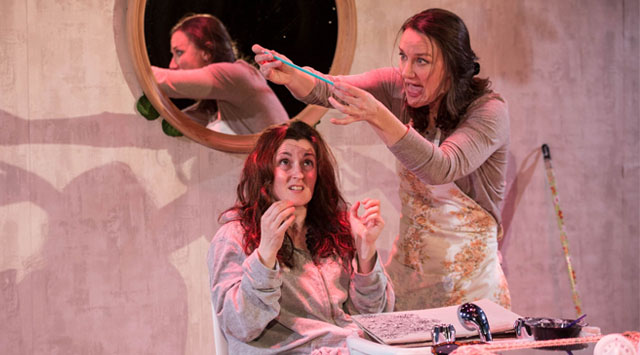
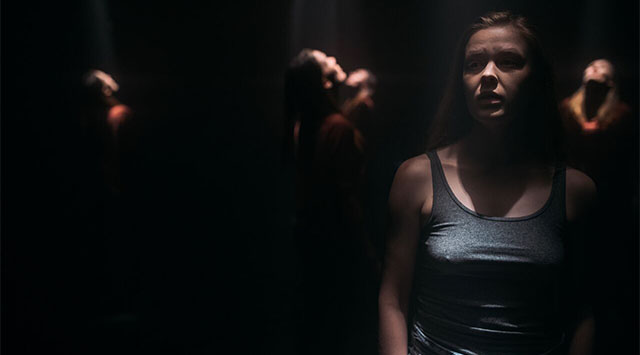
Whitney Richards appears in The Wind In The Underground by Sam O’Sullivan.
Dates: 23 May – 3 June, 2017
Venue: Old Fitz Theatre

Review: Homeroom Series (ATYP)

Venue: ATYP (Walsh Bay NSW), May 10 – 19, 2017
Images by Tracey Schramm

Girls Like That
Playwright: Evan Placey
Director: Robert Jago
Cast: Annika Bates, Claire Giuffre, Ella Hosty-Snelgrove, Rashie Kase, Michelle Khurana, Molly Kyriakakidis-Costello, Miranda Longhurst, Emily Longville, Natasha Pontoh-Supit, Cara Severino, Emily Simmons, Lucy Valencic, Lara Wood

Michael Swordfish
Playwright: Lachlan Philpott
Director: Tamara Smith
Cast: Ashutosh Bidkar, Eden Bradford, Fergus Finlayson, Jason Hartill, Tim Kenzler, Louis Nicholls, Angus Powell, Daniel Steel, Gus Watts

Theatre review
Two plays about teenagers in high schools, both utterly contemporary, and equally relevant to the Australian experience. Evan Placey’s Girls Like That makes a powerful statement about feminism for the young, and Lachlan Philpott’s Michael Swordfish offers unconventional observations about teenage masculinity. Uncompromisingly complex, they each offer an unusual opportunity to explore adolescence in ways that might be surprising, through themes that are confronting but pertinent to all our lives. We watch the young, and learn about ourselves.

Robert Jago’s exquisite direction of Girls Like That is powerful, deeply engaging and thrilling in its combativeness. Michael Swordfish takes a gentler approach, with director Tamara Smith offering a poetic perspective to our young men’s lives. Designers, too many to mention, do an excellent job for an impressive pairing of shows that look and sound as vibrant as they are polished.

The actors are uniformly compelling and enthusiastic, with many displaying very fine potential for serious careers in performance. Cara Severino’s ebullience is unforgettable, while Rashie Kase has an unshakeable authenticity that can convince us of anything. Louis Nicholls portrays his character with a sense of creative freedom and adventure, and Gus Watts captures our attention with a confident hand at subtle comedy. These fledgling artists, all 22 of them, should feel greatly encouraged by the outstanding quality of work here.

The characters are in their formative years, so what they acquire now, could well stay with them for the rest of their days. What happens to them, and how they react, are depicted in both plays with a degree of honesty, that does not allow us to detach. For their contexts of juvenility, it is easy to diminish these experiences and consider them trivial, but contained within their microcosms, are truthful interrogations about our shared existence. Through these kids, we discern right from wrong, and decide how we must evolve.

www.atyp.com.au

Review: Educating Rita (The Depot Theatre)

Venue: The Depot Theatre (Marrickville NSW), May 10 – 20, 2017
Playwright: Willy Russell
Director: Julie Baz
Cast: David Jeffrey, Emily McGowan
Image by Katy Green Loughrey

Theatre review
We meet Rita as she begins to realise her discontentment with banality. Going back to school, she wishes to make improvements to her life, although not entirely sure what a better existence should look like. Her tutor Frank on the other hand, is an alcoholic, and a poet who no longer writes. Both are subconsciously thinking “anywhere but here,” but only Rita knows to seek for answers in a productive way.

Willy Russell’s Educating Rita is about aspirations, and also, in its very British way, about class distinctions. Its humour relies on Rita’s lack of sophistication as a Liverpudlian hairdresser, but under Julie Baz’s direction, the characters speak as Australians, with our Rita in a broader, shall we say, working class type accent.

It is a bold decision that proves to be at times effective, and at others, quite awkward. The text mentions a slew of British places and personalities, and talks of Australia as a faraway country, so the production’s ability to assist with our suspension of disbelief tends to be inconsistent. However, the show remains otherwise attentive to the spirit of Russell’s writing, and we always feel that its heart is kept in the right place.

The actors take a couple of scenes to warm up, but when Emily McGowan gets comfortable in her role, Rita’s endearing qualities shine through, allowing us to engage with the play’s ideas and sentimentality. Both actors, McGowan and David Jeffrey, can on occasion slip into an unfortunate reticence with their parts, but when confident, their scenes become involving and quite amusing. Also noteworthy is Tim Linghaus’ music providing an air of melancholy appropriate to the characters’ inner worlds.

Rita and Frank cross paths, as they both embark on new trajectories. Life is change, but we do not have to think of moving up as the only meaningful way to achieve progress. We have to value the sense of surprise in all our narratives, just as we know to enjoy the simple straightforward increments in things we usually pursue. The universe will take us places, whether we like it or not. It is how we choose to understand them and delight in them, that makes all the difference.

www.thedepottheatre.com

Review: Doubt: A Parable (Apocalypse Theatre Company)

Venue: Old Fitzroy Theatre (Woolloomooloo NSW), May 10 – Jun 3, 2017
Playwright: John Patrick Shanley
Director: Dino Dimitriades
Cast: Charmaine Bingwa, Damian de Montemas, Belinda Giblin, Matilda Ridgway
Image by Robert Catto

Theatre review
John Patrick Shanley’s genius masterpiece, Doubt: A Parable takes a deep and extensive look at the nature of doubt, and through it, reaches for something fundamentally real about who we are. Its greater power however, lies in its narrative. It is the literal rather than the allegorical that many will find affecting in the play, with the ongoing predicament of paedophile priests in our churches never seeming to find satisfying resolution.

Sister Aloysious possesses no concrete evidence of Father Flynn’s trespasses, but her position as school principal requires that students are protected at all cost. Operating under severely defective systems of patriarchy and the clergy, Aloysious can only do the right thing by dehumanising herself in order that she may be able to undertake necessary measures, “in the pursuit of wrongdoing, one steps away from God.”

This sensitive interpretation by director Dino Dimitriadis pulls close focus to Shanley’s words, with theatrical devices kept at an intentional quiet, so that we garner maximum impact from the extraordinary writing. Design aspects are minimal and unobtrusive, but elegantly effective.

Performed with great detail by an impassioned cast of four, we are offered a marvellous intensity of interplay between characters that could only emerge from exhaustive study and immersion into the text. Belinda Giblin is stunning as Aloysious, psychologically meticulous and emotionally complex, she gives us crystal clear insight into the personality being presented, while providing astute access to the unusual world in which she resides. A wealth of meanings are implied in Shanley’s dialogue, and Giblin makes certain that we receive them all.

Father Flynn’s uncompromising ambiguity is the show’s dramatic lynch pin, brilliantly manufactured by Damian de Montemas whose hints of malice keeps us engrossed and on edge, even if he does sound uncomfortable in his American accent. The magnetic Charmaine Bingwa leaves a strong impression in a singular pivotal scene, embodying Mrs Muller’s specificity of time and space with a remarkable authenticity of presence. Matilda Ridgway is a quirky Sister James, veering slightly too far from naturalism, but whose interpretations are unquestionably entertaining.

We watch these people participate in a religion that has overwhelmed their lives, and wonder if Catholicism takes more than it gives. We see the destruction it causes, and are suspicious of the way it claims to be of benefit to these individuals. We also see the inextricability of religion, and the difficulty of achieving emancipation from its indoctrination. As our nation continues to wage war against “radical Islam”, rapists in our Catholic and Christian churches are allowed to fester year after year. We hear about investigations and inquisitions taking place every day but they deliver little, while our children face dangers that are constant, secretive and insidious. Sister Aloysious does the best she can, but knows that it is not yet enough.

www.apocalypsetheatrecompany.com

5 Questions with Emma Chelsey and Gabe Fancourt

Emma Chelsey

Gabe Fancourt: What’s the most challenging aspect of revisiting a character you’ve already played?
Emma Chelsey: I think it’s always important not to bring judgements or preconceived ideas of the character or comparisons to what you have done previously and just start again with a fresh set of eyes. This was challenging to do but I feel it was helpful. There was a lot of development to the script so a lot of it was new and hadn’t been investigated yet so I was able to go deeper having explored this person before and learn a lot more about her the second time around. It’s also easy to fall into a previous way of delivering lines so you have to break that vocal pattern and discover it again as if for the first time!

What did you learn about the play getting it in front of an audience the first time?
That it’s silly, funny, absurd and a thrill!

What is your character’s spirit animal?
Abby is a horse for sure. Flighty, skittish, easily affected by the energy around her, sensitive and can display both dominant and submissive behaviour depending on the situation!

How do you prepare for/ approach scenes that are sexual or intimate in nature?
With laughter. Literally that’s all you can do. You obviously make sure you and your scene partner are comfortable, you rehearse very specifically, everything is choreographed and then you laugh about it a lot…

What’s the strangest/ most unconventional thing about this play?
Sex on stage. It’s confronting and quite foreign to see in theatre and I am intrigued by what the audience reaction will be. Also, the sexual fantasies are strange and wonderful!

Gabe Fancourt

Emma Chelsey: Describe the play This Is Not Mills And Boon in five words.
Gabe Fancourt: Irreverent, playful, honest, dynamic, fun.

What is one of the questions you hope this play asks or answers?
I think with a large part of itself this play is grappling with the extent to which our identity, and in particular our sexual identity, is shaped by our sense of shame. How can we connect with our tastes and preferences when those impulses are met with reflexive shame?

What is the craziest acting related thing you’ve ever done?
In my first school play I was cast as a question mark. For research I interrogated people relentlessly with questions. I also hurt my back trying to get the physicality right.

What has been your favourite part of the process so far?
It sounds nerdy, but I really love the dramaturgical element involved in the development. Sitting down with a script and really sharpening in on how the scenes function and how the story is told in a clear and compelling way is something I find very satisfying.

What do you think is the naughtiest part of this production?
Definitely the fish on fish sex scene. (Spoiler alert)

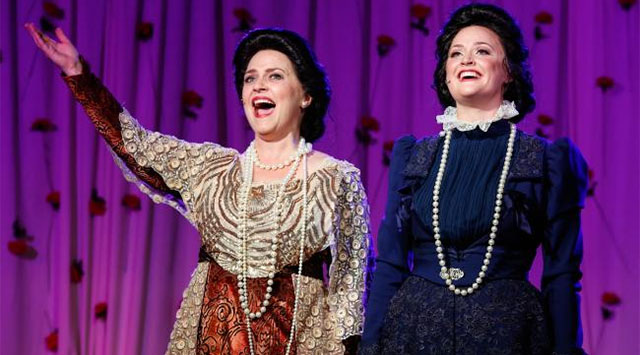
Emma Chelsey and Gabe Fancourt can be seen in This Is Not Mills And Boon by Erica J Brennan.
Dates: 23 May – 3 June, 2017
Venue: Old 505 Theatre

Review: Black Is The New White (Sydney Theatre Company)

Venue: Wharf 1 Sydney Theatre Company (Walsh Bay NSW), May 5 – Jun 17, 2017
Playwright: Nakkiah Lui
Director: Paige Rattray
Cast: James Bell, Kylie Bracknell [Kaarljilba Kaardn], Tony Briggs, Luke Carroll, Vanessa Downing, Geoff Morrell, Melodie Reynolds-Diarra, Shari Sebbens, Anthony Taufa
Image by Prudence Upton

Theatre review
Charlotte worries about being too white, or to be more accurate, she carries shame about her life not being black enough. The blood in her veins is Aboriginal, but having been born into great privilege, she can only observe, what she considers an authentic black experience, from afar. In Nakkiah Lui’s Black Is The New White, we visit a wealthy black home, through what could be the whitest of storytelling genres possible, the Christmas family comedy.

The show is very funny. Indeed, the jokes do at times, sit on a level of superficiality characteristic of the format, but Lui’s relentless need to interrogate the state of Aboriginal politics allows her show to speak in any tone it wishes, while always retaining a gravity that justifies the exercise, along with providing an extraordinary level of intellectual involvement that keeps us firmly engaged. The work has a specificity that feels completely of the moment; its language, its concerns and its ideas are thoroughly modern. It articulates what we are thinking, but have hitherto been unable to discuss with great fluency. It allows the convoluted disarray of contemporary Aboriginal perspectives surrounding issues of colonialism, be magnificently displayed in all its unresolved vexations. The play is an important timestamp that chronicles the discontent inherent in today’s social dynamics, and a fantastic piece of entertainment with a surprisingly wide appeal.

Paige Rattray demonstrates excellent flair for the sardonic with Black Is The New White. Very pointed observations are made agreeable, and dark subject matter is turned satirical; we are all compelled to have a sense of humour, at Rattray’s insistence. Big conversations between its characters about Australian morality are finely gauged, so that we receive the full impact of what each person is saying. We analyse their upper-middle class lives as their stories unfold before us, but cannot escape shades of complicity, while we inevitably recognise ourselves in so much of the blistering dialogue.

A spectacular cast of nine is fiercely present, determined to enthral and educate. Each vibrant actor offers up a personality that is detailed and authentic, and we get to know them with extraordinary familiarity. Not all are picture perfect and several prove themselves to be quite nasty people, but we fall head over heels nonetheless. They are all very charming.

Charlotte is played by Shari Sebbens, a performer especially effective when things gets politically combative. The conviction she brings is impressive, leaving no room to doubt her very edifying intentions and desires. Melodie Reynolds-Diarra is commanding in her maternal role, incisive with her humour, but adoringly warm as leader of her pack. Remarkably elegant, she delivers some of the play’s biggest laughs with what looks to be little effort. The narrative’s pivotal parts of duelling fathers, are played mischievously by Tony Briggs and Geoff Morrell, both imaginative and effervescently confident with what they introduce to the stage. Their bickering is hilarious, and the actors’ chemistry as an unexpected pairing, is a highlight.

Set design is brilliantly conceived by Renee Mulder, who establishes five separate performance spaces within the interiors of a very glamorous house. Aesthetically refined and superbly functional (without relying on moving parts), it presents comfortable aspects to all seats in the auditorium, although decoration and costumes could benefit from a bolder, more adventurous style.

There are many ways to talk about race and Indigenous experiences, and in Black Is The New White, we find several of them co-existing. The joy of being able to partake in its pluralist approach to these difficult matters, makes the play uniquely refreshing. The people we meet have differing views, but they are all likeable. As audience, we are then given permission to agree with contradictory points of view, or at least, are encouraged to take moments to appreciate what our adversaries value. It is a messy affair at the Gibson household (complete with an epic food fight), and although the stories all conclude nicely, à la Hollywood (and Bollywood), the issues that had been brought up do not diminish. Money can solve many problems, as we witness at this spirited Christmas gathering, but it is how we move our rich resources around that will bring about the improvements we desperately need.

www.sydneytheatre.com.au

Review: Between The Streetlight And The Moon (Mophead Productions)

Venue: Kings Cross Theatre (Kings Cross NSW), May 5 – 27, 2017
Playwright: Melita Rowston
Director: Anthony Skuse
Cast: Joanna Downing, Ben McIvor, Lucy Miller, Suzanne Pereira, Lani Tupu
Image by Clare Hawley

Theatre review
Talent is a thing of mystery, and one of its elusive qualities surrounds the faith that an artist should have in their own abilities. In Melita Rowston’s Between The Streetlight And The Moon, we examine the ways in which painters are able to find a sense of belief in themselves, or more accurately, how their spirits can be dampened, by longstanding institutions that thrive on their own elitism and the implied deterrent of new individuals who wish to join the ranks.

The number of female names in the world of celebrated Western artists, is unquestionably paltry. The play looks at the way women painters and their work, are routinely subjugated and subsumed by their male mentors and counterparts. This chauvinism seems systematic, and it feels dangerously instinctual, and we wonder if this dynamic exists everywhere else in life.

Rowston’s writing is at its best when wistful and poetic. Her words are powerfully evocative, always passionate with advocacy for something meaningful. The plot is however, not as gripping as it wishes to be. Intrigue builds slowly, and when the story eventually becomes dramatic, we find ourselves more interested in Rowston’s philosophical ideas than the narrative being woven over them. Dialogue has a tendency to sound stilted when scenes attempt to be conversational, but the language turns beautifully sublime when characters move into more heightened modes of theatricality.

Actor Lucy Miller is an entrancing presence as painter-turned-academic, Zadie. Vulnerable, with an unmistakable gravitas, Miller brings authenticity to a protagonist who exists between shifting states of self-doubt and self-belief. Also impressive is Joanna Downing as the enthusiastic emergent, Dominique. Precise and considered, Downing’s portrayal of a brainy Millennial is truly delightful, even if her French accent is comically exaggerated.

Visual design is sparing but elegant. The use of projections to assist with our imagination of classic paintings is effective, and very gratifying, but an interpretation of The Seine requires much bolder execution. Live accompaniment by Benjamin Freeman on piano, adds brilliant flair to the show, a rare treat that theatregoers will find thoroughly enjoyable.

Zadie suffers humiliation when she mistakes a streetlight for the full moon. It is hard to conceive of creativity without sensitivity, but it is the artist’s responsibility to weather attacks on their pride, and return with greater vigour. It is also the responsibility of society to provide support to those who have the ability to give expression and meaning, to the human experience. In Australia, we have to give mindful emphasis to those artists whose voices continue to be silenced by a history of colonialism and its accompanying white patriarchy. Our art must strive for an accurate reflection of Australian life, and the white male artist is far from enough.

www.mophead.com.au

5 Questions with Charmaine Bingwa and Belinda Giblin

Charmaine Bingwa

Belinda Giblin: Who is Charmaine Bingwa?
Charmaine Bingwa: I am such an amalgam, but will try to be concise. I was born in Australia and am the youngest of the three children born to my Zimbabwean parents. I grew up in Perth and moved to Sydney on my own when I was 18. In terms of job titles, besides actor I have also turned my hand as director, producer, composer, singer, guitarist, writer, amongst other things. I’m a Scorpio, I don’t sleep very much, I prefer character over comfort, I pretty much always have a script or book in my hand, I like to lead by example, I don’t drink alcohol, I care too much, I love to sing, I value sincerity, I work stupid-hard and I am addicted to making those around me laugh.

Tell us a bit about your journey into the acting profession?
It was quite serendipitous really. I was studying music, I decided to take acting as an elective to help with public speaking. But I loved it and was almost immediately hooked. I got permission to do the acting course in addition to my music degree and here I am!

What is it that draws you to a particular role? What drew you to this particular play?
I like playing complex individuals. I believe that personality traits lie on a spectrum, where the same trait that helps someone, can also hurt or hinder them. For me, that is humanity. For me, that is where the gold lies in characterisation. For me, that is the crux of Doubt: A Parable. I love the investigative process of finding a character. I’ve always been fascinated by how things work; as a kid, I even used to pull apart computers and rebuild them just for shits and giggles.

And at risk of sounding otherworldly, I believe that roles choose me. Certain roles find me at critical junctures of my life when I need to learn or experience something on a deeper level. I also feel like roles gift me, more than I gift them. I’m fastidious in my preparation, so I come away learning so much more about history, people, moments in time, disorders, human nature, personality types or whatever it may be. For a nerd like me, that’s Christmas.

Doubt is set in the Bronx in 1964, if Mrs. Muller were to live under the Trump presidency, would she be a Republican or a Democrat? What would be her political agenda?
I think she would be a Democrat for sure. She would have loved that there had been a President Obama! All this woman wants is progress, and she is willing to put aside short-term well being in exchange for long-term advancement. For her, a Trump presidency would be a hard pill to swallow.

I think Ava DuVernay’s Academy award nominated documentary The 13th puts forward the hypothesis perfectly that the persecution of African American people just reappears in different permutations throughout history; slavery turned into convict leasing, which turned into lynchings and Jim Crow, which turned into the war on drugs and mass incarceration, which turned into police brutality and institutionalised racism. I think she would be heavily involved in the Black Lives Matter movement.

Actors prepare for their roles in different ways. Do you have a “process” that enables you to inhabit a role?
The preparation I do is always dictated by the role. For Mrs Muller I did extensive research as I felt in order to temper the words that come out of her mouth, the audience needs to feel her history. The answers lie in the generations that have gone before her – so backstory was key.

I just keep asking questions – what bible verses does she love, what were her formative years like, what is the one secret she is taking to the grave? I’m always fascinated by what I find. But my most important step is to throw all the technical work I’ve done away and just tell the truth, or tell their truth rather. The rest of my process is a secret!

Belinda Giblin

Charmaine Bingwa: What made you first want to get into acting?
Belinda Giblin: Both my parents and siblings were involved in the Performing Arts in one way or another so I was surrounded by a lot of singing and dancing and acting from an early age. I’ve always had an instinctive need to perform, to put on that “mask” if you like, so the acting profession was a very natural choice for me.

Mind you, I did a few things before I got there, including an Arts degree and a short stint at NIDA. They threw me out of NIDA after one year. I was described as “laconic” and it was suggested that “trial and error” may be my better training! My first job was in the TV series Matlock… in black and white!

John Patrick Shanley says Doubt is the “age-old practise of the wise”. Do you agree and how is this evident in your life?
Absolutely. When I was 16 I thought I knew everything! Nothing had been tested too much at that age. But now, in my 60’s, I am more circumspect because, of course, life keeps changing, the goal posts get moved, nothing is certain and we never stop learning and growing. Therein lies the wisdom I guess. Pretty exciting!

If you and Sister Aloysius had a dinner party and could invite 2 guests each-who would you each bring and why? And yes, they all have to get along!
Oh dear! Well…. Sister Aloysius would invite the Pope of course because she would wish to get his opinion on the “Boys’ Club hierarchy” of the Roman Catholic church and have a few words to say to him about that! And because she is an educated woman and a great lover of words she would invite that famous 19th Century poet Gerard Manley Hopkins, to discuss his religious doubt-filled sonnets, particularly the one about “God’s Grandeur”. Please explain!

I would invite Germaine Greer and that fabulous camp American satirist, Randy Rainbow, to throw into the mix! Sister Aloysius would have a lot in common with Germaine Greer and Randy Rainbow would cheer Gerard up no end! The Pope would sit and smile benignly and fall asleep!

Is there a dream role you are still yet to play?
I’ve never hankered after roles that have been done before, to put my particular stamp on them. There will always be comparisons. I tend to favour something new, as long as the writing is wonderful! Oh what?….did Meryl Streep do Doubt? Why didn’t someone tell me?

We’ve seen you play so many amazingly crafted characters, but what are Belinda Giblin’s defining qualities?
Optimism; humour; resilience; curiosity; tenacity; self-determination; obsessiveness; dedication; compassion…what? Oh, I’m sorry… is that enough? OK.

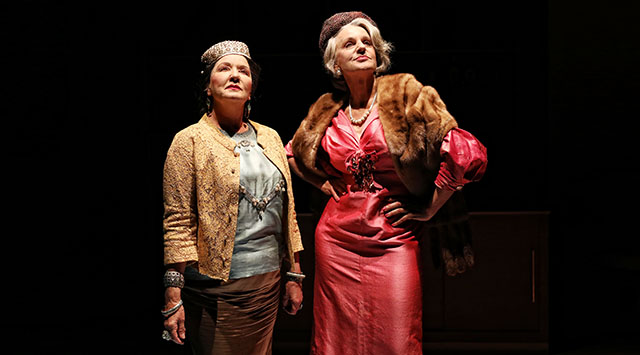
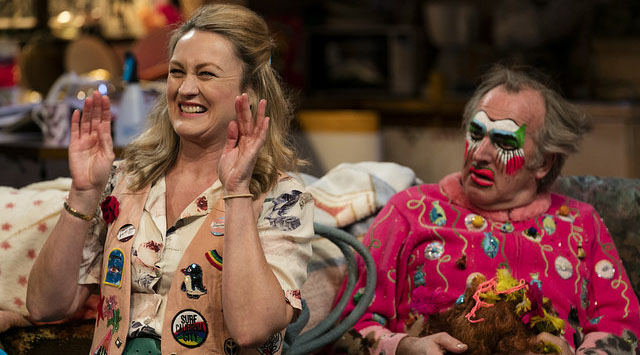
Charmaine Bingwa and Belinda Giblin can be seen in Doubt: A Parable by John Patrick Shanley.
Dates: 10 May – 3 June, 2017
Venue: Old Fitz Theatre

5 Questions with Joanna Downing and Ben McIvor

Joanna Downing

Ben McIvor: Jo, what do you love about your character Dominique?
Joanna Downing: I love that she can be so dry. I love her intelligence. I love that she is so considered – the way that she looks at the world, and art.

If Dom was an animal, what would she be, and why?
Cat. All lithe and bendy and somewhat mindless of other people’s space.

How do you prepare for a role?
Read the play as many times as humanly possible. Films and books invariably come up in conversation in the rehearsal room, so I try to watch/read as many as I can. I’m reading the Female Eunuch at the moment because of this one! I also started an image collection… Dom knows so much more about art and artists than I do, so I needed to familiarise myself with the images. Oh and of course, the French. I’ve been practising daily to get it up to scratch.

How has this play affected your understanding of art?
Well I hope it’s made me more conscientious. It’s definitely made me want to go to Musee D’Orsay and Marmottan to spend time with the real pieces. I think the play has given me an emotional attachment to the works, simply through Dom’s love of them, that I didn’t have before.

What’s it like working with Anthony Skuse?
Heaven! He is so considered and very open. The tone of the room was always warm and comfortable, but he also cuts through any extraneous bullshit. I have a sneaking suspicion that he can read me better than I can read myself.

Ben McIvor

Joanna Downing: What do you like most about the space at KXT (Kings Cross Theatre)?
I hope this doesn’t sound too weird, but I absolutely love the foyer! The art, the furniture, the typewriter, that stunning lamp, the egg timer, the books, that creepy dream catcher blowing around in the air conditioning under the glow of the exit sign… it feels like you’ve stepped into a strange dream.

What’s the biggest point of difference between you and your character?
I tend to think ahead a lot, whereas the thing I admire most about Barry is he lives moment to moment. He doesn’t think, he just does.

Who is your favourite artist and why?
Oooh, good question! This is particularly hard to answer because doing this play with Mr Skuse has really opened up a world that seemed so foreign to me. I’m going to go with Scottie Marsh, though. Growing up in the Inner-West, Hip-hop and graffiti played a big part in shaping my youth, and “fine art” seemed like something so far away from street art. Sipping nice wine in white-walled galleries was a world away from Posca’d train cabins and “Bombed” walls. I think Mr Marsh seems to do a great job of blurring the line between graffiti and fine art… and if I was a youth in 2017 who was into street art, this type of work might spark my interest into the world of fine art. I hope that makes sense!?

Do you have any pre-show ‘rituals’ to get you into character?
I guess it depends on the role. I like to do character work early on in the rehearsal process and I have a long list of questions that I ask my character to discover more about how they view themselves and their world… I read some of the responses before each show, and think about the images they create.

What’s your favourite music and what’s your character’s favourite music?
I think Barry is very much a jazz man. I think when he paints, he doesn’t like typically structured songs with lyrics, a beginning, middle, and end. I think he likes improvisation- instruments talking with each other. Me? At the moment I’m really into Bossa Nova. It’s the kinda stuff you can relax to, dance to, cook to, drive to or jam to. I love the variety of instruments that are used in Bossa… the sound has a certain “charm” to it.

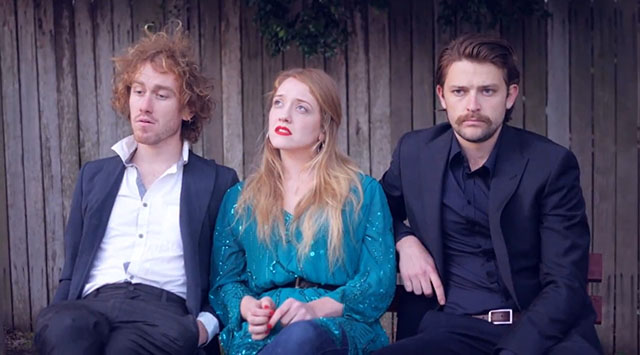
Joanna Downing and Ben McIvor can be seen in Between The Streetlight And The Moon by Melita Rowston.
Dates: 5 – 27 May, 2017
Venue: Kings Cross Theatre

5 Questions with David Jeffrey and Emily McGowan

David Jeffrey


Emily McGowan: What do you and your character Frank (your character in Educating Rita) have in common and what sets you both apart?
David Jeffrey: We’re both mad, I currently have too much hair on my head and I do like going to the pub, though I seldom get to enjoy this pleasure. The obvious difference between us is that Frank loves poetry and I love plays.

Tell us how Frank would spend his day if he could do anything, no expenses spared?
Frank would take Rita by the hand and time travel back to late 18th century London to invite William Blake for a pint at the Lamb & Flag.

I have hired you a private 3 hat Michelin chef for the night, what do you ask them to make you and why?
Love my classics. Shrimp Cocktail, Duck a l’Orange, followed by Baked Alaska.

What is one of the greatest challenges you have found working on Educating Rita?
Knowing what scene is coming next. Sounds simple but not in this play.

If you were an animal what would you be?
A Blue Dragon.

Emily McGowan

David Jeffrey: What do you like the most and the least about your character Rita in Educating Rita?
Emily McGowan: What I like the most about Rita is her heart. She is passionate about justice – she loves people! I love that she isn’t crippled or trapped by her inequities, but rather, she is a go-getter and takes every opportunity. Something I don’t like about Rita is that she can sometimes be a bit clueless, I often feel like saying “Come on girl! Screw your head on.” But really she is hard not to love.

If you could live and work anywhere in the world, where would it be and why?
This is a hard one as I have two bucket list places (in which I have never been to). It would be either Paris or New York. Both places seem to steam with possibility and culture – quite different ends of the spectrum, and they both embrace art so much. Paris might win though as I am addicted to croissants.

How do the challenges Rita faces to become ‘educated’ compare to your own life challenges to date?
I think Rita gets put in a box by many of the people around her – they label her as simple and at times stupid. Frank however believes in her and unlocks those boxes, showing her that if she puts her mind to it she can be educated. I had a teacher in high school, who very similarly believed in me and empowered me to case my dreams

You produce your own work as well as act. How does that work for you?
It’s great! Honestly, you can’t just sit around and wait for other people to hand you opportunities on a silver platter. I think being able to create a piece and bring people together really empowers me – more people should try. My big thing is don’t micro manage. I have my skill sets, you have yours. I’m not going to tell you how to do a job I know nothing about. But that is why I love making theatre so much, collaborating as a creative team is such a rewarding experience.

You’ve just been told you will become deaf and blind in 24 hours time. What do you do?
That’d be a nightmare! Spend all that time with my family, locking into the memory bank what they look and sound like.

David Jeffrey and Emily McGowan are appearing in Educating Rita by Willy Russell.
Dates: 10 – 20 May, 2017
Venue: The Depot Theatre