Review: In Real Life (Darlinghurst Theatre Company)

Venue: Eternity Playhouse (Darlinghurst NSW), Sep 15 – Oct 15, 2017
Playwright: Julian Larnach
Director: Luke Rogers
Cast: Anni Finsterer, Elizabeth Nabben
Image by Philip Erbacher

Theatre review
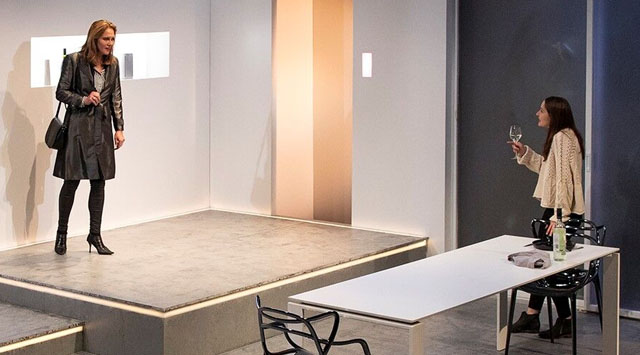
Although a completely natural state of being, we think of emptiness as a kind of malady. It is that sense of lack, that so often drives us to action. At our best, we are productive and inspired, but at our worst, it is our decisions that can cause unimaginable harm. In Julian Larnach’s In Real Life, we meet Theresa, a highly successful entrepreneur and innovator, whose own emptiness moves her to create two entities that define her life. Her invention Drum is a technological device that has captivated the world and is used by 2 billion people. Eva, her daughter, is the other source of pride.

The play deals with the dichotomy of organic versus synthetic, and the increasing conflation of the two in today’s lives. It explores our fears of technology, as innumerable others have, but provides space for its audience to determine independently, the morality, of its characters and of its narrative, within which we are inexorable participants. Larnach’s work is valuable in its timeliness, as it is vitally important that we discuss phenomena as they occur, but its concepts, although pertinent, are not always presented with sufficient salience, to be effectively engaging.

The two actors however, provide clear commentary on motivations and emotions represented by each character. Anni Finsterer is operatic in approach, telling Theresa’s story with great panache. We recognise all her psychological states, and the plot is made satisfying as a consequence, but it is a relentlessly intense performance that can seem deficient in authenticity. Elizabeth Nabben plays Eva, along with a host of secondary characters, demonstrating excellent focus and versatility. The two-hander is directed by Luke Rogers, who ensures that a sense of theatricality always accompanies the show’s intellectual interests. It is a well designed production, if slightly too literally rendered, with Sian James-Holland’s lights proving memorable in their playful liveliness.

Theresa constantly reaches outside of herself to seek answers for her anxieties. Even though there is no denying the greatness she has achieved, it is the profound sorrow of which she is architect, that remains. That singular desire, arising from an ineffable emptiness, has delivered both the best and worst of her existence. It is true, that our choices are good and bad. Regrettable decisions should be regarded as such, so that errors are not repeated. Regret, and disappointment, are crucial to how a person grows. Perhaps this is also how we can view our relationship with technology. Movement is inevitable, but trajectory and velocity can always be manipulated, in accordance with the lessons we learn.

www.darlinghursttheatre.com

Review: Ghosts (Belvoir St Theatre)

Venue: Belvoir St Theatre (Surry Hills NSW), Sep 16 – Oct 22, 2017
Playwright: Henrik Ibsen (adapted by Eamon Flack)
Director: Eamon Flack
Cast: Tom Conroy, Taylor Ferguson, Robert Menzies, Colin Moody, Pamela Rabe
Image by Brett Boardman

Theatre review
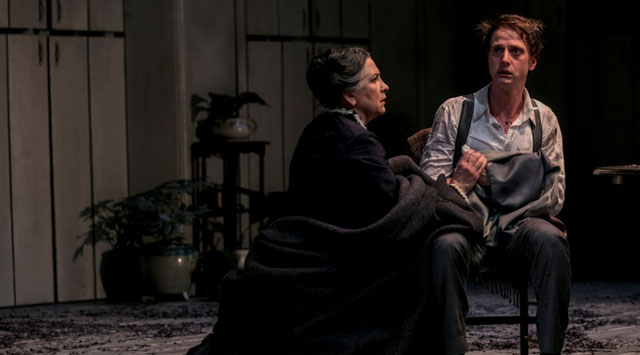
It is late 19th century, and the widowed Mrs Alving is building an orphanage so that her dead husband’s money can be released from her conscience. She is still unable to find peace, even though her poisonous marriage is now over, after having suffered in silence for decades. Ibsen’s Ghosts is about the incontrovertible links between past and present. It looks at how we are controlled by beliefs, events and decisions of days gone by, and the unconscious ways in which we keep ourselves and one another bound to societal rules and conventions.

Mrs Alving understands that a better life is possible, yet she persists with misery. Director Eamon Flack prompts us to question the nature of our protagonist’s volition, whilst simultaneously placing emphasis on external forces that insist on her compliance. From all our personal experiences, we know the tension that lies inevitably between others and the will of the self. The concept of a self-determined existence is an attractive one, even though none of us can lay claim to have fashioned an entirely independent state of being.

Ghosts is an inherently challenging work, and with the passage of time, its narrative has turned predictably archaic, leaving only its central philosophies to speak with pertinence. Tradition and religion no longer hold the same power, so the Alving family’s story is in many ways only a relic, but Flack’s ability to turn the essence of Ibsen’s writing into a resonating force for his show, is certainly admirable.

Pamela Rabe’s performance as Mrs Alving has an understated charm, that shifts the play’s old melodramatic quality to something that is altogether more elegant and naturalistic. It is quite extraordinary, the way Rabe sublimates obsolete details into her very convincing storytelling. All the actors are worth their salt, successful in bringing invigoration and surprising nuance, to some very dry material. Equally remarkable are Nick Schlieper’s lights, especially noteworthy in the final act, when imagery turns breathlessly sublime, and we see baroque paintings come to life.

Artists need knowledge of the past, in order that they may forge new ground, but like characters in Ghosts, their work is constantly under threat of being undermined by the reverence we so often attribute to the historical. The continual resurrection of dead white males like Ibsen can be considered necessary, but it can also be thought symptomatic of problems that the Australian artistic landscape faces. Our art means little if it hinges so strongly on traditions of olden Europe. The Alving patriarch might be dead and buried, but those he had left behind are doomed to perpetuate his agony. We want them to renounce those burdens and henceforth, prosper with the current of their own autonomy, but it seems easier said that done.

www.belvoir.com.au

Review: Assassins (Hayes Theatre)

Venue: Hayes Theatre Co (Potts Point NSW), Sep 16 – Oct 22, 2017
Book: John Weidman
Music & Lyrics: Stephen Sondheim
Director: Dean Bryant
Cast: Laura Bunting, David Campbell, Connor Crawford, Martin Crewes, Kate Cole, Bobby Fox, Hannah Fredericksen, Jason Kos, Rob McDougall, Maxwell Simon, Justin Smith
Images by Philip Erbacher

Theatre review
Australia does not believe in capital punishment, and we certainly never condone murder under any circumstance, but this principled conception of the world relies entirely, on a justice system that convinces us of its adequacy. If men in high places get off scot-free after committing egregious acts of immorality, we begin to think in terms of vigilantism. In Stephen Sondheim and John Weidman’s Assassins, a congregation of women and men remembered for the dubious accolade of having attempted to shoot and kill American presidents, are gathered for a history lesson, that talks about the phenomenon of political assassinations, and the meanings it represents in our modern democracies.

It is a great joy to be able to take pleasure in a work of musical theatre, that is not frivolously romantic, or twee, or excessively sentimental with its concerns. Some might argue that its topic is of particular relevance in 2017, but Assassins is thematically pertinent as long as our governments are a thing of contention, and for true democracy to exist, that sense of discordant anxiety must surely be ever-present. Whether or not the leader is to your tastes, there will always be a substantial portion of the population that is against them, if we are to uphold the fundamental doctrines surrounding our shared understanding of freedom.

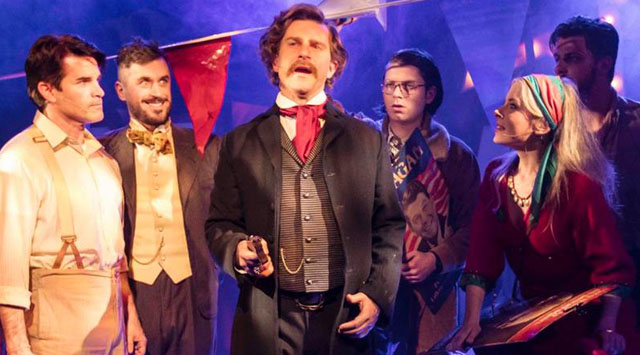
Brilliantly conceived for the Sydney stage by director Dean Bryant, who balances spectacle with nuance, to deliver a show that is as entertaining as it is meaningful. In perpetual and harmonious motion, Bryant and choreographer Andrew Hallsworth, have created a sophisticated interpretation of Assassins, that addresses the genre’s need to tease and dazzle, whilst maintaining an air of gravity to proceedings. The production is a visual delight. Alicia Clements’ set and Ross Graham’s lights continually steal the show, with surprises that unfurl through every scene, splendid and ravishing from beginning to end.

An impressive ensemble takes charge of the material. Although not evenly skilled, their spirited cohesion makes for a performance that is firmly captivating. David Campbell is compelling as John Wilkes Booth, the man responsible for Lincoln’s death. Fabulously gifted in voice, and delicately studied with his acting, Campbell may not be a leading man on this occasion, but proves himself to be the unequivocal star of Assassins. Justin Smith’s marvellous acting chops too, make a fascinating Samuel Byck, the all too familiar loony who would very likely be a regular caller on talkback radio if alive today. Also memorable, is Martin Crewes, whose passionate singing and radiant presence, are reliable, as always, for adding vibrancy to the presentation.

There is always a temptation to imagine a world suddenly better, after a terrible tyrant is killed, but history has proven time and time again, that the removal of a head, does not automatically bring peace to the body politic. If there is anything worth celebrating about our Western democracies, it is our ability to argue for the greater good to prevail. As long as our conscience leads the way, harm can be minimised, but by the same token, the imperfections of our societies will remain salient. Murder can be sweet revenge, but it solves nothing, serving only to prolong the torment of injustice.

www.hayestheatre.com.au

5 Questions with Kurt Pimblett and Annie Stafford

Kurt Pimblett

Annie Stafford: In Cleansed, your character is a ghost for the majority of the show, do you have a favourite ghost story or have you ever had a run-in with a ghost?
Kurt Pimblett: Yeah, me and my cousins and sister saw a lot of ghosts growing up. One of them was the ghost of our dog who’d been run over the year before, which was nice. I think my favourite ghost story though is that Paul Jennings one where a boy falls down a well and there’s a ghost down there who steals all your clothes and escapes and then you become the naked ghost trapped in the well. I feel like that’s the kind of weird ghost thing Graham would do.

When you first read the stage directions “dance of love”, what dance moves came into your head?
Two things, simultaneously. One of them was this incredibly beautiful and emotive sequence that was immediately recognisable as a dance of love – no-one would ever put any other name to it. The other was the bit from High School Musical where those two kids do a weird interpretive dance to audition for the winter musical and get told they should have therapy. I hope that what we’ve ended up with is a happy medium between the two.

Now this is a classic question, in the Hollywood film version of this play, who would you want to play Graham and why?
Harry Styles. No explanation necessary.

What did you find the hardest when approaching this text? Because let’s be honest, its pretty damn out there.
With Cleansed, Sarah Kane has been quite kind with the dialogue and emotional journeys of most characters. Everything that’s happening makes sense, the logic isn’t hard to access, and it feels natural to embody and put into action. Cleansed is a huge practical challenge though, and a lot of thought has gone into realising her incredible stage directions. A lot of them seem a bit impossible, but what I found most confronting in rehearsal was the things that aren’t impossible. The things that you can totally just go and do, but wouldn’t, or shouldn’t, if you weren’t in this play. Another thing I found difficult was rationalising Graham’s relationship with Grace, in conjunction with Graham’s relationship with Tinker. I very much approached the text thinking that Graham was always right and was totally a good guy (which is a useful perspective to keep in mind as an actor), so I was pretty shaken when it started to dawn on me that sometimes his choices aren’t the most upstanding.

You’re stuck on a desert island with only one other cast member from Cleansed, who would you want it to be? And why?
Okay. I would want it to be someone whose sense of humour gelled well with mine, so that it doesn’t get boring, but also so that when I start making off-colour panic-jokes they don’t get weirded out. Are we trying to escape the island? Because then I would also want someone who’d be determined and upbeat enough to help me make a billion different palm tree boat prototypes. Also probably someone with a nice grounding in facts because on a desert island my skills probably wouldn’t extend far beyond writing poems about the ocean and I’d need someone to tell me what’s okay to eat and where snakes live so I can avoid them. There’s also a high chance that I’d get so restless and desperate for entertainment that I’d stop listening to them about which berries are poisonous and start to provoke the snakes just for something to do, so it would be great if the person could talk me down from doing things like that. Look, this is a tall order, so Cleansed cast, if any of you feel like you can adequately fill this role, hit me up.

Annie Stafford

Kurt Pimblett: Tinker has a lot of power but (arguably) questionable morals. What kind of life advice would she give? If she wrote a self-help book what would it be called?
Annie Stafford: I sincerely hope no one ever asks Tinker for advice let alone reads her self help book. How the heck did she get that book deal?! That aside, I think her incredibly deep and sage life advice would be “Get shit done. Shut shit down”. To be completely honest, that’s been my own motto for the past 2 years. But in a very absurdist way it applies to Tinker. She’s pretty proactive, getting things done. And if she’s not about something or it isn’t worth her time, she shuts it down. It’s title? “I’m not responsible.”

Shoot, shag, marry: Cleansed. Go. And try not to shag or kill anyone you’ve already shagged and killed.
Oh well that narrows it down, you’ve literally left me with 3 characters. I think I’d…Tinker would marry Woman. But they’d have to travel to make that happen, cheers Australian Government for that one. Who would have thought you’d be living the dream in a Sarah Kane play. Political moment over. Shag Carl just to add insult to injury, and oh so much injury poor ol’ Carl. And I guess kill Robin. That’s actually quite hard when you take out of it everyone I’ve already killed and shagged. I mean Tinker has already killed and shagged, don’t want to get too method over here.

It is a tricky text – is there anything that you read and thought would be difficult but turned out not to be? Anything that went the opposite?
I actually thought the sex scene between the Woman and Tinker would be really hard, maybe not simply to choreograph, which it wasn’t, but my ability to do it. To be naked in a rehearsal room in such close proximity to someone else, without the tricks of the trade you get in screen. But the process of it was so smooth, and after a while it just makes sense. After sitting in the play for so long and sitting with Tinker and her journey, that moment is so necessary and normal and just feels right-thus I felt so ready to do it when it came to that time. And the opposite? Figuring out Tinker. She’s a tough cookie. So close to performances and I’m still working her out. Which I like actually, she keeps surprising me.

What’s your favourite Sarah Kane’s Cleansed stage direction?
But there are so many excellent ones!!! Can I do a top 3? Well, I’m going to anyway.
1. “Carl tries to pick up his hands – he can’t, he has no hands.”
I’ve decided against giving 3, I want there to be some element of surprise for the audience. But I’ve definitely given you an absolute gem. Sarah Kane is actually hilarious.

Lastly, in a direct theft from the dude from Inside The Actors Studio, if heaven exists, what would you like to hear God say when you arrive at the pearly gates? Answer as both yourself and Tinker.
Before I say, I want these answers to be read in the voice of Morgan Freeman. For some very unknown reason, that’s what my idea of God sounds like. As Annie I would like to hear “Hey mate, good work, here’s a beer”. It would preferable be a VB, taste of the old country. As Tinker, I think she will hear “You don’t even go here!” but I reckon she’d like to hear “You did what you had to do for love”.

Kurt Pimblett and Annie Stafford are appearing in Sarah Kane’s Cleansed, part of the Sydney Fringe Festival 2017.
Dates: 19 – 23 September, 2017
Venue: PACT

Review: All Our Lesbians Are Dead (Zenowa Productions)

Venue: New Theatre (Newtown NSW), Sep 16 – 19, 2017
Playwright: Natalie Krikowa
Director: Natalie Krikowa
Cast: Teneale Clifford, Stephanie Hamer, Felicity Keep, Laura Nash, Gemma Scoble

Theatre review
Only 2% of all television characters are lesbian or bisexual women, but they account for 10% of deaths. As the representation of gay women increases in our media, it seems that they are being killed off at an even higher rate. These are the alarming statistics we hear about in Natalie Krikowa’s All Our Lesbians Are Dead, a comedy that presents this wanton massacre on our TV sets, as conspiracy theory.

There are men in high places who understand that the inclusion of queer characters is advantageous to the bottom line, but are unwilling to accept the validity of queer lives. Lesbians are added to shows, to serve their purpose as profit-making commodities, but are routinely murdered to maintain the heteronormative status quo, established since the inception of television almost a century ago.

The plot involves a private investigator being hired by a couple of lesbian couch potatoes, to investigate the reasons behind these rampant TV deaths of queer women. There are scintillating data and intriguing hypotheses in Krikowa’s script, but dialogue is stilted, with unrealistic personalities constructing narratives that are rarely engaging. The cast exhibits good conviction, with actors Teneale Clifford and Gemma Scoble providing a level of proficiency that offer us moments of invigoration, in what is a very basic effort at making theatre.

Bianca says in the play, that it is better not to see yourself at all, than to see yourself dying over and over again. LGBTQI people should not have to choose between invisibility and destruction. Neither should we still be begging for legitimacy in the twenty-first century, but the truth is that our oppression persists. To see ourselves portrayed with fairness in mainstream media may or may not happen in this lifetime, but the alternative underground is where we have always thrived, and it is here that we find our voice and solidarity. Long may we reign.

www.newtheatre.org.au

Review: The Night Alive (O’Punksky’s Theatre)

Venue: Old Fitzroy Theatre (Woolloomooloo NSW), Sep 13 – Oct 14, 2017
Playwright: Conor McPherson
Director: Maeliosa Stafford
Cast: Laurence Coy, Patrick Dickson, Sarah Jane Kelly, John O’Hare, Darren Sabadina
Image by Rupert Reid

Theatre review
In a run-down home in Dublin, surrounded by insidious violence, its inhabitants go about their simple lives, acculturated and unperturbed. Conor McPherson’s The Night Alive begins with Aimee’s bloodied face, and we are struck by the astonishing ease at which everyone is able to recover from the savage episode. These are people who live rough, and we watch them get on with it, like most humans do, trying to figure things out in a world that always seems to be on the verge of turning dystopian.

Director Maeliosa Stafford brings to the stage, the quintessential Irishness of its characters, offering an intriguing glimpse into a culture that oscillates between familiar and exotic. Our Australian sensibilities at times run parallel, but can often seem divergent. With McPherson’s very fascinating dialogue, the other side of the planet is turned immediate, and even though the slow pace at which Stafford allows for things to happen can prove demanding, The Night Alive is a whimsical piece with definite charm.

Tommy is down on his luck, but John O’Hare’s naturalistic portrayal of a man who soldiers on, gives the show its tenacious optimism. Sarah Jane Kelly is spiritedly valiant, in her attempts at preventing the sole female in The Night Alive from dissolving into a subjugated accessory for the men’s stories. It must be said however, that romance blooms unconvincingly between the two.

Laurence Coy and Patrick Dickson are memorable in the play’s quirkier roles, both delightful presences with a sense of precision in their respective approaches. Kenneth is a slightly cliché bad guy type, but Darren Sabadina’s energy is refreshing, and a much needed boost for a production that tends to fall too languorous.

It may be hard out there, but we brave it. There are forces that work against Tommy and his friends, and not a day passes without its challenges, yet they remain hopeful. We can be certain that without hope, all our tomorrows may as well cease to exist. To live, we must keep on dreaming, for it is only in how we manufacture anticipation, that time can derive its meaning.

www.opunkskystheatre.com

Review: Dinner (Sydney Theatre Company)

Venue: Sydney Opera House (Sydney NSW), Sep 11 – Oct 28, 2017
Playwright: Moira Buffini
Director: Imara Savage
Cast: Caroline Brazier, Brandon Burke, Claire Lovering, Rebecca Massey, Aleks Mikić, Sean O’Shea, Bruce Spence
Image by Brett Boardman

Theatre review
Paige is throwing a pretentious dinner party, for people she dislikes. Moira Buffini’s takedown of the English upper class, Dinner, begins promisingly enough, with pathetic women and impotent men tearing into each other, to expose the ignorant indulgences of those at the top, who seem to have things much easier for no good reason. Touches of surrealism give the play an enjoyable whimsy, but we quickly discover its plot and dialogue to be unoriginal, almost generic in its castigation of the rich. Characters with a depraved sense of entitlement, all in broken relationships, engaging in hateful exchanges over an expensive meal; none of it ever ceases to feel a tad too familiar.

The action takes place in a glorious dining room (designed by Elizabeth Gadsby), behind a big glass window. Either the great unwashed has to be kept at bay, or the theatre patrons need to be protected from some big mess that is poised to take place on stage. Three words, “fuck things up”, are given grand emphasis several times in the course of the production, but the wait for radical activity proves fruitless. Director Imara Savage makes several obtuse gestures in her staging, attempting to introduce the idea of subversion to her work, but it all feels much too polite, and they fall regrettably flat.

Caroline Brazier gives a polished performance as Paige, and although we can certainly see the disquiet and the deceptive fragile glamour of the lady of the house, we never really come to an understanding of the source of her immense toxicity, which underpins the entire narrative of Dinner. Aleks Mikić plays Mike, the outsider who stumbles in, representing the working class, in a juxtaposition of the privileged against the concept of an everyman. In spite of the actor’s strange and unexplained use of a posh accent, the enigmatic qualities created for his persona, makes him one of the more intriguing aspects of this production.

There are laughs to be had, and valuable concepts to chew on, but Dinner needs a lot more spice if its ambitions are to be fulfilled. Social inequity is a problem of great severity, especially troubling in the Trump age, and when we decide to challenge the imbalance of wealth, any hint of the perfunctory would risk the exercise turning inadequate and hypocritical. It is never sufficient that artists are well-meaning. We rely on them to tell the truth in a way that the truth may have an effect on how we think and live, and when the message is hard to digest, their arguments need to find a way to make themselves persuasive. A gentle simmer might be an easy way to broach the subject, but it rarely manages to get the job done.

www.sydneytheatre.com.au

Review: 5 Guys Chillin’ (New Theatre)

Venue: New Theatre (Newtown NSW), Sep 12 – 15, 2017
Playwright: Peter Darney
Director: Patrick Howard
Cast: John Michael Burdon, Tom Christophersen, Tim De Souza, Stevie Haimes, Will Reilly

Theatre review
The idea of a drug-fuelled sex party might seem, from the outset, a titillating proposition for the adventurous, but in Peter Darney’s very shocking, but desperately truthful, 5 Guys Chillin’, “chemsex” is anything but arousing. The play is an outrageously revealing collection of verbatim disclosures from five men on the fringe, part of a gay subculture that few have investigated. Filled with taboos, this is raw and edgy theatre, replete with astonishing detail. The result is something that is best described as hardcore, and is certainly not for the faint-hearted.

Directed by the provocative Patrick Howard, who brings to his staging a corresponding boldness, we are urged to find an explanation for the extreme behaviour that these characters embrace so resolutely. The self-destruction is evident, and the urgency at which Howard presents that agonising sense of oblivious ruination, is irresistibly thought-provoking, and politically significant. Hypnotic in its nauseatingly realistic rendering of scenes that will never play out in most of our sheltered homes and imaginations, 5 Guys Chillin’ is an opportunity to gawk at how far some of us have to go, to make life bearable.

The spectacle is created by a strong cast, impressively well rehearsed, with each actor demonstrating a depth of understanding that makes us share in the material’s pertinence. John Michael Burdon plays the revolting B, fearless and memorable in his portrayal of a man with no redeeming features. These are difficult personalities to make convincing, but we believe every disgusting word that comes out of Burdon’s mouth. J is performed by Tom Christophersen who leaves a remarkable impression with excellent comic timing and a touching vulnerability. Also poignant is Tim De Souza as PJ, whose disquieting revelations are striking in their emotional authenticity.

Gay men have suffered prejudice and hate for as long as they have existed. Individuals have risen out of homophobia injured but strong, while others continue to languish in insurmountable pain. 5 Guys Chillin’ shows us some of the darkest reactions to that discrimination. We know of teenagers committing suicide as a response to their communities’ rejection of their sexual identities, and here, even though each of the gay men are able to put on a brave face, they are each living out their own private death wishes. Hate can do no good, and we must confront each occurrence with vehemence.

www.newtheatre.org.au

Review: Diving For Pearls (Griffin Theatre Company)

Venue: SBW Stables Theatre (Kings Cross NSW), Sep 8 – Oct 28, 2017
Playwright: Katherine Thomson
Director: Darren Yap
Cast: Michelle Doake, Jack Finsterer, Steve Rodgers, Ebony Vagulans, Ursula Yovich
Image by Brett Boardman

Theatre review
We ascribe only noble values to the Aussie battler, because we believe hard and honest work to be the greatest of virtues. In our celebration of the underdog, it is easy to forget the injustices that society inflicts on our disadvantaged. Katherine Thomson’s Diving For Pearls shows us the struggles of the poor, but instead of indulging in a pointless admiration of their fortitude, we question how it is that we allow these extreme discrepancies in wealth to exist, as though it is a completely natural and healthy phenomenon.

Barbara is a brassy broad who is more than willing to give life a go, naive in her trust that dreams do come true, that all you have to do is to play your cards right, and all the appropriate rewards will eventually be delivered. She dates Den, less ambitious but equally accepting of his place in the world. The couple do not complain about their lot in life, hardly aware of the forces at work that are determined to keep them at the bottom of the food chain.

Steve Rodgers and Ursula Yovich are the charismatic leads, both tremendously likeable and hence highly effective, in having us empathise with the stories they present, even as their characters make some very questionable choices. Playing young Verge is the remarkable Ebony Vagulans, who leaves a strong impression with her vibrant and animated presence. She brings to the role exceptional nuance, in both physical and psychological terms, that reflects sensitivity and a sophisticated theatrical instinct. The production does not always speak with great power, but audiences will find the tale nonetheless meaningful.

Poverty is required so that the wealthy can retain social dominance. Those at the bottom are made to believe that they are owed nothing by society, and that all the riches of the universe are available to them, if only they were smarter, worked harder, or simply luckier. When Barbara and Den find themselves unfulfilled, we wonder if there is ever recourse for those in their position. If we are comfortable with access becoming increasingly restricted, it will only be radical action that can bring us to something fair and balanced.

www.griffintheatre.com.au

5 Questions with John Michael Burdon and Patrick Howard

John Michael Burdon

Patrick Howard: What about this play drew you to it and led to your auditioning for it?
John Michael Burdon: In 23 years of theatre, I have never had the opportunity (until now) to work on a truly contemporary written piece that really transforms the idea of what we expect queer theatre to be. The fact that it is a verbatim piece and is telling the stories of real people yet maintaining a certain theatricality to it is not something we see every day as an actor. And I truly do try to push my personal boundaries as an actor to find the truth of this play and my character in ways I have never done before so that’s exciting; to have the opportunity to look at a part of myself I’ve always tended to avoid in the past on stage. Plus I’ve always wanted an excuse to wear a leather harness on stage.

The ‘guy’ you’re playing, B, describes himself as an ‘instigator’, and that certainly comes to fruition in the show. How do you relate to playing this role?
My character B, is definitely the most sexually driven and sexually charged character, not only in the play, but also that I have ever performed. As a young man, I was very much the same and lived in the same world of sorts and B, for me, is who I think I would have become, had I not settled down with a partner and become a parent. It’s like playing an alternative future for me – a “what could have been” scenario had I stayed on the path I was on in my late teens / early twenties.

5 Guys Chillin’ is a bit deep-end in its content at times. Why do you think people should come and see this play, rather than avoid it?
Let’s be honest, this play is graphic. From the stories told to the language used, and the simulated sex scenes and drug use, it is quite hardcore to watch. There’s a sense of voyeurism that borders on intrusion from an audience point of view. But I would also say it’s an exercise in watching bravery on stage from a group of actors who are really trying to bring the truth to stage.  This play is set in London where this particular “scene” is a lot more common, however it is happening in Australia as well. It’s an exploration into the way gay men now connect with each other in a world of apps, instant connections, swipe rights, immediate gratification and easy access. I lived in a world of MSN Chat, gay phone lines like Manhunt & clubs and bars – but this play definitely shows us a new world in the gay community and how the men who live in it, still try to find any connection to other men that they can. 

You’re coming into this show right off the back of playing John in After The Dance at the New. What’s it been like juggling these two very different roles?
It’s been a strange experience, there’s been times when I have gone directly from a 5 Guys Chillin’ rehearsal in the rehearsal room upstairs at the New Theatre to preparing for an evening performance of After The Dance, a Rattigan play set in 1939. Jumping from one to the other has been a challenge. Having said that, the two plays and characters are so very far removed from each other, it’s easy to compartmentalise my “actor brain”. Which is a great thing, because the last thing I need is to jump on stage as John in After The Dance and start talking about the epic sex party in Berlin I went to.

I’m going to throw your question right back at you: what is the most embarrassing situation you’ve found yourself in in performance / rehearsal?
Let’s just say it involved a production of Hair, where I appeared naked on stage. I had eaten something bad the night before and…yeah…
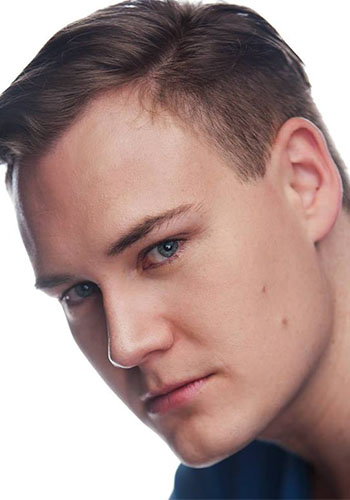
Patrick Howard

John Michael Burdon: What has been the biggest challenge in directing 5 Guys Chillin’?
Patrick Howard: Moving past my crippling lack of self confidence, actually. This is the first time I’ve directed a play on my own in quite a number of years, and having trained and worked since with a very collaborative approach to theatre, I’ve constantly been questioning my style of developing theatrical work is effective when directing a scripted piece. But a few minutes into every rehearsal I’m so at ease, it’s all working out really well and I’m learning a lot! I also knew from the start that, given that movement and choreography are some of my weaker attributes as an artist, making the sex scenes and intimate moments on stage work was going to be a challenge. But, I trusted my strongest skills, and have a great and very generous cast, and we’ve all really come together (so to speak…)

Describe 5 Guys Chillin’ in five words.
Funny, affronting, concerning, honest, human.

What is your experience in verbatim theatre?
Before I studied theatre, I’d done an Honours thesis for my music degree which involved a lot of fieldwork, interviews, transcribing and writing and I really enjoyed that. I first took an interest in verbatim theatre when we did Paul Brown’s Aftershocks and Campion Decent’s Embers in drama school, and that was where I started to see where my interests in qualitative research and theatre could meet. I took it upon myself to make it my own private major study in drama school and developed two verbatim plays about police brutality and student politics, and a surreal ‘documentary musical’ about food and medication, which was produced as part of our graduating production. I’ve worked on quite a number of verbatim and documentary works over the past few years, including Götterdämmerung with my own company, Arrive. Devise. Repeat. I love the idea of sculpting something raw with such truth to become part of some bigger truth, and then finding a way to make that exist in space and time in and interesting way that moves an audience. 5 Guys Chillin’ is tremendously successful in this sense – the characters and drama of the work are compelling through subtext, despite being a collage of interviews. It stays fascinating from beginning to end and there’s no judgement or bias of the stories told at all.

Can you see yourself taking part in one of these parties if you were invited?
To be honest, probably not. The opportunity has been there many times, and I’ve never taken it up. Again, there’s that crippling lack of self-confidence again, but this time with reference to my body. I am very good friends with people who a part of this scene, and through them feel like I have experienced it in a way (I’ve certainly experienced helping cleaning up the aftermath of one…) and while I think the idea of it is great, I have a bit of a hesitation with putting myself in situations where I’m not in control. And obviously, with some of the drugs used in this scene, there’s some substantial risks involved, which gives me another reason to pause for thought.

What is the most embarrassing situation you’ve found yourself in in performance / rehearsal?
I tend to be a bit of a risk taker when it comes to art, so don’t easily find myself embarrassed. As an actor, directors tend to give me notes like, ‘A very bold choice, but…’ and as a director, well, we’ll see…? I think, though, some of my teenage memories probably fit the bill, when I didn’t have any self-confidence and was a terrified closeted little band geek. Having to kiss a girl when I had the lead role in the musical in year nine was a big one. I wanted the ground to eat me up whenever it came up. I remember passing a note to my romantic interest via a friend assuring her I was gay and it didn’t mean anything, but that didn’t make it any easier at all. There were some corker teste-pop notes in that show too, god, and I was singing pop/rock songs and I’m just not cool enough to pull that off at all, even now.

Patrick Howard directs John Michael Burdon in 5 Guys Chillin’ by Peter Darney.
Dates: 12 – 15 Sep, 2017
Venue: New Theatre