Review: The Flick (Outhouse Theatre)

Venue: Seymour Centre (Chippendale NSW), Apr 5 – 21, 2018
Playwright: Annie Baker
Director: Craig Baldwin
Cast: Justin Amankwah, Matthew Cheetham, Mia Lethbridge, Jeremy Waters
Images by Marnya Rothe

Theatre review
Almost every cinema in the world has completed the transition from analogue to digital, and with it comes aficionados bemoaning the loss of authenticity and tradition, in an art form that touches the lives of all. In Annie Baker’s The Flick, not only is celluloid under threat of annexation by blu-ray, the employees at a small picture house have friendships that are challenged by what they think to be real or illusory. They spend days together, becoming increasingly intimate, but always conscious of the distances between. They experience comfort in each others’ presence, but trust is never a certainty. When push comes to shove, the surprise of betrayal rears its ugly head, and like the technology in their projection room, convenience and cost takes precedence.

The play is beautiful in its sensitivity, and wonderfully humorous. Development of its characters and relationships, are cleverly written, replete with nuance and acuity. Dialogue is amusing and brilliantly observed, with contemporary colloquialisms thoughtfully utilised, for an accurate reflection of Western society at this very point in time. These people may or may not be familiar, but we always know exactly how they feel. For cinephiles, The Flick‘s obsessive enthusiasm with film culture, is a very big added bonus.

It is a glorious set, designed by Hugh O’Connor and constructed by Rodger Wishart, thrillingly realistic in its replication of the typical interiors of a movie theatre. Music paying tribute to genres of film, are meticulously crafted by Nate Edmondson, who also creates a variety of unmistakably unique sounds, in the form of whirrs and purrs to be heard emanating through the walls whenever we congregate for a movie. Martin Kinnane achieves a surprising range of atmospheric modifications with his lights, and has us transfixed with the unusual perspective offered by having us looking, wrong way round, into the projector lens, watching rays instead of images that have accompanied us hundreds, if not thousands, of times before. Led by stage manager Steph Kelly, technical aspects are remarkably well managed for this production of The Flick.

Directed by Craig Baldwin, the show is full of resonance; comical, whimsical and emotional. Chemistry between actors is masterfully harnessed, for a thoroughly honest and genuine depiction of social dynamics in The Flick. Actor Justin Amankwah is convincing, and very charming, in the role of Avery, the withdrawn youngster who loves movies more than he does any human being. His minimal, but precise approach gives depth and intrigue to the story, with a portrayal of mysterious qualities that has us captivated. Also very entertaining is Jeremy Waters as Sam, the Gen X slacker who finds himself suddenly older but not much wiser. It is an endearingly animated performance by Waters whose nuances are a joy to watch, and whose confidence with punchlines delivers some excellent laughs. Mia Lethbridge plays Rose the projectionist, with a delightful playfulness that prevents the less than agreeable character from becoming too alienating. The three form a tight partnership, and even though the show does extend to the three-hour mark, we never tire of their company.

The Flick is completely satisfying, but there is no question that in it, people are disappointing. Avery’s adoration of Hollywood is a reflection of his idealism, and his struggles in engaging with real life can be considered in terms of society’s deficiencies, or we can think of it as Avery having problems understanding the world as it actually is. Accompanying the cynicism in Annie Baker’s play, is our unambiguous desire for virtue. The stories we tell may not always be happy and uplifting, but they invariably contain our eternal faith in things that are good. Although new films no longer come to us on film, nothing will stop us from imagining better lives and better worlds, in all our arts and sciences. Of humanity’s many flaws, our naive belief in progress seems forever invincible.

www.outhousetheatre.org

Review: Sami In Paradise (Belvoir St Theatre)

Venue: Belvoir St Theatre (Surry Hills NSW), Apr 1 – 29, 2018
Playwright: Nikolai Erdman (adapted by Eamon Flack and the company)
Director: Eamon Flack
Cast: Paula Arundell, Fayssal Bazzi, Nancy Denis, Charlie Gerber, Victoria Haralabidou, Marta Kaczmarek, Mandela Mathia, Arky Michael, Yalin Ozucelik, Hazem Shammas, Vaishnavi Suryaprakash
Images by Clare Hawley

Theatre review
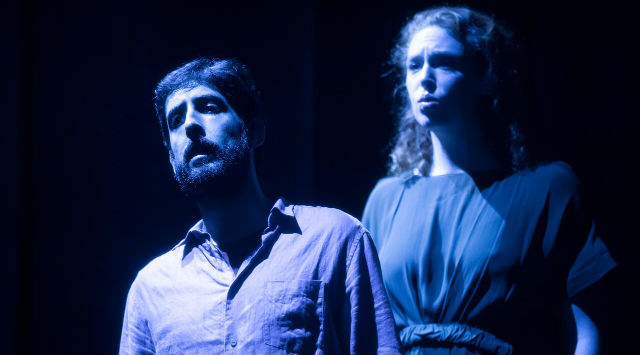
In a refugee camp, life is cheap. Its inhabitants are essentially stateless, treated like human waste; unwanted and despised by the world. When word goes out that Sami is contemplating suicide, a throng materialises, of groups suddenly taking interest in his existence, not to offer dissuasion or rescue, but to leverage his impending death for their own purposes. Nikolai Erdman’s deeply cynical The Suicide undergoes a wild adaptation by director Eamon Flack and the company of Sami In Paradise, updating the 90 year-old play so that it converges with concerns of the day. The ubiquitous but blasé digital activism being disseminated in developed nations, is juxtaposed against the dire plight of asylum seekers, to deliver a work that interrogates our social consciousness through some very acerbic humour.

A thoroughly entertaining production, Sami In Paradise engages cleverly with its audience, discussing the most serious of issues with a deceptively light touch. The many laughs that it provides requires that we pay attention to matters that many usually choose to turn a blind eye to; the only way to indulge in its comedy is to be engrossed in the dark tale that lies at the centre of all the jolly action. An effervescent carnival atmosphere is manufactured by Flack, who demonstrates extraordinary inventiveness in his use of space and talent. Jethro Woodward’s music plays an integral part in calibrating energy and mood for the piece, with musicians Mahan Ghobadi and Hamed Sadeghi proving invaluable to the show’s resounding success.

A motley crew of sprightly characters, inexhaustibly mischievous, take to the stage for an exceptionally well-rehearsed and creative theatrical experience. Their confident chemistry ensures that we enjoy every minute of their presentation; delightful and provocative in equal measure. Leading man Yalin Ozucelik’s glorious portrayal of the despondent and confused Sami, is a work of comic genius. Technically brilliant, but also undeniably soulful, his storytelling captivates and inspires, while keeping us endlessly amused. The cast’s ability to convey a sense of depth within each of its jokey manoeuvres, makes their show revelatory and meaningful.

Humans are capable of great atrocities, and it is important that art helps us understand the parts of ourselves that are reprehensible. It is easy to ignore the ugly ways in which we operate, and let comforting delusions lead us to believe that humanity is only benevolent. Art has to embody and reflect the truth, and the more that it is able to let us see who we actually are, the more it needs to be championed, even if the results are difficult. Sami acknowledges that we hold power over his destiny, and asks us point blank, if we wish to have him killed. Our answer should be simple, but all the evidence suggests that we are not capable of doing the right thing.

www.belvoir.com.au

Review: The Sound Of Waiting (Darlinghurst Theatre Company)

Venue: Eternity Playhouse (Darlinghurst NSW), Mar 31 – Apr 22, 2018
Playwright: Mary Anne Butler
Director: Suzanne Pereira
Cast: Reza Momenzada, Gabrielle Scawthorn
Images by Phil Erbacher

Theatre review
Hamed is stranded at sea with his small daughter, after having lost the rest of their family to explosives in their war-torn home. Escape is the only option, but with no apparent destination, their scurry can only be treacherous and agonising. Mary Anne Butler’s The Sound Of Waiting gives voice to those we term asylum seekers, whose stories are routinely exploited by politicians and media outlets for selfish gain. Here, however, we attempt to hear from the source, a first-person narrator untarnished by intrusions of our prejudice.

Also present is the Angel of Death, a mystical creature and a force of nature, but at times also a human enemy, who pursues Hamed, determined to annihilate. Both are in fierce opposition, but they speak almost in tandem, sharing a rhythm that drives the plot and action. Although in sync, the two characters develop in divergent trajectories, with Death always pulling attention away from our concern for Hamed. It is appropriate that they are not telling a cohesive story, and perhaps revealing, in the way director Suzanne Pereira allows a degree of distraction from the real tragedy.

Pereira’s work is powerful in its treatment of atmospherics. Together with Samuel James’ video projections and Tegan Nicholls’ sound and music, it is a spectacular collaboration that enchants the senses. Also very strong are both performers, Reza Momenzada and Gabrielle Scawthorn, who bring depth and intensity to the production. Momenzada’s ability in conveying authenticity is particularly valuable in this very contemporary tale of loss and hope.

Australia’s reaction to Hamed’s adversity is not explicitly written into The Sound Of Waiting. The audience is given a plain version of facts, so that our mettle is tested. It wants us to rise to the challenge of a compassionate response, which it accomplishes successfully. The consequences of war, as we see here, are undoubtedly bleak, but more significant is the play’s implication that compassion has become a challenge of our times, and although pervasive and banal, our cruelty is deplorable and deeply shameful.

www.darlinghursttheatre.com

Review: The Children (Sydney Theatre Company)

Venue: Sydney Opera House (Sydney NSW), Mar 29 – May 19, 2018
Playwright: Lucy Kirkwood
Director: Sarah Goodes
Cast: Sarah Peirse, Pamela Rabe, William Zappa
Image by Jeff Busby

Theatre review
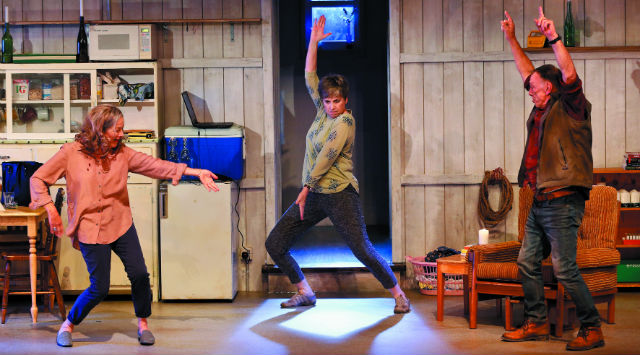
Lucy Kirkwood’s The Children imagines what it would be like, if an all-consuming ecological disaster were to strike today. Instead of the pandemonium surrounding earthquakes and tsunamis, we see an aftermath involving three scientists who are partly responsible for the catastrophe. It is a story about technology, concerned with the way inhabitants of the developed world are failing to find harmony with our greater environment. Hazel, Robin and Rose are retirees approaching seventy years of age, but their work in nuclear power is an enduring legacy that has wreaked havoc to all of humankind.

The play takes on some of the most important themes of our times, not only in its bold discussions of climate change, but also with its ultramodern perspectives on ageing and death. Explored with remarkable sophistication, Kirkwood’s ideas are edgy but truthful, often confrontational in their dissection of responsibility and attribution of blame, as they pertain to the current state of our planet. Diligently crafted to provoke thought and to elicit benevolent responses, The Children tackles pressing issues with intelligence and splendid inventiveness. It is a gripping work, surprisingly entertaining, but is ultimately most valuable for its political statements.

Set inside a humble cottage (designed with minimal fuss by Elizabeth Gadsby), the action begins deceptively mundane as its three characters skirt the issue, trying to be cordial company, before a sense of security arrives that will allow floodgates to open. Everything feels precarious, even before the audience is let in on the severity of their situation. Director Sarah Goodes teases with an exquisite balance of the austere, banal and lighthearted aspects of the story. Tensions ebb and flow, but we are mesmerised, captivated by the extraordinary stakes of the fictional tale, and how they feel so immediately, and terrifyingly, applicable to our real lives.

Actor Pamela Rabe plays Hazel, a woman straining under delusions, surviving on a despairing combination of determination and feeble crutches. It is a wonderfully humorous performance, dark and sensitive, cleverly conveying the fragility of existence under the mercy of indomitable forces. Rose, performed by Sarah Peirse, appears out of the blue, complete with bleeding nose, to shake us into reality. A charismatic and powerful mouthpiece for the play’s central ideology, Peirse is eminently compelling and deeply persuasive. Robin is the thorn among the roses, entrusted with the plot’s more sentimental sections. William Zappa brings authenticity and warmth, and occasional levity, to what is essentially a caustic evaluation of our nature.

Our experts work ceaselessly to extend our lives, to have us live longer and more voraciously than ever before. We keep finding greater ways to devour the world, to satisfy an insatiable and ever-escalating list of wants, in a narcissistic experience that forever thinks of human as supreme. We plunder remorseless, even when faced with irrefutable evidence of our self-destruction, as though carnage can only be accepted as inevitable, and we persist in a race that feels too far gone to accommodate any idea of reversion. In The Children, characters figure out the best way to live by weighing between options of death. We can only bear witness to their calamity and hope to do better.

www.sydneytheatre.com.au | www.mtc.com.au

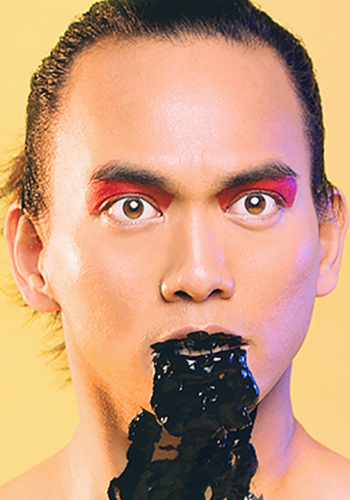
5 Questions with Shannan Lim and Vidya Rajan

Shannan Lim

Vidya Rajan: What does being Asian-Australian mean to you? Do you like the term?
Shannan Lim: For me, ‘Asian-Australian’ works. I was raised between Singapore and Australia. So it indicates two parts of an identity—people are always more than one thing. I am ambivalent about the term though. I’ve always thought, you can only call yourself ‘Australian’, without a prefix and without questions, if you look white.

What do you enjoy most about Asian Ghost-ery Store?
That it alternates between frank, sometimes mumblecore dialogue between our characters to the audience, and then over-the-top or physical scenes. As a writer you can speak in two different tones, and as a performer there are different rhythms to play with so that’s nice. And I really like the ending of Asian Ghost-ery Store!

What has been most challenging, either artistically or in reception?
Because you and I play versions of ourselves and all the stories are at least partly truthful, even if they are edited or swapped between us or amplified, when the audience wasn’t onboard in the earlier days it used to shake me. But this has changed the more Asian Ghost-ery Store has grown, the more experience we’ve had doing it.

Has there been anything that has surprised you about your identity through making this work?
The biggest shock has been how much people have connected with our brand of Asian-ness, which is kind of pathetic and self-involved. But it’s very relatable, I think. It’s strangely made me —at the same time—more OK with my Asian identity and how it relates to other parts of my life, and more riled about the politics of race.

What does political theatre or practice mean to you now and going into the future?
Is this an essay question? If you’re making political theatre your intent is to have the audience question something about their everyday that they take for granted. I’m a clown too, and clowning is outside of intellectualism. So going in the future, I want to balance the politics in my work with me just rolling around on the floor for no reason.

Vidya Rajan

Shannan Lim: We started creating Asian Ghost-ery Store close to four years ago. How have you changed as an artist, as a person since then?
Vidya Rajan: Has it been that long? I’ve changed immensely. I’ve become more serious about being an artist I suppose, I moved to the Melbourne (the true mark of it haha) pretty and finished study at the VCA recently. I’ve explored new forms of work, and I think or hope my practice is evolving in exciting ways and becoming deeper. I suppose I hope the same for myself as a person but I am not sure if that’s true.

If the play was turned into a TV series and you had to cast different performers, who would you cast as our characters Shan and Yaya? What qualities would you look for?
Aiya! I’d be looking for actors who could be sassy and off-kilter but emotional at the same time. Maybe John Early and Kate Berlant, but in…brown and yellow face (NO). Nobody springs to mind really, which could be a function of my lack of knowledge, or the fact there’s such little representation still.

What would Asian Ghost-ery Store look like if it were staged a hundred years in the future?
I think and hope it would lose some of its immediate relevance that relies on certain racial stuff being true? It would be like staging an interesting history piece. But I hope the humour and relationships would carry through to the holograms.

What are you looking forward to seeing or doing while you’re in Sydney?
I’d really like to see other shows at the fest! Other than that, I’ve rarely been in Sydney so all the touristy stuff. I love a good botanical garden.

What’s the next project you’re working on?
A few things! I’m writing on a pilot at the moment, and devising a couple of shows. Also working as an Associate Artist with Theatre Works in the first part of the year. I’m also trying to stop my aged Indian relatives from constantly sending me inspirational memes about god which is almost a full-time job.

Shannan Lim and Vidya Rajan appear in Asian Ghost-ery Store, part of the Batch Festival at Griffin Theatre Co.
Dates: 11 – 28 April, 2018
Venue: SBW Stables Theatre

Review: Diplomacy (Ensemble Theatre)

Venue: Ensemble Theatre (Kirribilli NSW), Mar 23 – Apr 28, 2018
Playwright: Cyril Gély (translated and adapted by Julie Rose)
Director: John Bell
Cast: John Bell, John Gaden, Genevieve Lemon, James Lugton, Joseph Raggatt
Image by Prudence Upton

Theatre review
On the eve of Paris’ impending decimation by the Nazis, Raoul Nordling a Swedish diplomat, pays a surprise visit to the hotel suite of German military governor Dietrich von Choltitz. In Cyril Gély’s Diplomacy, we witness the intense negotiations that lead to Choltitz’s eventual surrender. We always knew how the play was going to conclude, so it is the dynamics between the two men that are crucial to the drama that ensues.

These historical facts, albeit amplified, are fascinating. The idea that one man could thwart an operation of such scale, should prove to be quite astonishing, but the production is tepid, unable to convey the tension of war, and the very serious stakes never become sufficiently persuasive.

It is a good looking show; Michael Scott-Mitchell’s set design is sophisticated and inventively functional, while Genevieve Graham’s costumes are detailed and impeccably tailored. Lights by Matt Cox and sound by Nate Edmondson, are elegant, both suitably restrained and minimal in approach.

As Choltitz, John Bell is appropriately imposing, but it is a portrayal that can feel surface and impenetrable. John Gaden plays up the charm of Nordling, and makes good use of comic opportunities, but chemistry between the two leads struggles for authenticity, and their story ends up being told with only grandiosity and no discernible nuance.

Stories of war will always be worth recounting, as long as we continue to undertake them. Histories repeat, as though human nature will forever be doomed to replicate all its mistakes. Some will consult the annals to try for improvements to our behaviour, but others it seems, will look to the past only to learn how to win at meaningless battles of our future.

www.ensemble.com.au

Review: Going Down (Sydney Theatre Company)

Venue: Wharf 2 Sydney Theatre Company (Walsh Bay NSW), Mar 23 – May 5, 2018
Playwright: Michele Lee
Director: Leticia Cáceres
Cast: Paul Blenheim, Catherine Davies, Josh Price, Naomi Rukavina, Jenny Wu
Images by Brett Boardman

Theatre review
After the publication of her first book, young author Natalie finds herself at a crisis of authenticity. What she had thought to be a good representation of her life and times, has turned out a commercial disappointment. In the search for success, she embarks on a process of self-redefinition. Michele Lee’s Going Down is a tricky story to tell. The play begins at a point where we have to watch our protagonist cave in, to societal pressures that are determined to tell her that she is inadequate. Early scenes feature a confident woman being attacked for not producing a commercially viable product in her autobiography, and although she does offer some resistance, the premise of Going Down is that society wears Natalie down, transforming her from self-assured to self-doubting. Although we discover that society is ultimately right in its estimation of Natalie, as her story does lead to a conclusion of greater fulfilment, it remains a matter of contention that a young woman’s self belief should be defeated by market forces and community.

The spirit of the writing however, is undeniably vibrant, and the production is accordingly energetic and colourful. Set and costumes by The Sisters Hayes, along with lights by Sian James-Holland, are humorous and playful, completely delightful in their interpretation of the world inhabited by a youthful Melbournite. Much of the show’s comedy is reliant on visual cues, and the creatives are certainly excellent in this regard. Music too, is incisively formulated to reflect the culture being represented. Composer and sound designer The Sweats does marvellously to tell us precisely who these characters are, and in the process keeps us invigorated and entertained.

The extraordinary Catherine Davies plays Natalie, feisty yet vulnerable, for a character memorable for her passionate full throttle approach to living life. We are convinced by all that the actor offers, whether portraying juvenile antics or deep awakenings, her performance of the role is utterly perfect. The supporting cast is also effective and very funny. They play a big range of personalities, many of whom are weird and whacky, and thoroughly amusing. Director Leticia Cáceres has put together an inventive show, charming in its quirkiness. Her ability to infuse each moment of Going Down with layers of meaning, keeps us engaged, with both our instinctual and intellectual capacities.

It is difficult however, to find Natalie’s story entirely satisfying. Maybe being an ethnic minority does prevent one from being unfettered and wholly buoyant. Natalie is not a white woman, and the play questions if she can ever write a book that is blind to race. We wonder if she can ever put race aside, or if she will forever be talking about her Asian heritage. This is an honest conundrum, one that is worthy of considerable analysis. Natalie must be regarded as autonomous, for she is a grown woman, but our relentless expectations of her as one of the tribe must influence her conceptions of autonomy. The matter is a troubling one, and it awaits further exploration.

www.sydneytheatre.com.au

Review: The Resistible Rise Of Arturo Ui (Sydney Theatre Company)

Venue: Roslyn Packer Theatre at Walsh Bay (Sydney NSW), Mar 21 – Apr 28, 2018
Playwright: Bertolt Brecht (translated by Tom Wright)
Director: Kip Williams
Cast: Mitchell Butel, Peter Carroll, Tony Cogin, Ivan Donato, Anita Hegh, Brent Hill, Colin Moody, Monica Sayers, Hugo Weaving, Charles Wu, Ursula Yovich
Images by Daniel Boud

Theatre review
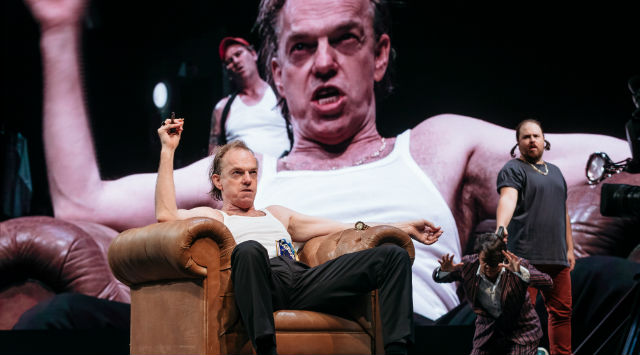
A gangster film is projected on screen, as we witness it being shot on a sound stage. The action happens across not two, but three platforms. We watch a film, the making of the film, and a theatre production, all simultaneously and frantically taking place before our eyes. Bertolt Brecht’s The Resistible Rise Of Arturo Ui is concerned with artifice and image, written at the time of Al Capone and Bugsy Siegel. Director Kip Williams’ decision for a multimedia presentation may seem initially, to be little more than gimmickry, but his profusion of Brechtian devices transcend academic tribute, proving themselves relevant and ultimately, highly effective.

Brought up to date by Tom Wright’s very shrewd adaptation, Arturo Ui’s story is now unquestionably of our time. A criminal hungry for attention, he stops at nothing to satisfy an interminable and narcissistic urge for notoriety. To make his presence a permanent fixture, Arturo takes on political ambitions in order that his influence may turn pervasive and inescapable. We can think of more than a few public figures who operate in a similar vein. It is a witty and wise transposition, taking Brecht’s meditations on the Hitler phenomenon and applying them to the current state of our world. Retaining the spirit of epic theatre, Wright’s work is dark but rarely pessimistic. A parable and cautionary tale, it demonstrates human nature at its worst, but is deliberate with its manipulations of our autonomy as audience and citizens. It always reminds us of our capacity to resist and reverse the actions of those with an appetite for destruction.

Williams’ production is sophisticated, often extravagant and flamboyant in its attitude and accompanying style. Its theatrical grandness is alluring; we find ourselves seduced by its many clever manoeuvres, and are surprised by our unequivocally political response to its ideas. The show knows what it wants to do, and achieves it well. Sections of dense dialogue might be lost, when we get distracted by the very busy stage, but the simple overall point of it all, is clear and powerful under Williams’ interpretations. The director’s ability to shift our attention between screen and stage becomes impressive, once we get over the shock of the unusual. Once we stop questioning the validity of the complicated form being presented, the efficacy at which information is being conveyed, through its complex amalgamations, is quite astounding.

The set takes the shape of an efficient film studio that accommodates complicated camera work whilst prioritising direct audience access, designed by Robert Cousins with appropriate restraint. Nick Schlieper’s lights are attractive and suitably dramatic, conspiring closely with cinematography to provide stunning live visuals with some very advanced video technology. Justine Kerrigan’s adventurous and imaginative cinematography is quite an amazing thing to behold. Also deeply satisfying is Stefan Gregory’s music, inspired by early genre films, and assisted by excellent sound engineering, to offer great drama and intrigue, electrifying from prologue to epilogue.

Hugo Weaving’s performance as Arturo Ui exhausts the gamut of emotions, as well as all the superlatives a critic is tempted to use in describing his brilliance. If there is ever perfection in art, Weaving embodies it here. The man is in charge every second, and we are putty in his hands, hopeless and lost in whatever he wishes to impart. His skill is second to none, and his mesmerising charisma is bewildering. It is hard to come close to the standard that he sets, but others in the cast too, are truly remarkable. Peter Carroll in particular, contributes extraordinary incisiveness as Dogsborough, depicting the blurred lines of good and bad with wonderful flair and persuasiveness.

If we see the natural world as an organism with tendency for chaos, and humankind’s insatiable need for creating order, in our own image, a kind of violation, then man’s obsession with power is an abomination. Arturo Ui goes against everything that we want to think of as good and right in the world, in his continual seizure of power and domination over every being, but it is likely that the only language he and his ilk understand is power, and to rival them requires that we take mirroring actions. Pacifism and the qualities of integrity that it encompasses, may be a more idealistic way of approaching peace, but in The Resistible Rise Of Arturo Ui it is hard to not see these romantic notions as ineffectual or much worse, calamitous. It is time perhaps to find better ways to fight fire with fire.

www.sydneytheatre.com.au

5 Questions with Danica Burch and Dominique Purdue

Danica Burch

Dominique Purdue: If you could describe your character using a song, what would it be?
Danica Burch: Due to the circumstances in this play, I think “Haunted” by Beyonce would be the most appropriate fit for poor Helen. But maybe at the end of the play she is more of a “Walking On Sunshine” kinda gal.

What movie traumatised you as a kid?
I remember watching Scary Movie 2 as a kid and I was actually really scared. I didn’t realise it was a parody of other horror films… and I obviously missed the comedy in it. Forrest Gump used to creep me out as well, especially the war scenes. I saw that film about 3 or 4 times as a kid and always found it really unsettling.

Apart from acting, what’s your dream job?
If I wasn’t acting, I think I would enjoy being a celebrity fashion stylist or maybe even someone’s personal creative director… Someone really extra like Lady Gaga or Cardi B. How fun would it be to dress someone up in ridiculous outfits and decide if they should arrive at the Grammy Awards in an alien egg or a meat dress.

If you could play any instrument, what would it be?
Well, I can already play the piano… I wish I was more skilled, but I no longer have a piano to practice on. Although, the other day I saw that you can get silicone keyboards that roll up for storage. It blew my mind. I think that I should get one so that I can start playing again. I’d also like to learn the violin one day.

If you could live in any fantasy universe, what would it be and why?
Well obviously I would love to ride a hippogriff and drink butterbeer and experience all that Hogwarts has to offer. But if that’s asking too much, I would settle for a world where teleportation is possible. I think it would be so useful and you would have so much extra time. No rush hour train rides, no sitting in traffic, no 23 hour flights to Europe. Also, think of the money you’d save!

Dominique Purdue

Danica Burch: What is your favourite theatre production that you have seen?
Dominique Purdue: There’s been so many, but I saw Twelfth Night last year at the Globe Theatre in London. It was insanely good; I always thought the Globe put on really traditional productions of Shakespeare, which I also enjoy, but this one was so well-adapted for modern audiences and I was literally laughing the entire time. I also bought an embarrassing amount of Shakespeare merchandise from the gift shop, so that was definitely a plus.

Do you believe in ghosts?
Hell yeah I do. I haven’t had a supernatural experience yet, but I watch too much Ghost Adventures to not believe in ghosts.

What is the weirdest food combo that you enjoy eating?
I like a lot of weird food combos. I like pineapple on pizza, so there’s that. I also like really, really salty fries dipped in ice cream.

What city, apart from Sydney, would you like to live in?
I’m an actor, so I’m gonna say New York, for sure. I also recently visited Lisbon in Portugal last year, and I surprisingly loved it, so I would definitely live in Lisbon for a good few months.

If you could get inside the mind of any actor in the world, who would it be and why?
Oh man, the dream! It changes every few weeks, but right now I’m gonna say Taika Waititi. He’s directed/acted in a bunch of golden indie films and he recently directed the new Thor film. I think he’s a genius, I love the sense of humour that in puts into each of his films, even when they’re dealing with some pretty hard-hitting issues. I would really have loved to have been in his head when he was developing/filming What We Do In the Shadows. That film should be a New Zealand national treasure.

Danica Burch and Dominique Purdue are appearing in Sherlock Holmes And The Speckled Band, by Arthur Conan Doyle, adapted by Max Gee.
Dates: 7th April – 12th May, 2018
Venue: Genesian Theatre

Review: Silent Disco (New Theatre)

Venue: New Theatre (Newtown NSW), Mar 22 – Apr 14, 2018
Playwright: Lachlan Philpott
Director: Johann Walraven
Cast: Leilani Loau, Badaidilaga Maftuh-Flynn, Natasha McNamara, Brendan Miles, Tom Misa, Gemma Scoble
Image by Liam O’Keefe

Theatre review
15 year-old Tamara has a talent for writing, but little else besides. Her story in Lachlan Philpott’s Silent Disco, is one of disadvantage and hopelessness. Although living in one of the world’s wealthiest nations, her future as a Millennial Australian is pessimistic. At the mercy of parents and a school system that are broken and desperately failing, we watch Tamara struggle, as her circumstances lead her to a path of ruin. The young rely on our nurturing, but when we offer only neglect and abuse, the inevitable result is destruction.

There is remarkable sophistication in Philpott’s beautifully stylised writing, but the ideas in Silent Disco are simple. Although its characters are dynamic, and the relationships between them are intriguing, Johann Walraven’s restrained direction provides only minimal dramatic tension, offering instead an unyielding sense of naturalistic authenticity to its melancholic situations. Set design by Ester Karuso-Thurn is visually arresting, but activity feels distant, in a vast space that requires a less understated approach. Jessica Dunn’s work as sound designer is refreshing, and her inventive compositions help enliven proceedings.

Actor Gemma Scoble is a convincing Tamara, looking and sounding every bit the rebellious school girl on all of our suburban high streets. Her portrayal of the wilful teen is certainly accurate, but a greater sense of theatricality would allow us to engage better with her experiences. Tamara’s boyfriend Squid, is played by Badaidilaga Maftuh-Flynn, appealing with the emotional nuances he very effectively conveys, and Leilani Loau’s performance as a compassionate teacher is quiet but powerful, and vitally thought-provoking.

We disapprove of any parent less than responsible and competent, but we routinely allow our community organisations to falter. Tamara’s parents are deeply disappointing and probably unforgivable, but their human flaws are understandable. As a nation that boasts of so much, our failure to protect each other should be even more reprehensible, but the ease with which we turn a blind eye, is appalling. In becoming increasingly individualistic, society turns neglectful. It is as though we have stopped thinking of the weak as deserving of care, and have begun regarding them as dispensable and contemptible.

www.newtheatre.org.au