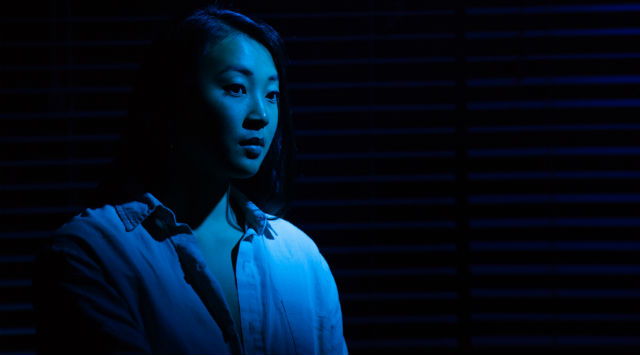
5 Questions with Liz Arday and Daniela Haddad

Liz Arday

Daniela Haddad: You’ve made the decision to cast a woman in this play instead of a man. Why did you make that decision?
Liz Arday: When I first read this piece I couldn’t really justify it focalised through a male lens. I know the original production utilised a male performer in the solo role, at the time the discussions around objectification of the female body were forefront, so that was an incredibly clever choice. How brilliant to place a man on stage and challenge an audience to objectify him in the same way they objectify women. But in 2018 and in the wake of “Me Too” and “Time’s Up”, reclamation and amplification of the female voice in the discussion around consent is paramount. Young women have begun to reclaim their bodies through platforms like YouTube and Instagram and in doing so have rejected the mainstream media’s damaging narratives, but we still have a way to go in having our voices heard… and believed. Our production therefore is about challenging an audience to believe our voice, our story, over that of a man’s. Which is why I felt it was important to cast a women in the solo role.

How has working with only women in the rehearsal room impacted the creative process for you?
This is wonderfully not the first time I’ve run a female only room. When I directed A Woman Alone in London last year I also closed the room for most of the process allowing only female creatives in. It creates a very safe space that allows for more honest and in-depth discussions around female sexuality, identity and the sharing of personal experience which culminates in a more truthful, brave and defiantly feminist performance. I think it’s a powerful process tactic and has proven to be both super successful and liberating for all involved.

There’s been a wave of female monologues on Sydney stages this year, including A Girl Is A Half-formed Thing at KXT and Lethal Indifference at STC. What do you think the appeal is?
I think “Me Too” has empowered female makers to stand up and tell their stories, and has also given audiences permission to engage with them. I think a female monologue piece is the pinnacle of that empowerment as it demands a raw, honest and virtuoso performance from it’s solo actor, and denies a masculine voice in the space (unless embodied through a female form). It’s the ultimate finger to the theatre establishment and traditions on which our industry is built.

What skills can you take from this project to apply to your Sandra Bates assistant directorship at the Ensemble?
One of the shows I’m working on is Unqualified, which is a female comedy written by and starring Genevieve Hegney and Catherine Moore. It’s Tina Fey level hilarious, and is a brilliant example of a work that scene after scene passes the Blechdel test. I think knowing the value of cultivating a safe feminist space in the rehearsal room and encouraging open discussion will serve well. Also it’s a play that travels to many different spaces and places without elaborate sets to frame it, much like our piece, so I’ll be ready to tackle those challenges!

Why do you think people should come to see this show?
Because it’s absolutely stunning piece of award winning Australian writing by one of our greatest assets, Fleur Kilpatrick. Because it’s articulating the seismic cultural shifts that are happening internationally and here at home. Because you’ll be supporting a team of talented and passionate independent theatre makers getting work up without co-production or funding support. Because it’ll be powerful punch of theatre we promise won’t disappoint!

Daniela Haddad

Liz Arday: What was it about the play that made you want to audition?
Daniela Hadda: The script and these characters drew me in and I was attracted to the idea of how models are inherently actors themselves. I was interested to see how this would play out on the theatre stage. Models also contribute hugely to the definition of ‘beauty’ given their influence in the digital sphere. So, this was a really important opportunity to explore the meaning of beauty for myself on a more personal level. The added challenge of a double role excited me as an actor, because of the opportunities it gave me to stretch my skills to the limit.

Throughout the piece you are often playing two characters (Emmy the model and Peter the photographer) who are often on stage together at the same time. What challenges have you come up against in creating these moments and how have you gone about overcoming them?
I had to find ways to create two distinct characters in voice, movement, body language – two very different people with two very different energies who are conveying a different story through their perspectives. From the beginning, I eased into Peter’s character quite nicely. There was a high level of comfort there with his overall energy, grounded nature and of course being Australian. Emmy, I found to be a bigger challenge as she’s an American model and certainly more reserved and calculated compared to the transparent Peter. She is living this idea of what she’s supposed to be according to the modelling industry. This concept paired with her intricate layers of life experience makes for an interesting story but also for the huge challenge on my end to tell this story in all its truth. There are no costumes changes to indicate the shifts between Emmy and Peter. Although there are different accents involved, the physicality speaks volumes in this piece. However the impact of that is only felt when the transitions are swift and seamless. At times, that really can be tiresome to critique, but the pay off of refined theatre is well worth working towards. Plus, the added fun of having that creative freedom to explore within the space and all of that wonderfully paired with the projections Liz has been working on. A grand gesture of art installation and theatre.

As part of our research we’ve been watching some pretty interesting YouTube videos on how to be an alpha male. Can you share any hot tips?
It’s just hilarious that there are entire YouTube channels dedicated to ‘how to be an alpha male’! They were helpful in giving me some physicality choices to experiment with for Peter. Three of my favourites are: 1) Stand straight. The best way to check your alpha posture is to stand against a wall, heels, calves, bum and shoulders should all touch. Step away from the wall but keep those points projected. 2) Use physical reinforcements, touch the person you’re speaking with at the high points of conversation. 3) Smirk, don’t smile.

Emmy is written as a model, but we’ve been re-framing her a bit as an influencer. How would you describe the difference between the two?
The concept of beauty is becoming increasingly blurred. In the 90’s for example a fashion model was typically someone exceedingly tall with a unique look, usually including sharp cheekbones, paired with a memorable walk or iconic pose or gaze. Nowadays, that particular mould of a fashion model is in decline due to the rising prominence of digital influencers. A digital beauty influencer being someone who produces online content that strays from the traditional ideas of fashion and aims to create something more accessible to their mass following. Today beauty is more than just physicality. It’s definitely got a personality edge to it.

In five words how would you describe this production?
Confronting, honest, hilarious, insightful, relevant.

Liz Arday and Daniela Haddad are presenting Yours The Face, by Fleur Kilpatrick.
Dates: 1 – 12 May, 2018
Venue: Blood Moon Theatre
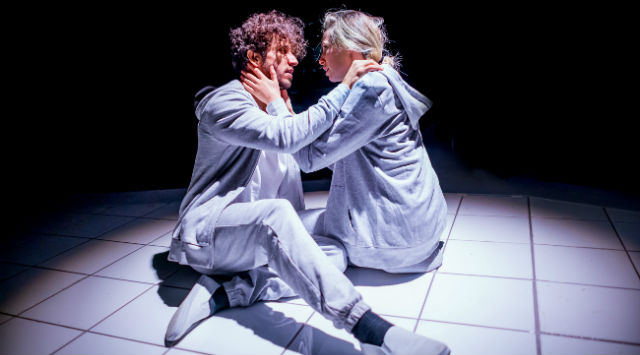
Review: The Effect (Old Fitz Theatre)

Venue: Old Fitzroy Theatre (Woolloomooloo NSW), Apr 18 – May 19, 2018
Playwright: Lucy Prebble
Director: Andrew Henry
Cast: Emilie Cocquerel, Firass Dirani, Emma Jackson, Johnny Nasser
Image by John Marmaras

Theatre review
Connie and Tristan are participants in a medical trial involving antidepressants. Temporarily shut off from the world, they live inside a science facility with only each other for company, and very quickly develop a strong romantic connection. Lucy Prebble’s The Effect is interested in the chemical aspects of what we understand to be human nature, and the moral implications of drugs we design to alter our experience of life. It poses questions about what we consider to constitute authenticity in being human, and looks at the ways in which we place value on things we term natural and synthetic.

The play is ridden with anxiety, fuelled by the pervasive scepticism we have of pharmacology and the money around it, but a puerile disquiet is undeniably present, that relies on reductive ideas presupposing the natural to always be unquestionably better. The Effect features scene after scene of tense drama, which director Andrew Henry is certainly not averse to amplifying at every opportunity for maximum theatricality. Alexander Berlage’s lights are accordingly bold and intrepid, effective in delivering some memorably stark imagery. The show is often gripping, with an intensity that sustains our attention, but its arguments are not always persuasive. It arouses intrigue, without providing sufficient rationale for us to feel satisfied with the statements it attempts to make.

Actor Johnny Nasser brings valuable subtlety to the role of Toby, alternating between good and bad guy, for a sense of complexity that resonates with truth, in this discussion of mental health and modern medicine. Other players have a significantly more grandiose approach, that can restrict us from reaching a greater understanding of the text’s nuances. Their extravagant gestures make for an energetic performance, but our access to the psychology of characters is consequently limited. The Effect contains philosophy that matters to us all, although a more detailed conveyance of meanings would be necessary for the production to affect us deeper.

As we watch ourselves being challenged by medicine, unable to submit easily to the science, we see an obstinate belief in a state of purity, and are prompted to interrogate the validity of our trust in naive ideals associated with all things “natural”. It is also similarly evident that when individuals are called upon to put their lives in the hands of others, trust is an issue that can never be made completely unassailable. Underlying these thoughts are fears that reflect our need for self-preservation. We can doubtless see the insignificance of the human race in the widest scheme of things, but our indomitable hunger for control seems essential to how we think and act, even when we know the futility of our efforts.

www.redlineproductions.com.au

Review: Get Her Outta Here (107)


Venue: 107 (Redfern NSW), Apr 19 – 21, 2018
Creator: Isabella Broccolini
Cast: Isabella Broccolini
Images by Phil Erbacher

Theatre review
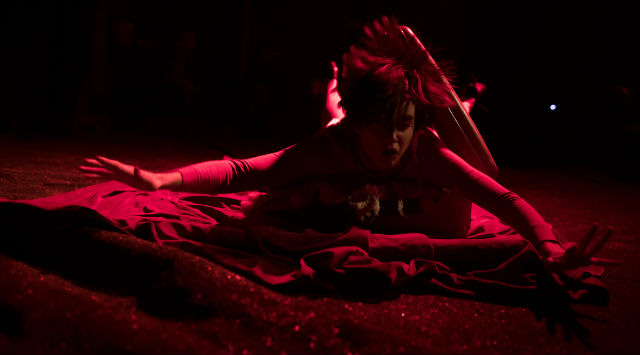
Isabella Broccolini is the lady in red, swathed in an uncompromising colour representative of all things fiery. We see a picture of obstinacy, a woman of dogged determination making single-minded statements about selfhood, and of identity in general. Her red suitcase never leaves her side, like a snail with her home attached, adding to the image of tenacity, but symbolising discontentment, in a performance piece that seems to talk a lot about the unexpected duality of perseverance and relocation.

Get Her Outta Here is wonderfully engrossing, fuelled by the inexorable presence of its creator. Broccolini’s physicality is confident and powerful, with an idiosyncratic style to its movement that has us captivated. Her body is untethered to the homogenising nature of dance training, but offers a clarity and strength to what it wishes to convey, as though disciplined in accordance with her own ideals.

The work is abstract, beautifully so, and audiences will interpret it how they wish. When art refuses to be obvious, it runs the risk of leaving us apathetic, but Broccolini’s enigmatic (and often very funny) approach is deeply alluring. We find ourselves opening up to her, allowing her obscure expressions to provoke and inspire. Music by Grace Huie Robbins moves the show through its various phases with excellent effect, creating shifts in dimensions that help enrich our imagination. Lights however, are under-explored and regretfully monotonous, for a production that is otherwise an aesthetic delight.

Broccolini’s speech is coy, but glimpses of honesty are revealed in her storytelling, to help our minds assemble a sense of truth for the red lady. Under the quirky and jokey, almost camp, deflecting exterior, lies a distinct rage, drenched in blood, perhaps too gory to expose unadorned. Get Her Outta Here is a woman’s fight with territory, even as she resists every place that she finds herself. Outsiders wish to be anywhere but here, and for us, the cliché is especially true, that it is the journey, and not the destination, that fulfils. Our project of reclaiming and redefining space, is not yet able to afford any room for complacency. For the time being at least, the red lady’s adventures with her red suitcase shall not cease.

www.107.org.au | www.isabellabroccolini.com

5 Questions with Stefanie Jones and Andrew Kroenert

Stefanie Jones

Andrew Kroenert: Who do you think should have a fictional lovechild?
Stefanie Jones: Of all our most loved and most famous cultural icons, a child between Marilyn Monroe and Joe DiMaggio (once they’d separated) would have been pretty cool. She would have made a great mother, and we know how much he loved her. On top of all that, what a gene pool! So all the right ingredients, I say.

If it were the last day of your life, how would you spend it?
Without a doubt, Brisbane. My parents created the most beautiful family home there for us to grow up in, with an outdoor terrace and a pool surrounded by palm trees to watch the sun go down over. Being able to sit there with a glass of wine in my hand, with my mother’s cooking on the table and surrounded by family and friends would be absolutely perfect.

If you could play any role of the opposite gender, what would it be?
The Emcee in Cabaret would be oodles of fun! He is confused, in some ways debased, yet he is intelligent and has that rare ability to turn tragedy into satire / comedy. Cabaret is a very smart, important and relevant story so any role in that show would be a dream and also a great way to continue talking about our political and social history.

Any pre-show rituals or superstitions?
No, although I wish I had a few to help with my nerves sometimes! Mainly I just like to not feel rushed, to have the time to check in with fellow cast mates and to get ready at a comfortable pace, unlike Andrew Kroenert.

If you could have written any pop song, what would it be?
‘Never Give Up On The Good Times’ by The Spice Girls. It just came to me, and I’m sold on this choice.

Andrew Kroenert

Who do you think should have a fictional lovechild?
Doesn’t everyone want Tina Fey and Amy Poehler to have a ridiculously funny, quirky (and most likely wonderfully camp) little boy? He would be absolute heaven.

If it was the last day of your life, how would you spend it?
Last day on earth I would probably host a BBQ at my house with all my family during the day, hang out with the nephews and have a few beers with my siblings and parents. Then I’d send them home and have a quiet evening with my partner, Jess. Maybe split a bottle of wine, play some cards listen to all my favourite music.

If you could play any role of the opposite gender, what would it be?
I think it would be super fun to play Cathy in The Last Five Years. It would be interesting to see how the themes and people’s feelings towards those characters would hold were they played by members of the opposite sex.

Do you have any pre-show rituals?
I don’t have any pre-show rituals but I’m never in costume before the 5 minute call, in fact I try to stay out of costume for as long as possible before a show starts! And I’ll always have a coffee before a show.

If you could acquire any one skill to add to the strings of your bow, what would it be?
I would like to be fluent in another language. Having just been to Mexico currently that language is Spanish although I have long wished to be fluent in French.

Stefanie Jones and Andrew Kroenert can be seen in Carmen, Live Or Dead , by Craig Harwood and iOTA.
Dates: 28 Apr – 6 May, 2018
Venue: Hayes Theatre

Review: Sex & Death (Blood Moon Theatre)

Venue: Blood Moon Theatre (Potts Point NSW), Apr 10 – 28, 2018
Something In The Basement
Playwright: Don Nigro
Director: Garreth Cruickshank
Cast: David Luke, Annette van Roden

It’s Time
Playwright: Garreth Cruickshank
Director: Garreth Cruickshank
Cast: Russell Cronin, Jack Douglas, Kitty Hopwood, Annette van Roden

Theatre review
Two short plays, both concerned with marriage, form a double bill entitled Sex & Death. The first, Something In The Basement by Don Nigro is ostensibly about the mystery of sex, and the second, It’s Time by Garreth Cruickshank, deals with family violence. They both point to some fundamental ideas about the traditional unity of two persons, perhaps questioning the validity of that ancient institution for our current times.

Something In The Basement is a comedic exploration of sex, using the basement of a couple’s home as allegory, for the strange workings of compatibility and the libido. Humour is obscure for the piece, and its performers never quite manage to make it a sufficiently funny show. The meanings, as represented by their relationship with each other and with their house, too are rarely satisfactorily conveyed, left abstract with scant resonance. The production’s naturalistic approach seems an inappropriate choice, exposing only the mundanity of married life, and little else besides.

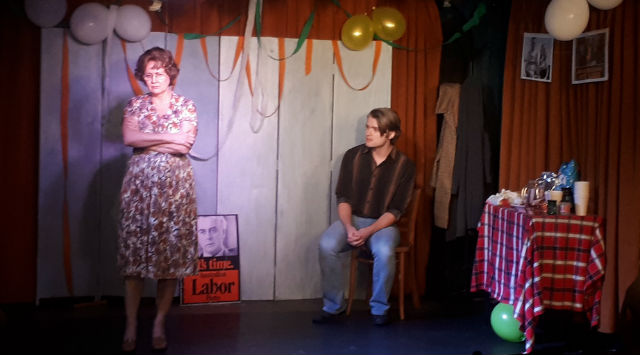
It’s Time dwells on the harrowing experiences of a housewife from the 1950s, who receives regular beatings from her husband. We meet her later in life, but it is her recollections of her darkest days that she wishes to share. Mrs O’Brien tells all, as flashbacks are introduced, with regrettable inelegance as actors walk in and out of view for sequences that last mere seconds. Annette van Roden plays the role with great sensitivity and maturity, exhibiting exceptional strength as a woman put through the wringer, and who emerges victorious. We wish to see how she escapes abuse and grows stronger in the aftermath, but the play ends abruptly, allowing only her suffering to define this version of Mrs O’Brien.

The people in Sex & Death fail at marriage, but we see them work hard at salvaging things to fulfil their commitments. Marriage is full of promise. We are told that it is essential to a good life, although arguments are never more than tenuous. Tethering the self to another, through measures religious and legal, is a bizarre habit that continues to prove hard to break. We aim to understand ourselves through science, logic and facts, but it often appears that irrationality plays the biggest part in being human. There is no rhyme or reason for so much of what we do, and hence we are prone to repeat our foibles time and again. Marriage will never live up to the grandness of its pitch, but we will nonetheless keep buying in. It is romance, idealism and delusion, but we are only human.

www.bloodmoontheatre.com

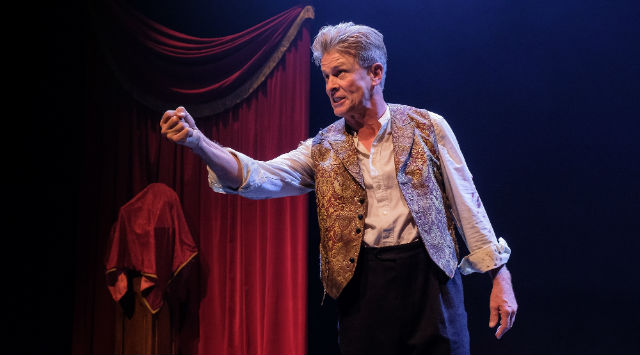
Review: The Time Machine (Strange Duck Productions)

Venue: NIDA Parade Theatres (Kensington NSW), Apr 11 – May 2, 2018
Playwright: Frank Gauntlett (based on the novella by HG Wells)
Director: Gareth Boylan
Cast: Mark Lee
Images by Robert Catto

Theatre review
In the space of science fiction, our imagination of what is yet come, reveals less about the truths of the future, and more about the values and beliefs that we hold today. In Frank Gauntlett’s adaptation of HG Wells’ The Time Machine, an Englishman travels from Victorian times to the year 802,701 AD, where he encounters an evolutionary state of humankind, split into clear distinctions of species, good and bad.

Instead of luxuriating in the welcoming utopia that he stumbles upon, our protagonist pursues the evil creatures who had stolen his machine, and in the process interferes with the ecosystem that he discovers. There is also a romantic encounter, with the hero claiming a female character from the new world, as he tries to bring themselves back to the 19th century. The Time Machine is an action-packed one-man show that puts on display, the narcissistic self-aggrandising tendencies of men, who are persistent in figuring themselves as braver, more righteous, more long-suffering and under attack than anyone else in their fictional narratives.

The true hero is actor Mark Lee, whose energetic precision provides all the theatrical entertainment we require. He is a captivating presence, interminably persuasive with all that he serves up. A highly skilled performer, with an astonishing familiarity with the text, Lee is intense, inventive and tenacious in approach, leaving his audience impressed, even if the material he presents is less than inspiring. Director Gareth Boylan introduces a healthy quantity of visual variation to the show that helps draw our attention back, when we begin to lose interest in the monotonous narration of unwavering gallantry. Lights by Martin Kinnane are particularly useful in this regard. Michael Waters’ sound design too, works hard to facilitate our concentration.

It is a recurring theme in our stories, where we find ourselves in places belonging to others, then quickly and convincingly asserting our victimhood, before successfully overcoming the enemy. There is truth in saying that life requires us to move outside of ourselves, that the spirit of curiosity and discovery is essential to a meaningful existence, but the belief that “the world is your oyster” must be examined with greater sensitivity. Spaces are defined long before we enter them. Wherever we choose to venture, we must be mindful of how it is configured. If we decide to cause disruption, we must tread with utmost care and caution.

www.nida.edu.au

Review: Alison’s House (The Depot Theatre)

Venue: The Depot Theatre (Marrickville NSW), Apr 4 – 21, 2018
Playwright: Susan Glaspell
Director: Julie Baz
Cast: Matthew Bartlett, Veronica Clavijo, Penny Day, Dominique De Marco, Elliott Falzon, Nyssa Hamilton, David Jeffrey, Brendan Lorenzo, James Martin, Tasha O’Brien, Sarah Plummer
Images by Katy Green Loughrey

Theatre review
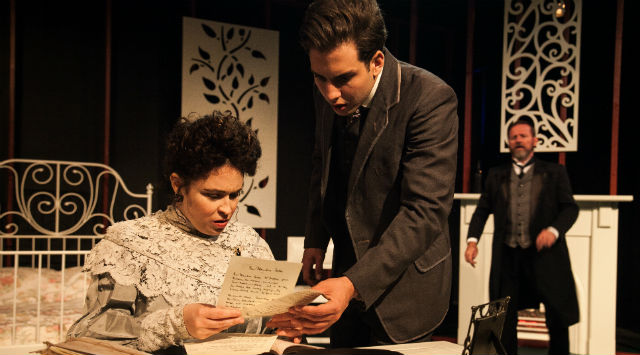
Fewer than a dozen of Emily Dickinson’s poems were published during her lifetime. Her body of work, comprising approximately 1,800 pieces, only saw the light of the day after her passing; she was female after all. In Susan Glaspell’s Alison’s House, Alison Stanhope is a surrogate for Dickinson, and we meet her family on the eve of the year 1900, 18 years after her death. The Stanhopes are moving house, but Alison’s presence is strong and a mystery around her posthumous success emerges. Although a Pulitzer Prize winner, the play feels every bit her 88 years of age. Central concerns about authorship and artistic legacy remain valid, but its dramatic structure is now gauche, with stodgy dialogue that many will find alienating.

Its first two acts are particularly inaccessible, and the cast’s divergent approaches make the show a difficult one to engage with. The third act however, is a fortunate change of pace, with the plot suddenly turning lively, when the crux of the matter is finally revealed and addressed. Actor Brendan Lorenzo is a delight in the role of Eben, with intense conviction and a buoyant energy that helps introduce a quotient of enthralment. The production is a faithful rendition of a dated script, with everything kept coloured inside the lines. It is an adventurous spirit that dares take on this forgotten play, but this execution of Alison’s House requires greater imagination to resurrect it from obscurity.

Our great writers write from personal perspectives, but what is put on paper may not always be intended for public consumption. Time however, has the capacity to change anything. What was once private, objectionable or simply unfinished, could transform, over the years, into something that serves a greater purpose. We must then consider what it is that we want to hold sacred, when tossing up between the private and the public, or the dead and the living. When ambiguities abound, coming to decisions is difficult, but it is the very quality of ambiguity that interrogates the deepest of our beliefs, and that shows us who we truly are.

www.thedepottheatre.com

Review: A Girl Is A Half-formed Thing (Brevity Theatre)

Venue: Kings Cross Theatre (Kings Cross NSW), Apr 6 – 21, 2018
Playwright: Eimear McBride (adapted for the stage by Annie Ryan)
Director: Erin Taylor
Cast: Ella Prince
Images by Clare Hawley

Theatre review
Our destinies are written long before our flesh is are conceived. The unnamed girl in the story was born into an underprivileged Irish family, of a conservative Catholic town where ancient rules are upheld without question or suspicion. Women are allocated their place, but men occupy everything, including the female body. In Eimear McBride’s novel A Girl Is A Half-Formed Thing, violations take the form of rape, physical but also mental, emotional and spiritual. The entirety of the girl’s adolescence is characterised by the abusive imposition of all surrounding characters, determined to prevent any sense of individual agency from developing. She is deemed an object, an empty vessel with which society can do whatever it wishes.

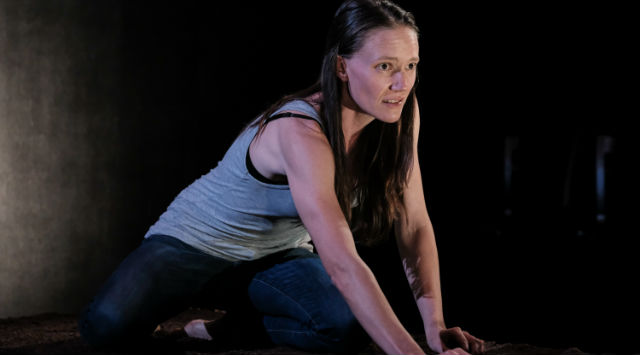
It is a problematic adaptation by Annie Ryan who retains the “stream of consciousness” form of McBride’s book. One actor is designated to play not only the girl, but also every significant personality of her microcosm. Conversations are brief and unanticipated, often leaving us confused about the identities of people being portrayed, although we might as well think of them all as one uniform perpetrator, considering the analogous way in which our protagonist is being defiled. Actor Ella Prince is unable to provide clarity in terms of detail from the difficult text, but her capacity for authenticity and focus are certainly impressive. It is an extremely powerful presence that she brings to the show, and the gravity of the play’s concerns are never compromised under Prince’s depictions. The traverse stage proves challenging, requiring half of the show to be performed with her back to the audience, which proves unsatisfactory for a production that relies so heavily on its star’s facial expressions.

There is however, very fine design work being accomplished here. Isabel Hudson’s sophisticated set makes for a morbid but dramatic evocation of ideas around burial and death. Lights by Veronique Bennett are surprisingly dynamic, whilst administering a relentless austerity that is crucial to the play’s very specific tone. Chilling sounds created by Clemmie Williams ensure that we never deviate from the mournful devastation being analysed.

The girl is defiant, aggressively so, but she holds no power. We watch as she is put through a progression of torment, wondering if a person like this could ever grow into something whole. In places where freedom exists, we can imagine individuals flourishing, beyond the bounds of inevitable social restrictions. We want to believe that each human bears potential that is unique and good, and opportunities are available where against all odds, people can create the best out of their embryonic selves. This may or may not be true, but where there is no freedom, the only certainty is the unremitted spawning of deformed lives.

www.brevitytheatre.com.au

Review: Greater Sunrise (Belvoir St Theatre)

Venue: Belvoir St Theatre (Surry Hills NSW), Apr 5 – 21, 2018
Playwright: Zoe Hogan
Director: Julia Patey
Cast: Laurence Coy, Jose Da Costa, Cassandra Sorrell, Alexander Stylianou
Images by Hon Boey

Theatre review
Australia’s history with Timor-Leste is chequered, to say the least. In Zoe Hogan’s Greater Sunrise, we see an account of the evil that we are capable of, when dealing with a neighbouring nation rich with oil, but poor in influence. Australian aid worker Joana discovers the ugly operations that her government undertakes in the country she is assigned to help, and tries to find a way for justice to prevail.

It is admirable that Hogan brings attention to the important but under-reported issues surrounding our relationship with Timor-Leste, but the play struggles to speak powerfully, with a plot structure that is perhaps too filmic in its approach to work on the stage. The erratic timeline and its excessively frequent scene changes, prevent us from becoming invested sufficiently in Joana’s story.

Cassandra Sorrell shows good conviction in the lead role, but performances in Greater Sunrise are rarely more than adequate. The production feels distant and vague, preventing us from finding any meaningful resonance that could correspond with its grand message. Lights by Benjamin Brockman and sound by Clare Hennessy, however, provide a level of polish that helps sustain our attention. The emotional cues provided by design elements give the narrative some tenacity when other aspects falter.

Greater Sunrise provides valuable elucidation about the ongoing project of colonisation in our region. It tells us that we need to find satisfactory methods of reparation for the way Indigenous communities have been unjustly exploited, and also to take responsibility for the immoral and unethical dimensions of our insatiable capitalistic drives. The planet provides immense wonder, but its allure seems determined to elicit human behaviour that is cruel and deplorable.

www.belvoir.com.au

5 Questions with Veronica Clavijo and James Martin

Veronica Clavijo

James Martin: How is your role in the play different from anything you have done before?
Veronica Clavijo: I must say it is definitely a first that I get the opportunity to play this type of character for a period piece. Louise is majorly concerned with the societal values of the time and her character seems to be a reflection of the society as a whole. She seems to be ‘the voice of reason’ in the show and shows the audience how radical and forward thinking some of the others are. In the last show I did, Fiddler On The Roof, I played Tzeitel, a woman who was rebelling against society. It has been interesting to get into the mind of someone from the other side of the spectrum. It has been interesting to understand Louise’s truth and what family, society and honour mean to her.

What about Louise do you as Veronica most relate to?
Louise is passionate and outspoken and is actually quite forward with the men around her. Although I can’t relate to her wanting to do everything possible to appease the town and the society I can relate to her passion. I can relate to the fact that she will not stop until she is heard and that she challenges the men in her life. She is not afraid to speak her mind, to correct them and to question them. She is a fighter!

If you were a poet, what would you write about?
I would write about happiness, love and the human condition! And maybe my love of Harry Potter.

Why is this story important to be told in the 21st century?
I believe it is important because it still harbours relevant issues. The idea of love, family, honour and responsibility the play touches on are all things an audience can relate to. Another thing is the question of who should have Alison’s poetry? And, did she indeed write it for women. If that is the case, shouldn’t it be the women in her family who decide what to do with them?

Is there another character in the play that you can relate to?
I can relate to the character of Eben empathetically. Eben is sad, bored and is unhappy with his job and his life. I mean, we have all been there before! He wants more, he is sensitive and he wants to feel more in his life. He searches for truth, love and happiness. He wants to mean more and for his life to mean more. I think these are basic human feelings that we can all relate to. I love that Susan Glaspell gave these qualities to a man. Eben is not unfeeling, or stern, or angry or written to be aggressive in a stereotypically masculine way. For this reason, I think a lot of audience members will relate to him.

James Martin

Veronica Clavijo: What was it about the play, Alison’s House that made you want to audition?
James Martin: Reading the script for the first time, I found it to be a moving story with 11 different quirky characters with their own story and journey, all coming together to remember Alison in their own way. When I realised that I couldn’t not audition.

You play a character who is seemingly disinterested in Alison’s poetry, life and the respect she garnered through her literature. Tell us what you have discovered about Ted and how he feels about his Aunt Alison.
Doing my work on Ted, I found him to be the outcast in his family. Not quite fitting in with his father or Eben or even Elsa. Which leads me to believe that he is a bit of a mummy’s boy. We also need to consider the Ted was 2 years old when Alison died. So really Ted see’s Alison as this goldmine that he can make some money from, or at least use to pass college. I mean he obviously cares about her and the rest of the family, but If I was related to someone as influential as Alison Stanhope, I’d probably be trying to make money off them as well. However what I admire about Ted is that he’s a hard worker! He is willing to put all this work into something if he knows it’s going to make him successful.

Why do you think the play is still relevant if not more today?
Every family is so different, especially in today’s world. There is no ‘social norm’ when it comes to family. Everyone does it different and I think that this play shows that. It has the ability to tell a story of a close family that has grown apart and is now coming back together, and I think there is something beautiful and timeless in that.

What has been your favourite part of the rehearsal process?
Just seeing how far and how big Ted can go. Trying to find the boundaries of Ted and his role in the family is so much fun and it’s a never ending Journey.

Finally, if Ted was put into a modern setting what type of millennial would he be?
Ted’s a big personality with a good mind for business. I think he would be some kind of social media influencer, like a YouTuber just doing dumb things on camera and entertaining millions.

Veronica Clavijo and James Martin are appearing in Alison’s House, by Susan Glaspell.
Dates: 4 – 21 April, 2018
Venue: The Depot Theatre