Review: Revolt. She Said. Revolt Again. (House Of Sand)

Venue: The Old 505 Theatre (Newtown NSW), May 2 – 19, 2018
Playwright: Alice Birch
Director: Charles Sanders
Cast: Violette Ayad, Anna Cheney, Enya Daly, Richard Hilliar, Moreblessing Maturure, Eliza Sanders
Images by Jasmin Simmons

Theatre review
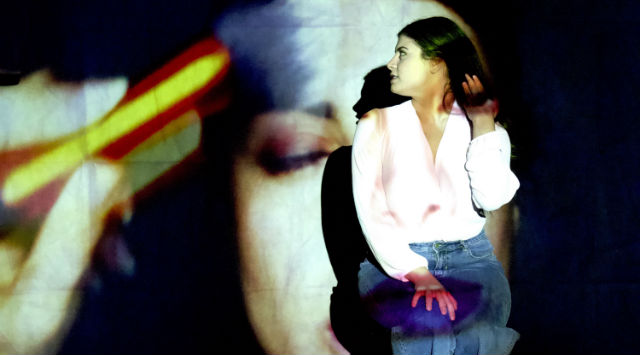
The play begins as though a manual providing instruction on becoming a radical feminist, offering steps of revolutionary action to attain some kind of ideal state of being. For those who understand their subjugation, the idea of taking down the powerful is always appealing, but the truth remains, that vacuums are nonviable and breaking something down requires the installation of something new. Alice Birch’s Revolt. She Said. Revolt Again. is a thrilling ride for anyone with a taste for rebellion. Its militant spirit is seductive, with powerful declarations that will excite those similarly inclined. The piece evolves unexpectedly, introducing in later portions, complexities that confront its own passionate proclamations of earlier scenes. Birch wants us mobilised, but in a smart way. Activism cannot thrive only on impulse. Long term strategies must accompany courses of action, or we risk ending up at a place worse than before.

The show speaks resonantly, with director Charles Sanders’ intellect a fortifying authority that establishes clarity for all its arguments. The politics in Revolt. She Said. Revolt Again. are made compelling by Sanders’ palpable enthusiasm for the subject matter, and their insistence that we hear its messages, translates into excellent drama. Design style is fairly simple for the production, with Joanne Joy’s visual projections particularly effective in helping to assert some of the highly provocative concepts.

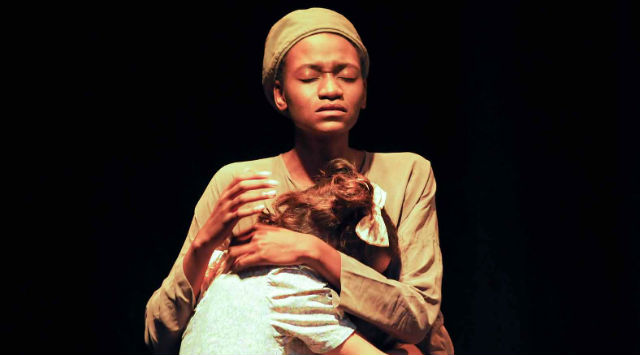
All six performers for the piece are impressive, each one given ample opportunity to put on display their individual talents, as well as a unifying and admirable conviction pertaining to the material at hand. Eliza Sanders imbues her lines with authenticity and precision, delivering a delightful acerbity with every utterance, and equally memorable for her disciplined physical expressions. The imposing figure of Moreblessing Maturure is accompanied with a tender vulnerability, especially convincing in a maternal role, conveying unassailable qualities of our humanity with beautiful restraint and confidence. The lone thorn among the roses is Richard Hilliar, whose comedy hits all the right notes, whether understated, madcap or frighteningly bombastic. Violette Ayad and Enya Daly bring emotion when we least expect it, creating additional dimensions to an already rich work, and Anna Cheney’s ability to oscillate between realism and the flamboyantly bizarre, has us fascinated and entertained.

Anarchy may not be the answer we need, but the power of resistance must never be underestimated. Revolt. She Said. Revolt Again. is full of inspiration, for those of us who recognise the concerns that it raises. Revolutions must start somewhere, and the personal can be the site on which we begin positioning the battleground. Warriors have the capacity for long, hard slogs, and they understand that to suffer the pains of combat, far surpasses the unbearable torment of injustice. Fights are best undertaken when there is light at the end of tunnel. In the business of social activism, soldiers will get beaten down every day, but a resilient optimism is the key conspirator, to the ability to know right from wrong.

www.houseofsand.org

Review: Yours The Face (Blood Moon Theatre / LZA Theatre)

Venue: Blood Moon Theatre (Potts Point NSW), May 1 – 12, 2018
Playwright: Fleur Kilpatrick
Director: Liz Arday
Cast: Daniela Haddad
Image by Liz Arday

Theatre review
Emmy is a female fashion model, and Peter is a male photographer. They meet on a job in London, both excited to be visiting from abroad, and both finding themselves attracted to one another. We watch nervously, waiting for disaster to strike, predicting the inevitable in this tale of power imbalance, but Fleur Kilpatrick’s Yours The Face refuses to fit into the mould. It is a relief to see Emmy resist being infantilised, that her sexuality and sense of self are presented as valid, even if the structures that she operates within are problematic.

The work challenges us to think about institutionalised sexism, whilst it presents individuals who seem blameless and who look to be acting with agency. It questions our participation in industries that thrive on inequity, making us think about the meaning of responsibility, in situations when acting in accordance with what is considered legal and permissible, are arguably ethically inadequate.

Daniela Haddad plays both roles, and proves herself sufficiently prepared, but the actor’s inexperience is evident in the demanding work. Positioned in front of a screen, with projections accompanying her entire performance, Haddad’s face is often obscured by the imagery, and we find ourselves routinely distracted by competing visual elements. Director Liz Arday’s concepts are strong, and they make for a show that is ultimately thought-provoking and rewarding, but the production is certainly demanding of its audience’s ability to concentrate.

When we are not actively taking down and taking over old systems, our involvement only serves to sustain them. There will be benefits that come with playing by the rules, but hidden costs have to be examined, and measured against what we deem to be genuinely decent. What Emmy and Peter do, are conventional and accepted, in fact they stand to become rich and famous if the stars align, but in Yours The Face, we observe that all is not well. Disease festers and exacerbates, when we choose only to pay attention to all that glitters.

www.lza-theatre.xyz | www.bloodmoontheatre.com

Review: Youth And Destination (Manifesto Theatre Company)

Venue: Kings Cross Theatre (Kings Cross NSW), Apr 27 – May 12, 2018
Playwright: James Raggatt
Director: James Raggatt
Cast: Jack Angwin, Georgia Blizzard, Gloria Bose, Julia Christensen, Maree Cole, Skyler Ellis, Alex Malone, Bardiya McKinnon, Nikita Waldron, Ross Walker
Images by Emily Havea

Theatre review
There is no conventional narrative in James Raggatt’s Youth And Destination, only a series of short sequences that offer insight into his young mind. The brevity of scenes allows the playwright to touch on a broad range of topics over the course of an hour, but the format prevents sufficient depth from being reached, aside from occasional dialogue that might inspire a sense of intrigue that encourages us to see beyond the mundane.

There is much to admire in the young; they are often inquisitive, passionate and fearless. Wisdom, although never restricted to the mature, can however be elusive. On this occasion, thoughts expressed are honest and very earnest, but the lack of life experience is evident, and Raggatt’s attempts at circumspection will not be able to satisfy every member of audience. Some nonetheless, will see themselves accurately reflected, in this work by young people, for young people.

An exceedingly pleasant group of actors prove themselves accomplished, with no fiction to perform but instead, putting on stage a convincing semblance of the self. In the absence of more complex story lines, their task is to make compelling, snippets of modernity, whether banal or extraordinary. Star of the show is not an actor, but lighting designer Martin Kinnane, whose aesthetic inventiveness and technical excellence, bring to the production a necessary polish, along with rigorous calibrations of mood, from scene to scene.

The young can tell us so much about the world, but pinning down the meaning of life, is not usually their strongest suit. Youth And Destination is a sensitive work, slightly overcautious with how it wishes to be perceived. Whether young or old, we all have to grapple with how others look upon us; we are so fundamentally social. It is incumbent on the artist however, to be courageous, and to always be revealing of their own truth, especially that which is unique and idiosyncratic in quality. Few can claim to speak for communities, but when we return to the individual in an exhaustive and meticulous way, what we say about the personal can become unimaginably significant.

www.kingsxtheatre.com.au

5 Questions with Chris Miller and Jacqui Robson

Chris Miller

Jacqui Robson: What are five words you’d use to describe Lennie Lawson and five words to describe Hugh Lusk?
Chris Miller: Lennie Lawson – Charming, boyish, manipulative, adaptive, psychotic. Hugh Lusk – Determined, confident, altruistic, ambitious, stubborn.

Where on the spectrum of human behaviour would these two men overlap?
More than likely, narcissism. Lawson is pathological and most definitely at the disordered end of the spectrum, lacks empathy and is a slave to his delusions. Lusk is empathetic, yet has a swagger of arrogance to him. Where they overlap is they both suffer from ‘magical thinking’: Lawson in the way he justifies his abhorrent acts of cruelty and Lusk in the way he clutches at straws to build a defence for Louisa Collins when the odds are stacked against him. Where they differ is Lusk has empathy and control whilst Lawson definitely does not.

What has been the hardest thing about playing Lennie?
I’ve done a hell of a lot of research on personality disorders and the Dark Triad (psychopathy, narcissism and Machiavellianism). It’s really heavy stuff. I’ve been exploring which spectrums I sit on, and ramping them up and walking around in public to get a feel for it… and it’s crook. I’m a naturally empathetic kid, so switching into psycho mode and exploring egocentric, sadistic magical thinking is not without its detriment. I’ve had to counterbalance with meditation and positive affirmations, which has actually been awesome as well. So it’s double edged. That, and I have to be consciously aware of not creeping out the cast and crew because I’m in so deep. Either way… it’s real juicy.

What’s it like being in these two productions at the same time?
Awesome! I freakin’ love it. Two totally different characters, pushed to the max, and a sensational team of directors, cast and crew. Jacqui (and the rest of the cast) are so talented, giving and supportive. Also, it’s a different experience playing real people of history. The back story is done for me; it almost feels like I’m allowing them in to possess me and, of course, I get to decorate the cake with Miller-isms. The main thing is just vehemently telling the truth.

Would Hugh Lusk take on Lennie Lawson as a client?
Hmmm, as ambitious as Lusk is, and although he fights for the underdog, Lawson is an abhorrent violent criminal with zero chance of redemption. The evidence is so stacked against him and cut and dry. So, my answer is no. It would be morally incongruent for Lusk to take the case.

Jacqui Robson

Chris Miller: What draws you to playing characters such as Jean Turnbull, June Dally Watkins and Louisa Collins?
Jacqui Robson: Each of these real-life women were caught up in extreme circumstances and I am grateful for the chance to explore their behaviours, and creatively make choices based on what I can only guess at why they did what they did. They are all complex and, in these stories, they experience terrible tragedies in different ways. I get to play with their strengths and vulnerabilities, but hopefully also honour their experiences.

Tell us about your process to delve deeper to find the truth and embody these characters.
I started with imagining how I would behave in their circumstances, and then try to understand why they acted the way they did. Then I looked into the research. For the Lennie Lawson story, there were helpful articles about the Lennie Lawson attack on SCEGGS that gave me some clues into Headmistress Jean Turnbull’s character and choices. There’s also plenty of content on June Dally Watkins around to give a guideline into her personality. How they behaved with Lennie Lawson is how I imagine I would have in those circumstances. (I might not have been as hardcore heroic as Jean Turnbull, though I’d like to think so.)

Louisa Collins is more difficult. She’s enigmatic. Playwright Gina Schien loaned me her copy of The Last Woman Hanged by Caroline Overington. It’s a brilliant collection of primary research with many contradictions in observations about how Louisa behaved, so I’ve found it challenging to make any decisions about her. She constantly surprises me. I’m making the best choices I can, so I just hope that I represent her as truthfully and compassionately as possible.

What’s the difference that you find in playing imaginary characters compared to actual women of history?
Playing real women of history brings with it a great amount of responsibility to represent them and their actions truthfully and accurately. History is decided by others so maybe it’s impossible to ever really do this, but I still try. Fictional characters are a lot more freeing and I care a lot less about what others’ think of my interpretation. If people don’t like my choices, I can’t do much about it and can’t worry about it.

Why act?
I bloody wish I knew. It’s like being on drugs. The creative highs are amazing. The lows – the poverty, rejection, artistic failure, bad reviews, objectification, inability to plan life – all suck immensely. Honestly, if I could get my creative kicks some other way, I bloody would.

What is your dream role and why?
I just like to be doing something, chasing something, acting in pursuit of that something. Give me a role in which I have a job to do. Preferably in a great ensemble piece with amazing dialogue. My favourite plays and shows are the ones where there are at least five people talking. I love to contribute to a symphony of fantastic dialogue in an electric scene where everyone is fighting for something (e.g. an episode of The West Wing, or Tracy Lette’s August: Osage County). My creative north star is probably Allison Janney playing CJ Cregg in The West Wing.

Chris Miller and Jacqui Robson are appearing in Deadhouse: Tales Of Sydney Morgue.
Dates: 24 April – 19 May, 2018
Venue: The Rocks Discovery Museum

5 Questions with Priscilla Jackman and Charles O’Grady

Priscilla Jackman

Charles O’Grady: What’s the most significant or surprising thing you’ve learned about trans people and gender identity through the process of making this show?
Priscilla Jackman: I’ve learnt so much on this journey but probably the most obvious thing has been correcting my previous misconception about the homogeneity of the trans community. In my
ignorance as a cisgender white woman, I assumed that trans people share common ground, common values, options etc. Of course, just like all facets of society there is enormous range and diversities within the trans community. Getting to know Catherine McGregor has been such an extraordinary revelation, because her experience and her journey has made me think, quite deeply about humanity and the commonality of our experience, as much as those aspects of her life which are so different to my own.

I find that every time I do a show like this – this one in particular! – I come away having learned or re-evaluated something about myself. Is there anything you’ve discovered over the course of this production that’s changed how you understand your own identity?
I guess a chief understanding and development for me has been an affirmation of the extraordinary collaborative process that making theatre is all about. Often as a director in the past, I have felt solely responsible for overseeing every aspect of a project, feeling I should have all the answers to everything. The most wonderful and humbling experience of working on this show has been to realise that in terms of my identity as a director, actually, the creative solutions have often been born through a deep and rich collaboration with all my team. Recognising the power of this collaboration and the creative strength and collective experience in the room has led to some of the most important creative break-through moments during rehearsals.

You and I have talked a lot about how beautiful and resonant Cate’s voice is. If you could have her read one book or play aloud to you, what would it be?
Apart from cricket, Catherine’s chief obsession is language – her love and faculty for language and storytelling is precisely what captivated and inspired me in the first place. She loves Shakespeare, the Greeks, can rattle off any number of famous military and political speeches verbatim, in a heartbeat. I love to hear her recount famous speeches – Robert Kennedy is a favourite. I love her love of poetry. But perhaps my favourite is her rendition of St Crispin’s Day speech from Henry V. So to answer your question, I would love her to read Henry V to
me.

What element of this show are you most proud of?
There is so much to be grateful for, being involved in bringing this production to life. For me, one of the greatest gifts has been to work with the team. I have never felt as supported and connected to my design team and have absolutely loved and adored working with Michael Scott Mitchell and Nick Schlieper. I have learnt so much from them both. Working with Heather Mitchell has also been one of the most inspiring experiences of my professional life – all members of our team have given so much heart and soul to the work, it has been extraordinary. The day Cate arrived at our rehearsal room, unexpectedly and played cricket with the cast, was one of the proudest days of the rehearsal process – because in that moment everything made sense – the journey that
we have been on together, the importance of telling this extraordinary story, the grace and generosity of both Cate and the cast and the team. I think we all walked away from that day feeling very affirmed that this is indeed, a very special project and special opportunity.

How has making this show differed to other shows you’ve directed in the past?
There are many differences and many similarities. Differences lie in the experience of the team I have around me – including working with you Charles – my first ever Assistant Director! I have created new work in the past using adaptation processes, but this is the first play I have written using a verbatim methodology.

Charles O’Grady

Cate talks frequently about her idol and ‘talisman’, Indian cricketer Rahul Dravid. Do you have a ‘Dravid’ in your professional or personal life, and if so, who?
I feel like I have several Dravids – most of whom would hate to be mentioned by name here! – in the sense that there are a lot of people in my life who have directly or indirectly kept me going, pulled me back from the edge in darker periods, reminded me there are reasons to keep surviving, or just been there when I needed calm and clarity. They all know who they are and they’re all rolling their eyes because, as Dravid says to Cate, “it was nothing” for them to show me kindness and support. I think often we don’t know who the “still points” in our chaos and turmoil are going to be until we find them and we’re clinging on for dear life. In terms of celebrity talismans I’ve carried with me in my life as a gender diverse person, Laura Jane Grace (lead singer of Against Me!) was a big one, as her album Transgender Dysphoria Blues was what gave me the courage to come out to my family. One time she tweeted me saying we were “BFFs”. It was amazing.

What about the text or the concept most excited you when we first discussed it?
There were two things that most got my blood running when reading the script and chatting to you about it. The first thing was that, despite our very different lives and worlds, I found a surprising number of similarities in my story and Cate’s story – something I wouldn’t have necessarily expected from someone who transitioned later in life, and who is involved in sports and the military! There’s so many moments in the script – some big, some minute – that felt to me like a hand reaching out and touching mine, like someone saying “I was there too, you’re not alone”. The second and possibly greater thing was that I saw a nuanced and complex portrayal of a trans person whose opinions I often disagree with. I love that I’ve been forced to re-examine some of my own pre-conceptions, that this is a play that constantly demands more from me, that gets me fired up and passionate. As a younger queer person, I can sometimes fall into the trap of forgetting there are multiple views within my community. Engaging with the words of someone who sees certain things differently to me, who also expresses her views so eloquently, has been as much an intellectual challenge as an emotional one.

Cate talks about cricket being a space for her where “everything just dissolves” and she feels congruent in her identity. Do you have any passions that have the same effect on you?
For me it’s always been dancing. I did ballet from age five to eighteen – I was never very technically proficient but I knew a lot about dance and loved every moment of it. For me, ballet, and dance generally, became a space free of gender – odd, as I was in classes exclusively with girls and we were constantly feminised. But the physical act of dancing was always about being a body moving in a space, and not being a gender – it was about making shapes and evoking stories, and I didn’t need to be a girl OR a boy to do that. Now, though, I find that I get the same euphoria of congruence when I sing.

What’s your favourite iconic ‘cricket sledge’?
Now that I’ve quite literally read the book on the noble Art of Sledging, I’d have to say my fave sledge is by Stephen Harold Gascoigne, better know as ‘Yabba’, who said to a fumbling batsman: “Bowl the bastard a grand piano and see if he can play that instead!”

Sum up this play in five words or less.
Chaos. Congruence. Cry-inducing. Cursing. Cate.

Priscilla Jackman is director, and Charles O’Grady is Assistant Director for Still Point Turning: The Catherine McGregor Story.
Dates: 21 April – 26 May, 2018
Venue: Wharf 1 Theatre

Review: Carmen, Live Or Dead (Oriel Entertainment Group)

Venue: Hayes Theatre Co (Potts Point NSW), Apr 28 – May 13, 2018
Music & Lyrics: iOTA
Book: Craig Harwood
Director: Shaun Rennie
Cast: Natalie Gamsu, Stefanie Jones, Andrew Kroenert
Images by David Hooley

Theatre review
It is true that Frida Kahlo had had an affair with Soviet politician Leon Trotsky, but it is entirely fictional that a lovechild was born as a result of that brief relationship. Nonetheless, Craig Harwood’s vividly imagined Carmen, Live Or Dead almost has us believing in its fantasy, that Kahlo’s offspring does exist, and that Carmen Frida Leon Davidovich had once lived in Australia.

It is an appealing fabrication; the idea that Kahlo’s magnificence lives on beyond her legendary paintings, and Harwood does create a persona that is as colourful and spirited as any fan could wish for, even if the writer’s plot structure has a tendency to be unnecessarily convoluted. Prominent in the presentation, are eight original songs by iOTA, all of them charming, often very quirky in style, and thankfully not too derivative of the Broadway genre.

Visually sumptuous, the production features a whimsical set, exquisitely decorated and painted by designer Dann Barber, evoking quintessential Mexican beauty, alongside enchanting imagery that pays tribute to the art of Kahlo. Benjamin Brockman’s lights are sensual and alluring, providing a sensation of transcendence that convincingly elevates the theatrical experience, whilst retaining its delicious and unique aura of street-smart griminess.

Director Shaun Rennie manufactures a series of captivating moods, allowing every scene to intrigue, with moments of visceral engagement that leave an impression. Performer Natalie Gamsu is a warm presence who shines in each song, but the character being portrayed does not always feel authentic; her true emotions are elusive and the connections we make can feel tentative. Stefanie Jones and Andrew Kroenert provide musical accompaniment, as well as actorly support, both accomplished with their contributions, for a show memorable for the surprising effectiveness of its restrained approach to instrumentation.

Carmen announces her impending death early in the show, inviting us to partake in flashback summations of her life and times, that constitute this piece of musical theatre. We are also inspired to consider our own deaths, and how our individual stories will eventually be told. Footprints will fade, but nothing matters more than how much good we are able to leave behind.

www.carmenliveordead.com

Review: The Lieutenant Of Inishmore (New Theatre)

Venue: New Theatre (Newtown NSW), Apr 24 – May 26, 2018
Playwright: Martin McDonagh
Director: Deborah Mulhall
Cast: Lloyd Allison-Young, Michael Becker, Alice Birbara, Steve Corner, Angus Evans, Patrick Holman, James McCrudden, Nicholas Sinclair
Images by Bob Seary

Theatre review
It is 1993, and the threat of devastating violence in Northern Ireland is a daily reality. Groups are formed, and re-formed, in accordance with shifting political ideals that deliver little more than bloodshed and suffering. Martin McDonagh’s The Lieutenant Of Inishmore first appeared in 2001, only a few years after the abatement of conflict, when the memories of terror were still fresh, and the play’s comedy is therefore, predictably dark.

Also completely absurd and deeply ironic, a narrative is built around Padraic, a homicidal maniac who kills in the name of nationalism, and the very unlikely soft spot he has for Wee Thomas, the pet cat at home. Blisteringly funny, the sardonic The Lieutenant Of Inishmore deals with real life trauma, by channelling the senselessness of recent history through heightened humour, into a digestible form. Every time we laugh at a joke, we are required to reflect on the wounds to which it refers, and in that process find a way to reach an understanding, of things too difficult to find psychological and emotional resolution for.

Director Deborah Mulhall sets the tone perfectly, for an outrageous ride of a show. The bold comedy is as enjoyable as it is thought-provoking, and our communal laughter works to create a sense of unity around the play’s discussions of terrorism and war. A delightful cast keeps us amused from the very start, when the formidable duo of Patrick Holman and James McCrudden open the production with an energetic confidence and delightful eccentricity. Chemistry between the two is nuanced and tenacious, and thoroughly enjoyable to the bitter end. Lloyd Allison-Young is a very compelling leading man, incisive in his portrayal of Padraic. Inventive and charismatic, with an enviable knack for comic timing, he lands every punchline with finesse and flair.

The story is ridiculous, but we leave the theatre thinking its wild fiction is no stranger than the truth. As we grapple with the idea of children in foreign lands being bombed, and of our neighbours being arrested for charges of terrorism, we often experience disorientation and confusion, as though the world had been turned upside down. We try to install order into things to form a semblance of logic, because information must be arranged to cohere somehow, for the alternative of ignorance and apathy is unforgivable. So much of how we are is bizarre, and bizarrely inhumane, but even when we are unable to locate the reasons for our atrocities, to prevent them from occurring must always be fundamental to who we are.

www.newtheatre.org.au

Review: Still Point Turning: The Catherine McGregor Story (Sydney Theatre Company)

Venue: Wharf 1 Sydney Theatre Company (Walsh Bay NSW), Apr 21 – May 26, 2018
Playwright: Priscilla Jackman
Director: Priscilla Jackman
Cast: Nicholas Brown, Andrew Guy, Chantelle Jamieson, Ashley Lyons, Heather Mitchell, Georgina Symes
Images by Philip Erbacher

Theatre review
For those of us who are transgender, the experience of life is always a little bit extraordinary. Radically othered, by virtue of the fiercely homogenising quality of gender, there is a part of us that cannot help but perceive things from the periphery, whether we feel ourselves to be accepted or marginalised. Catherine McGregor is a media star, in many ways Australia’s answer to Caitlyn Jenner, both sixty-something, both extremely privileged and established in their professional fields, and both coming out as trans in spectacular fashion in the 2010s. They are not trailblazers by any means, for we have existed since the dawn of humankind (assuming gender had existed from the very beginning), but their stories coincide with a particular time in Western history, when being trans is suddenly a thing to celebrate.

This new interest in our identities contains unquestionably, a hint of the freak show; we often find ourselves a curiosity that everybody else feels as though they finally have license to poke and prod at. It can be argued however, that we are the ones who have demanded attention be paid to our difference, in this, for many, lifelong battle for approval and recognition. In Priscilla Jackman’s Still Point Turning, a delicious balance is struck, in which the object of our gaze is simultaneously accommodating and commanding. The audience is intrusive, but at the protagonist’s insistence. She proclaims to not want the responsibilities of being a poster-girl for the movement, but presents herself with blunt candidness and a fearless embrace of the prying spotlight. The work is “based on interviews with Catherine McGregor”, and she is very forthright with her disclosures.

It is a political and benevolent act, but also narcissistic (as she admits), and that seemingly dissonant combination provides a potent vitality for playwright and director Jackman, whose creation here proves to be a remarkably rich piece of theatre. The show satisfies our need for the sordid and gossipy, allowing us into the profoundly personal struggles of a public figure, whilst offering some of the most informative and thought-provoking content of any biographical account. For a play about a personality whose interests are in sport and the military, Still Point Turning is perhaps surprisingly entertaining, relentlessly so, but its true value is in its frank and unembellished, and thus rare, depiction of a transgender experience.

We may not have arrived at a point where a story of this nature does not bear the burden of having to make that desperate plea for understanding, and we find McGregor’s suffering often occupying front and centre of the stage (alongside her charming sense of humour) but it is noteworthy that the show does go quite a distance beyond an exploitative depiction of trans tragedy. Societal progress can be observed in its ability to discuss its issues inquisitively and genuinely, offering perspectives that are less emotional and more sincerely exploratory. For audiences of all persuasions, the play’s statements and contemplations about how each of us negotiates gender (and other identity markers or constraints) is a rewarding opportunity for deep reflections about our places in social life; who we think we are, how we wish to be perceived, and the things we do to create a persona that each can be personally content with.

The production is passionate and polished, with clever lighting by Nick Schlieper creating comfortable shifts between time and space, whilst helping contain an unnecessarily large performance area. Music and sound by Steve Francis are conventional but highly effective in their calibrations of atmosphere. Designer Michael Scott-Mitchell’s costumes are simple but very smart, with the lead’s pristine white Carla Zampatti suit a breathtaking, memorable design feature.

Actor Heather Mitchell delivers a brilliant performance in the starring role; intelligent and insightful with her dramaturgy, impressively precise, bold in presence, and gloriously funny. Eminently convincing and disarmingly charismatic, we cannot take our eyes off of her. Her Catherine is fascinating and delightful, and we almost wish for the show not to end, if only to retain her company. A supporting ensemble of five effervescent players add to the fun, each one independently compelling and endearing, but wonderfully cohesive as a team, thick as thieves and marvellously engaging.

Even though Catherine McGregor has accomplished a great deal in her illustrious life as journalist, cricket commentator and military officer, the woman presented in these 100 minutes of Still Point Turning is defined principally by her transness. Whether or not this is an accurate depiction of McGregor’s own truth, it is an intriguing proposition that one’s fundamental sense of identity can be so firmly attached to ideas of gender. It is perhaps a consequence of unyielding persecution, of oppression and cruel humiliation, that what should only be an incidental element of a person’s being, is turned into a subsuming component.

McGregor puts blame on no one, talking only about transphobia as a personal demon, but the undeniable truth remains, that when we harm ourselves, it is always a result of conditioning by the outside. It is easy to think of McGregor as a person who has it all, and as such, we require that she expresses only humility and gratitude. However, the prejudice that all trans people continue to be subject to, range from insidious to barbaric. It is pervasive, even in progressive regions, and there is no doubt that we must always take the opportunity, to step up to defend the rights of our transfolk. To be visibly trans is crucial to our progress, and Cate’s indomitable capacity for attention, is to be admired and more importantly, emulated.

www.sydneytheatre.com.au

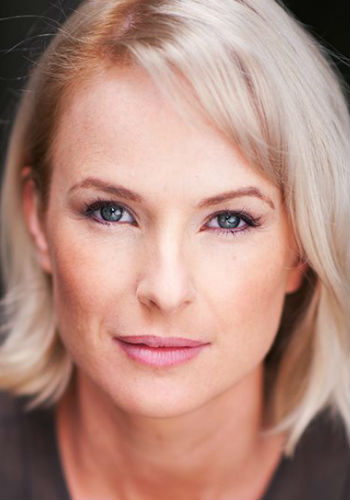
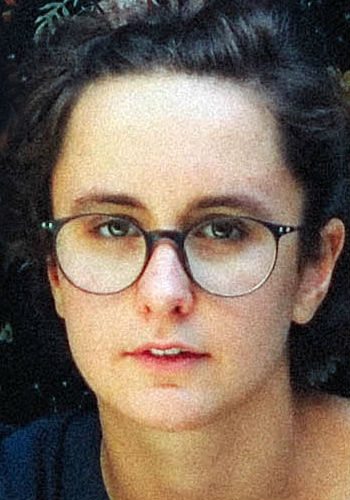
5 Questions with Anna Cheney and Eliza Sanders

Anna Cheney

Eliza Sanders: What’s the first show you ever saw?
Anna Cheney: Romeo And Juliette the ballet… oh no it wasn’t, it was 7 Little Australians. I felt really privileged to be taken to the theatre as child, because it has shaped me and I bloody love live theatre because it is visceral, it causes you to think and ask questions of life and humans and I think it can change lives.

What was your first acting experience?
I used to do magic shows. I used to learn magic tricks from a book and then create a show and then take them into primary school and perform them in front of the class. Then when my classmates learned how to do the tricks they teased me.

What did you do then?
I cried all night then went back the next day and did it again, but better. Fuck you school kids!

Why are you passionate about this show?
I’ve never read a play that is quite as radical and unusual as this play and this theatre company is the perfect company to take it on. The director has a very clear vision regarding his desire for both equality and great theatre. House of Sand has brought together a diverse range of professionals to undertake this ‘everistic’ task (is that a word?… climbing theatrical mountains) Now, a week away from opening I can see even more how much of a genius Alice Birch is because we have a kick ass production from what seamed like a very strange conglomeration of words on a page, vignettes and abstract provocations regarding women and language. I don’t know how this writer has done it, but fuck, she’s amazing.

What’s your favourite female body part?
This bit (gestures to place above belly button below breast. It’s got a name but I can’t think what it’s called. Solar plexus? It’s soft and smooth and close to your heart. On my body, my hands, but not aesthetically, just what I can do with them.

Why do we need feminism?
A million thoughts rage in my head! Feminism has a long way to go but, fuck, it’s important. If we didn’t have it, the world would be in a worse place. True equality or the aim for true equality is something that I believe would help every person on the planet.

Eliza Sanders

Anna Cheney: What is the answer to the patriarchy?
Eliza Sanders: Fuck knows.

AC: What do you think about shows that use sexy women to sell them?
ES: Depends if that has anything to do with the content on the show. I don’t think it is bad to use women’s bodies for marketing if it is justified and consensual. But I think men’s bodies should be used more often for marketing, but maybe that just because I personally love the look of men’s bodies.

As a professional dancer, what is it like acting in a play?
Not as physical. Haha. It is more different than I thought it would be. The communication around language is much more considered which makes for a different pace in the rehearsal room which has taken some adjusting. It’s slower in the moment but somehow the whole work seems to come together much quicker. There is also more work that you have to do outside of the studio like learning lines and investigating character choices, and less rolling all over your collaborators.

How is Sydney going to respond to this play?
That is something I really can’t predict, Sydney audiences are not particularly familiar to me. I think they will be amused and entertained primarily and hopefully it will cause then to question and reassess their perspectives on feminism and language.

How is live theatre relevant in a world of screens?
It’s about building communities and bringing people together in physical space. Giving people a reason to leave the house and socialise and interact with ideas without being able to press pause whenever they want. There is a different energetic charge in a live room that you don’t get from a screen. The reason I do it is because it affects your body in a physical way and that allows intellectual and emotional understanding to be gained in a different capacity. Primarily it is about sharing. You can’t do it on your own.

Anna Cheney and Eliza Sanders are appearing in Revolt. She Said. Revolt Again. by Alice Birch.
Dates: 2 – 19 May, 2018
Venue: The Old 505 Theatre

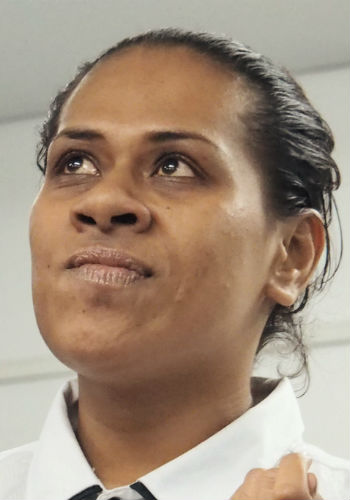
5 Questions with Gloria Bose and Nikita Waldron

Gloria Bose

Nikita Waldron: What are some obstacles you have had to face as a person of your background coming in the industry?
Gloria Bose: Easy – diversity and representation, not only within my race but class, age, education, sexuality and being of this time. It can be quite disheartening when I do find monologues and it’s either an African American woman suffering from domestic violence or a Rwandan prostitute raising her bastard child in the civil war. Like, those are my choices?… (I used the above monologues to get into drama school)

What’s your favourite warm up tongue twister?
I don’t do tongue twisters, but rattling off consonants, sirening and Y-buzzing (Arthur Lessac) are my go-tos.

If you could swap careers with any actor who would it be and why?
Eddie Murphy! I’m particularly interested in his longevity and variety of his career. From stand-up in the 80s, to movies, he’s released an album, produced his own films, voice overs for the Shrek instalments, playing numerous characters in The Nutty Professor and then all those swing & a miss movies – building a career to have agency to create.

What’s the best thing about working with such an eclectic bunch of young actors?
Difference of opinion and having insight from all walks of life. It’s been great to hear all these offers, some come to fruition and others get left on the rehearsal room floor.

What’s it been like to work with a brand new piece of writing?
Challenging in all the best ways. It’s funny because I don’t find it brand new. James has been working on this play for about 3-4yrs and I remember going to readings in 2015, 16, 17 and now
2018 I’m in it – I think it’s spent enough time on paper and I’m excited for its time onstage.

Nikita Waldron

Gloria Bose: Are you the type of person, who’s about the journey or the destination?
Nikita Waldron: Someone once told me that if I was going to embark on an acting career, I’d have to enjoy the journey otherwise I’d be deeply disappointed by the destination, and it’s probably the most valuable advice I’ve ever gotten. Having said that…a good destination is hugely motivating. Especially on a path like this.

Describe your youth in three words?
Redskins. Literature. Daydreaming.

If you could have one thing change tomorrow, what would it be?
I’d change the President of the United States. Or I’d end global warming. But I think the first issue would definitely put us on track to combat the second.

What is one misconception of being a woman of colour?
The biggest misconception? That I think of it as a disadvantage in this industry. Or worse as an advantage. The truth is, I don’t really think about my skin colour that often. I’ve grown up in a household where it was drilled into me that with hard work almost anything is possible. Period. I’ve got my parents to thank for that. While I’m thrilled that there are more opportunities in the arts for people who look different, I hope that one day it’ll be so normal that we won’t have to talk about it.

If you had to take me on a date, what/where would it be?
I’d fly you to Queenstown in New Zealand (near where my Dad grew up) for a Fergburger. They’re the best burgers in the world – you can quote me on that.

Gloria Bose and Nikita Waldron are appearing in Youth & Destination, by James Raggatt.
Dates: 27 April – 12 May, 2018
Venue: Kings Cross Theatre