Review: Van De Maar Papers (Ratcatch / The Old 505 Theatre)

Venue: The Old 505 Theatre (Newtown NSW), Jul 9 – 20, 2019
Playwright: Alexander Lee-Rekers
Director: Camilla Turnbull
Cast: Melissa Hume, Jessie Lancaster, Tom Matthews, Lucy Miller, Nathalie Murray, Terry Serio, Sophie Strykowski, Simon Thomson
Images by Clare Hawley

Theatre review
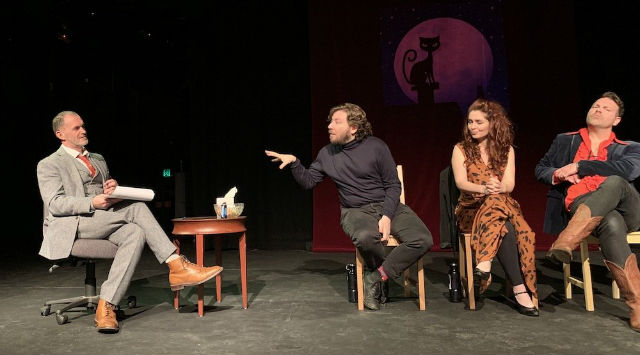
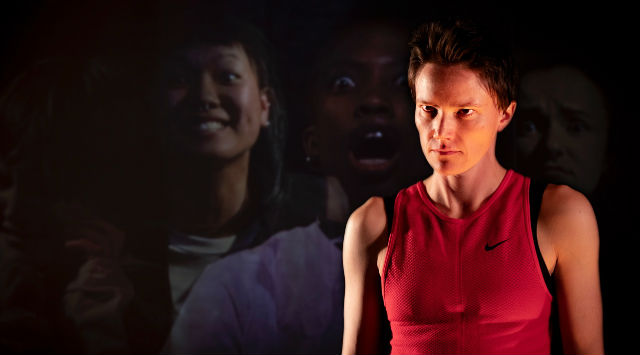
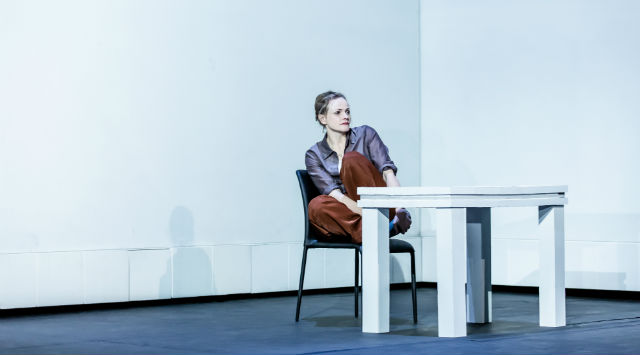
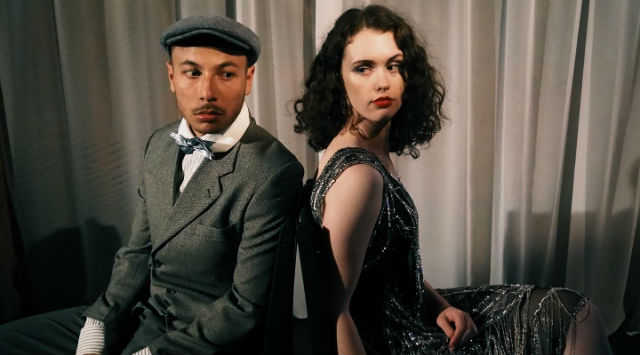
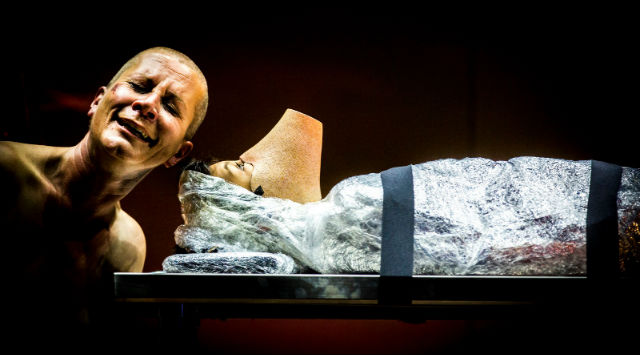
A man of extraordinary wealth and influence has died, leaving behind a secret manuscript that he wishes to get published, now that he is no longer here to face the critics. The family however, will have to suffer the consequences of a book that could well destroy the family name. Alexander Lee-Rekers’ Van De Maar Papers is concerned with ambition. Levi Van De Maar, the deceased, had wanted to achieve something that he only saw possible after leaving this mortal coil. His wife Christine has her own priorities of self-preservation, as does Frank, a nephew trying to make his own mark in a world that only sees him as a surname.

Lee-Rekers’ writing is often fascinating, with an idiosyncratic humour that keeps us amused. The production can however feel too serious and slow, with director Camilla Turnbull placing emphasis on conveying psychological accuracy, and comedic impulses made somewhat secondary. Lucy Miller and Simon Thomson play the main surviving Van De Maars, both actors believable if slightly too subtle in their approach. The role of unscrupulous publisher Ron Huck is depicted with an enjoyable theatricality by Terry Serio, whose relentless vibrancy is a real asset for the show. At times, he seems to be the only one who is in on the joke with the audience.

The obsession with money and status in Van De Maar Papers encourages us to question our own values. Juxtaposed against the inevitability of death, we are struck by the intensity with which the shallow and the materialistic can overwhelm and determine every course of action. We know with absolute certainty the brevity of existence, yet we submit to meaningless pursuits, letting the appetite to outdo one another, take over the entirety of our being. There are better things to do than to invest in keeping up with neighbours; the tricky thing is to be able to identify that which will be truly fulfilling, and stick with it.

www.old505theatre.com

Review: Glittery Clittery: A Consensual Party (Griffin Theatre Co / The Furies)

Venue: SBW Stables Theatre (Kings Cross NSW), Jul 8 – 20, 2019
Playwright: Fringe Wives Club (Victoria Falconer, Rowena Hutson, Tessa Waters)
Director: Clare Bartholomew
Cast: Laura Frew, Rowena Hutson, Tessa Waters
Images by Kate Pardey

Theatre review
It is a rowdy cabaret with three women in sequinned jumpsuits, very excited by feminism, and thrilled at the prospect of preaching to the converted. Christened Glittery Clittery: A Consensual Party, the show is perfectly suited to our current climate of placing centre stage, all things woke and womanly. Devised by Victoria Falconer, Rowena Hutson and Tessa Waters, collectively known as the Fringe Wives Club, the work consists of relentlessly amusing songs, and witty repartee that make for an enjoyable hour. It has a coalescing power, through its comical observations and vivacious representations, that makes us feel like a tribal audience, united in laughter against the patriarchy.

Directed by Clare Bartholomew, the cabaret presentation is intensely energetic, if slightly frenetic and unfocused in parts. Music is one of its indubitable strengths, although sound engineering could be improved to exploit more fully, the rousing pop potentials of the backing tracks. The performers bring a palpable warmth to the space, perhaps too polite in their approach, but all three are earnest personalities who insist on our adoration; Hutson is particularly likeable when temporarily assuming the scintillating part, “Lagoon of Mystery”.

Glittery Clittery is a sweaty, joyous mess; its text accurately expresses the thoughts and experiences of modern women everywhere in the Western world, but more importantly, the bawdy vigour with which its characters conduct themselves, is a marvellous exemplification of a new feminist spirit that we can utilise in conjuring up new feminine identities. This “clitterati” is unlikely to be anything close to what our grandparents had envisioned, and that is a sure sign of the progress that is under way for us all.

/www.facebook.com/fringewivesclub

Review: We Are The Himalayas (Brave New Word Theatre)

Venue: Fringe HQ (Potts Point NSW), Jul 3 – 21, 2019
Playwright: Mark Langham
Director: Richard Cornally
Cast: Charlotte Chimes, Steve Corner, James Gordon, Chelsea Hamre, Ben Mathews, Emilia Stubbs Grigoriou
Images by David Hooley

Theatre review
It was 1938 when Anna Larina was first incarcerated. With her husband Nikolai Bukharin charged with treason against the Soviet Union, Larina found herself similarly persecuted by the paranoid state, for simply being a wife. Mark Langham’s We Are The Himalayas tells the tale of the individual versus an oppressive regime, featuring characters from a specific point of history, but is timeless in its relevancy. Scintillating dialogue is the work’s greatest pleasure. Its narrative can be slightly lacklustre, but there is much to enjoy in the dynamics between characters, and in Langham’s words themselves.

Leading lady Charlotte Chimes offers focus and intensity, although a greater exploration of range and depth for Larina would create a stronger sense of empathy for her audience. A more complex rendering of personality comes from Ben Mathews who gives a Bukharin that feels layered, and hence intriguing. As secret police apparatus Lavrentiy Beria, is the exceptional Steve Corner, whose nuanced dramatics has us enthralled. His scenes with Chimes and Mathews have them lifting their game, for a second half of We Are The Himalayas that quite suddenly turns explosive.

Not every actor is able to deliver with enough resonance for the show to be consistently meaningful, but director Richard Cornally keeps his storytelling disciplined, with a considered approach that successfully accumulates tension over the duration. Sound design by Patrick Howard is especially noteworthy for its impressive precision, guiding us across time and space with remarkable sensitivity.

There is strength in numbers, although our collectivism can easily turn evil when left unchecked. The greater good is always a noble consideration, but the autonomy of singular entities must never be conveniently disregarded. In 2019, we can see with great clarity, the corruptible nature of power, with those in high places becoming increasingly wanton in the way they execute their affairs. It is tempting to think that our Western democracy is a world away from Stalin’s communism, but the second we ease pressure on the brakes, our ruling class will no doubt drive us to a destination that few will appreciate.

www.bnwtheatre.com.au

Review: Once (Darlinghurst Theatre Company)

Venue: Eternity Playhouse (Darlinghurst NSW), Jun 26 – Aug 4, 2019
Book: Enda Walsh
Music & Lyrics: Glen Hansard, Markéta Irglová
Director: Richard Carroll
Cast: Joe Accaria, Stefanie Caccamo, Cameron Daddo, Victoria Falconer, Toby Francis, Conrad Hamill, Drew Livingston, Abe Mitchell, Rupert Reid, Alec Steedman, Joanna Weinberg
Images by Robert Catto
Theatre review
Guy meets girl, and girl decides to spend all her days helping insecure guy fulfil his dreams. Once is only about a decade old, but already feels like a story from an archaic era. The musical is however not unappealing, with an avalanche of beautiful melodies, and the now famous concept of having its cast double up as musicians for the show’s entirety. It is quite a spectacle, watching eleven performers playing instruments, singing and acting. Entertainment value for Once is predictably high, even with all of its unrelenting cliches.

Directed by Richard Carroll, the production is thoroughly sentimental, to emphasise the romantic nature of the central relationship, although it does seem to diminish the potential for greater humour through the plot. Set design by Hugh O’Connor elegantly transforms the stage into a very believable Irish pub, with Peter Rubie’s lights bringing a dusty melancholia to proceedings. Remarkable work by sound engineer Dylan Robinson translates all the live music into honey for our ears, making the sounds of Once a truly memorable feature.

Lead performers Stephanie Caccamo and Toby Francis are exceptional singers, both deeply impressive with their renditions of these saccharine show tunes; we are left wanting to hear their voices forever. Their acting however is rarely convincing, with chemistry between the two a conspicuous absence. Charisma is compensated by several of its supporting performers, most notably, Victoria Falconer and Drew Livingstone, who create adorable characters that try to bring a sense of effervescence to the stage. On occasions where movement director Amy Campbell has the opportunity to work her magic, everything comes to life, but those moments are few, in this frequently sombre presentation.

Once allows us to celebrate the extraordinary talent of those who live amongst us. There is so much that our artists are capable of, if only they have all the platforms necessary to demonstrate what they do best. When we first meet the protagonist, he had all but given up hope of finding an audience for his wonderful songwriting. This is sadly an all too common truth for so many. Humans are creative by nature, but the way we live today, so often negates those capacities, in favour of conventional systems that require the repression and impediment of our best tendencies. Artists need self-belief, and they need to be supported, especially when the going gets tough, as it invariably does.

www.darlinghursttheatre.com

Review: I Hope It’s Not Raining In London (Bearfoot Theatre)

Venue: PACT Centre for Emerging Artists (Erskineville NSW), Jun 26 – 29, 2019
Playwright: Nicholas Thoroughgood
Director: Riley McLean
Cast: Daniel Cottier, Cassie Hamilton, Nicholas Thoroughgood, Zoe Walker
Images by Riley McLean

Theatre review
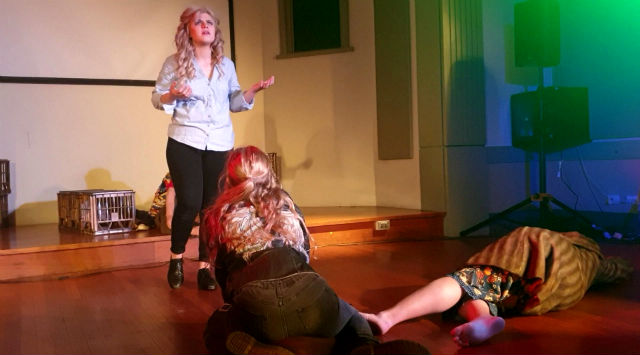
It begins with two young people in a mysterious room, both of whom are not quite sure who or where they are. The amnesia gradually fades away, as they proceed to recollect memories explaining how they got here. We learn soon enough, that Nicholas Thoroughgood’s I Hope It’s Not Raining In London is about these protagonists’ relationships with their parents. They look back at the warm and the chilling, and try to figure out, where to from here. It is a sensitive piece of writing, well considered but perhaps not quite as powerful as it wishes to be. The structure elicits a healthy dose of intrigue, although we find ourselves arriving at its climax with insufficient dramatic tension.

Directed by Riley McLean, the production is elegantly styled, with an emphasis on chemistry between actors that keeps our attention on the story. Daniel Cottier and playwright Thoroughgood perform the central characters, both persuasively naturalistic, with an ease and familiarity with the material that allows them to bring sizeable confidence to the stage. Also noteworthy is McLean’s lighting design, simple but varied, efficient with the management of scene transitions, and effective in conveying atmospheric transformations.

Some say that heaven, hell and purgatory are not about the afterlife, but are allegorical concepts for the here and now. Indeed, it is helpful to always think about today as a consequence of yesterday, in order that we may learn to make improvements. In our storytelling too, causation, of one thing leading to another, shapes all our narratives. We can however, disconnect from the past, or at least, formulate new beginnings, so that we can experience radical reconstructions, when so desired. What’s done cannot be undone, but what we do with the future is only restricted by imagination.

www.facebook.com/bearfoottheatreaus

Review: The Astral Plane (25A Belvoir)

Venue: Belvoir St Theatre (Surry Hills NSW), Jun 12 – 29, 2019
Playwright: Charlie Garber
Director: Charlie Garber
Cast: Eden Falk, Emma Harvie, Julia Robertson, Imogen Sage, Ella Scott Lynch, Michael Whalley

Theatre review
Charlie Garber’s The Astral Plane happens in that space one arrives at before attaining nirvana, where imagination easily turns into reality, or to be more accurate, material. It is all very strange. Depending on personal inclinations, Garber’s sense of humour can be appealing, even in an adventure featuring talking rats and social media influencers that proves to make no sense whatsoever. It is a comedy about nothing, that can leave one feeling quite empty by its end, but there are certainly laughs to be had in every one of its wacky scenes.

An energetic cast, full of conviction, takes us on a spirited ride. They are determined to entertain, and their presence is consistently infectious. In the role of Romi is Imogen Sage, who brings to the stage, an exaggerated effervescence and more than a hint of quirkiness. Julia Robertson is impressive as Deborah, very powerful with an artistic approach that is always daring and robust. Emma Harvie and Michael Whalley are the rats, both performers extraordinarily charming, able to convince us of anything, no matter how farfetched their story.

There is tremendous creativity in The Astral Plane, but its idiosyncrasy will only find appreciation from some. Art can hope to be universal, but it must originate from a personal place if we require it to be honest. Thinking that people are all the same is dangerous, for we are only equal and never replicants of each other. There must be generous allowance for artists to express their individuality, no matter how off-kilter, as long as we are prepared for it to land where we do not predict.

www.facebook.com/theastralplane | www.belvoir.com.au

Review: The Happy Prince (Little Ones Theatre)

Venue: SBW Stables Theatre (Kings Cross NSW), Jun 25 – Jul 6, 2019
Director: Stephen Nicolazzo
Cast: Catherine Davies, Janine Watson
Images by Robert Catto

Theatre review
It is the perfect symbiotic relationship, when the swallow meets the statue and they see deep into each other, not through some mutually obsessive infatuation, but by a shared fervour for bringing peace unto others. In this adaptation of Oscar Wilde’s short story The Happy Prince, we observe selflessness as the ultimate joy and fulfilment. Independently, each entity can do little, but together, they are able to help people in need, and it is only in bringing happiness to strangers, that they themselves are at their most exultant.

Directed by Stephen Nicolazzo, the show is correspondingly generous. Its messages are earnest, fiercely so, and it stringently disallows any room for our customary cynicism. A profound sense of melancholia works almost as its guiding light, taking us down a journey of meditative reflection, to facilitate an examination of the values we use to navigate this thing called life. The swallow and the statue exist in a concurrent state of joy and pain, and we feel every nuanced articulation of emotion depicted by this extraordinary staging. Poetic, with a sublime beauty that transcends all manner of convention, The Happy Prince speaks its truth with remarkable clarity, to deliver an hour of theatre that is as moving an experience as any fairy tale could wish to be.

Music by Daniel Nixon holds us tight, keeping us firmly in the grasp of a show determined to connect with the best of our humanity. Nixon’s work is tender, tremendously stirring, and we respond only with an attitude of pure benevolence. Katie Sftekidis’ lights have a similar effect, drawing us into a sentimental dreamscape, gently pushing away inhibitions so that our capacities know to welcome all the warmth, and wistfulness, of Wilde’s story.

Catherine Davies and Janine Watson are our players, both enchanting and majestically impassioned, full of soul in their performance of a piece that all our broken hearts need to encounter. Watson is the statue, the eponymous Happy Prince who shows us that glory means nothing when left enshrined and static. The actor communicates powerfully, the best of human nature, with a stylistic restraint that barely contains the urgency of what she wishes to convey. Davies takes flight as the swallow, giving us comedy and pathos in equal potent measure, precise at every point in the illustration of her character’s vacillating transformation, from apathetic to spirited. The robust couple is inventive, with an extraordinary charisma that demands our attention. Their sensuality adds a dimension of eroticism to the work, that operates to enhance the theme of compassion, as the play’s central concern.

It is easy to think of sacrifice in terms of loss. In The Happy Prince however, we are reminded that the purpose of sacrifice is to attain something greater, that more often than not, paying a price will lead us to a reward. We watch the statue and her swallow go through considerable suffering, but we are left without doubt as to the immense satisfaction they experience as a result of their pain. Pleasure does not always involve the sting of its cost, but when one is compelled to give until it hurts, what returns is usually from the realms of the divine.

www.littleonestheatre.com.au

Review: Trevor (Outhouse Theatre Co)

Venue: Kings Cross Theatre (Kings Cross NSW), Jun 14 – Jul 6, 2019
Playwright: Nick Jones
Director: Shaun Rennie
Cast: Di Adams, Jemwel Danao, Garth Holcombe, David Lynch, Ainslie McGlynn, Jamie Oxenbould, Eloise Snape
Images by Clare Hawley

Theatre review
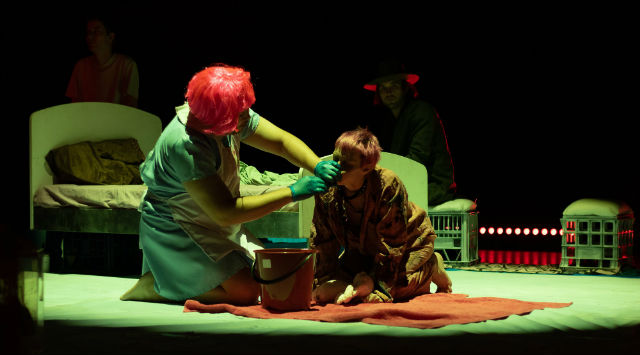
Sandra owns a pet chimpanzee, who in Nick Jones’ Trevor, fancies himself a professional performer, having appeared as a younger primate, on stage and screen. Work has dried up, and Trevor is increasingly restless about his career’s downward trajectory. This of course, is all in his own mind, with Sandra completely oblivious about the turmoil that is brewing inside of the animal. Trevor is given his own voice by the playwright, but he talks as though in a monologue, never expecting any of the humans to understand, thus setting up for the play an inter-species disconnect that figures heavily as its ultimate raison d’etre.

Actor Jamie Oxenbould is persuasive as the chimp, with animalistic energy emanating from all of his being, without excessive reliance on physical mimicry. We believe his ambitions and his frustrations as Trevor, and appreciate the dramatic escalations being presented, through every plot development. Similarly convincing is Di Adams as Sandra, whose own problems are revealed at a slower pace, although no less powerful. There is however, a significantly stronger emphasis on Trevor’s experience than there is on Sandra’s, and considering our predictable affinity with the human character, it is a strange choice that prevents us from a closer empathy with the story.

In allowing Sandra to be somewhat subsumed in the production, director Shaun Rennie risks a distance that could result in a degree of emotional detachment for the audience, but it is a show that is relentless lively, and we find ourselves consistently involved, if not always invested. In a similar vein, Garth Holcombe and Eloise Snape both play larger than life, and very flamboyant personalities, who amuse us at every appearance, but who do little in engaging us on more profound levels. Their costumes though, are notably striking, humorously assembled by Jonathan Hindmarsh, who also solves spatial challenges as set designer, with demarcations of the stage that are, by and large, surprisingly effective. Lights by Kelsey Lee and sound by Melanie Herbert too, are accomplished, for an overall theatrical impact that proves gratifying.

It is absurd that a creature like Trevor should ever be kept as a pet. Human environments are barely feasible for our own survival, yet we insist on removing animals from their natural habitats, to put up with what we know is completely impracticable for them. This is the extent of our arrogance and narcissism. We see nature as a resource to be plundered, and fail to consider the consequences of our incessant exploitation. Trevor is about nature fighting back, and a timely work that opens up discussions about extinction, of the human race.

www.outhousetheatre.org

Review: Things I Know To Be True (Belvoir St Theatre)

Venue: Belvoir St Theatre (Surry Hills NSW), Jun 8 – Jul 21, 2019
Playwright: Andrew Bovell
Director: Neil Armfield
Cast: Miranda Daughtry, Tom Hobbs, Matt Levett, Tony Martin, Anna Lise Phillips, Helen Thomson
Images by Heidrun Löhr

Theatre review
Fran and Bob suddenly find themselves in their sixties, and although both have worked hard, there seems little to show for. After having put everything into raising a family, the couple is starting to have to confront their twilight years. With four adult children still struggling to find their own feet, and a marriage that has long lost its lustre, years of sacrifice seems to have delivered little contentment. Andrew Bovell’s Things I Know To Be True is a portrait of one family, in some ways typical of the Australian experience, but certainly not representative of our myriad diversities. More bitter than sweet, this family drama contains excellent humour and a great deal of sentimentality, as though trying to mask the pessimism that it fundamentally contains.

The Price family presents an admirable facade. There is undeniable love, very well depicted by director Neil Armfield, but we are encouraged to question the choices Fran and Bob had made, or more precisely, to question the options they had perceived to be available when deciding to follow the straight and narrow. Fran concedes that she had adopted others’ expectations as her own, that she believed her destiny was to be a mother and nothing else. Now observing her legacy, we see her constantly trying to find satisfaction, usually tenuous at best, with all that she had manifested. The thing about parenthood is that room for regret is virtually non-existent.

The production is incredibly well-crafted, with every faculty operating at levels of excellence, keeping us enthralled from beginning to end. Armfield magnifies all the comedy and drama, for a show determined to entertain, even if its emotional resonances tend to feel highly romanticised. Lights by Damien Cooper warmly lull us into a daze of tenderness, making us a forgiving audience for Things I Know To Be True, almost oblivious to its characters’ flaws and frequent moments of stupidity.

Terribly ordinary people are turned captivating, by a cast of actors brimming with charm. Tony Martin is especially charismatic as Bob, beautiful with the vulnerability that he so effectively depicts, alongside a convincing rendering of archetypal suburban masculinity. The very funny Helen Thomson, who never misses any opportunity to create laughter, plays Fran, a wonderfully complex character, able to sustain our empathy even after some very unkind behaviour. Miranda Daughtry is notable as youngest daughter Rosie, whose unyielding innocence sets the tone from curtain-up, allowing us to see the story with her eyes, often too pure for our own good.

Things I Know To Be True does not intend to be a cautionary tale, but one could be tempted to interpret it as such. Aside from Fran who had worked tirelessly for decades as a nurse, there is no evidence of any great contribution to society or to humanity, in these small, albeit painful, existences. The Prices think about nothing but themselves, and are perhaps unsurprisingly, overwhelmed with frustration and anguish. Fran and Bob were committed to being the best parents, but never found a way to impart a sense of fulfilment to their offspring. If we return to the initial unexamined notion of procreation as an obligatory social and personal imperative, we might be able to draw from Fran and Bob’s story, the consequences of doing things without thinking them through.

www.belvoir.com.au

Review: Anatomy Of A Suicide (Sugary Rum Productions)

Venue: Old Fitzroy Theatre (Woolloomooloo NSW), Jun 12 – Jul 6, 2019
Playwright: Alice Birch
Director: Shane Anthony
Cast: Danielle Catanzariti, Jack Crumlin, Andrea Demetriades, Teale Howie, Charles Mayer, Guy O’Grady, Natalie Saleeba, Anna Samson, Kate Skinner, Contessa Treffone
Images by Kate Williams

Theatre review
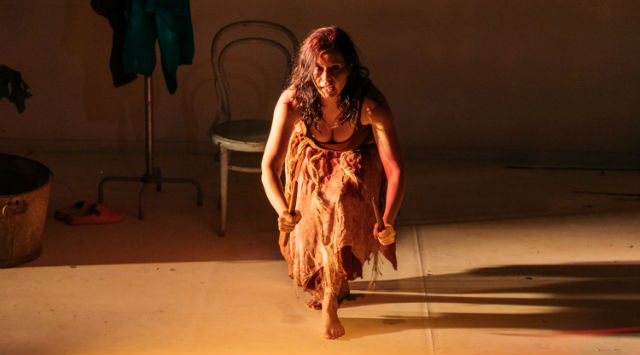
Suicide always seems just a breath away for Annie, Bonnie and Carol. Alice Birch’s Anatomy Of A Suicide follows the struggles of three women, all of them skating dangerously close to the ultimate act of self-destruction. The play asks very big questions, but it is the way its provocations are dispensed, that makes it remarkable. The three leads exist in independent chronologies, but their stories are told in tandem, often overlapping, for a theatrical experience highly unusual in its plot structure. Parallels are drawn across narratives from different decades, to examine generational implications, in the way things may or may not change over time, in relation to women’s autonomy over their existences.

There is tremendous pleasure in seeing women lead the play, but it can also feel problematic that their neurotic behaviour is consequently associated with their gender. The only people out of control in the story are these women, and we find ourselves tempted to think of the issues being raised as being specifically gendered, when their femaleness should on this occasion, be a secondary concern.

Director Shane Anthony brings a mesmerising urgency to his staging; the stakes always feel high, and we are seduced by the intensity of his dramatic flair. His set (designed in collaboration with producer Gus Murray) is graceful and efficient, and along with Veronique Benett’s dynamically emotive lights, the visuals are sumptuous, for a deeply satisfying aesthetic that is always in dramaturgical harmony. Damien Lane’s music too, is beautifully rendered, memorable for being appropriately sentimental, able to help us access reservoirs of visceral sensations that resonate at every crucial plot point.

The cast is consistently impressive, with all members demonstrating excellent focus and a sense of disciplined precision reflecting consummate preparedness. Anna Samson is a wonderfully idiosyncratic Carol, convincing in her portrayal of mental illness, always rich with nuance and complexity as the subjugated, and gravely despondent, 60’s housewife. Anna, the addict who resorts to motherhood for salvation, is played by a powerful Andrea Demetriades, who delivers a severity for the character that persists in securing our empathy. A more naturalistic approach by Kate Skinner, allows us to relate to her Bonnie as a contemporary, and therefore more immediate, figure. In the singular scene in which she does turn rhapsodic, the atmosphere erupts and none can escape its poignancy.

More than the women before her, Bonnie is conscious of the forces that work to undermine her autonomy. We observe however, that knowing one’s demons does not necessarily spawn the capacities to defeat them. Being human, we almost always know good from bad, but the eternal conundrum of being able to do the right thing is what haunts us. Bonnie’s determination to outsmart her fate seems almost superhuman. She rejects that which seeks to entrap and define her, and in her story we see how hard it can be, to simply be your own woman.

www.facebook.com/sugaryrumproductions | www.redlineproductions.com.au