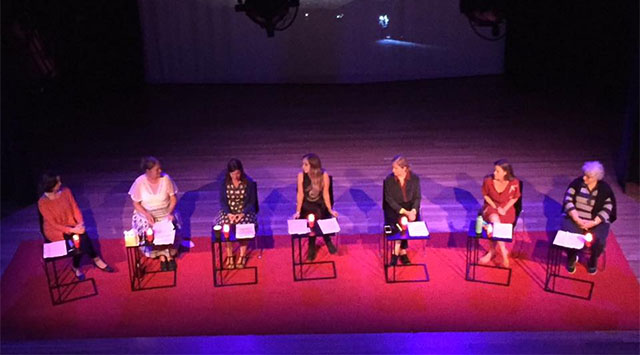
5 Questions with Joanna Downing and Ben McIvor

Joanna Downing

Ben McIvor: Jo, what do you love about your character Dominique?
Joanna Downing: I love that she can be so dry. I love her intelligence. I love that she is so considered – the way that she looks at the world, and art.

If Dom was an animal, what would she be, and why?
Cat. All lithe and bendy and somewhat mindless of other people’s space.

How do you prepare for a role?
Read the play as many times as humanly possible. Films and books invariably come up in conversation in the rehearsal room, so I try to watch/read as many as I can. I’m reading the Female Eunuch at the moment because of this one! I also started an image collection… Dom knows so much more about art and artists than I do, so I needed to familiarise myself with the images. Oh and of course, the French. I’ve been practising daily to get it up to scratch.

How has this play affected your understanding of art?
Well I hope it’s made me more conscientious. It’s definitely made me want to go to Musee D’Orsay and Marmottan to spend time with the real pieces. I think the play has given me an emotional attachment to the works, simply through Dom’s love of them, that I didn’t have before.

What’s it like working with Anthony Skuse?
Heaven! He is so considered and very open. The tone of the room was always warm and comfortable, but he also cuts through any extraneous bullshit. I have a sneaking suspicion that he can read me better than I can read myself.

Ben McIvor

Joanna Downing: What do you like most about the space at KXT (Kings Cross Theatre)?
I hope this doesn’t sound too weird, but I absolutely love the foyer! The art, the furniture, the typewriter, that stunning lamp, the egg timer, the books, that creepy dream catcher blowing around in the air conditioning under the glow of the exit sign… it feels like you’ve stepped into a strange dream.

What’s the biggest point of difference between you and your character?
I tend to think ahead a lot, whereas the thing I admire most about Barry is he lives moment to moment. He doesn’t think, he just does.

Who is your favourite artist and why?
Oooh, good question! This is particularly hard to answer because doing this play with Mr Skuse has really opened up a world that seemed so foreign to me. I’m going to go with Scottie Marsh, though. Growing up in the Inner-West, Hip-hop and graffiti played a big part in shaping my youth, and “fine art” seemed like something so far away from street art. Sipping nice wine in white-walled galleries was a world away from Posca’d train cabins and “Bombed” walls. I think Mr Marsh seems to do a great job of blurring the line between graffiti and fine art… and if I was a youth in 2017 who was into street art, this type of work might spark my interest into the world of fine art. I hope that makes sense!?

Do you have any pre-show ‘rituals’ to get you into character?
I guess it depends on the role. I like to do character work early on in the rehearsal process and I have a long list of questions that I ask my character to discover more about how they view themselves and their world… I read some of the responses before each show, and think about the images they create.

What’s your favourite music and what’s your character’s favourite music?
I think Barry is very much a jazz man. I think when he paints, he doesn’t like typically structured songs with lyrics, a beginning, middle, and end. I think he likes improvisation- instruments talking with each other. Me? At the moment I’m really into Bossa Nova. It’s the kinda stuff you can relax to, dance to, cook to, drive to or jam to. I love the variety of instruments that are used in Bossa… the sound has a certain “charm” to it.

Joanna Downing and Ben McIvor can be seen in Between The Streetlight And The Moon by Melita Rowston.
Dates: 5 – 27 May, 2017
Venue: Kings Cross Theatre

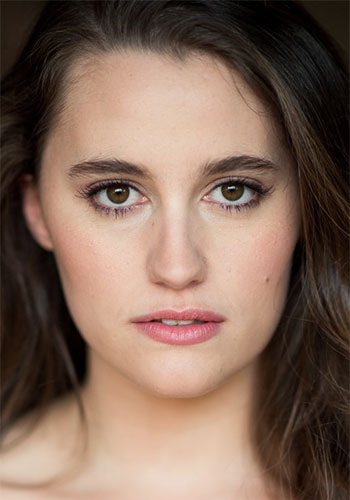
5 Questions with David Jeffrey and Emily McGowan

David Jeffrey


Emily McGowan: What do you and your character Frank (your character in Educating Rita) have in common and what sets you both apart?
David Jeffrey: We’re both mad, I currently have too much hair on my head and I do like going to the pub, though I seldom get to enjoy this pleasure. The obvious difference between us is that Frank loves poetry and I love plays.

Tell us how Frank would spend his day if he could do anything, no expenses spared?
Frank would take Rita by the hand and time travel back to late 18th century London to invite William Blake for a pint at the Lamb & Flag.

I have hired you a private 3 hat Michelin chef for the night, what do you ask them to make you and why?
Love my classics. Shrimp Cocktail, Duck a l’Orange, followed by Baked Alaska.

What is one of the greatest challenges you have found working on Educating Rita?
Knowing what scene is coming next. Sounds simple but not in this play.

If you were an animal what would you be?
A Blue Dragon.

Emily McGowan

David Jeffrey: What do you like the most and the least about your character Rita in Educating Rita?
Emily McGowan: What I like the most about Rita is her heart. She is passionate about justice – she loves people! I love that she isn’t crippled or trapped by her inequities, but rather, she is a go-getter and takes every opportunity. Something I don’t like about Rita is that she can sometimes be a bit clueless, I often feel like saying “Come on girl! Screw your head on.” But really she is hard not to love.

If you could live and work anywhere in the world, where would it be and why?
This is a hard one as I have two bucket list places (in which I have never been to). It would be either Paris or New York. Both places seem to steam with possibility and culture – quite different ends of the spectrum, and they both embrace art so much. Paris might win though as I am addicted to croissants.

How do the challenges Rita faces to become ‘educated’ compare to your own life challenges to date?
I think Rita gets put in a box by many of the people around her – they label her as simple and at times stupid. Frank however believes in her and unlocks those boxes, showing her that if she puts her mind to it she can be educated. I had a teacher in high school, who very similarly believed in me and empowered me to case my dreams

You produce your own work as well as act. How does that work for you?
It’s great! Honestly, you can’t just sit around and wait for other people to hand you opportunities on a silver platter. I think being able to create a piece and bring people together really empowers me – more people should try. My big thing is don’t micro manage. I have my skill sets, you have yours. I’m not going to tell you how to do a job I know nothing about. But that is why I love making theatre so much, collaborating as a creative team is such a rewarding experience.

You’ve just been told you will become deaf and blind in 24 hours time. What do you do?
That’d be a nightmare! Spend all that time with my family, locking into the memory bank what they look and sound like.

David Jeffrey and Emily McGowan are appearing in Educating Rita by Willy Russell.
Dates: 10 – 20 May, 2017
Venue: The Depot Theatre

Review: Motherlode (The Hub Studio / Rue De La Rocket)

Venue: Actors Centre Australia (Leichhardt NSW), May 4 – 13, 2017
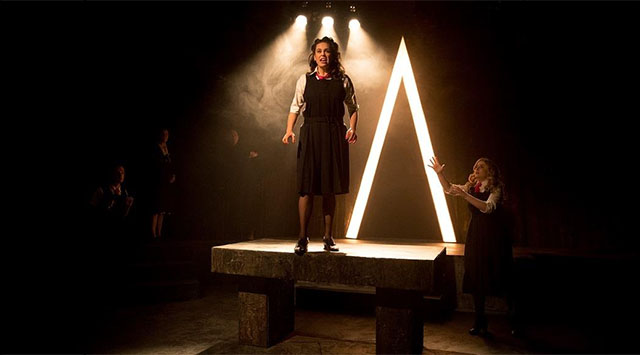
Director: Dean Carey
Cast: Jo Briant, Mel Dodge, Karli Evans, Lana Kershaw, Monette Lee, Jan Oxenbould, Natalie Rees

Theatre review
The journey begins from an unremarkable place. Seven women of Caucasian appearance sit in a row, talking about their children. The play is verbatim, with a script collated from interviews about the topic of motherhood, a life experience that many share, but little of which remains surprising. When humans bond, we can only embark with conversations that are pedestrian in nature, and then destiny decides if things can get deeper.

Halfway through Motherlode, the discussions become powerful, disarmingly so. The women begin to reveal the darkest of their lives, in order to get to the crux of how they manage their relationships with children. We can only love the way we had been shown, so much of the talk is about these women’s own parents, and one of these stories in particular, is nothing short of harrowing.

Actor Karli Evans’s retelling of a character’s shocking childhood encounters involving unimaginable abuse, is by far the most poignant of the vignettes that make up the play. Evans delivers the monologue with a sense of psychological accuracy, along with thorough emotional authenticity, causing us to not only witness the pain hidden behind some of our everyday facades, but also to understand the depth of meaning that having children could mean.

Similarly memorable is Monette Lee in the role of a bubbly, spirited immigrant of Russian origin, who offers balance to narratives that tend to depict Australia as being singularly bourgeois. Lana Kershaw’s portrayal of a lesbian-identifying sex worker and PhD candidate, who had chosen to be a single parent, adds immeasurable texture to an otherwise narrow image of motherhood. Both Lee and Kershaw use the outsider qualities of their parts to excellent effect, equally impressive with the exuberance they each bring to the stage.

The production concludes with a strong message of solidarity, but we think of the other mothers who are not represented on this stage. To understand our families, is to understand our cultures. It is not entirely clear if women of colour are among Motherlode‘s interviewees, but the increasingly diverse face of Australia requires that we broaden our conceptions about values and traditions. In anthropological investigations of motherhood, it is important to understand that we come from a range of backgrounds as varied as our skin colour. As we discover what it is to be an Australian mother, it is crucial to explore how our Indigenous women relate to the subject. If we are unable to cherish the past of this land, and if we continue to ignore the changing complexion of our evolution, we will never be able to completely know who we are.

www.thehubstudio.com.au | www.ruedelarocket.com

Response from show producer:
Thank you for seeing the show. And thank you for your comment about the casting – this is such an important issue and one we would like to briefly comment on. The production had culturally diverse collaborators on the project during its development process, but unfortunately due to last minute scheduling conflicts to do with family and work opportunities, a couple of cast members could unfortunately not proceed with the show. As we were unable to recast appropriately to tell the stories authentically, we decided to focus on this phase as a development stage of the project with a limited cast. We are really excited for the next phase where we will be actively increasing the culturally diverse stories told and broadening the conversation around motherhood.

Review: The Chapel Perilous (New Theatre)

Venue: New Theatre (Newtown NSW), Apr 25 – May 27, 2017
Playwright: Dorothy Hewett
Director: Carissa Licciardello
Cast: Courtney Bell, Alison Chambers, Julia Christensen, Meg Clarke, Jasper Garner-Gore, Brett Heath, Madelaine Osborn, Tom Matthews, James Wright
Image © Bob Seary

Theatre review
Defiant by nature, Sally faces a real challenge, having to live in the conservative times of 1930s Australia. In Dorothy Hewett’s The Chapel Perilous, we observe a young woman trying to be her own person, not hurting a soul in the process, but who constantly suffers injustice and oppression from a society that demands her gendered subjugation. Sally is a symbol of feminism, although she seems to be unfamiliar with the concept herself, unable to comprehend the futility of her insatiable need to make herself an object of desire to men who offer her little. She is not a hero, but she is like many of us, when we find ourselves motivated by pure desire, unafraid to want.

It is a dynamic production that Carissa Licciardello directs, with adventurous and vivid interpretations of scenes coinciding effectively with clever use of space. It is noteworthy that Kyle Jonsson’s set and Martin Kinnane’s lights are beautifully rendered, for a show that looks remarkably polished. There are moments however, where the politics of the piece becomes muddy, probably due to a conflict in ideologies between personnel and text, and the delivery of meanings end up less poignant than imagined.

Julia Christensen is a very exuberant Sally. The actor is extremely animated with her portrayal of the central role, bringing to the stage a sense of boundless energy, but that continuous vigour can turn alienating. Like the character she plays, Christensen has a hard time endearing herself to everyone in her presence. The charming duo of Alison Chambers and Brett Heath play figures of authority, with excellent nuance and flair. Both give commanding performances in what are admittedly less complex parts, leaving strong impressions in spite of that simplicity.

Sally has no compatriots in her struggle, so the chances of her emerging victorious are close to none. All of society objects to her behaviour, and when a person realises that she is one against the world, hope can only give way to hopelessness. The sadness in The Chapel Perilous however, belongs to the past. What we have today are radically improved circumstances. Feminists now join in a movement that gains momentum everyday, and although we feel the pain of our wronged protagonist (for we have experienced similar transgressions), we know that progress is taking place. Those whose resistance had counted little, are to be mourned, and those who continue to blaze our trails, must be celebrated.

www.newtheatre.org.au

Review: Perhaps, Perhaps… Quizás (The Old 505 Theatre)

Venue: Old 505 Theatre (Newtown NSW), May 2 – 13, 2017
Playwright: Gabriela Munoz
Director: Gabriela Munoz
Cast: Gabriela Munoz
Image by Ricardo Castillo Cuevas

Theatre review
It is so sad when a woman is unable to find a man to marry her. When a man stays single however, the situation is not nearly as dire. In Perhaps, Perhaps… Quizás, Greta spends all her time lamenting her spinsterhood, and goes about creating fantasy weddings to escape her misery. It is a woeful context for a show, but when coming face to face with a sad clown, we discover the unique discipline that conflates depression with comedy, and makes everything work.

In art, we have to be careful about the messages we send, but we must also be authentic with how lived experience is represented. Gabriela Munoz’s work may be highly stylised, but the accuracy at which she presents her character’s feelings, persuades us to connect with the unquestionably real human emotion that is being recreated. For a moment, we put judgement aside and share in her melancholy.

Munoz is a funny lady, and her show is often hilarious. We laugh because we recognise the struggles she face, and also because so much of what she does, makes us feel uneasy. A significant segment involves audience participation, and one lucky viewer gets to be on stage for more than a few minutes to help Greta indulge in her craziest delusions. It is as unnerving as it sounds.

The best of theatre happens when safety nets are removed, and everything comes to life. Munoz’s face might be hiding under chalk white pancake, but she opens herself up to our incontrovertible presence, accepting and encouraging our input into her performance. The vulnerability is moving, and the fragility is beautiful.

The truth is that we are sad about Greta’s sadness, rather than her failure to find a mate. Some of us wish that she gets her man some day, and some of us wish that she finds something else more meaningful on which to expend her energy. Life promises so much, but for most of us, it gives so little. There is always more to want, but to be in love with what we do have, is how the days become a bit sweeter.

www.old505theatre.com

Review: Smurf In Wanderland (National Theatre Of Parramatta / Griffin Theatre Company)

>Venue: SBW Stables Theatre (Kings Cross NSW), May 2 – 13, 2017
Playwright: David Williams
Director: Lee Lewis
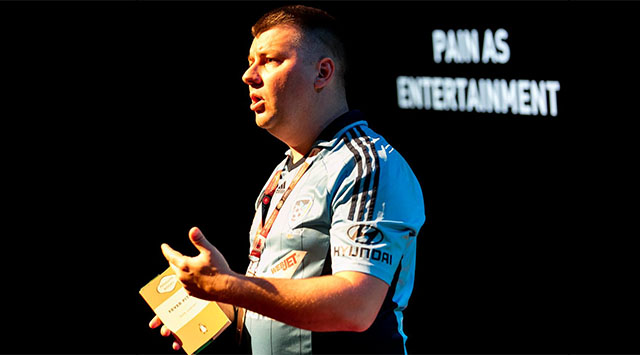
Cast: David Williams
Image by Brett Boardman

Theatre review
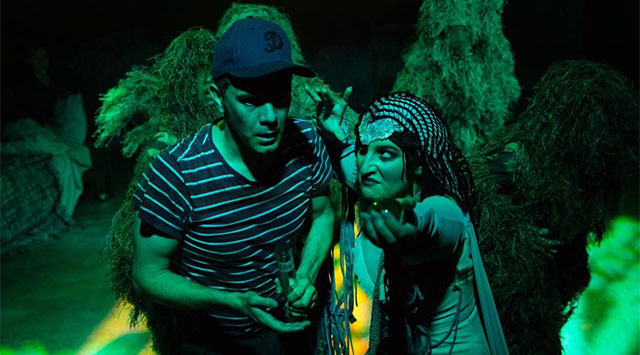
Life means little without passion. David Williams loves football, and he is here to tell us all about it, whether we like it or not. Smurf In Wanderland offers us more than a glimpse into the world of a football tragic, and while it may often be tedious for those of us who are sport-averse, Williams’ more general observations about Sydney life are truly valuable. He talks about modern city tribes, and all the silly things we do to feel belonged. There are attempts at explaining desire, the most potent yet bewildering of human qualities, looking at why we do the things we do, and the bizarreness of us all as a species.

There are moments of poignancy, fleeting yet memorable, including a sequence about the discontentment of those in Western Sydney, and our habitual postcode bias against those perceived to be less metropolitan. We delve into the fundamental masochism involved in rooting for teams when games will always insist on having losers. There is a lot to relish about Smurf In Wanderland, but it all lies beneath the surface. We are given an opportunity to understand our community better, but it is not always an enjoyable process. Sifting through Williams’ obsessive detailing of soccer fandom is fun for some, but exasperating for others. It is a story about us and them, told in a way that makes the ostracism it is concerned about, feel very genuine indeed.

As performer, Williams is charismatic and engaging., with a determination that forbids our attention from straying. His enthusiasm for the Sydney Football Club is a propulsive force that fills the stage with energy, and we must respond with anything but ambivalence. At the end of the piece, there will be individuals who experience fulfilment, and those who will feel worse for wear, but it is likely that all will share a fondness for the personality we had met.

The presentation breaks through the superficial walls we erect between one another. We imagine people to be different, as a way to validate our own existences, but we all exist in undeniable parallels. Our values may be different, but the lenses through which we view the world do not alter the world as it is. If art and sport are in opposition, then Smurf In Wanderland forces us out of our echo chambers and disrupts the silo effect, at least for one night. To love thy neighbour is easier said than done, but few things are as worthwhile an exercise.

www.riversideparramatta.com.au/NTofP | www.griffintheatre.com.au

Review: Big Fish (RPG Productions)

Venue: Hayes Theatre Co (Potts Point NSW), Apr 18 – May 14, 2017

Book: John August (based on the novel by Daniel Wallace and the screenplay by John August)
Music & Lyrics: Andrew Lippa
Director: Tyran Parke
Choreographer: Cameron Mitchell
Cast: Kirby Burgess, Seth Drury, Joel Granger, Brendan Godwin, Zoe Ioannou, Brenden Lovett, Phillip Lowe, Alessandra Merlo, Adam Rennie, Katrina Retallick, Brittanie Shipway, Aaron Tsindos, Zachary Webster
Image by Kate Williams

Theatre review
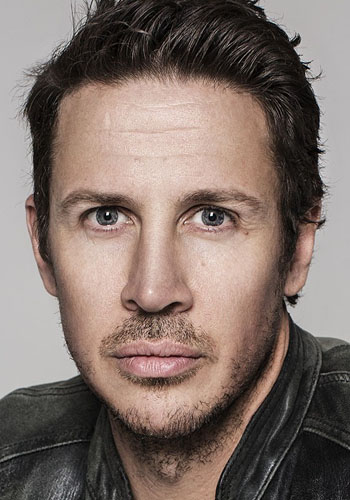
Edward Bloom spins yarns that only he can believe. He deals with reality using outrageous embellishment, but these tall tales have alienated his son Will, who struggles to connect with the man behind the illusions. Big Fish is about life and death, love and family, all the emotional stuff that make musicals work. A formula exists because it is effective, and here, we see all the obvious manipulations that get us to a predictable sentimental peak, yet we cannot help getting ourselves entangled in all of the Bloom family’s drama.

Dubbed the “12 Chairs Version”, this rendition may be streamlined, but director Tyran Parke brings a richness to the staging, with simple but exciting visuals that live up, surprisingly, to the story’s imaginative landscapes. The cast is buoyant and bubbly, determined to entertain. Leading man Phillip Lowe is fabulously charming, but problems with a throat infection seriously impair his ability to deliver the show’s many very grand showtunes. Instead, on hand to offer vocal magic is Adam Rennie in the role of Will, who is nothing less than sensational when the songs get chipper and stirring.

Women characters in Big Fish are often pathetically conceived, but the players do their best to bring life to their parts. Katrina Retallick takes the role of an embarrassingly docile mother, and turns her into a memorable figure; warm, generous and full of spirit. Her delivery of the heartbreaking “I Don’t Need A Roof” is a highlight, with Retallick’s performing talent proving to be the most captivating feature of the production. Also delightful is Brenden Lovett, simultaneously grotesque and adorable as circus ringmaster Calloway. The most over-the-top of Edward’s fantasies is also one of the most moving, when given the Lovett treatment.

We all know that our lives are finite, but we rarely think about how our deaths affect the way we live. We go about our daily business as though there is always tomorrow to worry about, but the unassailable truth is that death will come too soon. Edward was offered, as a child, a glimpse of his final moments, and what he saw was joyful. If we can all believe that what we eventually leave behind is going to be good, then our experience of today, must surely be replete with contentment.

www.bigfishaustralia.com.au

5 Questions with Gabriel Egan and William Jordan

Gabriel Egan

William Jordan: What one book would you go to the ends of the Earth to track down, and why?
Gabriel Egan: Berossus’s Babyloniaca. It’s been lost since the third century BC. I’d require an open cheque book for a thorough investigation, and with little to no hope of recuperation it would be an advantageous way to travel the world.

If you were locked in a room for an entire night, who would you choose to be locked up with?
Donald Trump. I’d like to talk US green cards and a scholarship to study at the Susan Batson Studio in New York. He seems like a reasonable man, maybe we could come to some type of arrangement. I’ve always been lucky with fiery redheads.

Your character, Simon, is a self-professed adventurer; what’s your most memorable adventure?
I slipped into Arq night club once. It was like Narnia’s wardrobe. What a jungle – it took me three days to find the revolving porthole to the outside world…

Simon can’t survive without a cigarette, what’s your worst habit?
Acting. It takes up all my time and pays nothing!

If you were caught with your pants down, would you be wearing briefs or boxers?
Free-balling baby! Everyone’s just hanging loose these days… right..? Or I have always been partial to a leopard print g-string!

William Jordan

Gabriel Egan: What book would be your first choice to throw right out a second story window?
William Jordan: The Oxford English Dictionary! Cause it’s on Google now.

If you were locked in a room for an entire night, what would you need with you to survive until morning?
Coffee and keilbasa. A deadly combination. Also like the book by Harry Houdini to churn the mix.

Your character, Timothy, owns a bookstore – what kind of store would you own?
I would love to own a little second hand book shop like Glee Books. That’s something Timothy and I have in common!

Do you think you’d get along well with a guy like Timothy?
He would definitely be my drop in mate.

If you had to hide a dead body, how would you do it?
Cut it up and put it in a fridge? YUCK!! My vomit trail would give me away… I know, sit it on a toilet and lock the door! People would be too polite to enter.

Gabriel Egan and William Jordan can be seen in Down An Alley Filled With Cats by Warwick Moss.
Dates: 25 Apr – 13 May, 2017
Venue: King Street Theatre