Review: Giving Up The Ghost (Pop Up Theatre)

Venue: Limelight on Oxford (Darlinghurst NSW), Oct 17 – Nov 3, 2018
Playwright: Rivka Hartman
Director: Rivka Hartman
Cast: Elaine Hudson, Chris Orchard, Andrew Wang, Madeleine Withington

Theatre review
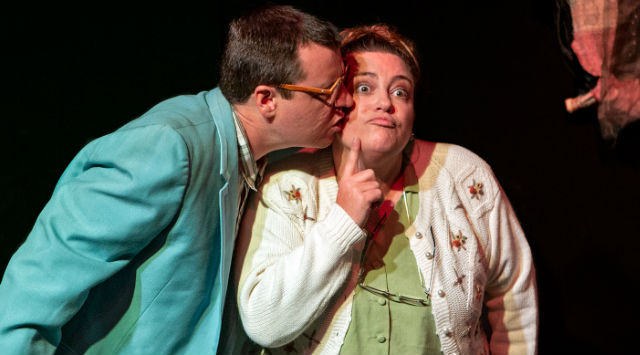
There is a coffin in Lana’s living room, because her husband Ben had just died. Although the corpse lies securely within, Ben’s ghost is up and about, teasing and bantering with his wife, as they might had done for forty years of marriage. They argue over their daughter Gemma, who is considering giving up a valuable career opportunity for her less than ideal boyfriend. Lana tries to offer surreptitious parental guidance, with Ben interfering in the background, whilst everyone frantically gears up for the funeral.

Rivka Hartman’s Giving Up The Ghost is a screwball comedy about the grieving process. Looking at how we deal with loss, the play examines the consequences that we suffer, when a loved one passes on. Perhaps unsurprisingly, it is not the giddy humour, but the serious ideas in Hartman’s show that really engage. Discussions relating to euthanasia are particularly stimulating, and we are left somewhat bewildered that the controversial topic does not occupy a more substantial portion of the plot.

Actor Elaine Hudson’s exuberance as Lana has us charmed. Along with Chris Orchard, who plays the very lively ghost of Ben, both prove to be confident personalities able to hold our attention with little effort. Their performances become palpable when the story turns solemn, allowing for a more naturalistic approach than earlier scenes of quite laboured madcapery. Madeleine Withington demonstrates good capacity for nuance in the role of Gemma, and Andrew Wang plays her depthless boyfriend with a laudable, albeit slightly green, boldness.

Gemma is not a woman completely of her parents’ invention, but it is a pleasure to observe her values reflect those of Lana and Ben’s. The apple doesn’t fall far from the tree, and we delight in the idea that the best of our persons could potentially be bequeathed to future generations. It is true that we are ultimately no more than ash and dust, but all that we do while we walk the earth, whether good or bad, deliberate or accidental, will have reverberations beyond the grave. Only a fool will believe that all of life is within one’s control, but to be careless with the time that we do have, is unconscionable.

www.limelightonoxford.com.au

Review: In Waiting (Blood Moon Theatre)

Venue: Blood Moon Theatre (Potts Point NSW), Oct 11 – 19, 2017
Playwright: Liviu Monsted
Director: Liviu Monsted
Cast: Courtney Adams, Alison Benstead, Alana Birtles, Roslyn Hicks, Nathaniel Hole, Dale Wesely Johnson Green, Steve Maresca, Dean Nash, Katie Regan

Theatre review
In a purgatorial room, the dead wait for their turn to meet Ignus, a psychoanalyst in the esoteric dimension, who provides assistance to move these wandering spirits on to their eternity. It is an appealing allegory that we find in Liviu Monsted’s In Waiting, using the device of psychotherapy to illustrate the need for a certain enlightenment, intellectual and emotional , before life can take on a meaningful course. Monsted sets up an intriguing context, with charming interaction between his ghosts, but substantial portions of the 150-minute production involve two-hander sessions in Ignus’ consultation office, during which the writing often becomes convoluted and self-indulgent.

The work is certainly contemplative, but its dialogue frequently lapses into a dense and obtuse language, that is probably more suited to the form of a short novel than it does the stage. Acting style is uniformly animated, and although rarely authentic, the performers demonstrate a generosity in their prioritising of the text, which helps us decipher the proceedings. Actor Alison Benstead cuts a striking figure as the mysterious Ignus, impressive with the quantity of words she commits so effortlessly to memory. Also showing good commitment is Katie Regan as Estelle, the young woman who has to confront hard memories before she can be released from a state of stagnation.

The waiting room is a necessary space, but some of us can stay too long, in a condition of regret and fear. The future is always in conversation with the past. It might be useful to think that we can close the door on anterior events, but there is nothing we do today, that is not a result of experiences from all the yesterdays. To forget, is only to have it relegated to the subconscious. The characters who do well in In Waiting, are those able to find something that looks like acceptance. Time may not be linear, but no matter how we conceive of its passage, torment is not being able to move with it.

www.bloodmoontheatre.com | www.monsansproductions.com

Review: Evie May (Hayes Theatre)

Venue: Hayes Theatre Co (Potts Point NSW), Oct 12 – Nov 3, 2018
Book & Lyrics: Hugo Chiarella
Music & Lyrics: Naomi Livingston
Director: Kate Champion
Cast: Amanda Harrison, Loren Hunter, Keegan Joyce, Tim Draxl, Jo Turner, Bishanyia Vincent
Images by Nik Damianakis

Theatre review
In Hugo Chiarella and Naomi Livingston’s musical Evie May, a queer woman from early last century takes centre stage, to tell a story of lost loves against a backdrop of bittersweet nostalgia. We watch as our protagonist’s star rises, revelling in her achievements as an illustrious vaudeville performer, but also mournful of the sacrifices demanded of her, in a world that simply would not allow a woman to be her true self. Evie May is a strong work, beautifully imagined and executed with admirable integrity. Its narrative is intelligently constructed, with songs that are memorable yet unusually tasteful.

The show feels somewhat anomalous. In an industry that seems to thrive on relentless exhilaration, the languid melancholy of Evie May is paradoxically refreshing, sustained by a palpable desire to authentically represent a woman genius from our recent past. Director Kate Champion’s approach is elegant, often understated, and although visually underwhelming, her show is ultimately a moving one, profound in the messages it is able to convey. The characters come from a different time, but they all exist to impart something meaningful, and valuable, to how we see ourselves, then and now.

Within a no frills set up, the cast prove themselves more than proficient, at a lot of heavy lifting. The ingenue version of Evie, is played by bona fide triple-threat Loren Hunter, whose powerful acting and mesmerising dulcet tones, has us hopelessly engrossed in her character’s captivating melodrama. Amanda Harrison brings star quality to Evie at her early retirement age, a confident presence, thoroughly reliable as the production’s heart and soul, on which all the action anchors. Love interest June is played by a very delightful Bishanyia Vincent, effervescent as flamboyant showgirl and deeply poignant as the one who got away. Vincent is equally persuasive in the role of Margaret, Evie’s sister, a difficult personality made worthy of compassion by the actor’s detailed rendering.

It is convenient to think that the worst of our oppression as LGBTQ women are over, but Evie May’s story is not just a relic of yesteryear. The compromises we have to make, in order to succeed, or simply to survive, continue to be unreasonable and unjust. It is a modern Australia, but we must not live in the delusion that the straight white man has relinquished his position as top dog. Until our girls can walk into any space they choose, there is still much to fight for.

www.hayestheatre.com.au | www.newmusicalsaustralia.com.au

Review: TickTickBoom (Subtlenuance Theatre)

Venue: The Actors Pulse (Redfern NSW), Oct 10 – 20, 2018
Playwright: Melissa Lee Speyer
Director: Paul Gilchrist
Cast: Rose Marel, Emily McKnight

Theatre review
When the story begins, Jodie is seventeen and finishing up high school, but instead of exams and puppy love, it is her failing health that becomes all-consuming. To have her dug out of doldrums, chirpy schoolmate Clara is sent by parents to be the gallant lifter of spirits. In Melissa Lee Speyer’s TickTickBoom, the heart is the subject, literal and figurative, as we observe two young women navigate life and friendship, with a constant and unassailable reminder that death is always around the corner.

Big existential themes are cogently woven together by Speyer, who presents her observations in a manner that is indelibly tender and benevolent. The production struggles to establish an effective sense of humour, but its heavier sections are certainly sensitively rendered. Director Paul Gilchrist’s earnest approach makes for a warm, contemplative experience, and although chemistry between actors can seem inconsistent, both demonstrate undeniable talent, as they proceed to find authenticity, as well as integrity, for their respective roles. Rose Marel brings a valuable vulnerability to Clara, so that we can have an appreciation of the character beyond her shiny exterior. Emily McKnight is convincing in her performance of Jodie’s recalcitrance, for a portrait of teenage angst that we are all familiar with.

Time means nothing to this earth. It is the vanity of our mortal selves that creates the notion of time, and the notion of life running out. When Jodie is fearful of death, she is paralysed, unable to pay reverence to the ticking seconds that she so anxiously counts. To believe in time, is to imbue it with meaning. Species can come and go, but the world will evolve regardless of our individual fates. For each of our personal domains however, to make this fleeting existence bearable, will require a thing we name spirit, whatever one would like for it to mean.

www.subtlenuance.com

Review: Ear To The Edge Of Time (Sport For Jove Theatre)

Venue: Seymour Centre (Chippendale NSW), Oct 11 – 27, 2018
Playwright: Alana Valentine
Director: Nadia Tass
Cast: Belinda Giblin, Gabrielle Scawthorn, Christopher Stollery, Tim Walter
Images by Kate Williams

Theatre review
Martina is a young astrophysicist, poised on the brink of greatness. When she meets Daniel, a poet assigned to observe and write about her experiences at the culmination of her PhD work, a fissure transpires, revealing the entrenched gender inequity that works against Martina and other women in the field of science. Structural sexism is not an easy phenomenon to dissect, but in Alana Valentine’s Ear To The Edge Of Time, we are presented persuasive evidence of how power is wielded to the exclusion of women, especially at the highest ranks of our authoritative organisations. It is perhaps inevitable that substantial portions of the play would feel alienating for those dulled by science, or for those suffering from political apathy, but there is no denying Valentine’s embracive diligence in her crafting of this purposeful work.

It is a simple staging, directed by Nadia Tass, who puts immense faith in her actors to deliver all. Gabrielle Scawthorn is astonishing with several big passages of science speak, that she launches into with tremendous aplomb. Some depictions of emotional turmoil can seem slightly exaggerated, but she provides admirable clarity in her depiction of Martina’s oscillating mental states, to unveil the intricately shifting strategies required of women in managing our careers. Daniel is played by Tim Walter, impressively precise, and a passionate, dependable presence adept at sustaining energy levels. Supporting roles are manifested with rich vibrancy, by Belinda Giblin and Christopher Stollery, who introduce unexpected complexity to their parts, both engrossing and delightfully entertaining.

Women navigate their careers in different ways, but by virtue of simply being women, we have additional hurdles put before us, all along our trajectory towards the glass ceiling. Ear To The Edge Of Time is by no means unique in its messaging. These issues have in recent times, been discussed repeatedly and quite obsessively. It is undeniable that the problem has now become visible, but the solutions that it asks for, remain elusive, at least in our art. There can only be two ways that this groundhog day will conclude; either our concerted efforts will help us make headway and we progress onto a new consciousness, or feminism will once again fall out of favour. We need only to look at legacies of the three previous waves for answers, and be able to find assurance that change is indeed afoot.

www.sportforjove.com.au

Review: The Feather In The Web (Griffin Theatre Company)

Venue: SBW Stables Theatre (Kings Cross NSW), Oct 5 – Nov 17, 2018
Playwright: Nick Coyle
Director: Ben Winspear
Cast: Tina Bursill, Gareth Davies, Michelle Lim Davidson, Claire Lovering
Images by Brett Boardman

Theatre review
At one point in the show, the protagonist declares that she has MS, but of what we are able to observe, Kimberly exhibits no symptoms of multiple sclerosis. We are nonetheless, tempted to pathologise her, to interpret all her absurd behaviour as evidence of some kind of mental disorder, to label her crazy. Nick Coyle’s The Feather In The Web is a tale of obsessive love, but one that is grounded in little reality. It is doubtful if audiences in general will be able to find points of meaningful connection with the play’s outlandish situations, but its wild imagination is certainly entertaining.

Director Ben Winspear’s creation is highly sophisticated, marvellously polished, and very funny indeed. It is a thoroughly engrossing production, full of mystery and always bursting with energy, featuring dynamic and seamless collaborations from an excellent design team. Sophie Fletcher and Mic Gruchy work wonders for a series of backdrops and projections that are as whimsical as they are functional. Lights by Trent Suidgeest are versatile and unpredictable, able to traverse mundane and surreal with ease, and sound by Steve Toulmini is bold and humorous, powerful in its control over the audience’s emotional responses.

The magnificent Claire Lovering is dazzling as Kimberly, exceptional in her ability to simultaneously deliver uproarious comedy with a grave solemnity. Brilliantly amusing, she sweeps us away to places that are completely nonsensical, but all the while, keeping us keenly aware of the troubling psyche that underlies her character’s strangeness. Lovering’s own vivacity and strength, represents a valuable female presence that offers balance, to moments where the text comes precariously close to misogyny. We are bewildered and upset by Kimberly’s incapacity for agency and self-determination, but are won over by her resolute attitude. Ultimately, we have to let a woman want what she wants.

Three supporting players take on a range of kooky types, with Gareth Davies particularly memorable for his unrelenting propensity for insisting on our laughter; his work is enjoyable no matter the personality he assumes. Michelle Lim Davidson introduces surprising depth in later sections, urging us to shift focus to something considerably more poignant. Tina Bursill’s nonchalant cruelty as Regina is acerbic and accurate, deliciously biting in one of the show’s more believable roles.

The Feather In The Web is often unsettling, because we cannot help but feel disturbed by the abnormality put on display. It is true however, that we have no right to want Kimberly to transform into someone normal and palatable. She is non-compliant and non-conformist, and much to our chagrin, she can think of nothing else but for her affections to be reciprocated. Her heart’s desire may be objectionable, but when we look at the things she has absolutely no interest in; conventionality, respectability, mediocrity, and other markers of social acceptability, Kimberly turns into someone quite remarkable.

www.griffintheatre.com.au

Review: An Enemy Of The People (Belvoir St Theatre)

Venue: Belvoir St Theatre (Surry Hills NSW), Oct 7 – Nov 4, 2018
Playwright: Melissa Reeves (after Henrik Ibsen)
Director: Anne-Louise Sarks
Cast: Peter Carroll, Catherine Davies, Leon Ford, Steve Le Marquand, Kenneth Moraleda, Kate Mulvany, Nikita Waldron, Charles Wu
Images by Brett Boardman

Theatre review
Dr Stockman is wellness consultant at the local spa resort, where business is booming, resulting in great prosperity for the township. When contamination is discovered in the water and patients are developing diseases as a consequence, she proceeds to reveal all in order that harm can be minimised, and that the town can find the right way forward. Her good intentions however, are met with opposition by men in power, who are motivated only by self-interest, refusing to let emerge, the truth that will cost them severely. In Melissa Reeves’ version of Henrik Ibsen’s An Enemy Of The People, there is the added dimension of Dr Stockman’s gender, that fuels the actions of these deplorable men.

This revision of the 1882 classic arrives at a time of heightened consciousness, in matters relating to the deep-rooted, long-established and systematic deprivation of power as experienced by women everywhere. There is no explicit naming of misogyny in Reeves’ reinvention, but director Anne-Louise Sarks makes it abundantly clear, that what we are talking about here is not only Ibsen’s concerns over democracy and corruption, but also the currently pertinent topic, on the pervasive abuse of women, in this undeniably and resolutely patriarchal world. The show suffers a slow start, with tentative humour and uncomfortable chemistry between personalities, but things escalate for a spectacular second half, enthralling and powerful in its exposition of political ills and challenges that we face as a community.

The addition of a scene involving Stockman’s cleaning lady, Randine chastising the middle classes, along with the theatre-going bourgeoisie, expands our understanding of the body politic. In efforts to make our nations great again, it seems we inevitably become embroiled in discussions that turn increasingly petty in their scope; as we drill down deeper and get closer to the bone of what we think our problems are, we habitually turn exclusionary, always putting ourselves first and forgetting the rest. Intersectionality is not yet the custom, and in Reeves’ An Enemy Of The People, we watch it explained with agonising clarity.

Actor Kate Mulvany is strong as Dr Stockman, particularly persuasive when the role gets emotionally intense. There is an infallible sense of confidence in Mulvany that allows her audience to engage deeply in the arguments being made, and we find our philosophical and ideological selves gratifyingly enriched by the experience. The aforementioned Randine is played by Catherine Davies, who impresses with exquisite nuance and a robust presence. Also memorable is Kenneth Moraleda as the obnoxious Aslaksen, delightfully comical in his animated depiction of a crooked, repugnant undesirable.

2018 could be remembered for the unprecedented number of elected women officials quitting Australian politics, with names like Julia Banks, Emma Husar and Ann Sudmalis making the news, telling stories about bullying and intimidation taking place in quarters where we should be demanding the highest of integrity. The numbers reveal, plain and simple, that women are being deliberately shut out from positions of power, but myths around notions of biology and meritocracy have formed narratives that prevent us from carrying out justice, whether or not we are personally invested. Dr Stockman says she will fight to the bitter end, but our reality demonstrates that her solitary perseverance is no match for the glass ceiling.

www.belvoir.com.au

Review: What The Butler Saw (New Theatre)

Venue: New Theatre (Newtown NSW), Oct 2 – Nov 3, 2018
Playwright: Joe Orton
Director: Danielle Maas
Cast: Madeleine Carr, Jake Fryer-Hornsby, Andrew Guy, Martin Quinn, Ariadne Sgouros, Amrik Tumber
Images by Bob Seary

Theatre review
The play is set inside a psychiatrist’s clinic, with four doors facilitating the all too familiar frenzied parading of manic personalities, in this rowdy old-fashioned English farce. Joe Orton’s What The Butler Saw first appeared 1969 in London’s West End, presumably conceived to take the mickey out of fuddy duddy types, by placing mildly scandalising dialogue and activity at its centre, for what could now be thought of as a sort of relic of the swinging sixties. It involves experts and authorities being ridiculed, which is always a pertinent and gratifying function of the theatre, but a substantial reinvention of the hackneyed sex comedy genre would be required, if Orton’s work is to remain truly effective.

It is a handsome production, designed by Tobias Manderson-Galvin with lighting by Martin Kinnane, but director Danielle Maas’ efforts for something delirious and avidly hectic, often disintegrates into little more than a confusing wreck. It is however noteworthy that the show does deliver improved coherence in Act II, for those who are able to persist and return to the action post-intermission. There is no shortage of conviction from its cast (actor Amrik Tumber’s capacity for memorising some very long bizarre speeches is impressive), but their comedy feels forced, and attempts to outrage never reach anywhere far enough to provoke meaningful response.

Although muted and peculiarly tentative, semblances of an anarchic spirit can be detected in the show. Art practices are valuable when they find ways to shake us out of our mundane stupor, offering a wake up call to all that we forget to question. It can provide answers, or it can simply help us begin to examine things that are hitherto undisputed or axiomatic. What The Butler Saw wants to lift the lid on subjects like the medical establishment, law enforcement, gender constructs, traditional marriage, and (gasp), incest; all of which are worthy of exploration no doubt, but it seems that our apathy can be quite a formidable encumbrance to be coming up against.

www.newtheatre.org.au

Review: Lie With Me (The Old 505 Theatre)

Venue: Old 505 Theatre (Newtown NSW), Oct 2 – 13, 2018
Playwright: Liz Hobart
Director: Warwick Doddrell
Cast: Lyn Pierse, Nathalie Murray, Julia Robertson
Images by David Hooley

Theatre review
There are monsters walking amongst us, murderers, rapists and cannibals, who look just like everybody else, made of the same flesh and blood. Sebastian is one such monster, responsible for 17 gruesome deaths. His mother is Janice, and in Liz Hobart’s Lie With Me, we explore the impossibly difficult notion of having to come to terms, with being the woman who had birthed such an abomination into the world. Whether nature or nurture, the connections we draw between mother and son, make it an intolerable existence for Janice to have to bear.

Fractured and achronological, scenes in Lie With Me are presented like randomised shreds of memories, challenging us to make coherence out of unimaginable inhumanity. Dark, passionate and urgent, Hobart’s writing makes for engrossing, fascinating theatre. Directed by Warwick Doddrell, the staging can at times be excessively elaborate, but it proves to be an ultimately rich and rewarding experience. Lights by Sophie Pekbilimli are creative and lively, effective in giving unexpected dimension to the space. Sound is delicately managed by Ben Hinchley, who deftly maintains intensity throughout.

Sebastian the monster is conspicuously, but thankfully, missing in action. Janice is played by Lyn Pierse, strong and compelling with all that she offers. Her sophisticated approach ensures that the show never descends into exploitative territory. The very charming Julia Robertson is delightful in her playful array of roles, particularly biting as Sebastian’s father Len. Nathalie Murray provides solid support, a disciplined and nuanced performer proving herself to be inexorably reliable.

Lie With Me is about motherhood, and the many roles women have to play, that deprive us of our sovereignty. Janice tries to be her own person, but having devoted her life to being little more than mother and wife, she struggles to find self-worth when forsaken by both son and husband. It is anybody’s guess if she would again choose motherhood if the reversal of time were possible, but one would hope that the lessons she has learned would lead to a reclamation of power and independence. For those of us with time on our side, the play is a reminder of how we should define existence, and the bigger things we are capable of.

www.bnwtheatre.com.au

Review: Maggie Stone (Darlinghurst Theatre Company)

Venue: Eternity Playhouse (Darlinghurst NSW), Sep 30 – Oct 21, 2018
Playwright: Caleb Lewis
Director: Sandra Eldridge
Cast: Kate Bookallil, Branden Christine, Alan Dukes, Anna Lee, Thuso Lekwape, Eliza Logan
Images by Robert Catto

Theatre review
Maggie is a racist. We know this not only because we see her make racial insults about black people to their faces, but she also admits to not approving loans at the bank where she works, when encountering applicants who are of African descent. Maggie does not feel bad or embarrassed about her behaviour, and part of the pleasure of Caleb Lewis’ Maggie Stone, is to see white Australians being upfront about their racism. The main focus of the play however, is Maggie’s accidental embroilment in Amath’s life, after begrudgingly approving the latter’s loan application. Amath is a recent migrant from Sudan, struggling to make ends meet after the sudden death of her husband. When Maggie begins to see Amath as a real person deserving of compassion, the story turns into one of redemption and reconciliation.

It is hard not to see Maggie Stone as a play suffering tediously from white saviour complex, when a substantial portion of it features the unlikely heroine running around kicking down doors to help fix a black family’s problems, but its central message about white people having to transcend racial ignorance is never out of fashion. The themes are undoubtedly pertinent, but the mediocrity of its perspectives makes the show a predictable one. Everything about it feels derivative, and for a subject matter that is so much a part of our daily consciousness, its inability to proffer fresh or more sophisticated ideas, is disappointing.

The production is adequately assembled, and Sandra Eldridge’s direction, although lacking in innovation, keeps the action moving along swiftly. As Maggie, actor Eliza Logan is a very endearing presence, able to prevent us feeling too alienated by her character’s unforgivable qualities. Branden Christine brings conviction and integrity to her interpretation of Amath, a less than meaty role that has a tendency to feel perfunctorily, or maybe too cautiously, written.

Amath’s story is likely a better one to tell than Maggie’s, but Australian writers who can speak appropriately to that experience, are perhaps still in the process of being nurtured and discovered. When talking about race, it is not often that a white person can present something new to help make meaningful progress. Abolitionists of racism do not all have to be people of colour, but this is a job that cannot be done with black and brown people on the outside. It is a crucial point that none of the white characters in Maggie Stone prove themselves able to satisfactorily acquiesce space, in symbolic or practical ways, in this discussion about racial relations on this colonised land. There is an obvious desire for a clear conscience, but the hard work required of all of us, is not yet invested.

www.darlinghursttheatre.com