Review: Company (Limelight On Oxford)

Venue: Limelight on Oxford (Darlinghurst NSW), Nov 14 – Dec 1, 2018
Book: George Furth
Music & Lyrics: Stephen Sondheim
Director: Julie Baz
Cast: Heather Campbell, Maree Cole, Grace Driscoll, Emily Dreyer, Lincoln Elliott, Jacqui Greenfield, Michele Lansdown, Michael McPhee, Alexander Morgan, Bridget Patterson, Brendan Paul, Ileana Pipitone, Marcus Rivera, Richard Woodhouse
Images by Clare Hawley

Theatre review
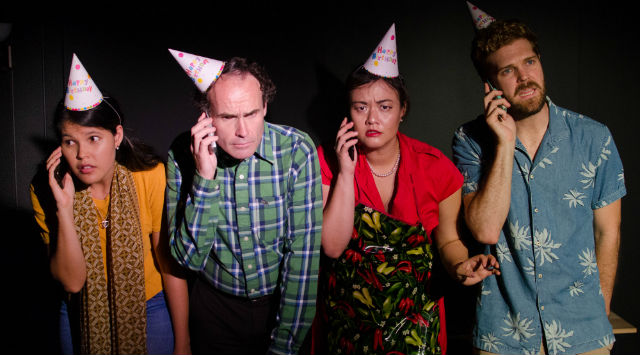
Bobby is celebrating his thirty-fifth birthday, with friends who all appear to be married couples, unable to resist badgering him into finding a wife of his own. Stephen Sondheim’s Company is approaching half a century old, and although its conceit seems archaic, we know that the experience it depicts remains resolutely accurate. People are often unwilling to accept single life as a valid and healthy option, and even though the musical does not portray marriage to be comprehensively wonderful, its insistence that Bobby comes to an acquiescence, in spite of his quite fabulous New York City bachelor existence, is representative of our narrow definitions of identity.

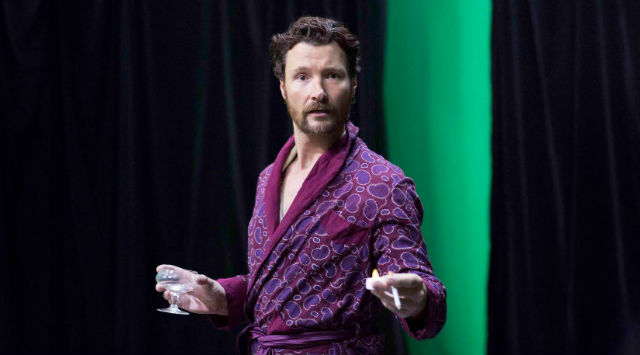
George Furth’s book for the 1970 creation might bear an exasperating plot that does not stand the test of time, but Sondheim’s songs continue to be sublime. Directed by Julie Baz, the production is entertaining and spirited, on a very busy stage that although not always visually appealing, is consistently ebullient, with an ensemble cast full of beans. Leading man Brendan Paul does an adequate job of his singing, but it is his radiant high-wattage smile that really charms. Heather Campbell is deeply impressive as Amy, delivering a rendition of the notoriously difficult “Getting Married Today” at an exceptional standard. Another memorable tune, “The Ladies Who Lunch” is performed by the commanding Michele Lansdown, whose interpretation of the socialite lush Joanne, is a delightful contrast to a lot of the squeaky clean goings on. Also noteworthy are the jubilant musicians that make up a sensational six-piece band, led by Antonio Fernandez whose music direction brings us a great deal of class, through his faithful interpretation of a now nostalgic score.

When Bobby finally admits to his loneliness, we question the veracity of his proclamations, wondering if it is a case of peer pressure leading our protagonist, to invent feelings that are not entirely authentic. Sondheim came out as gay in 1998, at the age of 68. Company is essentially a work he had written about the confirmed bachelor, at a time when his sexuality was in the closet, in which the protagonist’s friends are confounded by his refusal to settle with a woman. The incessant nagging leads to Bobby eventual relenting, not by actually marrying a woman, but by performing a ruse of regret and embarrassment, that many gay people have had to carry out, as a strategy in dealing with the heteronormativity that they inevitably have to contend with. Like many LGBTQ people, Bobby probably feels no need to satisfy those traditional expectations, but a big song and dance is always useful in getting them off our backs.

www.limelightonoxford.com.au

Review: Love (Darlinghurst Theatre Company)

Venue: Eternity Playhouse (Darlinghurst NSW), Nov 17 – Dec 9, 2018
Playwright: Patricia Cornelius
Director: Rachel Chant
Cast: Rose Riley, Anna Samson, Hoa Xuande
Images by Robert Catto

Theatre review
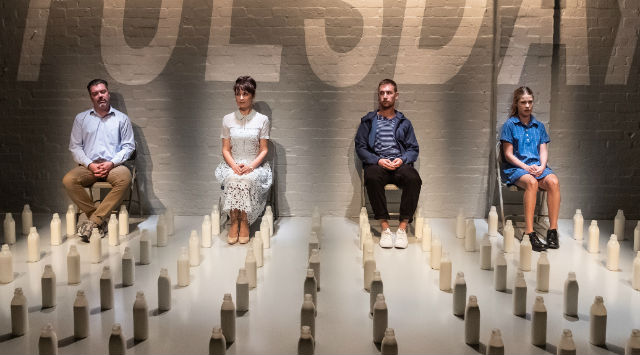
In a polyamorous relationship and loved by two, Annie can sometimes feel like the happiest girl in the world. Often, however, things can get very rough for this nineteen year-old. Both her lovers are addicts, and money from Annie’s sex work seems to go only toward their drug habits. Patricia Cornelius’ Love is a portrait of broken lives failing to find salvation from romantic union. It dispels the myth that love will save the day, revealing instead the way we bring our damage into relationships, more likely to tarnish the other, than to attain a miraculous harmony that we all crave.

We watch as flaws of the three compound, each person bringing increasing misery to the others, with Annie’s suffering especially severe as a result of this toxic merger of lost souls. Magnificent direction by Rachel Chant turns this desolate tale into incredibly compelling theatre; even if the personalities feel far removed from our middle class realities, Chant’s exhilarating rigour from beginning to end, insists on our engagement. Design elements are cleverly imagined, by the wonderfully concordant trio of Ella Butler (set), Nate Edmondson (sound) and Sian James-Holland (lights), for a production rich and sophisticated in its impact.

Actor Rose Riley is sensational as Annie, bold and very powerful in her depiction of premature womanhood. No longer naive but still heartbreakingly innocent, Riley’s ability to convey dignity for a character suffering piteous circumstances, is remarkable. The morally confused Tanya is given palpable complexity by Anna Samson, who convinces us quite astonishingly, of a destructive nature that seems unaware of its own capacity for evil. Lorenzo is a user with no real redeeming features, a simpler role performed with brilliant exuberance, and made thoroughly entertaining, by Hoa Xuande. Timing and chemistry between all performers, whether as a “throuple” or in assorted pairs, are marvellously harnessed for a relentlessly provocative show.

There is no right way to be in love, no matter what religions or other experts might say. We watch Annie, Tanya and Lorenzo go about their painful business, wondering if they had been better off separate, but we arrive at no conclusive answer. As the saying goes, “hurt people hurt people,” and when we think nothing good can come out of dysfunctional partnerships, we have to remember that loneliness is by definition unbearable, and most of us will enter into arrangements against better judgement, for no other reason than that we are human. The mind is rarely a match for the heart, or to coin another cliché “the heart wants what the heart wants”. Romance will make us suffer its consequences, but to deprive oneself of it, is no less tormenting.

www.darlinghursttheatre.com

Review: The Serpent’s Teeth (Kings Cross Theatre)

Venue: Kings Cross Theatre (Kings Cross NSW), Nov 9 – 24, 2018
Playwright: Daniel Keene
Director: Kristine Landon-Smith
Cast: Danny Ball, Bernadette Fam, Phoebe Grainer, Nicholas Hasemann, Lisa Huyhn, Badaidilaga Maftuh-Flynn, Steven Menteith, Jillian Nguyen, Angela Sullen, Jens Radda, Joseph Raggatt, Saleh Saqqaf, Chloe Schwank, Louis Segeuir, Ross Sharp
Images by Clare Hawley

Theatre review
The two very distinct halves of Daniel Keene’s The Serpent’s Teeth, contrast the repercussions of war and violence, as characterised by their distance from actual conflict. The play begins close to the action, and later takes us away from the borders, for a sensitive examination of human responses to trauma. Appropriately fractured, the writing bears an inherent chaos that understands our impulse to create cohesion out of disorder. We form narratives out of the rubble, to see both the familiar and the unfamiliar, although it is arguable if much of it proves to be satisfying.

In a small space that effectively magnifies creative intentions, the large cast of fifteen endeavour to represent the complexities and diversity of war-time experiences, by conveying nuanced portrayals usually absent from mainstream reportage of disaster and strife. Director Kristine Landon-Smith elicits contemplative performances from her actors, for a show though not always engaging, is dignified in its determination to maintain a restrained, rather than sensationalist, approach. Rare dramatic outbursts therefore become memorable, with Phoebe Grainer and Jillian Nguyen particularly strong in their theatrical moments, offering us a taste of something slightly indulgent, and therefore emotionally accessible.

All the people in The Serpent’s Teeth are acutely affected by wars taking place, whether in their own backyards or in foreign lands. The rest of us, although implicated in our nation’s battles, are often ignorant of those operations. It is this very ignorance that allows atrocities to be carried out on our behalf; we are culpable but are either blissfully unaware, or simply intimidated and turned helpless in the face of its enormity. Stories about war are careful to avoid its glorification, so the message is always unambiguous and predictable, yet our shared acknowledgement about these ravages, seem to do nothing to make this world a better place.

www.hbrcreatives.com.au

Review: Eurydice (Mad March Hare Theatre Company)

Venue: Old Fitzroy Theatre (Woolloomooloo NSW), Nov 14 – Dec 15, 2018
Playwright: Sarah Ruhl
Director: Claudia Barrie
Cast: Alex Malone, Jamie Oxenbould, Nicholas Papademetriou, Ariadne Sgouros, Ebony Vagulans, Lincoln Vickery, Megan Wilding
Images by Marnya Rothe

Theatre review
In the afterlife, Eurydice is reunited first with her dead father, before briefly seeing her husband Orpheus come to rescue her. Having crossed over from one realm to another, things can no longer be the same, and in Sarah Ruhl’s version of Eurydice, we observe human consciousness undergo celestial transformations when the body fails, in a fantastical speculation of how it might be.

Mournful but awash with beauty, the play is deeply romantic, as it vacillates between optimism and hopelessness, for a theatrical experience that fills us with a sensation of melancholic longing. Claudia Barrie’s direction take us on a rocky ride, through sequences that vary in levels of efficacy. Although not always sufficiently compelling, Barrie’s work is consistently delicate, with ethereal atmospherics removing us temporarily from the unrefined tedium of our daily existences. Set design by Isabel Hudson provides the humble auditorium with a transfigured grandeur, along with the marvellous scent of fresh cut wood that dominates the space. Benjamin Brockman’s lights are relied upon for a lot of the heavy lifting. His meticulous imagination is determined to place us in one dream state after another, resulting in an impressive delivery of arresting imagery for every scene. Sounds by Ben Pierpoint are the soul of the event, precise in its calibrations of mood and impact.

Ebony Vagulans takes on the eponymous role with palpable conviction, slightly lacking in complexity with her renderings, but an endearing presence nonetheless. The three Stones, mystical ghost-like creatures, are played by Alex Malone, Ariadne Sgouros and Megan Wilding, who introduce a splendid sense of mischief to proceedings, refreshing at every appearance. Jamie Oxenbould and Lincoln Vickery play father and husband respectively, both actors finding moments of pathos that reveal the emotional investment we hold, perhaps surprisingly, for the story. A campy Nicholas Papademetriou offers valuable comedic balance to a show that can get very gloomy.

Nobody knows what the hereafter is, but our conjectures about it are crucial to the way we are. It is that sense of eternity that concerns us. Even the slightest chance of having to exist in an unrelenting permanency for all of tomorrow, is enough to terrify, so we occupy ourselves with fabrications of what could be, using instinct, desire and fear, to concoct visions that help provide semblances of assurance. There is a need to satisfy questions about the self, and about loved ones we have lost. Anxiety is a sensation that requires release, and grief is an emotion that must be eradicated. When we worry, and when we mourn, our capacity to see meaning in darkness becomes paramount.

www.madmarchtheatreco.com

Review: The Overcoat (Belvoir St Theatre)

Venue: Belvoir St Theatre (Surry Hills NSW), Nov 15 – Dec 1, 2018
Book & Lyrics: Michael Costi (based on the short story by Nikolai Gogol)
Music: Rosemarie Costi
Director: Constantine Costi
Cast: Laura Bunting, Kate Cheel, Aaron Tsindos, Charles Wu
Images by Clare Hawley

Theatre review
Nikolai is an unremarkable man, an ordinary citizen of Russia, who lives and works in St Petersburg, not unlike the faceless millions in any of the world’s cities. He is unambitious, able to be content with a simple life, but the most basic of human requirements, dignity, eludes him. He is sold a luxurious coat, one he is unable to afford, with the promise that the new garment would finally help him gain the respect of people he sees every day at work. Based on Nikolai Gogol’s short novel of the same name, The Overcoat is about injustice, and the sacrifices some have to make, just to attain a level of subsistence.

Adapted by Michael Costi, whose book and lyrics retain the poignancy of the original, this musical version is an understated but thoroughly moving work of theatre. Rosemarie Costi’s music is consistently gripping, and delightfully idiosyncratic, incorporating shades of Kurt Weill and Stephen Sondheim to find exquisite balance in this sophisticated take on the genre. Director Constantine Costi exhibits great style, alongside a sensitive understanding of drama, for a production that lulls us gently to some very deep places in our hearts and minds.

Performer Charles Wu is an enchanting presence, vulnerable yet confident as Nikolai. Not only does he earn our empathy for the pitiful character, Wu elevates our experience of the sad story with his capacity to inspire our intellect. Aaron Tsindos’ booming voice thrills and satisfies, as do his extravagant depictions of several unforgettable supporting roles. Laura Bunting and Kate Cheel create a range of ebullient personalities, both actors proving themselves to be as commanding as they are charming.

Our protagonist procures his coat, with money that should have gone to food and rent. Before society can provide him with a feeling of belonging, Nikolai must give up more than all he has; we come to the cruel realisation that the real world does not offer unconditional love. When we participate in the labour force, we go to work for survival and for salvation, but there is never any guarantee that the exchange can be a fair one. In fact, we see in The Overcoat, that when the marketplace is left to its own devices, many of us are put in positions where we have to give more than we can ever receive in return. The unfairness is ubiquitous, and without intervention, disparities can only widen.

www.belvoir.com.au

Review: The Wild Party (Seymour Centre)

Venue: Seymour Centre (Chippendale NSW), Nov 15 – 24, 2018
Book: Michael J. Lachiusa, George C. Wolfe
Music & Lyrics: Michael J. Lachiusa
Director: Alexander Andrews
Cast: Michael Boulus, Jack Dawson, Nick Errol, Emily Hart, Prudence Holloway, Matthew Hyde, Tayla Jarrett, Katelin Koprivec, Victoria Luxton, Matilda Moran, Rosalie Neumair, Sophie Perkins, Olivier Rahmé, Zach Selmes, Samuel Skuthorp, Georgina Walker, Simon Ward, Jordan Warren, Madeleine Wighton, Victoria Zerbst
Images by Clare Hawley

Theatre review
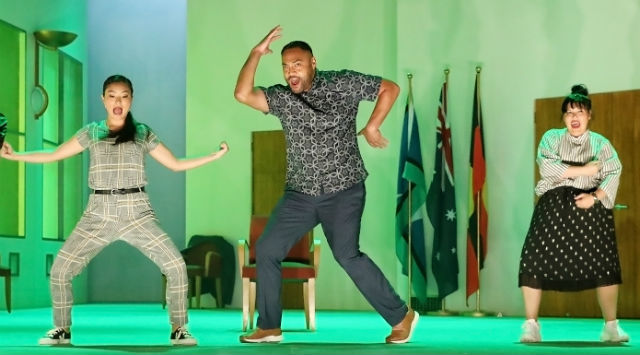
It is New York City in the 1920s, and the party is lit. Bohemian types gather at the behest of volatile lovers Queenie and Burrs; not a single introvert in sight, all thirsty for a good time, ready to make the drama happen. Michael J. Lachiusa and George C. Wolfe’s 2000 musical The Wild Party is a rollicking ride with colourful characters taking us through a succession of exuberant numbers, celebrating life in the most exciting of cities.

Under Alexander Andrews’ direction, The Wild Party is a dazzling, fun-filled romp. Even though its narrative becomes somewhat vague, the production’s relentless vibrancy keeps us engaged and uplifted. Music direction by Conrad Hamill is lush and decadent, a wonderfully evocative element. Outstanding choreography by Madison Lee brings unexpected sophistication. Imaginative and adventurous, Lee’s work is thoroughly compelling, and along with dance captain Sophie Perkins’ efforts, it is the way bodies move through every second in this staging, that proves truly splendid. A group of 5 chorines, Victoria Luxton, Matilda Moran, Rosalie Neumair, Jordan Warren and the aforementioned Perkins, are the stars, brilliant with their spirit and charm, extraordinarily cohesive with all that they present.

Georgina Walker plays a very alluring Queenie, with an attitude and physical gestures that are flawlessly reminiscent of that bygone era. Sound engineering is often deficient, and Walker’s voice suffers as a result, but the intricacy of her performance is no less impressive. Prudence Holloway and Victoria Zerbst take on flamboyant roles with extravagant aplomb, both actors fierce and fabulous.

Parties are worth little when participants are unable to let their hair down, but as we see in The Wild Party, things can go too far. Art however, plays by different rules, and social transgressions are often an important part of how it can create impact. Considering the context, this staging is perhaps slightly polite, so it is never really able to provide much more than entertainment. To be wild, is to explore boundaries and question the rules. Little Miss Goody Two-Shoes may well be liked by everyone, but she is unlikely to have left an indelible mark anywhere.

www.littletriangle.com.au

Review: Blame Traffic (The Old 505 Theatre)

Venue: Old 505 Theatre (Newtown NSW), Nov 13 – 24, 2018
Playwright: Michael Andrew Collins
Director: Michael Andrew Collins
Cast: Violette Ayad, Nic English, Emma O’Sullivan, Mary Soudi, Alex Stylianou
Theatre review
Insurance investigator Lilian’s frustrating encounters with a blue Mercedes, over several days on the streets of Sydney, has stoked her occupational resolve. She finds herself secretly trailing the mystery man, trying to formulate an explanation for the latter’s shockingly poor driving etiquette. Blame Traffic by Michael Andrew Collins features a series of fractured scenes that gradually merge into an integrated, and satisfying, narrative. Collins’ playful dialogue ensures that each sequence is full of amusement, and the intrigue that he constructs, is a consistent pleasure, and the play’s strongest quality.

In lieu of realistic settings for many of Blame Traffic‘s on-road scenarios, the production takes a minimal but effective approach, with chairs and three sliding monitors, to convey its oscillating range of times and spaces. Designer Patrick James Howe keeps things slick and restrained, for unobtrusive solutions that provide surprising impact. Collins’ direction of the piece is taut, with an air of urgency that has us absorbed for its entire hour.

An energetic and rigorous ensemble takes us through the fast-paced action. Emma O’Sullivan shines in both her roles; she turns a very strange Jacquie convincing, whilst endearing us with her quirky characteristics, and as Dion, the actor’s interpretation of a young Italian-Australian is simply hilarious. Dion’s uncle Zio is played by Nic English, whose honest impulses make him a riveting presence. Violette Ayad and Alex Stylianou provide the fireworks with their partnership, in a segment memorable for its scintillating chemistry, both performers taking the opportunity to demonstrate their impressive skill and natural talent. Also wonderful is Mary Soudi who brings a thoughtful complexity to her part of Sarah.

Although not particularly provocative, Blame Traffic is an entertaining work of theatre, that uses the bane of our city’s daily existence as catalyst for its storytelling. We see people interspersed but connected, each heading in their own obstinate directions, occasionally stopping to think of others. Individualism and independence are highly valued in our metropolis; we believe in the freedom that allows people to live to their full personal potentials, regardless of tradition and conventions. It is also clear that Sydney is not an entirely selfish city, even if we do feel like we dwell inside bubbles that only seem to ever grow smaller. Our roads converge every day, allowing our trajectories to meet, at places like the theatre, where we congregate as one, to figure out the people we are, and the people we want to be.

www.facebook.com/twentysevensix

Review: The Dance Of Death (Belvoir St Theatre)

Venue: Belvoir St Theatre (Surry Hills NSW), Nov 10 – Dec 23, 2018
Playwright: August Strindberg (literal translation, May-Brit Akerholt)
Director: Judy Davis
Cast: Giorgia Avery, Colin Friels, Pamela Rabe, Toby Schmitz
Images by Lisa Tomasetti

Theatre review
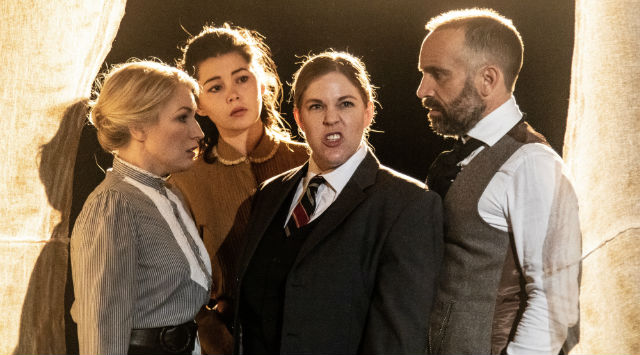
Alice and Edgar live secluded on an island, married to each other but full of hate, in a state of constant exhaustion from having spent every waking moment bitter, and berating all that they come in contact with. When relative Kurt arrives for a brief visit, the antagonism escalates, as we observe the vitriol begin to infect their unsuspecting guest. From 1900, August Strindberg’s The Dance Of Death is characteristically expressionist, with the writer’s socialist attitudes perceptible in the play, although its criticisms of class are somewhat benign by today’s standards.

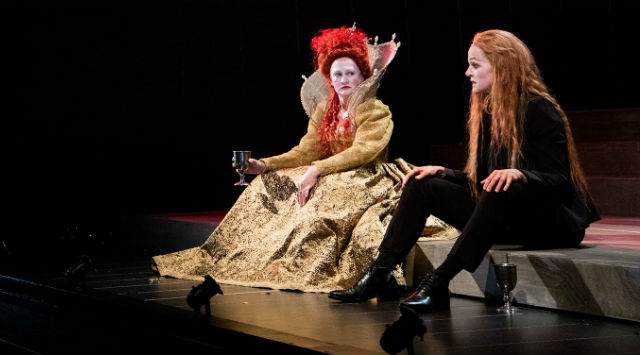
Its comedy is dark and caustic, and Judy Davis’ direction certainly conveys that subversive quality well, for a show that is consistently amusing, if not quite laugh out loud funny. Strindberg’s absurd and surreal dimensions are embraced by designers, who deliver a production many will find stimulating with its declarative flamboyance. Paul Charlier’s music is libidinous but disturbing, and extraordinarily theatrical in its effect. The stage floats on a pool of blood, with a backdrop proclaiming “hell on earth”; Brian Thomson’s set design and Matthew Scott’s lights conspire in a visual tango that intrigues and mystifies. Costumes and wigs by Judy Tanner are wonderfully evocative, with an exquisite red gown late in the piece, proving to be particularly memorable.

Pamela Rabe cuts a striking figure as the decadent former actress Alice, operatic in style and thoroughly entertaining, if slightly deficient with her character’s emotional authenticity. Edgar is played by Colin Friels, similarly heightened in his approach, for a beguiling study of narcissistic machismo at its ugliest. Cousin Kurt is taken through drastic transformations by Toby Schmitz, whose cheeky humour reinvigorates the action with each of his entrances.

The Dance Of Death succeeds at keeping us engaged, but we wait for poignancy that never arrives. It inspires us to think about marriage, about the way we deal with this thing called love, and how hate only exists in response to something unequivocally cherished, but the show keeps distant, as though aloof, unwilling to be touched, unable to move. Emotions can be frightening, so we go to art to better witness its machinations. Alice and Edgar share a love, but their vulnerabilities are all but calloused by the time we meet them at their twenty-fifth year of entanglement, and it is as though they no longer feel anything. They know only to make demands, and are incapable of giving anything, yet this dynamic is set on a perpetual loop, sustained by the ever surprising human capacity to withstand debasement. From the outside however, it is always easier to perceive with clarity, and we know that walking away from someone who has overstayed their welcome, is the simplest solution.

www.belvoir.com.au

Review: The Norman Conquests (Ensemble Theatre)

Venue: Ensemble Theatre (Kirribilli NSW), Nov 2, 2018 – Jan 12, 2019
Playwright: Alan Ayckbourn
Director: Mark Kilmurry
Cast: Danielle Carter, Rachel Gordon, Brian Meegan, Sam O’Sullivan, Yalin Ozucelik, Matilda Ridgway
Images by Prudence Upton

Theatre review
Ruth’s husband is having dalliances with her sister and her sister-in-law. These extramarital trysts with Norman are at least momentarily pleasurable, but it comes as no surprise that there is pandemonium when the cat is out of the bag. Alan Ayckbourn’s trilogy The Norman Conquests takes place in a weekend, with each instalment encompassing the action at a specific area of the family’s country home. Table Manners occurs in the dining hall, Living Together in the living room, and Round And Round The Garden in the garden. They form a cohesive whole, but each part stands alone, for this intricate 1973 comedy about the meaning of marriage, at a time of sexual liberation as Britain emerges from the swinging sixties.

Its humour is of a classic style, with 45-year-old jokes likely to divide audiences, but at the heart of the piece is Ruth’s surprising permissiveness, still refreshing by today’s standards. Her reluctance to see the affairs as necessarily catastrophic, but more of an annoyance, leads us to a progressive evaluation of monogamy, still relevant to how we conceive of relationships and marriages today. This revival, directed by Mark Kilmurry, is bright and bubbly, a compelling jaunt back in time that is surprisingly resonant, even if its language is obviously outdated.

The characters may sound like the past, but they are made to feel current, by an excellent, and tireless, uniformly captivating cast. Yalin Ozucelik gives Norman an appropriate sex appeal, cleverly depicting that familiar blend of naivety and cunning, to convey the ambiguously deceptive quality of men who love too many. Matilda Ridgway is a marvellously complex Annie, the aforementioned sister, richly imagined with veraciously human conflicts, clearly presented for a personality sensual and intelligent. Ruth is played by Rachel Gordon, wonderfully vivacious and highly sophisticated, for an exemplary portrait of a woman with an open mind, unafraid to set her own rules.

When Ruth declares that she does not own her husband, we are urged to re-examine sexual relationships, and perhaps define them anew. In letting our loved ones go, we in turn disallow ourselves from ever being enslaved. Love, however, can make free people want to be bound. To have and to hold is a divine notion, but life without freedom is abhorrent, just as life without love is unbearable. In every intimate connection, whether fleeting or longstanding, delicate negotiations are required; traditional prescriptive methods, when adopted unquestioned, rarely deliver satisfactory results. Congress between organic beings can never be completely predictable, for every entity is different and in constant flux. We just need to make sure that nobody gets hurt, although it seems always to be easier said than done.

www.ensemble.com.au

Review: A Cheery Soul (Sydney Theatre Company)

Venue: Sydney Opera House (Sydney NSW), Nov 5 – Dec 15, 2018
Playwright: Patrick White
Director: Kip Williams
Cast: Emma Harvie, Anita Hegh, Jay James-Moody, Brandon McClelland, Tara Morice, Sarah Peirse, Monica Sayers, Shari Sebbens, Nikki Shiels, Bruce Spence, Anthony Taufa
Images by Daniel Boud

Theatre review
Miss Docker is an inconvenient older lady. Living in the suburbs, her presence is a constant source of irritation to all and sundry, even though she goes out of her trying way to be a useful member of community. Possessing neither great discernible talent, nor satisfactory social skills, her good intentions prove inadequate, and having gone past an ascribed use-by date, exclusion is her daily reality.

Critical of the Australian middle classes, Patrick White’s A Cheery Soul takes aim at our parochial values, and that strange sense of fear resulting from our insecure colonial identity, one that corrupts the way we are with one another. Additionally, the play is a study of how women are devalued, through its depictions of a character who has failed to fulfil her destiny of wife and mother, in a society determined to disallow her from deviating from its narrow definitions of womanhood.

White’s signature incorporation of poetry and abstraction have a tendency to dilute the drama in his narratives, and although director Kip Williams does well to introduce a generous and robust scale of theatricality that is quite dazzling, the show oscillates regularly between entertaining and challenging, for an experience that feels, ultimately, not much more than moderately rewarding. Nevertheless, it is noteworthy that live video is an inventive and memorable device here, with Williams and set designer Elizabeth Gadsby demonstrating an admirable meeting of the minds for a very effective use of the medium.

Actor Sarah Peirse brings a charming and familiar eccentricity to Docker that conveys a valuable realism for the piece, but it is arguable if the protagonist is on this occasion, sufficiently appealing for us to be firmly engaged with the plot. Reverend Wakeman is played by Brandon McClelland, whose flamboyant approach offers wonderful moments of intensity that add texture to a persistently sad story. Ensemble work is strong in the production, with sequences featuring the cast performing as a haunting chorus especially beautiful.

When scared little people make up the majority, it is the imaginative and the adventurous who are ostracised. Still in our psyche, an outpost of the old British Empire, we remain consumed by anxiety, always thinking ourselves deficient, desperate to be as good as everyone else in faraway fantasised Europe. We behave as though neglected and orphaned, consequently responding by always choosing to embrace the ordinary, in a constant state of keeping up with the Joneses, and irrational in our fear of all things different and unexpected. There is little value in living by replicating, even though it gives an impression of social cohesion, conformity holds us back from progress and deprives us of compassion. In A Cheery Soul we see that to love thy neighbour can be easy, if only we learned to step of our own way.

www.sydneytheatre.com.au