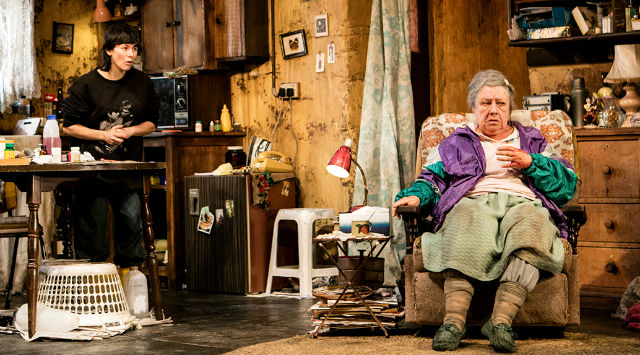
Review: White Pearl (National Theatre of Parramatta)

Venue: Riverside Theatres (Parramatta NSW), Oct 24 – Nov 9, 2019
Playwright: Anchuli Felicia King
Director: Priscilla Jackman
Cast: Deborah An, Mayu Iwasaki, Matthew Pearce, Vaishnavi Suryaprakash, Merlynn Tong, Catherine Văn-Davies, Shirong Wu
Images by Phil Erbacher
Theatre review
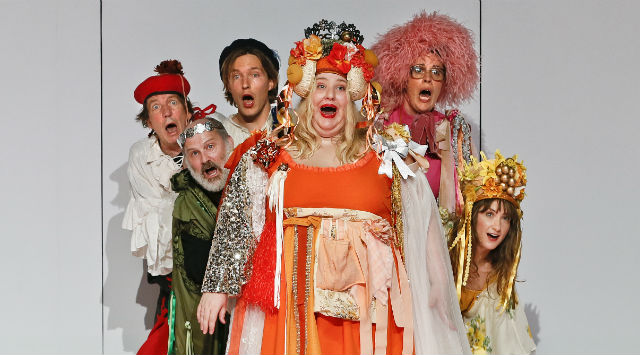
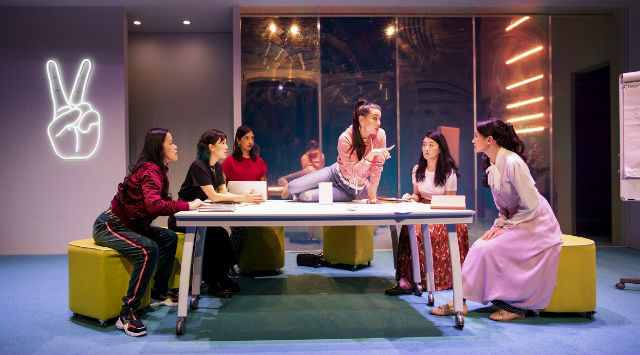
A cosmetics company specialising in skin whitening creams, wakes up in hot water, when one of its ads appears online prematurely and quickly goes viral, as a result of its shockingly racist content. The Clearday headquarters in Singapore instantly turns into a war room, with executives desperately scrambling for damage control. All six of them are Asian women, from various parts of the world, each with a different experience of race and its associated politics. In Anchuli Felicia King’s White Pearl, we see the group devolve into a belligerent mess of conflicting principles, unable to sustain an alliance forged initially by very dubious ethics.

It is a sensational piece of writing, thoroughly researched and passionately rendered. White Pearl throws us into a cauldron of frenzied chaos, but each line of dialogue is crafted with immense precision, for an insightful examination not only of capitalism and racism, but also of the classism and sexism that govern so much of how these characters operate. The play’s unravelling of corporate culture, engenders a caustic sense of humour that keeps us on edge, for a wildly funny theatrical ride that never releases us from its moral interrogations.

Director Priscilla Jackman keeps dramatic intensity at fever pitch for the entire duration, establishing an unrelenting awareness in our consciousness reminding us that the stakes are very high indeed, not only in the fiction that we encounter, but also the real life implications of this timely tale about our social responsibilities as groups and individuals. Sound design by Michael Toisuta and Me-Lee Hay amplifies the women’s stress levels, to fill the auditorium with shuddersome atmospheric pressure. Jeremy Allen’s production design and Damien Cooper’s lights are nimbly manufactured, to keep the storytelling moving at lightning speed. The playwright’s own video projections feature social media comments relating to the offending incident, ranging from amusing to appalling, working as a device that constantly widens the story’s context, so that each viewer can remain personally connected with the narrative. Dramaturg Courtney Stewart does remarkable work that allows the play to consistently resonant with accuracy.

Seven actors form a formidable ensemble to deliver an intelligent and highly entertaining show, that reveals many truths about who we are today. Priya Singh, the British Indian founder of the company is portrayed by the phenomenal Vaishanavi Suryaprakash, whose extraordinary range enables an endlessly textured study of a woman in deep trouble. It is a powerful performance that exposes the human and structural problems of the modern business world. Also very affecting is Deborah An, who plays Korean scientist Soo Jin Park, bringing incredible nuance and emotional gravity to the depiction of a very dire situation. Merlynn Tong (as Sunny Lee) and Shirong Wu (as Xiao Chen) are unforgettable for providing the biggest laughs, both immaculate with their comic timing, and wonderfully idiosyncratic with their respective interpretations of ethnically Chinese women, the former from Singapore, and the latter China.

Catherine Văn-Davies plays Built Suttikul, a fabulously wealthy, American-educated Thai national, with imposing confidence and a vigorous physicality that defies any underestimation of the ladies in White Pearl. Her sensitive choices for a sex scene brings surprising elevation to the character, and highlights the persistent impossibly of retaining integrity in the pursuit of commercial supremacy. Her French ex-lover Marcel Benoit too, becomes unexpectedly complex, as performed by a self-possessed Matthew Pearce. New addition to the “Clearday family”, Japanese recruit Ruki Minami is perfectly balanced between naivety and wisdom by Mayu Iwasaki, for a personality that demonstrates the limits of human integrity, in the stupefying face of money and power.

Clearday sells products nobody needs, that could very well be harmful. The people who comprise the company, expend all their energy on questionable activities, so that they may one day feel like a leader of the pack. This is the narrative not only of White Pearl, but also of many a conventional life in the modern world. Money and power are blinding, they shape our values so that we make compromises to morality, in the promise of a glory that rarely comes to fruition. We disregard justice, to uphold racist, sexist and classist ideals every day, in hope that the system would reward us with all that it professes, but in fact, as we see in the play, no one will emerge truly victorious.

www.riversideparramatta.com.au/NTofP | www.sydneytheatre.com.au

Review: The Real Thing (Sydney Theatre Company)

Venue: Sydney Opera House (Sydney NSW), Sep 9 – Oct 26, 2019
Playwright: Tom Stoppard
Director: Simon Phillips
Cast: Johnny Carr, Charlie Garber, Rachel Gordon, Geraldine Hakewill, Shiv Palekar, Julia Robertson, Dorje Swallow
Images by Lisa Tomasetti
Theatre review
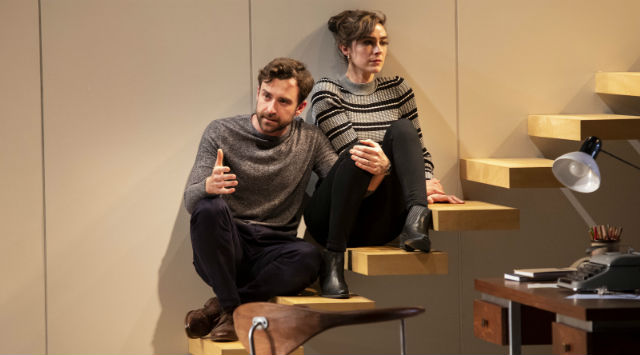
Henry has an excellent relationship with words and philosophy, which is just as well, being a successful playwright much like his creator Tom Stoppard. In The Real Thing however, we discover that his cerebral talents do not extend to matters of the heart. It is that very human conundrum we deal with in Stoppard’s extraordinarily rigorous piece of writing, that it is one thing to be able to know so deeply all that can be intellectualised, yet be unable to have much control over how one loves. People in the play are smart. Their understanding of the world is astute and penetrating, and their talk is very highbrow, but when we observe the way their feelings are being enacted, it seems there is no escaping the fools that we ultimately are.

Couples in The Real Thing wrestle with issues of fidelity. They cheat, they are suspicious, they are apologetic, and they fail repeatedly. They struggle with the need to be faithful, often engaging in discussions about the meaning of love and monogamy, but what they say have little bearing on how they feel. A constant discord exists between logic and emotions, prompting us to wonder if there can be more than one real thing in the human experience, if what we think and how we act are so often not in concurrence.

Director Simon Phillips brings remarkable clarity not only to these immediate themes, but also to the many tangential musings that make The Real Thing memorable. The density of the text is translated on stage by Phillips into a luxuriant tapestry of inspiring observations emerging from Stoppard’s brilliant mind. In the role of Henry is the sensational Johnny Carr, bringing a startling truthfulness to dialogue that could very easily be turned, under the wrong hands, highfalutin and empty. The actor’s presence and timing have us captivated, as we find ourselves enraptured, deeply invested in the many meaningful discussions that provide the foundation, for an admittedly bourgeois narrative. Geraldine Hakewill too, is engaging as Annie, a strong counterpoint in the story, effortlessly convincing with the complexity she portrays, whether playing subject or object in this tale about affection and attraction.

Production designer Charles Davis delivers a spectacular set, wonderfully imagined for the revolve stage, to facilitate poetic parallels between words and visions. His costumes are quiet but effective, able to bridge the time disparity inherent in reviving a 37-year-old work. Lights by Nick Schlieper are correspondingly sophisticated, always pleasing with the imagery he manufactures, and exacting in the way he shifts our impulsive responses from scene to scene.

It is likely that one can arrive at the conclusion that realities are multitudinous, yet there is something in our nature that cannot resist the idea that there could be a singular essence to things, that there is a fundamental truth in how we regard the world. It is as though a key exists, that life is only ever experienced as a sort of mystery that requires solving. Henry’s racing thoughts are incessant, and luckily for us, always beautifully articulated, yet we only ever see him carry on like a fool for love, as though knowledge can never live up to its promise of having the answer to everything.

www.sydneytheatre.com.au

Review: Avalanche: A Love Story (Sydney Theatre Company)

Venue: Roslyn Packer Theatre at Walsh Bay (Sydney NSW), Aug 29 – Sep 14, 2019
Playwright: Julia Leigh
Director: Anne-Louise Sarks
Cast: Maxine Peake (with Jethro Jensen, Amy Wahhab)
Images by The Other Richard

Theatre review
Humans have an inexhaustible capacity for obsession. As individuals, we see the world in infinitely different ways, and each of us has our own private passions that can easily be seen as meaningless or bizarre by others. What is of fundamental importance to one, can be interpreted as totally nonsensical by another, yet we all cling on to these idiosyncrasies, often letting them consume and define us.

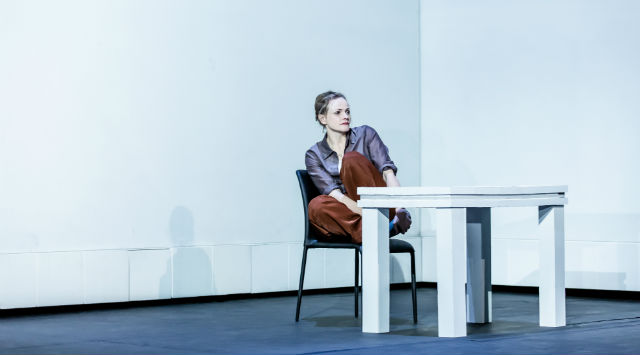
In the case of Julia Leigh’s Avalanche: A Love Story, an unnamed protagonist spends years absolutely absorbed by the notion of having to bear a child, and subjects herself to expensive and traumatising IVF treatments in hope of falling pregnant. She sacrifices relationships and a prestigious career in film making, to devote all her energies and resources, into the seemingly uncontrollable urge to have a baby. The play comprises scene after scene of one woman’s deep disappointments, and her inability to extricate herself from a suffering that only ever looks to be self-imposed. We watch in amazement, her persistence with this pipe dream, but certainly not all of us will be able to muster up the empathy that the playwright is intent on appealing to.

At best, the show is an honest and painful examination of experiences many have shared, but at its worst, Avalanche: A Love Story is a melodramatic and highly indulgent study of rich people’s problems, manifestly unaware of the way it opens itself to ridicule. The very skilful Anne-Louise Sarks brings, as director, an atmospheric intensity that almost has us forgetting, that the story requires our emotions invest in a kind of torment that can only befall the privileged.

There is no question that the production is adroitly assembled. Everything is considered, purposeful and remarkably polished, with not a hair out of place. Marg Horwell’s spectacular set design is unforgettable. Lizzie Powell’s lights and Stefan Gregory’s sounds are incredibly delicate in their rendering of a woman’s very genuine struggles. The contentious nature of this subject matter notwithstanding, the creative forces have no doubt accomplished a work of theatre replete with technical brilliance.

Maxine Peake too, is precise and inspired as performer of this 75 minute monologue. She holds our attention throughout, and convinces even the most sceptical, of the profound sorrow being expressed on stage. Her efforts are detailed and sensitive, always aiming to communicate at a level of uncompromising accuracy.

It is unlikely that Avalanche: A Love Story can preach beyond those already converted. The character’s anguish is undeniable, but the more that we delve into that narrative of grief, the more we question her choices. A woman can make any choice she so desires, but whether her need for sympathy as a result can ever be satisfied, is quite another matter.

www.sydneytheatre.com.au

Review: Banging Denmark (Sydney Theatre Company)

Venue: Sydney Opera House (Sydney NSW), Jul 26 – Aug 24, 2019
Playwright: Van Badham
Director: Jessica Arthur
Cast: Michelle Lim Davidson, Patrick Jhanur, Amber McMahon, TJ Power, Megan Wilding
Images by Prudence Upton

Theatre review
It is very 2019 to have in a comedy, an online feminist warrior meet a leader of digital misogynistic communities, but as we see in Van Badham’s Banging Denmark, that is exactly the kind of story we need right now. Jake has run out of easy conquests, and is now setting his sights on a Danish librarian, a woman from an enlightened future impervious to his seedy charms. The quickest way to achieve cut-through, he figures, would be to enlist the help of Ishtar, whom he knows to be struggling with poverty, having just sued her through defamation law for every penny. If Ishtar is authority of all things feminist, she would clearly be the one to get Jake into a raging feminist’s pants.

Badham’s writing is keenly observed and very biting. It pours scorn on those who are deserving of insult, for an intensely contemporary experience that appeals to our very à la mode, adversarial tendencies. The work feels original in its scope and structure, a tremendously entertaining tale that proves unpredictable, rich with imagination yet entirely plausible. It bears all the characteristics of a romantic-comedy, only to subvert the narrative time and again, for a meaningful agitation of our nonsensical desires.

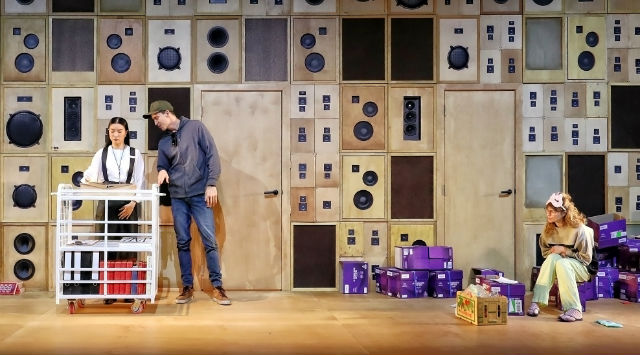
Designed by Renée Mulder, the backdrop is an imposing conglomeration of speakers, a visual delight that doubles perhaps, as a symbolic gesture pointing to our all talking, no listening culture. Director Jessica Arthur introduces just enough acerbity so that her show connects with an easy humour, whilst retaining the valuable intentions of the piece. Although consistently stimulating, the production never gets too intellectually demanding. There is a cheekiness to Banging Denmark that many will find entertaining, and with an emphasis on story over ideology, it demonstrates a prudent need to prevent itself from alienating any of its audience.

Actor Amber McMahon is full of exuberance as the irrepressible Ishtar, delivering a thoroughly enjoyable performance that is as funny as it is intelligent. In the role of Jake is TJ Power, deeply impressive with the dynamic range he brings to the staging, remarkably confident in presence, able to turn a hateful character into something believable, salvageable and human. Three supporting players, Michelle Lim Davidson, Patrick Jhanur and Megan Wilding, offer a variety of textures that make the experience a surprisingly expansive one, that urges us to think beyond the lazy binary.

If Banging Denmark‘s happy ending leaves one unsatisfied, one should probably reflect on their appetite for discord and destruction. We live in such disharmony, largely because of our own design. We have found ways to argue and fight, committed to making things better in accordance with personal perspectives, but we keep moving further and further away from all fabled notions of peace. Addiction to technology is real, and with that it seems, we have become addicted to disunity; happier to wrestle with aggression and rivalries, than to find ways for friendly co-existence. This is an age with unprecedented, and unlimited, capacity for speaking, but it can often look like no one is listening.

www.sydneytheatre.com.au

Review: Lord Of The Flies (Sydney Theatre Company)

Venue: Roslyn Packer Theatre at Walsh Bay (Sydney NSW), Jul 23 – Aug 24, 2019
Playwright: William Golding (adapted by Nigel Williams)
Director: Kip Williams
Cast: Joseph Althouse, Justin Amankwah, Nyx Calder, Yerin Ha, Daniel Monks, Mark Paguio, Rahel Romahn, Eliza Scanlen, Contessa Treffone, Nikita Waldron, Mia Wasikowska
Images by Zan Wimberley

Theatre review
The boys are sent away from war, but their plane crashes and they land on an uninhabited island, having to fend for themselves, using instinct, along with their memories of civilisation. In Nigel Williams’ stage adaptation of William Golding’s Lord Of The Flies, the question of nature versus nurture once again comes to the fore. Jack is the unequivocal villain of the piece, a horrific specimen of mankind, hell-bent on causing death and destruction. His quick ascent to position of warlord tempts us to interpret the child’s evil tendencies as learned behaviour, although there is no denying the parts of ourselves that seem naturally drawn to causing harm.

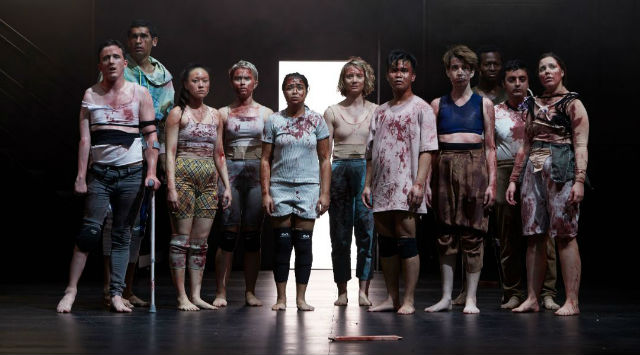
The pessimistic tale is given a modern staging by director Kip Williams, who brings new dimensions to Golding’s concerns of 1954. Where many had in the past regarded Lord Of The Flies as a work about being human, Williams’ vision allows us to interrogate the text from perspectives of culture and gender, that had been routinely neglected. The diversity of cast (but alas, not of creatives) inspires discussions about whiteness and masculinity, as we ponder on the meanings of women playing boys, and of people of colour playing the colonials. Indeed, the production rarely lets us look away from the Brechtian artifice of its presentation, always consciously involving itself with a stylised design aesthetic that never tries to fool us with attempts at naturalism. The experience becomes one of theatre as commentary, rather than art as representation.

Instead of manufacturing a landscape of delusive vegetation, set design by Elizabeth Gadsby exposes the stage’s bare bones, for a chilling Brutalist effect, that establishes from the outset an appetite for subversion. Intensive work on lights by Alexander Berlage may lack restraint, but is undoubtedly spectacular with its many bold manoeuvres. James Brown’s sound design guides us through the story’s legendary descent into savagery, particularly impressive when it operates in conjunction with actors at their most dramatic and vivid.

There are moments when stagecraft overwhelms, but the ensemble proves nonetheless to be engaging, with Daniel Monks especially memorable in the role of Roger. Vile, vicious and thrilling in his depiction of a boy’s darkest inclinations, Monks delivers moments that are quite genuinely terrifying, and enormously powerful in what he has to say about our capacity for cruelty. The purest one is played by Rahel Romahn, who gives us a Piggy that is completely adorable, and in his nuanced demonstration of what virtue looks and sounds like, the actor ensures that all the show’s arguments can only be won by the good side. As the democratically elected leader of the pack, Mia Wasikowska is a passionate Ralph, but the actor tends to be too subtle in approach for the vast and cacophonous stage. Much more persuasive is Contessa Treffone as the big bad Jack, made resonant by Treffone’s intricate mimicry of masculine voice and gesture, for a portrait of male toxicity at its most despicable.

It is easy to get lost in discussions about how the boys have turned out so awfully, but more worthwhile is to find ways we can improve, or indeed reverse, this dreadful state we are in. Whether a result of genetics or of social conditioning, the characters in Lord Of The Flies are broken, and while one can choose to take a fatalistic reading of the text, the show certainly encourages a more hopeful interpretation. Boys will be boys, if we accept the status quo. Racism will remain a component of our structures, if we persist with them. Golding suggests that an intrusion is necessary for the lost ones to be rescued, but to sit and wait, is no solution for those who proclaim to be young and free.

www.sydneytheatre.com.au

Review: The Torrents (Sydney Theatre Company)

Venue: Sydney Opera House (Sydney NSW), Jul 18 – Aug 24, 2019
Playwright: Oriel Gray
Director: Clare Watson
Cast: Emily Rose Brennan, Luke Carroll, Tony Cogin, Gareth Davies, Rob Johnson, Geoff Kelso, Sam Longley, Celia Pacquola, Steve Rodgers
Images by Philip Gostelow

Theatre review
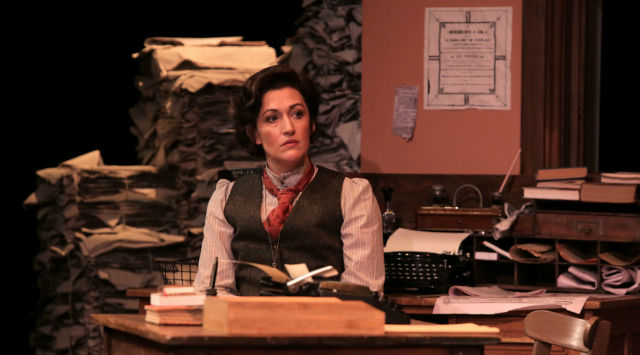
Jenny Milford has barely begun working in a news room, but is already being threatened with the sack. It is the end of the nineteenth century, and the old white men of Koolgalla’s local newspaper simply cannot imagine a woman working with them. In the meantime, agriculture in Koolgalla is at a crossroads, with old interests having to give way to advancements, or the population will have to face extinction. The Torrents was written by Oriel Gray around 1955, and although its themes are undoubtedly pertinent, it comes as no surprise that this is only the play’s second staging in over half a century. Its plot structure is awkward, its dialogue dry, and its narrative too simple.

Director Clare Watson adds to Gray’s work a lot of ornamentation, and the show becomes, fortunately, of satisfactory quality. It is an elegantly designed production, not particularly inventive with any of its renderings, but certainly accomplished with what it sets out to achieve.

Actor Celia Pacquola is spirited in the leading role, able to introduce a modern sense of sass for Jenny to remain likeable. Although crucial to the story, the character often feels insufficiently dominant in the scheme of things, with many sequences seeming to keep her excluded. The play’s title refers to Rufus Torrent, editor of the paper, and his son Ben. The former played by a sturdy, dignified Tony Cogin, and the latter, a kooky Gareth Davies, whose impulsive comedy adds a reliable and welcome invigoration to proceedings.

It is evident that all performers in The Torrents invest in an attempt to fortify their show. There is good effervescent energy, and an admirable precision to their rhythms as an ensemble, and although the staging is ultimately underwhelming, polish of this standard is always impressive.

Like the residents of Koolgalla, we need something radical to wake us up to our impending destruction. It may be narcissism, or simply fear, that keeps us from accepting the truth of ecological and technological disasters that are already in motion. It was not until the old boys club in The Torrents were able to let the first woman in, that significant change was able to begin.

The powerful is almost always conservative. Those at the top are habituated into thinking that they must protect the existing, and are thus unable to conceive of big transformations that would make things better. They keep doing things the old way, to try and reinforce the security they imagine themselves enjoying. They manufacture a supremacy, to be protected at all costs, unwilling to recognise that it is not mother nature who will be obedient, but us, who must abide by nature’s laws.

www.sydneytheatre.com.au | www.bsstc.com.au

Review: Cat On A Hot Tin Roof (Sydney Theatre Company)

Venue: Roslyn Packer Theatre at Walsh Bay (Sydney NSW), Apr 29 – Jun 8, 2019
Playwright: Tennessee Williams
Director: Kip Williams
Cast: Addison Bourke, Tristan Bowes, Peter Carroll, Harry Greenwood, Emily Harriss, Jye McCallum, Josh McConville, Zahra Newman, Pamela Rabe, Holly Simon, Nikki Shiels, Lila Artemise Tapper, Arie Trajcevski, Hugo Weaving, Anthony Brandon Wong, Jerra Wright-Smith
Images by Daniel Boud

Theatre review
Characters in Tennesse Williams’ Cat On A Hot Tin Roof suffer immense anguish. Regardless of where they happen to reside in the hierarchy of their social order, powerful or powerless, Maggie, Brick and Big Daddy are each unable to escape a torturous existence. A result perhaps of the family’s wealth, or maybe the American deep south in 1950s had truly been indiscriminately stifling, or life is simply unbearable no matter one’s choices and orientations; the beauty of Williams’ play is that it explains little. In its exhaustive excavations of human emotion however, we identify the truths of our beings at their deepest, but Williams leaves us to draw our own conclusions, on the causes of, and the resolutions for, all the pain that inevitably befalls us.

There is a lot that is sublime in director Kip Williams’ vision. A momentary glimpse of sitting Vice President Mike Pence on Brick’s television set, is a powerful suggestion of the play’s timelessness. Oppressive aspects of Western values, rooted in white patriarchy, is the undercurrent disquiet that drives the action. The production manifests a sense of hopelessness appropriate to the playwright’s pessimism, one that is masochistically gratifying, as is typical of classic melodrama, but also undeniably thought-provoking.

Brick and Maggie’s bedroom is sleek and modern in style, with dark colours and hard edges representing a masculine space in which Maggie’s lack of status is evident. Designed by David Fleischer, the stage is visually seductive, but arguably ineffectual with invisible doors, for a play that repeatedly involves itself with notions of intrusion. Stefan Gregory’s music takes its cues from film noir, nostalgically evocative and very pleasurable. Lights by Nick Schlieper are cold, almost menacing in their depiction of emotional torment. The many instances of fireworks in Act II are controversially manufactured, each time overwhelming our senses for several seconds, with their cacophonous, and repetitive, disruptions into Brick and Big Daddy’s long confrontation.

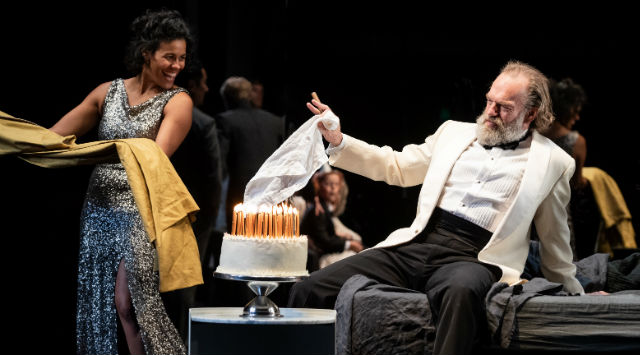
Actor Zahra Newman is entirely splendid as Maggie, dejected but determined, a broken woman hanging on to the little that she has, to turn a living hell into something coherent. Newman’s extraordinary instinct and artistic inventiveness, along with an uncompromising vigour, make Act I of Cat On A Hot Tin Roof a personal tour de force that has us hopelessly exhilarated. Big Daddy is masterfully performed by Hugo Weaving, who although brings to the role nothing that is unexpected, demonstrates his unparalleled stage presence and a searing conviction that absolutely captivates. The exaggerated theatricality he employs is riveting, with a psychological accuracy that allows us to perceive complicated dimensions of human nature, as we luxuriate in the sumptuousness of his delivery. Also very resonant, is Harry Greenwood as Brick, who overcomes his physical dissimilarity to the character, for a convincing portrayal of a defeated man who retreats into self-abuse. Greenwood’s approach is restrained by comparison, but he adds dynamism and texture to how the story is conveyed, on what is often a very loud stage.

Brick’s indulgence in alcoholism looks as though he is willing himself to die. Maggie on the other hand, who has much less to live for, can be seen maniacally scrambling for survival at every moment. Those are the extremes of how we can be, when facing the worst. The people in Cat On A Hot Tin Roof are all left to their own devices. Although under one roof, this is a family whose bonds are weak, with relationships built on mendacious foundations (the word “mendacity” is mentioned multiple times). Unable to locate anything honest and real, what they have can only feel empty; distracted by material riches, it is loneliness that is left unnoticed and festering. We see no love in this household, and realise that no peace or happiness could ever come their way.

www.sydneytheatre.com.au

Review: Mosquitoes (Sydney Theatre Company)

Venue: Sydney Opera House (Sydney NSW), Apr 8 – May 18, 2019
Playwright: Lucy Kirkwood
Director: Jessica Arthur
Cast: Annie Byron, Jason Chong, Mandy McElhinney, Jacqueline McKenzie, Angela Nica Sullen, Louis Seguier, Nikita Waldron, Charles Wu
Images by Daniel Boud

Theatre review
The two sisters could not be more different. Alice is a high-achieving scientist, and Jenny is an anti-vaxxer; it would seem that all the brains had gone to one sibling, leaving the other quite the imbecile by comparison. Lucy Kirkwood’s Mosquitoes sets up a dynamic that tempts us to think in binary terms, but guides us away from forming false equivalences in our estimation of its characters. Although we see good and bad, smart and stupid, the play is able to convince us that people are people, that to determine some life as more valuable than others, would always be tenuous and quite indecent.

After one very big mistake, Jenny’s messy life appears to be going resolutely downhill. The reverberations of her self-destruction are felt by Alice, whose own existence begins to unravel, perhaps as a result of her sister’s chaotic proximity. Playwright Kirkwood sets the family drama against a backdrop of science and nature, with Alice’s career in physics providing context for us to ruminate on both the separateness and inseparable-ness of things. We isolate things to understand them, but forget their indissolubility in the bigger scheme. Our minds are able to conceive of distinct particles, but none exists in absolute detachment. Families are made of individuals, who are at once autonomous and conjoined.

Mosquitoes‘ small domestic scenes are not an easy fit on this vast stage, and although production designer Elizabeth Gadsby and lighting designer Nick Shlieper do not always succeed at containing and concentrating our vision, there is an alluring quality in the elegance that they do achieve. Some very big acting by Annie Byron, Louis Seguier and Charles Wu in supporting roles, are risky choices that prove helpful, and satisfying, in getting us involved. Director Jessica Arthur brings excellent amplification to personal emotions for the characters we meet, but her show is insufficiently provocative, able to communicate effectively only on surface levels. We want more insight into our contemporary times, and more philosophy in general, from a piece of writing that seems to promise so much intellectual rigour.

Jenny is played by Mandy McElhinney, whose humour is a striking feature, full of confidence and impressive verve. Jacqueline McKenzie’s Alice is appropriately high-strung, with an admirable intensity, although slightly one-note in her approach. Their work is assisted by James Brown’s music and sound design, who does marvellous work when tensions are rising, but is occasionally deflating, when in contradiction with the comedy being presented by the cast.

When we find Alice at the end of her tether, rationality turns her ironically monstrous, almost fascistic in attitude, as she tries to put order back into life. At that moment, the shiny appeal of her intelligence and sophistication, reveals something inhumane, and we begin to perceive Jenny’s prior weaknesses with disarming empathy. It is a magical instance of equalisation that transpires, if only in our irresistible urge to place judgement. At these times of extraordinary factiousness, there is perhaps no greater need than the urgency to look for similarities in between. In our efforts to make things better, we identify problems, and relegate them to imagined groups of others, and forget the ultimately inextricable culpability of the self. It is easy to think of the cosmos as one, but to prevent it from falling to pieces, in this day and age, looks to be impossible.

www.sydneytheatre.com.au

Review: How To Rule The World (Sydney Theatre Company)

Venue: Sydney Opera House (Sydney NSW), Feb 11 – Mar 30, 2019
Playwright: Nakkiah Lui
Director: Paige Rattray
Cast: Gareth Davies, Vanessa Downing, Michelle Lim Davidson, Nakkiah Lui, Hamish Michael, Rhys Muldoon, Anthony Taufa
Images by Prudence Upton

Theatre review
In Nakkiah Lui’s How To Rule The World, the government is trying to pass the Sovereign Territory Bill, a thinly-disguised piece of legislation that further advances the white supremacy cause that is already too much a part of our social fabric. Canberra insiders Vic, Zaza and Chris, are people of colour, all absolutely fed up with the state of affairs. They join forces to install a political puppet, by hiring a white male actor as a shoo-in for the senate, who will subsequently hold the balance of power required to kill off the offending bill.

It is a passionate work, piercingly funny, with an ambitious scope that even at over two-and-a-half hours, can at times feel hurried with its plot. As a result, we may not always understand with great detail, why the people do the things they do, but we nonetheless have an excellent time watching them being unequivocally hilarious. Directed by Paige Rattray, the show is exuberant, but laden with irony, and thoroughly modern in its dissection of power distribution in Australia, making no bones about the white patriarchy that corrupts our country from the inside out.

Lui herself plays Vic, a character central to the play’s advocating of a national treaty that will recognise and institute Indigenous rights, for the past and future. It is a performance memorable for its vulnerable authenticity, effortless at delivering a poignancy that stays with us, long after the laughter has subsided. Michelle Lim Davidson and Anthony Taufa are Zaza and Chris respectively, both endearing and vibrant personalities who ensure that we are always rooting for the right people. The three make a cohesive team, independently effective, but powerful as a singular entity.

The stooge is played by Hamish Michael, who breathes exciting life into an otherwise rudimentary character. His Tommy Ryan is a painfully accurate portrayal of the suits we see everyday on TV; vacuous, desperate and bizarrely comedic. The Prime Minister is a suitably deplorable man, as interpreted by Rhys Muldoon, who shines especially when his true colours are revealed in the latter half, as the going gets tough for the man on top. Gareth Davies appears in a very large assortment of roles, each of them wonderfully imagined and executed with stunning perfection, to earn the biggest laughs of the night. Also in multiple parts is Vanessa Downing, who although creates less of an impact, proves herself a dependable and unwavering source of support for the show’s louder types.

Set design is functional, and appropriately dreary in Marg Horwell’s depiction of our halls of parliament. The decision to do without set changes is a contentious one, considering the play’s frequent location changes, but to keep the action economically contained, encourages its scenes to flow quickly for the audience to remain exhilarated. Lights by Emma Valente are cleverly and efficiently rendered to shift time and space, with little noticeable fuss. Valente’s video projections include an instance of encircling sharks in the PM’s office that is particularly delightful. Paul Mac and Steve Francis provide sound and music, further perking up the proceedings, consistently reliable in their addition to the production’s humour.

We like thinking that the Western societies in which we dwell are democratic, but we also accept that there are people who want to rule the world, and we habitually acquiesce to those desires. At all our election days, each of us casts a vote, feeling as though we are an indispensable part of the most integral of processes, then we walk away letting the powerful carry on with business as usual. They climb their way up, as though determined to leave us behind. When we notice that the interests of those who have made it to the upper echelons are no longer in accordance with our concerns, we become exasperated. Injustices are felt only at the bottom, yet we wait for those on top to lead the change.

www.sydneytheatre.com.au

Review: Mary Stuart (Sydney Theatre Company)

Venue: Roslyn Packer Theatre at Walsh Bay (Sydney NSW), Feb 5 – Mar 2, 2019
Playwright: Kate Mulvany (after Friedrich Schiller)
Director: Lee Lewis
Cast: Fayssal Bazzi, Caroline Brazier, Simon Burke, Peter Carroll, Tony Cogin, Andrew McFarlane, Rahel Romahn, Helen Thomson, Matthew Whittet, Darcey Wilson
Images by Brett Boardman

Theatre review
Queen Elizabeth I of England must finally decide whether to sign the death warrant of her cousin Mary, Queen of Scots, after 19 years’ imprisonment. In Kate Mulvany’s adaptation of Friedrich Schiller’s 1800 play Mary Stuart, we look at the final days of this historical feud, paying attention to political machinations, as well as the fascinating psychological processes that the two women would have had to go through, in what is clearly the most difficult and traumatising of human experiences. A highly intelligent work, Mulvany transposes the ancient story into a contemporary tale foregrounding themes that matter today, with renewed focus on the feminist implications of this conflict between powerful women.

Surprisingly funny, featuring witty dialogue that transcends the ages to connect with our everyday ears, Mulvany transforms the royals into flesh and blood individuals that we can easily relate to. With none of the pretension often associated with period pieces about European queens and kings, we are free to examine all the sublimated dynamics between Elizabeth and Mary, to come to our own conclusions about power structures, whether or not one chooses to share the playwright’s feminist lens. Mary Stuart is also effective in delivering drama, powerful in the way it conveys the palpable emotions of a woman compelled to put a loved one to death, and another who faces her own demise.

The vast auditorium is put to good use by Elizabeth Gadsby who situates the action in a suitably grand setting, palatial but austere. Lights by Paul Jackson are especially effective in the graver sections, to facilitate the sensation of mounting pressure as we move toward the inevitable. Music and sound can sometimes be too subdued, especially in the earlier more comedic scenes, but when things turn serious, Max Lyandvert is certainly on hand to heap on the tension. Costumes are a highlight, perhaps predictably, with Elizabeth’s opulent gowns really making an impact. Mel Page’s work on all the women’s looks are unequivocally remarkable.

Director Lee Lewis exercises a stylistic restraint over her stately presentation, determined not to let pomp and ceremony distract from its central concerns. Visuals can sometimes feel sparse and incommensurate with our imagination of both the queens’ worlds, but Lewis’ strength in elucidating rationale behind all manner of human behaviour, is sublime. Actor Helen Thomson is electrifying as Elizabeth, appropriately majestic and piercingly humorous, insisting that entertainment value accompanies all the intellectual stimulation that the play so doggedly provides. Thomson continually reveals layers to the queen throughout the two-hour duration, consistently unpredictable with her depictions, including moments of poignancy that are quite unexpected. Her rendering of Elizabeth as a real and authentic person, is an astounding achievement. Mary is played by Caroline Brazier, whose very deliberate portrayal of grace under pressure is as beguiling as it is intriguing. Her penultimate scene of exposure is truly arresting, as she performs an outpouring of intense and contradictory emotions that gives us a glimpse of the woman under the crown.

Women compete because our power is scarce. We are pit against one another, and we participate in these battles, rarely challenging these absurdly unjust systems and the beliefs that they perpetuate. American Professor Emerita of Sociology and Women’s Studies, Gail Dines suggests that empowerment is a false hope, for to place ourselves within patriarchal hierarchies necessitates the exploitation of many women. Liberation on the other hand, evokes a collectivism that prohibits oppression of any kind. The two queens in Mary Stuart were able to wield power of all kinds, but it is clear that their lives were never their own. Enslaved by their fathers, their states and their religions, we watch them at war, inside a living hell not of their own making, and wonder how much of our own lives are just the same.

www.sydneytheatre.com.au