Review: Orlando (Sydney Theatre Company)

Venue: Sydney Opera House (Sydney NSW), Nov 9 – Dec 19, 2015
Playwright: Sarah Ruhl (based on the novel by Virginia Woolf)
Director: Sarah Goodes
Cast: Matthew Backer, Luisa Hastings Edge, Garth Holcombe, John Gaden, Jacqueline McKenzie, Anthony Taufa
Images by Prudence Upton

Theatre review
Virginia Woolf’s novel Orlando: A Biography was published in 1928, when discussion of sexuality was made in hushed tones, and inseparable from notions of gender identity. If a person loved a woman, they had to take the form of the masculine, and the reverse was true. The centrepiece of Orlando‘s story is a man’s magical transformation into a woman, wistfully described but scarcely explained, though by simple deduction, one could perceive more than an indication of sexual fluidity, and a desire to explore what is now known as sexual orientation. It would be remiss however, to reduce the work to be simply about sex, for its interest in fluidity extends to the whole of a person’s identity, or how one sees themselves, along with how society conceives of that individual.

Sarah Ruhl’s 2010 stage adaptation can be understood as a feminist piece. Orlando’s life as a man is depicted with an extroversion that is concerned with the character’s appetite and discovery of the world around him, but as a woman, she turns introspective and we are presented with constant interrogations about her place in relation to things as the fairer sex. In other words, maleness is seen as an unquestionable natural state, while the feminine requires persistent justification. In dramatic terms, Ruhl’s work is poetic, sublime theatre that uses all the capacities of language to excite, provoke and enchant, and to tell a fascinating story that is strangely engaging in spite of its contextual distance.

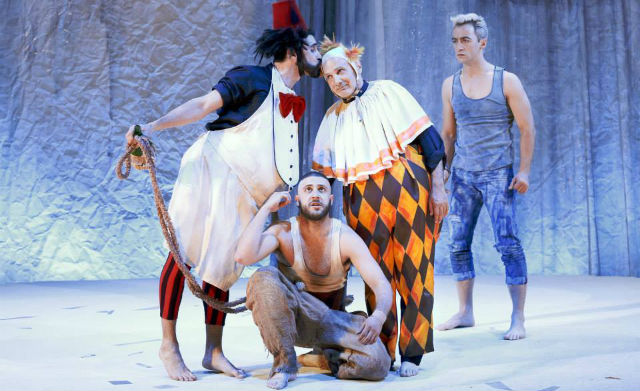
It is a humorous text, gentle in its approach, but always charming and amusing with its renderings. Director Sarah Goodes executes that subtle comedic tone with great sophistication, and although the production is seldom laugh-out-loud funny, her brilliant wit is deeply endearing. There is clever use of space, with a relatively small ensemble establishing an active and visually dynamic stage. Comprising two flights of mobile staircases and concentric revolving platforms, our eyes are kept busy and no time is wasted on scene changes, but the production is not strikingly lavish. It makes occasional reference to the well-known Sally Potter film of 1992, but that extravagant beauty, still fresh in many of our memories, is absent from this staging.

Our focus is placed squarely, and appropriately, on the title role’s narrative, but the show features a charismatic four-man chorus that helps with a lot of heavy lifting. Matthew Backer, John Gaden, Garth Holcombe and Anthony Taufa play a wide range of roles in all gender states, and provide commentary in song and narration that moves the plot along in spirited, gay fashion. Backer in particular, is impressive with his fervent embrace of the show’s vaudeville style of presentation, taking the opportunity to showcase delightful comic timing and a flair for exquisite camp.

In the role of Orlando is Jacqueline McKenzie, keeping us spellbound with a delivery that will be remembered for its intelligence, precision and unrelenting effervescence. It is noteworthy that the actor’s interpretation of Orlando’s personality does not alter significantly with the sensational gender transformation. Whether in male or female costume, McKenzie maintains a singular essence, reflecting a modern and enlightened attitude toward the construction of gendered identities. Her unfaltering energy gives life to two solid hours of stage time, every minute compelling and whimsical, keeping us engrossed in the development of Orlando’s extraordinary narrative with her captivating confidence.

The word “transgender” was recently announced as one of Collins’ dictionary’s “Words of the Year”. As Western societies begin to better understand the way we live out our gendered lives, we can recognise that a new dawn in civilisation is imminent, where people will no longer be persecuted for the way they express their gender, and individuals are free to adopt any form of gender identity they wish to inhabit. Hardly anyone bats an eyelid when Orlando emerges as a woman after living thirty years as the opposite sex. We may not share her aristocracy, wealth and power, but we can appreciate the nonchalance surrounding her transformation, and indeed realise the curious irrelevance of something that convention considers so crucial to how we understand life. Feminism is about achieving equality, and in equality, all that we think separates us, can be vanquished.

www.sydneytheatre.com.au

Review: Hamlet (Bell Shakespeare)

Venue: Sydney Opera House (Sydney NSW), Oct 27 – Dec 6, 2015
Playwright: William Shakespeare
Director: Damien Ryan
Cast: Philip Dodd, Ivan Donato, Robin Goldsworthy, Josh McConville, Julia Ohannessian, Sean O’Shea, Matilda Ridgway, Catherine Terracini, Michael Wahr, Doris Younane
Images by Daniel Boud

Theatre review
Director Damien Ryan’s rendition of Hamlet takes place in mid-20th century Denmark, with surveillance technology, airport last call announcements, and broadcasts of royal weddings. The prince is deeply upset by the death of his father, and by his mother’s very quick remarriage, but within this modern context, his very well known nervous breakdown seems to also involve the pressures of nobility as we understand them today. Our memory of Diana, Princess of Wales persevere, and the way she had been spoken off as having gone out of control, serves as a parallel to this Hamlet.

Ryan’s ideas are refreshing and plentiful. They can be meaningful, or merely ornamental, but his work is invariably engaging. In our age of collective attention deficit disorder, the production’s ability to retain our interest for over 3 hours is remarkable. Every scene is energetic, whether poignant, comedic, or transitory, Ryan finds a way to deliver entertainment and a quality of intrigue regardless of the text’s intentions. This is excellent directing, that has given rise to a show that can captivate even the most cursory of Shakespeare’s fans. Visual design contributes significantly to its pleasures. Alicia Clements’ versatile set produces dimensions on the stage with minimal fuss, and lighting designer Matt Cox’s nightmarish atmosphere administers a mesmerising effect that takes charge of our gaze.

In its efforts at bringing a newness to Hamlet, it might be argued that some dramatic tensions are unfortunately lost from the plot. The significant subdual of King Claudius’ villainy, along with the decision to play Queen Gertrude as an innocent, might be politically correct moves, but they take away from the power struggles that provide a certain spiciness to the admittedly clichéd foundations, especially in its first half. Nevertheless, the sophisticated and measured performances of the entire cast are enjoyable, and thankfully, easy to follow.

Josh McConville’s interpretation of the title role is a dynamically ranging one that exhibits a daring freedom eager to explore and experiment. McConville is powerful with all that he presents, playing comedy and tragedy equally well, but the distinction between both can appear too drastic. We understand the subject of madness involved, but it is debatable whether consistency of character can be improved in his expression of Hamlet’s state of mind. Ophelia is played by Matilda Ridgway, who shakes off the personality’s obligatory tweeness over the course of the play and puts on an impressive display of sorrow and rage in her concluding moments, for some of the most passionate and compelling scenes of the production. Philip Dodd is memorable and disarmingly funny in his parts as Polonius and Gravedigger. The actor’s confident and nuanced comic timing is a necessary element that helps with the show’s buoyancy, effectively preventing any monotony from setting in.

Revenge speaks to our base desires. A hallmark of advanced societies is the rejection of capital punishment, yet stories about vengeance resonate with no trouble at all. In Hamlet, revenge is a cancer that destroys from within. Its effects are contrary to the emotions that guide it. When enacted, the only ones who win are those from the outside, uninvolved in the eye for eye narrative. It is a profound lesson, one that is deeply, and appropriately for this text, Christian. To forgive and forget is an ideal that is unthinkable for many, but probably the only alternative to our prince’s tragic demise.

www.bellshakespeare.com.au

Review: Anything Goes (Opera Australia / Gordon Frost Organisation)

Venue: Sydney Opera House (Sydney NSW), from Sep 5 – Oct 11, 2015
Music and Lyrics: Cole Porter
Book: Guy Bolton & P.G. Wodehouse, Howard Lindsay & Russel Crouse, Timothy Crouse, John Weidman
Director: Dean Bryant
Cast: Gerry Connolly, Carmen Duncan, Bartholomew John, Wayne Scott Kermond, Debora Krizak, Claire Lyon, Todd McKenney, Caroline O’Connor, Alex Rathgeber
Images by Jeff Busby

Theatre review
Cole Porter’s songs are amongst the most familiar in the Western world, and Anything Goes boasts a whole raft of evergreen hits, all taking pride of place in the musical. Originally staged in 1934, the show has been revived many times, along with film versions in 1936 and 1956 and a television special in 1954. Porter’s music is unquestionably delightful and quite irresistible. The wit of his lyrics, and catchiness of his melodies were perfect for stage and screen during his active years from the 1920’s until his final TV score in 1958 for Aladdin. This latest rendering of Anything Goes is a nostalgic gem that brings back all that is wonderful of the era, and adapts it to contemporary tastes. Direction by Dean Bryant is snappy and bold, but the production is always mindful of the conservative American climate that it re-enacts and never allows itself to get vulgar, although moments of bawdy humour are plentiful and extremely well-received. Where there are forbidden fruits, the idea of “anything goes” can take hold anywhere, and Bryant’s less is more approach pays off. By being only slightly naughty, he makes us laugh from beginning to end, tapping into a sense of old-fashioned cheekiness that still works.

Anything Goes features an ensemble cast, with many small (and very lightweight) narratives held together by the conceit of a classic cruise liner setting. We do not usually expect definitive stars for this variety of show, but Caroline O’Connor’s presence clearly dominates. Her skill, energy and seasoned pizazz, together with supreme confidence and splendid comic timing, ensures that her talent is a cut above the rest and that her every appearance jolts the crowd into spasms of irrepressible excitement. Also fantastic are the young lovebirds, Claire Lyon and Alex Rathgeber, both with impeccable voices beautifully suited to the genre, and each with physical disciplines that let the depiction of their characters be believable, charming, and terribly romantic. Their rendition of De-Lovely is a show-stopper with demanding choreography by Andrew Hallsworth executed with tremendous flair and exquisite sentimentality, bringing to the show a sophistication that exceeds all expectations. Supporting players are effective comedians but less gratifying in their respective musical numbers, most of which appear in Act II, and causing an unfortunate dip in energy as the show attempts to reach its climatic conclusion.

Designers of the show must be lauded for a lavish production that looks outstanding in its refinement and elegance. Even though visual elements are probably derivative and significantly inspired by previous incarnations, costumes by Dale Ferguson are a treat to behold and a genuine highlight. Ferguson’s set, along with Matt Scott’s lights, are as dynamic and intelligent as they come. Every movement on stage occurs flawlessly, and our eyes shift effortlessly under the spell of their technical wizardry. Placement of the orchestra in the elevated centre stage is a genius touch that recalls big band formations of the past, and contributes to a wonderful acoustic dimension impressively balanced by Michael Waters on sound design.

The title might be Anything Goes, but nothing is left to chance. There is little logic in the stories and characters we see (and its occasional racial humour will undeniably offend some), but everything on the stage is measured to utmost precision. It is professional theatre at its strongest, and will provide benchmarks on many aspects of performing arts, in Australia and worldwide. Musicals are not the best at advancing a society’s politics and civilisation, and it rarely reveals rare truths of the human condition, but a work of this standard will inspire greatness in many forms. A night of sheer entertainment might not move mountains, but where we can find meaning, is the way it helps us see that mere mortals are the ones to make miracles happen.

www.anythinggoesmusical.com.au

Review: The Tempest (Bell Shakespeare)

bellshakespeare
Venue: Sydney Opera House (Sydney NSW), Aug 19 – Sep 18, 2015
Playwright: William Shakespeare
Director: John Bell
Cast: Robert Alexander, Matthew Backer, Felix Gentle, Brian Lipson, Arky Michael, Hazem Shammas, Maeliosa Stafford, Damien Strouthos, Eloise Winestock
Image by Prudence Upton

Theatre review
Shakespeare’s fantastical masterpiece The Tempest, with all its mystique and magic, is almost an allegory for the transportative and imaginary qualities of the world of theatre. On Prospero’s island, anything can happen, and on the stage, it is precisely that boundless unpredictability that makes it a special, and for many, sacred space. Whether it is the stories of everyday that are being presented, or manifesting scenarios beyond the wildest of dreams, theatre has the ability to provide something extraordinary to all its participants.

Like Prospero abandoning the magical arts at the play’s end, John Bell directs his last production with this rendition of The Tempest. The cast he has amassed is an impressive one, and Bell’s extensive acting background is clear to see, in the fascinating and intricate characters being brought to life. Every player is detailed, energetic and palpably present, yet the resultant show is oddly placid. Themes of the text fail to resonate. Ideas such as the distinctions we draw between nations, between nature and civilisation, between freedom and confinement, struggle to find illumination, even though their presences in modern life remain relevant. Exoticism is explored well in the show, but its sense of adventurous fantasy is not always established with sufficient dynamism. Music by Alan John and sound design by Nate Edmondson are outstanding features; helping to drive the production through atmospheric transformations and exquisite moments of ethereality. Less successful are its visual elements that seem to lack whimsy and ambition. The story being told is celestial and outlandish, but what we see is staid and dated. Even exits and entrances are awkwardly managed to accommodate the inconvenient access to stage wings of the uninspired set.

Prospero is played by Brian Lipson, whose nuanced and vibrant performance provides sustenance for the entire plot, and whose sharp focus keeps us compelled. The production suffers from an overall lack of poignancy, but Lipson depicts emotions with gravitas and complexity that assist with some level of audience identification. Arky Michael and Hazem Shammas are a show-stealing couple whose mischievous antics are a persistent source of amusement. They create some of the most memorable sequences with brilliantly broad comedic interpretations of their dual roles (Michael plays Sebastian and Trinculo, and Shammas is Antonio and Stephano), captivating us with what looks to be an updated, and improved, Laurel and Hardy act.

The story is about kingdoms, sorcery, and heavenly creatures, but the show does not bear the majesty of the famed text. With its delicate and sincere approach, it is easy to be disappointed by the production’s simplicity, even though the thoroughness of its thespian executions are evident. William Shakespeare’s imagination is a genius that is unparalleled, and it seems that our meagre capacities in the dark auditorium requires greater facilitation, in order to achieve the same vision he had intended.

www.bellshakespeare.com.au

5 Questions with Debora Krizak and Wayne Scott Kermond

Debora Krizak

Debora Krizak

Wayne Scott Kermond: You have interesting and diverse talents in show business, what do you enjoy most as a performer?
Debora Krizak: I enjoy hearing an audience laugh. I wondered for years what it was that I loved most about being on stage and then I started getting a few comedic roles and there was no doubt in my mind that this is what I wanted to do more of. Life’s too short not to laugh so laugh out loud, peeps. I also love a good spontaneous adlib. We have so many great ad-libbers in Anything Goes. I only wish I got more stage time with Wayne and Todd. That could be dangerous.

How did you get started in this business we call show?
I started out as a young four-year-old at a local suburban dance school in Adelaide. They used to put on amateur concerts and from the age of 11 they put us all around a piano and bashed out “As Long As He Needs Me” from Oliver. I think I might have been the only eleven-year-old there that day that could naturally pick up the melody and remain in tune. So the role was mine. It was a great learning experience. My mum would buy me all the soundtracks and videos and I would just try to mimic them all. I’ve always had a knack for mimicking. My first professional music theatre break came when I was cast in Mel Brooks’ The Producers. I was lucky enough to understudy Ulla and learnt a lot from that experience. Prior to music theatre, I toured the country in rock bands. That’s a book in itself. I saw the big banana, the big pineapple, the big ….the big… Yeah that was a decade of my life I’ll never get back sitting in the back seat of a Tarago van.

You are relatively a tall lady, do you like working alongside short men, or does it bother you they are constantly looking at your boobs.
I’m tall but not as tall as people think. I’m five foot ten. Girls are getting taller thankfully and hopefully more roles will become available to tall women in Australia! The comedy of a tall woman/short man has been around for years and I love working alongside Wayne. Yes he has to look at my boobs but I am juggling them in his face. They have their own spotlight and show. The things we do!

You are living 2 lives, during Anything Goes. Deb the performer, and Deb the wife and mother, how do you juggle the two so successfully.
I’m lucky that I have a wonderful husband who can work from his office at home in Sydney when needed which gives me the flexibility to skip a few school pick ups. I have 7 year old boy/girl twins who are in their second year of school. Touring is harder as the kids are in school and I don’t like up rooting them too much. I usually don’t like locking myself into run of play contracts that open in another city. Short contracts in each city can work as I have an arrangement with the kids school that they can travel with me for four weeks of a term and I home school them. It’s tough and exhausting but I’d rather that than spending too long away from them. As it is we’ve had to spend two weeks apart here in Brissy and it breaks my heart to be missing important things like their athletics carnival and gymnastics concert. Those days are hard. I’m lucky though that when the kids are with me, they will often come to work with me and sit in my dressing room and just take it all in. It helps to know where mum is and have an understanding of what I do so its not so inferior to them. I love being a mum and am also grateful for these extraordinary performing opportunities. I think being a parent gives you a whole different perception on life and a whole new layer as an actor. Gee it’s exhausting being the best version of yourself with both hats on though!

What are your plans for the future, after Anything Goes.
I’m very fortunate to have been offered a short contract in another wonderful show that I’m very excited about. It hasn’t been announced yet so I can’t say what it is but it will be fun. I start the very next day Anything Goes finishes at the opera house! What a year. Three shows back to back. How lucky am I?

Wayne Scott Kermond

Wayne Scott Kermond

Wayne Scott Kermond: You’re from a prominent show biz family, what was your first experience in the theatre?
Debora Krizak: I was first carried onstage for a bow with my parents at the tender age of two-and-a-half weeks old. My first musical appearance was playing a Tap Dancing Sailor in the production of Gypsy at Sydney Her Majesty’s Theatre starring Gloria Dawn and then Toni Lamond.

Where did you learn the art of slapstick and who do you get inspiration from?
Being a fourth generation performer it was passed on to me by my family. My grandfather and his 2 brothers (The Kermond Brothers) were physical comics, hoofers, acrobats, eccentric dancers, they and my Mum and Dad taught me the skills. Also growing up watching other acts and performing with my parents, I was always inspired by the funny guy, like Donald O’Connor, Buster Keating, Abbott & Costello, I learned I could make people laugh by falling over or walking into a door. Particularly for the girls when I was at school. Now I do it for a living.

You are a relatively short man. Do you like working alongside tall women or do they scare you?
When you’re my height everybody is taller than me. I love tall women, I’m married to one, she is a dancer. But as she says to me, it’s all the same lying down.

Do you have a favourite musical comedy performer?
No, as comics, I love and am inspired by Robin Williams, Jerry Lewis, Gene Wilder, Peter Sellers, Lee Evans and Jim Carrey, great physical and verbal comics and more importantly their pathos. They make me laugh and cry.

What’s been the best part of the Anything Goes experience for you so far?
I love playing the role of Moonface Martin, it allows me to perform my love for comedy and more importantly bring back the art of physical comedy to the older generation but more importantly introducing a new generation to the old style of physical comedy. Audiences still love a pie in the face.

Debora Krizak and Wayne Scott Kermond will be appearing in Anything Goes with Opera Australia.
Dates: 5 Sep – 11 Oct, 2015
Venue: Sydney Opera House

Review: Ghost Stories (Sydney Opera House)

ghoststories1Venue: Sydney Opera House (Sydney NSW), Jul 8 – Aug 15, 2015
Playwright: Jeremy Dyson, Andy Nyman
Director: Peter J. Snee
Cast: Tim Franklin, John Gregg, Lynden Jones, Aleks Mikić, Ben Wood

Theatre review
Horror movies have existed since the dawn of film technology in the 1890’s. It is a genre of storytelling that has always existed, and as such, should be thought of as integral to the way we communicate as a species, yet live theatre does not seem to have embraced that particular mode of presentation. Jeremy Dyson and Andy Nyman’s Ghost Stories adopts for an assembled crowd, the tradition of telling scary tales of the paranormal, with the intention of fascinating our senses and entertaining us. The work aims simply to frighten and thrill, so the script is tailored precisely for that purpose. It does not add much else to the experience, but its unpretentious simplicity helps it achieve an unusual show format that is refreshing and often very scary indeed.

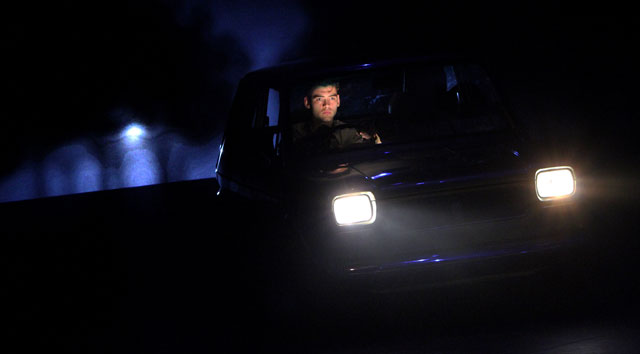
Peter J. Snee’s direction cleverly manipulates all audio and visual cues in the venue to create the familiar sensations one derives from the horror genre. Unlike film though, we seem to require less extreme stimuli to respond with fear in live theatre. Thankfully, Snee does not push our limits too much, and the experience he provides never becomes unbearable. His design team (comprising Phil Shearer on production design, Christopher Page on lights, and Lana Kristensen on sound) does an excellent job of fulfilling its brief of creating a relentless air of skin-crawling foreboding that keeps tensions high, and when appropriate, shock us with powerful effects that literally make us jump.

There is a glaring lack of gender and ethnic diversity in the piece, but its all male cast is an accomplished one, with Lynden Jones’ performance as Professor Goodman providing the show with an inviting and dynamic energy. The actor is charmingly compelling, with an ability to turn the outlandish contexts believable, and a warmth that engages us for the entire duration, even when the plot starts to lose its resonance in its final moments.

Ghost Stories is a rare form of entertainment in the live arena, but it certainly does what it says on the bottle. The scares diminish with time, perhaps because of our acclimation to the production’s provocations, but on the occasions that it is effective, few things are quite as electrifying. There are many ways to have frivolous fun at the theatre, but choosing a night of horror over yet another musical is more than a novel option.

www.sydneyoperahouse.com

Review: The Dream (The Australian Ballet)

ausballetVenue: Sydney Opera House (Sydney NSW), Apr 29 – May 16, 2015
Choreographer: Frederick Ashton (reproduced by Francis Croese)
Image by Daniel Boud

Theatre review
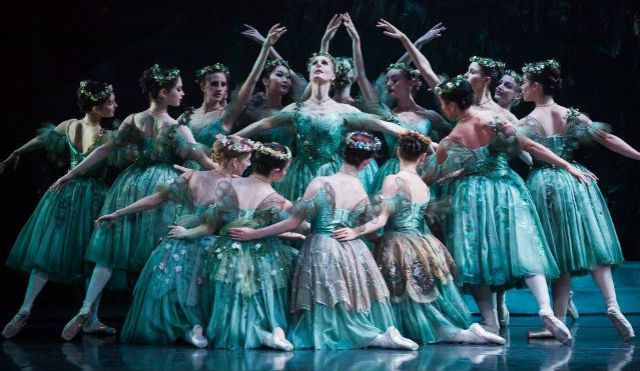
Frederick Ashton’s adaptation of Shakespeare’s A Midsummer Night’s Dream distils all the magic and fantasy of Titania and Oberon’s Fairyland, and uses the ethereal qualities of ballet to provide lyrical expression. Familiar characters are vividly brought to life in dance form, with performers from The Australian Ballet investing in their roles surprising colour and fitting charm. Particularly engaging is Chengwu Guo as Puck, whose powerful and nuanced work is an effervescent highlight of the production.

Retaining original visual design elements for the programme is perhaps unexpectedly effective, especially for Ashton’s Symphonic Variations, which is presented as a prelude to The Dream. Sophie Fedorovitch’s delightful set and costumes for the 1946 piece looks as modern today as it must have seven decades ago, with a stunning backdrop reflective of the early emergence of post modern design at the end of the second World War and in the wake of the Art Deco movement. Ashton’s work features six dancers, all of whom remain on stage for its entire duration, and although adventurous and dynamic by nature, its presentation on this occasion seems too aloof, and energy levels too consistent, to portray the multi-dimensional qualities of its choreography.

The first (of three) Ashton works in the schedule is Monotones II, created in the mid 1960’s to the music of Erik Satie. With just three dancers and a disarming starkness to its visual language, the piece is absolutely unforgiving, and requires of its performers, the utmost in precision, focus and cohesion. When moments coalesce, we obtain the kind of sublime beauty that we seek of the art form, and as inevitable imperfections reveal themselves, one is reminded of the “wabi-sabi” philosophy from Japanese aesthetic principles. Absence makes the heart grow fonder, but it also gives greater meaning to the rest that are present. Perhaps more than any other discipline, ballet’s incessant pursuit of perfection is fundamental to its very meaning and existence. For those of us who deny the possibility of perfection (and hence probably not possess the traits required of professional dancers), it is that very act of pursuance that appeals. The spirit is always willing and pure in our best performers, so even if the body can never live up to our abstract fabrications, what we witness in good theatre is always that passionate belief in something greater, something borne of the brave hearts of our most courageous idealists.

www.australianballet.com.au

Review: Jumpy (Sydney Theatre Company / Melbourne Theatre Company)

Venue: Sydney Opera House (Sydney NSW), Mar 26 – May 16, 2015
Playwright: April De Angelis
Director: Pamela Rabe
Cast: Laurence Boxhall, Caroline Brazier, John Lloyd Fillingham, Brenna Harding, Tariro Mavondo, Marina Prior, David Tredinnick, Jane Turner, Dylan Watson
Images by Brett Boardman

Theatre review
With each scene of Jumpy, pieces of furniture travel across the stage on castor wheels, moving past its protagonist Hilary. She is fifty of age, her only daughter Tilly has turned sixteen and is beginning her own sex life, and we meet them at a time when Hilary has come to realise that a period of stasis is coming to an end. Like the set that keeps rolling past, life seems to have left her behind while she dutifully plays the role of mother and wife. April De Angelis’ script is concerned with women who had grown up with second-wave feminism, particularly those from the era marked by the legacies of Germaine Greer, Gloria Steinem and Helen Reddy. Idealism and militancy fades or perhaps evolves into a modernity that bears little resemblance to the dreams that were birthed, like Hilary, half a century ago. Tilly is in some ways, a disappointment for her mother. De Angelis is critical as well, of the young woman’s need to build her identity around the male gaze. She allows many of her decisions to be determined by a need for the affections of men, and the dissatisfaction she derives from those behaviour evade her self-awareness. Hilary is confounded, and we all wonder how it has come to be that a generation can grow so contrary to its parental intentions. The text does not however, go so far as to say that child-bearing is pointless (although there is a tendency to characterise some parents as being selfish and afraid of loneliness), but we are certainly encouraged to assess the choices Hilary had made for herself.

The context is simple, with a sense of the everyday found in all aspects of its plot. Characters and events are familiar, but De Angelis’ ironic humour is omnipresent. Her comedy depicts middle class existence with a healthy cynicism, and is indeed, thoroughly entertaining. Each personality’s flaws are exposed shamelessly, but the writer’s compassionate approach prevents anyone from turning into clowns or villains. In fact, we identify with all of them, and find most to be very charming. Pamela Rabe’s direction is nuanced and gentle, with no big political proclamations and few dramatic gestures. Relationships are established convincingly, and every narrative is delivered clearly to make us care, and to keep us engaged.

Star of the show, Jane Turner’s outstanding ability and likeability as one of Australia’s top comic performers is well utilised in the production. We are always on her side, and we laugh whenever she wants us to. Turner’s trademark vaudevillian style of performance keeps her at some distance from her role, but there is enough authenticity and commitment in her portrayal to keep things believable. Reasons for the production not being transposed to an Australian context is unclear, but Turner’s British accent is less than satisfactory. It is an unnatural and overly posh affectation that can be uncomfortable to hear, and slightly inappropriate for the story being told. Other cast members are more adept speech-wise, and every supporting character is colourfully performed and memorable. Hilary’s best friend Frances is played by Marina Prior whose captivating vibrancy and self-deprecating humour keep the show buoyant. The contrast, and similarities, between the two middle-aged women are fascinating to observe, and their friendship is deeply meaningful, even though other relationships are given greater weight in the text. Also impressive is Tariro Mavondo’s performance as Lyndsey, the sixteen year-old new mother who treads the fine line between ignorance and purity, spouting pearls of wisdom when least expected. A heart of gold can be tricky to inhabit, but the actor’s effortless charisma turns her character’s innocence into a thing of beauty, and poses a challenge to the way we think about teen moms.

The production is a hugely enjoyable one that keeps our attention firmly under its control. There is a mildness in tone that reflects the theme of maturation, but it finds ways to amuse us from start to end. Its message arrives in the form of questions, but it leaves answers ambiguous. Middle class lives are full of anxiety, and Jumpy shows that the state of peacefulness does not emerge spontaneously with age and happiness does not necessarily materialise upon the fulfilment of duties of one’s choosing. The show does not hold the key to peace and happiness, but it provides inspiration, or at least a reminder, that it is never too late.

www.sydneytheatre.com.au | www.mtc.com.au

Review: As You Like It (Bell Shakespeare)

Venue: Sydney Opera House (Sydney NSW), Feb 21 – Mar 28, 2015
Playwright: William Shakespeare
Director: Peter Evans
Cast: George Banders, John Bell, Gareth Davies, Alan Dukes, Emily Eskell, Charlie Garber, Zahra Newman, Kelly Paterniti, Dorje Swallow, Tony Taylor, Abi Tucker
Images by Rush

Theatre review
As You Like It is not one of Shakespeare’s phenomenally poignant stories, nor is it an exceptional work of fantastical exuberance. It offers interesting personalities and amusing situations, but lacks a sense of grandeur and elements of surprise. Shakespeare might be idolised in all the right quarters, but his writing is certainly not without its detractors. His use of language especially, can be alienating for twenty-first century audiences, and when handled with less than expert proficiency, productions rarely deliver good results. Peter Evans’ direction never quite takes flight. There is plenty of investment into characters who seem to be dynamic and colourful, but we struggle to relate to anyone. Action on stage is lively and confident, but nobody connects with authenticity.

It is never certain where the centre of the play lies. The obvious focus would be on the love story between Rosalind and Orlando, but the remarkably poor chemistry between the two leads leave us searching for something more meaningful, or at least with some level of appeal. Zahra Newman as Rosalind is effervescent and a joy to watch when given the opportunity to take centre stage, but the important quality of romance in her narrative does not convince. Playing Orlando is the regrettably miscast Charlie Garber, whose charming presence and considerable comedic talents prove not to be sufficient for the role to take shape in our imagination. He does his best to exhibit commitment to the more dramatic sequences, but his efforts pale in comparison to when he gets to play the fool.

The stars of the show are its designers. Michael Hankin’s set brings to the stage a glorious interpretation of a Shakespearean forest, with floral garlands cascading from above, adding beautiful dimension and breathtaking hues to the performance space. Lighting by Paul Jackson is sensual but also varied, effectively depicting the movement of time and transformation of space. Kate Aubrey’s costumes are subtle and elegant, with just enough theatrical flourish to help actors establish mood and traits of individuality. Music and sound are utilised with great impact to influence atmosphere and to provide a sense of unpredictability. Kelly Ryall’s songs are pure entertainment, and an excellent touch that helps enrich an otherwise unexciting plot structure.

John Bell plays Jacques, and late in the second act, delivers the famous “all the world’s a stage” monologue. For a moment, the theatre turns electric, and descends into an attentive hush. The magic is real, and there is no mistaking its existence when it does take over. It takes a village to raise a child, and it takes a very big team of talents to put on a show of Bell Shakespeare’s usual ambitious scale, but on this occasion, it seems that the sum of its parts has not resulted in a collaboration greater than the whole.

www.bellshakespeare.com.au

Review: Suddenly Last Summer (Sydney Theatre Company)

Venue: Sydney Opera House (Sydney NSW), Feb 9 – Mar 21, 2015
Playwright: Tennessee Williams
Director: Kip Williams
Cast: Paula Arundell, Melita Jurisic, Brandon McClelland, Robyn Nevin, Eryn Jean Norvill, Susan Prior, Mark Leonard Winter
Images by Brett Boardman

Theatre review (originally published at Auditorium Magazine)
The very nature of trauma is dramatic. It disrupts the heart and mind, and leaves in its wake, disorientation and damage. To repair and to move on, fragmented pieces must first be assembled so that a sense of narrative and coherence can be found. The business of theatre involves storytelling, but it also involves a representation and expression of the human condition. At its best, art communicates something that is deep, but also universal. We want to be able to connect on some meaningful level, whether obtuse or simple. Like psychotherapy and other healing processes, theatre can often be difficult and confusing, but what matters is that artists and audiences emerge with something of value, and perhaps something new.

More than half a century has past since Tennesse Williams’ Suddenly Last Summer first appeared off Broadway, but its ideas remain seductive, and his words have proven themselves to be eternally sublime. Scripts in the theatrical canon are timeless because they are of themselves exceptional, or are able to initiate something extraordinary. Williams’ brilliant work appearing on any stage today will spark debates on the degree to which a new interpretation should stray from the predictable. There will always be purists who prefer faithful renditions that acknowledge the perfection of what is already established on paper, and then others would applaud daring departures that take the text to unexpected realms. Kip Williams’ production places three video cameras on stage with his cast. The revolving stage contains a plain cyclorama that doubles as a screen, so that multiple perspectives of the same stage moment can be offered. The show opens with just the back of the screen in view, and the first scene is projected onto that backdrop so that we can only see a movie sized projection of the performance. The stage then turns to reveal its other side where the actors and set are situated. The projection now continues on the front of the backdrop as the action takes place right before it. The camera operators do not hide from our sight, and although all its design harks back to 1937, our experience is a thoroughly modern one.

The actors portray characters with a sense of nostalgic accuracy, but there is no conventional theatrical experience to indulge in. Our eyes are constantly being pulled away from one image to another, and yet another. We are never allowed to focus too long on any dramatic moment. The work distracts us from itself, and we become frustrated and anxious, like the disturbed people we are studying. The concept of the stage is redefined by the use of video in Suddenly Last Summer. Surely, what we see in the theatre constitutes the performing space, but if our eyes are being manipulated by technology so that we are exposed to something strange, then space takes on different form and notion. If all we can see in the 544-seater is a needle piercing into the leading lady’s arm, then something magical has happened on that stage. Similarly, if a man runs off stage but appears to continue running up the fly tower on screen, then the confines of the proscenium can be seen to have vanished. It is certainly experimental work, and with everything that is unusual, we react first with bewilderment, and if our mental capacities are able to process beyond the immediate, then perhaps the work has achieved interesting intellectual effects. When the director’s work is good, it is because he is immensely inventive, but when bad, it is for the same reason.

Less ambiguous is the quality of performance from Eryn Jean Norvill, phenomenal in the role of Catharine. Through madness and fear, the most extravagant drama can materialise, and Norvill is stunningly uninhibited with the level of emotional and visceral intensity she achieves. Williams’ poetry is delivered through her voice as though singing the most sumptuous, yet tragic, of arias. Whether observing her in the flesh or through the lens, her star quality is undeniable, and it is clear that without her heartbreaking portrayal of a woman in agony, the production would not be remembered for much more than its formalistic inventions. Also captivating is Robyn Nevin, whose regal presence is a perfect match for the severe and menacing matriarch, Mrs Venable. The veteran actor’s portrayal is authentic and hugely engaging, which probably explains the camera’s frequent focus on her, even at moments when she is not taking centre stage. Nevin’s “reaction shots” are beautifully done, but a tricky element that can sometimes diminish the effect of what is actually unfolding in the plot.

Suddenly Last Summer has an astonishing story to tell, with exciting themes that would interest any audience, but the playwright’s efforts come dangerously close to being subsumed by the methods in which his story is told. The unorthodox staging eclipses the text itself. There is so much to discuss and think about when the curtains fall, but what takes precedence is the director’s orchestration of proceedings, which seem to be much more concerned with structure, rather than content. Of course, we should not prioritise the writer’s voice over the director’s simply because the play is well-known, but human impulse wants to revel in narratives, and any deprivation of that enjoyment will come up against resistance. Luckily, when the shock of the new fades away, we discover that it is the immortal soul of a classic tale that endures, and suddenly, last night’s turmoil is distilled and the essence left behind is the memory of Mr Tennessee Williams’ unparalleled legacy.

www.sydneytheatre.com.au