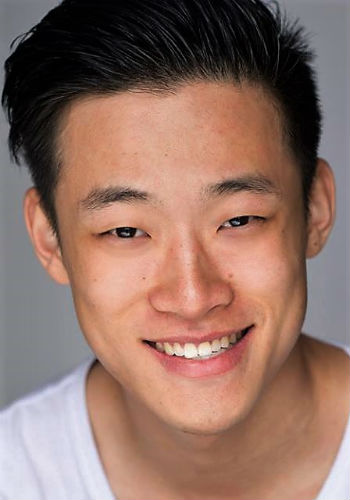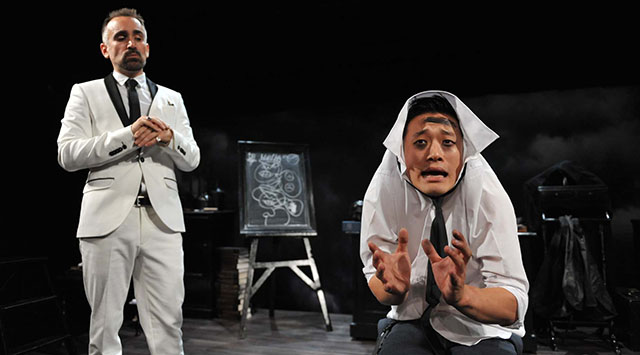
5 Questions with Yannick Lawry and George Zhao

Yannick Lawry

Yannick Lawry

George Zhao: Sum up the character of Screwtape in 5 words or less.
Yannick Lawry: Mad, bad, dangerous to know…

CS Lewis doesn’t pull any punches when it comes to saying what he believes about the world. Playing the character of Screwtape, what is the most confronting thing you say in your personal opinion?
I think one idea Lewis presents is that we, as human beings, are not the ones in ultimate control or our circumstances. That’s massively confronting to many of us (me included!) One line that makes me think every time I utter it is when Screwtape talks about a ‘patient’ he recently captured by distracting him all the time and the patient’s words as he arrive in Screwtape’s kingdom are: “I now see that I spent most of my life doing neither what I ought nor what I liked”. A line that often comes into my head when I’m mindlessly flicking through the news feed on my phone..

You have about 75 mins of dialogue to learn for this show. How on earth did you manage that?
Um.. well, I don’t mind the sound of my own voice so I record each letter and listen to it back again and again until it sticks. Fortunately, Lewis’s train of thoughts and arguments follow nice, logical lines so they’re easy to map out and don’t take too long to sink in!

You’ve done a heap of theatre in London and Sydney but if you could replay any of your past performances which one would it be?
One of the first roles I played in London was Hamlet. He’s such an existentially-challenged brat; but I love the journey he goes on and the range he gives an actor to play in. Being in my late-30s, I probably need to get onto it quickly if I want to give him another shot!

It’s my round, what are you drinking?
If it’s cocktail hour and your budget will stretch to it, a Negroni. Otherwise a VB is just fine, thanks!

George Zhao

George Zhao

Yannick Lawry: Sum up your show, The Screwtape Letters, for us in 5 words or less!
George Zhao: Who’s pulling the strings, then?

What are the habits of a successful actor in your opinion?
Good question! In my humble opinion, they are:
– Knowing what success means to you personally and striving to achieve it.
– Constantly improving on your skill sets and on yourself.
– Allowing yourself time to rest .
– Most importantly, you need to genuinely love to those around you. I really can’t stress enough how much of an impact that has on people!

In The Screwtape Letters, you play a demon and the human “patient” – how do you separate out the two characters when playing them so close together?
I like to flow into the characters via physicality, once i move into the character a certain way, the voice, objectives and history of that character follow.

So, you recently filmed the second season of the awesome SBS series The Family Law – any gems from behind the scenes that you can share with us?
I’m actually still in the process of filming it while I write this! I’ve been incredibly blessed to work with all the people on this production, they are all incredibly loving and willing to help those around them without a second thought, and the catering is AMAZING! As the cast, we have this set of dances which are hilarious when we all do them together. I started a dance in front of the camera during a break in the scene last week, being silly and whatnot, and as I turned around i saw that the *entire* family were behind me doing the dance as well. I’m really hoping the camera was rolling, would be hilarious to watch that back!

You’re touring this show to Melbourne and Canberra after Sydney – where (and why!) are your favourite hangouts in those cities?
Can you believe, I’ve never ever been to Melbourne. So I’m open to suggestions! And the last time I was in Canberra was when I was a kid. So this tour will be significant for me in a whole bunch of ways.

Yannick Lawry and George Zhao will be appearing in The Screwtape Letters by C.S. Lewis.
Dates: 22 Nov – 10 Dec, 2016
Venue: Seymour Centre

Review: Next Fall (Seymour Centre)

boyslikemeVenue: Seymour Centre (Chippendale NSW), Oct 26 – Nov 19, 2016
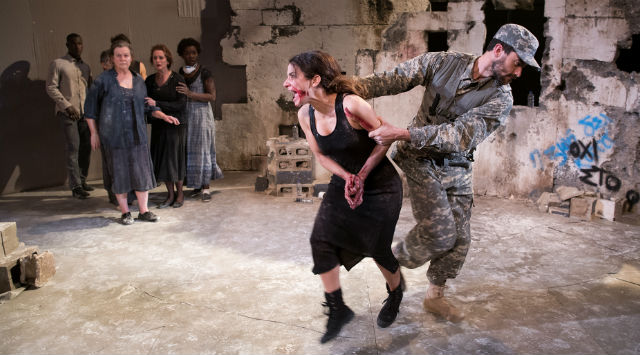
Playwright: Geoffrey Nauffts
Director: Andy Leonard
Cast: Cormac Costello, Mark Dessaix, Alex Ewan, Victoria Greiner, Mary Anne Halpin, Darrin Redgate

Theatre review
Luke is a gay man who believes in God and all that his church teaches. The contradictions that exist between his religion and his sex life are complex, but Luke is able to create enough justification for himself to negotiate and tolerate those intense personal discords. When he falls in love with the agnostic Adam, things become destabilised and the couple has to confront not only their spiritual incompatibility, but also the problem of Luke’s refusal to come out to his parents.

Geoffrey Nauffts’ Next Fall is a romantic tragicomedy that deals with the issue of familial and internal oppression that can often figure in unconventional or non-traditional relationships. In Luke’s case, it is about the homophobia he endures from his family, as well as his own internalised hatred that come into focus, and we observe that the ones who suffer the most, are the lovebirds themselves, while Luke’s church and parents are blissfully oblivious to the damage they cause.

The writing is charming, with excellent comedy and an honest melancholy intermingling for a play that takes aim directly, at the heart. It is surprisingly old fashioned, with little that would prevent it from being re-contextualised from 2009 to, say, 1978, revealing that while thoroughly enjoyable, the work offers nothing that has not already been said many times before. Society’s snail-paced advancement for queer movements around the world is truly disappointing.

Andy Leonard proves himself to be an earnest director, whose straightforward approach tells the story with clarity and an effective sentimentality. Actors in the piece are similarly impassioned. Alex Ewan’s naturalistic style provides Luke with a convincing innocence that helps us make sense of his predicament. Adam is played by Darrin Redgate who entertains with effective comedy and authentic emotions. Mary Anne Halpin and Cormac Costello, as Luke’s flamboyant parents, are probably the most impressive of the cast. Both are theatrical yet warm with their presence, executing precise and nuanced interpretations of their parts that give the show an excellent sense of texture and credibility.

People like us, in places that are free and rich, must take responsibility for our own happiness. Luke thinks that he is answerable to a higher power, but what the facts disclose, is that the only one who jeopardises his relationship with Adam, is himself. Of course, this is a glaring reality that everyone but Luke is able to see, and what the play indicates, is that each of us has individual crosses to bear that are not unlike those on stage. We can tell the characters in the show, with no difficulty at all, what their lives would have needed, but when it comes to our own existences, nothing is quite as simple.

www.seymourcentre.com

Review: Antigone (Sport For Jove Theatre)

sportforjoveVenue: Seymour Centre (Chippendale NSW), Oct 6 – 22, 2016
Playwright: Sophocles (adapted by Damien Ryan)
Directors: Terry Karabelas, Damien Ryan
Cast: Andrea Demetriades, Anna Volska, Deborah Galanos, Elijah Williams, Fiona Press, Janine Watson, Joseph Del Re, Louisa Mignone, Marie Kamara, Thomas Royce-Hampton, William Zappa
Image by Marnya Rothe

Theatre review
In Damien Ryan’s adaptation of Antigone, a single word ‘terrorism’ leads the charge in transforming the ancient text into a story for our times. Language and its accompanying sensibilities are disarmingly modern in the suddenly new play, and we are compelled to engage with its ideas in a thoroughly contemporary manner. It makes us think about the inconvenient evolution of democracy in the age of social media, and the frightening consequences of vacuous personalities running for office. We confront the demonisation and scapegoating of people who have been turned into the public enemy du jour, and examine the eternal dilemma of making sacrifices for the greater good. Almost like a time capsule of culture as it stands, with many of today’s concerns contained in a tale from ages past.

The production encourages our minds to build associations between the unfolding story with our immediate realities, delivering resonances that can feel disparate and divergent, but direction of the work (by Ryan and Terry Karabelas) maintains a dramatic focus with its emphasis on characters and atmosphere. The use of percussive instruments provide tremendous manipulation to mood, and to meaning; Thomas Royce-Hampton’s ability to create just the right sounds at every crucial moment of tension is one of the show’s strokes of genius. The chorus is effectively utilised to steer our moral compasses, along with our emotions, for a theatrical experience that captivates our senses and intellect. It must be noted that there is an elegance and often very delightful approach to the chorus’ stylistic work that brings surprising texture to the show. Visual design is beautifully considered and confidently executed, with Matt Cox’s lights and Melanie Liertz’s set, impressive from the very start.

It is an appealing cast, fortified by excellent chemistry and timing, exuberantly alive for the entire duration. Andrea Demetriades is an earthy Antigone, restrained and almost minimalist in performance style, but consistently believable. More could be made of her crises, that will allow the actor greater space to showcase her abilities, and for us to feel closer to the plight of Thebes’ people. Courage, determination and strength of will are Antigone’s dominant qualities, but they are often left offstage. We witness the aftermath of her heroic deeds, but not the very moments of bravery that are central to how we know her to be. When Antigone defies the demands of community and the state’s decree, she is moved by conscience and love. Through her actions, we arrive at an absolute truth, discovering something fundamental to human experience. She urges us to persist with what we know to be right, and her tender age teaches us to be suspicious of grown-up notions of shades of grey. How a person chooses to live in the real world, becomes that person’s own reality. Antigone is dead at 15, but her life held only pure and good.

www.sportforjove.com.au

Review: Letters To Lindy (Seymour Centre)

merrigongVenue: Seymour Centre (Chippendale NSW), Sep 2 – 10, 2016
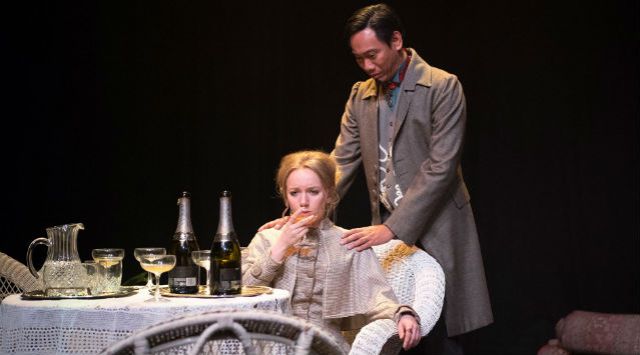
Playwright: Alana Valentine
Director: Darren Yap
Cast: Jeanette Cronin, Glenn Hazeldine, Phillip Hinton, Jane Phegan
Image by Lisa Tomasetti

Theatre review
There was always something impenetrable about Lindy Chamberlain. Without performing appropriately the role of a distraught mother losing her child, many Australians found her coolness disarming. Alana Valentine’s Letters To Lindy too, does not reveal enough of the protagonist’s inner world. A substantial portion of the show is absorbed in recounting events that are already familiar, and although it does provide glimpses into Chamberlain’s deeper thoughts, the play’s structure although earnest, does not quite deliver a poignancy that lives up to its central, harrowing incident. The mother retains a sense of detachment from her public, and we once again struggle to connect.

Jeanette Cronin is star of the show, impressively dynamic in her approach, with surprising interpretations that prevent Chamberlain’s story from turning cliché. Director Darren Yap pitches the performance at a level suitable to the vast auditorium, encouraging actors to bring a vigour to the stage that keeps us attentive. Of the supporting cast, Glenn Hazeldine is particularly charming in a wide ranging suite of personalities, colourfully portraying each character with a delightful, and thoughtful, sensitivity.

We have no right to demand that Lindy Chamberlain acts out a part to fit a narrative that pleases us. In fact, she is to be commended for going against the grain of stereotype, especially in this new era of pervasive and obsessive media scrutiny, to insist on presenting a face of authenticity. As a theatrical work however, Letters To Lindy needs to fulfil our need for something more engaging, and more moving, in its drama.

The cruelty that societies are so ready to dispense on individuals, especially those in the public eye, have to be kept in check, yet we keep creating opportunities for those injustices to be amplified. It seems our need to witch hunt does not cease, even when we already know better.

www.merrigong.com.auwww.seymourcentre.com

Review: Three Sisters (Sport For Jove Theatre)

sportforjoveVenue: Seymour Centre (Chippendale NSW), Jul 28 – Aug 13, 2016
Playwright: Anton Chekhov (translated by Karen Vickery)
Director: Kevin Jackson
Cast: Tom Campbell, Paige Gardiner, John Grinston, Noel Hodda, Zoe Jensen, Graeme McRae, Michael McStay, Kenneth Moraleda, Lyn Pierse, Lauren Richardson, Shane Russon, Justin Stewart-Cotta, Dorje Swallow, Janine Watson
Image by Marnya Rothe

Theatre review
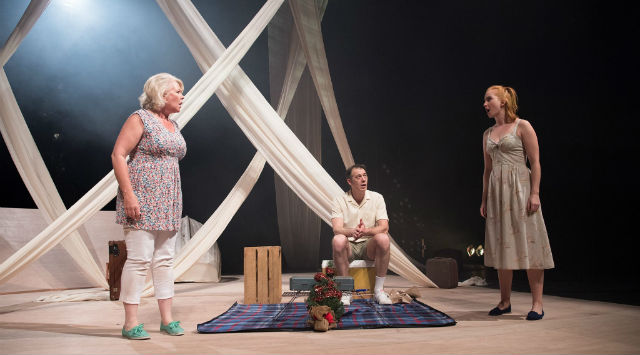
There are few absolutes in life, but change is certain. The world transforms from moment to moment, and how each person experiences the flux of being is where we discover meaning. In Chekhov’s Three Sisters, characters talk about progress, expressing hopes for the future, but are unable to propel themselves into action. Passivity is the enemy, and they succumb to its control. Years pass by and each day in their provincial estate becomes increasingly forlorn and depressed. There is something about the comfort of wealth that prevents individuals from reaching the best of their potentials; in the absence of urgency, one is left frozen, unable to attain greatness that can only result from courage and risk.

The production is both courageous and risky. Under Kevin Jackson’s direction, actors make bold decisions with how their stories are told. They commit to a highly animated style of presentation, uncommon in our day and age, that delivers wonderfully amusing results, but can at times be jarring to our benumbed bourgeois sensibilities. Whether or not we find interpretations believable in psychological terms, Jackson brings a level of clarity to the ideas being discussed that allows the hundred (and some) year-old Three Sisters to speak with an unexpected relevancy.

The director’s love of acting is evident in the amount of detail he encourages from the cast, but at over three hours long, the play is too much of a good thing. Nonetheless, the delightful ensemble of twenty diverse actors (resplendent in costumes by Emma Vine) is teeming with vigour, and evenly impressive. The most memorable scene belongs to Irina, Masha and Olga in Act III when they confide in each other, sharing feelings about sad events, but guffawing at themselves. The contradictions they perform are not only effective in reinforcing Chekhov’s commentary on aristocracy, but a sophisticated device that marries irony with theatricality, for a complex representation of humanity at a moment of despondence.

The tragedy of not being able to realise one’s dreams is made more pitiful when there is nothing ostensibly in the way. The women and men of Three Sisters have no one to blame but themselves for their disappointments, and we react with laughter and with sadness, a bittersweet acknowledgement of their predicament that we readily relate to. In the play, happiness is a concept detached from realities, and the concept becomes increasingly abstract with age. We end the show with women on the verge of a nervous breakdown, but the conclusion is a buoyant one for it provides answers to burning personal questions, along with an optimistic perspective of what can often be a very dark existence.

www.sportforjove.com.au

Review: Resident Alien (Seymour Centre)

seymourVenue: Seymour Centre (Chippendale NSW), Jul 12 – 23, 2016
Playwright: Tim Fountain
Director: Gary Abrahams
Cast: Paul Capsis

Theatre review
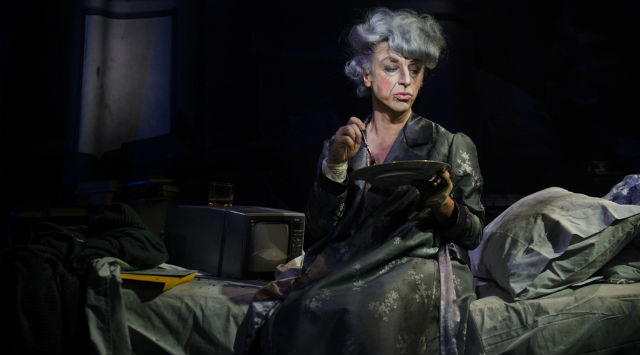
Quentin Crisp is the original and quintessential queer icon of our modern times. Wildly flamboyant and tenaciously outsider, he has left behind a legacy not only of words, but also an attitude and perspective of life that remains cutting edge and inspiring for subsequent generations that continue to be oppressed by the bourgeoisie and its prejudicial values. Tim Fountain’s Resident Alien is eighty minutes of extraordinary wit, unparalleled wisdom and genius observational comedy. Many of the standout lines are familiar to Crisp fans, whether lifted verbatim from his writing and interviews, or simply an accurate representation by Fountain of our memory of the hero. The monologue however, is more than a piece of nostalgic resurrection. It introduces shades of human emotionality to a character who was resolute in presenting a frosty and severe image. The British gentleman is given an opportunity to reveal his tender and vulnerable sides in Resident Alien, so that we can find an even deeper connection through the ever reliable mechanism of sentimentality.

It is a gorgeous production, designed by Romanie Harper (costumes and set) and Rob Sowinski (lights) who provide us with all the visual cues necessary to imagine the decrepit bedroom in which Crisp dwelled, while creating a sense of decadent drama that befits our protagonist, and bringing to sharp focus the physical subject of this monologue presentation. Paul Capsis is the star, captivating, glamorous and alluring with a kind of magnetism that we all desire but rarely encounter. There are efforts at mimicry, but we quickly give up on analysing the impersonation, and delve instead into the glorious essence that Capsis presents on stage, operatic in scale with his bodily and facial gestures, along with a bewitching voice that turns every syllable into song.

We see both Capsis and Crisp, or perhaps more than that, we see ourselves in Resident Alien. It is the meanings that become important. Director Gary Abrahams understands that personality and style are the weapons of seduction, but they play second fiddle to the words that attack with fierce resonance to shake us out of our drear realities. We came to be close to a legend, but are gifted instead a profound and subversive confrontation of our selves, as was Crisp’s very principle for his own existence. His facade was extravagant but flimsy, perhaps intentionally so, so that we can access the truths behind, that his mighty erudition was so generous to offer. Abrahams does the same. His cosmetics are delightful but transparent, allowing us to leave not only with insight into a celebrity’s biography, but the greatest lessons Crisp had learned through 91 years on this earth. His was a theatrical life that always had room for an audience, and the performance was about the alleviation of suffering and a disruption to prejudice. It is the most noble kind of theatre we can hope for, and in Resident Alien, his work lives on.

www.seymourcentre.com

Review: Away (Sport For Jove Theatre)

sportforjoveVenue: Seymour Centre (Chippendale NSW), Jun 22 – 25, 2016
Playwright: Michael Gow
Director: Damien Ryan, Samantha Young
Cast: Angela Bauer, George Banders, James Bell, Michael Cullen, Danielle King, Berynn Schwerdt, Georgia Scott, Lizzie Schebesta, Christopher Stalley, Christopher Tomkinson, Eloise Winestock, Amy Usherwood, Sarah Woods
Image by Marnya Rothe

Theatre review
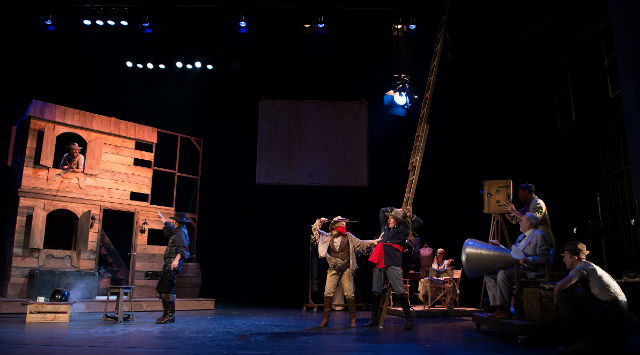
Michael Gow’s Away is about ordinary lives and their hidden struggles. The action takes place in 1967 Australia, but the problems faced by its characters are of a personal nature and therefore eternal in their resonance. Social turbulence evolves with each era, and although we think of the world as being a different place with different challenges through time, Gow’s play demonstrates the constancy of our inner struggles. We can imagine ourselves existing in any period, but human mortality is the basis of how we conceive of ourselves; the awareness of death’s inevitability tells us what we want from each day and what we wish to leave behind.

Away is not essentially of an operatic scale, and its many intimate qualities are lost in the very vast theatre space. The production is attractively designed, sleek and refreshing in its simplicity, but the set has an asymmetry that causes the play to project to approximately two-thirds of the auditorium, leaving remaining seats cold. Direction is similarly negligent of this spacial imbalance. Actor Sarah Woods is a clear stand out for her deliberately exaggerated performance, gripping the audience with an over-the-top entrance, and keeping us engaged with her dramatic flourishes as her character Gwen proceeds to reveal her surprising complexities.

The text has an interest in the dark and messy sides of life but the show has a sterility that disconnects from its intentions. The story might be conveyed well to the better seats in the house, but its message is not delivered with sufficient power. We congregate at the theatre to listen, and those on stage have the responsibility to reach out to all who have made the effort to participate. The room can be packed full through commercial brilliance, but the night proves to be fruitless if people leave with emptiness.

www.sportforjove.com.au

Review: The Taming Of The Shrew (Sport For Jove Theatre)

sportforjoveVenue: Seymour Centre (Chippendale NSW), Mar 19 – 28, 2016

Playwright: William Shakespeare
Director: Damien Ryan
Cast: Robert Alexander, George Banders, Angela Bauer, Michael Cullen, Barry French, Terry Karabelas, George Kemp, Danielle King, James Lugton, Lizzie Schebesta, Christopher Stalley, Christopher Tomkinson, Amy Usherwood, Eloise Winestock
Image by Marnya Rothe

Theatre review
The Minola sisters are the very antithesis to each other’s being. Bianca is sugar, spice and everything nice, while Katharina is outspoken and rebellious. In Shakespeare’s The Taming Of The Shrew, we witness patriarchy at its worst, exposed through the way women are idealised and diminished, made to conform to rules that apply only to their gender. Bianca is perfect, but Katharina is flawed, never mind that Katharina’s behaviour, although vilified, is much closer in essence to the menfolk’s than the anomalously agreeable personality of Bianca. Women are not allowed the same liberties. Like the men in the story, Katharina is too loud, she complains too much, and is uninterested in marriage, but she alone is a figure of contention, and the world resolutely inflicts upon her, that same subjugation and suppression virtually all women have had to endure.

Damien Ryan’s direction does not provide the answer to how we can subvert Shakespeare’s writing for a feminist interpretation, but it is a thought-provoking work nonetheless, sensitive to modern sensibilities regarding representation and politics of gender. The highly controversial speech by Katharina that concludes the play, and that demonstrates the successful vanquishment of her spirit, is orchestrated not with a celebratory tone as originally intended, but with an aura of tribulation. The words are offensive but they are not censored. Ryan does his best to convey the problematic nature of ideologies that underpin the play, but it is ultimately a reverential work that asks many right questions without actually hitting back at its master’s sins. Politics aside, the production is highly entertaining and wildly inventive, leaving no stone unturned for a theatrical experience rich with spectacle and wonder.

If the most significant trait of live performance is the very liveness of its reality, then The Taming Of The Shrew is a triumph of energy and impulse. Although tightly rehearsed, the ensemble is doggedly present and full of vitality. Danielle King is the shrew in question, unapologetically feisty in her portrayal of delicious recalcitrance. Playing the softer sister, but no less powerful, is Lizzie Schebesta, impressive with her physical agility and humour. Both actors bring to the stage passion and strength, creating characters independently admirable, shifting slightly the text’s repugnant power imbalance of genders. Also memorable is Terry Karabelas as Hortensio, full of dramatic exuberance, enthralling in all his scenes and irresistibly funny with every deliberate gesture.

The production begins with an announcement of thanks to supporters of independent theatre, but we soon discover that our associations of independence with smallness has no bearing at all on the scale of talent displayed here. Design aspects of the show are uniformly superb. Anna Gardiner’s set design is charming, surprising and gloriously innovative. Lights by Sian James-Holland are boundlessly dynamic and sophisticated, and sound by Tom Allum is replete with instinctual accuracy. We are treated to a thing of great beauty, marvellously polished and thoroughly delightful with its aesthetic explorations.

With patriarchy reinforced by Katharina’s transformation and her eventual discovery of love and happiness, the audience is left in two minds. If we believe in happily ever after, then our protagonist’s debasement is to a certain degree, justified. We can acknowledge that playing by the rules of the boys’ club has its rewards, but it does not take extraordinary incisiveness to perceive the immorality that is at play. Authenticity is compromised, and the cards are stacked against half of us, in a game that we all have trouble avoiding. Shakespeare’s persistence in our cultural landscape is a reflection of the maleness that flaunts its dominance. Unable to help ourselves, we keep going back to the Bard and all his archaic ideas, that we insist on perpetuating for all time.

www.sportforjove.com.au

5 Questions with Maria Angelico and Simon Corfield

Maria Angelico

Maria Angelico

Simon Corfield: In Bad Jews it is their grandfather’s heirloom that they fight for. What would be the thing that would send you into battle against a family member?
Maria Angelico: I love that the question is worded as to assume I’ve never gone into battle with a family member before! Being one of three sisters with Sicilian background; unfortunately we have. That being said though, we’ve never gotten to the level that this play does. If there were something though, it I would have to be if one of us did something to damage our closeness. It may sound strange but my family work hard to be close, so if one of us went against that, we’d fight fiercely to fix it… so I guess we’d go against each other to not be against each other if that makes sense ha!

Daphna is a force to be reckoned with, what kind of natural disaster do you think she would be?
Great question! Tornado. She’d be a lone freakish Tornado that you see coming but can’t look away. She approaches slightly and it’s almost exciting, then all of a sudden you can’t escape and she sucks up all your world, energy and cookies, leaving nothing but mess and exhaustion…. yet she’s still kind of cool and exciting. So yeah, she’d be a tornado.

Have you found it difficult playing Daphna each night? If so, what in particular?
Playing a role that thinks and speaks at three times the pace that I do is incredibly difficult. It takes a lot of energy! Sometime I feel like I’ve run a marathon after the show and I have to keep looking after myself. That’s not too difficult though, it’s satisfying. The hardest thing would have to be how cruel she is. It is so much fun getting to be a bitch on wheels every night, it really is, but getting into Daphna’s bitterly lonely psyche every night can feel a bit heavy. I have to make sure I spend lots of time in-between shows, laughing, relaxing and spending time with puppies and people I love. I wouldn’t have it any other way though! I’m thrilled and grateful to get to be Daphna, Joshua Harmon did such a wonderful job of writing such a dynamic, smart, witty and deep role for a woman and I cherish the opportunity!

You have written and starred in your own acclaimed comedy web series, Movement. Who tickles your funny bone?
So many people do! I’m a big fan of SNL Kristen Wiig and Maya Rudolph in particular, I also LOVE Louis CK and Larry David, oh and Julia Louis- Dreyfus, Jenny Slate, Ilana Glazer and Abbi Jacobson of broad city and Lilli Tomlin, Woody Allen, Gilda Radner! Oh god the list could go on and on and on! That being said, I actually think I find my funny bone most often ticked by strangers and moments I witness in my day to day activities, from little things I over hear or awkward moments that happen even to myself or friends. Life to me is more than often hilarious. We humans are funny awkward creatures!

Any tips for those wanting to access their inner manipulative bitch?
1. No one is your friend. You can be anyone’s but choose not to be.
2. You are superior.
3. People are amusingly stupid.

Simon Corfield

Simon Corfield

Maria Angelico: What do you like most about the play?
Simon Corfield: That when you walk on stage each night you never know if the audience are going to laugh, gasp, or both. *added bonus is people coming up to you in the foyer telling you how much they hated you.

What do you dislike most about the play?
That it’s only 90 minutes. Once I have jumped into the world of Bad Jews, I really could keep going. It’s too much fun being a self-entitled, smug little f&@k.

How would you describe the cast in three words or a phrase?
A cast that laughs together, farts together.

What TV or film is the play most like?
The comedy in the play reminds me of early Woody Allen, or Curb Your Enthusiasm, but the fight between Liam and Daphna reminds me of the awesome 80’s film The War Of The Roses.

What have you learnt from the play?
When playing a character like Liam, to never be afraid of your audience disliking you. You cannot control what personal experiences and beliefs an audience member walks in with. Bad Jews delves into the fight between different belief systems about religion, a timely conversation that needs to keep being had, and I have learnt that in such a piece if someone hates you onstage, they are going to walk away and think or talk about why. The conversation will continue beyond watching the show, and that’s what every theatre maker wants.

Maria Angelico and Simon Corfield can be seen in Bad Jews by Joshua Harmon.
Dates: 18 May – 14 June, 2016
Venue: Seymour Centre, Sydney

Dates: 13 July – 31 June, 2016
Venue: Queensland Performing Arts Centre, Brisbane

Dates: 9 – 14 Aug, 2016
Venue: Regal Theatre, Subiaco

Review: Bad Jews (Vass Theatre Group)

badjewsVenue: Seymour Centre (Chippendale NSW), May 18 – Jun 4, 2016
Playwright: Joshua Harmon
Director: Gary Abrahams
Cast: Maria Angelico, Simon Corfield, Anna Burgess, Matt Whitty

Theatre review
Joshua Harmon’s Bad Jews explores authenticity of the self in relation to religion, ethnicity and history. At opposite ends of a spectrum are the religiously observant Daphna and her atheist cousin Liam, both Jewish by genealogy but each relating to their backgrounds in vastly different ways. They fight over what constitutes right and wrong, constantly and fervently berating each other for their conflicting life choices. At its best, Harmon’s writing is deliciously cutting, with characters verbally attacking each other at the most vicious degrees imaginable. The words are brutal, but they ring true, even as they emerge in contradiction from opposing sides of the argument.

The play’s comedy is not always refined but director Gary Abrahams injects a confident energy into the production to ensure that chutzpah makes up for the occasional shortcomings of the text. Abrahams’ eye for detail delivers a very tight production that insists on being compelling at every moment, and rich with thrilling resonance whenever it delves into more meaningful proclamations.

Excellent performances by the cast of four make Bad Jews a memorable night at the theatre. Daphna is played by Maria Angelico with extraordinary gusto. Dangerous, funny and vulnerable, she goes through the gamut of human emotions for a portrayal of what seems an oddity but in fact translates with intimate accuracy. We may not be able to identify with her world of religious righteousness but her very human expressions of desperation are universally accessible. In the role of Liam is Simon Corfied, animated and passionate with great conviction, giving life to an uptight scholarly type who although represents the voice of reason, is comically unable to quell his shortness of temper for his adversary. Supporting actors Anna Burgess and Matt Whitty are both accomplished and precise with their depictions. Burgess in particular, impresses with her capacity to turn every brief opportunity in the limelight into a delightful showcase for her comedic genius.

For all its talk about religion, and the varying extents to which its individuals practise the beliefs that they inherit, Bad Jews makes a convincing point about love being the overriding factor that helps determine how we live. We cannot decide who we truly fall in love with, much like we do not choose who we are born to. Liam is accused of sacrilegious desecration by the pious Daphna, but the play makes us understand that anything that would come between real love to be erroneous. Liam revels in the purity of his romantic relationship, while Daphna experiences purity in her religious orthodoxy. They are concurrently right, even if in a state of war.

www.badjewstheplay.com