Review: Which Way Home (Ilbijerri Theatre Company)

Venue: Seymour Centre (Chippendale NSW), Jul 4 – Aug 4, 2018
Playwright: Katie Beckett
Director: Rachael Maza
Cast: Katie Beckett, Kamahi Djordon King
Images by Snehargho Ghosh

Theatre review
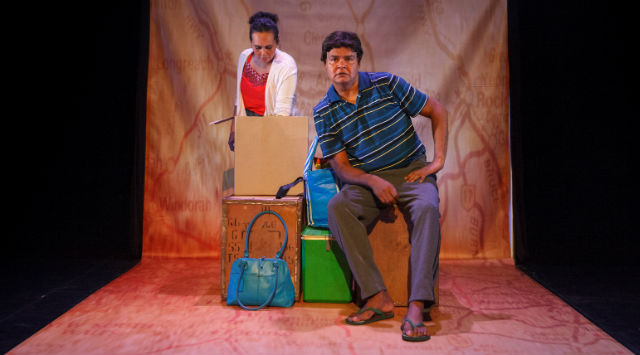
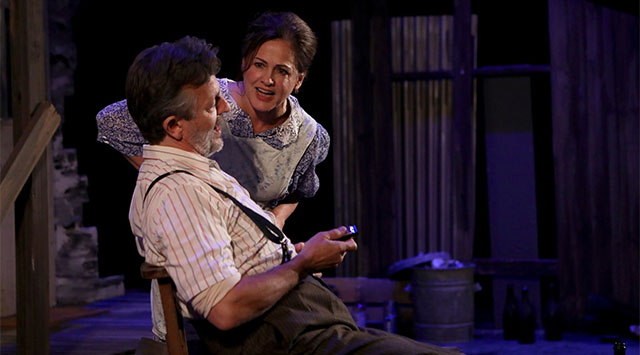
Tash and her father are on a road trip to Lightning Ridge. Even though Tash is the one behind the wheel, she is jittery and hesitant, while her father is at peace, completely trusting that they are going to reach their destination with no troubles at all. Katie Beckett’s Which Way Home is a tender work about the father-daughter relationship, and a look at the ageing process. Young and old are placed in contrast with one another, for an appreciation of the way we mature, and for the value that elders embody in our communities. At its best, the play contains profound observations about family that are rarely articulated in our art, but a tendency to mollify the harder questions about kinship, results in a reduction of poignancy with what is being delivered.

Directed by Rachael Maza, the show feels warm and buoyant, and whether or not we are able to identify with its characters, an effortless charm from both actors keeps us engaged in their journey. Beckett takes on the role of Tash, proving herself a detailed performer adept at telling stories with remarkable clarity. Kamahi Djordon King is an affable presence, with an inviting sense of humour that wins us over. A more naturalistic approach to acting would provide a more authentic experience, but the pair brings a beautiful energy to the piece that many will find reassuring.

Life’s lessons require time. Words of wisdom can be spoken but they are not always heard. It is perhaps our greatest weakness, that the young are doomed to repeat the mistakes of the past, but nature will have its way and insist that we let it take its course. Tash learns all she can from her father, but she can only take things at her own pace. We all have a duty to leave this a better place than how we had found it, and the older we get, the more salient that notion becomes. The children must be taught the best we know how, and we can all but hope that things do keep getting better.

www.ilbijerri.com.au

5 Questions with Katie Beckett and Kamahi Djordon King

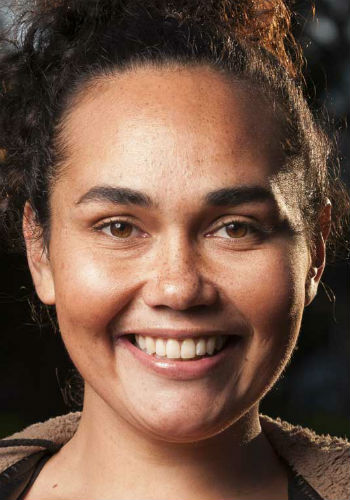
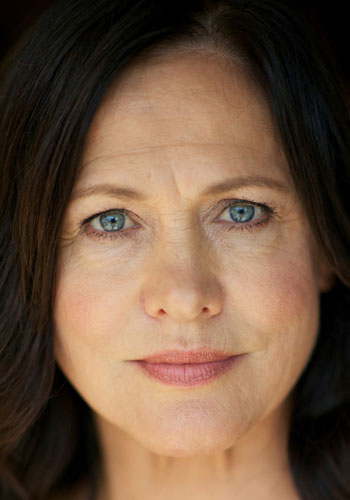
Katie Beckett

Kamahi Djordon King: How do you feel about playing back on home turf at the Seymour centre with a different actor in the role of Dad?
Katie Beckett: I am so excited to be playing back in Sydney. I love Sydney. The west and the inner west are my hoods. I was born out in Western Sydney, went to primary school there in north St Mary’s. Moved to QLD, then moved back. And as an adult lived around the inner west, Redfern, Newtown, Enmore, Glebe and now Lilyfield. So Sydney holds a special place in my heart. The last time I did the show in Sydney it was part of the Sydney Festival at Belvoir and we smashed it out of the park. Sold out with an extra week. 

I love working with Kamahi as Dad. My dad even loves Kamahi as playing him. Kamahi brought a breath of fresh air to the character, love and comedy to the role. Professional and easy going to work with. It’s been a dream having him.

Has the end result of the work surpassed your expectations on how the work is received by audiences?
Yes!! I’m surprised for me it was just a little family yarn. A way of healing and coping with dad’s fifth heart attack. So I write with heart. And it’s beautiful seeing the audience take it.

Question to the writer. What are three things you would change about your character and why?
Considering it’s my first play and I now have a bit more experience of writing I would change my character to be softer in moments. And make her grow up a bit more. I find her annoying and childish at times. But I also did that to get the comedic elements to work with the dad.

What did you see yourself doing at this age twenty years ago?
I saw myself working in the camera department in film and tv industry. I dreamed of being a cinematographer. But here I am an actor and writer for theatre, film and tv.

What has the impact been on you as an actor with a new person stepping into the dad role? 
The impact has been fantastic and I found things I discovered before in my character. I have a different connection with Kamahi so it’s easier to do.

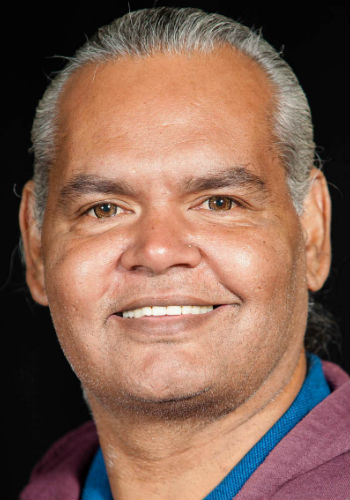
Kamahi Djordon King

Katie Beckett: Were you worried about coming into a role that has already been played by another actor?
Kamahi Djordon King: I was a little at the start until I figured you and Rachael were not expecting me to be exactly the same as the other actor. 

What made you say yes to taking on this role?
It was going to be my first tour with an Ilbijerri produced play and I though it would be nice to work on a tour again.  Especially a long tour like this.  Plus it was an affirmation that I was getting older and playing someone’s dad is the best thing for that, as an actor challenge-wise I mean. 

I’m impressed with you learning the script in 2 weeks. Can you share your secret to learning and developing your character in a short time?
Yes, the honesty and truth of the character comes from the physicality of the actions.  The memories are created by rehearsing the script up on the floor.  It is almost like muscle memory with dancers.  After a while the lines sink in together with the actions of the character and a memory is created so that when you are doing the play, the memories become your inner monologue and you deliver your lines with their actions creating honesty or truth.  I learned this from The Actors Workshop in Brisbane with Lynn Kidd.

I hear you are close to Constantina Bush. Any chance she will pop up along the tour? Has she said anything about the show?
Yes, we are close although very much in competition with each other all the time.  I think she said she is popping in to do shows in Mildura and Canberra. She reckons she will try to catch the show at one of those places although I wouldn’t count on it.  She has never once seen one of my shows.  Nor I hers for that matter… 

You are a true artist… writer, actor, singer, dancer, painter, female impersonation. And do it all incredibly well. And always in demand. How do you manage to balance all your artistic ventures?
The balance seems to happen naturally, very rarely do I double book, although it has happened. The art is something that keeps me busy when either of us has no work.  The visual art side of things is something that I have been doing for a long time and it does sell which keeps me in money when the performance side is quiet.  I come from a family of artists so that is natural. The performance is something that i have had to learn and perfect though and I only get better with everything that I do and take on such as this play.  It will be great for when I have to play someone’s dad again, haha.

Katie Beckett and Kamahi Djordon King can be seen in Which Way Home , by Katie Beckett.
Dates: 24 Jul – 4 Aug, 2018
Venue: Seymour Centre

Review: The Rolling Stone (Outhouse Theatre)

Venue: Seymour Centre (Chippendale NSW), Jul 5 – 21, 2018
Playwright: Chris Urch
Director: Adam Cook
Cast: Henrietta Amevor, Nancy Denis, Zufi Emerson, Damon Manns, Mandela Mathia, Elijah Williams
Images by Clare Hawley

Theatre review
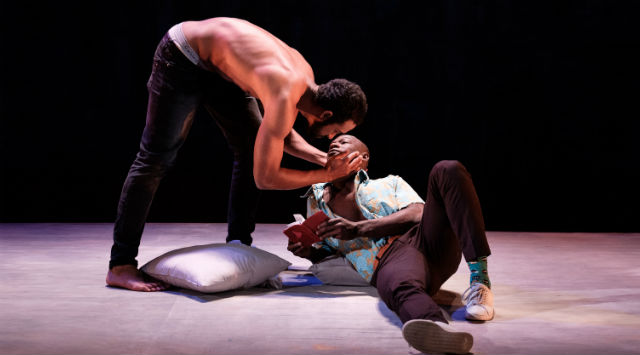
Dembe is an 18 year-old gay man living in Uganda. His family thinks of themselves as being exemplary Christians, but for many in their culture, the killing of homosexuals is not only a permissible deed, it is often exhorted to be a godly act. When Dembe falls in love, the personal and the social can no longer be reconciled. The persecutions illustrated in Chris Urch’s The Rolling Stone, are extremely cruel, but we know them to be factual. Urch pulls no punches in his storytelling; the passions are wild, whether evil or virtuous, and we are not spared the worst of human nature, even as we delve into the purest of our emotions.

Much of the play is horrifying and depressing, but an overt theatricality in the production’s tone chooses our minds over hearts, in how it wishes to keep us engaged. Adam Cook’s direction requires of us, a cerebral approach in our appreciation of his show, so that we may come to a greater understanding, of the colossal stakes at play, and of the mechanisms that drive the barbarism being depicted. The Rolling Stone steers clear of ever turning itself into torture porn, ensuring that Dembe’s conflicts and suffering are used, not for masochistic indulgence, but for a greater sociopolitical purpose.

Elijah Williams is a powerhouse leading man, completely captivating with a larger than life presence, and disarming with the extraordinary degree of vulnerability he is able to convey. Dembe’s love interest Sam, of Northern Irish and Ugandan descent, is played by Damon Manns, deeply impressive with the nuance he puts into the portrayal, of a man unable to escape the oppression he has to endure for his sexuality, in both Europe and Africa. The actor delivers remarkable dynamism and complexity, for a role that he makes wonderfully convincing.

Also very endearing is Henrietta Amevor as Naome, the young woman who has lost her voice to trauma. Amevor’s performance speaks louder than words, perfectly calibrated to tell us all we need to know of her secret story. Zufi Emerson proves herself very likeable, pairing an effortless warmth with technical precision, for a surprisingly memorable turn as Dembe’s sister Wummie. Nancy Denis and Mandela Mathia are splendid in more dramatic scenes, both bringing chilling power to the formidable malice they represent in this painful tale.

There are noteworthy technical elements in the production, including Isabel Hudson’s sophisticated take on scenic design that adopts traditional style wings to complement the show’s classic acting traits. Lights by Sian James-Holland give the stage an astonishing beauty, even when the action turns daunting. Ryan Devlin and Nate Edmondson keep music and sound design understated, but there is no denying the efficacy, and elegance, of what they accomplish.

The Rolling Stone is an important story for people of colour everywhere. LGBT activism has achieved exceptional advancements in many white communities, but whether in developing or industrialised nations, there is no question that gay liberation has thus far failed many queer people of colour. The abuse and murder of gay and trans people that occur every day, no longer make the Australian news. With the passage of marriage equality, we have convinced ourselves that the work is complete. Even if we do not wish to spare a thought for atrocities overseas, what happens in the neglected enclaves of black and brown Australia must not be ignored.

www.outhousetheatre.org

Review: The Flick (Outhouse Theatre)

Venue: Seymour Centre (Chippendale NSW), Apr 5 – 21, 2018
Playwright: Annie Baker
Director: Craig Baldwin
Cast: Justin Amankwah, Matthew Cheetham, Mia Lethbridge, Jeremy Waters
Images by Marnya Rothe

Theatre review
Almost every cinema in the world has completed the transition from analogue to digital, and with it comes aficionados bemoaning the loss of authenticity and tradition, in an art form that touches the lives of all. In Annie Baker’s The Flick, not only is celluloid under threat of annexation by blu-ray, the employees at a small picture house have friendships that are challenged by what they think to be real or illusory. They spend days together, becoming increasingly intimate, but always conscious of the distances between. They experience comfort in each others’ presence, but trust is never a certainty. When push comes to shove, the surprise of betrayal rears its ugly head, and like the technology in their projection room, convenience and cost takes precedence.

The play is beautiful in its sensitivity, and wonderfully humorous. Development of its characters and relationships, are cleverly written, replete with nuance and acuity. Dialogue is amusing and brilliantly observed, with contemporary colloquialisms thoughtfully utilised, for an accurate reflection of Western society at this very point in time. These people may or may not be familiar, but we always know exactly how they feel. For cinephiles, The Flick‘s obsessive enthusiasm with film culture, is a very big added bonus.

It is a glorious set, designed by Hugh O’Connor and constructed by Rodger Wishart, thrillingly realistic in its replication of the typical interiors of a movie theatre. Music paying tribute to genres of film, are meticulously crafted by Nate Edmondson, who also creates a variety of unmistakably unique sounds, in the form of whirrs and purrs to be heard emanating through the walls whenever we congregate for a movie. Martin Kinnane achieves a surprising range of atmospheric modifications with his lights, and has us transfixed with the unusual perspective offered by having us looking, wrong way round, into the projector lens, watching rays instead of images that have accompanied us hundreds, if not thousands, of times before. Led by stage manager Steph Kelly, technical aspects are remarkably well managed for this production of The Flick.

Directed by Craig Baldwin, the show is full of resonance; comical, whimsical and emotional. Chemistry between actors is masterfully harnessed, for a thoroughly honest and genuine depiction of social dynamics in The Flick. Actor Justin Amankwah is convincing, and very charming, in the role of Avery, the withdrawn youngster who loves movies more than he does any human being. His minimal, but precise approach gives depth and intrigue to the story, with a portrayal of mysterious qualities that has us captivated. Also very entertaining is Jeremy Waters as Sam, the Gen X slacker who finds himself suddenly older but not much wiser. It is an endearingly animated performance by Waters whose nuances are a joy to watch, and whose confidence with punchlines delivers some excellent laughs. Mia Lethbridge plays Rose the projectionist, with a delightful playfulness that prevents the less than agreeable character from becoming too alienating. The three form a tight partnership, and even though the show does extend to the three-hour mark, we never tire of their company.

The Flick is completely satisfying, but there is no question that in it, people are disappointing. Avery’s adoration of Hollywood is a reflection of his idealism, and his struggles in engaging with real life can be considered in terms of society’s deficiencies, or we can think of it as Avery having problems understanding the world as it actually is. Accompanying the cynicism in Annie Baker’s play, is our unambiguous desire for virtue. The stories we tell may not always be happy and uplifting, but they invariably contain our eternal faith in things that are good. Although new films no longer come to us on film, nothing will stop us from imagining better lives and better worlds, in all our arts and sciences. Of humanity’s many flaws, our naive belief in progress seems forever invincible.

www.outhousetheatre.org

5 Questions with Dina Panozzo and David Soncin

Dina Panozzo

David Soncin: In five words how would describe your character, Momma Bianchi?
Dina Panozzo: Heart, big-love, the-boss, fire and wit!

Do you find your character, or the play as a whole, has any similarities to your life personally?
I think we’re similar in her immediacy and, sometimes, her hot head! The play is a direct shot to my heart of the past as my family, with my 18 month old brother and 3 month old baby me, arrived in Melbourne in 1955, just at the time of this play’s setting! So these people are so like my people back then.

Have you found any challenges with approaching this particular text?
To fight my prejudice against the assumption of its clique-ness! In my first read of the play, the Italians, written with the ‘accent’ in the lines by an Anglo writer, read as an Australian fairytale to me… non-authentic. But, as I’ve gone deeper into the process of telling this story along with my fellow actors, I find it to be profound and moving — with Tony Poli who plays my husband, we go into the sound of our first language — and it is coming to life and so, so much more complex than I first thought. It is an important study on racism and tolerance I believe.

Do you have any inspirations for approaching Momma’s character, or even your work in general?
My mamma e papà, Maria Panozzo e Bruno Panozzo, who were and are still brave and true, and — I have to say even if too “woggy” sounding — all the immigrants who want to belong (like Gino, our son in the play, who is really the only one who stands up for his right to belong).

If you could pick out of Momma Bianchi’s two children, why is Gino your favourite?
Because he’s still young enough to kiss and hit if cheeky!

David Soncin

Dina Panozzo: What five words would you use to describe The Shifting Heart?
David Soncin: Immigrants, assimilation, family, racism, pride.

What’s the most difficult part of bringing this play/Gino to life?
Probably exploring and understanding that part of Gino that seeks acceptance – understanding the struggle with indifference, and his determination to assimilate, which he does with total optimism – and finding those similar things in myself. That, and singing 4 bars of “Americano”.

What do you think Gino dreams about for the future?
I think Gino deep down just wants to live a good life in his new country: get married, have kids, have a successful business with his brother-in-law and, most importantly, be accepted by his Anglo counterparts as a true Australian.

What do you love about the play?
Well firstly, I love the fact we have an Australian classic that explores Italian culture and, having a full Italian immigrant background on both sides of the family, it’s exciting that I get the chance to tell these types of stories. It deals with the psychology of racism, discrimination, racial and domestic violence, and the cultural struggle of an immigrant family. But I also love the fact it doesn’t shy away from the humour of a loud Italian family because that shit is funny!

How do you think this play relates to us in the here and now?
I could probably write a whole essay answering that question, but the school students seeing the show might plagiarise. The short answer is, I absolutely believe the play is still relevant, for many reasons. The Shifting Heart highlights the negative patterns of thinking and physical behaviour towards immigrants, different cultures and ethnicities, and that those patterns seem to keep seeping through the cracks each generation. I don’t think the play’s intention though is to put Italians specifically in a sort of victim pigeon hole, but I believe it’s an important period of reflection of Australian immigrant history.

The play also comments on the interesting notion of subtle/subconscious racism in everyday language, like jokes about one culture being okay, but not others; when is it innocent and when is it racist? I have my own experiences but not necessarily the answers. But, as opinions are often the lowest form of knowledge, I’d have to say come and see the show! I’m always curious to hear about audiences’ own experiences on the play’s subject matter.

Dina Panozzo and David Soncin can be seen in The Shifting Heart by Richard Beynon.
Dates: 8 – 24 Mar, 2018
Venue: Seymour Centre

Review: The Shifting Heart (White Box Theatre)

Venue: Seymour Centre (Chippendale NSW), Mar 8 – 24, 2018
Playwright: Richard Beynon
Director: Kim Hardwick
Cast: Laurence Coy, Lucas Linehan, Dina Panozzo, Tony Poli, Di Smith, David Soncin, Ariadne Sgouros
Image by Danielle Lyonne

Theatre review
It is Christmas time 1956, and the Bianchi home in Melbourne is bustling with activity. The family is getting excited about the festivities ahead, occupying themselves with the frenzied yet mundane business of the Australian summer. We soon discover, however, that beneath the Bianchis’ attempts to go about their normal lives, they have to contend with the social stigma of being recent immigrants to a land where strange and cruel attitudes prevail, about which people are deserving, and not deserving, of being here.

Richard Benyon’s 61 year-old play The Shifting Heart is concerned with a peculiar brand of racism that we undertake, whereby earlier immigrants persecute later immigrants, whilst Indigenous peoples are routinely neglected. The Bianchis discover that although legally permitted to settle here, many do not extend them a welcome. Benyon portrays the family trying to get on with life the best they can, amidst the unjust obstacles heaved at them every day.

It is a sensitive piece of writing, offering insights that remain pertinent; a valuable study of how racial prejudice operates in societies like ours, with an ever evolving racial composition. As a work of drama though, scenes of emotional vigour seem to occur few and far between, and its manufacture of tension tends to be overly understated.

Directed by Kim Hardwick, the production is a persuasive one. We may not be heavily invested in its personalities, but their stories are certainly believable. Isabel Hudson’s set and costumes, along with Martin Kinnane’s lights, are beautifully evocative, affecting our imagination with flair and efficiency.

Dina Panozzo and Tony Poli, as Momma and Poppa Bianchi, bring chemistry and warmth to the stage, both effective in transporting us to another time of our shameful history. David Soncin leaves a strong impression as Gino Bianchi, the gregarious and passionate young Italian-Australian determined to live unhampered by prejudice. Their neighbour Leila Pratt is played by the very likeable Di Smith, relied upon to deliver much needed humour, and effervescence, in this weighty observation of Australian life.

There is no denying that humans everywhere cannot help but create difference, seemingly for the purpose of baseless discrimination. Bigotry is not natural to our children but somehow, a need to hate is developed as we mature, and whether it pertains to race or to other arbitrary features, we learn to feel good about ourselves by exerting power over others. This is ubiquitous, but we must never think it irreversible.

www.whiteboxtheatre.com.au

Review: Strangers In Between (Seymour Centre)

Venue: Seymour Centre (Chippendale NSW), Feb 14 – Mar 2, 2018
Playwright: Tommy Murphy
Director: Daniel Lammin
Cast: Simon Burke, Wil King, Guy Simon
Image by Sarah Walker

Theatre review
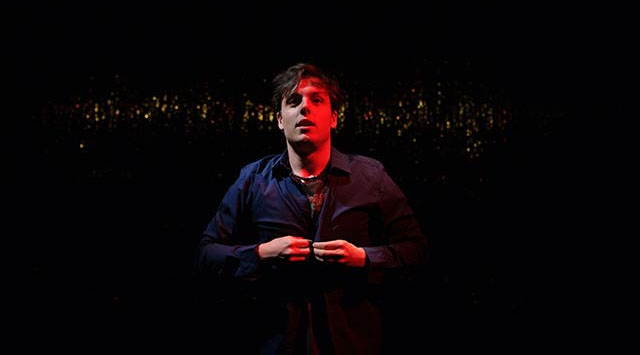
Not everyone is lucky enough to have families who offer affection and support. For many LGBTQI people, the system of kinship is often a manufactured one, relying on families that we have chosen for ourselves rather than the ones we were born into. The prejudices that continue to divide us, are very alive in Tommy Murphy’s Strangers In Between, a story that takes place in the early years of this new century. Shane has left the country town of Goulburn, for the bright lights, and acceptance, of the broadminded city folk in Sydney. The teenager runs from the systematic bigotry of home, in search of a community he hopes would be welcoming. Queer children will always be birthed by straight parents, so the threat of domestic conflict will perhaps never completely diminish, therefore Murphy’s tale of belonging can be thought of as a timeless one.

Actor Wil King is dramatic, but convincing, in the role of Shane. Delivering both theatricality and nuance, King is as compelling as he is sensitive, for a depiction of innocence that is unexpectedly moving. His intensity can occasionally prove overbearing, but there is no denying the trenchant perspectives he brings to the stage. The middle-aged gay man Peter, is played by the delightful Simon Burke, who creates a camp and compassionate personality many will find endearingly familiar. It is a delicate performance that combines a cool exterior with a warm heart, to accurately portray a Darlinghurst “scene queen” type. Also very accomplished is Guy Simon, who impresses in his dual roles of Will and Ben, characters as different as night and day, but both equally authentic with all that they convey. Director Daniel Lammin does exceptional work in bringing the play to life. His minimal approach ensures that the bonds that form between the men, are depicted with clarity and profundity, so that the audience is transported to a space of reflection and appreciation for the communities that we are part of.

The LGBTQI rights movement has delivered significant change to perceptions and acceptance, but the more freedoms we attain, the less likely we seem to want to attach ourselves to ideas of community. The Darlinghurst in Strangers In Between, from just thirteen years ago, has now lost its vibrancy. What was once a tight-knit locale, is now dispersed and aloof. The queer city slickers today are powerful and entitled, protected by advancements in attitudes and legislation. We no longer hold on to each other for dear life. In the past, young ones like Shane were able to fall into the nurturing arms of Oxford Street, but what happens today and hereafter, looks to be ever less optimistic.

www.dontbedown.net | www.fortyfivedownstairs.com

Review: Joan (Seymour Centre)

Venue: Seymour Centre (Chippendale NSW), Feb 16 – 18, 2018
Playwright: Lucy J Skilbeck
Director: Lucy J Skilbeck
Cast: Lucy Jane Parkinson
Image by Robert Day

Theatre review
When they burned Joan of Arc to death at the age of 19, it was punishment for the charge of heresy, of dressing in men’s clothes. In Lucy J Skilbeck’s Joan, we acknowledge the warrior as a queer figure, finally indulging in the highly probable idea that the hero was in fact transgender. For those whose gender identities are never a complicated matter, this might seem a little like making mountains out of molehills, but for many LGBTQI individuals, Joan’s story of persecution is one that needs to be recognised for what it is.

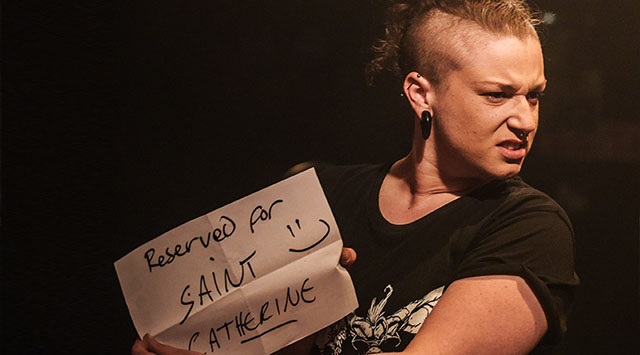
In Skilbeck’s revised account of events, we sometimes see Joan as a lesbian in love with Saint Catherine, sometimes a drag king, but mostly we are encouraged, finally, to regard Joan as a person unable to comply with age-old rules of gender. The masculine armour was not merely an instrument of practicality for the fighter. We now know those struggles to be commonplace, that trans people exist everywhere, and that we always were. The restoration of queer and trans perspectives in our legends and histories is crucial to the way we think about ourselves, and represents an urgent demand that society validates all our contributions to the world; past, present and future.

Lucy Jane Parkinson showcases a wealth of talents, as performer of the one-person show. A captivating presence, versatile and confident in their effortless vacillation between goofy and sentimental, Parkinson presents a character determined to steal our hearts one way or another. Their ability to maintain a personal connection with all of the audience, for the show’s entire duration, is a stunning feat, achieved through an intense sense of vulnerability and a precise, exhaustive familiarity with the work.

Joan of Arc’s legend was always about gender, yet for centuries, that story was told with a major obfuscation at its very core. When society refuses trans people the freedom to be ourselves, by misgendering us, and by forcing us to adhere to its narrow definitions of gender, that cruelty and injustice will invariably have reverberations beyond the immediate, and the damage caused is always greater than any of us would be ready to admit. This is why reinstating Joan’s truth in our historical memory, for the benefit of LGBTQI generations hereafter, is important. The meaning of gender is little more than the imposition of restrictions, to manufacture a system of control over individuals. It benefits few, yet virtually all of us participate in its fictions. We can dream to demolish these beliefs, but before we reach that point of enlightenment, all these rules have to be loosened, if only to salvage what is left of our humanity.

www.milkpresents.com

Review: Give Me Your Love (Seymour Centre)

Venue: Seymour Centre (Chippendale NSW), Oct 31 – Nov 4, 2017
Playwright: Jon Haynes, David Woods
Director: Jon Haynes, David Woods
Cast: Jon Haynes, David Woods

Theatre review
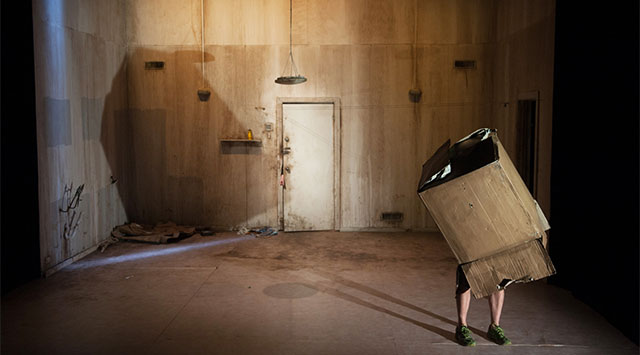
Not only is Zach trapped in his room, he has resolved to stay inside a cardboard box, never to emerge. Jon Haynes and David Woods’ Give Me Your Love portrays life after war, for a Welsh soldier suffering from Post Traumatic Stress Disorder. Although wildly imagined, the work never deviates from a sense of authenticity in the way it discusses mental illness. The comedy is clearly outlandish in style, but the scope of its concerns remains faithful to a sense of accuracy, and urgency, in its depiction of a veiled but serious social problem.

It is an enormously witty show, and fantastically inventive, not only with its clever dialogue, but also in the sheer theatricality of what it presents. Jacob Williams’ set design is viscerally affecting, powerfully evocative of spaces in and around our protagonist. Zach’s tattered box is wielded masterfully by Woods, like an oversized mask. In his best moments, we connect in a profound way to the agony being explored, and reach a decent understanding of the difficult psychology and emotions, as experienced by those who live with PTSD. We can see that Zach is being ridiculous, but in quite an inexplicable way, we know what it feels like, to persist with behaviour that makes no sense.

Give Me Your Love relies on our universal need for empathy. The audience is introduced to an extraordinary set of circumstances, but the storytelling touches us intimately, and we recognise Zach’s dysfunction to be fundamentally human. It is also about sacrifice, personal and communal, inevitable and unfortunate. Life does not permit anyone to go through it unscathed. Damage will be done, but it is when we learn to heal the wounded, that we can begin to regain some control.

www.ridiculusmus.com

Review: No End Of Blame (Sport For Jove Theatre)

Venue: Seymour Centre (Chippendale NSW), Oct 12 – 28, 2017
Playwright: Howard Barker
Director: Damien Ryan
Cast: Akos Armont, Angela Bauer, Danielle King, Sam O’Sullivan, Monroe Reimers, Lizzie Schebesta, Amy Usherwood, Bryce Youngman
Image by Kate Williams

Theatre review
In No End Of Blame, Howard Barker creates a hero out of political cartoonist Bela Veracek, who begins his life in Hungary at the end of the 19th century, and ends up in England decades later, after a stint in Lenin’s Russia. It is a man’s search for truth, through decades of war and social unrest, and an artist going against every grain to make sense of the world.

First published in 1981, the piece is stylistically representative of English male playwrights of the time, angsty and very wordy. Thatcher had become Prime Minister, and the righteous had much to fight for; Barker is certainly argumentative in No End Of Blame. Damien Ryan’s production updates the work from the punk era to something altogether more earnest and refined.

Projected on a large, white backdrop, are drawings by Nicholas Harding, David Pope and Cathy Wilcox, who bring an extraordinary dimension of artistry, constantly pulling our attention back to the actual medium being celebrated. Also remarkable is Alistair Wallace’s sound design, utilising a meticulous selection of music that takes us to places far away and sublime.

There is a lot of excellent acting to be enjoyed. Akos Armont is the charismatic and passionate lead, dependably convincing even though Bela’s emotions seem always to be operatic in scale. Supporting roles are all vibrantly rendered, with Danielle King especially memorable in a range of small parts, and highly effective as newspaper editor Stringer, delivering a tremendous sense of poignancy at show’s end.

As commentators of our world, cartoonists have the noble responsibility of pointing their finger at all that is wrong. This usually means that it is the powerful that come under the pencil’s attack, and it is necessary for us all to be cognisant of how those powers will try to quash their naysayers. Bela’s story came before the internet age, but even though we no longer have the same reliance on the print industry to provide a battle ground for democracy, those same dynamics exist today in how we use our phones and computers. The bad guys are able to control our freedoms, in some ways easier than before, and our resistance must remain vigilant and tenacious.

www.sportforjove.com.au