Review: What Is The Matter With Mary Jane? (Seymour Centre)

seymourcentreVenue: Seymour Centre (Chippendale NSW), Aug 4 – 8, 2015
Playwright: Wendy Harmer, Sancia Robinson
Director: Sancia Robinson
Cast: Gabrielle Savrone
Image by Jodie Hutchinson

Theatre review
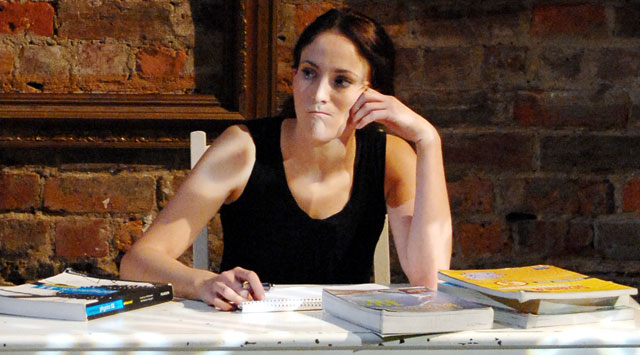
Wendy Harmer and Sancia Robinson’s What Is The Matter With Mary Jane? gives exposure to the experiences of patients who suffer from acute eating disorders. It is a passionate work with clear intentions of informing society about lives that are often shrouded in the secrecy and shame of anorexia and bulimia nervosa. The play has a desire to improve awareness and perhaps inspire political action that will help with healing or eradicating these horrific diseases from our communities, which results in a text that is full of enthusiasm but also clinical at times. The work focuses on the processes involved in, but not the reasons behind its protagonist’s affliction, so that it can represent a wide range of experiences unified by manifestations of the illness. The play acknowledges that the causes of these disorders vary widely, but the omission of psychological insight or analysis of specific events that have contributed to its unfortunate circumstances, is a significant decision that prevents the show from engaging with its audience more deeply. Sentimental dramatics might not always be elegant, especially in profoundly personal disclosures, but they are often necessary in helping our heads and hearts in becoming more involved with the story and its message.

In directing her own biography, Robinson brings to the stage an intimacy and truthfulness that can only come from having lived through the ordeal very personally. There are some shocking revelations, but the authenticity in her style of presentation disallows any room for doubt, and important facts from Robinson’s recollections are imparted in the process. Gabrielle Savrone’s portrayal of pain is accurate and moving. We are convinced of her character’s divulgements, and she satisfies the purpose of the work by alerting us to the nature of the problem from personal and societal perspectives. The lighter portions of the play are less effectively performed, but the actor’s conviction is strong, and her work develops with more power as the play progresses.

Self-image is an integral part of every individual’s being. How we live depends largely on how we see ourselves, and for many, physical appearance is a component that can turn into an all-consuming preoccupation, which is actually symptomatic of an impairment that lies deeper than skin. What Is The Matter With Mary Jane? demonstrates an extreme consequence of untreated emotional difficulties that requires our vigilance. Compassion towards others, and having a healthy attitude towards other people’s bodies is a good, and necessary start, that will quickly evolve into the same generosity that we must afford our selves.

www.seymourcentre.com

Review: Of Mice And Men (Sport For Jove Theatre)

sportforjove2Venue: Seymour Centre (Chippendale NSW), Jul 9 – Aug 1, 2015
Playwright: John Steinbeck
Director: Iain Sinclair
Cast: Andre de Vanny, Andrew Henry, Anna Houston, Anthony Gooley, Charles Allen, Christopher Stollery, John McNeill, Laurence Coy, Terry Serio, Tom Stokes
Image by Marnya Rothe

Theatre review
Lennie’s intellectual disability in Of Mice And Men reveals the forgotten innocence inherent in all of humanity. His experience of the world is one that everyone can identify with, but the virtuous purity that he exemplifies is utterly absent from our daily adult lives. Unlike Lennie, we have grown too complicated and are often dishonest in the way we treat one another and ourselves. Few of us can remain idealists, and even though John Steinbeck’s play inspires the longing for a simpler and truer existence, the inevitability of its demise is also exposed. We question the corruptness that we allow in, and meditate upon the dynamics in our communities that instigate these unfortunate states of affairs. Most people are good, but when we come together, bad situations easily arise. Of Mice And Men looks at a group of men, bound by poverty and by dreams, and their journey towards a calamitous fate.

This production, directed by Iain Sinclair, is a near flawless rendering of Steinbeck’s 78 year-old text. Beautifully realised by a brilliant design team (Michael Hankin is production designer, with Nate Edmondson on sound, and lights by Sian James-Holland ), the show feels rich with authenticity and provides our senses with a satisfying approximation of how Northern America must have been at the Great Depression. Sinclair’s consummate control of atmospherics delivers a transportative pleasure that pulls us into the emotions and actions of characters that are a world away from our current realities. Each personality is conveyed with compelling idiosyncrasy, and chemistry between every actor in every scene is calibrated just right, so that stories and events are convincing and splendidly detailed.

The cast is uniformly strong, with a sense of egalitarianism in the ensemble that supports the play’s themes of camaraderie and community. Andrew Henry is sensitive, tender, and unquestionably touching as Lennie. His work is performative but also heartfelt, so that the audience’s engagement with his creation is much more than skin deep. Instead of applying a basic treatment to a simple character, Henry’s approach is meticulously inventive and the results are as entertaining as they are moving. The other leading man of the piece is Anthony Gooley, who fills the stage with charisma and a magnetic energy that is impressively dramatic. In the role of George, his empathy for Lennie is depicted powerfully, which is key to the plot’s effectiveness, but the final scene requires greater pathos from the actor for a more explosive conclusion. Charles Allen and Laurence Coy play smaller roles but are individually captivating. They generate theatrical magic with deeply nuanced interpretations of identity and sentimentality, both enthralling in their moments of eminence.

Classics resonate through the years because they encapsulate something true and universal that time is unable to diminish. Of Mice And Men represents our belief in justice, and the right of all persons to seek improvements for their circumstances. It appeals to our need to define right and wrong, and that desire to understand the differences between. Most of all, it serves as a reminder that we should strive to be better people, and to avoid the complacent and inferior, even if it requires going against every tide.

www.sportforjove.com.au

5 Questions with Charles Allen and Anna Houston

Anna Houston

Anna Houston

Charles Allen: How do you prepare to play a character that isn’t even given a name in the play, you are only referred to as Curley’s Wife?
Anna Houston: I work like a script detective … what clues are in Steinbeck’s script, his novel? Then I broaden the scope to look at the time period she came from. That helps with filling in the gaps about domestic life, socio economics, education, and so on. The rest is imagination and intuition. So much of what you bring to a role is intuitive, emotional. That’s the fun stuff. I also found a beautiful letter that Steinbeck wrote to Claire Luce, the first actress to play Curley’s Wife on Broadway in 1937. In it, he discusses her background, her motivations and desires. That letter does a lot to restore her dignity and humanity.

Curley’s Wife wants to be a star in the movies… which would you choose, being a star on stage or in the movies?
Can I do both, please? I think I’ll go with being a star on stage, paid movie star money.

5 words you’d use to describe working with a cast of 10 actors.
A noisy explosion of creativity.

Favourite down time activity on your days off from acting?
Sleeping.

Why should people see Of Mice And Men?
Because it’s Steinbeck! It’s gritty, heart breaking and timeless. It’s epic on the most intimate and vulnerable scale. And the artists at the helm of this production are at the top of their game. Excellent direction, design and performances. It deserves a damn big audience!

Charles Allen

Charles Allen

Anna Houston: Of Mice And Men is controversial for its language and the social environment surrounding its only African American character Crooks, how do you feel playing a role like that?
Charles Allen: Well, that comes down to separating the ego of the actor from the behavior of the character. I feel fine especially considering playing such a character requires me to stretch as an actor.

Crooks likes to read a lot of books, which book have you read recently that you really enjoyed?
I’m into Memoirs Of A Dutiful Daughter right now and I am really enjoying that.

Which actors inspire you?
My friend and fellow actor Mark Nassar. He isn’t well known but I’d put him in the ring with any actor past or present.

You are currently based in Brisbane… what is the first touristy thing you’ve done in Sydney?
Take a picture of the Opera House.

Why should people see Of Mice And Men?
Because it’s an atypical love story that is destined for tragedy. It uses simple characters to tell a complex story. It’s beautiful.

Anna Houston and Charles Allen will be appearing in Spot For Jove Theatre’s Of Mice And Men/em> by John Steinbeck.
Dates: 9 – 25 July, 2015
Venue: Seymour Centre

Review: Triassic Parq (Squabbalogic Independent Music Theatre)

Triassic Parq Company 3   Pic Michael Francis.jpgVenue: Seymour Centre (Sydney NSW), Jun 17 – Jul 4, 2015

Book & Lyrics: Marshall Pailet, Bryce Norbitz, Steve Wargo
Music: Marshall Pailet
Director: Jay James-Moody
Cast: Mark Chamberlain, Keira Daley, Blake Erickson, Crystal Hegedis, Rob Johnson, Adèle Parkinson, Monique Sallé
Image by Michael Francis

Theatre review
There are two sides to every fight. In Triassiq Parq, we finally learn the truth about the dinosaurs in Spielberg’s Jurassic Park and why they had run amok killing every human in sight, all those 22 years ago. It turns out nature had imposed its own ideas about gender and reproduction on the living exhibits, and along with the subsequent collapse of religion in the neo-Triassic community, all hell breaks loose. Clearly, absurd doesn’t even begin to describe it, but the madness of the contexts proves to work even better in the musical format than in a blockbuster adventure-thriller movie. Sure, there are no frightful moments of computer generated cartoonery here, but the level of hilarity being spawned would rival any attempt at filmic entertainment.

The production is a relentlessly comical one. Even though it takes itself seriously enough to display an impressive standard of professionalism, director Jay James-Moody unearths a great deal of inventiveness to ensure that the show is funny at every step of the way, and with a wicked but sophisticated sense of humour, he prevents the show from ever turning too unsavoury in light of the text’s extravagant silliness. Minor sacrifices are made in terms of the relationships between characters that could have been portrayed with more emotional depth, but it is a small price to pay for the genuine and incessant laughter it is able to manufacture.

Neil Shotter’s brilliant set design achieves an unexpected variety of spacial configurations that help make scene transitions dynamic and cohesive. It is not a lavish construction, but what it delivers is incredibly imaginative and very effective. Also contributing to the show’s success is its 4-piece band, headed by musical director Mark Chamberlain, as well as the work of sound designer Jessica James-Moody. The confidence and liveliness of what they present, along with its ability to coalesce all physical and visual elements on stage into an effervescent whole, is remarkable.

Performances from all members of cast is strong. They are entirely committed and unified in vision, and what they may lack in terms of star quality, they more than make up for with tenacity and skill. Blake Erickson is memorable as the Pastor (and also as Morgan Freeman), with a powerfully versatile voice, and a delightfully camp sensibility that stretches from wincing to wild, perfectly suited to the tone of the show. In the role of the curiously transgender T-Rex 2 is Adèle Parkinson, who attacks with a kind of outrageous abandonment that keeps us captivated at every turn. Parkinson’s singing connects as much as her comedy does, and we find ourselves enamoured with all that she brings to the stage. Leading man Rob Johnson plays the Velociraptor of Innocence, the dinosaur who declares it a beautiful day to be a woman, before disaster strikes. The vibrant and energetic Johnson is a precise, if slightly wooden, performer whose disciplines as a triple-threat serve him well in the part. His presence needs to grow larger for centre stage, but it is a warm one that makes him an easily liked personality.

There are few things as irritating as a musical that tries to convey deep and meaningful messages, and fails. Triassiq Parq is no such thing. It uses the musical format to bring joy and wonder to an eager crowd desperate to be divorced from reality, who for 90 minutes escapes into a world of childlike stupor in search of something extraordinary and light. Triassiq Parq is clever, mischievous, and dexterously executed. It is everything one could need at trying times.

www.squabbalogic.com.au

5 Questions with Blake Erickson and Jay James-Moody

Blake Erickson

Blake Erickson

Jay James-Moody: When you only have three weeks to rehearse a full scale musical, what is your process?
Blake Erickson: Research, research, research. I draw on inspiration from a wide range of sources. Obviously everything begins with the text, but people are complex, so I start to think about the influences on a characters life. When I’ve done that I begin fleshing out a character starting with their voice. Then it’s all up to what happens in a rehearsal room, the wonderful thing is that it’s a different experience every time!

Do you find it easier or more difficult working with collaborators you have a long performing history with?
When you’ve worked with someone before it does take the mystery out of it and you do get to move straight to the work rather than the usual ‘getting to know you’ side of producing a show. That said, there’s nothing I love more than new collaborations. Old friends or new, it’s wonderful to be in a room with like-minded people working toward a common goal. The theatre is a bit magical like that.

How would you say the industry of music theatre has changed in the time you have been involved?
There’s so much more! When I started out less than a decade ago there seemed to be a dearth of new work, small shows, and independent works. That has changed considerably thanks to people taking risks and having the courage to actually create something – be it a venue, a company, a show, a song, a play, even a rehearsal space.

When being tasked with bringing a character named Velociraptor of Faith to life, where do you draw your inspiration?
Religion aside, the concept of ‘faith’ to me suggests an enormous amount of self-confidence and strength. I approached the character looking at performances that have impressed me due to their quiet intensity and power. The work of Frances Conroy, Meryl Streep, and Laura Dern (ironically enough considering her Jurassic Park pedigree) have been particularly influential.

What is the most compelling reason an audience should come and watch Triassic Parq?
When I sat down to read the script for Triassic Parq, it was (and remains) the funniest script I have ever read in my entire life. Now I’ve seen it on stage with these extraordinary performers at the top of their game, it remains the funniest musical I have ever seen in my entire life. How could you resist?

Jay James-Moody

Jay James-Moody

Blake Erickson: When Squabbalogic chooses a show to produce, what most informs your decision?
Jay James-Moody: “Is this something I’m going to want to watch 20 times?” is the primary drive. There are a few other motivations including “I’m desperate to see this and nobody else is going to do it” and “I haven’t seen anything quite like this before.” More selfish reasons are “Is there a part in this for me?”

A lot of actors send you headshots and bios when audition time rolls around, do you have any do’s and don’ts or general advice for those aspiring to work with the company?
If you write me an email and address me as “James”, I tend to frown on that. It’s also telling when we are approached by actors who actually haven’t seen our work. That says a few things. But I never mind someone getting in touch and letting me know they are interested in coming on board. In terms of auditions, I want to meet people who are authentic as people and give me the impression that we will have a good time together for a few weeks and aren’t going to be trouble. Folks who are team players. Your reputation on the grapevine also counts for a lot.

Who in the business would you most like to work with, but haven’t yet had the opportunity?
It’s an incredibly long list, and we have already been very fortunate to have ticked off a number of names. A few names that spring to mind: Michelle Doake, Genevieve Lemon, Sharon Millerchip, Mitchell Butel, Bert La Bonte, Peter Carroll…

What is “Australian musical theatre” to you?
Something that needs and deserve more attention and support – not people decapitating tall poppies with a ride-on lawnmower.

You win $10m on an instant scratchie, what do you do?
Start development on that 500 – 1200 seat theatre Sydney desperately need.

Jay James-Moody is directing Blake Erickson in Triassic Parq a comedy musical involving dinosaurs!
Dates: 17 June – 4 July, 2015
Venue: Seymour Centre

Review: The Merchant Of Venice (Sport For Jove Theatre)

sportforjoveVenue: Seymour Centre (Chippendale NSW), May 22 – 30, 2015
Playwright: William Shakespeare
Director: Richard Cottrell
Cast: Darcy Brown, Michael Cullen, Pip Dracakis, Jonathan Elsom, Lucy Heffernan, Jason Kos, Erica Lovell, James Lugton, Lizzie Schebesta, Christopher Stalley, Damien Strouthos, Aaron Tsindos, John Turnbull
Image by Marnya Rothe

Theatre review
At the centre of Shakespeare’s The Merchant Of Venice is its anti-semitic depiction of the principal antagonist, Shylock, the Jewish moneylender. Productions today face the conundrum of having to adjust their interpretations to fit contemporary sensibilities, while maintaining a level of faithfulness to the author’s original. The script not only demeans Shylock as an individual, it often makes sweeping statements that can only be termed racist.

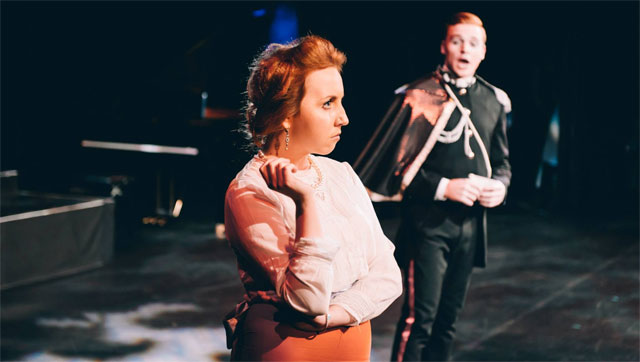
Richard Cottrell is clearly aware of the problem, as his direction of the work reflects the precariousness of bringing to stage a script that, although well-crafted, is painfully archaic in its representation of attitudes toward Jewish peoples. Cottrell’s show does not hide the outrageously vilifying lines of the text, but subverts them to reveal ugliness of those words. Content that is objectionable by today’s standards, is portrayed as such, so that the company declares its oppositional stance to what Shakespeare had intended. The production is set in pre-WWII, and it encourages us to view the Bard’s vilifications in a context that relates to the rise of Nazism. It is a sophisticated treatment of the material, but the play’s conclusion is preserved sufficiently, so that the story’s distasteful moral is kept intact. It is hard to deny what the work is about, and much as Cottrell is careful with the issue, the show leaves a very bad after-taste. Some are fond of questioning the interminable choice of reviving Shakespeare, but on this occasion, the question is undeniably about the decision to pick this title in particular.

A reason for any interest in Merchant could be that Shylock is among the most spectacularly audacious characters in the Shakespearean oeuvre. Performed by the magnetic John Turnbull, the role is colourful, unpredictable and spine-chillingly dangerous. Turnbull’s work is precise and calculated, but also full of panache and vigour. It is a very stylish performance that is fascinating to watch, and the actor’s ability to present both good and bad sides of his character is complex and quite beautiful. Another star of the production is designer Anna Gardiner, who has created a simple but effective Art Deco set, and a wardrobe of very handsome suits, for an elegant aesthetic that makes the unpleasant goings-on slightly more digestible.

The way we relate to Shakespeare in Australia today is peculiar. We like to think that being suspicious of authority is a crucial part of our identity, yet virtually all quarters readily accept the legitimacy of his genius. The gender bigotry in all his texts is conveniently swept under the carpet, and it appears that we are quite happy as well, to let sleeping dogs lie when it comes to issues of ethnicity and faith. The company has created an entertaining show, and all their individual talents are marvellously present, but we need to take a stronger stand for the things we believe to be true.

www.sportforjove.com.au

Review: A Little Night Music (Sydney University Musical Theatre Ensemble)

muse2Venue: Seymour Centre (Chippendale NSW), Mar 25 – 28, 2015
Book: Hugh Wheeler
Music & Lyrics: Stephen Sondheim
Director: Alexander Andrews
Cast: Stuart Bryan, Emma Elsley, Owen Elsley, Harry Flitcroft, Louise Flynn, Sarah Gaul, Bronwyn Hicks, Christie New
Image by Wenray Wang

Theatre review
Desiree and Frederik are middle-aged but they are yet to find fulfilling relationships. Sondheim’s A Little Night Music is a very adult love story that contains more farce than it does romance, and speaks to a slightly jaded audience that understands the complexities and illusions of love. The text is an intelligent but mischievous one, offering interesting insight into the personal aspects of mature lives. The most popular song of Sondheim’s entire oeuvre, “Send In The Clowns” is a prominent feature that encapsulates the experience of longing and regret. The decision by MUSE (Sydney University Musical Theatre Ensemble) to stage the work is ambitious on many fronts, but the greatest challenge is for its very young team to convincingly portray the show’s main characters who are at least twice their age. The humour and pathos of the narrative, and its musical numbers, are heavily nuanced and demanding of any cast, but to expect those who have yet to taste all the flavours of life to interpret A Little Night Music with depth and poignancy is a very tall order indeed.

Director Alexander Andrews may not have the most seasoned performers at his disposal, but his flair for musical theatre is undeniable. Andrews is careful to keep the stage active with movement and surprise, so that we are visually engaged throughout the three hour production. Dramatic tension is not always present, and the piece often lacks exuberance, but sequences are paced quickly, with fresh events unfolding consistently to retain our attention. Stronger performers include Christie New, who creates a very funny Charlotte Malcolm, endearing us with sharp self-deprecation, and a knack for delivering powerful punchlines in both speech and song. Also memorable is Madame Armfeldt, the brilliantly zany matriarch presented by Sarah Gaul with gusto and flamboyance. Stuart Bryan cuts a fine figure as the show’s leading man, but his approach is too reserved, and his self-consciousness distracts from Frederik’s emotional journey. Quality of singing in the production is accomplished. Clare Richards’ powerful soprano is a standout, and Conrad Hamill’s work as Music Director, while being fairly rigid is delightfully detailed and precise.

Mr Sondheim’s work is quite literally second to none. He is an original and an undisputed genius, whose creations are ubiquitous and magnificent. Good productions of his body of work make for sublime nights of unparalleled theatrical pleasure, but lesser attempts can still be enjoyable by virtue of the sheer prowess of foundations already laid down years before. Musical theatre is rarely reinvented, and young practitioners of the genre subject themselves to emulating successes they had witnessed before. There is a sense of duplication that exists, whether effort is put into matching what had been great, or intentions are to supercede prior manifestations. It is a true conundrum, when one considers the true essence of art and the pursuit of all that is new.

www.museatusyd.com

Review: Man Of La Mancha (Squabbalogic Independent Music Theatre)

Venue: Seymour Centre (Sydney NSW), Feb 25 – Mar 21, 2015
Book: Dale Wasserman
Lyrics: Joe Darion
Music: Mitch Leigh
Director: Jay James-Moody
Cast: Stephen Anderson, Marika Aubrey, Hayden Barltrop, Reece Budin, Ross Chisari, Laurence Coy, Paul Geddes, Courtney Glass, Brendan Hay, Glenn Hill, Jay James-Moody, Rob Johnson, Shondelle Pratt, Kyle Sapsford, Tony Sheldon, Joanna Weinberg, Richard Woodhouse
Images by Michael Francis

Theatre review
Optimism and delusion can sometimes be different sides of the same coin. In an often dreadful world, having only a realistic mindset can be a debilitating existence. Hope is essential for moving forward, and at certain points in life, the only thing that we can cling to. The darker the days, the braver the dreams, and against the backdrop of the Spanish Inquisition, Man Of La Mancha features perhaps the most idealist of all literary characters, Don Quixote.

Jay James-Moody’s direction of the work is dark and desolate. The pessimism underlying the protagonist’s fantastical imaginings overwhelms the stage, and while melancholia can be a beautiful thing, it can also be oppressive. The production is polished and slick, and nothing much seems to be out of place, but the lack of a joyful energy makes for a show that feels monotonous, even though it bears a warm sincerity that can become very moving at crucial points.

Tony Sheldon’s rendition of the principal song “The Impossible Dream” is perfectly delivered, and he shows us what it is that makes a star. Sheldon’s performance is perhaps not sufficiently effervescent in earlier sequences, and the tone of the show is set too grave too early, but the depth that he brings to the role is more than anyone can hope to glean from a commercial musical, and his ability to create quiet moments of profundity is a thing to behold. In the role of Aldonza is Marika Aubrey who provides a much needed vibrancy to the music with her very bright timbre, but her acting does not reach the level of authenticity necessary for her narrative to engage. Much is made of Aldonza’s struggle for goodness, but we never quite believe that story.

More compelling is Ross Chisari whose impressive disciplines in voice and movement stand him in good stead, for a dependably charming performance as Don Quixote’s squire Sancho Panza. Chisari also serves as choreographer, and his work on that front is equally accomplished. The cast is moved around the stage with meaning and ease, and his efforts at creating colour from gestures and tableau are subtle but highly effective. The creatives do a solid job on the production, making this the best looking show from Squabbalogic thus far. Brendan Hay’s costumes, Simon Greer’s set and Benjamin Brockman’s lights are transportative and aesthetically sophisticated, and even though they are unable to inject greater buoyancy into the dramatics, they achieve great success with its visual imagery.

The dark is meaningless without light. Man Of La Mancha is lovingly crafted, but it does not communicate with enough fluency. It needs to be punchier, with greater dynamic range, so that our emotions can fluctuate with its story. The plot is written so that we come to a powerful conclusion, but what we feel does not match closely enough to what is seen unfolding on the stage. The artists here have dared to dream, and that is important, for as long as the brave lead the way, the rest can follow.

www.squabbalogic.com.au

5 Questions with Ross Chisari

rosschisariWhat is your favourite swear word?
Easily, fuck. I say it like people say the word ‘and’ or ‘like’. I think it’s because I’m Italian. It’s basically the first word we learn!

What are you wearing?
Ha, I’m currently wearing Superman boxers from Peter Alexander. If I’m gonna sleep in something, it has to be classy.

What is love?
Love is difficult. It’s difficult to find. It’s difficult to understand. It’s difficult to hold onto. That feeling towards something or someone that makes you defy all logic. It’s what some people dream about, or (like me) it’s what some people spitefully toast to cheap wine and thai take-out!

What was the last show you saw, and how many stars do you give it?
The last show I saw was Sweet Charity at the Opera House. It’s a knock-out show. The cast is actually a joke to watch on stage and the music gives you chills. 4.5 stars for sure!!!

Is your new show going to be any good?
Man Of La Mancha is going to be like nothing anyone has ever seen before. It’s got an incredible cast and creative team and the company have the most inspirational, dedicated, hard-working soul as it’s leader (Tony Sheldon) and I have a feeling we’re gonna cause a stir whether people like it or not!!! 😉

Ross Chisari is choreographing and also appearing in Man Of La Mancha, with Squabbalogic Independent Music Theatre.
Show dates: 25 Feb – 21 Mar, 2015
Show venue: Seymour Centre

Review: The Credeaux Canvas (Lambert House Enterprises)

lamberthouseVenue: Seymour Centre (Chippendale NSW), Jan 29 – Feb 14, 2015
Playwright: Keith Bunin
Director: Ross McGregor
Cast: Emilie Cocquerel, Carmen Duncan, Felix Johnson, James Wright

Theatre review
In Keith Bunin’s The Credeaux Canvas, the commodification of art and youthful ambition are explored through the intertwined lives of three young Americans in 2001 New York City. This is a story of broken dreams and deceit, as well as the often underplayed hardships of growing up. On the surface, Bunin’s characters have everything in the world going for them, each with talent, intelligence and social access, but they make choices that are doomed from the start, and all have to pay the price for their mistakes. The play delves into relationships and events, but leaves us to question the ways humans err, and to investigate what it is that likens us to the moth that gets burned by a flame.

This is a handsome production, beautifully and thoughtfully designed to evoke an accurate sense of time, space, and drama. Emma Vine’s set of a dilapidated apartment is executed with sophistication and flair, and lighting by Liam O’Keefe adds variety and nuance to scenes with careful subtlety. A highlight of the show is music by Christopher Gordon, who takes charge of scene transitions with great imagination and impressive elegance.

Ross McGregor directs the show with a passionate sensibility. He tries to keep scenes active and lively, but is restricted by individual abilities of his cast. Leading lady Emilie Coquerel is polished and energetic, but her character never feels believable enough, although it must be said that her transformations are depicted with good clarity. The key role of Winston is played by James Wright, who brings a natural naiveté to the painter’s wide-eyed entrance into adulthood. Both Coquerel and Wright can be overly self-conscious, most notably in a nude scene where the actors engage uncomfortably in a long conversation, revealing not much more than their bodies.

Felix Johnson is a dynamic performer who shows great commitment in his supporting part of Jamie, with an endearing emotional volatility that allows us to identify and engage with his narrative. Veteran actor Carmen Duncan appears in just one scene, but blinds the audience with her formidable talent and skill. She plays art collector Tess with sensational presence and brilliant humour, captivating the crowd in a way that only extensive experience and that enviable star quality can.

Death is mentioned several times in The Credeaux Canvas, and indeed, life is short, and although we only have one chance at it, mistakes are made so that they can be rectified, and through regret, we can grow. There is a darkness to the play’s conclusion with its characters finding themselves at a juncture where they can either continue on roads of destruction, or make a change for the better. It is a significant point in time for them, but their story gives us the knowledge that every moment is an opportunity to move, from the dark to the light.

www.facebook.com/credeauxcanvas