Review: Così (Sydney Theatre Company)

Venue: Sydney Opera House (Sydney NSW), Nov 1 – Dec 14, 2019
Playwright: Louis Nowra
Director: Sarah Goodes
Cast: Gabriel Fancourt, Esther Hannaford, Glenn Hazeldine, Bessie Holland, Sean Keenan, Robert Menzies, Rahel Romahn, Katherine Tonkin, George Zhao
Images by Jeff Busby

Theatre review
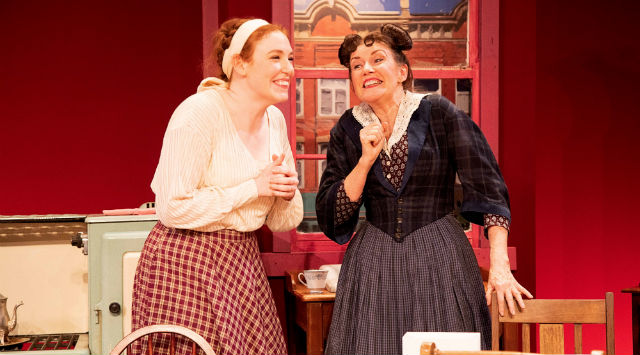
Theatre director Lewis finds himself at a mental asylum, not as a patient, but as a facilitator for a one-night-only staging of Mozart’s Così fan tutte, starring clients of the home. This is 1972, many years before deinstitutionalisation had begun, and the personalities Lewis meets are varied in capacities, but uniformly charming. Louis Nowra’s Così is a 1992 comedy with a premise that remains intriguing, but much of its humour has lost its lustre. We have learned to regard mental illness with a diminished sense of alienation, and characters in the play have lost their sense of otherness accordingly, causing many of its jokes to feel archaic.

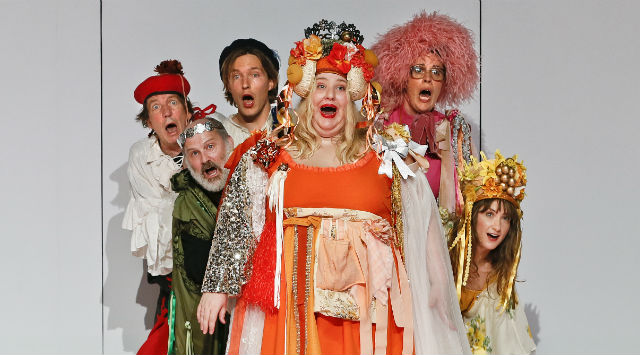
The production is directed by Sarah Goodes, who does extensive work to reflect a modern sensibility in her iteration of Così. While it does provide an updated sense of cultural appropriateness, with a renewed perspective of people with mental health challenges, we discover that there is little at its heart that truly resonates for today’s audiences. Nevertheless, it is a smartly designed show, with Dale Ferguson’s set and Jonathon Oxlade’s costumes providing a valuable sense of playfulness. Lights by Niklas Pajanti, along with Chris Williams’ music, keep the action jaunty and energised.

Actor Sean Keenan is convincing as the unassuming and somewhat meek Lewis, a sturdy presence who lets his colourful counterparts occupy our attention. Unofficial ringmaster Roy is played by Robert Menzies, who is powerful in the role, and effective in having us invest in his passions for Mozart and classical opera. Bessie Holland is unforgettable as the brassy Cherry, impressive in her ability to deliver big laughs, even with Nowra’s dubious dialogue. Similarly charismatic is Rahel Romahn, consistently and effortlessly funny as Doug the pyromaniac, setting the stage alight at every appearance.

In Così fan tutte, people pretend to be somebody else to discover truths about themselves. Così too, features playacting, with patients of the asylum masquerading as characters in an opera, as though on a recess from their real lives. Individuals can come to new understandings of themselves, when they experience distance from their own existences. Art allows us to step out, and observe the world from a different perspective, which is an immense benefit for all of us who forget the diminutiveness of being, and the inanity of any ego.

www.sydneytheatre.com.au | www.mtc.com.au

Review: The Underpants (Seymour Centre)

Venue: Seymour Centre (Chippendale NSW), Oct 31 – Nov 23, 2019
Playwright: Steve Martin (adapted from Carl Sternheim)
Director: Anthony Gooley
Cast: Beth Daly, Duncan Fellows, Ben Gerrard, Robin Goldsworthy, Gabrielle Scawthorn, Tony Taylor
Images by David Hooley

Theatre review
Admirers start knocking on Louise’s door, asking to rent her spare room, immediately after the fortuitous incident of Louise’s underpants falling to her feet in public. For a moment, her little apartment feels expansive, as the narrow existence with her controlling husband Theo, begins to look more promising. Steve Martin’s The Underpants (adapted from Carl Sternheim’s Die Hose) is set in early twentieth century Germany, with a focus on the hypocrisy of the bourgeoisie, that explores our tendencies towards unthinking, parochial lives. We see Louise struggle under Theo’s unreasonable demands as traditional head of household, but with the arrival of new suitors, we wonder if a brighter future is on the cards.

The show begins with excellent humour, directed by Anthony Gooley who encourages an animated playfulness that strikes a chord early on. Lustre is gradually lost however, as the staging grows distant and tired, due largely to a narrative that seems to stagnate after its rambunctious start. It is a polished production, with Anna Gardiner’s set and Benjamin Brockman’s lights providing satisfying imagery, and Ben Pierpoint’s sound design proving effective at crucial plot points.

Gabrielle Scawthorne leads a strong cast, memorable for the unexpected nuance she offers as Louise. Theo is given a radiant presence by Duncan Fellows, whose sardonic approach proves reliable in delivering a delicious sense of irony to the piece. Exquisite comic timing by Beth Daly and Tony Taylor, help to elevate proceedings at each of their entrances, both actors extremely charming, with a dazzling confidence that makes us feel in safe hands. The lodgers are played by Ben Gerrard and Robin Goldsworthy, inventive performers commendable for creating a couple of richly imagined personalities.

In The Underpants, Louise is a tormented housewife at the end of her tether, wishing to be rescued. She spends her time dreaming up ways to move from one man to another, completely ignoring the fact that, even a century ago, independence was a valid option, as exemplified by her idiosyncratic neighbour Gertrude. Social acceptability almost always means that we are required to conform, which implies that to be true to oneself, one could risk being outcast. Louise can choose not to be of the respectable class, but the thought of abandoning the bourgeoisie is almost too hard to bear. Each of us constructs identities that feel immutable, and we form attachments to people and structures that hold us hostage. When walking away seems inconceivable, it usually means that one simply needs to think bigger.

www.facebook.com/sugaryrumproductions

Review: The Indian Wants The Bronx (Chippen Street Theatre)

Venue: Chippen Street Theatre (Chippendale NSW), Oct 24 – Nov 2, 2019
Playwright: Israel Horovitz
Director: Rahel Romahn
Cast: Tristan Artin, Elliott Giarola, Rajesh Valluri
Images by Shayan

Theatre review
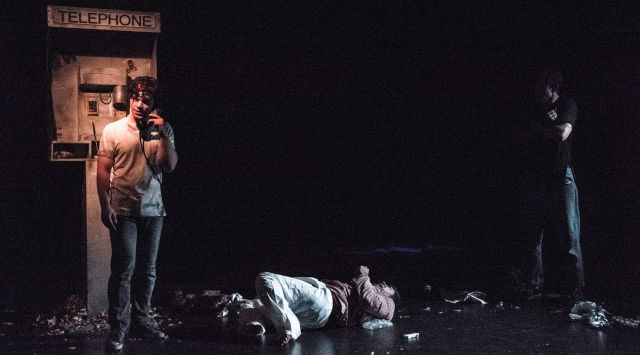
As delinquents Murph and Joey wander the streets of New York, they stumble upon Gupta at a bus stop trying to get to the Bronx without knowing the English language. The boys are amused by Gupta’s Indian clothing, and proceed to taunt him, gradually increasing in intensity over the play’s 45 minutes.

Israel Horovitz’s The Indian Wants The Bronx premiered in 1968, the year of Martin Luther King’s death, at the height of America’s civil rights movement. Although the work is undoubtedly dated, with a central Indian character unable to speak English, the way it frames bigotry as an unassailable reality regardless of intentions by individuals, remains valuable in our discourse about race. The young New Yorkers do not think of themselves as xenophobic, but consequences of their actions are certainly racist.

Directed by Rahel Romahn, the show is suitably energetic, fuelled by the irrepressible ebullience of unruly youth. A greater sense of danger, and dramatic tension, is slightly missing in early portions, but the show delivers the goods in its second half. Sound by Kailesh Reitmans provides excellent support in calibrating atmosphere for every scene, and lighting design by Thomas Walsh, although obvious with its objectives, is effective in escalating tensions.

Three accomplished performers take us through this story of racially motivated violence, with Rajesh Valluri leaving a strong impression as Gupta, able to convey a sense of dignity for the character in spite of his unfortunate circumstances. Tristan Artin and Elliott Giarola are strong in their roles, both actors detailed and passionate with what they bring to the stage. The production is an engaging one, made believable by a thoughtful and cohesive team.

One of the boys is Irish, and the other Jewish. Mid-century New York was not always kind to them, yet they are unable to see themselves reflected in their Indian victim. History shows that it is easy for people to forget their own persecution, and dispense upon others the injustices they had previously suffered. Half a century after Horovitz’s writing however, it may seem that the new generations of today, determined to define themselves as unprecedentedly enlightened, have become much more compassionate in how they regard society. The establishment is still in the habit of keeping groups of people subjugated, but opposition to their modus operandi is indisputably growing.

www.chippenstreet.com

Review: Haunted (Spark Youth Theatre)

Venue: Petersham Town Hall (Petersham NSW), Oct 29 – Nov 8, 2019
Concept: Felicity Nicol
Directors: Felicity Nicol, Scott Parker
Cast: Alan Fang, Andrea Mudbidri, Bedelia Lowrencev, Caitlyn Wright, Ellie Oppen-Riley, Emily Pincock, Fanar Moonee, Jeno Kim, Jeremy Lowrencev, Mason Phoumirath, Niamh Kinsella, Pedro Luis Barrientos Rios, Rebekah Parsons, Tirian Tanious
Images by Patrick Boland

Theatre review
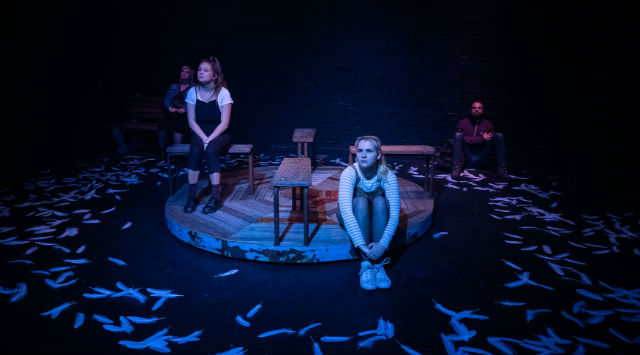
It is night time, and a group of young adults are exploring a disused hall, spinning tales involving missing persons from a 1940’s debutante ball. The audience too are on foot, lingering and observing, and soon we find ourselves standing in as ghosts, when the adventurers begin seeing things. Felicity Nicol’s Haunted makes extensive use of an old town hall, one that is similar to the hundreds that exist all over Australia, with performers dispersed throughout the venue, and us behaving like voyeuristic apparitions, tracking their activities over ninety spooky minutes.

Directed by Nicol along with Scott Parker, the work is fresh and playful, impressive in its exhaustive and imaginative use of space. There is pleasure not only in investigating the many curious satellite occurrences, but also in the very experience of exploring a forgotten building. Sensational work on sound by Nate Edmondson heightens all our senses, to have us feeling as though immersed within a world of horror cinema. Lights by Benjamin Brockman are extravagant at pivotal moments, to help convey varying states of surrealism, for a story about young people discovering their local history.

A cast of fourteen performers demonstrate excellent commitment and verve, relying on intuition and physicality, rather than dialogue, to deliver a thrilling, inventive and often beautiful work of modern theatre. Mason Phoumirath and Niamh Kinsella are memorable in their featured roles, proving themselves to be compelling actors, with limitless potential.

The present collides with the past in every moment, but we are rarely encouraged to look back, whilst we wrestle with busy existences dominated by demands of the rat race. Mistakes may not have to be made again, if only we understand their previous incarnations, and evolution would only be in positive directions, if only we remember all former failures. Individuals are only young once, and as a community we too should always strive to mature with each passing day. Lessons learned must not be forgotten, or we will forever be in positions of regret.

www.sparkyouththeatre.com

Review: Bird (Old Fitz Theatre)

Venue: Old Fitzroy Theatre (Woolloomooloo NSW), Oct 22 – Nov 2, 2019
Playwright: Katherine Chandler
Director: Jane Angharad
Cast: : Marvin Adler, Sarah Easterman, James Gordon, Bella Ridgway, Laura Wilson
Images by Clare Hawley

Theatre review
Ava is turning 16 and homeless. Her cruel mother rejects repeated efforts by Ava to mend bridges, letting the girl languish in crisis accommodation, and on the streets of her Welsh town. Katherine Chandler’s Bird is about survival, when a young person is abandoned. We look at the challenges that Ava has to negotiate having been left to her own devices, and the dangers she encounters as she does her best to stay alive.

It is a poignant story, featuring an honest portrayal of a loveless family not often seen in our storytelling. Its characters are realistic and thoroughly explored, so that we may sympathise with the depths of Ava’s despondency, and identify the hope that she never relinquishes. Directed by Jane Angharad, the production tends to be overly subtle in approach, but its emotional resonances are strong when necessary. The dynamics she renders between cast members is often moving, for an effective manifestation of the play’s generous measure of sentimentality.

Actor Laura Wilson’s authentic portrayal of innocence is crucial to how we regard Ava, along with a commendable focus and conviction that keeps us invested in the protagonist’s journey. The mother, Claire is played by Sarah Easterman, whose quiet brutality provides valuable fortification to how the plot unfolds. Mystery man Lee is given excellent depth by James Gordon, whose ambiguity creates exquisite dramatic tension for all his scenes. Marvin Adler and Bella Ridgway play Ava’s friends, both performers offering a balance of melancholy and purity, for depictions of youth that are vividly truthful.

To be unwanted by one’s parents is unimaginable for most, yet many continue to flourish in spite of this bitter deprivation. The odds against her are staggering, but Ava never gives up trying. With no choice but to be fearless, she is always able to muster the courage to march on, even if her days are aimless and sad. We have all experienced what it is like to be lost, but to brave the world when feeling unloved, is an immense tragedy, yet somehow, we are capable of it.

www.secrethouse.com.au | www.redlineproductions.com.au

Review: White Pearl (National Theatre of Parramatta)

Venue: Riverside Theatres (Parramatta NSW), Oct 24 – Nov 9, 2019
Playwright: Anchuli Felicia King
Director: Priscilla Jackman
Cast: Deborah An, Mayu Iwasaki, Matthew Pearce, Vaishnavi Suryaprakash, Merlynn Tong, Catherine Văn-Davies, Shirong Wu
Images by Phil Erbacher
Theatre review
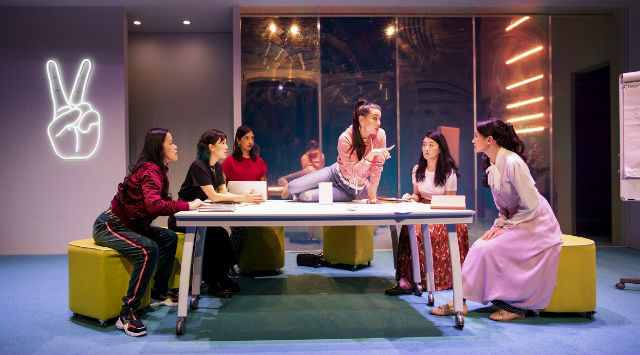
A cosmetics company specialising in skin whitening creams, wakes up in hot water, when one of its ads appears online prematurely and quickly goes viral, as a result of its shockingly racist content. The Clearday headquarters in Singapore instantly turns into a war room, with executives desperately scrambling for damage control. All six of them are Asian women, from various parts of the world, each with a different experience of race and its associated politics. In Anchuli Felicia King’s White Pearl, we see the group devolve into a belligerent mess of conflicting principles, unable to sustain an alliance forged initially by very dubious ethics.

It is a sensational piece of writing, thoroughly researched and passionately rendered. White Pearl throws us into a cauldron of frenzied chaos, but each line of dialogue is crafted with immense precision, for an insightful examination not only of capitalism and racism, but also of the classism and sexism that govern so much of how these characters operate. The play’s unravelling of corporate culture, engenders a caustic sense of humour that keeps us on edge, for a wildly funny theatrical ride that never releases us from its moral interrogations.

Director Priscilla Jackman keeps dramatic intensity at fever pitch for the entire duration, establishing an unrelenting awareness in our consciousness reminding us that the stakes are very high indeed, not only in the fiction that we encounter, but also the real life implications of this timely tale about our social responsibilities as groups and individuals. Sound design by Michael Toisuta and Me-Lee Hay amplifies the women’s stress levels, to fill the auditorium with shuddersome atmospheric pressure. Jeremy Allen’s production design and Damien Cooper’s lights are nimbly manufactured, to keep the storytelling moving at lightning speed. The playwright’s own video projections feature social media comments relating to the offending incident, ranging from amusing to appalling, working as a device that constantly widens the story’s context, so that each viewer can remain personally connected with the narrative. Dramaturg Courtney Stewart does remarkable work that allows the play to consistently resonant with accuracy.

Seven actors form a formidable ensemble to deliver an intelligent and highly entertaining show, that reveals many truths about who we are today. Priya Singh, the British Indian founder of the company is portrayed by the phenomenal Vaishanavi Suryaprakash, whose extraordinary range enables an endlessly textured study of a woman in deep trouble. It is a powerful performance that exposes the human and structural problems of the modern business world. Also very affecting is Deborah An, who plays Korean scientist Soo Jin Park, bringing incredible nuance and emotional gravity to the depiction of a very dire situation. Merlynn Tong (as Sunny Lee) and Shirong Wu (as Xiao Chen) are unforgettable for providing the biggest laughs, both immaculate with their comic timing, and wonderfully idiosyncratic with their respective interpretations of ethnically Chinese women, the former from Singapore, and the latter China.

Catherine Văn-Davies plays Built Suttikul, a fabulously wealthy, American-educated Thai national, with imposing confidence and a vigorous physicality that defies any underestimation of the ladies in White Pearl. Her sensitive choices for a sex scene brings surprising elevation to the character, and highlights the persistent impossibly of retaining integrity in the pursuit of commercial supremacy. Her French ex-lover Marcel Benoit too, becomes unexpectedly complex, as performed by a self-possessed Matthew Pearce. New addition to the “Clearday family”, Japanese recruit Ruki Minami is perfectly balanced between naivety and wisdom by Mayu Iwasaki, for a personality that demonstrates the limits of human integrity, in the stupefying face of money and power.

Clearday sells products nobody needs, that could very well be harmful. The people who comprise the company, expend all their energy on questionable activities, so that they may one day feel like a leader of the pack. This is the narrative not only of White Pearl, but also of many a conventional life in the modern world. Money and power are blinding, they shape our values so that we make compromises to morality, in the promise of a glory that rarely comes to fruition. We disregard justice, to uphold racist, sexist and classist ideals every day, in hope that the system would reward us with all that it professes, but in fact, as we see in the play, no one will emerge truly victorious.

www.riversideparramatta.com.au/NTofP | www.sydneytheatre.com.au

Review: Duckpond (The Old 505 Theatre)

Venue: The Old 505 Theatre (Newtown NSW), Oct 22 – 26, 2019
Playwright: Tabitha Woo
Director: Alison Bennett
Cast: Danen Engelenberg, Melissa Hume, Rizcel Gagawanan, Rudolf Hendrikx, Samantha Lambert
Images by Alex Smiles

Theatre review
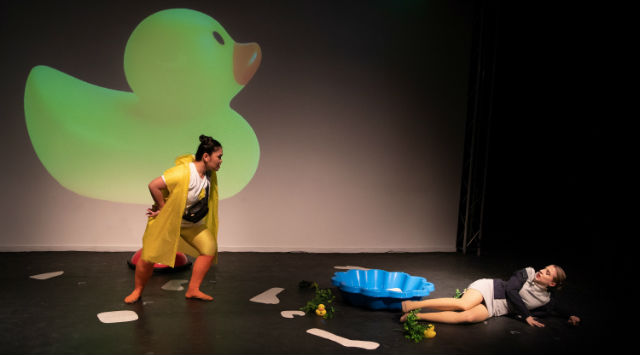
Ingrid seems to have survived a plane crash, except she wakes up in a surreal landscape, and begins to see things in a very different light. In Duckpond, playwright Tabitha Woo interrogates the notion of reality, with a particular interest in the way religion and technology not only construct meanings for our existence, but are in fact totalitarian determinants of how we perceive the world. We are ducks in a pond designed by false gods and technocrats, unable to swim out of a paradigm created by others, for the benefit of others.

It is an evocative allegory, charmingly illustrated, in a play enjoyable for its absurdity, if slightly too coy with its humour. Alison Bennett’s idiosyncratic direction delivers a production memorable for its kooky style, with frequent disruptions to theatrical conventions, that help us look into the nature and origins of normality as a general concept. Actor Melissa Hume offers an effective blend of ordinariness and inquisitiveness, in her depictions of a state of awakening, as flight attendant Ingrid begins to discover the artifice behind everything that wishes to pass as real. Her companion is a duck, played by Rizcel Gagawanan, sprightly and amusing with her representation of blissful ignorance.

Humans have an interminable desire for truth, but we are often distracted by the comfort of certainty. Capitalistic forces seduce us with that numbing gratification of phoney answers that they provide, in the form of certainties that rarely contain more than a semblance of truth. They know that when we stop questioning, we are turned into complacent consumers and obedient subjects, easily manipulated to serve their interests, as we languish in a perpetual and frustrating blindness.

www.thirtyfivesquare.com

Review: Much Ado About Nothing (Bell Shakespeare)

Venue: Sydney Opera House (Sydney NSW), Oct 22 – Nov 24, 2019
Playwright: William Shakespeare
Director: James Evans
Cast: Vivienne Awosoga, Danny Ball, Marissa Bennett, Mandy Bishop, Will McDonald, Zindzi Okenyo, Suzanne Pereira, Duncan Ragg, Paul Reichstein, David Whitney
Images by Clare Hawley

Theatre review
It is the classic story of misunderstandings, and the bumpy road that lovers must take, before arriving at happily ever after. Shakespeare’s Much Ado About Nothing features endless witty repartee, between idiosyncratic characters who seem to specialise only in matters of the heart. Romance takes centre stage, in an old-fashioned world that wants us to believe that nothing is more valuable than a monogamous heterosexual union.

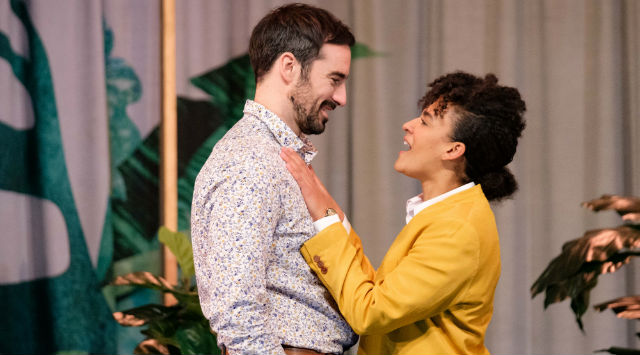
Although rarely inventive, the production, directed by James Evans, is a joyful one, with a sense of playfulness that helps us get through the inevitable return of a perennial favourite. In the role of Benedick is an irrepressible Duncan Ragg, genuinely hilarious with his robust comedy, cleverly conceived and perfectly executed. Zindzi Okenyo plays a sophisticated Beatrice, memorable for an understated approach that works to reduce the cheese factor in Shakespeare’s play.

Hero is given emotional authenticity by Vivienne Awosoga whose efforts at instilling strength makes palatable the damsel in distress, and her gullible husband-to-be Claudio is depicted by a vibrant Will McDonald, who leaves a remarkable impression with his creative and energetic presence. Demonstrating that it is often Shakespeare’s male roles that truly shine, Mandy Bishop steals the limelight as Dogberry and Balthasar, incisive and effortlessly funny with all that she brings to the stage.

It is true, that we spend inordinate amounts of time and attention on romantic love. We seek a satisfaction unique to that experience, determined to find someone to fill an emptiness that cannot be otherwise occupied. There are things much more logical, and much more within an individual’s control, yet we stray from the possibilities of real achievement, to pursue that which is in many ways narrow and selfish. It seems that being human, we are capable of immense knowledge, but wisdom does not always mean that we act in the best interests of our species.

www.bellshakespeare.com.au

Review: Baby Doll (Ensemble Theatre)

Venue: Ensemble Theatre (Kirribilli NSW), Oct 18 – Nov 16, 2019
Playwright: Tennessee Williams (adapted by Pierre Laville, Emily Mann)
Director: Shaun Rennie
Cast: Kate Cheel, Maggie Dence, Socratis Otto, Jamie Oxenbould
Images by Prudence Upton
Theatre review
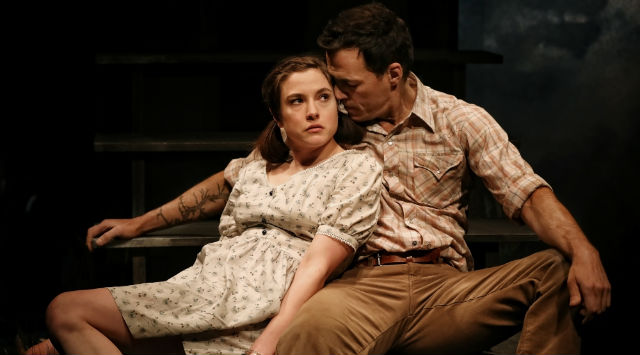
A young woman finally has to consummate her marriage, on her twentieth birthday, after two years of being with a much older husband. On the eve of that fateful night however, a tall, dark and handsome stranger appears, as though poised to rescue the girl from the event she has long dreaded. Tennessee Williams’ Baby Doll takes place in Mississippi Delta, at a time when women, even those who were young, white and beautiful, had few rights and opportunities to speak of. We observe the restrictive circumstances faced by the protagonist, and how her choices are limited to just two men, neither of whom have her best interests at heart, but in this adaptation by Pierre Laville and Emily Mann, we are able to see her desires and fortitude come to the fore, and it becomes evident that the girl is not giving up without a fight.

Directed by Shaun Rennie, the scintillating production grips us, not only with the exciting paradigm shifts deliberately introduced to the old story, but also with its exhaustive efforts at imbuing every theatrical moment with a rich sensuality, able to have us captivated on levels beyond character and narrative. Lights by Verity Hampson convey an intense sexuality, oppressed yet untameable, a wild undercurrent emerging from all sides of this lustful triangle. Sound and music by Nate Edmondson moves effortlessly from episodes of rhapsodic extravagance, to sequences filled with hushed precarity. We always know what the people on stage are thinking and feeling, even if their words are designed to disguise the truth.

Actor Kate Cheel plays the girl named Baby Doll, with a delicious intellectual aplomb that powerfully resists the relentless sexual objectification imposed upon her from all directions. The character we see is libidinous, seductive and strategic, courageously using everything she owns to make the best of a terrible situation. The shrewd defiance being portrayed by Cheel elevates the entire exercise, for a surprisingly modern take of an otherwise outdated Lolita tale.

The repellent husband Archie Lee is depicted in full bigoted glory, by an exuberant Jamie Oxenbould, who keeps us engaged by his bold embodiment of the deplorable antebellum hangover. Stoking the fire as Silva Vacarro, is Socratis Otto who manipulates levels of authenticity for a deceptive type who seems only to have ulterior motives. Otto makes every line of dialogue believable and enthralling, so that we may follow Baby Doll as she falls hopelessly under his spell. Maggie Dence is memorable in the subsidiary role of Aunt Rose, absolutely charming and humorous at each appearance.

There is little Baby Doll could do to make things better for herself, but she pulls out all the stops. Women today do not experience the same level of subjugation, but we certainly do have to rely on ingenuity and resourcefulness, to navigate a world that continues to be unjust and dangerous. Most of us can now walk away from failed marriages, but few of us can turn our backs on a culture determined to limit our identities, and an economy built on our servitude. Our survival requires that we participate within structures that routinely place us at a disadvantage. We may feel duplicitous and hypocritical, when we bite the hand that feeds, but there is no escaping that which we wish to demolish. As demonstrated in Baby Doll, we can never be prevented from being instigators for change, no matter how small a part we play in whatever revolution that may be brewing.

www.ensemble.com.au

Review: Natives Go Wild (Sydney Opera House)

Venue: Sydney Opera House (Sydney NSW), Oct 22 – 27, 2019
Playwright: Rhoda Roberts
Music: Damian Robinson
Director: Chelsea McGuffin
Cast: Waangenga Blanco, Mika Haka, Beau James, Josephine Mailisi, ‘SistaNative’ Seini Taumoepeau, Samuela Taukave aka Skillz
Images by Anna Kucera

Theatre review
There is probably nothing more objectifying than being part of the display at a human zoo. To be placed in that position can of course be an entirely voluntary enterprise, but in the 19th century, it is likely that circumstances at fairs and carnivals were less than dignified, with the acquisition and misrepresentation of Indigenous peoples for the pleasure of gawking colonials, forming a crucial feature of the circus industry.

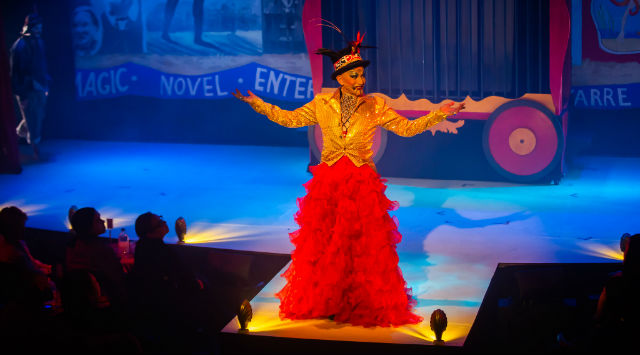
Rhoda Roberts’ Natives Go Wild is critical of that tradition of humiliation, of a West obsessed with exoticism, depriving people of colour their agency. In this show however, identities are reclaimed, and tables are turned, as Indigenous performers from various Antipodean regions, take charge of their narratives, telling us precisely what we need to know, about who they are and what they do.

It is a glamorous production, featuring excellent work by designers Mark Howett (set and lights) and Tim Chappel (costumes). Original songs and music by Damian Robinson are full of inspiration, contributing a sense of transcendental elevation to the staging, with singer Seini SistaNative Taumoepeau bringing remarkable soul to these refreshing compositions. Director Chelsea McGuffin is charged with the responsibility of assembling disparate elements into a cohesive whole, for a vaudeville style of presentation that asks all the right questions.

Ringmaster Mika Haka is high camp personified, but in an acerbic and confrontational style, never letting us easily off the hook. Waangenga Blanco and Samuela Skillz Taukave are mesmerising dancers, both portraying a series of legendary Indigenous figures from circus history. Aerial artist and contortionist Josephine Mailisi conveys true beauty with a physicality full of strength and discipline. The interminably charming clown Beau James delivers some of the funniest and most moving sequences, proving himself a real star we cannot get enough of.

Some might argue that colonisation has improved lives, but there is no question that the inherent cruelty of Western values, has had negative impacts on Indigenous communities that remain significant today. The persistent inability of white people to prioritise Indigenous voices have meant that their needs are consistently ignored, and their wisdom disregarded. Even as we watch the world crumble under instruments of white supremacy, it refuses to cede power, tenaciously holding on to reins that have failed economies and the environment. Unless the next stage of our collective evolution is to better incorporate those who have demonstrated actual skills of survival, the future can only be bleak.

www.sydneyoperahouse.com