Review: Calpurnia Descending (Sisters Grimm / Sydney Theatre Company)

sistersgrimmVenue: Wharf 2 Sydney Theatre Company (Walsh Bay NSW), Oct 9 – Nov 8, 2014
Playwright: Ash Flanders, Declan Greene
Director: Declan Greene
Cast: Paul Capsis, Ash Flanders, Sandy Gore, Peter Paltos
Image by Brett Boardman

Theatre review
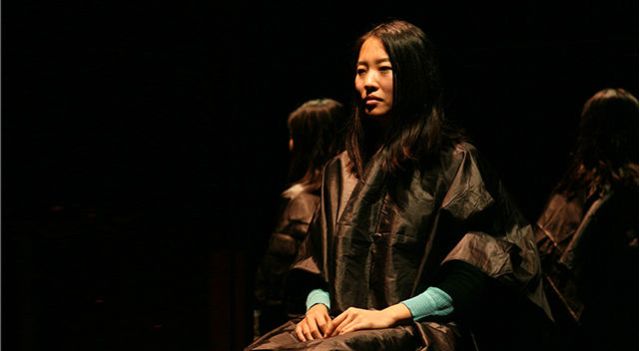
Calpurnia Descending borrows heavily from the 1950 Hollywood films, All About Eve and Sunset Boulevard. With an exploration into the evolution of show business and media, we observe that artifice and female rivalry persist as dominating themes that shape our consumption of popular culture through the years. Ash Flanders and Declan Greene’s script is a decadent high camp romp that exercises its creators’ eccentric and original vision, with a resulting beast that is more about heresy and iconoclasm than it is about entertainment or storytelling. In spite of its meaningful central ideas, the work does not aim to deliver poignancy but is interested instead, in unusual perspectives of theatre and innovative modes of experiencing live performance.

Half of the show is seen on a cinema sized screen. We can hear sounds from the live action emanating from behind the projection, so we know that the actors are creating the show in real time, but the significant length of the filmic portion means that it feels strangely close to being at the movies. It is understandable that Greene, as director, chooses the video format to discuss our obsession with screens big and small, but placing the production in a theatrical context is a curious decision, given the obvious affiliation with film and its possibilities. Nevertheless, Greene’s work is vibrant, colourful and thoroughly quirky, often with an air of vaudeville permeating the atmosphere. He is sensitive to energy levels, and although the show’s sense of humour is specific, he maintains a pace that is tight and lively, ensuring an amusing experience for most audiences.

Paul Capsis does his best Norma Desmond in the role of Beverly Dumont, a star of the Broadway stage poised to make a sensational comeback at the ten-year anniversary of her misreported death. Capsis brings a drama and grandiosity that the part requires, along with excellent comic timing and a gripping presence. The role is simple, but the actor’s work is beautifully complex, adding gravitas to something that is determined to revel in its silliness. Calpurnia Descending‘s version of Eve Harrington is the duplicitous Violet St Clair, played with mischievous exuberance by Flanders whose wide range of camp extends from delightful to macabre. The actors form a strong and balanced team in their portrayal of a malevolent sisterhood, but not much is made of the inevasible drag element. There is no obvious commentary that arises from the casting of male performers, and the production would not present too differently without it, so perhaps a point is made about the irrelevance of gender in the narratives we weave.

At a time when some of us can spend virtually every waking moment in front of a screen of some description, the production should be able to provide some resonance with its interest in the way we relate to mass media and its celebrities, but its preoccupation with depicting shallowness prevents us from connecting in an authentic way. Be that as it may, the show is memorable for being adventurous and rich with original thought, and it is the artists who dare to push the boundaries that we must value the most.

www.sydneytheatre.com.au | www.sistersgrimm.com.au

Review: Kill The PM (Unhappen)

unhappenVenue: Old 505 Theatre (Surry Hills NSW), Oct 8 – 26, 2014
Playwright: Fregmonto Stokes
Director: James Dalton
Cast: Nicholas Hiatt, Zoe Jensen, Michael McStay, Lily Newbury-Freeman
Image by Lucy Parakhina

Theatre review
We must not take our democracy for granted. It is a key element to meaningful lives, as it insists that every person and their liberties are included. The ideal is a world in which everyone has an equal say, even if we end up with a messy and inconvenient state of affairs, but today’s reality sees a grave inequality of power and influence. As Australia becomes increasingly capitalistic, previous notions of a classless society are quickly eroded, acquiescing to the dominance of the 1%. Our leaders are still democratically elected, but there is no camouflaging the fact that prevailing ideologies of government are disproportionately geared towards the benefit of the wealthiest. One person may still receive one vote, but our voices do not carry the same weight, and the loudest have proven themselves to be the most selfish.

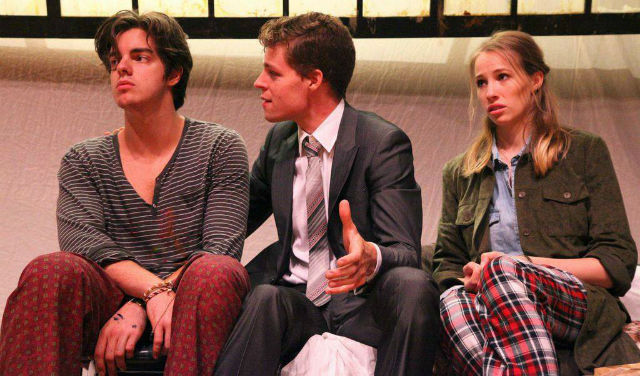
Fregmonto Stokes’ Kill The PM is inspired by the fantasy of the masses, and begins with the most simplistic of ideas. The assassination of a leader is a proposition symptomatic of the disquiet that citizens experience, but the play does not indulge extensively in that premise. Instead, it explores the absurdity of the suggestion that the murder of one person is all the revolution that is required to cause an effective change in the way our nation carries on its business. Stokes’ writing has a sense of wildness that is dramatic and exciting, with surrealist aspects that keep us intrigued. There are unexpected ambiguities which make the script rich and thoughtful, but its narrative structure falters at certain junctures when a more poetic approach takes over. Stokes’ work is thought-provoking, but it has an uncomfortable gentleness that contradicts its powerful subject matter.

Direction of the piece by James Dalton suffers the same shortage of aggression. The characters are blinded by passion but what happens on stage is oddly subdued. The cast does not portray sufficient conviction for the story to take hold, and their relaxed disconnection from the plot (and each other) is frustrating. This is a story that should speak to anyone who is even remotely interested in politics, but none of the players manage to find points of resonances for the contentious issues being discussed.

Fortunately, the production shifts gears in the middle, giving up its unsuccessful naturalism for a spectacular theatricality in a series of dreamlike sequences. Dalton’s strengths with visual aesthetics and his talent at manipulating atmosphere rescue the show to some extent, although its core messages would benefit from greater elucidation. It is the formidable design team that shines in this production, with Dylan Tonkin’s set leaving the greatest impression, having given the venue an extreme transformation with daring innovation, excellent taste and a sophisticated flair. Benjamin Brockman’s lights are another highlight, cleverly adapting to the theatre’s unconventional facilities, and using gadgets that function charmingly as set pieces in addition to providing interesting illumination.

Kill The PM suggests that the elimination of any single person or group would not be advantageous, regardless of how blood thirsty our primitive selves can be. We see the importance of community in the process of affecting policy changes, but also the difficulties in locating ways that people can unite to find strength and commitment. Having a voice in any political climate is challenging, and it is only as collectives that we will be heard. The theatrical arts are fundamentally collaborative, and we must value the egalitarianism that allows individuals to come together to create and to speak. Regimes come and go, but art endures, and at the theatre, the subversive can find expression, and sometimes, have an impact.

www.unhappen.org

Review: It’s War (Bulldog Theatre Company)

bulldogVenue: Factory Theatre (Marrickville NSW), Oct 9 – 19, 2014
Playwright: Alex Lykos
Director: Alex Lykos
Cast: Jenny Apostolou, Chris Argirousis, Marissa Marie Kaye, Janette Lakiss, Ben Maclaine, Maria Tran

Theatre review
Note: This review reveals a key plot twist.

Discussions about race never seem to cease in Australia. Our history of migration over the last 226 years has seen a multiculturalism that has required constant arbitration and re-imagination. In our theatre landscape however, these discussions are few and far between, with an Anglo-Saxon culture persisting with its dominance in production and output. Alex Lykos’ It’s War attempts to shed light on racial relations at a grass roots level, with a story about neighbourly altercations involving characters from diverse ethnicities. We live in a time where the representation of that diversity is usually suppressed in mainstream media, as the depiction of difference can often be interpreted as malicious. Faces of “minorities” are presented occasionally, but they are discouraged from displaying modes of behaviour that may be too idiosyncratic. The notion of colour-blindness is well-meaning, but it tends to institute a kind of assimilation, reducing differences to a generic beigeness that serves as an image of a unified nationhood.

Lykos’ show however, exaggerates our differences by amplifying racial stereotypes, which is uncomfortable viewing for our political correct sensibilities, but also thoroughly amusing. It is challenging to laugh too heartily at a script that characterises Vietnamese women as dog-eating mail order brides, Indians as smelly curry munchers, “Aussies” as spineless, and Greek men as adulterous closeted poofters. We strive hard in our daily lives to distance ourselves from such misrepresentations, but Lykos’ efforts at finding universality through gross overstatements for every character is an interesting proposition, and because no one is spared his distortion, the show’s comedy becomes almost feasible.

Maria Tran approaches her role Ngoc Bich with an extremely coarse, but hilarious, interpretation of the recent migrant. Tran is the only actor who puts on a speech accent that is drastically unlike her natural voice, presumably because the character has only spent five years in Australia. It is debatable whether making Ngoc Bich a mail order bride actually helps with the plot but nevertheless, Tran provides many of the biggest laughs of the production with her impressive comic abilities, and enthusiasm for the stage. Also memorable is Jenny Apostolou as Soula, who creates the only realistic personality in the play. Apostolou brings an authenticity that is otherwise missing in the show’s lampoonery tone, and her reassuring presence gives a professional polish to her work. Performances in general are funny, if a little uneven, but cast chemistry is strong, displaying a good level of camaraderie and trust.

The work is neither sophisticated nor subtle, but its structure is taut and every scene is engaging. There is a vibrant energy in the writing and also in its performances, which help moderate some of the more alienating and controversial touches of the script. “Can we all get along” is Rodney King’s immortal quote from the 1992 Los Angeles riots that has found resonance the world over, and that simple message is just what It’s War wishes to say.

www.bulldogtheatre.com

Review: Harvest (New Theatre)

newtheatre2Venue: New Theatre (Newtown NSW), Oct 7 – Nov 8, 2014
Playwright: Richard Bean
Director: Louise Fischer
Cast: Nick Bolton, Sarah Carroll, Alex Chalwell, Xavier Coy Peter Eyers, John Keightley, Dave Kirkham, Annie Schofield, Isabella Tannock, Abi Rayment, Benjamin Vickers, Bishanyia Vincent, Steve Vincent, Jeremy Waters
Photograph © Bob Seary

Theatre review (of a preview performance)
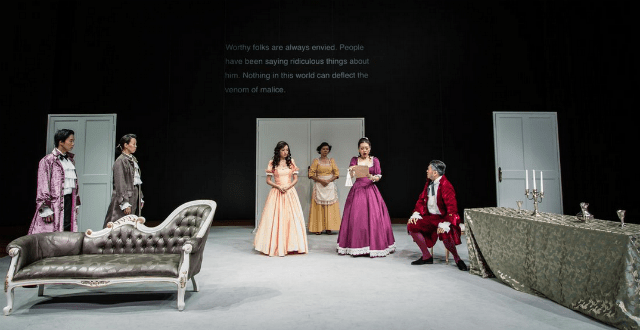
Nostalgia can be ineffectually sentimental, but in Richard Bean’s Harvest, it is a telescope through which some of our contemporary social concerns are examined. The Harrisons are farmers in Yorkshire of England, and through their evolution over the last century, the deterioration of community and drastic alterations of market forces come into sharp focus. There is a definite pining for the past in Bean’s text. Even the villains of yesteryear seem quaint by comparison. Modern developments of civilisations are obviously not completely deplorable, but the play does put forth convincing arguments that pay reverence to bygone notions of honour, and the debate it inspires on alternative modes of progress is interesting.

Direction by Louise Fischer provides dramatic poignancy with an earnest approach to the script’s political positions, but the production’s tone is uncomfortably subdued in its first act. Early scenes require greater levity and chemistry between actors to deliver bigger laughs before the play’s deeper meanings emerge. The show begins to take flight at the introduction of the character Titch, played with exuberant confidence by Benjamin Vickers. His broad style of comedy finds a delightful harmony with Bean’s writing, and he creates the most memorable of the host of supporting roles on stage.

Leading man Jeremy Waters impresses with a consistently charming and dynamic portrayal of a character who grows from very young to very old. His colourful and entertaining work is a reliable central focus of the production, with scenes working best when his colleagues are able to locate points of ignition with his talents. There are moments when Waters’ diction proves slightly challenging for the audience (partly due to the distinctive Yorkshire dialect), but the actor’s physical expressiveness discloses sufficient plot detail to compensate for the shortfall. The role of Laura has a similarly vast age range for actor Bishanyia Vincent to explore, and she certainly rises to that challenge, shining especially brilliantly at the older stages. Vincent’s presence is unassuming but solid, and she surprises with increasingly captivating instances of creativity as the plot unfolds, culminating in a surprisingly riveting final scene.

Bethany Sheehan’s set cleverly converts the vast stage into a more concentrated and intimate performance space, with a backdrop that helps with the cast’s volume levels. Transformations to reflect the passage of time are necessary but set changes can sometimes lack elegance, as do several entrances and exits that see actors venturing off the stage, and into the auditorium. Nevertheless, Fischer’s work as director is defined by the conviction and power she injects into the moral of the show’s story. Bean’s writing seems to glorify the good old days with a dose of convenient selective amnesia, but Fischer turns his concepts into thought-provoking characters and events that move us. It is true that we are always ready to abandon the old in favour of all that is shiny and new, and while obsolescence should be improved upon, we must always be careful to separate the archaic from that which is eternal. Nothing lasts forever but many things endure further than a single generation’s lifetime.

www.newtheatre.org.au

Review: Howie The Rookie (Red Line Productions / Strange Duck Productions / Sydney Independent Theatre Company)

redlineVenue: Old Fitzroy Theatre (Woolloomooloo NSW), Sep 30 – Oct 25, 2014
Playwright: Mark O’Rowe
Director: Toby Schmitz
Cast: Sean Hawkins, Andrew Henry
Image by Kathy Luu

Theatre review
Howie and Rookie are two young Irish men who live epic nights and emerge to relay their experiences to anyone who would listen. They are base and depraved, with values a world away from the middle classes of theatre-land, yet their lack of pretension and extraordinary candour allow us to find identification with a shared essence of humanity. Their stories are terrifying and sickening, but they are never alien, for our instincts understand what it is to be like them, much as we spend our days fighting tooth and nail to create distance from their godforsaken universe. Mark O’Rowe’s script is a detailed look into a life driven by impulse and unaffected appetite, formed by two monologues written with a brand of poetry that is gritty and coarse, although irresistibly beautiful at many points. It is geezers doing lyricism, and art in its enemy’s territory.

Direction by Toby Schmitz delves into the psychology of his actors, to create characters that feel palpable and real, although both are highly theatrical in expression. A thorough authenticity is manufactured by instituting clarity in thought and intensity of emotion in the performers, which translates into wonderfully vivid storytelling and stunning performances. Schmitz reduces the stage into an exaggerated intimacy so that the only thing that matters is the cast.

Design aspects are extremely subtle, for they aim to disappear, but all elements contribute effectively to the power of the men’s dynamic presence. Lights by Alexander Berlage and sound by Jeremy Silver are sensitive and elegant, with many manoeuvres that are practically undetectable but crucial to atmosphere transformations. Stage manager Nicholas Foustellis executes these changes perfectly. Lisa Mimmocchi’s set and costume design takes a minimal approach but the vision she creates resonates with accuracy, even in its spacial abstraction.

Andrew Henry performs the first half of the piece in the role of Howie. He first addresses the audience out of character, with mundane information about mobile phones and emergency exits, using the opportunity to establish humour and a camaraderie that he brings into the play. Henry maintains eye contact with us throughout, insisting that we hear every word, and we do. The actor’s delivery in both physical and vocal terms is almost acrobatic in its agility. He is funny, outrageous and disturbing, always keeping us firmly in the palm of his hand, and the range of emotion he portrays can only be described as impressive. A major mood transition occurs at the end of his soliloquy that is absolutely breathtaking, and a must-see for any fan of the dramatic arts.

Also remarkable is Sean Hawkins, who takes on the latter half of the production as Rookie. Hawkins’ energy is vibrant and sprightly, providing a clever contrast to the darker Howie. Hawkins is a passionate raconteur who brings brilliant animation to his tales, and the stripes shaven into his temples to match his Adidas tracksuit, indicate the depth at which the actor has absorbed the text. Revealing all that the character believes and feels, Hawkins’ face is mesmerising. It tells us all that Rookie wishes to divulge, and then some. The performer lays bare an honesty that lets us read into a complex portrayal of what seems to be a simple existence.

Small theatre can refer to budgets, venue sizes, or the actual scope of content being produced. In the case of Howie The Rookie, it is the serendipitous meeting of all three that has created something sublime. More extravagant expenditure or auditorium capacity will not improve the colossal genius presented on this very special occasion.

www.sitco.net.au

Review: Sondheim On Sondheim (Squabbalogic Independent Music Theatre)

squabbalogicVenue: Seymour Centre (Sydney NSW), Oct 1 – 18, 2014
Music & Lyrics: Stephen Sondheim
Conceived and Originally Directed by: James Lapine
Director: Jay James-Moody
Cast: Blake Erickson, Rob Johnson, Louise Kelly, Debora Krizak, Phillip Lowe, Monique Sallé, Christy Sullivan, Dean Vince
Image by Michael Francis

Theatre review
The second act of Stephen Sondheim’s musical about himself starts with the number, God. Written in 2010 for Sondheim On Sondheim, the song is obviously tongue-in-cheek, but it reflects the adoration, if not obsession, that many lovers of the genre have for him. Conceived and originally directed on Broadway by James Lapine, this biographical work juxtaposes live performance with a film composed almost entirely of Sondheim’s interview footage, old and new. We hear a little about his personal life, as well as vignettes about the origins of certain songs, but perhaps more interestingly, he provides insight into his artistic process. Interspersed with the master’s candid introspection is a cast of eight interpreting his creations, with songs from as far back as 1946 included in the programme. It feels a lot like a greatest hits compilation, except most audiences would probably only find half the selection familiar.

The show is a tribute, and tributes can involve a level of fanaticism. For musical theatre geeks, this is a gift from heaven, and for the rest of us, it is a variety show featuring magnificent singers. Director Jay James-Moody and choreographer Monique Sallé provide the cast with solid emotional and physical structures to navigate around, but focus is kept simple; we hear Sondheim speak, and we hear the cast sing his compositions. It is a challenge to prevent repetitiveness without surprise guest performers and big visual trickery, as variety shows are want to do, and on this occasion, the production does lose a little steam halfway through act two.

It is a tricky thing to perform musical theatre numbers out of context. Without a narrative, some of the more emotive sequences cannot help but feel trite and corny. At a running time of over two hours, there is a good chance that persistent levity would turn sour. Most scenes are not set up sufficiently for the songs to communicate at depth, but an exception is the segment featuring a medley from Sondheim’s 1994 work, Passion, which gives us background information for characters and circumstance, thus allowing us to connect with the tragic love story. Louise Kelly’s sensitive and powerful portrayal of the lovelorn Fosca is beautifully moving, and a reminder of the importance of story and empathy in any theatrical work.

Dynamic work by Mikey Rice on lighting design and Jessica James-Moody on sound, give the independent production a surprising polish. The set design is highly effective, although its resemblance to Brevity Theatre’s Wittenberg at the Old Fitzroy Theatre earlier this year must be noted. Costumes (uncredited) are a disappointment, with many unflattering and unimaginative pieces sabotaging an otherwise pleasant vista.

Sondheim On Sondheim can be thought of as being about heroes and vanity. We sit back and admire phenomenal work by the songwriter and turn green with envy at this excellent collection of voices. We can also think about great art as being a source of inspiration for all. The way we live our lives, and indeed the reasons for living, are infinitely diverse, but a commonality exists in our universal need for a vision of something greater. There is no doubt that greatness presides on this stage, and bearing witness to their extraordinary talent is almost necessary.

www.squabbalogic.com.au

Review: Brother Daniel (TAP Gallery)

brotherdanielVenue: TAP Gallery (Darlinghurst NSW), Sep 24 – Oct 5, 2014
Playwright: James Balian
Director: Travis Green
Cast: Vincent Andriano, David Attrill, Mel Dodge, Jeannie Gee, Adam Hatzimanolis, Errol Henderson, Richard Hilliar, Naomi Livingstone
Image by Mark Banks

Theatre review
James Balian’s Brother Daniel discusses the concepts of heroism and revolution. His work is dense and intellectual, but the ideas that he introduces into the play are vibrantly refreshing. We are made to examine our relationship with heroes, and that incessant need to turn narratives into tales of inspiration and motivation with headlining objects of worship. We elevate people into positions of sainthood and martyrdom, by obliterating the very qualities that bind us as the human race. We have a need to make real our abstract ideals so that aspirations can be formed and individuals or groups can find ways to progress. The betterment of society requires epitomes, but those examples of perfection can only exist in our imagination. Daniel is a legend in prison, and a revolution is taking place outside. The crowds are moved by the memory of Daniel’s legacy, but we are in his cell, witnessing an iconoclasm and the deconstruction of a national hero.

Although Travis Green manages to direct the play with an appropriate severity, there is a stasis to his style that prevents sufficient dramatic effect from taking shape on the stage. Balian’s wordy script proves a challenge, and the heavy reliance on dialogue with very minimal visual inventiveness is challenging for its audience. We need to understand the writing not only through our ears, but when in the theatrical space, our other faculties have to be equally addressed. It is noteworthy that sound design is a well considered element, efficiently adding a foreboding dimension to the atmosphere.

The cast is a strong one, bringing confident presence and polish to the production. Daniel is played by the effortlessly enigmatic Adam Hatzimanolis whose committed performance grounds the show. His interpretation of the personality’s ambiguity is beautifully presented, and he adds to his scenes, a powerful intensity that leaves an excellent impression. The play features several roles that feel too surface, mainly due to their brief stage time, but Daniel is dimensioned and unpredictable, with a depth that is crucial for a central character.

We are not told where the action takes place, but our minds go to the current demonstrations in Hong Kong, where civilians are taking to the streets in protest of their totalitarian government. Revolution is bold, and Brother Daniel is at heart, a bold piece of writing, but what transpires on stage needs an approach closer to anarchy.

www.tapgallery.org.au

Review: Rizzy’s 18th Birthday Party (Curiousworks)

curiousworksVenue: Carriageworks (Eveleigh NSW), Oct 1 – 4, 2014
Screenplay: S. Shakthidharan, G. Gonzalez
Director: S. Shakthidharan
Cast: Varun Fernando, Firdaws Adelpour, Henry Vo, Jamie Meyer-Williams, Patrick Uly, Sophie Hawkshaw, Anandavalli

Film review
The film is projected with incidental music performed live by two-person band Kurinji whose vocalist Aimée Falzon recalls the singing of Sarah McLachlan and Róisín Murphy. The band provides an ethereal start to the night, but the film is more earthy in tone. Set in the recent past, just before 9-11 had changed the world, it features a cast of multiracial characters, which stands distinct because it is a rare representation of our daily Australian realities. It is not a vision we often see on screens, but the diversity looks entirely natural, making a strong political case against the persistent ethnocentrism of Caucasian faces in our media landscape.

The story is a curious one about the anxiety that young people of Western Sydney experience. It showcases rarely articulated societal concerns through Rizzy, who pretends to be a resident of the affluent suburb of Crows Nest, where he is in fact, a member of the working classes in the stigmatised Fairfield region. He is aspirational but perhaps for the wrong reasons. The film makes an effort to contradict Rizzy’s belief that his background is inferior by depicting great friendships and colourful environs, but it results in a very alienating protagonist. We never reach any meaningful understanding of his feelings, so the film remains distant. Its insistence on focusing only on young men, and having women characters exist at its periphery, further restricts its ability to find relevancy with wider audiences.

It is a strong cast, carefully directed by S. Shakthidharan who retains the rawness of the young actors, while drawing good commitment in their performances. Anandavalli plays Rizzy’s mother Helen, with a beautiful sensitivity that moves us with her minimal but authentic approach. It is unfortunate that her role is a deeply subservient one, but the actor’s work is the film’s standout element. Leading man Varun Fernando is less accomplished, but his comic abilities provide some entertainment value in lighter sections. The young men are a group with excellent chemistry that gives energy to many of the earlier scenes, and the film suffers as attention is shifted away from them as the plot progresses.

The work has issues with pace and structure that prevents tension from building satisfactorily. Also, the stakes in the narrative are never high, so we do not respond with much excitement. Rizzy’s 18th Birthday Party is a quiet and earnest movie that attempts to provide a voice to a segment in our community that is not often heard, but it needs to amplify its assertions in volume and in poignancy if it wishes to leave a greater impression.

www.curiousworks.com.au

Review: The Glass Menagerie (Belvoir St Theatre)

Venue: Belvoir St Theatre (Surry Hills NSW), Sep 20 – Nov 2, 2014
Playwright: Tennessee Williams
Director: Eamon Flack
Cast: Harry Greenwood, Luke Mullins, Pamela Rabe, Rose Riley
Images by Brett Boardman

Theatre review (originally published at Auditorium Magazine)
Tennessee Williams refers to The Glass Menagerie as a memory play. The work is semi-autobiographical, inspired by events, people and recollections from his own life. The making of art often involves the search for an understanding of the artists’ self and their immediate environment, through the expression of subjects that are familiar and intimate. Williams’ story examines the home life he had shared with an overbearing mother and a “crippled” sister. Seventy years have past since its initial staging, but their life together remains intriguing and poignant, covering timeless and universal themes that resonate with audiences today the world over. Film adaptations from India and Iran in the last decade demonstrate the wide appeal of the play’s premise and characters.

Williams’ language is romantically evocative of the American South in the 1930s, with old fashioned values that seem quaint and charming to our modern sensibilities, but that same regressiveness in attitude can prove to be harmful, as witnessed in the Wingfield family’s tribulations. Amanda has a definite, and narrow, view of the world and expects her children’s adherence to her every imagined obligation to society. It is a small mind that rules the household, and its painful repercussions are felt by all its members, including the matriarch herself. Eamon Flack’s direction is punctuated by inventive touches, but it is his effective exploration of the original’s concepts that strikes a chord.

A key feature of the production involves two large screens flanking the set, and several video cameras on tripods positioned on the periphery of the stage. Close ups of live action are periodically projected in black and white, shifting the audience between modes of theatre and cinema. This mechanism is slightly gimmicky, but it enriches the viewing experience by allowing an intrusion into more private spaces. Sean Bacon’s work on video design manages to bring elegance to the technology, finding a beautiful balance between stage and screen, rarely causing conflict or confusion for our eyes. Flack’s decision to have faces enlarged for our viewing pleasure enhances emotion and empathy for the piece, but it also brings into doubt the strength of performances that require that augmentation.

Also intensified in Flack’s direction is Tom Wingfield’s homosexuality. Before Williams’ lines are able to reveal the source of Tom’s disquiet, we observe from the very beginning, actor Luke Mullins’ purposeful flamboyance eagerly presenting an image of repressed and hidden gayness. The negation of that obsolete taboo inherent in the text, is an interesting and politically appropriate move for our times, and we are glad to see Tom, our narrator, approach us with fresh honesty. In terms of dramatic structure however, the build up of frustration and tension resulting from his gradual and inevitable disclosures is thus omitted.

Mullins is delightfully spirited in the role. He finds many opportunities for playfulness that helps maintain an electric atmosphere, regardless of moods being portrayed. The staidness of his home is placed alongside a confident showmanship that ensures entertainment in spite of the play’s many grim turns. Within the script’s shrewd treatment of secret sexuality, Mullins exercises a surprising range of nuance that conveys as much as Williams had tried to conceal.

The role of Amanda, the Wingfield mother and faded Southern belle, is played by Pamela Rabe who excels at locating authenticity in a highly dramatised character. Obsessive concern becomes comprehensible in Rabe’s depiction, thereby giving the tale its emotion and meaning. The woman’s severity leads to her own anguish, both qualities delivered by the actor with firm conviction. Amanda’s neurosis is strangely subdued at the play’s early stages, which slightly dampens the drama surrounding family dynamics, but when her hysteria sets in, its theatrical effects are quite wonderful.

Rose Riley’s interpretation of Laura is a fascinating one. Her family believes her to be disabled, but we do not see much evidence for it. The ambiguity surrounding Laura’s impairment sheds light on the changes in attitude over time that societies hold for notions of health and normalcy. Riley puts on an intense but introspective performance and her best moments occur when the camera catches her face in tight shots, revealing very strong and genuine outpouring of emotion. She is the perfect counterpoint to the loudness of her mother and brother, but a lengthy scene with a romantic interest Jim (Harry Greenwood) is unduly quiet and both actors’ subtlety leaves a blemish on an otherwise dexterously paced show.

Set design by Michael Hankin manufactures a sense of claustrophobia with the very small Wingfield home. An unbearable pressure exists together with their poverty, and their dysfunction becomes logical. The aesthetics of the production is fairly muted, with an emphasis on accuracy over theatricality, but Damien Cooper finds opportunities with his lighting design to implement instances of creative flair that add sensual and shifting textures to the plot.

Tom, like his father and his author, escapes oppression in search of a greater truth. The most significant of America’s patriotic qualities is freedom, and The Glass Menagerie gifts us a portrait of its opposite. Enslaved by archaic beliefs and antiquated values, the play’s characters endure a continuance of suffering and painful delusion. Today, the story looks to be a relic of a bygone era, but in fact, that same denial of liberty persists in our personal and social spheres, albeit in insidiousness. The play’s optimistic conclusion sees Tom taking action to remove his psychological shackles. The act seems at once desperately painful, and plainly simple.

www.belvoir.com.au

Review: Wouldman (The Old 505 Theatre)

wouldman1Venue: Old 505 Theatre (Surry Hills NSW), Sep 17 – 28, 2014
Playwright: Justin Buchta
Director: Justin Buchta
Cast: Justin Buchta

Theatre review
Wouldman is like a super hero. His costume is made of wood and in it, he would do many things. Justin Buchta’s very unique one-man show is an amalgamation of many disciplines and forms. There are influences from mime, dance and mask work. He even does yoga and attempts auto-fellatio (simulated). There are songs and poetry, and stories are sometimes narrated but the show is not at all narrative driven. It is abstract, almost dadaist, with segments that flow into each other, some chapters more decipherable than others. This is a fascinating show that is frequently funny and amusing, with an expansively creative approach to communication.

Buchta is an extremely energetic performer, who uses his solid presence to give the production an air of impulsiveness. He seems to leave many elements to chance, creating an atmosphere that is consistently surprising and alive. Buchta keeps us thoroughly engaged even while he bewilders us with his avant garde antics, and we respond with a complex mix of thoughts and emotions. The show’s style of ambiguity is an inviting one that can be challenging at times, but always with sufficient frames of reference to construe meanings.

The artist’s creativity is characterised by a sense of boundless freedom, one that does not require adherence to conventions and expectations. Buchta is concerned with the act of expression itself, and meanings are left to fashion their own lives. This is an art that encourages open hearts and minds in order that interaction can occur. Justin Buchta proves himself in Wouldman to be risky and fearless, but it remains to be seen if his audience is equally gallant.

www.venue505.com/theatre