5 Questions with Annie Byron and Ildiko Susany

Annie Byron

Annie Byron

Ildiko Susany: What would be one piece of advice you would give an emerging actor breaking into the industry?
Annie Byron: To thine own self be true. Train, meditate, exercise, read, forge your inner resources – you’ll need them. Pursue your passion. If the challenges start to sour your love of your craft, stop it and do something else. Persisting makes no sense if you are not being enriched by the experiences, and having fun.

How do you think things have changed for women in theatre since the time you started in the industry to now?
Well, not enough. It was astonishing to sit in those early Women In Theatre meetings last year and hear exactly the same things being said as in the Limited Life funding meetings of almost FOUR decades ago. But look! Within a year a whole Festival Fatale organised, that’s women working with women for women. Women have always supported each other. Maybe what’s changed is that companies generally take more seriously the need to be conscious of gender equity. I think we might be better organised and more articulate. I’d like to think the work of those who have gone before has made taking new steps easier. I’m not sure I can answer this question. It’s depressing that it still needs answering.

What do you think is the naughtiest part of this production of Babes In The Woods?
I think it has to be the relationship between Phyllis and Jack, with a moment of leg licking being one among numerous exquisite high points.

What is your biggest challenge in playing ‘The Dame’ (or, a woman playing a man, playing a woman)?
Before we started rehearsal, this is what I thought about most. Perhaps it says something about the level of subtlety of my performance (!) that now that we are in to it, I have kind of forgotten all about those layers, and I’m just going for a character, and for clarity of story telling. And enjoying the possibility of facial hair. There is a generous allocation of gender bending in this show, and I’m trusting it is something to be played with and enjoyed – without too much depth of thought.

If you could sing any song in this production (regardless of rights) what would it be?
“37 Babies” – the one I WILL be singing! It’s fierce and black and cheeky and political, and I adore it. Having been told repeatedly as a child that I couldn’t sing (and even instructed to mime in the school choir!) this is a major victory for me. I’m delighted that it is so steeped in the feel of Kurt Weill, and I intend to have a lot of fun with it!

Ildiko Susany

Ildiko Susany

Annie Byron: What do you experience as the things most needing to change for young women in our profession?
Ildio Susany: Gender parity. The erroneous view is that women require more training; women aren’t ready; women aren’t as talented or produce as good work as men in the industry (this is also the perception of artists of diverse backgrounds). This is completely false. We need to change this view from the outset. An example of this is that statistics show that roughly 50% of film school graduates are women and yet these women are only represented at less than 30% across all fields in the film industry. Women are in greater audience numbers than men and according to the Geena Davis Institute on Gender in Media, films with female leads made considerable more money than films with male leads. Women don’t need further training or internships – women need access to work and opportunity. Women need to be trusted for their work and skills and insights and capability in the same way that men are. Young women need to own this conversation. Be a part of Women In Theatre & Screen (WITS) and Women In Film and Television (WIFT). The industry is not a meritocracy – unconscious bias and notions of historic gender roles are still in effect today. We need to work together to change this.

Working with full commitment for little or no money, what makes being in an ‘independent’ production worthwhile?
Independent theatre is a place where artists can test their muscle, take risks and break new ground. I think this space can be the best for creating change and bringing major issues to light. I perform in independent theatre and create independent productions because I love to work, I love to be able to tell the stories that I want to tell (stories which may not be featured on the mainstage); stories which might be more inclusive and reflective of our society in terms of gender and diversity and the issues that we need to be exploring in society.

What is the best thing about being in our panto, Babes In The Woods?
The team. I’m working with some of the best artists, actors and creatives who are highly astute with excellent comic timing! It is a joy to play and improvise in this work space. I also love the themes and politics explored in this play which are centred on Australian identity and landscape.

What do you most enjoy about playing a male role?
My favourite part about playing the male role of Robbie is debunking the myths of masculinity and exploring issues of feminism, white privilege and male privilege from my perspective as a woman of colour.

Can you name 5 roles you would like to play by the time you are 60?
Lady Anne. Lady Macbeth. Eliza Schuyler Hamilton or Angelica Schuyler. Any other strong and complex female character – who might have to do some stunts or fight choreography!

Annie Byron and Ildiko Susany can be seen in Babes In The Woods by Phil Rouse (based on the good works of Tom Wright).
Dates: 13 – 21 Dec, 2016 and 6 – 21 Jan, 2017
Venue: Old Fitz Theatre

Review: The Shadow Box (Red Line Productions)

Venue: Old Fitzroy Theatre (Woolloomooloo NSW), Nov 15 – Dec 10, 2016
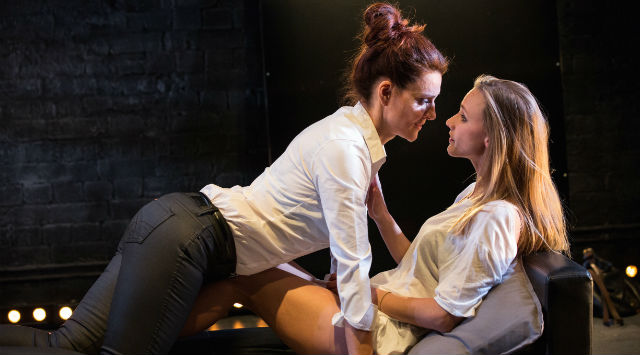
Playwright: Michael Cristofer
Director: Kim Hardwick
Cast: Jackson Blair-West, Jeanette Cronin, Anthony Gooley, Mark Lee, Tim McGarry, Fiona Press, Ella Prince, Kate Raison, Simon Thomson
Image by Robert Catto

Theatre review
Three terminal patients in a hospital are waiting for the inevitable, but in the meantime, they try to experience life in an ambiguous space of transience, acutely conscious of their imminent fate. Michael Cristofer’s The Shadow Box is a meditation on death, which in its distillation of life’s essence, leaves us with a play that talks a lot about love and hope.

We think about existence as being conditional on the future, letting what we do today rely on our imagination of what is to come tomorrow. When tomorrow becomes increasingly uncertain, how we experience the now transforms into something that is thoroughly disquieting. Rattled and agonised, the characters in The Shadow Box, ill and otherwise, negotiate a strange state of being that feels like a constant struggle of trying to say goodbye.

Kim Hardwick’s direction honours the depth of Cristofer’s writing with an elegant and quiet approach. Its starkness is designed in order that thoughts and emotions may erupt with immediacy, but results are mixed. Not all of its scenes are able to engage meaningfully. Even though the show works hard to demonstrate the melancholic sentimentality that each personality endures, it can often feel too distant in its coolness. Considering the weight of its themes, the production is surprisingly, more cerebral than it is emotional, leaving us craving for an experience perhaps slightly more conventionally dramatic in style.

The actors are individually robust with what they bring to their respective roles, each one shiny with conviction and professional polish. Kate Raison steals our hearts, playing up her role Beverly’s dogged optimism and blistering self-deprecation, and Jeanette Cronin’s final moments of sorrow are as devastating as they are satisfying. Performances are well-rehearsed, but chemistry is not always present, in a production that does not necessarily wish to represent any unified or rigid philosophical positions.

To love is not to possess or to shackle, but for anyone to be able to love and let go, is harder said than done. A fundamental expression of love is to be present for the other, and in The Shadow Box, we observe the ultimate in selflessness that is required for loving the dying. Sitting with the ill gives the assurance of a life valued and valid, but helping them cross over is an act of great benevolence that the ones left behind will often find themselves unequipped to administer.

www.oldfitztheatre.com

Review: The Bitter Tears Of Petra Von Kant (Mophead Productions)

mopheadVenue: Old Fitzroy Theatre (Woolloomooloo NSW), Oct 11 – Nov 12, 2016
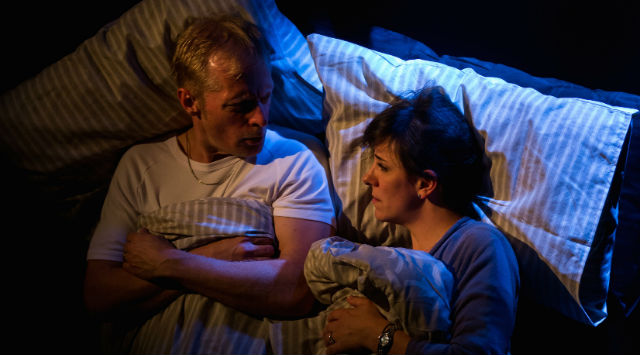
Playwright: Rainer Werner Fassbinder (translated by David Tushingam)
Director: Shane Bosher
Cast: Taylor Ferguson, Judith Gibson, Matilda Ridgway, Mia Rorris, Eloise Snape, Sara Wiseman
Image by Clare Hawley

Theatre review
In Fassbinder’s The Bitter Tears Of Petra Von Kant, we search for the meaning of love. Petra had just ended a marriage, but now finds herself enamoured with another. Through an examination on the nature of unrequited love, the play is an invitation to meditate on one of life’s biggest mysteries, by looking at the space between being in love, and being out of love. Petra has an object of desire, someone she obsesses over, who responds with nonchalance. Her devotion is both voluntary and involuntary, she gives of herself in hope of reciprocation, but continues to invest her all, even when the outcome is not as intended. She thinks only that her suffering bears a purpose of winning favour, but does not realise the masochistic pleasures that envelope the burning sensations of pain she thrives on.

The writing is phenomenally thrilling, and deeply important. Masochism is a pivotal part of our psyche, but we make little acknowledgement of it. In our human inability to be perfect, we all experience on a daily basis, the impulse to do what is not going to deliver the best results. Although we wish for a level of optimal performance in all the things we do, we are not machines, and we know that the instinctive tendencies to jeopardise are always strong. We are expected to be good, but really, we cannot stop from wanting to be bad. Our ethics prevent us from being destructive with the decisions we make at work, at home, in society, but when discussing the romantic and the carnal, destructiveness becomes personal and we have the right to choose how bad we wish to be. In his creation of Petra’s tragicomedy, Fassbinder reveals an honest aspect of humanity, and the inherent darkness of our existences. In our heroine’s pursuit of a very fiery love, she uncovers her true self, perfectly beautiful yet devastatingly vicious.

Sara Wiseman is resplendent in her warts and all portrayal of the title role. Operatic and visceral, it is a stunning performance of a woman in control, and out of control, overwhelmed by infatuation and lust, completely unhinged, motivated only by her own desires. Wiseman unleashes profound emotional and psychological accuracy that makes every debauched plot detail believable, along with a magnetic sensuality that has us entranced from beginning to end. Furthermore, it is not a narcissistic display that she puts on, but a thoroughly nuanced study of dynamics between Petra and the people around her, with the star manufacturing scintillating chemistry with every co-actor for a show that keeps us frothing at the edge of our seats. Also fabulous is Matilda Ridgway, sensational in an entirely speechless role but powerfully present at the periphery of every scene. Marlene is a controversial servant character, made even more confronting by Ridgway’s fierce dedication. It is a hugely impressive study of the only woman on stage who gets everything she wants.

The production looks sophisticated, severe and sexy. Georgia Hopkins’ set is executed with a confident minimalist edge, radiantly glamorous and intimidating in its strict glossy blackness. Shane Bosher’s direction breathes new, electrifying life into a play approaching its fiftieth year, proving that Fassbinder’s ageless legacy continues to be relevant and resonant, especially when it comes to issues of our libido. Bosher’s love of the strong female is magnificently showcased, with every woman bold and alluring in her uniqueness. His fetishistic depiction of Petra as Goddess, allows the show to bewitch and to inspire awe. The temptress and us, breathe the same air, but we are at her mercy, and anywhere she wishes to take us in the theatre, we must surrender, and revel in it.

www.mophead.com.au

Review: 4 Minutes 12 Seconds (Outhouse Theatre Co)

outhouseVenue: Old Fitzroy Theatre (Woolloomooloo NSW), Sep 13 – Oct 8, 2016
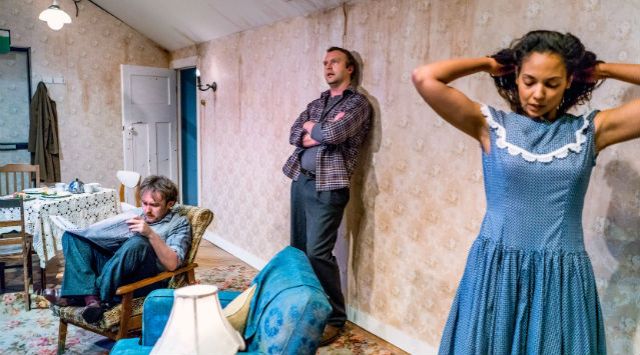
Playwright: James Fritz
Director: Craig Baldwin
Cast: Kate Cheel, Felix Johnson, Danielle King, Jeremy Waters
Image by Rupert Reid

Theatre review
There is a monster in the house, and we need to know where he has come from. Jack is seventeen and, to his parents, suddenly no longer a boy, but a strange being whose abhorrent behaviour towards his ex-girlfriend shocks the family to its very foundations. James Fritz’s 4 Minutes 12 Seconds is about the parenting of boys, the evolving nature of sex, and most of all, it is about misogyny; all examined against a backdrop of today’s advanced state of information technology. There are few things that can be definitively termed “new”, but the current proliferation of pornography is unprecedented. We have a level of access that permits anyone, children and teenagers included, unrestricted consumption, and unlike anything we had known before, an unimaginable ease in its production and distribution by any individual.

Jack is from a generation where sex education is derived almost entirely from the limitless abyss of our internet. Their personalities and sexualities are not shaped by anything considered or cautious, but the exact opposite. Where we used to rely on the constrictions of tradition and religion to help us navigate the always tricky process of teaching intimacy, the unpoliceable world wide web is now imposing itself on unsupervised youngsters, who open themselves up to every undeniable putridity that we have let free in cyberspace. Where a separation had existed between real sex and fantasy, is now a hazardous conflation indistinguishable to the young ones. What used to be titillating in the darkest recesses of our mind but never to be realised, is now thought of as normal. A culture of subjecting women to humiliation and violation is no longer containable in fictional pornography. What was once taboo and rigorously concealed is now part of the sexual DNA of young heterosexual men. If rape pornography is the only kind that can excite, what happens in real life between men and women can only be tragic.

Fritz’s play explains a problem that can appear in any aspirational middle-class home. Through nuanced and revelatory descriptions of how parents think and act in this modern world, we are able to make sense of the objectionable ways in which young adults behave. Each of Fritz’s characters, whether or not they appear on stage, are manifested with stunning detail, and the psychological accuracy of his work prohibits us from any possible denial of the sad state of affairs we are currently living through. The transformations we observe in Di and David, as they come to terms with their son’s actions, is absolute drama, powerful and compelling. The plot in 4 Minutes 12 Seconds is scintillating at every turn. Provocatively entertaining, but also relentless in its need to challenge and inform. It is a play of the now, and essential for all.

This production, helmed by director Craig Baldwin, is as engrossing as any work of theatre one could wish for. All its moments are replete with emotion and energy, keeping us deeply involved in both its sentimental and intellectual dimensions. Danielle King’s outstanding performance as Di insists that we invest completely in her conundrums. The actor’s incisive humour wins us over from her first line of dialogue, and sustains our empathy with unmitigated authenticity even when her struggles with morality become tenuous. Also wonderful is Jeremy Waters in the role of David, whose portrayals of both good and evil, resonate with such immense honesty and truth, that our humanity refuses to let us detach from his reality, even when the going gets very tough. Design aspects of the show are also remarkable. Baldwin’s own work on sound, Hugh O’Connor’s set and Christopher Page’s lights are dynamic, sophisticated and innovative.

There is a lot to love in 4 Minutes 12 Seconds, but its message is dark, dire, and desperate. We can easily say that parents need to do more to prevent our boys from growing up like Jack, but it is incontrovertibly true that the internet’s pervasiveness is a threat to young minds that no one has an impervious solution for. It has always been our duty to provide a shield from harm and corruption, but what we are currently facing is indomitable if our aim is to keep that danger under subjugation. Misinformation is inevitable, but it can be counteracted. Education is the perennial answer to a stronger future, and in this case, the only weapon we have against a force of sheer evil.

www.oldfitztheatre.com | www.outhousetheatre.org

Review: Look Back In Anger (Red Line Productions)

redlineVenue: Old Fitzroy Theatre (Woolloomooloo NSW), Aug 16 – Sep 10, 2016 | Belvoir St Theatre (Surry Hills NSW), Sep 13 – 17, 2016

Playwright: John Osborne
Directors: Damien Ryan, Lizzie Schebesta
Cast: Robin Goldsworthy, Andrew Henry, Melissa Bonne, Chantelle Jamieson
Image by John Marmaras

Theatre review
Jimmy is a very angry young man, and in Look Back In Anger, we are subjected to a series of his incessant, long and very tedious rants that prove themselves to be ultimately ineffectual, and highly irritating. At one point, he insists “that voice that cries out doesn’t have to be a weakling’s does it?”

1956 it seems, was a completely different time. Today, a white man with youth and a university education, living in a Western society, is considered to be in possession of the greatest of privileges, and we have no patience for their complaints about their perceived (and possibly, imagined) injustices of life. Of course, residing in positions of advantage does not automatically absolve a person of angst and self-proclaimed victimhood. Jimmy’s grief with our troubled existence is valid, and it is his right to refuse to suck it up, grin and bear it, but like all the furious white male voices that rule the talk-back radio waves, we can choose to ignore their shrill babble. John Osborne’s play is well structured, but its themes and concerns could not be more dated, and for many feminists, not much is lost if Look Back In Anger, along with its overt misogyny, is left dead, buried and cremated.

From a technical perspective however, co-directors Damien Ryan and Lizzie Schebesta have revived the play with admirable accuracy and nuance, delivering powerful drama, especially to those more welcoming of its ethos. Also accomplished are its designers; Jonathan Hindmarsh’s set and Anna Gardiner’s costumes add meaningful, dynamic touches to the look of the piece, thoughtfully utilising the space’s intimacy to provide a vibrant immediacy to the experience.

The cast is uniformly strong, with each actor contributing impressive depth in their characterisations of less than inspiring personalities. Osborne’s dialogue is provocative (to say the least), and his lines are given tremendous fervour by an ensemble insistent on winning us over. Andrew Henry is at his bombastic best as Jimmy, with a portrayal so passionate and convincing that we struggle to detach our dislike for the character from what is actually an excellent performance by the leading man. Henry finds scintillating chemistry with each of his co-stars, and it must be said that every scene is captivating, but also undeniably excruciating for audiences less tolerant of its turgid drivel.

Like many works of art (good or bad) that cause exasperation, Look Back In Anger will spark discussion. In its time, the work was relevant for its interest in class consciousness and issues of poverty, but these ideas have evolved into something that is now inseparable from contexts of race and gender. In the past, audiences were able to understand the world from Jimmy’s perspective, but today, the world turns the tables and puts him under scrutiny. We are made to look at anxieties of the white man, but his anger scarcely raises a brow. Perhaps it is only himself who could possibly benefit from wallowing in that distorted and narcissistic reflection.

www.oldfitztheatre.com

5 Questions with Melissa Bonne and Robin Goldsworthy

Melissa Bonne

Melissa Bonne

Robin Goldsworthy: Cast your mind back…you’ve picked up Look Back In Anger for the very first time. You read it cover to cover and gently set it down beside your play reading chair. Walk us through your immediate gut reaction.
Melissa Bonne: Well, I actually read this play for the first time while I was studying acting at The Actor’s Pulse, but I was 17 so I don’t know if I was smart enough or open enough to truly take the story in. When I read it for the first time, since the first time, I actually just sat there (in my play reading chair), staring at the last page for a while, not only unsure of what to make of how the play ended, but also unsure of why it made me feel so uncomfortable. At the time I didn’t exactly know how to articulate why I was feeling that way but I knew that because of that, I had read something very special and that this play was probably going to be very important for me in some, if not many ways. It also didn’t feel like I had just read a play. It felt more like I was right there in that tiny room with these four people. I think that’s a pretty rare gift for anyone — artist or audience — that when it comes to a play or film or story, it feels almost too real to be something you are watching but more something that you are a part of, and I think maybe that is one of the things that is great about this play…it is so confronting and ruthless in everything that it is saying, that it’s almost impossible for audiences not to get pulled in and become so personally involved in the experiences of the characters.

What an amazingly complex character Alison is! A true gift for any actress to sink her teeth into. So my question is: If Alison were a sandwich, what type of sandwich would she be?
Hmm. Well, she would have to be the best bread made from the finest ingredients by maybe a French Chef or something. And I’d say her crusts would have to be gently sliced off. Her bread parts would also have to be right out of the oven so that she was still warm when served. Inside there would have to be something with bite, but tender, like a spicy piece of organic chicken. She would need a bit of razzle dazzle, so maybe something like a slice of avocado with a drizzle of olive oil and some broccoli sprouts. And she wouldn’t be complete without something sweet, so perhaps a thin slice of beetroot. When served, Alison would need to be gently sliced into triangles, as a triangle is her favourite shape.

Have you, yourself ever looked back in anger with regards to any moment in life thus far?
Oh dear. Well in regards to my own life, I’ve mainly looked back in anger at the not so great things that I myself have done or the great things that I had the opportunity to do but didn’t do… times in my life where I could have been kinder to people or paid more attention – like during a card game or something, where I would be in my own world and end up losing every time. One of the things that comes to mind that I would be angry looking back at, is growing up as a teenager and thinking I knew what was best for me. So silly. Should’ve listened to mum more. Grrr.

What is the best/worst thing about working with the prodigious acting talent of Robin Goldsworthy?
Haha, well it’s been delightful so far. I think you were perfectly cast and I am so glad because you’re a very authentic person to work with and you always make me laugh – which is so very important! Overall I feel very blessed to have you, Andrew and Chantelle to work with because you all make it very easy for me to believe you in every moment and believe you are the characters you are playing. So the best thing would totally be that you are completely believable as Cliff, but the worst thing would be that you have such a great, charming accent… which is, just so you know, quite the distraction. Oh and your jackets… I’m a big fan of how you dress to rehearsals. Very cool you are.

If John Osborne wrote Look Back In Anger today, how do you think the play would shift thematically?
If you think about what the themes possibly mean in the context of this story, I don’t think they would have to shift all that much to be relevant today or in other words, for audiences to relate to, especially when you simplify it all. For example, you have Alison and Jimmy — from two completely different backgrounds — who fall in love, only to find that their backgrounds are a constant obstacle in their relationship with each other and their lives together. I feel like there is always this human need for connection through understanding and you can see it in so many stories and it is such a dominant force in this play. When people come from different upbringings and backgrounds, it sometimes seems to cause conflict and that conflict eventually separates people from one another. That’s what happens throughout this play. But there is this truth that everyone can relate to on some level, and that is, through understanding all bridges are formed, but that understanding is only really possible when people are heard. I think that finding your voice and having your voice be heard is such an important part of this play and ultimately, every voice being just as relevant as the next, is a message that we are left with. Although Osborne may use a more modern way of delivering this story, I think using the same themes would be just as a gift now for people as they were in 1956.

Robin Goldsworthy

Robin Goldsworthy

Melissa Bonne: What would you like people to take away from this play, or in other words, what about this play would you like to stay with our audiences after they have seen it?
Robin Goldsworthy: Mainly how relevant this play still is. 2016 has been a pretty ugly year so far and there’s so much fire in the heart of this play that slots perfectly into our modern context. There’s a lot of anger and passion around the world at the moment, and this play’s got that in spades.

If you were alive and living in London in 1956 and still you — a wonderful person and actor — what do you think it would be like to play Cliff in the original production of Look Back In Anger?
Oh I think it would have been tremendous fun! There had never been a play like this on the London stage before… The institutions and ideas that are raged against in Look Back make it such an exciting and dangerous play. To do that for the first time, who wouldn’t love that?

Cliff’s upbringing and background is a bit of a mystery in this play. What story would you give him that could possibly change everything that we think about this man and his journey in the play?
Well we talked about Cliff’s sexuality in rehearsals for a while. There’s such a closeness and tenderness between him and Alison that’s totally non threatening to Jimmy (husband to young Alison) so yeah, we discussed the possibility of Cliff being gay. Would it change much? Not sure. In another production it would have been really fun finding out.

What has this play and/or Cliff taught you about yourself?
That Welsh is an incredibly hard accent to tame. At the moment I sound like Mrs Doubtfire’s gone to India. We’ll get there, hopefully.

What is the one question you would ask John Osborne?
I’d ask him if he were a sandwich, what kind of sandwich would he be? 😉

Melissa Bonne and Robin Goldsworthy can both be seen in Look Back In Anger by John Osborne.
Dates: 16 August – 10 September, 2016
Venue: Old Fitz Theatre

Review: Belleville (Mad March Hare Theatre Company)

madmarchhareVenue: Old Fitzroy Theatre (Woolloomooloo NSW), Apr 30 – May 12, 2016
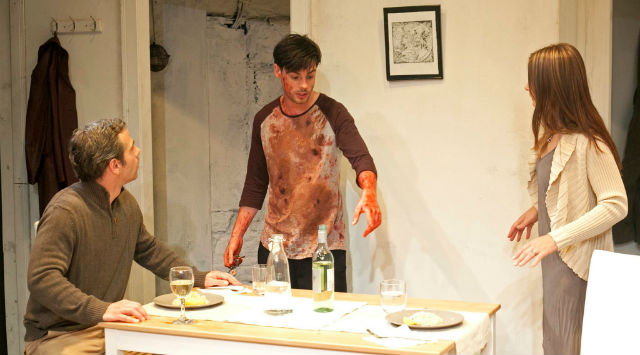
Playwright: Amy Herzog
Director: Claudia Barrie
Cast: Josh Anderson, Taylor Ferguson, Chantelle Jamieson, Mansoor Noor

Theatre review
Whether or not one believes in “happily ever after”, there is little doubt in the truth that relationships are never completely smooth-sailing. When people are bonded together, what keeps them from breaking up are not always snowdrops and daffodils. Amy Herzog’s Belleville is about the poison that can fester in romantic unions, observed through a married American couple, Abby and Zack, disquieted and displaced in Paris. We see them trying to make things work, but the only thing they share is a chronic anxiety about being together, the causes of which the playwright keeps concealed until the end. In our efforts to explain the mystery of their circumstance, we access our own understandings of how things can go awry between two people who have grown so close, thereby reflecting an unfortunate universality of the experience.

It is a play full of intrigue and danger, brought to the stage by director Claudia Barrie who creates a disarming tension from the unrelenting but subtle details of the couple’s relationship collapse. Their unnamed dysfunction is made palpable by Barrie’s flair for manufacturing suspense, and our minds are kept racing in response to the mysterious plot. The production is confidently designed by a team who taps into the undercurrents and subtexts of the writing, to address the less deliberate parts of our consciousness. The characters struggle to say what they mean, but their feelings are manifest in the atmosphere that we share. Performances are committed and thoughtful, with all actors proving to be dynamic and entertaining, although some moments could be less tentative. Abby is played by Taylor Ferguson who does a marvellous job of expressing physically what her role is unable to put in words, and Josh Anderson’s volatility as Zack keeps us on tenterhooks, wondering if and when he is going to reach a point of nervous breakdown.

Paris is the city of love, and many dream of its enchanting and exotic perfection, without ever having stepped foot in it. Indeed, Paris represents a kind of quixotic approach to romance that is fundamental to its appeal. We want what we have never experienced, certain of the fulfilment it will deliver without knowing what it actually contains and entails. Abby and Zack arrive at their point of difficulty because of decisions made on a basis of weakness, conformity and resignation. They went after something they knew nothing of, and find themselves stranded in a space of destruction and hopelessness. If they get out of it alive, they can leave ignorance behind and head into the future with brighter minds, but if they remain trapped, the end can only be calamitous.

www.madmarchtheatreco.com

Review: Orphans (Seeker Productions)

seekerproductionsVenue: Old Fitzroy Theatre (Woolloomooloo NSW), Apr 19 – 30, 2016


Playwright: Dennis Kelly
Director: Richard Hilliar
Cast: Liam Nunan, Jacki Mison, Christopher Morris

Theatre review
In Dennis Kelly’s Orphans, we look at violence and its origins. Liam is a young man who encounters unspeakable brutality. His world is one of turbulence and confusion, the nature of which was established years ago as an orphaned child, that he unfortunately sustains through to the present day. Helen is his caring sister who although similarly traumatised, is determined to create normalcy in their lives. Their story is a moving one, but presented with additional dimensions of a thriller and some very black comedy. The conflict between Helen’s order and Liam’s chaos presents tensions that serve the play well, with a skilfully designed escalation of stakes that draws us in deeper and deeper into its drama.

The very compelling characters in Orphans are played by three excellent actors who showcase their remarkable talents in a work that presents some colourful extremities to show off their thespian muscles. Director Richard Hilliar opens up every opportunity for the players to shine, and the thoroughness at which each personality is explored and portrayed, is the show’s strongest feature. Liam Nunan’s depiction of his role (also named) Liam’s trauma is unrelenting yet textured. The level of focus and emotional power he puts on display is a marvellous sight that provides a sense of edginess appropriate for the confronting nature of the material. Equally intense is Jacki Mison who gives Helen an intriguing sense of complexity that is almost hypnotic in its appeal. The more she reveals, the more we wish to discover, and the authenticity she is able to introduce along with the character’s strangeness keeps us engrossed in Helen’s quandary. Christopher Morris has a more subtle approach but is no less dynamic as Helen’s husband Danny, whose surprising transformations through the plot are crafted with great instinct and precision. The outlandish narrative is offered balance by the actor’s quiet but confident presence, allowing us breathing space within its profusion of aggressive energy.

There is also good work to be found in Liam O’Keefe’s lighting design and Tegan Nicholls’ efforts on sound. Atmosphere is generally modulated well for transitions between scenes, although visual cues do not provide enough certainty about the married couple’s socio-economic status, which becomes increasingly relevant. Similarly ambiguous are the play’s comic qualities. The darkness of its themes notwithstanding, clearer indication of humour would garner better responses to the production, and provide a greater variance in tonal shifts over its duration.

Trauma in childhood is perhaps inevitable. At varying degrees, each of us would have felt violated or betrayed in our time as small, vulnerable creatures navigating the environment, but how we develop from that tainted moment, is a real concern that Orphans investigates. We think about the process of growing up, and question the practicability of becoming happily stable adults. Some of us discover the fallacy of “happy ever after” early on but many others cling to the belief that ideals exist and a life of perfection is within reach. The truth is that things do get better, but whether we believe that there can ever be an end to personal struggle, would depend exclusively on each individual’s outlook.

www.facebook.com/…

5 Questions with Sheridan Harbridge and Ryan Johnson

Sheridan Harbridge

Sheridan Harbridge

Ryan Johnson: Is 80 Minutes No Interval exactly what it claims to be?
Sheridan Harbridge: It is exactly that. 80 minutes of punchy fun dark love with no breaks for a wee. Compact theatre for the average functioning bladder.

Your character has a real issue with theatre. Do you empathise?
My character Clare has a real problem with artsy fartsy theatre. She sits in the audience and feels ignored by the plays she sees. I don’t have that problem, I go dreamy for a beautiful classic where the director gets out of the way and honours the playwright’s intention, but I do also like risk and experimentation in my theatre. Unlike Clare, I am empathetic with the nature of risk and that more often than not, it doesn’t work, and you’re left with 35 actors running around on stage for 7 hours in diamante G-strings, holding dildos stuck on the end of some glittered sceptres singing Kylie Minogue hits in Latin. But when the risk pays off, the “Locomotion” in Latin is a real winner.

Do you think theatre needs to be more accessible?
I love the theatre scene in Australia. For the small arts community we have, we have a range of companies ticking the boxes for whatever may be your flavour. The problem is always the struggle for money, and how quickly these companies and artists burn out trying to consistently produce quality accessible and experimental theatre. Then they have to take less risks to stay safe and afloat and we all begin to complain again.

What makes our play different?
It’s a beautiful dark dark comedy with so much heart, and so so much absurdity. And plenty of fake blood, S&M whippings and nudity from an actor so handsome even Nanna will like it.

Most ridiculous thing I have ever seen in the theatre?
I saw a girl spill a tin of pencils on the floor and stand on them for half an hour trying to stay upright while monologuing. She fell so many times, the pencils were splitting in pieces and cutting the hell out of her legs. Exceptional.

Ryan Johnson

Ryan Johnson

Sheridan Harbridge: Is 80 Minutes No Interval exactly what it claims to be?
Ryan Johnson: Yes, depending on how many laughs we get and also how fast we act. It is absolutely endeavouring to be 80 minutes and it definitely has no interval.

Your character Louis is desperate to make a great work of art, to leave a legacy behind. What will people say about the legacy of Ryan Johnson?
I don’t think I’ll be remembered as a great actor or father or husband. It won’t be as ‘that scallywag who always seemed to have time for a chat with everyone.’ No – I’ll be remembered as the guy from the Cadbury Favourites commercial.

What do you think about 8-hour plays with 2 intervals and a dinner break?
I would rather eat hair. No one needs that in their life. Maybe the tech operators on the show who get paid by the hour but for anyone else, I’d say “don’t buy a ticket, you’re just enabling them”. If you want to be confused for 8 hours while watching A-list Australian actors talk funny in silly costumes, just watch one of the Hobbit movies.

What’s your favourite moment in the show?
The bits where you and Robin do anything. I think you are both comically brilliant and I feel very fortunate I get to share a space with you both!

What’s the most ridiculous thing you have ever seen in the theatre?
90’s Australian Basketball megastar Andrew Gaze in Jack And The Beanstalk at the Gold Coast Art Centre. The production was brilliant but he just didn’t capture the giant’s vulnerability. I wanted to know what was behind his ‘hunger’ for Jack but I couldn’t help but feel like Andrew was just ‘playing evil’.

Sheridan Harbridge and Ryan Johnson can be seen in 80 Minutes No Interval by Travis Cotton.
Dates: 8 March – 9 April, 2016
Venue: Old Fitz Theatre

Review: 80 Minutes No Interval (Thread Entertainment)

redlineVenue: Old Fitzroy Theatre (Woolloomooloo NSW), Mar 8 – Apr 9, 2016
Playwright: Travis Cotton
Director: Travis Cotton
Cast: Jacob Allan, Robin Goldsworthy, Sheridan Harbridge, Ryan Johnson, Julia Rorke
Image by Rupert Reid

Theatre review
Travis Cotton’s play is as much an analysis on the creative process as it is about entertainment. 80 Minutes No Interval interrogates its own writer’s abilities, ambitions and approach to art and life, but its self-indulgence is very consciously altered to accommodate Cotton’s awareness of a paying crowd’s expectations of enjoyment and fulfilment. A brilliant wit provides coherence between the simultaneous, and usually divergent, needs of being innovative and crowd-pleasing, with an unabashed lust for laughter that determines its every stage moment.

When the show is not delivering unadulterated and outrageous hilarity, it is at least piercingly amusing. Constantly alternating between juvenile and sophisticated tones of humour, it tickles our funny bone relentlessly, and aggressively, insisting on our immersion into its worlds of humour. Robin Goldsworthy and Sheridan Harbridge play a range of supporting characters, and are linchpins to the effectiveness of this fun factory. Both gloriously adventurous and bold, the actors are faultless in their precise comedy, no matter how broad or how subtle they choose to attack the material. Their work here is unmissable. Leading man Ryan Johnson has the hard task of playing straight man in the midst of a lot of hysteria, and although not quite as funny, he certainly holds his own with graceful charm and an ever-present all-knowing glint in his eyes. The role of Louis is perhaps too unsentimental a creation for the play to establish poignancy, but Johnson is nonetheless able to introduce a valuable humanity that elevates it from mere farce.

The production is designed with ingenuity and admirable exactitude. Sound and music by Hamish Michael and Hue Blanes are crucial to how the audience’s emotions respond at every plot juncture, and Ross Graham’s dynamic lights create unexpected variety and dimension to what is essentially a small and blank black space. Beautifully executed by stage manager Liam Murray, the show’s technical accuracy contributes significantly to the way we are kept persuaded and engrossed.

80 Minutes No Interval is a study of negotiations between art and entertainment in theatre. The joy it provides is undeniable, and it makes statements about art that are acute and intelligent. Using autobiography as a point of departure, but disallowing the ego from getting in the way of a good time, Travis Cotton finds himself in a space that is both critical of the art world, and also deeply self-deprecating. It is hard to imagine better ways of spending eighty minutes than with this gleeful concoction of silly and smart, whether just for laughs or food for thought.

www.oldfitztheatre.com