Review: Dancendents (PACT Centre For Emerging Artists)

pactVenue: PACT Theatre (Erskineville NSW), June 17 – 20, 2015
Choreographers: Flatline, Leah Landau, Rhiannon Newton
Cast: Flatline, Leah Landau, Rhiannon Newton
Image by Matt Cornell

Theatre review
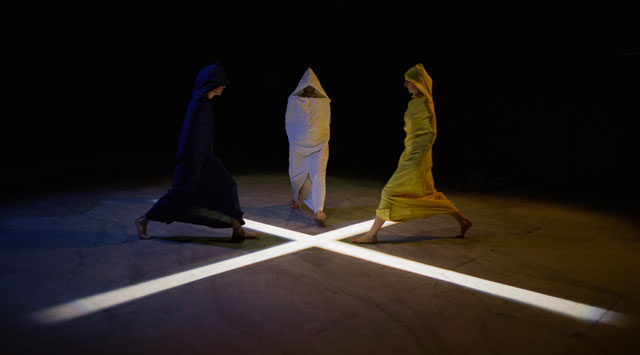
In the search for a definition of art, Flatline’s work Drawn To Move relies on the exposure of process in dance choreography to give meaning to a completed work. Two pencil scribblings are displayed on a wall, emulating archetypal notions of the art establishment. From a fine art perspective, the pieces are primitive and ugly, but in the live drawing of the third, the creators reveal the rationale behind the pieces, rendering irrelevant the commodified hanging objects, and shifting attention to the dance, and time, behind the inanimate finished products.

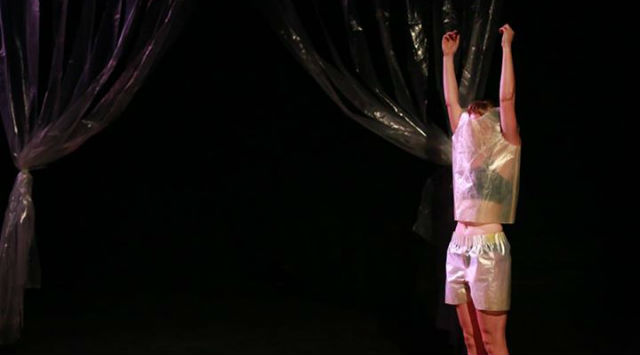
In a charming parallel, Rhiannon Newton’s Assemblies For One Body is concerned with using the rehearsal process quite literally, to present a performance piece. Newton goes through repetitive movements, with facial expressions and an eyeline that demonstrates an inward focus, as she seeks to unlock motion and gesture for reaching an intangible target of perfection. Without the presentational vocabulary of a conventional show, Newton relies on an enduring vitality to keep her audience engaged. We are drawn in by the energy of her tenacious commitment in exploring body and space, and she fascinates us with an intelligent juxtaposition of sounds (rhythmic and otherwise) with her physicality. We can never fully grasp Newton’s mental processes in each moment, but she certainly encourages us to form personal narratives and interpretations in the presence of her visual elucidations.

Leah Landau’s approach in Summer Bone is decidedly different. Inspired by ideas about nature, wildlife, farming and food, the work is underlined by a serious and earnest environmental concern, but with manifestations on stage that are humorous and thoroughly whimsical. Landau creates language with her body, and communicates persuasively, basic concepts of conservation, that would otherwise struggle to find sophistication in more conventional paradigms. It is hard to find new perspectives on long-standing issues, but art can establish new depictions so that we understand them with refreshed interest. Beyond its political message, Landau’s is a delightful piece of physical theatre that captures imagination, and amuses sight. It is dance that breaks a few rules, so that we come to a renewed appreciation of the artist’s passions.

When theatre abandons narrative, we see more clearly, why we do the things we do, and what it means to make art. Modern life is all but usurped by capitalism, and we forget our humanity outside its gluttonous and all-consuming monetary imperatives. Reading abstract dance, is to explore reasons behind human behaviour. Allowing incoherence to transpire, within the restrain of truth, will deliver a kind of beauty and transcendental pleasure that is unique to the art form, and it is in its embrace that we are reminded of the deeper and more rewarding facets of life.
www.pact.net.au

5 Questions with Leah Landau and Rhiannon Newton

Leah Landau

Leah Landau

Rhiannon Newton: Do you remember the first flicker of an idea for Summer Bone and can you explain it?
Leah Landau: The first flicker of Summer Bone came in an image of a plump, ripe orange hanging from a tree. The weight, colour and abundance of the fruit reminded me of a woman who is constantly pregnant. I bought some oranges and experimented with the weight of the fruit, and then stuffing the orange with another orange. I also buried them. I found there was a type of violence in burying perfectly made natural food. I went back and forth between oranges and improvising in the studio, and Summer Bone was born.

What’s your favourite thing about the work?
I like how each section of the work requires a particular attention. Although the dance is improvised and changes each night, there are some very clear methods and instructions. Some of these instructions are impossible to do, and I enjoy working with the movement complexity that comes from that.

What’s the background of the title Summer Bone?
I wanted a title that insinuated freshness, but had something hard in the middle. Some alternative titles included Mountain Dance, The Prairie, The Harvest or my favourite Womb Salad which thankfully didn’t make the cut.

Any plans for your time in Sydney?
I’ll be catching up with family and friends – and definitely heading to the beach!

Is there something in Summer Bone that you feel like you are, or will be solving, or continuing in your next piece?
Part of my research for Summer Bone was looking at deep time and how the Earth was formed. I created a practice of writing how the universe started in four minutes, then repeating this three times.

I’m interested in how different beginnings form under pressure, and will continue this in my next work, The Space Hour which has its first development in October at Arts House, Melbourne. It’s a group experience/performance that takes place on the journey from Earth to a new planet, re-imagining a third space of performance between now and the future.

Rhiannon Newton

Rhiannon Newton

Leah Landau: When did you first fall in love?
Rhiannon Newton: I think I fall in love a lot – particularly when I’m travelling, but not necessarily with people. I think I fall in love with beautiful, generous, awesome things – things, moments or places that are phenomenal and unexplainable. I don’t know when I first fell in love, I probably should say my boyfriend – I remember loving my cat a lot, I think I almost choked it once because I hugged it so tightly.

What’s one work you wished you made?
If I’d made it I don’t think I would love it so much, but there’s a couple of works that have really stayed with me, even though I saw them years ago the images and feelings from them are still very vivid and visceral. One of them would probably be a work I just saw in Avignon by Eszter Salamon called Monument 0. It was a really intense study of war dances from cultures that have been at war in the past 100 years – it was a quite political work that was still really grounded in dance – I hope it comes to Australia at some point.

What’s the most pleasurable thing about performing Assemblies For One Body?
I think the fact that it’s a very different dance each time I perform it. The work has a strict structure that I meet each night with improvised dancing, so there’s a bit of thrill, or surprise as I go through the work and watch it become something that I can’t really predict. Because there’s a lot of repetition in the work too it can be very gruelling physically, so this openness in the dancing gives me respite and a bit of delight, as well as helping me to make it through the tougher parts.

If you had ten people performing Assemblies For One Body, what would it look like?
I would love to do it with 10 people! To begin with it would be like 10 people dancing really chaotically and then, over the duration of each section it would become gradually more ordered. By the end each of the 10 people would be caught in their own little one second loop of material, traced from the very first dance they did.

What’s the next piece you’re working on?
I am just starting to work on a new solo – I think it might be called Doing Dancing. I’m still working with repetition – it has kind of become an automatic part of how I think about choreography and dancing and the world – but Im trying to approach repetition more as a means of growing something, rather than combatting the ephemerality of dancing. I’m not sure what it will look like yet, but I think where Assemblies For One Body is kind of like a machine this next solo will be more like a plant or a creature.

Leah Landau and Rhiannon Newton are presenting their works in

Review: Metafour (Glorious Thing Theatre Co)

gloriousthingVenue: PACT Theatre (Erskineville NSW), Jul 30 – Aug 15, 2015
Playwright: Samuel Beckett
Director: Erica J Brennan
Cast: Aslam Abdus-Samad, Bodelle De Ronde, Victoria Greiner, Sophie Littler, Pollyanna Nowicki, Gideon Payten-Griffiths
Image by Stephen Godfrey

Theatre review
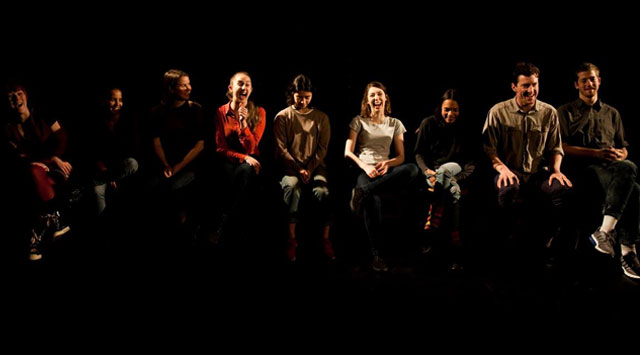
Encompassing four short plays by Samuel Beckett; namely Quad, Rockaby, Come And Go, and Catastrophe, this exploration into Beckett’s experimental work is a daring venture into some of the most abstract writing for the theatrical space. Whether entirely composed of stage directions or of barely coherent dialogue, this is a collection of pieces that requires an examination of a practitioner’s relationship with conventions and ingenuity. Beckett uses time and space as language, without the aide of stories, to find a mode of communication that necessitates original thought from all participants. We confront the nature of theatre, and of art, to contemplate how the stage operates, and also how our psyches and senses work in the creation and reception of art.

The only certainty in theatre should be the very presence of an audience in a space that is activated in any capacity by artists. Beckett’s writing is interested in the essence of that connection, and the creative mechanisms that become available when people converge at showtime. Erica J Brennan’s direction embraces the ephemeral quality inherent in the text, to create an experience that compels us to pay attention to the erratic movement of time in the production, through fascinating sequences, bewildering moments, and periods of boredom. The work is a risky one that can alienate, but the discovery of theatrical qualities beyond entertainment and sentimentality, in its sophisticated deconstructed form, is valuable. The encounter is often meditative, hypnotic and mesmeric. Our approach as spectators is an unusual and stimulating one, and even though the discomfort and challenges it presents can be disarming, what endures is striking imagery and unique sensations that are rarely encountered.

Being present is key to the appreciation of Metafour, and being there is its main point. The meanings that the show imparts are difficult to articulate, but their subliminal existence is powerful. There are forms of art independent of words, and it is their visceral effects that demonstrate their relevance. At its best, this presentation of Beckett’s work opens minds and advances cultural milieus. At its worst, it numbs our senses, but we cannot resist returning to the impressions it leaves behind, for a repeated experience of their mystery. Time is made elastic, and the show continues to linger.

gloriousthingtheatreco.wordpress.com

Review: Listen! I’m Telling You Stories‏ (PACT Centre For Emerging Artists)

pact4Venue: PACT Theatre (Erskineville NSW), July 20 – 25, 2015
Director: Katrina Douglas
Cast: Courtney Ammenhauser, Alicia Dulnuan Demou, Amber Jacobs, Carissa Licciardello, Jessica McKerlie, Tasha O’Brien, Mitchell Whitehead, Steve Wilson Alexander, Dubs Yunupingu
Image by Katy Green Loughrey

Theatre review
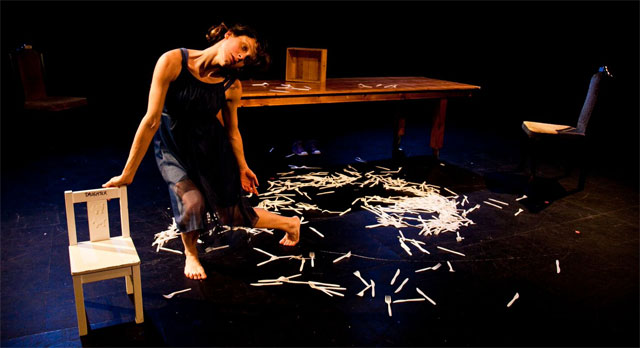
Presented by a group of young artists studying the theatrical arts through the exploration of spacial awareness, physical training and team rapport, Listen! I’m Telling You Stories‏ is an earnest demonstration of their journey as apprentices of performance. Each creates a short vignette offering varying degrees of insight into their life and mind, but it is not the content of what they have to say that is actually fascinating. The show is a cohesive and sensitive amalgamation of nine lives brought together temporally, and we witness their creative energies in motion, all focused on generating something purposeful, at least from their own perspective. What results is a succinct work, under an hour, that is more about practice than communication. Their approach is a sincere one, and although engaging for its duration, no great resonance is sustained beyond the curtain call.

There is a beautiful uniformity in the ensemble’s voice and attitude for the piece. Our attention goes to a singular entity of the whole, even though disparate elements are always present in the work’s intelligent plurality. Direction by Katrina Douglas brings out the strengths of her performers and successfully balances the individual with the group, so that the piece always feels even. The work of designers, Amber Silk (lighting) and Peter Kennard (sound) are prominent features that give the production polish and depth, in the absence of a compelling script. Our eyes and ears are ingeniously and constantly surprised in the show, and the sense of wonder provided by the team is a notable achievement, but there is nothing that seems to be able to connect on a more meaningful, or perhaps emotional, level.

On many levels, Listen! I’m Telling You Stories‏ appears to be experimental, with inventive modes of expression a distinguishing feature. At the same time, there is a safeness to the production’s artistic choices that keeps it from being more exuberant or idiosyncratically memorable. Artists in training need to understand rules and gain skills that will help them attain their visions for the stage, but often it is in the calculated abandonment of those standards that something spectacular can materialise.

www.pact.net.au

Review: Dining [Uns]-Table‏ (PACT Centre For Emerging Artists)

pact1Venue: PACT Theatre (Erskineville NSW), June 17 – 20, 2015
Choreographer: Cloé Fournier
Director: Cloé Fournier
Cast: Cloé Fournier
Image by Katy Green Loughrey

Theatre review
Events from childhood have the potential to shape a person’s entire life, no matter how innocuous they might seem at the time. Little souls have a kind of sensitivity that adults forget, and things that we do and say can have a lasting effect beyond any of our intentions. Cloé Fournier’s Dining [Uns]-Table is an exorcistic ‏work that draws inspiration from memories of a Christmas party with family members many years ago. Fournier works from a base of dance and physical theatre, but she establishes a definite sense of narrative, to provide her audience with reference points that allow us to connect with the surprising range of emotions that are being expressed. The style of art on stage is experimental and its language is thrillingly original, but all its moments are communicative and we read the unconventional presentation from an instinctive and familiar space of interior intimacy. Fournier’s exploration of her personal memory, is in conversation with our own remembrances, and the commonalities we are able to locate, are divine.

If essential ingredients for theatre are inventiveness and a spirit for adventure, Dining [Uns]-Table scores top marks. Furthermore, it is performed with exceptional gusto and flair, by a dancer whose talents are diverse and irrepressible. Fournier’s physicality is flawlessly employed by her own choreography, which is in turn, always thoughtful and refreshing. Her presence is that of a seasoned actor, with the ability to convey story and sentiments clearly and succinctly, always keeping us enthralled. The artist has a precise approach that leaves no stone unturned, and the show feels exhaustive both in terms of what it wishes to depict, and how it does so. The experience is fascinating and all-consuming, and by the end, we are completely satisfied and leave the space thoroughly impressed.

When we approach a work of art, we hope to see a reflection; not an exact facsimile of selves, but a representation of the human condition that we can relate to. This requires both creator and viewer to take a step forward, and to find a point of contact that will spark imagination and hopefully discover something meaningful. In Cloé Fournier’s work, we get in touch with elements that are fundamental to the construction of our identities, shared or personal. The depth that she leads us to, comes not as a result of the divulgement of details from her own experiences, but from the way she seeks to move us in the space that we temporarily encounter. There is so much power in the meeting of strangers at the theatre, and Dining [Uns]-Table agitates an eruption that brings new definition to how things are made and received on Australian stages.

www.pact.net.au

Review: The Great Speckled Bird (PACT Centre For Emerging Artists)

pactVenue: PACT Theatre (Erskineville NSW), June 17 – 20, 2015
Playwright: Ryan McGoldrick
Director: Ryan McGoldrick
Cast: Ryan McGoldrick, Claire Stjepanovic, Steve Wilson-Alexander
Image by Sanja Simic

Theatre review
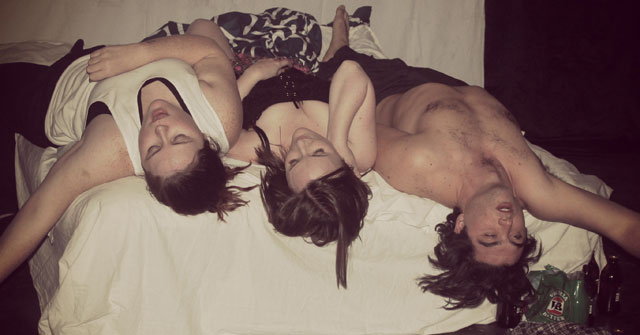
The show opens with three blank panels on the backdrop, and with Ryan McGoldrick talking about the desire to write. In The Great Speckled Bird, we are never quite sure if McGoldrick has anything to say, apart from exploring and putting into articulation, the creative process itself. Perhaps commencing from the conditions of a writer’s block, and then finding liberation as the key to releasing artistic expression (as opposed to the sort forcibly derived from hard toil), what McGoldrick creates is something ephemeral, nonsensical, and thoroughly whimsical. It is also beautiful, with minimal visual embellishment but the artist has a knack for communication that holds our attention with a gentle persuasion. He introduces a spirit of innocence and wonderment that we recognise instinctively, and should we choose to embrace it, represents a re-acquaintance with something that one would hope is universal and pure.

Musicians Claire Stjepanovic and Steve Wilson-Alexander share McGoldrick’s quality of playfulness, and their presence adds a dynamism that helps the work take flight. What they achieve is entertaining and joyful, and the story they tell, while fanciful, inspires personal thoughts about the origin of life, which is clearly a deep meditation no matter how one chooses to approach it. The collaborative efforts here are seamless and full of idiosyncratic character. Stjepanovic and Wilson-Alexander’s music is delightful, and splendidly performed.

Quirky and experimental theatre is the antithesis, and indeed, the antidote for big, serious productions that can often become too caught up in conventions and commercial expectations. Art should be aware of its audience, but it must not imagine a uniformity in its reception. It needs to address a diversity that reflects the social context that it comes out of, and not seek to perform only to one kind of people. There is a confidence in The Great Speckled Bird that believes in the ubiquity of viewers who are not of the mainstream, and it chooses not to speak down to anybody, even if we are only over-sized children caught up in the creators’ fantasy.

www.pact.net.au

Review: Love (Shut The Front Door)

shutthefrontdoorVenue: PACT Theatre (Erskineville NSW), June 2 – 6, 2015
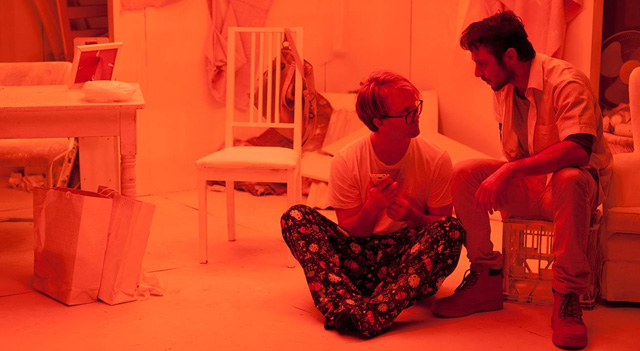
Playwright: Patricia Cornelius
Director: Sean O’Riordan
Cast: Kimberly Kelly, Ebony Halliday, Ford Sarhan

Theatre review
Art can tackle any subject matter, but when it ventures into the more obscure parts of life, artist and viewer must both find a way of communication that achieves some level of resonance. Patricia Cornelius’ Love features three young drug addicts and their aimless existences. Nothing they experience is more than fleeting pleasures, except for the romantic love that they may, or may not, have found. Cornelius’ use of language is an interesting exploration into the speech of young Australians from the low rungs of life’s echelon. They speak plainly, but their words do not express depth of thought and emotion. The best they can manage is frustration, which is perhaps a true representation of youth. For many theatregoers, the characters’ lives are distant and objectionable, and although Sean O’Riordan’s direction translates plot lines well, we struggle to find any common ground. Horrible things happen but finding empathy is challenging.

The performers begin the piece with insufficient passion, but eventually find their feet to portray more genuine sentiments in the latter half. The play is about love and romance, but we are rarely able to be convinced of the relationships on stage, which unfortunately makes the production quite precarious at many points. Ford Sarhan provides good support as Lenny, with a natural comic ability that can deliver laughs at will. Even though the actor can feel like the show’s saving grace, his style of performance does not always find cohesion with his colleagues, and the tone he introduces, although delightful, seems to run contrary to intentions of the text. Leading ladies Kimberly Kelly and Ebony Halliday are less charming, but both manage to provide strong focus and poignancy at the end.

For some, the only thing worth living for are the relationships they foster. Those less fortunate might have nothing but a string of pointless moments interrupted only by emptiness. Creating a life with meaning does not come easy, but with education and age, enlightenment is always within reach for those of us in the developed world. Love asks us to think of the young and how we treat them. Our prejudices are put to test, but converting fundamental beliefs is a difficult task, and compassion proves not to come spontaneously in all cases.

www.facebook.com/shutthefrontdoortheatre

Review: Shivered (Mad March Hare Theatre Company)

madmarchVenue: PACT Theatre (Erskineville NSW), May 7 – 30, 2015
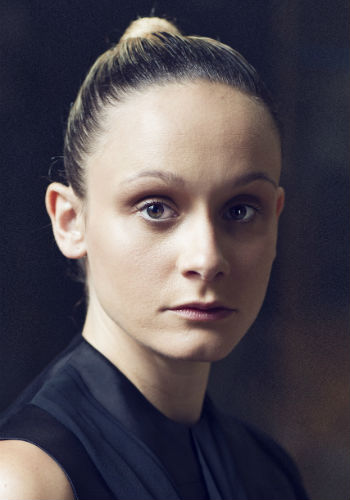
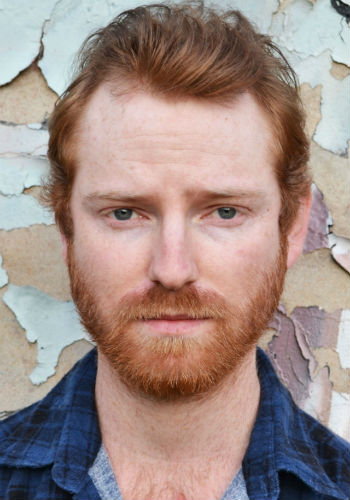
Playwright: Philip Ridley
Director: Claudia Barrie
Cast: Josh Anderson, Joseph Del Re, Rhonda Doyl, Libby Fleming, Andrew Johnston, Brendan Miles, Liam Nunan

Theatre review
Illusory contours “are perceived where there is no physical luminance, colour or texture difference,” referring to our ability to see things that are not actually there. In the case of Philip Ridley’s Shivered, we form narratives and create meanings from a series of scenes that do not immediately relate to each other, almost as though in a state of delusion. Our human nature is explored not only in the stories being told, but also in the way the audience is encouraged to makes sense of all that is put on stage. Looking at our propensity to interpret events in a way that never strays far from “cause and effect”, it is an examination of logic, which the play suggests is sometimes insufficient, and indeed, futile. Ridley’s work deals with many of the worst things in life, and makes us wonder if we can ever think of our darkest moments as inevitable, and the ethical implications of being embroiled in disappointments and disasters that we do not have direct control over.

These are big philosophical considerations, but individual scenes are melodramatic, almost operatic, in nature. Director Claudia Barrie invests heavily into that duality of intellect and emotion, with a fierce dedication to her stagecraft, and her work here is effective on both those levels. We get caught up in intense family drama not unlike those favoured by tabloid journalism, but the work is unrelenting in placing us at a conceptual distance so that we are always analysing the catastrophic consequences from an abstract perspective, in addition to experiencing the anguish that is being performed. The text is an edgy one, and Barrie takes great care in having Ridley’s words articulated with excellent clarity, but with all the taboo subjects involved, the production often feels tame in its expression when compared to the controversies being discussed.

Light and set design by Benjamin Brockman delivers a sophisticated space that is able to portray abstraction or realism as required, sometimes simultaneously. It accommodates the haphazard timeline of the plot beautifully, and the starkness of his aesthetic matches the brutality of Ridley’s writing very well, but at over two hours, scene transitions become repetitive and predictable later in the piece. The economy of technology Brockman experiments with, though slightly restrictive, is a success story that signals a significant evolution in lighting for Sydney stages.

The cast is detailed and powerful. Every character in the show touches us, despite the outrageous contexts we find them in. Libby Fleming alternates between quite campy humour and palpable rawness, for an enthralling performance that is as fascinating as it is moving. Her impressive ability to portray depths of despair provides a solid core of empathy that keep us anxiously attentive. The connection Fleming establishes with her sons in the play is the crucial ingredient that secures the gravity for its various threads of turmoil. Also wonderfully engaging is Liam Nunan whose presentational style effervesces with extravagance, but with a surprisingly convincing focus that keeps us engaged. Josh Anderson plays the damaged young Ryan with quiet sensitivity, but the threatening intensity he produces teeters close to eruption, and we are fascinated by the complexity he consistently works into his role.

There are horrors around us, and they are by nature absurd, for if they were fathomable, they would also be preventable. Humanity necessitates that we make sense of things, but life often insists on defying logic to demonstrate its dominance over humans. Life is hard, but we are resilient. All the characters in Shivered struggle, and their persistence with survival means that in order to overcome, they have to figure things out, whether possible or not. No one in the play gives up, and that is the moral of the story.

www.madmarchtheatreco.com

5 Questions with Cloé Fournier and Ryan McGoldrick

cloefournier

Cloé Fournier

Ryan McGoldrick: How have you found working in the arts in Australia compared to France?
Cloé Fournier: I must say I really started my professional career here in Australia. But in general, I feel like in Australia we have a quarter of the time to develop a work, a lot less funding too as well. But, somehow, Australian artists make it work. At the end of the day, it is hard everywhere. The main difference would be in the work process and how people interact with each other. In France, we are very direct. If something is shit or if you are not doing what is asked of you, the person will just tell you it is crap. Blunt, cut throat but straight to the point. Here, it is much more polite. People are more encouraging or perhaps not as honest!

Dining [Uns]-table deals with family relationships, how do you approach including personal material in your work?
I am very interested in social behaviours and specifically human interactions. I guess that is one of the reasons I started developing this work. I often use my personal experience when I start working on a project. Then it expends but somehow I need a personal connection to the subject matter to deliver an honest work. I also think there is always something tragic present in every family story. And I like to make fun of everything that is not necessarily funny.

When did you start dancing and what made you want to make a career out of it?
From what Mum told me, I came home one day and simply said to her that I wanted to enrol in dance classes. I have no recollection on why and Mum never pushed me to become a dancer. She was far from the “ballet mum” stereotype. I was 4. I never stopped. I did not choose to make a career out of dance. The truth is I just wanted to dance so I made it happen. But it now goes beyond. I have other interests such as theatre and technology. Dance is always present in the work I create but not in its purest form.

What interests you in audience participation in performance?
The challenge, the thrill of having to improvise every night depending on who your audience is.

Who are you tipping to win the flag this year? (AFL)
Unless the players decide to play naked, I really do not care about AFL!

ryanmcgoldrick

Ryan McGoldrick

Cloé Fournier: You used to dance. In a bathtub. In public. Naked. Myth or Reality?
Ryan McGoldrick: ‘Dancing’ might be a stretch, but I did spend some time bathing with other actors in the lounge room of an ex-nunnery-turned-sharehouse in Marrickville for a sell-out season at Woodcourt Art Theatre. Yah. Reality. #freethearts

What is the best memory you have of your childhood?
Playing soccer on crisp, wintery Saturday mornings.

How does the use of technology influence your daily life?
I’m a news junkie, so I’m quite attached to my digital news subscriptions.

Do you identify as an “Arty-Nerd” specimen?
Yes. I was living a lie for so many years, but now I’m finally at peace with it, and it feels great.

With the big news about the change of funding for the Arts, do you think we are mad to be artists?
Nope.

Why should I come to see your show? (OMG, that’s six questions! #rebels – Suzy)
Because I’ve got a fucking great story to tell you.

Afterglow – 2 emerging performance makers, 2 new works, 2 weeks.
The Great Speckled Bird by Ryan McGoldrick 17 – 20 June, 2015
Dining [Uns]-Table by Cloé Fournier 24 – 27 June, 2015
Show venue: PACT Theatre

Review: Antigone (Théâtre Excentrique)

theatreexcentriqueVenue: PACT Theatre (Erskineville NSW), Apr 23 – May 2, 2015
Playwright: Jean Anouilh (translated by Kris Shalvey and Anna Jahjah)
Director: Anna Jahjah
Cast: Roslyn Blake, Kate Fraser, Kirsty Jordan, Aurora Kinsella, Karl Kinsella, Philippe Klaus, Neil Modra, Gerry Sont, Ellen Williams, and students from Blacktown Girls High

Theatre review
The word “wilful” is usually applied to the young, along with connotations of idealism and immaturity. We think of them as “not knowing any better” to explain away their inconvenient behaviour. The lead character in Jean Anouilh’s Antigone is all of the above, but she is also virtuous. Like us, her world is one that has too many things gone awry, yet everyone is required to stick to its rules in order that an illusory sense of order can be preserved. Anarchic activity is often classed criminal, regardless of intentions good, bad or ugly. This twenty year-old woman knows the dire consequences that await but she is fearless, and proceeds to do what she believes to be right. Anouilh’s version of the Greek tragedy is passionate, philosophical and political. It is a stirring piece of writing that provides inspiration for the way we make choices, and the way we create theatre. Its incorporation of a chorus and narrator allows for ideas to be articulated directly, while sequences of realism (beautifully preserved in this English language translation by Kris Shalvey and Anna Jahjah) puts us in scenarios that feel familiar in spite of their contextual distance.

Direction of the piece by Jahjah is energetic and suitably expressive. The use of a chorus comprising only of young girls, puts focus on the dimension of gender in the play’s arguments. All dressed in white, their innocence and purity of spirit are the physical embodiment of the text’s key motifs. Use of space is inventive and thoughtful. Characters are positioned freely within the dynamically designed space, and their movements contribute to the depiction of emotional states and of narratives unfolding. Jahjah’s work may not always be affecting, but her production is a surprisingly entertaining one.

Ellen Williams is impressive as our heroine, with a deeply authentic fury and righteousness that gives the show its poignant foundations. We share Antigone’s beliefs, and are thrilled to see her fighting with conviction and wild abandon. Williams shows glimpses of tenderness and sadness that helps us connect with her role’s humanity, but these do not surface often enough. The cast works well to keep us amused and engaged, but many of the key roles are not explored with enough complexity and nuance. Creon is Antigone’s uncle and adversary, whose strong oppositional points of view raise the stakes and add to the drama, but Neil Modra’s work, while exuberant and charmingly idiosyncratic, does not convey his character’s beliefs with sufficient clarity. The central struggle of the show then becomes unbalanced and disappointingly, weakened.

There are many things we want for our children, but courage is not always at the top of lists. We are afraid of what might result, and prefer instead for them to grow up cautious, sensible and safe. It is our responsibility after all, to be their shelter from harm. In Antigone, honour comes at a price, although glory is nowhere to be found. In a tragedy where nobody wins, the moral of the story can be ambiguous. The value of a life is usually determined by how well we live it, and how long we are able to experience it. Only in rare cases are we able to judge a life by the legacy it leaves behind.

www.theatrexcentrique.com