Review: Are We Awake (Old Fitz Theatre)

Venue: Old Fitzroy Theatre (Woolloomooloo NSW), Feb 28 – Mar 11, 2017
Playwright: Charles O’Grady
Director: Sean Hawkins
Cast: Aleks Mikić, Daniel Monks

Theatre review
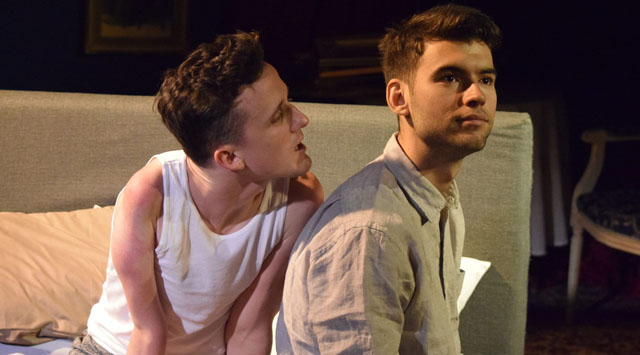
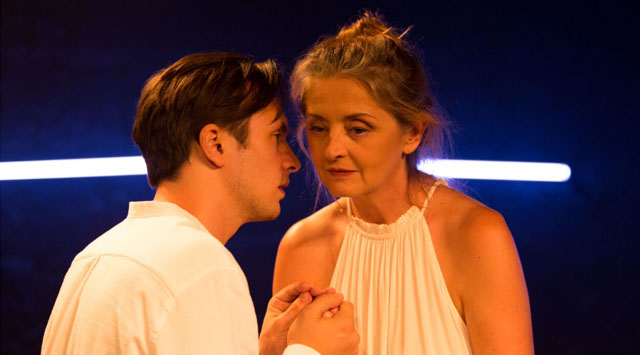
We think that an ideal romance is made of two perfect halves, where no one entity is more reliant on the relationship than the other. In Charles O’Grady’s Are We Awake, Hypnos lives with an increasingly severe disability, and while his lover Endymion has no problems taking on the role of carer, things come to a head when he is offered a job in a different city. The story is concerned with the nature of the unions that we forge, exploring what it means to be in love, when a person is unable to be self-sufficient. There is great sensitivity in O’Grady’s writing, with remarkable depth in his imagining of characters for this sentimental, and very angsty, two-hander.

Sean Hawkins does excellent work directing the piece, giving beautiful variation to texture and tension for this otherwise straightforward single-setting play. He overcomes the challenge of the writing’s big, rambling speeches by keeping delivery of dialogue pacy, but offers balance with charming sequences of momentary silences. In the role of Hypnos is Daniel Monks, impressive in his precise articulation of a very wide range of emotion, for a sensational performance that feels wholly convincing. Equally engaging is Aleks Mikić, whose creation moves us with an admirable psychological accuracy in his depiction of Endymion’s internal struggles. The couple’s fabulous chemistry is the strongest feature of the show, and we are hopelessly captivated.

Few of us will find happily ever after with that one true love, but we all defy the fairy tales of childhood, every day of our lives. Even with the tremendous challenges that Hypnos has to bear, he can only look ahead and keep moving. We are taught that marriage is the most necessary of loves, but the truth is that good people will always have someone to lean on, no matter how we categorise our human connections. Some of us may need more help than others, but all our hearts have the capacity to be as big as our companions require. Even though it will not look the way we had dreamed it, love exists and it is all around.

www.oldfitztheatre.com

Review: The Judas Kiss (Old Fitz Theatre)

redlineVenue: Old Fitzroy Theatre (Woolloomooloo NSW), Feb 15 – Mar 11, 2017
Playwright: David Hare
Director: Iain Sinclair
Cast: Robert Alexander, Luke Fewster, Simon London, Hayden Maher, Hannah Raven, David Soncin, Josh Quong Tart
Image by John Marmaras

Theatre review
Oscar Wilde’s career was cut short, when in 1895, just several months after The Importance Of Being Earnest first opened, he was sentenced to two years’ imprisonment for homosexual behaviour. David Hare’s The Judas Kiss is a chronicle of Wilde’s downfall, with Act 1 detailing his last day of freedom, and Act 2 summing up his final years in exile and poverty.

Hare’s writing is nothing short of sublime. The beauty of his language lives up to our expectations of Wilde’s speech and milieu, along with gripping philosophy incorporated into its plot at every turn. It is a rewarding intellectual experience, but the play is also rich with romantic and emotional dimensions that have the ability to engage the more empathetic sides of our attention.

Under Iain Sinclair’s heavily melancholic direction, the show’s humorous Act 1 becomes more sombre than necessary. A dark cloud looms over all the brilliant wit and notorious flippancy associated with Wilde, taking away the laughs, and causing the gravity of the piece to appear too plain and obvious. Sinclair’s style is more effective in Act 2, where the serious tone provides good support to the dramatic unravelling of its main characters.

Playing Wilde is Josh Quong Tart, an actor capable of great intensity, excellent at portraying the role’s inner turmoil. We see him grapple with the writing’s complexity, slipping in and out of resonance, but Quong Tart proves himself to be always captivating even in momentary lapses of authenticity. The Judas in question is Wilde’s lover Alfred, performed by Hayden Maher who brings youth and energy to the stage, but his interpretation is a simplistic one that detracts from the story’s otherwise extraordinary depth. Simon London leaves a remarkable impression with his disciplined, understated approach as Robbie, a quiet personality given tremendous presence by the actor.

Kudos must also be given to Jonathan Hindmarsh’s extremely ambitious set design. Breathtakingly constructed by Colin Emmerton and Gautier Pavlovic-Hobba, one can hardly imagine the effort required for its daily assembly and dismantling.

The persecution of Oscar Wilde has made him an unwilling hero of our LGBT movement, one that is hungry for historical figures to help validate our existence, and to provide contexts for our narratives of struggle. People who had suffered before, tend to have their stories wiped away by the same dominant forces responsible for their mistreatment, so we cling on tightly to the tales that remain. Wilde is remembered not only for his legacy in writing, but also his part in helping us articulate, as a community to the wider world, the prejudice we face, and the value we bring to the world.

www.oldfitztheatre.com

Review: I Hate You My Mother (Old Fitz Theatre)

whiteboxVenue: Old Fitzroy Theatre (Woolloomooloo NSW), Jan 24 – Feb 11, 2017

Playwright: Jeanette Cronin
Director: Kim Hardwick
Cast: Jeanette Cronin, Simen Glømmen Bostad
Image by Rupert Reid

Theatre review
In Jeanette Cronin’s I Hate You My Mother, strange stories are told of women with webbed feet and their, less strange but more abhorrent, transgressions as defilers of sons. The playwright’s epic, mysterious, poetic style means that access to psychological dimensions are restricted, but its ability to intrigue is without doubt. Her characters are boundlessly colourful, made seductive by generous helpings of ambiguity. We find ourselves drawn in, enthralled by the sounds of their speech, although the subtlety of their revelations can cause frustration. The play’s enigmatic qualities work effectively beyond the sensual when they manage to provoke thought, but we often luxuriate only on the surface.

Elevated by beautiful work from its team of designers, the production is effortlessly elegant, with an atmosphere cleverly calculated to secure our attention. Director Kim Hardwick establishes an ethereal grace that underscores the entire show, but even though its theatricality is charming, its sense of drama tends to be underwhelming. Qualities of danger and moral deficiencies are central to the work but they feel underplayed, subsequently distancing the audience from its controversial themes. The play wishes to talk about paedophilia and incest, both difficult subjects, but its sophisticated approach lets us off the hook, and we continue to pretend not to see.

Cronin is actor for the female roles, each of them devious, powerful and unpredictable. There is no performer more gratifying than one with something to say, and Cronin is certainly rich with ideas and passionate intentions. Her male counterparts are played by Simen Glømmen Bostad, less confident but equally compelling nonetheless. They find excellent chemistry in every scene, luring us into all their exchanges, although resolutely cryptic in their expressions. The experience of gender can tell great stories, because none is free of its taint, yet it often hides itself from consciousness. In I Hate You My Mother, women do unspeakable things to boys, and we have to wonder why.

www.oldfitztheatre.com

5 Questions with Jeanette Cronin and Simen Glømmen Bostad

Jeanette Cronin

Jeanette Cronin

Simen Glømmen Bostad: You have a very successful career as an actor. Did you always write as well? And how did this other side of you emerge?
Jeanette Cronin: I’ve always jotted down ideas. Scraps of paper everywhere. One day I turned one of those scraps into a story. Perhaps it was because I was older and less busy, so I started writing
things for senior chicks. I didn’t really think about that, though, I just had a little story to tell.
In I Hate You My Mother we meet four women who in some ways share the qualities of the Bean
Nighe or the Cannard Noz, the washerwomen of Irish Folklore who drown men by the riverside.

How did this interest come about?
Couldn’t tell you now. Something took me there…

What do you want the audience to be left with after watching this play?
That love is king, and if you mangle it, you mangle everything. And also the slightest glimmer of hope.

If you got your hands on one of those highly sought after time-machines, what time and place would you visit?
The Neanderthals are tempting. But then those 1930’s frocks do suit me. And there are a few famous disappearances I would like to sort out…

If you could change one thing in this world what would it be?
Everyone would have imagination. And with it, empathy.

Simen Glømmen Bostad

Simen Glømmen Bostad

Jeanette Cronin: Simen, you play five characters in I Hate You My Mother – well, four characters and a prologue. Do you have a favourite?
Simen Glømmen Bostad: Favourite? Well, there is this Dr. Carreaux, a narcissistic hypocritical new-age
psychotherapist. Just try to say it.

Is this play something you would want your mother to see?
Of course. I want my mum to see everything I do, even if it might be unpleasant or shocking to her. I think we always need to be reminded of the bad in us, not just the good.

If you had to describe I Hate You My Mother in one word, what would it be?
Radiant.

What was the last play you did in your native Norway? Is there a theatre at home that you might
describe as a sister theatre to The Fitz? We could suss about a little cultural exchange…

Last thing I did in Norway was an interpretation of Romeo And Juliet, where there were 5
actors playing Romeo and 5 actors playing Juliet. There is a really cool theatre company in Oslo called, AntiTheatre. They give Oslo a flare of something dangerous in the theatre scene. I’m a huge supporter for international collaborations. I will be able to set up a dialogue straight away if its wanted by Old Fitz.

What do you miss most about home?
Parent’s cooking and the four seasons.

Jeanette Cronin and Simen Glømmen Bostad can be seen in I Hate You My Mother by Cronin.
Dates: 24 Jan – 11 Feb, 2017
Venue: Old Fitz Theatre

Review: Babes In The Woods – Australian Purity Defil’d (Don’t Look Away Theatre Company)

dontlookawayVenue: Old Fitzroy Theatre (Woolloomooloo NSW), Dec 13, 2016 – Jan 21, 2017

Playwright: Phil Rouse
Music: Phillipe Klaus
Director: Phil Rouse
Cast: Annie Byron, Gabriel Fancourt, Sean Hawkins, Alex Malone, Eliza Reilly, Ildiko Susany
Image by Ross Waldron

Theatre review
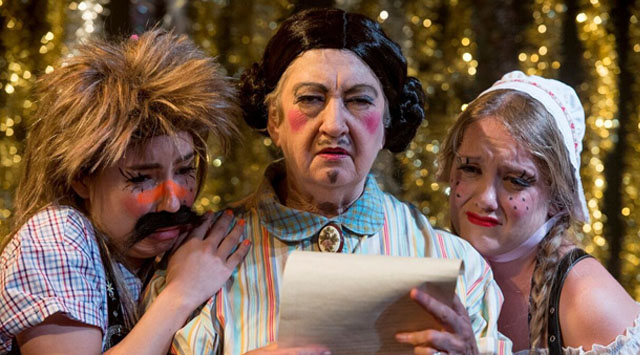
It is Christmas time, and in Australia, we go absolutely bonkers. Phil Rouse’s pantomime take on Babes In The Woods is a wild, wacky jaunt that marks the end of 2016, celebratory in tone but fiercely castigating of our ever-frustrating sociopolitical climate. If the show is a summation of the way we were, these 12 months are, once again, nothing to be proud of.

Rouse’s production however, is a triumph. Exuberant, inventive, poignant, and very funny, his creation is both frivolous and meaningful, targeting issues that concern us all, but always in the right shade of humour, no matter how dark the subject. The big and brash style of presentation allows the worst of our behaviour to be put on display, all in the name of comedy, but its need to keep things frothy can seem to diminish the severity and gravity of what is being discussed. Nevertheless, it is an admirable effort that does not forget the downtrodden, as we indulge in the unrestrained merriment and mirth characteristic of our silly season.

Phillipe Klaus’ spirited work as composer and musical director keeps the show structured and cohesive. Not all performers are impressive with their singing, but Eliza Reilly is delightfully memorable as the powerfully voiced Angel of White Privilege, allowing white children Australia-wide to act recklessly, and delivering more than a few laughs to her captive audience. Sean Hawkins is hilarious and shameless as Jack the himbo lumberjack, flexing muscles, both comedic and anatomic, to get us going. It is a remarkable cast, infectiously enthusiastic and impressive with their uninhibited creativity and imagination.

The final musical number in Babes In The Woods lampoons the lip service we often pay to the less fortunate. It makes fun of the $50 we might give to charity each month for absolution from the first-world evils that we commit. Theatre is a powerful medium, but it can also be ineffectual. Our art should always aim to do more, but if catharsis is the best we can manage on the night, there needs to be an accompanying sense of enlightenment that would take us to brighter days. A happy new year is incumbent upon how much we are able to learn from yesterday, so that tomorrow can be made better.

www.facebook.com/dontlookawaytc

5 Questions with Annie Byron and Ildiko Susany

Annie Byron

Annie Byron

Ildiko Susany: What would be one piece of advice you would give an emerging actor breaking into the industry?
Annie Byron: To thine own self be true. Train, meditate, exercise, read, forge your inner resources – you’ll need them. Pursue your passion. If the challenges start to sour your love of your craft, stop it and do something else. Persisting makes no sense if you are not being enriched by the experiences, and having fun.

How do you think things have changed for women in theatre since the time you started in the industry to now?
Well, not enough. It was astonishing to sit in those early Women In Theatre meetings last year and hear exactly the same things being said as in the Limited Life funding meetings of almost FOUR decades ago. But look! Within a year a whole Festival Fatale organised, that’s women working with women for women. Women have always supported each other. Maybe what’s changed is that companies generally take more seriously the need to be conscious of gender equity. I think we might be better organised and more articulate. I’d like to think the work of those who have gone before has made taking new steps easier. I’m not sure I can answer this question. It’s depressing that it still needs answering.

What do you think is the naughtiest part of this production of Babes In The Woods?
I think it has to be the relationship between Phyllis and Jack, with a moment of leg licking being one among numerous exquisite high points.

What is your biggest challenge in playing ‘The Dame’ (or, a woman playing a man, playing a woman)?
Before we started rehearsal, this is what I thought about most. Perhaps it says something about the level of subtlety of my performance (!) that now that we are in to it, I have kind of forgotten all about those layers, and I’m just going for a character, and for clarity of story telling. And enjoying the possibility of facial hair. There is a generous allocation of gender bending in this show, and I’m trusting it is something to be played with and enjoyed – without too much depth of thought.

If you could sing any song in this production (regardless of rights) what would it be?
“37 Babies” – the one I WILL be singing! It’s fierce and black and cheeky and political, and I adore it. Having been told repeatedly as a child that I couldn’t sing (and even instructed to mime in the school choir!) this is a major victory for me. I’m delighted that it is so steeped in the feel of Kurt Weill, and I intend to have a lot of fun with it!

Ildiko Susany

Ildiko Susany

Annie Byron: What do you experience as the things most needing to change for young women in our profession?
Ildio Susany: Gender parity. The erroneous view is that women require more training; women aren’t ready; women aren’t as talented or produce as good work as men in the industry (this is also the perception of artists of diverse backgrounds). This is completely false. We need to change this view from the outset. An example of this is that statistics show that roughly 50% of film school graduates are women and yet these women are only represented at less than 30% across all fields in the film industry. Women are in greater audience numbers than men and according to the Geena Davis Institute on Gender in Media, films with female leads made considerable more money than films with male leads. Women don’t need further training or internships – women need access to work and opportunity. Women need to be trusted for their work and skills and insights and capability in the same way that men are. Young women need to own this conversation. Be a part of Women In Theatre & Screen (WITS) and Women In Film and Television (WIFT). The industry is not a meritocracy – unconscious bias and notions of historic gender roles are still in effect today. We need to work together to change this.

Working with full commitment for little or no money, what makes being in an ‘independent’ production worthwhile?
Independent theatre is a place where artists can test their muscle, take risks and break new ground. I think this space can be the best for creating change and bringing major issues to light. I perform in independent theatre and create independent productions because I love to work, I love to be able to tell the stories that I want to tell (stories which may not be featured on the mainstage); stories which might be more inclusive and reflective of our society in terms of gender and diversity and the issues that we need to be exploring in society.

What is the best thing about being in our panto, Babes In The Woods?
The team. I’m working with some of the best artists, actors and creatives who are highly astute with excellent comic timing! It is a joy to play and improvise in this work space. I also love the themes and politics explored in this play which are centred on Australian identity and landscape.

What do you most enjoy about playing a male role?
My favourite part about playing the male role of Robbie is debunking the myths of masculinity and exploring issues of feminism, white privilege and male privilege from my perspective as a woman of colour.

Can you name 5 roles you would like to play by the time you are 60?
Lady Anne. Lady Macbeth. Eliza Schuyler Hamilton or Angelica Schuyler. Any other strong and complex female character – who might have to do some stunts or fight choreography!

Annie Byron and Ildiko Susany can be seen in Babes In The Woods by Phil Rouse (based on the good works of Tom Wright).
Dates: 13 – 21 Dec, 2016 and 6 – 21 Jan, 2017
Venue: Old Fitz Theatre

Review: Resplendence (Old Fitzroy Theatre)

oldfitzVenue: Old Fitzroy Theatre (Woolloomooloo NSW), Nov 29 – Dec 10, 2016
Playwright: Angus Cerini
Director: Nathan Lovejoy
Cast: James O’Connell
Image by Pernilla Finne

Theatre review
A young man walks into the auditorium, dishevelled and distressed. He is incoherent, and remains so for the entire duration of the 50-minute play. Our humanity compels us to connect; our instinct is to reach out for an understanding, but he is elusive, and we must decide how to make sense of his evanescent presence.

Actor James O’Connell’s performance is vulnerable yet confident, full of power and focus. What the play lacks in structural conventionality or narrative logic, O’Connell compensates with outstanding emotional intensity. Adding to the astringent atmosphere is director Nathan Lovejoy’s clever use of lights and sound, delivering an experience memorable for its unrelenting severity.

Angus Cerini’s Resplendence may not communicate well, but it represents with convincing legitimacy, a state, or perhaps, a mode of being, that contradicts how most of us think of life. Fractured, irrational and puzzling, the man reminds us of lost souls who roam the streets, people we might consider vagrant, even insane, but as we get lost in his anguished rhapsodies, we discover parts within our selves that are not dissimilar to the smithereens disseminated onstage.

www.oldfitztheatre.com

Review: The Shadow Box (Red Line Productions)

Venue: Old Fitzroy Theatre (Woolloomooloo NSW), Nov 15 – Dec 10, 2016
Playwright: Michael Cristofer
Director: Kim Hardwick
Cast: Jackson Blair-West, Jeanette Cronin, Anthony Gooley, Mark Lee, Tim McGarry, Fiona Press, Ella Prince, Kate Raison, Simon Thomson
Image by Robert Catto

Theatre review
Three terminal patients in a hospital are waiting for the inevitable, but in the meantime, they try to experience life in an ambiguous space of transience, acutely conscious of their imminent fate. Michael Cristofer’s The Shadow Box is a meditation on death, which in its distillation of life’s essence, leaves us with a play that talks a lot about love and hope.

We think about existence as being conditional on the future, letting what we do today rely on our imagination of what is to come tomorrow. When tomorrow becomes increasingly uncertain, how we experience the now transforms into something that is thoroughly disquieting. Rattled and agonised, the characters in The Shadow Box, ill and otherwise, negotiate a strange state of being that feels like a constant struggle of trying to say goodbye.

Kim Hardwick’s direction honours the depth of Cristofer’s writing with an elegant and quiet approach. Its starkness is designed in order that thoughts and emotions may erupt with immediacy, but results are mixed. Not all of its scenes are able to engage meaningfully. Even though the show works hard to demonstrate the melancholic sentimentality that each personality endures, it can often feel too distant in its coolness. Considering the weight of its themes, the production is surprisingly, more cerebral than it is emotional, leaving us craving for an experience perhaps slightly more conventionally dramatic in style.

The actors are individually robust with what they bring to their respective roles, each one shiny with conviction and professional polish. Kate Raison steals our hearts, playing up her role Beverly’s dogged optimism and blistering self-deprecation, and Jeanette Cronin’s final moments of sorrow are as devastating as they are satisfying. Performances are well-rehearsed, but chemistry is not always present, in a production that does not necessarily wish to represent any unified or rigid philosophical positions.

To love is not to possess or to shackle, but for anyone to be able to love and let go, is harder said than done. A fundamental expression of love is to be present for the other, and in The Shadow Box, we observe the ultimate in selflessness that is required for loving the dying. Sitting with the ill gives the assurance of a life valued and valid, but helping them cross over is an act of great benevolence that the ones left behind will often find themselves unequipped to administer.

www.oldfitztheatre.com

Review: Sweet Phoebe (Jackrabbit Theatre)

jackrabbitVenue: Old Fitzroy Theatre (Woolloomooloo NSW), Nov 1 – 12, 2016
Playwright: Michael Gow
Director: Suzanne Pereira, Anthony Skuse
Cast: Charlotte Hazzard, Alastair Osment
Image by

Theatre review
There is something superficial about Fraser and Helen’s relationship in Sweet Phoebe. They spend most of their time talking about work, using it as a distraction from issues at home. When a friend’s dog comes to live, their life begins to unravel, revealing problems they had previously chosen not to acknowledge. Michael Gow writes about how we get caught up in unimportant things. Middle class existences in wealthy Australia are preoccupied with inconsequential and frivolous obsessions that allow deeper parts of ourselves be ignored, until they become urgent for attention, culminating in crisis points, leaving us crying for help.

As Helen, Charlotte Hazzard presents truthful emotions that give the pair’s small world a sense of volatile authenticity. Alastair Osment’s theatrical approach highlights the artificiality and showy shallowness of Fraser. Both actors bring to the piece, a fine balance of comedy and tragedy that is often entertaining and quite gripping. Directors Suzanne Pereira and Anthony Skuse ensure that dynamics between characters are explored with sensitivity and a resonant accuracy. A plot twist does however, turn the production slightly predictable and banal towards its end, causing its conclusion to arrive deflated.

The play contains sharp humour and pointed commentary on modern couples, asking questions about the nature of intimate relationships in today’s climate of rationality and independence. As traditional values and religious beliefs fade away, it becomes necessary to understand the evolution of our psyche as it pertains to these unions, if we are to learn how to keep marriages working. There is little evidence in Sweet Phoebe that the couple should remain together, aside from the practicalities of property co-ownership. Where signs of romance do emerge, they materialise in negative ways through jealousy and anger, and while they do engage in sexual intercourse, it seems that their connection is less than extraordinary.

It is hard to make a meaningful life, when we are surrounded by things that matter little, or when we forget that time is finite. We should not be foolish with what we choose to pursue, and our decisions must never cause harm to others, but as our times become increasingly narcissistic, the likelihood of creating rich existences can only diminish.

www.facebook.com/JackRabbitTheatre

5 Questions with Charlotte Hazzard and Alastair Osment

Charlotte Hazzard

Charlotte Hazzard

Alastair Osment: What do you think Sydney audiences will enjoy most about Sweet Phoebe?
Charlotte Hazzard: It’s hard to pinpoint exactly what Sydney audiences will enjoy most about Gow’s play. I think the fact that it is set in Sydney will resonate with audiences. He paints such an unexpected, unpredictable and genuine picture of the private homes of others that Helen and Frazer find themselves and I think that’s thrilling – what sits indoors. That’s hopefully just one of the many.

How would you describe your character Helen in five words.
Open. Willing. Bubbling. Observant. Fire.

What made you decide to be an actor?
I was very shy when I was younger and so my mother forced me to do speech and drama classes and it quickly turned into a real passion. I was also mentored by a wonderful actress through high school and she made me really believe that I could pursue this career path.

What is your favourite role you’ve played in your career to date.
Tough… I’m going to answer this without considering this play…

Last year I worked on Angela Betzien’s War Crimes and played a character called Jade. Was my favourite because of many things cast/crew/sisterhood/everything but also the character is a total badass. She’s 16 years old and has been through hell and back- but despite all that she is the ultimate warrior. Never the victim, relentless, full of strength, life and love. I was really inspired by her.

What has been your greatest challenge with the text so far.
This has been such a wonderfully challenging play. There is a lot of white space on the page and also in the lives of the characters- there a not a lot of answers in the script but instead a lot of clues of what this pair are dealing with. With how they deal with each, their language and how they evolve through the play. Excavating and discovering these characters and their relationship with the very little purposely given has been a welcomed challenge. Michael Gow has also written without punctuation and when I first picked up the text I was like wow! What a freeing gift! but one of the other challenges, because although there is no punctuation it has been quite purposefully composed and discovery is still ongoing.

Alastair Osment

Alastair Osment

Charlotte Hazzard: Why did you decide to become an actor?
Alastair Osment: It’s the only thing I wanted to do when I left school… and to be honest it’s the only thing I was ever good at. My parents encouraged me to do a trade after high school . So after I completed my 4-year apprenticeship to become a qualified electrician I went off to WAAPA to study acting.

What has been the greatest challenge so far with this text?
This play was deliberately written without punctuation to allow the actors playing it to find the thoughts and syntax through discovery, rather than it being prescribed. That’s a great freedom… but also a massive challenge because I’ve found I’ve had to explore every ‘wrong’ way, to get to the ‘right’ way of delivery/sense.

Have you ever lost a dog?
A few times actually! Our childhood dog, Heidi, used to escape by slipping through the handrails on the upstairs veranda and jumping from the 1st floor!! Insane. We always found her again… but she kept on making those death-defying leaps.

What type of dog did you having growing up?
We had a Blue Heeler named Jude. And later we had a Fox Terrier named Heidi.

How would you describe your character Frazer in 5 words?
Passionate, Determined, Aspirational, Front-footed, Proactive.

Charlotte Hazzard and Alastair Osment are appearing in Sweet Phoebe by Michael Gow.
Dates: 1 – 12 November, 2016
Venue: Old Fitz Theatre