Review: Doctor Shopping / In The Bag (Cobbstar Productions)

Venue: Cobbstar Productions (Paddington NSW), Sep 11 – 22, 2019
Playwright: Shaun Angus Hall

Doctor Shopping
Director: Tamara Cook
Cast: Patrick James, Rory O’Keeffe, Monica Sayers, Kristian Schmid

In The Bag
Director: Brian Cobb
Cast: Angela Elphick, Michael Kotsohilis, Giuseppe Rotondella, Lukey Timmins
Theatre review
The late Shaun Angus Hall was only in his twenties when he wrote these two plays in the 90s. Both very broad comedies with intentions only to entertain, they bear a sensibility that seems dated now, as we go through an era of hypersensitivity in relation to issues of race, misogyny and homophobia, but Hall’s proficiency with dialogue remains evident.

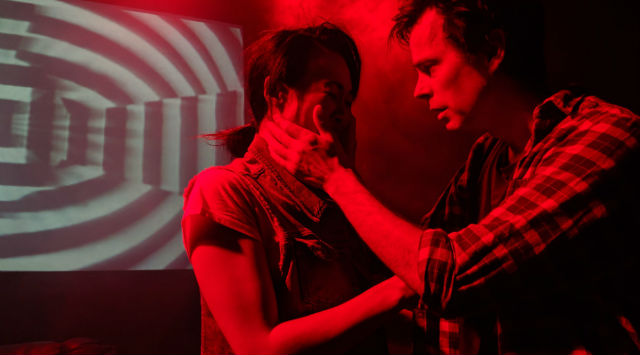
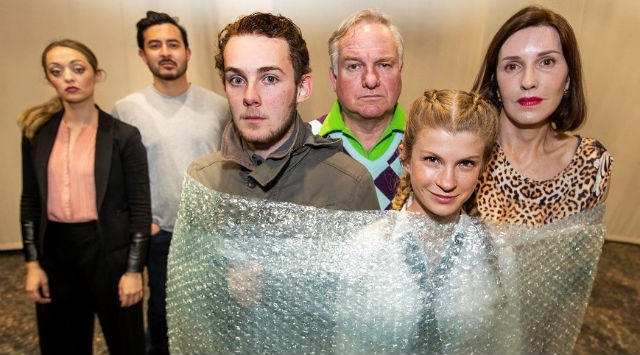
Doctor Shopping takes place mainly in a living room with four people who do nothing but abuse prescription drugs, while action in In The Bag happens at the race course, with goofy men gambling big bucks to dire results. Well crafted, but lacking in sophistication, these are plays with a specific appeal, that will prove very popular with the right crowd.

Direction for both shows prove accomplished. Tamara Cook gives Doctor Shopping an enjoyable playfulness, notable for her non-judgemental representation of addiction. Brian Cobb embellishes every moment of In The Bag with an overt humour, delivering robust energy from start to end.

Each story features four performers, all of whom are focused and enthusiastic; the quality of acting is an unequivocal highlight of the event. Kristian Schmid demonstrates excellent range as Ferris in Doctor Shopping, able to convey the light and dark of his character with ease. Giuseppe Rotondella’s strong presence as Angus provides In The Bag with a reliable anchor, and Angela Elphick’s multiple roles too are memorable, each one distinct and confident.

Some words seem to move with the times, but others can feel like relics. The nature of theatre allows old writing to be revived, and when necessary, it provides the opportunity for obsolete ideas to find relevance in a different era. Audiences however, can be stuck in the past, whether nostalgic or simply traditional. Theatre too, can decide whether to progress, or to ignore the future.

www.cobbstarproductions.com

Review: Trojan Barbie (New Theatre)

Venue: New Theatre (Newtown NSW), Sep 16 – 21, 2019
Playwright: Christine Evans
Director: Maddison Huber
Cast: Anthea Agoratsios, Sophie Avellino, Deng Deng, Sam Flack, Cathy Friend, Tristen Knox, Anjelica Murdaca, Taleece Paki, Lisa Robinson, Shannon Rossiter, Amy Sole, Kristelle Zibara

Theatre review
An homage to Euripides’ The Trojan Women, Christine Evans’ 2009 play Trojan Barbie places focus on legendary women of the Trojan War. Modern day tourist Lotte, who restores dolls in her normal life, is flung back to ancient times, where she is trapped in a women’s camp, witnessing the atrocities of war. Evans’ work is suitably tragic, but also surprisingly humorous in many of its early scenes. Familiar characters are rendered with a contemporary sensibility, allowing us to relate better to their stories, and to keep us amused.

Time travel aspects are not always presented effectively in the production, leaving us confused at several points, but director Maddison Huber ensures that each personality we encounter in her show, is distinct and memorable. Actor Lisa Robinson demonstrates strong comic abilities as Lotte, adept at delivering laughs even in the midst of battleground horrors. Kristelle Zibara is a convincing Hecuba, intense with the sorrow her maternal role is charged to convey. Sophie Avellino and Cathy Friend take on different kinds of madness, for Helen and Cassandra respectively, both performers bringing appropriate flamboyance to invigorate the stage. The show succeeds at dramatic moments of catastrophe, but when the action calls for a gentler touch, its lack of nuance can make for a less than satisfying experience.

A Chinese proverb says that women hold up half the sky. Even as men insist on occupying positions of power, we are always required to be on hand to pick up the pieces, whenever they bring degradation and destruction to the world. It is important that we look beyond how things currently operate, and commit to working towards a new system that does not simply replace men with women. These hierarchical modes of organising society have proven to be severely deficient, no matter who sits on top of the pile. If we want to ensure that nobody loses, it must mean that old ways of thinking about success, about winning, must be radically eliminated.

www.facebook.com/Scribe-Theatre

Review: The Becoming (New Theatre)

Venue: New Theatre (Newtown NSW), Sep 15 – 20, 2019
Playwright: Katie Pollock
Director: Brett Heath
Cast: Alison Benstead, Jo Goddard, Ben Hanly, Patrick Holman, Sarah Maguire, Paul Wilson

Theatre review
Greta and Gregor are rich kids from the eastern suburbs of Sydney, both going through significant transformation, as a response to the world’s current state of tumult. Katie Pollock’s The Becoming can be seen as a coming-of-age tale, but is more likely to be taken as commentary on the sociopolitical mess we are experiencing today. We see Greta deciding to be a nicer person, whilst Gregor turns angry and militant; it is as though one environment has bred two extremists on either ends of a spectrum, both of which the play presents as ineffectual and regrettable. It is an amusing context that Pollock has located, inspired by Franz Kafka, and obviously pertinent with its thematic concerns. As a work of absurdist comedy however, its characters never really depart sufficiently from the mundane, with a sense of humour that is probably too subdued.

Directed by Brett Heath, the show is thankfully raucous in atmosphere, although the players never really attain a level of authenticity that would allow its ideas to resonate. Each role is approached with an enjoyable sense of theatricality, but we struggle to connect with anything meaningful even if the text does point to matters contemporary and troubling. Sarah Maguire’s indefatigable ebullience as Greta helps sustain our attention, and Patrick Holman is suitably offbeat as the misguided Gregor, particularly noteworthy for his performance of live drums that prove to be a rousing and sophisticated touch.

It is true that so much of what we observe to be happening in society, can be infuriating. Greta and Gregor may have found radical ways to express their dissatisfaction, but they achieve nothing, other than to escape that dreadful sense of helplessness when one is crippled with inaction. When the system is broken, those of us who are more intrepid, like the siblings in The Becoming, might be moved to try for solutions, but it is revealing that the two do not confer, choosing instead to operate independently even though they live under the same roof, and share the same blood. They are unable to listen to the other, each so certain of their own beliefs. Watching the collapse of this kinship, of humans failing to connect, it becomes unsurprising that disaster should unfold.

www.newtheatre.org.au

Review: Cats Talk Back (New Theatre)

Venue: New Theatre (Newtown NSW), Sep 9 – 14, 2019
Playwright: Bess Wohl
Director: Sahn Millington
Cast: Callum Alexander, Jason Blake, Taylor Buoro, Shayne de Groot, Jodine Muir, Daniel Mulholland, Julian Ramundi, David Woodland
Image by Elissa Blake

Theatre review
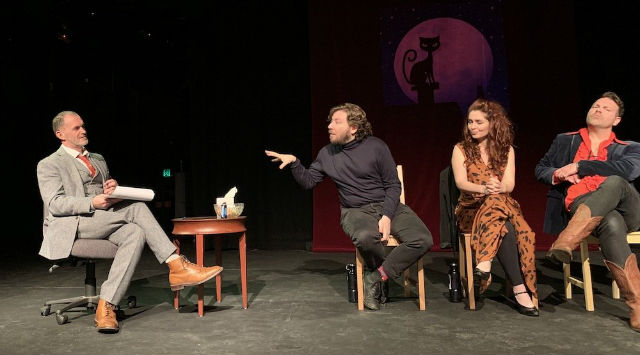
Not long after the closure of Cats the musical after an 18-year run on Broadway, five of its performers converge at a small panel event, to talk about life on the legendary show, and to relive, quite publicly, their glory days. Bess Wohl’s Cats Talk Back captures a moment of limbo, during which we see people stranded, cut off from the past, yet unable to move forward. The writing is often amusing, if slightly twee and predictable with its comedy.

Directed by Sahn Millington, the production is excessively naturalistic in approach, with a humour that seems needlessly restrained. Actors with a tendency for a more exaggerated style of performance, like Daniel Mulholland and David Woodland, are able to create distinctive characters that add spark to the production, but can also at times, seem discordant with the show’s overall subdued tone. Chemistry between players is hesitant, with each personality taking on separate approaches, unable to establish a cohesive sense of play as an ensemble. Theatre critic Jason Blake presents a version of himself, acting as moderator of the panel, notable for his easy charm and a sardonic timing that delivers several memorable laughs.

Nobody cares about these ex-cats, except the artists themselves. Every human is part of something bigger, but as is so clearly demonstrated in Cats Talk Back, we are almost always interested only in our individual experiences of the world. Narcissism is relentless, and it makes us fail to see that what feels like self-preservation, is actually gradually harming us all. Like characters in the show, we obsess over our little lives, consumed by the anxiety derived from notions of personal inadequacies, of not being loved. We long for personal satisfaction, and spend all our energies in pursuit of an elusive happiness, when it is abundantly clear that there are much more important things to do.

www.newtheatre.org.au

Review: The Grapes Of Wrath (New Theatre)

Venue: New Theatre (Newtown NSW), Aug 6 – Sep 7, 2019
Playwright: Frank Galati (based on John Steinbeck’s novel)
Director: Louise Fischer
Cast: Matthew Abotomey, Peter David Allison, William Baltyn, James Bean, Ted Crosby, Shayne de Groot, Simon Emmerson, Angus Evans, Peter Irving Smith, Brittany Johnson, Caroline Levien, Madeline MacRae, Ryan Madden, Kirsty McKenzie, Rowena McNicol, Matthew Raven, Andrew Simpson, Lily Stirling, Loki Texilake
Images by Bob Seary

Theatre review
It is the Great Depression, and the Joad family is on the road, having left Oklahoma, in search of opportunities for a better life. John Steinbeck’s The Grapes Of Wrath details economic hardships of barely a century ago, that seem so far removed from our twenty-first century realities. We can however, discern that although the conditions in which we operate have drastically transformed, the challenges and threats to our mortality remain. It may look like life has become easier, but to be human, it seems, will always involve a struggle for survival.

This stage version is a fairly concise adaptation by Frank Galati, and under the direction of Louise Fischer, its scenes move along swiftly, for a historical drama that does not demand too much of its audience. Tom Bannerman’s set design is notable for its elegance and efficiency, and along with Sharna Graham’s understated work on costumes, a visual authenticity is achieved for this American tale of adversity. David Cashman’s songs are a highlight, each one rich and evocative, often outshining the actual scenes that they are placed between.

The show is performed by a very big, and very strong, cast. Each character is lively and convincing, and as a team, they manufacture a sense of time and space effective in having us feel virtually transported. Actors Matthew Abotomey and Rowena McNicol are particularly impressive in scenes together as mother and son, both energetic and detailed, able to communicate the urgency of their situation, for moments of entrancing drama.

As with many other old stories, one could struggle to find the relevance in The Grapes Of Wrath, but the kind of fear that it encapsulates, is quite eternal. We worry about poverty and unemployment, afraid of being left behind. We see the destitute on our streets, and pray that our loved ones be spared from ever having to experience that calamity. One difference that can be observed in our narratives, after the 80 years since the publication of Steinbeck’s novel, is that his characters have each other to rely on, to suffer with. Their fears, unlike ours, do not include abandonment and isolation. We are never guaranteed absolute safety from the tides of time and natural chaos, but they at least had each other.

www.newtheatre.org.au

Review: This Bitter Earth (New Theatre)

Venue: New Theatre (Newtown NSW), Jul 11 – 27, 2019
Playwright: Chris Edwards
Director: Riley Spadaro
Cast: Mitchell Bourke, Michael Cameron, Matthew Predny, Elle Mickel, Sasha Simon, Ariadne Sourgos
Images by Bob Seary

Theatre review
Comprising six scenes, This Bitter Earth by Chris Edwards is essentially a series of short plays about being young, queer and white in Sydney. Although not particularly profound, Edwards’ writing is ultimately insightful, with an absorbing balance of light and dark to keep us intrigued and entertained. A refreshing addition to the legacy of queer playwriting, This Bitter Earth deviates from the tradition of torment and trauma, for a theatre that presents the hardship of coming-of-age as humorous and strikingly natural. The oppressive closet is conspicuously missing in action.

The staging is polished, elegant and very attractive, assembled by an excellent design team, who all but steal the show with their remarkable sense of style. Set and costumes by Grace Deacon are inventive and sophisticated, beautifully considered in each of its spatial transformations between scenes. Phoebe Pilcher and Morgan Moroney’s lights are sensual and poetic. There is a passion in their practice that proves to be quite captivating.

Riley Spadaro’s confident direction gives This Bitter Earth a gravity that helps it sing with purpose. His ability to convey nuance prevents the show from turning flimsy, even at moments when the narrative shifts to frivolous concerns. The show is performed by a charming cast, including an effervescent Elle Mickel whose comic timing is a real asset to the production. Matthew Predny introduces palpable vulnerability to his characters, along with a dynamism that is satisfyingly disarming. Also impressive is Mitchell Bourke, whose portrayal of the classic but tricky combination of camp and despair, resonates with surprising authenticity.

Generations of LGBTQI people have worked hard for today’s social and legal advancements; the equality that we do have are hard-won, to say the least. Watching our young, privileged ones in This Bitter Earth go through their 2019 version of rites of passage, is a joyous exercise, even as we watch them suffer through their growing pains. Coming out stories have dramatically changed, as we had hoped. Our tribe can now begin to experience early adulthood in a way that is no longer exponentially harder than their straight counterparts. Their challenges remain different from the mainstream, but the additional labour of having to deal with structural prejudice, is quickly vanishing. Understanding sex will never be easy, but there is no need for the process to be made more difficult by anyone’s ignorance.

www.newtheatre.org.au

Review: Collaborators (New Theatre)

Venue: New Theatre (Newtown NSW), Jun 4 – Jul 6, 2019
Playwright: John Hodge
Director: Moira Blumenthal
Cast: Michael Arvithis, Audrey Blyde, Ben Brighton, Elsa J Cherlin, Richard Cotter, Peter Farmer, Dave Kirkham, Madeline MacRae, Dominique Purdue, Joshua Shediak, Andrew Simpson, John van Putten, Annette van Roden, David Woodland
Images by Bob Seary

Theatre review
Near the end of his career, Mikhail Bulgakov wrote a play about Joseph Stalin. In John Hodge’s Collaborators, we examine that relationship between artist and dictator, speculating on the integrity that becomes compromised, when creativity is exposed to politics. From having his work banned, to completing Stalin’s flattering portrait, we observe the ease with which institutional power can infringe upon expression, and how the dissemination of information is always a precarious enterprise when governments and businesses are involved. Hodge’s play is imaginative, and quite dynamic, but the journey that it plots for Bulgakov is predictable; having sold his soul to the devil early in the process, it is a challenge for the narrative to go anywhere surprising.

It is however, a splendidly designed production, with Colleen Cook’s set and Martin Kinnane’s lights offering sumptuous imagery, and Patrick Howard’s luscious sound design adding to the surreal aesthetic being manufactured. The audience is immersed in a stylistic landscape inspired by Bulgakov and by Stalin’s Russia, one that feels accurate in its invocation of a time and space that feels historic, but not too long gone. Director Moira Blumenthal’s calibration of atmosphere for each scene is precise and passionate, but although tone is consistently well rendered for this staging of Collaborators, some of its dramaturgy proves insufficiently thorough, and what should clearly be a poignant experience, leaves us somewhat underwhelmed.

Leading man Andy Simpson brings a rich authenticity to Bulgakov. We believe this rendition of the struggling dramatist, even if his essence can eventually prove monotonous. Although not entirely convincing as a heavyset autocrat, Stalin is depicted by Richard Cotter, whose playful exuberance is an entertaining asset for the production. David Woodland impresses as Vladimir, secret police agent turned theatre director, bringing flamboyance as well as nuance to the show, keeping us riveted to his character, to deliver effective expositions when the story turns convoluted.

We need our art to be pure, but it is unrealistic to expect incorruptibility of our artists. More than anyone, they have to be open to the world, free to absorb anything that appeals to their senses. It is the nature of their vocation to be exposed to influences, but at the same, we need them to know the difference between right and wrong. In Collaborators, we see Bulgakov lose his way, as the propaganda machine gradually takes him over, reminding us that no artist is spared of human fallibility. People will fail, and failure must be acknowledged, so that we can recognise success when it appears.

www.newtheatre.org.au

Review: Pygmalion (New Theatre)

Venue: New Theatre (Newtown NSW), Apr 23 – May 25, 2019
Playwright: George Bernard Shaw
Director: Deborah Mulhall
Cast: Colleen Cook, Steve Corner, Tiffany Hoy, Lisa Kelly, Emilia Kriketos, Natasha McDonald, Mark Norton, Robert Snars, Shan-Ree Tan, Sean Taylor, Vitas Varnas, Emma Wright, Tricia Youlden
Images by Bob Seary

Theatre review
The most gratifying aspect of Eliza Doolittle’s story is her refusal to be content with a life of misery, no matter what form it takes. Whether an impoverished flower girl, or a faux aristocrat, she is compelled to break free of shackles, as soon as she identifies an opportunity to do so. George Bernard Shaw’s Pygmalion talks about independence, and dares to place a feminine figure at the centre of speculations, in a work that tries to unpack the implications of class in British society, along with twentieth century notions of personal autonomy. Having coincided with the suffragette movement of the 1910’s, Pygmalion can be seen as a remnant of early feminism, with a female lead determined to discover the conditions for freedom, even if the playwright does put her through an unyielding series of torturous circumstances.

It is a wordy script, that Deborah Mulhall tries to overcome as director, by injecting speed and energy into its rendering. There are no indulgent pauses and few languid moments of sentimentality, resulting in a show full of vim and vigour. Intellectual complexities are occasionally compromised, in the absence of space for meaningful rumination, but the production holds our attention adequately for the duration, perhaps trusting that we would attain some degree of poignancy in the hours thereafter. Mulhall’s steampunk costumes, although well executed, are a curious addition, for a narrative not of any science-fiction or fantasy genre. Tom Bannerman’s remarkable set design is stylish, and cleverly conceived to facilitate dynamic stage action.

Actor Emma Wright is a strong Eliza, playful but firm in her interpretation of the classic role. Technically accomplished, yet an instinctual presence and emotionally rich, Wright’s modern approach is a wonderfully refreshing take of that familiar persona. An impassioned Steve Corner elevates the Henry Higgins character, to someone much more vulnerable than is conventionally depicted, for unexpected layers to the story that prove highly rewarding. Colonel Pickering is less surprising, but nonetheless effectively portrayed by Shan-Ree Tan, who impresses with one of the more sturdy performances from its supporting cast.

At the end, we understand that Eliza wants to be her own person, unbeholden to anyone. We also realise that in England a hundred years ago, spaces for women to thrive independently are not yet widely established. Eliza’s fate was not an optimistic one. With the passage of time, we certainly feel more able to operate in accordance with our individual sovereign wishes. Women are gainfully employed like never before, in areas of work unimaginable a century ago, and access continues to widen as we persist with the dismantlement of barriers. Progress is undeniable. If only we would stop our prejudice and judgement on women who look and sound different.

www.newtheatre.org.au

Review: Once In Royal David’s City (New Theatre)

Venue: New Theatre (Newtown NSW), Mar 19 – Apr 13, 2019
Playwright: Michael Gow
Director: Patrick Howard
Cast: Alana Birtles, Ben Brighton, Amy Victoria Brooks, Sandra Campbell, Nathalie Fenwick, Nicholas Foustellis, Angela Johnston, Alice Livingstone,
Aimee Lodge, Francisco Lopez, Martin Portus, Bryden White-Tuohey
Images by Bob Seary

Theatre review
Will is on the verge of beginning a new job, just as his mother coincidentally lays dying in hospital. It is a new life that beckons, and with all the emotions that should feel overwhelming, Will retreats into a lot of academia, as is typical of theatre directors and educationalists. He spends his time thinking about Marx and Brecht, dealing with ideas of resource ownership and distanciation; not quite preparing for the period of mourning that is sure to come. Michael Gow’s Once In Royal David’s City is a piece of writing perhaps not entirely interested in coherence, allowing itself to move in various directions, almost defying our need to condense its contents into a more conventional narrative form.

Patrick Howard’s direction reveals with honesty, the often contradictory states of being human. Will never quite behaves the way we expect him to, yet there is nothing unbelievable about how he goes about his business. There are some hallmarks of Brechtian theatre in the presentation, although those expressions can seem perfunctory. It is a handsome looking show, put together with excellent taste by production and lighting designer Victor Kalka, and costume associate Luciana Nguyen. Their minimalist style suits the bluntness of Gow’s writing, unpretentious but elegant.

Actor Francisco Lopez brings an unassuming geniality to the lead role, effective in monologues that allow him to directly address the audience, but too mellow in contrast with scene partners. More compelling performances come from the likes of Sandra Campbell, whose commanding presence in several small parts proves refreshing. Amy Victoria Brooks too, is memorable as Gail, an anguished soul roaming the hospital, in search of connection and consolation. Will’s mother Jeannie is played by Alice Livingstone, ironically lively, able to bring verve to a character that is otherwise written with little originality.

To love books is in some ways better than loving people. Books can be crafted to perfection, and we as readers can hold dear, words and ideas that we deem to be impeccably arranged. To love humans however, is quite another thing. Not only are we deeply flawed, we are transient, destined to break hearts wherever bonds are created. Death and impermanence, however are the ultimate provocation, intensifying all the sensations that define love. The heart wants what the heart wants. Mortal or immortal, it is hardly up to us to choose for whom we fall.

www.newtheatre.org.au

Review: My Night With Reg (New Theatre)

Venue: New Theatre (Newtown NSW), Feb 5 – Mar 9, 2019
Playwright: Kevin Elyot
Director: Alice Livingstone
Cast: Michael Brindley, Steve Corner, Nick Curnow, James Gordon, Steven Ljubovic, John-Paul Santucci
Images by Bob Seary

Theatre review
In Kevin Elyot’s My Night With Reg, we meet a group of London gays, in the throes of the 1980s AIDS crisis. Just as a new post-Stonewall liberation had begun to inform the way these men were able to live, a dark period of oppression again descends upon them, threatening to quash any promise of a bright future for the community. The play portrays the intimate world of traumatised individuals, all suffering from the reverberations of a then mysterious killer disease, whilst demonstrating the undying vibrancy of an irrepressibly spirited band of brothers.

It is a sentimental piece, oddly apolitical, with an authenticity that today represents not just an enjoyable sense of nostalgia, but also provides opportunity for a valuable historical study of a society not long past. Elyot’s jokes are as funny as they would have been at their 1994 premiere, but his sorrowful expressions are less resonant, with the advent of significant medical advancement, so many years after the fact.

An endearing cast presents a heartfelt production, directed by Alice Livingstone who orchestrates an entertaining 95-minute exploration into queer identities, from the perspective of middle-class white gay communities of the time. Some of the acting is lacking in precision, and sensitive moments deflate as a result, but the show delivers sufficient poignancy for it to be an ultimately satisfying experience. Comedic roles in My Night With Reg leave the strongest impressions, with Steve Corner’s outrageously lascivious turn as Benny particularly delightful, diligently balanced with some very surprising vulnerability that proves affecting. Also memorable is Steven Ljubovic, whose quintessential rendering of cabin crew Daniel, is unapologetically camp, complete with one-liners that are simply irresistible.

There certainly are more relevant queer stories to tell for 2019, but to forget those who had fought hard for today’s freedoms, would be unconscionable. From living underground to nuptial vows, the journey for LGBTQI rights was (and in many other places, remains to be) long and arduous. My Night With Reg does not explicitly show external forces of subjugation, but the limitations and compromises to how we had lived, are clear. Having emerged triumphant, it is important that we know to value and to take advantage of these new liberties, and to revisit tales of our past, for a reminder of today’s privilege, is key.

www.newtheatre.org.au