Review: Aunt Agony (New Theatre)

auntagonyVenue: New Theatre (Newtown NSW), Sep 15 – 22, 2014
Director: Michael Campbell
Playwright: Richard Black
Cast: Sasha Dyer, Dave Kirkham, Taylor Owynns

Theatre review
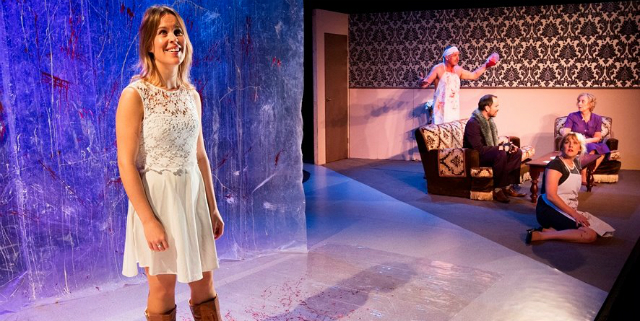
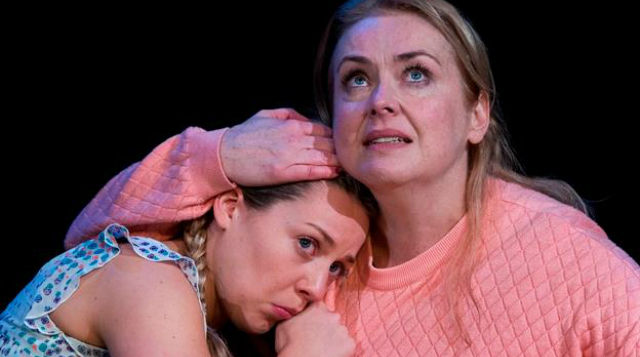
In a society that overvalues youth, we often forget that quirky old people are much more amusing and fascinating creatures than their offspring. Richard Black’s Aunt Agony is a farcical black comedy that imagines the secret wild life of Aunt Lynn from the conservative Upper North Shore of Sydney. Lynn is an eccentric and flamboyant lady who lives with a cat and a dark side. Her niece Christine has just ended a relationship and seeks refuge in Lynn’s apartment. Their love-hate relationship reveals a series of antics, funny and sinister, that forms the plot of this surprisingly textured show. Black’s characters are vibrant and his scenarios whimsically formulated, with punchy dialogue and timely sociopolitical references.

The work becomes tighter in pace after the halfway point. Early scenes move a little slow, preventing tension from taking form satisfactorily. Perhaps some edits to the script can provide some energy. The actors’ rhythms can also benefit from an increase in speed, but Michael Campbell’s direction is quite accomplished. He injects a wonderful playfulness to the production, and makes brave choices that befit the idiosyncrasy of the lead character. The play’s more nefarious elements are handled with just enough seriousness to retain their sobering reverberations, but they do not get in the way of the overall joviality of the show.

Lynn is played by the effervescent Taylor Owynns who is endearing from her very first entrance. She has a likability that keep us on her side no matter how abhorrent her shenanigans become. Owynns performs a charming madness, but some of her techniques can feel slightly repetitive. The show requires a high level of energy from her, and she delivers on most occasions especially when in close collaboration with Sasha Dyer who takes on the role of Christine. Dyer comes to life when the show’s brashness escalates. She is a spirited performer who works well with physical comedy, and there are many opportunities for her talents to shine through on this stage. Dyer’s firm commitment and focus makes substantial what is essentially a supporting part. Also providing effective support is Dave Kirkham whose good humour makes his brief appearances delightful and memorable.

Design of the show is pleasant and efficient, but the set leaves empty space in the down stage area, which is not often utilised. Moving set pieces closer to the audience would allow more intimacy and hence create greater impact. The production leaves a lasting impression with meaningful morsels littered through its text. It is often hilarious with a giddy silliness, but its entertainment value is sometimes coupled with poignancy, proving itself to be the kind of madcap comedy that refuses to underestimate its audience.
www.newtheatre.org.au

Review: The Sheds (New Theatre)

theshedsVenue: New Theatre (Newtown NSW), Sep 17 – 21, 2014
Director: James Cunningham
Playwright: James Cunningham
Cast: Patrick Chirico, Ludwik Exposto, Andii Mulders

Theatre review
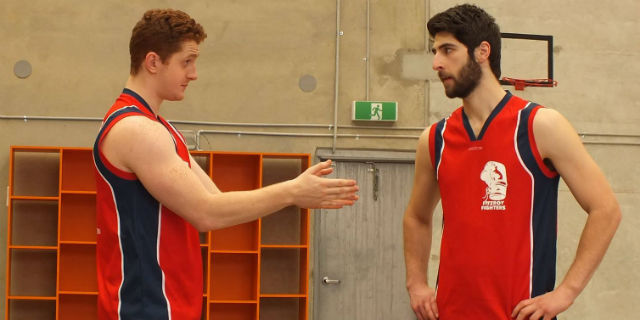
James Cunningham’s The Sheds begins when an AFL player Darren Anderson decides to reveal his homosexuality to his team and the public. It is not about the experience of being in the closet, but what happens after one decides to come out in an almost entirely male environment. Cunningham’s concepts for the play are strong. The tensions between the sporting industry and the very rare occurrences of fracture in its overwhelming heteronormativity are fertile ground for exploration, and indeed an area that our society needs to examine more closely. It is also a credit to the script that Anderson is portrayed as a liberated personality, without emphasis on his struggles, thus preventing the context from being dated and banal. Anderson’s character is paralleled by his friend and colleague Jimmy Davis, who has his own secrets, and the narrative is made substantial by Davis’ repression and its subsequent dramatic consequences.

Unfortunately, execution of Cunningham’s concepts are disappointing. His script is too obvious and plain, with unimaginative dialogue that feels compelled to tell too much, as though it is playing to a radio audience. Speech patterns for each of its three characters do not seem to vary. The way language is used does not sufficiently relay the differences in background and personalities. We appreciate that they are close compatriots who play for the same team, but the story requires a more distinct style of conversation for each character. Cunningham’s direction tries to create movement for the stage, but it can feel superfluous at times. There is a lot of pacing around, and changing of clothing, as though the actors are unable to deliver their lines without being told what to do with their hands. Transitions between scenes are handled without finesse. The actors often leave the stage, only to walk back in, a quick moment later. The passage of time can be conveyed more creatively than simply providing exits and entrances.

The cast is a good-looking one that represents a contemporary multi-ethnicity. The men are all athletic, which makes their depiction of the sporting space convincing, and while their instances of full-frontal nudity can seem a little gratuitous and distracting, it is nonetheless pleasurable to watch. The acting is not strong, with stilted performances and poor diction that make the plot a challenge to follow, but their energy levels are generally buoyant and there is a good level of enthusiasm that fills a lot of the show’s fifty minutes.

There is an urgent need for diversity in Australian theatre, and The Sheds makes a contribution. It talks of ethnicity, sexuality and mateship in a way that is fresh and timely. Cunningham’s voice is unseasoned, but it is a necessary one. We do not expect success to come out of every experimentation, but it is the courage to try that will always impress.

www.facebook.com/theshedsplay

Review: Wolf Lullaby (New Theatre)

newtheatreVenue: New Theatre (Newtown NSW), Aug 19 – Sep 13, 2014
Playwright: Hilary Bell
Director: Emma Louise
Cast: Maryellen George, Peter McAllum, Lucy Miller, David Woodland
Photograph © Bob Seary

Theatre review
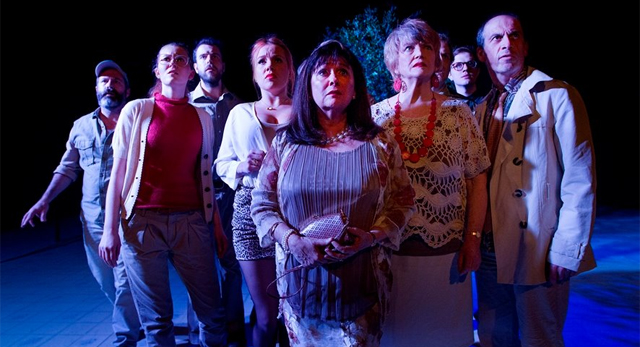
We walk around with rose-tinted glasses everyday. The world can be a very ugly place if one chooses to see it only for its flaws, so we hold on to convenient lies in order that we may arrive at bedtime relatively unscathed. In Hilary Bell’s Wolf Lullaby, a veil is lifted off some hard truths and we are confronted with concepts of childhood innocence and familial sanctity that contradict the comforting notions we hold dear. Bell’s play is dark, disturbing and challenging. It is also full of mystery and dramatic tension, with interesting characters that tell an unusual, and sometimes horrific, story.

Director Emma Louise’s interpretation of Bell’s text is subtle and unpretentious, but the resulting production is a powerful one. Much of the abomination that happens, can only be seen through our own imagination. Heidi Brosnan’s lighting, and sound by Chelsea Reed and Alexander Tweedale, contribute immensely to an atmosphere of foreboding, and Allan Walpole’s set, while being a little too literal, contains elements that heighten the play’s supernatural qualities. A highlight of Louise’s work is the handling of ambiguities in the narrative. She does not force upon us a strong point of view about unfolding events, but leaves morsels of intrigue resonating for our own discovery and comprehension.

Half of the show’s four characters however, feel a little too indistinct. The portrayals of Warren and Sergeant Armstrong are realistic, but their personality transformations seem too sudden and we are left with a less than thorough understanding of their behaviour and motivations. Fortunately, the more dominant roles are delivered with greater detail. Lucy Miller plays Angela, the mother character in the piece. Her work is beautifully complex, and she creates a multiplicity that is responsible for the work’s depth and intellectual impact. Angela is unexpectedly fascinating, and Miller’s measured approach makes her the most disarming and enigmatic character on stage. Nine year-old Lizzie anchors the play in a realm of nightmares. Maryellen George is an adult but her performance as Lizzie is accurate, touching and eerie. Her mimicry of childlike gesturing is impressive, but it is the way she balances conflicting truths within her personal narrative that thrills and perplexes us with a perverse delight.

Stories about children are often predictable and unoriginal, but Wolf Lullaby is a rare beast. It is not light entertainment, but it is certainly an enthralling and eye-opening night at the theatre. It locates sacred beliefs and punctures them with an honesty that cannot be doubted. Our world is not a perfect place, but its dangers are amplified when we endow them with delusions. Art is often about fantasy, but its real worth is found in its depiction of the human condition. This is now a production that will lull us into sweet slumber, but its messages will keep our minds occupied for a few nights thereafter.

www.newtheatre.org.au

Review: Book Of Days (New Theatre)

newtheatreVenue: New Theatre (Newtown NSW), Jul 8 – Aug 9, 2014
Playwright: Lanford Wilson
Director: Elsie Edgerton-Till
Actors: Amelia Cuninghame, Gael Ballantyne, Simon Davey, Kate Fraser, Jeannie Gee, Mark Langham, Brendan Miles, Alex Norton , Alyssan Russell, Geoff Sirmai, Joel Spreadborough, Kyle Walmsley
Photograph © Bob Seary

Theatre review
David Lynch’s Blue Velvet is referenced in the play. Lynch’s film opens with idyllic shots of a country town with smiling firemen and little children crossing the road under the guidance of a lollipop lady. Very soon after, the camera zooms into a decapitated ear, stranded on a field, and we burrow into the dark and sodden world that lurks just beneath the blissful provincial life, complete with menacing bugs and sopping dirt. Lanford Wilson’s Book Of Days is about the beautiful township of Dublin, Missouri, where its residents’ Caucasian appearance are made even whiter by a hundreds shades of beige and khaki (thoughtful costuming by Jacqui Schofield), and everybody lives in states of tranquil ignorance, reveling in the comfort and tradition provided by the local church. Dublin’s peace is disrupted only when a production of George Bernard Shaw’s Saint Joan comes to their community theatre. Its leading lady experiences an awakening that leads to unprecedented conflict within its community, and true colours emerge.

Elsie Edgerton-Till’s direction of the work is inspired and innovative. Each character is distinctly established, but they function as a harmonious team, and all 12 are individually interesting and memorable. The use of space is instinctive and dynamic. Georgia Hopkins’ set design is minimal, but actors are always cleverly positioned in the background to create subtle tableaux that add energy and dimension to scenes, and to manufacture an elegant aesthetic for the production. The show is entertaining, provocative and intriguing. Edgerton-Till speaks intelligently to her audience, but she has also successfully put together a production that is consistently, and surprisingly, engaging.

The ensemble is formidable. Every role is vivid, and every actor is accomplished. There are a number of moments that would benefit from additional rehearsals, but this is a very polished team, with a feeling that each personality is just right for their part. Simon Davey is a fantastic villain, with evil motivations and a desperate emotional world. His James Bates is a convincing creation, but the actor is careful to prevent any hint of endearment that could arise from his sometimes childlike behaviour. We believe he is horrible, and we wish the worst for him. His mother Sharon is played by Jeannie Gee with charming buoyancy and a painful naiveté. Her performance is lively and amusing, and her sense of humour plays at the dangerous precipice where the divergence between sincerity and irony are not always clear. Ruth Hoch is the Dublin woman who takes on the role of Joan of Arc. Kate Fraser’s portrayal of Ruth is precise and exciting, although her personality shift from encountering Joan could be more pronounced. The role has some complex and abstract scenes, and Fraser shines in those. The clarity at which she conveys the script’s meanings is commendable and delightful.

Book Of Days contains big ideas, but they do not come down on us like a sledgehammer. Its plot is classically structured, and we are swept away, completely captivated by its host of fascinating characters and their narratives. Edgerton-Till resists the temptation to turn the show into an edgy piece of theatrical experimentation, and lets Wilson’s concepts speak for themselves. What happens in Dublin implicates religion, sexism, and parochial hypocrisy, but the play’s politics are detailed gently. The main thing is the story, and it is a hugely satisfying one. All the other important stuff come a little later, but they stick around for a good while.

www.newtheatre.org.au

5 Questions with Elsie Edgerton-Till

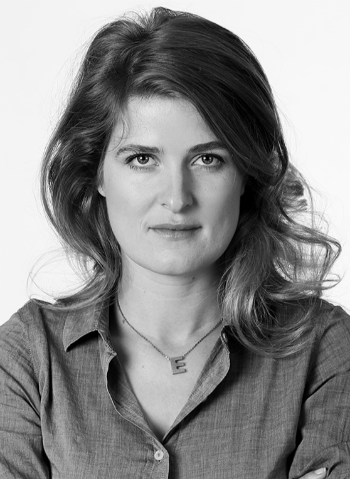
Elsie Edgerton-TillWhat is your favourite swear word?
Drat.

What are you wearing?
Navy corduroy high waisted pants and one deliciously oversized woollen jumper.

What is love?
A long, late Sunday lunch at home with friends and family.

What was the last show you saw, and how many stars do you give it?
A co-production between a New Zealand Theatre Company (The Court Theatre) and a Chinese theatre organisation based in Shanghai of A Midsummer Night’s Dream. I saw this truly culturally diverse production at the end of its New Zealand season prior to it heading Shangai. I give it a midsummer’s night sky of stars.

Is your new show going to be any good?
But of course! A comedy, a tragedy and a murder-mystery: how could it not be?

Elsie Edgerton-Till is directing Book Of Days, at the New Theatre in Newtown.
Show dates: 8 Jul – 9 Aug, 2014
Show venue: New Theatre

Review: Why Torture Is Wrong, And The People Who Love Them (New Theatre)

newtheatreVenue: New Theatre (Newtown NSW), Jun 3 – 28, 2014

Playwright: Christopher Durang
Director: Melita Rowston
Actors: Peter Astridge, Romy Bartz, Ryan Gibson, Terry Karabelas, Alice Livingstone, Ainslie McGlynn, Annie Schofield
Photograph © Bob Seary

Theatre review
With a title as provocative and powerful as this, the play’s central concept hangs over everything that unfolds. We evaluate every situation, trying to decide what our personal definitions of “torture” might be, in relation to the statements that the writer makes. It is not a passive experience, sitting in the darkness of this theatre. The script seeks to involve and implicate us in its world. We look at its characters and wonder how we fit in, or indeed how the stories fit into our lives.

The production however, struggles to connect with us. The players are in their own world, always at a distance, and while there is a consistent semblance of poignancy and performances are all polished and precise, there is an uncomfortable inaccessibility that makes engagement difficult. Melita Rowston’s direction is wonderfully heightened and outlandish, but its strict structure seems to restrict her actors from playing with audience reactions and from using our presence as extensively as a comedy of this nature should. Nevertheless, Rowston’s work is suitably subversive in vision, and the courage at which she tackles the play’s difficult subjects is noteworthy.

Set design by Sasha Perri and Clarisse Ambroselli is imaginative and efficient. The action takes place in almost ten different places, and great lengths are taken to make every setting convincing and evocative. The play goes through many scene changes, and each transition is managed with elegance. From a production values perspective, the show scores very well.

Standouts in the cast include Peter Astridge, who plays Leonard, an extreme right winger of the nutty and violent variety. Astridge’s confident absurdity is refreshing and seductive. The caricatured roles are not written with much range or variance, but Astridge manages to find nuances to create a sense of dimension and unpredictability. Romy Bartz as Hildegarde plays up to the wildness in Christopher Durang’s comedy and delivers several big laughs. There are no weak performances in the show, and all roles are cast well. The script seems to require its players to portray the duality of character and actor, and although some effort is put into creating a sense of “metatheatricality”, a more conventional approach is usually chosen. Immersed within their roles, they miss opportunities for a more post-modern style of commentary on the situations being depicted.

A play that examines our moral compasses with torture and terror, should never leave us cool, or cosy. Its elements of controversy and iconoclasm should take precedence, and their disruptive nature should spawn discomfort, or disquiet. The play shows itself thinking things through; it is concerned with the use of intelligence, and it wishes to be challenging. The edge of the envelope can be pushed further.

www.newtheatre.org.au

5 Questions with Melita Rowston

rsz_img_4054What is your favourite swear word?
Crikey.

What are you wearing?
Polka dots.

What is love?
A holocaust.

What was the last show you saw, and how many stars do you give it?
Scenes From An Execution at The Old Fitz, it was full of stars.

Is your new show going to be any good?
Theatre is good for nothing but to inspire something.


Melita Rowston is directing Why Torture Is Wrong, And The People Who Love Them, at the New Theatre in Newtown.
Show dates: 3 – 28 Jun, 2014
Show venue: New Theatre

Review: The Rise And Fall Of Little Voice (Lane Cove Theatre Company)

lanecoveVenue: New Theatre (Newtown NSW), May 15 – 24, 2014
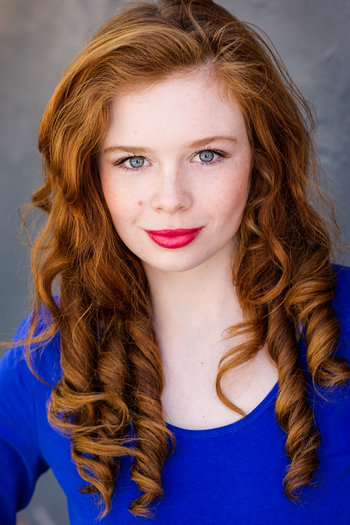
Playwright: Jim Cartwright
Director: Christine Firkin
Actors: Debbie Neilson, Wendy Morton, Michelle Bellamy, Nick Bolton, Luke Reeves, Kevin Weir, Mark Reiss
Image by Geoff Sirmai

Theatre review
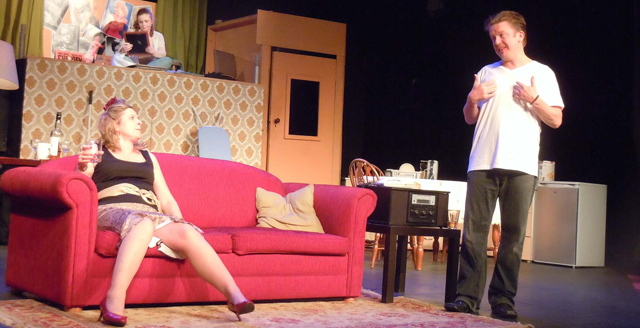
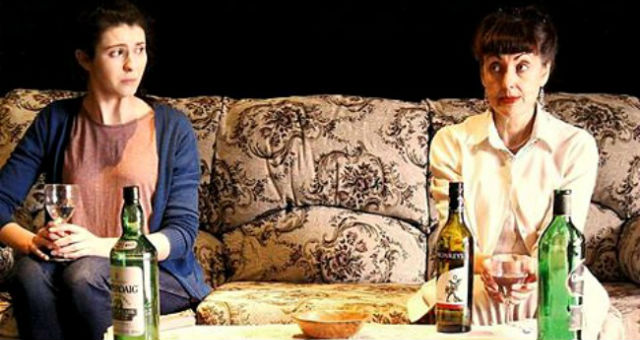
Northern England is a long distance away, with its own significant cultural and language affectations. The desire to stage a production from that region for a Sydney audience, demonstrates the universal appeal of Jim Cartwight’s script. The Rise And Fall Of Little Voice is a comedy that examines the darker side of family dynamics in a deceptively upbeat manner. It tackles dysfunction and neglect in the guise of a pseudo-musical, with ample measures of broad campy humour and a lot of singing.

Lane Cove Theatre’s production places emphasis on the play’s light-hearted elements. We see the drunken fumblings of a desperate middle-aged woman Mari Hoff, her daughter LV’s burgeoning and very innocent romance, and their neighbour’s kooky jesting. There is some effort at depicting Hoff’s love interest with some sinisterness, but by and large, the show lacks a gravity that would give meaning to its story and characters. Little Voice relies heavily on empathy and personal identification for its dramatics to be effective, but the narrative does not always connect sufficiently with its audience. An important aspect of the play is the loss of the family’s paternal figure that causes disharmony and grief, and it is the memory both women bear of the man that provides impetus for the plot, but his presence is unsatisfactorily sparse in this staging. He leaves a hole in their lives, but we are blissfully oblivious to it.

Wendy Morton is an energetic actor who provides Mari Hoff with an emotional neediness and instability that is uncomfortably believable. There is a sense of self-abandonment in Morton’s work that is entertaining and fitting, but the character she creates has too much warmth, and comes across overly endearing. The story needs a mother with a cruel and villainous edge to justify her appointed conclusion, and to help explain her daughter’s strangeness, but Morton lacks those malevolent qualities in her otherwise delightful portrayal. LV is played by Debbie Neilson who shines in musical sections where her talents as an impressionist take centre stage. She performs as Judy Garland, Lulu, Edith Piaf, Marlene Dietrich and Shirley Bassey, and is particularly memorable with her mimicry of Marilyn Monroe and Shirley Temple. It is clear that Neilson’s vocal ability contributes greatly to her part in the show, but the actor is not ideally cast. Neilson is a vibrant and gregarious performer who seems to be at odds with the timidness and melancholy that is fundamental to her character. In the role of her love interest Billy, is Luke Reeves who delivers the most consistent and convincing characterisation in the show. The script does not demand very much of the actor, but Reeves is clear of his contribution to the plot, and addresses each scene with charm and precision.

Little Voice is effervescent and colourful, but it is the exploration of the writing’s psychological and emotional depths that would give it a sense of authenticity. Death and mourning are themes that touch all our lives, and truthful theatrical renderings always resonate. Coming of age tales are appealing because they speak of hope, but they need the darkness before the light in order to hit home.

www.lanecovetheatrecompany.com

5 Questions with Debbie Neilson

rsz_debbie_neilson_8x12_medWhat is your favourite swear word?
Holy moly.

What are you wearing?
Still in my PJs 😉

What is love?
Complex and exciting!

What was the last show you saw, and how many stars do you give it?
I recently saw Noises Off at the Opera House by Sydney Theatre Co and I give it 7 stars out of 5! It was so amazing it had me crying with laughter. The comic timing from every cast member was immaculate; and, best of all, you could tell they were all having so much fun on stage. Which is why I bounced to my feet at the end for a standing ovation!

Is your new show going to be any good?
Little Voice has comedy, drama, singing and even some dancing so it has a bit for everyone’s buds. Our show is going to be fun cause we’re all having fun on stage so hopefully it’s contagious to the audience!

Debbie Neilson plays the title role in The Rise And Fall Of Little Voice, at the New Theatre in Newtown.
Show dates: 15 – 24 May, 2014
Show venue: New Theatre

Review: To Kill A Mockingbird (New Theatre)

rsz_1393776_612820905463443_633420420_nVenue: New Theatre (Newtown NSW), Mar 18 – Apr 19, 2014
Playwright: Christopher Sergel (from the novel by Harper Lee)
Director: Annette Rowlison
Actors: Khadija Ali, Katy Avery, Claudette Clarke, Sarah Carroll, Teagan Croft, Cheyne Fynn, Steve Donelan, Christine Greenough, John Keightley, Dave Kirkham, Kai Lewins, Craig Meneaud, Hudson Musty, David Ross, Donna Sizer, Lynden Jones, Peter Maple, Ryan Whitworth
Image by Bob Seary

Theatre review
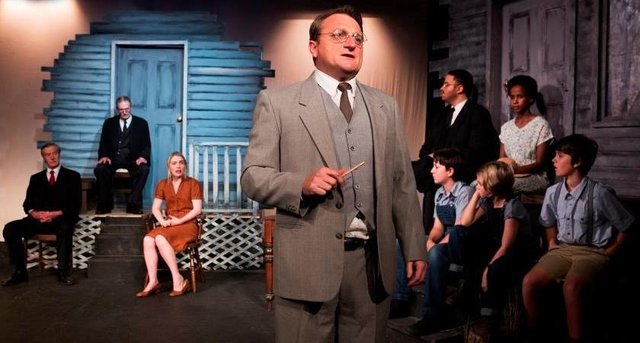
Harper Lee’s book was published in 1960, and has since become one of the most popular novels in modern times. Its central theme of social injustice remains poignant and the depiction of its characters’ courage to oppose them, is no less powerful half a century later. New Theatre’s staging is mindful of the story’s significances and director Annette Rowlison’s work pays reverence to our collective memory of To Kill A Mockingbird, whether in the form of book, film or theatre.

Rowlinson’s rendering of the American South in the 1930s has a charming and sentimental beauty. There is a joyfulness in watching children play outside, and neighbours going about their daily business on their porches and front lawns. The trio of child actors, led by Teagan Croft as Scout, bring magic to the stage with their undeniable talent, and Rowlinson’s ability to create chemistry between these vibrant children and their adult counterparts is central to the success of the show. In fact, the show only falters in the court scenes where the children are not in prominence.

Atticus Finch is played by Lynden Jones with great integrity. The subtlety in his performance is an intelligent choice for a character that audiences know so well. There is no need to explain who Atticus is. He takes into account our familiarity, and saves his dramatics only for a handful of emotional scenes. Jones’ most heightened moment happens in the courtroom, and his powerful delivery rescues that scene from being otherwise slightly low on energy.

The support cast is uniformly strong. In fact all actors bring something special and each have memorable moments in the production. Katy Avery as Mayella Ewell transforms her simple role into a riveting one, and the intensity at which she attacks her part is a highlight. Claudette Clarke’s Calpurina is grounded and tender. She has a relaxed confidence that is very enjoyable. Sarah Carroll plays Maudie Atkinson, who is the Finchs’ neighbour and our narrator. She brings an air of upbeat optimism that is comforting, and also provides an effective voice of reason that is a crucial mechanism of the plot.

Boo Radley’s appearance towards the conclusion can be tricky to handle, but Rowlinsons’ artistic sensitivity shines through and the scene is a triumph. A moving crescendo is delivered, and the moral of the tale is brought home. It is impossible to not love To Kill A Mockingbird. We have all experienced ostracism, and we have all witnessed discrimination. Boo Radley lives in all of us, and to see him materialise and lovingly depicted on stage, is profound.

www.newtheatre.org.au