Review: Me And My Mother, Singing (Blood Moon Theatre)

Venue: Blood Moon Theatre (Potts Point NSW), Aug 22 – 30, 2018
Creator and Performer: Oleg Pupovac
Image by Roman Wolczak

Theatre review
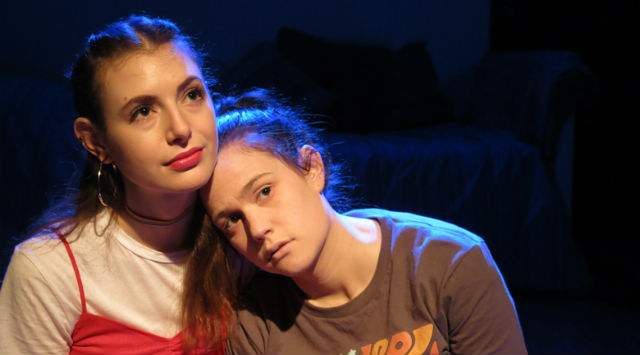
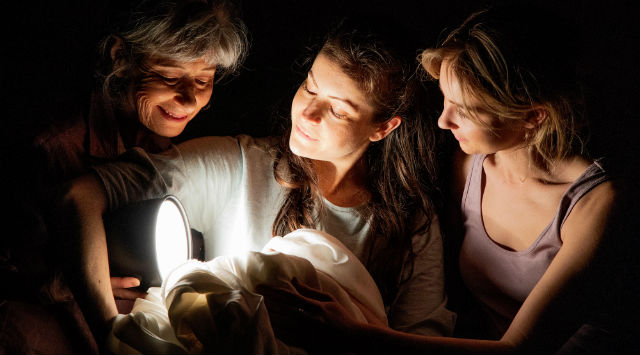
In Oleg Pupovac’s one man show Me And My Mother, Singing, we are invited into a dreamlike consciousness, a waking meditation perhaps, about the creator’s Yugoslavian and Serbian roots. Stories of his past feature heavily, in this work about identity, demonstrating the inextricable relationship between our memories and daily existence. A new dawn always arrives, but we move into each day with personal histories that can be contained but is rarely erased.

Pupovac seeks refuge in art, reaching for his father in paintings of snow, and his mother in folk songs. Trauma is addressed indirectly, for a healing process that can never be hurried, and love is rekindled, if only in the realm of the soul, for a solace that is necessary but that can never completely assuage the experience of loss and longing. It is a satisfying presentation, with multimedia elements offering insight into the most intimate recesses of Pupovac’s mind, and the performer’s own warm charm facilitating an empathy in the audience, even when scenarios turn obscure.

In the creation of his own art, Pupovac manifests a closeness with loved ones, that in turn inspires an appreciation for the complex ways, in which each of us thinks of family and roots. People can seem so different from one another, but underneath the surface are inevitable points of connection that can only endorse our kinship. We like to think ourselves special, and even though individual trajectories are always unique, the infinity of our sameness can never be denied, including, sadly, our age-old propensity to divide.

www.thetwopeas.com

Review: Mum, Me & The I.E.D. (Collaborations Theatre Group)

Venue: The Depot Theatre (Marrickville NSW), Aug 15 – Sep 1, 2018
Playwright: James Balian, Roger Vickery
Director: Kevin Jackson
Cast: Matilda Brodie, Martin Harper, Elaine Hudson, Philippe Klaus, Joshua Shediak
Images by James Balian

Theatre review
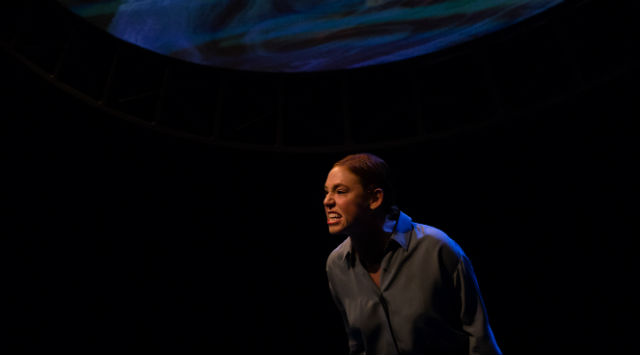
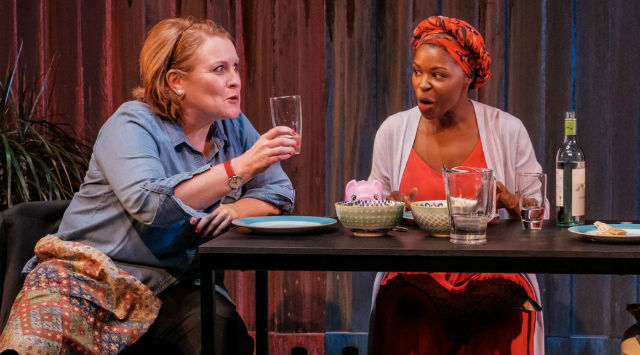
Mary Ellen has been an avowed pacifist since the Vietnam war, but still she was unable to prevent her son from aspiring to become a soldier. When we first meet them, Rob is undergoing treatment for PTSD, as part of the discharge process upon leaving Afghanistan. Mum, Me & The I.E.D. by James Balian and Roger Vickery, is an uncompromising look at the psychological damage inflicted on those we send away to war. The play’s anti-war sentiments are unambiguous and passionate, almost too blatant with their chastisements. Early scenes can feel repetitive, but its latter half turns dynamic, becoming more emotionally involving, as we tune in to Balian and Vickery’s reflections on casualties and their politics.

Director Kevin Jackson demonstrates creative use of space, in this story about intersecting dimensions. The protagonist’s mind is a convergence of confused realities, that Jackson’s staging renders coherent for our benefit. Lighting design by Martin Kinnane proves invaluable in conveying, with remarkable clarity, the many unusual spacial and temporal transformations required of the production.

Actor Philippe Klaus turns up the intensity for the show’s various points of heightened drama, but his performance of Rob’s trauma and suffering can seem slightly affected. His portrayal of a young man’s severe mental deterioration resulting from experiences in the battlefield, are full of conviction, but it is the authenticity in his depictions of family discord and the accompanying anguish, that we find convincing. Mary Ellen is played by Elaine Hudson who delivers a compelling and meaningful sense of depth to the character’s tribulations. Her work feels honest and accurately realistic, often with a surprising restraint that makes things even more believable.

The disadvantaged and the naive are perennially targeted for carrying out the devil’s work, and the world can be a shockingly dangerous place for those poised for independence. We want our young to understand that life is for taking chances, but we fear the irreversible consequences of their mistakes. Mary Ellen and her fierce conscientiousness were no match for the narrative of heroic patriotism that all nations rely on. The heartache that her family has to endure, is a phenomenon centuries old, that we seem determined to perpetuate.

www.facebook.com/CollaborationsTheatreGroup

Review: Moby Dick (Sport For Jove Theatre)

Venue: Seymour Centre (Chippendale NSW), Aug 9 – 25, 2018
Playwright: Orson Welles (based on the novel by Herman Melville)
Director: Adam Cook
Cast: Danny Adcock, Rachel Alexander, Mark Barry, Badaidilaga Maftuh-Flynn, Jonathan Mill, Wendy Mocke, Thomas Royce-Hampton, Francesca Savige, Vaishnavi Suryaprakash, Bryden White-Tuohey
Images by Marnya Rothe

Theatre review
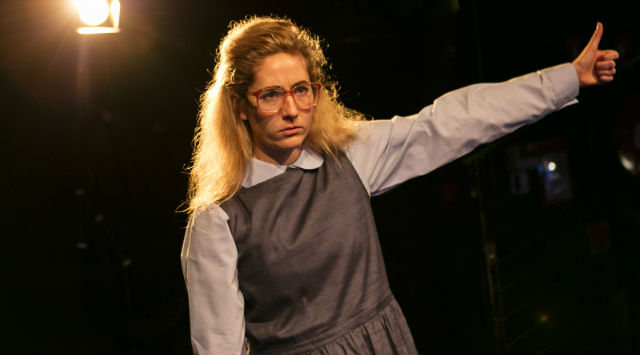
Ahab’s war on nature in Moby Dick seems altogether too familiar yet tragic. The eternal discord between humankind and our environment, is the site on which we can examine the disquiet of who we are as a species, especially in relation to our curious inability to be at one, and in peace, with nature. We are determined to extricate ourselves, always asserting a superiority that can never be. Orson Welles’ adaptation of Herman Melville’s classic, is abstract, often impenetrably so, but its concerns about our adversarial relationship with nature lay appropriately at its centre.

It is essentially a fight with the self that Ahab has to go through, and our vantage point allows his story to function as a sort of introspective interrogation, in order that we may recognise that futile struggle that we too, resolutely participate in. Director Adam Cook’s show is a vibrant cornucopia of activity that brings to energetic life, the whaling obsession that Ahab and his crew of sailors embark on. Their dialogue may confuse, but the production is a rich tapestry from which our creative minds can detect symbols, decipher language and find meanings.

A very accomplished merger of design talents help sustain a sense of magical fascination. Set and costumes by Mark Thompson are handsome, evocative and grand. Lights are industriously assembled by Gavan Swift, who manufactures a surprising beauty for the story. Sound designer Ryan Patrick Devlin keeps things lively with exciting music, much of which is thrillingly performed on stage by percussionist and actor Tom Royce-Hampton.

Danny Adcock leads the cast, suitably rhapsodic as Ahab, with an impressive presence that proves to be highly persuasive, in this mad man’s tale. Rachel Alexander is compelling as Pip, particularly memorable in a powerful scene with Ahab discussing things political and esoteric, then proclaiming with theatrical histrionics, “death to whiteness”. The role of Queequeg is beautifully portrayed by Wendy Mocke, who introduces valuable glimpses of emotional authenticity to a slightly too distant universe.

We send rockets out into the ether looking for life, trying to find points of connection with all that we deem to be alien. Back on earth, we go to great pains to alienate ourselves, in a never-ending project of division and of segregation. We have convinced ourselves that we are inexorably distinct from flora and fauna, and further, have formed an interminable habit of creating power structures and hierarchies within all our human societies. The albino whale swims in peace; its violence is only ever a result of provocation.

www.sportforjove.com.au

Review: King Of Pigs (Old Fitz Theatre)

Venue: Old Fitzroy Theatre (Woolloomooloo NSW), Aug 1 – Sep 1, 2018
Playwright: Steve Rodgers
Director: Blazey Best
Cast: Mick Bani, Wylie Best, Christian Byers, Ashley Hawkes, Ella Scott-Lynch, Kire Tosevski
Images by John Marmaras

Theatre review
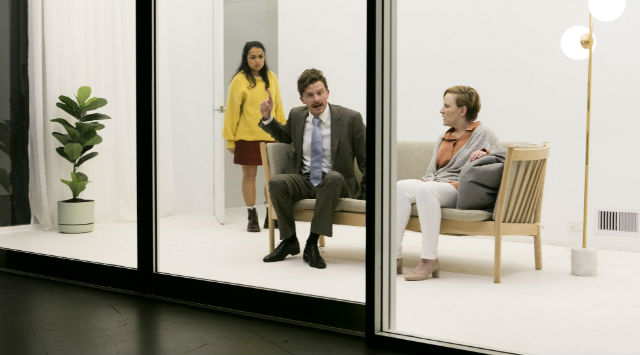
Actor Ella Scott-Lynch plays several characters, in this work about men’s violence against women. She embodies different personalities, but what they encounter in Steve Rodgers’ King Of Pigs, are essentially the same. The current climate of fervent interrogation into matters relating to gendered abuse, requires the male of our species to confront hard truths about their behaviour. It is a time of reflection and re-evaluation, and the play speaks directly to their conscience, asking them to examine the imbalances inherent in heterosexual dynamics.

It is an earnest work, perhaps too simplistic and obvious in style, but the urgency to make a point is certainly evident. Stories in King Of Pigs are very familiar, and although predictable, they still are able to have an impact. Direction by Blazey Best is suitably grave in tone, with a meticulousness to its naturalism that holds our interest. Isabel Hudson’s set and Verity Hampson’s lights collude to offer a sense of theatricality for the intimate situations under scrutiny, both effective in conveying a quality of ominous danger to the plot.

Scott-Lynch is convincing in all of her roles, each one thought-provoking, with little reliance on sentimentality. Kire Tosevski and Wylie Best provide strong partnership in family scenes that offer momentary consolation, through their warm rendering of a loving home, placed precariously alongside damaging relationships. Mick Bani, Christian Byers and Ashley Hawkes play the three perpetrators, each with memorable instances of character vagaries that point to pertinent questions about masculinity.

It is never easy to have those who hold power understand the depravity that results from their dominance. For sexism to be quelled, men have to participate in the feminist project, which although ultimately benefits all, many will perceive to be a threatening relinquishment of power. A world without the problems of gender requires a great number of processes, all of which can only be initiated by epiphanies derived from opportunities like King Of Pigs.

www.redlineproductions.com.au

Review: Hell’s Canyon (The Old 505 Theatre)

Venue: Old 505 Theatre (Newtown NSW), Aug 1 – 11, 2018
Playwright: Emily Sheehan
Director: Katie Cawthorne
Cast: Isabelle Ford, Conor Leach
Images by James John

Theatre review
Caitlin and Oscar are close friends, but things have been challenging lately and their relationship is suffering a moment of discord. When they meet to patch things up, the friction in between instigates a flurry of unexpected activity, revealing the troubles that are consuming each of the young characters. Hell’s Canyon by Emily Sheehan is an intriguing representation of our youth, particularly memorable for the authenticity of its dialogue. Speech patterns, as well as the psychology that it showcases, bear an admirable sense of accuracy, but the story can feel deficient in parts, as we try to find explanations for their behaviour. There is a whimsy to its approach that appeals, and an interest in the supernatural that gives the play an added dimension of theatrical flamboyance.

Actors Isabelle Ford and Conor Leach are engaging personalities, both absolutely persuasive and likeable, in this portrait of teenage angst. Ford demonstrates a strength that gives substance to Caitlin’s rebellious edge. Leach’s blend of vulnerability and ebullience makes for a charming Oscar. There is a sadness to the story that seems elusive in their performance, but the splendid chemistry that they harness, keeps us attentive. There is an enjoyable intensity and vigour to director Katie Cawthorne’s work, even when it falls slightly short of the emotional depths required of Hell’s Canyon‘s depictions of trauma.

We all know how it is to feel misunderstood, but the real danger is when we begin to believe in other people’s fabrications about ourselves. When Caitlin and Oscar find themselves ostracised, that rejection is all-consuming, and they lose sight of themselves, hence unable to find a way to arrive at a sense of peace. The two are intimate but there is no harmony, only confusion and self-doubt. Reaching self-acceptance can be a huge undertaking, one that requires at least as much introspection as it does an understanding of one’s environment. Caitlin and Oscar have to wade through the noise, to get to something real. This can happen in an instant, or it can be a lifetime’s drudgery.

www.old505theatre.com

Review: The Almighty Sometimes (Griffin Theatre Company)

Venue: SBW Stables Theatre (Kings Cross NSW), Jul 27 – Sep 8, 2018
Playwright: Kendall Feaver
Director: Lee Lewis
Cast: Penny Cook, Brenna Harding, Shiv Palekar, Hannah Waterman
Images by Brett Boardman

Theatre review
Anna started medication for mental illness at the age of 8. Ten years later, and no longer a child, she decides, on her own accord, to suddenly discontinue the drugs. The repercussions are dire, of course, and as she unravels, her relationships convulse and deteriorate, revealing the social value of those pharmaceuticals. In Kendall Feaver’s The Almighty Sometimes, we see sickness from the perspective of the one personally afflicted, as well as the wider reverberations of what is usually considered an isolated condition. Much of what the play conveys is not new information, but its characters are extraordinarily conceived, each one authentic and rich in their depiction, with very persuasive scenes of conflict that provide The Almighty Sometimes its excellent sense of drama.

It is a fiery piece of theatre, featuring high stakes and big emotions, that director Lee Lewis integrates powerfully for a tense, affecting experience. The play features a lot of fighting, but it is really the intense love underscoring the strife and angst, that we connect with. Actor Brenna Harding is marvellous as Anna, complex but precise in her interpretation of a difficult personality, allowing us to comprehensively understand and empathise with her plight. Whether delicate or savage, Harding is full of enthralment, and we luxuriate in the diligence she brings to the stage.

Similarly captivating is Hannah Waterman, who plays Renee the long-suffering mother, with an impressive nuance, delivering a realistic and moving portrait of a woman at wits end, but who remains determined to do her best. The resilient spirit being presented is embodied, very convincingly, by Waterman’s compelling presence. Penny Cook and Shiv Palekar offer excellent support, both creating intriguing roles that give the issues at hand, unexpected dimensions, for a show memorable for its intricacy. Also noteworthy is work on music and sound by Russell Goldsmith, who keeps us on tenterhooks, with subtle and steady manipulations to atmosphere that prove to be immensely potent.

We look to medical professionals to fix us, often forgetting that there is no one ideal for how we should live. When discussing mental health, our subjective opinions have to find ways that can accommodate both the patient’s well-being and its impact on the wider community. If what is best for society is incongruous, with what individual sufferers consider to be best for themselves, that negotiation will turn persistently fraught. Anna’s sickness consumes herself, along with all who come in close contact. The Almighty Sometimes demonstrates unambiguously that mental health is a social issue, and if we are unable, as a nation, to focus on both cure and prevention, it will be a failure to truly be ashamed of.

www.griffintheatre.com.au

Review: The Long Forgotten Dream (Sydney Theatre Company)

Venue: Sydney Opera House (Sydney NSW), Jul 23 – Aug 25, 2018
Playwright: H Lawrence Sumner
Director: Neil Armfield
Cast: Jada Alberts, Wayne Blair, Nicholas Brown, Brodi Cubillo, Melissa Jaffer, Ningali Lawford-Wolf, Wesley Patten, Justin Smith, Ian Wilkes
Images by Heidrun Löhr

Theatre review
King Tulla’s remains are being flown back to Australia, after having been detained in England for three generations. His grandson Jeremiah is required to preside over the welcome home ceremony, but the prospect of having to deal with buried trauma and lost family histories, sees him unravelling, as he comes to grips with all that his emotions have struggled to face. There are few stories as profound and important for us today, as H Lawrence Sumner’s The Long Forgotten Dream. It explores the crippling effect of colonialism, on our Indigenous peoples, as well as the paradoxical urgency of their need to recover, to foster a brighter future. Sumner is marvellously revelatory of the Aboriginal experience, splendid in his clarity of language and of thought, for a piece of writing extraordinary for the power it dispenses, and for the wisdom that it contains.

Director Neil Armfield brings palpable life to this tale of lost souls and transposed dimensions. We are moved by the production’s remarkable tenderness, evident in every delicate aspect that it presents on stage. Live music by William Barton is ethereal but incredibly precise, with a spiritual quality that has us responding in accordance with each of its enigmatic inclinations. Jacob Nash’s set design keeps us enthralled, speaking to us as though on a visceral or perhaps instinctive level, in varieties of shapes and proportions, carrying us from space to space. Mark Howett’s sensual lighting style is relied upon to add warmth to the family drama, and gravity to our national concerns. Technical elements of The Long Forgotten Dream are inventive in their conception, and sumptuously executed.

It is an exquisite cast that takes the stage, with leading man Wayne Blair delivering phenomenal intensity and poignancy, to anchor the show in an unyielding point of pertinence. He couples vulnerability with dignity, ensuring that we are moved by Jeremiah’s circumstances and more vitally, by all the wider injustices implied in the depiction of his suffering. It must also be noted that Blair’s whimsical approach to humour is deeply endearing, and a crucial factor in allowing us to identify with a personality that can seem a world away from most of our daily realities. Also very charming is Ningali Lawford-Wolf, who plays Jeremiah’s sister Lizzie, a sassy, bold presence dependable for introducing a vibrant luminosity with every entrance. Jada Alberts is suitably subtle and thoroughly convincing as Jeremiah’s daughter Simone, and Melissa Jaffer is captivating in a somewhat surprising way, when she conveys so effortlessly, the romantic secrets of a 102-year-old woman.

The refusal to listen, may be our biggest pitfall. We can make repetitive and incessant claims of good intentions, but our inability to actually prioritise the needs and demands of Indigenous communities, will only serve to sustain these unacceptable state of affairs. When we think about Aboriginal and Torres Strait Islander ancestral remains and sacred objects being controlled by colonising forces and their institutions, it becomes obvious the degree to which Australia denies the sovereignty of its First Nations. The inequity and, in some cases, inhumanity, they have had to tolerate, can only begin to find atonement when we are able to place their welfare at the very forefront of the national agenda, on equal footing with, if not ahead of, our selfish and exclusionary obsessions.

www.sydneytheatre.com.au

Review: A Taste Of Honey (Belvoir St Theatre)

Venue: Belvoir St Theatre (Surry Hills NSW), Jul 21 – Aug 19, 2018
Playwright: Shelagh Delaney
Director: Eamon Flack
Cast: Taylor Ferguson, Thuso Lekwape, Genevieve Lemon, Josh McConville, Tom Anson Mesker
Images by Brett Boardman

Theatre review
Jo is at the end of her teenage years, but there seems little she can look forward to in adulthood. Jo wishes to be independent of her mother, but Helen has taught her few skills, having spent her life dependent on lovers that never stayed the long haul. British playwright Shelagh Delaney wrote her first piece A Taste Of Honey at the age of 19, expressing youthful angst as it had meant in 1958. Her frustrations with the world, as encapsulated here, is likely a universal quality that recurs with each generation, but it is doubtful that the play’s temporal concerns have been able to retain much resonance.

Delaney’s depiction of negligent parenting in A Taste Of Honey is reliant on the denigration of the maternal character, with a criticism of her promiscuity in Act One that is no longer dramatically efficacious in 2018. In the absence of a persuasive villain, our empathy for the protagonist is compromised. The action happens almost entirely in a small apartment, with only a hint of the outside world evident in Jo’s troubles. The impact on young lives by social dynamics of the time are alluded to, but insufficiently examined. Our contemporary sensibilities look for commensurate details, but the work struggles to deliver more than cursory relevance.

Leading lady Taylor Ferguson is an endearing and compelling presence, with a wonderfully meticulous approach, ensuring that Jo is convincing at every juncture. Genevieve Lemon is a very entertaining Helen, delightfully vivacious in her portrayal of an intriguing personality. The surrounding men (Thuso Lekwape, Josh McConville, Tom Anson Mesker) are individually charming, with each performer able to introduce a greater sense of dimension to their roles than what is perhaps prescribed. The cast does a good job of sustaining our attention, and we stay with them until the end, but it is arguable if the production is able to convey much that is of lasting interest.

Young women today have so much to live for. Certainly, there are disparities between the sexes that are yet to be resolved, but the freedoms we enjoy in the West are hard fought for, and unprecedented. Girls no longer have to grow up into their mothers. Great examples of womanhood are everywhere, and it is no longer unimaginable to choose a courageous path. Jo’s pessimistic circumstances may not be entirely a thing of the past, but the opportunities for abandoning them today, are infinitely greater.

www.belvoir.com.au

Review: My Carer (Walk Now Productions)

Venue: Hellenic Art Theatre (Marrickville NSW), Jul 19 – 22, 2018
Playwright: Sam Cosentino
Director: Sam Cosentino
Cast: Maria de Marco, Helen Kim, Jacob McLean
Image by Katt Gao

Theatre review
Rebecca endures a lonely and hopeless existence. Having dedicated everything to a career in law, she finds herself at retirement age with nothing but a house and a cleaning lady as companion. Her husband has passed, and their son is estranged, living in a distant city, resentful of his mother’s neglectful behaviour.

Sam Cosentino’s My Carer talks about family discordance, and explores the challenges we face when trying to mend those bridges. The piece is thoughtfully written, mature and insightful with observations that will doubtless strike a chord. As director, Cosentino’s approach is oversimplified, for a production that can feel too basic and pedestrian, but the strength of his text keeps our attention firmly engaged with its characters and themes.

Also captivating is Maria de Marco in the role of Rebecca, offering a powerful depiction of a woman with more than a few regrets, and a prideful obstinacy to accompany them. The nuanced intensity de Marco brings to the stage is sheer theatrical delight. Helen Kim and Jacob McLean are not quite as compelling, but the young performers exhibit a conviction that is nonetheless infectious.

Some apron strings can only be cut with a great deal of ruthlessness. In order that her son may become his own man, Rebecca has to experience a rejection that is as humiliating as it is cruel. What happens in the aftermath proves just as difficult, when a new harmony is sought by both parties, each having to negotiate uncharted terms of their reconciliation. When love is not enough, the choice to take on the hard work that will mend the fissures, is rarely an easy one to make.

www.walknowproductions.com

Review: Stupid Fucking Bird (New Theatre)

Venue: New Theatre (Newtown NSW), Jul 12 – 28, 2018
Playwright: Aaron Posner
Director: Warwick Doddrell
Cast: Lloyd Allison-Young, Gil Balfas, Brendan Miles, Mansoor Noor, Megan Smart, Annie Stafford, Kaitlyn Thor
Images by Bob Seary

Theatre review
It is a wonderful world that the characters in Stupid Fucking Bird inhabit. Consumed by love and art, their lives might seem frivolous to some, but to those of us tired of the daily grind, their romantic mashup of 21st century Australia and 19th century Russia, suggests an imaginary existence where only the exciting things matter.

Aaron Posner’s rendition of Chekhov’s The Seagull retains the original’s narratives and personalities, but radically transforms the way in which the stories are told. Chekhov enshrined in his play, a wish to establish new theatrical forms, so it is appropriate that artistic liberties are taken. We are also entirely grateful for Posner turning the antiquated piece into something much more entertaining, and relevant to our times.

Director Warwick Doddrell presents a stunning production; gripping from the start, relentlessly amusing, compelling and vivacious, for a very unlikely experience of the venerated classic. Doddrell’s dramaturgical excellence is accompanied by an experimental spirit that permeates all faculties of the show, and we see all its cast and creatives deliver some truly outstanding work on this stage.

Set design by Jeremy Allen offers simple solutions for a highly effective transformation of space. Original songs by Jim Fishwick are replete with wit and charming vibrancy. Ben Pierpoint and Mary Rapp’s sound design is thrilling in its urgency, with an exuberant contemporariness that provides an air of irresistible edginess. Lighting designer Veronique Bennett is similarly striking in approach, creating alluring and refreshing imagery, demonstrating valuable proclivities that are sensitive yet vivid.

Seven actors, individually delightful, prove themselves a formidable ensemble in Stupid Fucking Bird. Mansoor Noor’s memorable athleticism and emotional vigour as Conrad, form a reliable centre for the show’s quality of interminable liveliness. Megan Smart is a splendid Nina, with a bewitching authenticity that accompanies every delicious melodramatic turn. The iconic Emma Arkadina is played by a fierce Kaitlyn Thor, seductive and powerful as the grandiose matriarch.

Lloyd Allison-Young and Annie Stafford are gifted with arresting presences, both captivating performers with a knack for making everything look effortless. Gil Balfas and Brendan Miles offer exquisite balance to the extravagant goings-on, both able to bring confident subtlety, at junctures where nuance is required but unexpected. Stupid Fucking Bird represents a rare theatrical occasion, where brilliance emanates from all its participant components.

Characters in the story suffer unrequited love and artistic jealousy. Their personal sense of inadequacy feels familiar, but also strange, if not completely bizarre, should we choose to evaluate their behaviour closely. The disquiet that overwhelms the privileged can be seen to be counter-intuitive, although it is clear that money does not solve all problems, least of all, our narcissism. When Conrad is told to “try loving something more than yourself,” the key to his salvation is succinctly and perfectly awarded, but predictably, left direly unheeded.

www.newtheatre.org.au