Review: A Man With Five Children (Darlinghurst Theatre Company)

darloVenue: Eternity Playhouse (Darlinghurst NSW), Jun 3 – 26, 2016
Playwright: Nick Enright
Director: Anthony Skuse
Cast: Jemwel Danao, Chenoa Deemal, Charlotte Hazzard, Jody Kennedy, Ildiko Susany, Anthony Taufa, Aaron Tsindos, Jeremy Waters, Taylor Wiese
Image by Helen White

Theatre review
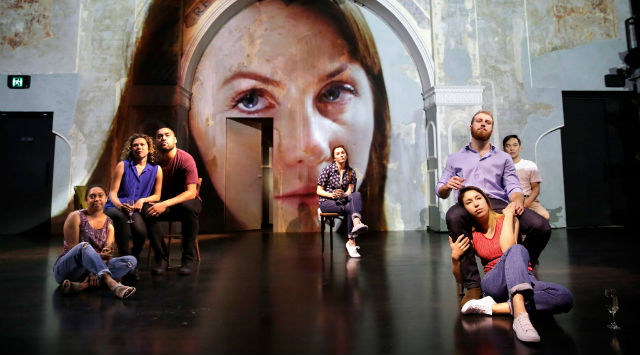
Like the “Up Series” from British television, Gerry in Nick Enright’s A Man With Five Children begins documenting the lives of five Australian seven year-olds in 1964 with his camera. Initially revisiting the group once a year, he becomes increasingly embroiled with his subjects, and the films he produces begin to lose their objectivity. The nature of Gerry’s art and his relationships are constantly transforming. We think about his responsibilities as film-maker, the validity of his work, and consequently, our collusion as a public that encourages intrusions of this nature. Enright’s play is highly sophisticated, with a big number of themes running through its stories, all thoughtful and sensitive, but its admirable complexity comes at a sacrifice of dramatic tension and focus. Several plot twists are revealed too abruptly, and its ambition to feature all five children with equal weight creates a narrative structure that our emotions struggle to find suitable empathy for.

The work is directed with excellent ingenuity by Anthony Skuse whose combination of live action and film expresses beautifully the way time and space is intertwined in the text (Christopher Page’s lights and Tim Hope’s AV design work together in perfect harmony for a presentation that will be remembered for its precise and elegant aesthetic iterations). Humanity is at the foreground, and Skuse’s remarkable compassion for every character is clear to see, but the ambiguous interpretation of Gerry’s traits and motives is ultimately too mild for its audience to respond with greater passion. Actor Jeremy Waters’ solid stage presence anchors the show appropriately with Gerry’s experiences, regardless of the character’s dubious attributes. It is a performance with power and sincerity, and although not a likeable role, we cannot help but be impressed by Waters’ professionalism and the obvious refinement of his craft.

The cast of nine forms a cohesive and engrossing ensemble. Every scene is lively and authentic, and every line of dialogue is delivered with wonderful conviction. Jemwel Danao plays the innocence and tragedy of Roger to great effect, creating the most poignant moments on stage with an approach that is unique in its subtlety, but also emotionally rich. He speaks directly to our sentimental sides, bringing us back to the play’s tender heart amidst its complications of ideas and incidents. Similarly heartbreaking is Jody Kennedy as Zoe, the girl who believes herself to be “ordinary”. The actor takes her character through many distinct transformations, each one striking in their accuracy, and is consistently charming with every portrayal. The “five children” perform to us not only in the flesh but also through the camera lens, and it is noteworthy that their work on screen is equally accomplished.

The media has played a major part of our lives for decades, but its increasing ubiquity from year to year cannot be understated. A Man With Five Children first appeared before the era of social media, so its major concerns are dealt with in ways that are perhaps slightly outmoded. Gerry is in a position of power that influences lives, in a way not dissimilar to how our own lives are being manipulated by corporations that seduce and insist on our reliance. On the surface, it is a love-hate relationship, but the play leaves little doubt as to the damage that any media can cause when we invite it into personal realms. Gerry’s children would have escaped his domination if their parents had not volunteered their participation but we can scarcely withdraw from the gaze of the modern world through the prevalence of smartphones and their infinite applications. There was a time before screens, and we all fall into the trap of yearning for those simpler days, but the truth is that humans have never been pure and life has never been easy. We have to identify the challenges of our times and their prevailing evils, and do our best to turn things for the better, even in the knowledge that the next malice is just around the corner.

www.darlinghursttheatre.com

5 Questions with Chenoa Deemal and Ildiko Susany

Chenoa Deemal

Chenoa Deemal

Ildiko Susany: What is your dream role to play?
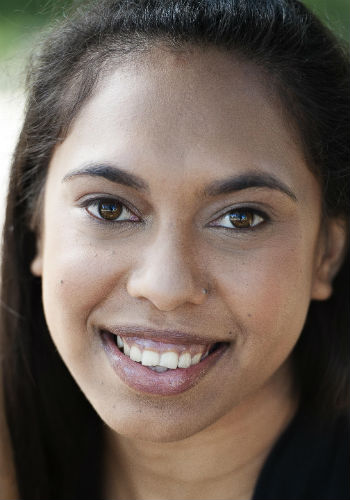
Chenoa Deemal: I’m not African or Egyptian, so this dream will probably never come to pass (and I’m completely ok about it because it’s always better if the correct nationality plays a historical role) but Cleopatra has always been my dream role. I really just hope that one day soon we’ll see a woman of colour play her.

What is the most interesting thing about playing Jessie in A Man With Five Children?
Jessie ages throughout the show from 7 to 35, what’s really interesting and challenging is making the subtle shifts between ages. For example, in one scene Jessie is age 14 and the next she’s 15, what’s interesting and exciting is finding the mental and emotional transition between these two scenes, this happens throughout the play and for me, it’s what makes the rehearsal process much more enjoyable.

If a documentary was made about your life, what aspect of it would you want them to focus on? Why?
I grew up on a remote mine site in Far North Queensland called Cape Flattery, I’d love to do a documentary recreating all the fun/silly things we did as kids. I’d like to show the rest of the country a different perspective of growing up in Australia and show that it doesn’t matter where you start in life, as long as you finish where you want to. Narrated by Morgan Freeman of course. Or would the more interesting choice be Dave Chappelle?

What is your relationship to social media?
I have a love/hate relationship with social media. I like that you can keep in contact with colleagues, family and old friends but more and more I feel that I prefer to not be on social media at all. To put it simply I feel it’s much better for my peace of mind. I think we’re becoming obsessed with following other peoples lives and projecting what we want other’s to see about our lives.

A Man With Five Children is set before the Facebook/social media phenomenon took over the world but it’s so interesting to look at this play in terms of that obsession. Initially the characters have no control over how they’re perceived by rest of the country but as they get older they realise that they want to change the labels they’ve been placed under. It’s the same with social media, we’re constantly projecting what we think is the best version of ourselves and more and more I’m finding it exhausting and boring.

What is your ideal vision for Australia in ten years time?
Very simply, I hope that Australia evolves into a country that is not controlled by fear of the unknown and more into a society that embraces differences with open ears and open hearts. Easy, isn’t it?

Ildiko Susany

Ildiko Susany

Chenoa Deemal: If you could have one superpower what would it be?
Ildiko Susany: It’s so hard to choose just one! I would love telepathy and telekinesis. Although, flying and invisibility would be really advantageous too… I want to be in a superhero movie! I really want to do my own fight scenes and action sequences!

What do you hope the audience will be thinking about as they drive home after the show?
This play is so epic and expansive. I want audiences to have their own debate about whatever themes rouse them to action and conversation. Personally, I am very interested in the evolution, complexities and unravelling of the constructed relationships within the play; the abuse of power; the pursuit of art and at what cost; the desire to leave a legacy. What also sparks my interest – based on the documentary focus of this play – is how we as a technologically advanced society construct our identity and present it to the rest of the world and how in this globalised community where it is so easy to instantly ‘connect’ with one another, we remain some of the loneliest people on this planet – concealed behind a screen with no true sense of purpose or community. What does it mean to have a tangible, mature and unguarded human connection? What is there to gain? To lose? Are we too terrified to be for others the human being we are deep within – the one unfettered by barriers; truthful, open, exposed?

What do you love about your character Annie?
I love Annie’s strength, resilience and generosity of spirit. She’s a tough woman and she’s down to earth. She’s doing all she can to keep her family together and rise above all of the challenges preventing her from pursuing her own aspirations for herself.

What do you dislike about Annie?
I’m probably defending my character too much – but I love her! I think she makes a poor choice in the play but she’s trapped in a very complex, challenging and heart-wrenching of circumstances. She is really trying to do her best to keep her family together and to keep them (and herself) afloat. She is just keeping her head above water when she’s losing the will to keep treading water. Despite her family, she is ultimately isolated, unsupported and alone.

In a movie about your life, who would play you?
I would really love a postmodern rendering of my life where different actors play me at various points in my life: Ilana Glazer, Idris Elba, Mary Louise Parker, Ray Chong Nee, Mariska Hargitay, Chiaki Kuriyama and maybe a cameo from Amal Clooney (although she’s not an actor)… and perhaps myself even! I would definitely want actors of colour in my biopic – no one is going to whitewash my story!

Chenoa Deemal and Ildiko Susany can be seen in A Man With Five Children by Nick Enright.
Dates: 3 – 26 June, 2016
Venue: Eternity Playhouse

Review: Savages (Darlinghurst Theatre Company)

darlotheatreVenue: Eternity Playhouse (Darlinghurst NSW), Apr 1 – May 1, 2016
Playwright: Patricia Cornelius
Director: Tim Roseman
Cast: Josef Ber, Thomas Campbell, Yure Covich, Troy Harrison
Image by Helen White

Theatre review
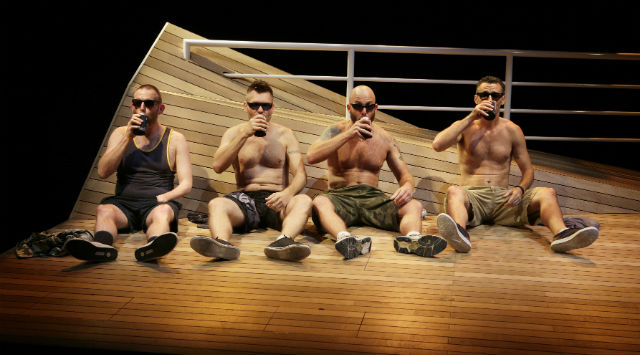
Not all men are arseholes, but the four blokes in Patricia Cornelius’ Savages are certainly frightful specimens of the species. They are close friends on a cruise holiday, intending to escape the daily grind but in fact, are in search of leaving behind civilisation altogether. Cornelius’ portrait of the middle-class Australian is one of privilege, ignorance and entitlement. The play does take care to explore her characters’ vulnerabilities as well, so that they become truthful and believable, but that honesty only serves to make them more repugnant, and their actions despicable. We recognise the challenges they face, for they are in fact commonplace, but cannot forgive their inability to find elevation and become better persons. Machismo is not at all an unusual dramatic subject, but when penned by male authors, bad behaviour is often accompanied by a warped sense of heroism, or at least some magnanimous sense of humour. Even though Cornelius does not create scenes of horror as Chuck Palahniuk, Martin Scorsese or Quentin Tarantino are want to do, her brutality lies in the merciless depiction of our average Joes as the very scum of our earth.

Director Tim Roseman’s approach is a surprisingly tender one. He brings balance to the bawdy goings on by indulging in the men’s private worlds, through earnest and deep portrayals of their suffering. We see that they are in some ways victims of a society that demands too much, but also realise their natural and unquestioned tendencies for mindless conformity. Roseman does excellent work in creating distinct segments out of what could easily be a singular poetic murmur, by providing a captivating plot manufactured with a great variety of tones, moods and emotions. Design elements are intricately dynamic, with Nate Edmondson’s very exhaustive and complex work on sound design playing an integral role in conveying subtexts and psychological undercurrents, and Sian James-Holland’s lights keeping visuals amusing with constant shifts in colour and movement. Also notable is Jeremy Allen’s evocative set design, which provides an intense intimacy to the small cast, and shapes the space in a way that allows acoustics to be perfectly established for every word of dialogue to ring with crystal clarity.

It is a cohesive production, with a very unified and charismatic cast. Their work is completely engrossing, with an outstanding sensitivity to rhythm, not only in speech, but also with their physicality. Each character is specific, but together, they tell an unambiguous and bold story. Yure Covich plays an effective alpha male, vibrant, brash and animalistic and effortlessly magnetic. His work as Craze is authentic to the degree that we are unable to identify the seam that separates actor from character, which in this case, is quite unnerving. In the role of Runt is Thomas Campbell, who brings both melancholy and comedy to what is essentially a context of severe grimness. Campbell plays the underdog with a beautiful sensitivity, but also wisely prevents the audience from placing undue sympathy for Runt’s culpabilities.

The end of Savages arrives abruptly. It is true that we have learned all there is to the four men, but we are deprived of their subsequent punishment. We wish for the lights to return, so that we may witness the atonement that must follow, but we are left to wonder if just desserts had indeed been served. The production is put together with impressive proficiency from all participants, and their talents are to be seen everywhere, but there is no escaping the sensation of overwhelming disgust that follows. Although it provides little pleasure or delight, the show raises important issues that affects us all. We are urged to think about how we practice gender, how we conduct friendships, and most of all, how we raise our children. If we believe that all babies are born innocent, then we must accept that a monster can only be created by the village that raises it.

www.darlinghursttheatre.com

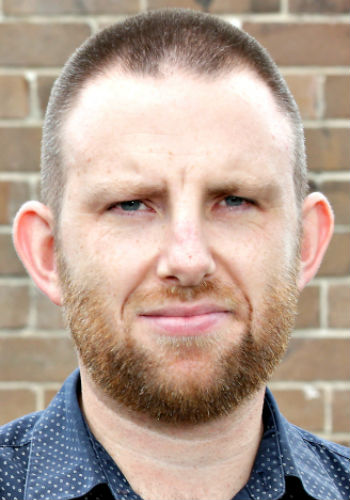
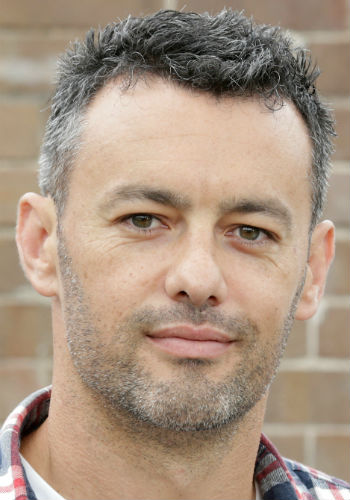
5 Questions with Tom Campbell and Troy Harrison

Tom Campbell

Tom Campbell

Troy Harrison: It’s not often that all cast members are on-stage every second of a production but such is the case in Savages. How have you found that?
Tom Campbell: With all of us on stage at all times, it meant that we had to bond and connect with each other pretty quickly. Particularly in this play, where there are big sections of poetry and we rely on each other to pick up each others cues, focus as one group and really work together as an ensemble. In saying that, I really don’t enjoy working with any of you, so it’s been tough.

Some actors look for similarities between themselves and the characters they play as a way to connect so are there any between award winning actor Tom Campbell and lying, loser Runt?
Ummmmm…. Well, we’re both liars……and both losers…..so yeah. And they both enjoy a drink.

What character have you never played but would love to?
Bobby in Company, The Baker in Into The Woods or Leo Frank in Parade. A musical please.

If a film was made about your life who would you want to play you and who would really get the part?
I could only hope for Mark Ruffalo, although he was very shouty in Spotlight. Some ladies in a foyer once told me I looked like Ben Affleck but I think they were on acid. Look, ultimately, Barbara Streisand would most probably be cast.

Do you like me?
No. I don’t like you. I’m desperately in love with you.

Troy Harrison

Troy Harrison

Tom Campbell: You worked for Darlinghurst Theatre in their first season in The Motherfucker With The Hat [Suzy’s review here]. Are you looking forward to revisiting the stage at the Eternity?
Troy Harrison: I am. I think the Eternity is one of the most beautiful theatres in Australia and Darlo are a great company to work for. My company, Workhorse Theatre Company was a co producer of Motherfucker, producing and acting in a production is quite an intense experience so it’s nice to be here and be able to focus purely on being an actor.

You worked on cruise ships years ago… tell me how gross they are?
Yep, I had a career as a dancer before I studied acting and I started out on cruise ships when I was 18. As for how gross they are, it depends on what type of gross you’re talking about so I’ll just say what happens in international waters, stays in international waters.

What’s the worst/most embarrassing thing you’ve ever done whilst pissed?
Voted Liberal. I was young and drunk but that’s no excuse. I’m so ashamed.

What do you think of the lock-out laws?
I think it’s a band aid solution to a much bigger problem. The binge drinking culture and the violence that can be a part of it needs to be seriously addressed. But having lockout laws only in a certain area does nothing but shift the problem to other areas. I also don’t think it’s a good look for our state government that the casinos are exempt. Whether it’s true or not it makes it look like money talks. And perception is everything in politics.

How’s preparations for the new ‘arrival’?
I’m guessing that you’re talking about my impending second child and not the extra terrestrials you’re always warning us about… but thanks for my tinfoil hat. Prep is going well. It’s a different experience the second time around. Living with a two year old is as fun as you’d think and gives you very little time to just enjoy the pregnancy like the first. Although watching my little girl cuddle and kiss my wife’s belly saying “cuddles for bubba” is quite possibly the greatest thing ever. I’ve also been rehearsing for Savages six days a week for the past month so my wife has been doing it all. She’s a champion. I’m extremely lucky with the two girls in my life.

Tom Campbell and Troy Harrison can be seen in Darlinghurst Theatre’s Savages by Patricia Cornelius.
Dates: 1 April – 1 May, 2016
Venue: Eternity Playhouse

Review: The Pride (Darlinghurst Theatre Company)

darloVenue: Eternity Playhouse (Darlinghurst NSW), Feb 5 – Mar 6, 2016
Playwright: Alexi Kaye Campbell
Director: Shane Bosher
Cast: Geraldine Hakewill, Kyle Kazmarzik, Simon London, Matt Minto
Image by Helen White

Theatre review
Like all good narratives that move toward a satisfying conclusion, we hope for political movements of each era to come with happy endings. Each of the causes that people fight for have a definite objective, but their reverberations are often felt far beyond those destinations, and happily ever after is never as simple a proposition as we might imagine. The Pride is about gay liberation, but its concerns extend beyond the legal rights that LGBT communities have, and continue to, achieve. It looks at the reparations that have not been made, even though our law books are altered for better standards of equality and humanity. Alexi Kaye Campbell’s script is about the scars that gay men continue to bear, at a time when the fight, in Britain at least, is meant to be over.

Campbell’s play is a very deep one. Its explorations of intimate gay histories is imbued with the most thorough cognizance of the human condition. We look not only at feelings, but also at the way people’s behaviours are shaped, when subject to generations of injustice and cruelty. Its insights are valuable, and its message important, but the script is lengthy, with scenes that struggle to sustain dramatic tension as they take time to get to their point, although every line of dialogue is undoubtedly beautifully crafted. Director Shane Bosher’s style is sophisticated and honest. He does not overcome the writing’s structural issues, but what he brings is marvellous elucidation to a rare discussion of contemporary gay life, and the challenges faced by a community that is often tricked into thinking that the worst is over.

The production is performed with great passion by its cast of four. The level of commitment in their work is truly splendid, even if their individual abilities may vary. Simon London is magnificent as Phillip. His portrayal of vulnerability is full of poignancy and vividly resonant, even as the character spends a lifetime manufacturing false fronts and deceptions. London inhabits all the contradictory qualities of his tragic role, along with the extreme emotionality of his thinly-veiled true nature, to leave a remarkable and lasting impression. Leading man Matt Minto has an appealing authenticity that makes Oliver’s stories palpable, but the actor has a tendency to be too quiet, almost film-like in his approach, requiring the audience to work harder to connect (in the absence of cameras zooming in for close ups). Geraldine Hakewill too, can afford to introduce greater theatricality to her roles, but even though slightly straightforward, her interpretations are consistently thoughtful and strikingly empathetic. Scene-stealer Kyle Kazmarzik pops up in different guises playing minor roles, but is completely delightful in every moment. His comedy is flawless, and transformations between personalities astounding. Kazmarzik takes on the easier parts of the script, but exceeds all expectations and requirements to deliver some of the most memorably engaging sequences in the production.

Like a pride of lions, our LGBT communities have weathered the worst that society is capable of, and have come out fierce, resilient and strong. We have also inherited a merciless savagery that can rear its head at unsuspecting times, even or perhaps especially, against ourselves. When the war is over, our impulse is to celebrate, but someone has to pick up the pieces left behind by the enduring harm inflicted in years past, or a beast of destruction will manifest. In The Pride, things end on an optimistic note, and even though its suddenly illusory quality of its closing scene does not deceive, its hopefulness is welcome, and necessary.

www.darlinghursttheatre.com

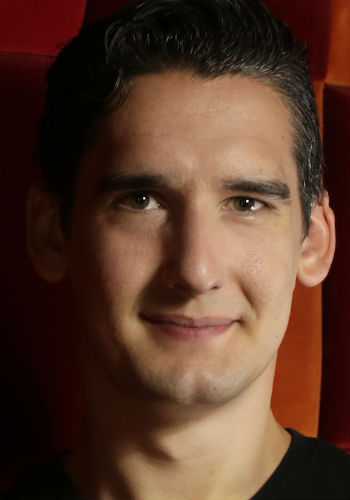
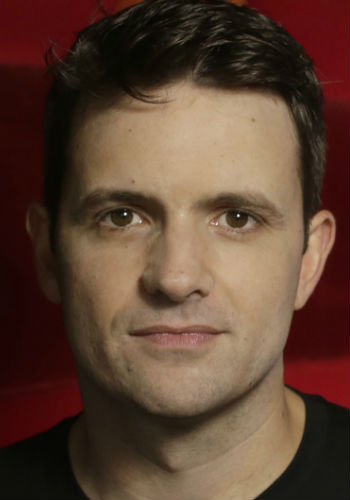
5 Questions with Kyle Kazmarzik and Matt Minto

Kyle Kazmarzik

Kyle Kazmarzik

Matt Minto: If you could sit down with anyone in history and have a good chat, who would that be?
Kyle Kazmarzik: Fairly recently in history, but Robin Williams. A legend, my idol, a beautiful soul and bloody hilarious. A chat would be difficult from the laughing but I just would have loved to meet him.

Has it been difficult juggling multiple roles?
Not really. Each has their own difficulties and distinctive characteristics which make it easier to flip between them.

What is the one role you are dying to play in your career?
It changes from time to time. Maybe Macbeth. Or Jim Carey in a biopic. But I’d kill to play a role in Star Wars, a dark jedi like Darth Vader or Kylo Ren.

If you could live anywhere in the world where would that be?
New York City.

Name 3 of your favourite actors?
I’ve already mentioned Robin Williams. And Jim Carey. I mean the list goes on and on. But to name a third, I absolutely adore Amy Adams. And a sneaky fourth: Kristen Wiig.

Matt Minto

Matt Minto

Kyle Kazmarzik: If you weren’t an actor, what would you be doing?
Matt Minto: I’m quite interested in psychology, so something in that field.

What’s your favourite play that you reckon you’ll NEVER be in?
A Streetcar Named Desire.

Half the show is in 1958. If you could travel back in time, when would you go?
Late 1960’s, London.

Have you ever ‘corpsed’, or almost ‘corpsed’ during a show?
Yep, I’ve corpsed way too many times. The worst was in a production of Macbeth where I spent, what felt like 10 minutes, shaking with suppressed laughter.

Which do you find more challenging, 1958 Oliver or 2016 Oliver?
They both have their challenges but probably 1958 because of the fact it’s a time period I have no direct experience of.

Kyle Kazmarzik and Matt Minto can be seen in Darlinghurst Theatre’s The Pride by Alexi Kaye Campbell, part of Sydney Gay & Lesbian Mardi Gras 2016 Festival.
Dates: 5 February – 6 March, 2016
Venue: Eternity Playhouse

5 Questions with Toni Scanlan and Jamie Oxenbould

Toni Scanlan

Toni Scanlan

What characters do you play in Good Works?
Toni Scanlan: Mrs. Kennedy – who is a working class woman with a strong connection with Catholisism and who has a daughter who challenges and disregards the social and religious expectations of the church.
Mrs Donovan – initially from a poor background and is now a social pillar of society. She is a glamorous, controlling woman who completely understands her role in her adopted community.
Sister John – A nun.

Nick Enright , the writer of Good Works, is a theatre legend. Did you ever meet him or work with him?
I met Nick through a couple of his friends who became mine – which inadvertently led me to being cast in his first production of Daylight Savings at the Q Theatre. I remember saying to him after the first read of the play on that Monday morning, “Don’t worry Nick I’m a better actor than I am a reader”. He just laughed this warm wonderful thing. Nick’s are the best “deathbed anecdotes” I have ever heard. Told to me by two of his closest friends. I’ve been telling them now for some time. They make me feel less worried about dying!

What’s you earliest memory of performing?
Earliest memory of performing was at the drinks party Mum held at home for the Chairman and bosses from the “shipping and export” department at Wesfarmers. This is the 60s. Mum’s high heels, shorts, mid-drift top and castanets. Humming a Spanish tune. This was my idea – my mother was completely unaware of what I was about to do.

Name your 3 most memorable shows, either as audience or performer?
1. Richard III performed by a Georgian Company. I was at Drama School in London. This was at the Round House. The play was, of course, spoken in Russian, I had never read it and it was the clearest Shakespearean play I have ever seen to this day.
2. An Evening With Erik Satie. In the tiniest theatre (max 30 people) on Isle de Cite, Paris – one man, one girl, a piano and 50 minutes. Heaven!
3. All My Sons was a major thing for me. I’ve now performed in a few plays by Arthur Miller and they are all up there with, arguably, some of the best work Ive done but there was something about this production… the cast and the director, Iain Sinclair, it was incredibly special and I will never forget it.

What’s your dream role?
Easy. Bessie Berger from Awake And Sing by Clifford Odets. Any takers?

Jamie Oxenbould

Jamie Oxenbould

You play several characters in the play, can you briefly tell me who they are?
My characters are Alan – a friend of Tim, one of the two central boys, who we meet in a gay bar in 1981. Iain Sinclair (our director) described him as a gay Mr Miyagi (Karate Kid reference for those in the dark). Brother Clement – who is a homophobic, sadistic teacher at the country Catholic boys school where our two central boys meet. Barry Carmody – who owns the local pub. A bit of a boofhead, besotted with Rita the firecracker barmaid and also partial to giving boys a beating. And Mr Donovan – the town’s lawyer and church elder who represents the puritanical, patriarchal side of rural Australia in the 1960’s.

Nick Enright , the writer of Good Works, is a theatre legend. Did you ever meet him or work with him?
I did meet him a few times. And I also worked with him acting in The Three Sisters at the Old Fitz many years ago. A true gentleman, a bit cheeky and a very charming actor. He was an icon of the industry and I would have loved to have been taught by him at some stage.

What’s your earliest memory of performing?
I did a play called Charlie’s Aunt at high school. I must have been about 16. It was a very corny farce and I got my first taste for laughs. I’ve been on the hunt ever since.

Name your 3 most memorable shows, either as audience or performer?
La Fura Dels Baus. A Spanish company that toured here in the 80’s. Just wild anarchy and visceral madness in the Hordern Pavillion. There were chainsaws and blood and weirdness. You had to run out of the way of the performers or risk injury. To a youngster starting out in theatre it was a real eye opener. Nicholas Nickleby – The STC did it in the 90’s (?). It was about an 8 hour production with a massive cast and just a fabulous piece of storytelling. I laughed and cried for the whole Dickensian ride. As a performer I would say Fully Committed at the Ensemble Theatre. It was the first one man show I did and basically after doing that you lose your fear of doing anything.

What’s your dream role?
Either King Lear or Mary Poppins. I’m going to go with Mary Poppins.

Catch Toni Scanlan and Jamie Oxenbould in Darlinghurst Theatre Company’s production of Good Works, by Nick Enright.
Dates: 31 October – 29 November, 2015
Venue: Eternity Playhouse

Review: Good Works (Darlinghurst Theatre Company)

darlotheatreVenue: Eternity Playhouse (Darlinghurst NSW), Oct 31 – Nov 29, 2015
Playwright: Nick Enright
Director: Iain Sinclair
Cast: Taylor Ferguson, Lucy Goleby, Anthony Gooley, Stephen Multari, Jamie Oxenbould, Toni Scanlan
Image by Helen White

Theatre review
In Nick Enright’s Good Works, we are often confused about time and characters. It is a deliberate ploy to have us focus on what people are doing to each other, regardless of when things had taken place or who those people might be. It probes us to consider if contexts matter when we are unkind. It talks about how we treat children, and how behaviour is perpetuated beyond the illusion of growing up. The play’s plot structure is perhaps its most interesting feature. The story and its themes are not unusual or spectacular, but through its highly inventive way of communication, we are required to relate to its ideas on a level of intimacy. If we do not have certainty about characters, we can only understand events by applying them conceptually, to our selves.

Director Iain Sinclair’s construction of space through Hugh O’Connor’s complex multi-tiered platforms is theatrical magic. The constant profusion of movement, visual depth and dimension is an aesthetic joy, and also an effective mechanism for providing demarcation for minute scene transitions. Sinclair’s knack for creating dramatic tension and his ability to extract meaning from them, ensures that the play unfolds with a gravity necessary for its poignant messages to hit home.

It is a strong cast that presents this challenging work. Each player is required to embody a range of ages and personalities, and although not every scene is equally powerful, there is no questioning the authenticity and thoughtfulness of their approach to individual parts. Lucy Goleby leaves an impression with studied stillness on a stage buzzing with energetic activity. Her eyes are, on more than one occasion, our sole focus as they convey quiet but intense emotion. Taylor Ferguson brings remarkable exuberance and strength to a character who faces multiple setbacks. The resilience and fallibility of humanity that she demonstrates is touching, and beautiful.

There is not much point to life if we do not try to do good, but Good Works shows us the conflict and complications that occur in communities when flawed individuals try to do their best within their inevitable limitations. We examine how it is that we can come to conclude which decisions are best, without resorting to convenient solutions that religions are keen to provide, and we question if there is possibility for behaviour to be anything else than emulation. Whether Enright’s play is pessimistic or otherwise, would depend heavily on one’s own outlook on life.

www.darlinghursttheatre.com

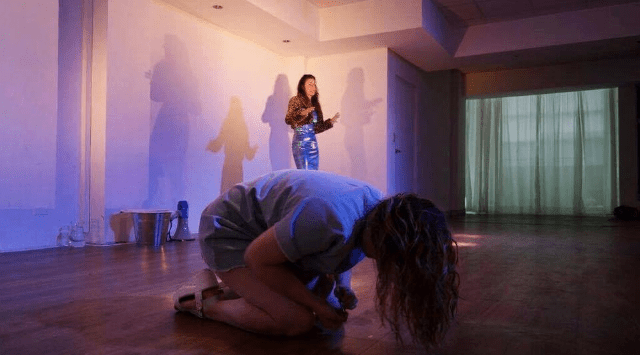
Review: Project #Oüahn (Baühs)

bauhsVenue: 46 Foveaux Street (Surry Hills NSW), Oct 21 – 26, 2015
Playwrights: Gabriella Imrich, Christina Marks, Eliza Scott
Director: Christina Marks
Cast: Gabriella Imrich, Eliza Scott
Image by Diana Popovska

Theatre review
On stage are two young women, best described as anxious and frustrated. They speak in symbols, and their art is abstract. What they do is rarely explicitly named, perhaps to avoid things becoming undermined by convenient labels that can never completely address their thoughts. Instead, what we have is a series of physical and verbal enunciations that provide unmistakeable visceral sensations and clear indications about the way we experience our bodies, the construction of identities, and the political forces that dominate and disenfranchise. Project #Oüahn is a subversive work about subversion. The work aims to challenge, and because of our inevitable participation in prevalent ideologies, we do find ourselves in uncomfortable spaces in its 60-minute duration. It is hard to tell if the piece communicates universally, but its intention is not to create an “us and them” dynamic with its microcosm. There are moments of division, but its interest is ultimately about self-determination and self-empowerment. Its message is one of independence, but also of love, even if much of its language is militant and tough.

We do not find a conventional narrative structure, but the two actors Gabriella Imrich and Eliza Scott begin by setting up a visual reference to the madonna-whore complex. Their surfaces appear to be different as day and night, but as they wage war and undertake torment on each other, we soon discover that they are two of the same. It is a representation of the internal dialogues that we have and the socially complicit nature of how we monitor and police our own thoughts and behaviour. There is a precision to the performers’ motivations, that makes sense of the work’s abstractions in spite of their deliberate ambiguity. Chemistry between Imrich and Scott is flawless, and the production forges ahead with a confidence that is assertive and powerfully convincing. Christina Marks’ direction balances mystery and revelation, for a show that intrigues at every point, but is satisfying throughout. Sound design by Enola Gay is to be noted for adding a sophisticated yet dramatic dimension to proceedings.

The final section of the production is as memorable as any theatrical moment can hope to be. A mesmerising sequence that expresses divine beauty and tranquil strength, embodying an affirmation of life, lived with wisdom and courage. The art that we make is never worth more than when it is progressive. Project #Oüahn is a selfless exploration into the meaning of freedom that will touch anyone whom it is able to connect with, but freedom, like all that is worthwhile, will only discharge its magical prowess for those who know to receive it.

www.bauhsbauhsbauhs.com

Review: Ride & Fourplay (Darlinghurst Theatre Company)

darlotheatreVenue: Eternity Playhouse (Darlinghurst NSW), Sep 4 – Oct 4, 2015
Playwright: Jane Bodie
Director: Anthony Skuse
Cast: Aaron Glenane, Tom O’Sullivan, Emma Palmer, Gabrielle Scawthorn
Image by Robert Catto

Theatre review
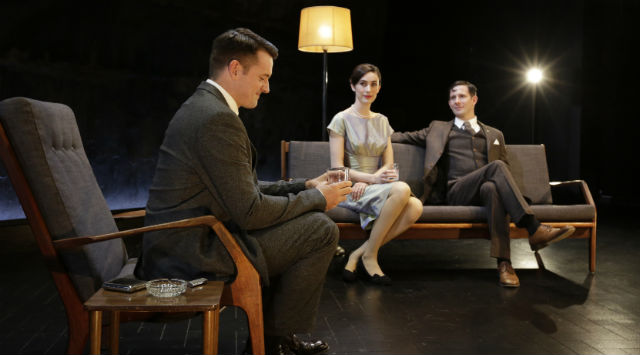
Ride & Fourplay are two plays by Jane Bodie about male-female relationships in Australia today. Bodie’s writing is obsessed with the mundanity and ordinariness of life, and where most writers choose to romanticise and dramatise those boy-meets-girl stories, these versions are in no rush to make their point. They linger and indulge in moments to let us observe human dynamics, and to analyse the inner workings of our emotions. As a result, Bodie’s are scripts that probably hold more value for performers than they do for audiences. Under Anthony Skuse’s direction, emphasis is placed squarely on how the cast brings life to the words. Other theatrics are kept to a minimum, and at a three hour running time, our stamina and patience for brooding reflections are thoroughly tested. Although its characters are not in any way exotic, we do not necessarily find it easy to relate to their many concerns. They are too much like us, and our own foibles fail to appear fascinating when portrayed in such a plain and direct manner.

All four actors are however, impressive. They take the opportunity to explore the painstaking naturalism, and achieve a great deal of authenticity with the material. They do their best to engage without compromising the style of the production, and even though results are ultimately underwhelming, there are many points of frisson that showcase their abilities. Tom O’Sullivan and Gabrielle Scawthorn display extraordinary emotional vulnerability that provide interesting dimensions to their narratives. Their portrayals are detailed studies of the subtle ways we think and act in response to the people around us who matter. Emma Palmer is captivating in Ride, with a broken heart and a lost soul. We recognise the ordeal she goes through, and admire the actor’s thoroughness at understanding her role’s psychology and all that is required to make Elizabeth complex and true. Aaron Glenane plays Jack, a slightly unusual man with a warm charm that helps us forgive his misdeeds. Glenane has the challenging task of turning what is frankly an outrageous circumstance into one that is endearing and uplifting. It is an unpleasant plot twist that he has to deliver, but he does so convincingly.

The production is free of frills, but ambience is beautifully manufactured by its team of designers. Alistair Wallace’s sound and Christopher Page’s lights rarely steal our attention but the mood in the theatre is consistently rich with sentimentality and a gentle electricity, derived from a very sensitive approach to the show’s quiet aesthetics. Hugh O’Connor’s big raked platform facilitates an intimacy that results from giving the actors no place to hide, doggedly exposing their every flinch and gesture. The vast space around them however, causes obvious problems with acoustics, even though the overall vista is a very satisfying one.

It is in our nature to love and be loved, but we do not need to think only in terms of the (in this case) girl-boy dynamic. Love takes many forms, yet we spend an inordinate amount of time and effort in the pursuit of things like romance, marriage, fidelity, and sex. We are drawn in by its terribly seductive power; it is a mysterious libido that scientists and philosophers have tried to explain for centuries, but it is a riddle that refuses to be solved. It is an uncontrollable force that goes round and round, and even though its chief motive is pleasure, its increasingly predictable manifestations can sometimes land us in scarce more than weariness.

www.darlinghursttheatre.com