Review: Betty Breaks Out (Life After Productions)

Venue: Kings Cross Theatre (Kings Cross NSW), Aug 27 – Sep 7, 2019
Playwright: Liz Hobart (after Maurice G. Kiddy)
Director: Ellen Wiltshire
Cast: Tommy Misa, Annie Stafford
Image by Jasmin Simmons

Theatre review
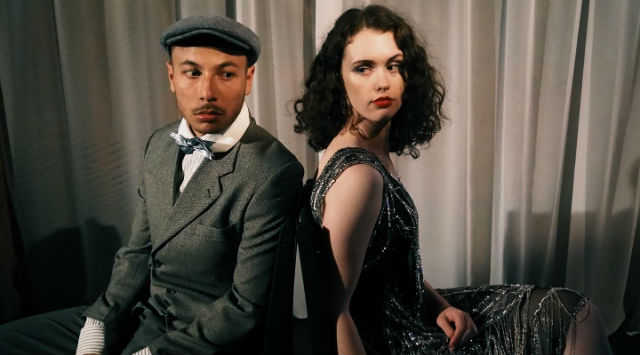
Betty and Fred are kidnapped, locked up in adjoining rooms to ponder their fate. Both are actors, trying to take control of a situation in which there is little hope of autonomy. Set in 1919 England, when moving pictures were silent, and damsels were always in distress, Liz Hobart’s Betty Breaks Out is a quaint piece that gives voice to characters that were previously one dimensional and mute. Whimsical and experimental, it resists clear narrative structures in favour of something offbeat and playful.

Directed by Ellen Wiltshire, the show is an effervescent, if slightly puzzling, exercise in theatre making. Without a straightforward plot, it is perhaps surprising that the staging takes a naturalistic approach, instead of a more abstract mode of expression, especially with a writing style that seems intent on creating a poetic experience. It is noteworthy however, that music by Alexander Lee-Rekers is an enjoyable aspect of the production, able to enhance mood and rhythm to keep us engaged. The performing duo too, brings a gratifying charm. Tommy Misa and Annie Stafford are delightful presences, even if they do seem somewhat restrained by a presentation that feels insufficiently adventurous.

It is true that much of how we face the public, can be described as performative. We all have to operate within structures that do not always make room for what our individual beings might think to be authentic. We are urged to play along with the game, to adopt pre-determined codes and languages, so that a semblance of harmony can be attained. We rarely feel at liberty to deviate, as ostracism is a threat that few can bear to endure. When it becomes clear that the notion of a greater good, is almost certain to only benefit communities disproportionately, our commitment to obedience must then be questioned. There will always be people who want us to stay in our narrow lanes, but the second that we begin to identify our own complicity in this oppression, is the moment that we begin to set the self free.

www.lifeafterproductions.com

Review: Caroline, Or Change (Hayes Theatre)

Venue: Hayes Theatre Co (Potts Point NSW), Aug 23 – Sep 21, 2019
Book: Tony Kushner
Music: Jeanine Tesori
Lyrics: Tony Kushner
Director: Mitchell Butel
Cast: Nkechi Anele, Andrew Cutcliffe, Alexandra Fricot, Amy Hack, Emily Havea, Tony Llewellyn-Jones, Genevieve Lemon, Ruva Ngwenya, Elenoa Rokobaro, Elijah Williams and Ryan Yeates
Images by Phil Erbacher

Theatre review
Caroline works in the basement of the Gellman household, washing and drying clothing in the stifling heat of Louisiana, 1963. Eight year-old Noah Gellman had recently lost his mother, and the Jewish boy is forming a fixation on his African-American cleaning lady, the intensity of which is amplified by his stepmother’s decision to have Caroline keep any money that the child may forget to remove from his pockets, before sending them to get laundered. Tony Kushner and Jeanine Tesori’s Caroline, Or Change is set during the peak of America’s civil rights movement, and although political marches and demonstrations are occurring far away, a distinct sense of resistance is beginning to take hold in the Gellman basement.

The material is poetic, and operatic. Often darkly humorous, Caroline, Or Change is an unconventional musical that does not rely on catchy melodies or cheap sentimentality, to sustain our interest. It intrigues with its powerful narrative, and its two very fascinating central characters. Directed by Mitchell Butel, many of the writing’s deeper resonances can seem lost in the cacophonous renderings of the musical format, but the show’s highly polished look and sound proves seductive, and along with some truly outstanding performances, we are kept absolutely enthralled.

Set design by Simon Greer is wonderfully evocative, and with four tiers of performing space, the small stage is quite miraculously expanded to accommodate the complex spatial requirements of the text. Lights by Alexander Berlage are romantic and lyrical, yet effective in providing dramatic punctuation whenever required. Anthony Lorenz’s sound design is excellent, able to make cohesive, and pleasurable, the multifarious dimensions emanating from singers and instruments.

Elenoa Rokobaro brings her phenomenal voice to Caroline, with a quality of singing that is impressive by any barometer of assessment. Her creation is an appropriately stoic personality, who gradually unravels, for a sophisticated and dignified depiction of resilient blackness. Ryan Yeates is a compelling Noah, technically precise but also emotionally authentic, almost effortless in his passionate expressions of a child discovering the harsh realities of existence. Rose, the stepmother, is played by an exuberant Amy Hack, whose faultless comedy is hugely gratifying, in this otherwise despondent tale. Ruva Ngwenya is a scene-stealer in her various parts, whether presenting herself as soul chanteuse or opera diva, we revel in all that she delivers.

The show ends on a note of hope, with Caroline looking to the future for solace and salvation. More than 50 years have past, and although there is comfort to be found in the strides that have no doubt been taken, there is clearly a long way yet to go, before Martin Luther King’s dream can be fully realised. In the progress towards equality, there are always those who will fight back against what is right. It seems today, that those who are wrong, are gaining momentum in their deplorable efforts to bring regression to how our lives are structured. The Gellmans look on the surface to be good people, but their inability and refusal to make things better for their wider community, is a problem that many of us have inherited and continue to persist with.

www.hayestheatre.com.au

Review: Chicago (Capitol Theatre)

Venue: Capitol Theatre (Sydney NSW), Aug 20 – Oct 20, 2019
Music: Fred Ebb, John Kander
Lyrics: Fred Ebb, John Kander
Book: Fred Ebb, Bob Fosse, John Kander
Director: Walter Robbie
Cast: Natalie Bassingthwaighte, Amy Berrisford, Tom Burlinson, Alinta Chidzey, Andrew Cook, Todd Dewberry, Rodney Dobson, Samantha Dodemaide, Casey Donovan, Mitchell Fistrovic, J. Furtado, Ben Gillespie, Chaska Halliday, Travis Khan, Hayley Martin, Kristina McNamara, Joe Meldrum, Tom New, Jessica Velluci, Romina Villafranca, Rachael Ward, Zachary Webster, Mitchell Woodcock
Images by Jeff Busby

Theatre review
Roxie and Velma are in the slammer, but it would appear that they are having a great time, having learned that in America, it pays to kill. Chicago deals with the subject of the celebrity criminal, and the conventional notion that in whatever realm of achievement, no matter how sordid, we insist always only on having one victor, if the parties involved are women. The story may be approaching a hundred years old, but the enduring musical retains its feeling of thorough modernity, thanks in large part to Bob Fosse’s unparalleled choreography (interpreted by Ann Reinking in 1997), giving the show an air of scandalous edginess that is as yet unsurpassed.

This Australian revival, with resident director Karen Johnson Mortimer at its helm, is sophisticated and sexy, an exceedingly accomplished rendition of one of Broadway’s longest running musicals. Beautifully arranged by musical director Daniel Edmonds, the songs of Chicago are once again vibrantly rousing, proving the timelessness of this legendary work.

The ensemble is unequivocally sensational. Each performer delectable, skilful, and incredibly tightly rehearsed, for a presentation that leaves us breathless from the very get go. Roxie Hart is played by a luminous Natalie Bassingthwaighte, who brings a surprising and highly effective humour to the role, marvellous in her ability to elevate the well-worn campness of her material to something quite unexpectedly exquisite. Alinta Chidzey is impressive with the technical proficiency she brings to Velma Kelly, a consummate professional who hits every mark with admirable precision.

Tom Burlinson is slightly less charming than he needs to be, as the unscrupulous lawyer Billy Flynn, and although able to hold all the notes, Burlinson’s voice is unfortunately quite underwhelming. Rodney Dobson is on the other hand, charisma personified, winning the hearts of every audience member as Roxie’s husband Amos, especially during his much-loved “Mr. Cellophane” number. The part of Mary Sunshine is perfectly sung by J. Furtado, and Casey Donovan is simply divine as Matron ‘Mama’ Morton, replete with superstar quality.

The feuding women come together at the end, after being chewed up and spat out by the patriarchy. Women are told that there is only ever room for one, and so many fight tooth and nail to get to the top, forgetting that a hierarchy will always require the subjugation of entire populations, and that no woman is allowed to stay eternally supreme in accordance with this mode of doing things. Competition may be healthy, but whenever we are made to betray the sisterhood, we must remind ourselves that much as we are seduced by the feeling of attaining personal gain, the real beneficiaries of the system is never us.

www.chicagothemusical.com.au

Review: A Deal (Chippen Street Theatre)

Venue: Chippen Street Theatre (Chippendale NSW), Aug 22 – 31, 2019
Playwright: Zhu Yi
Director: Shiya Lu
Cast: Paul Chambers, Abigail Coffey, Edric Hong, Suzann James, Simon Lee, Katherin Nheu, Simone Wang, Sally Williams, Susan Young, Shi-Kai Zhang
Images by Kelvin Xu (Luky Studio)

Theatre review
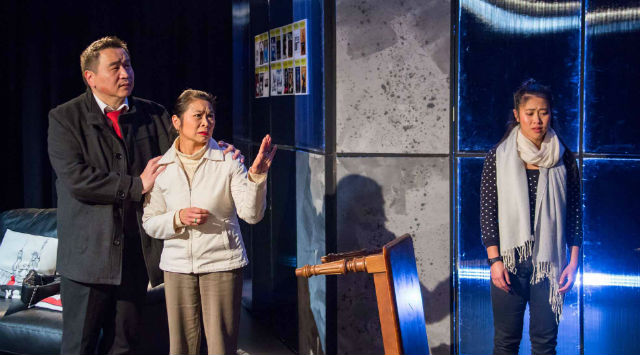
Li Su comes from the middle classes of China, but in her efforts to make it big as an actor in New York, she pretends to be a tragic stereotype, the kind of immigrant that the West likes to think of as a subject of oppression and persecution, victimised by an inferior authoritarian government. When Su’s parents pay a visit, bringing a million dollars in cash to buy her an apartment, the truth becomes a matter of grave inconvenience that she struggles to navigate. Zhu Yi’s A Deal details the experience of a new American, one who chooses to leave the East for the West, at a time when economic power is at an unprecedented equivalence.

The play is a fascinating exploration of timely issues, from a cross-cultural perspective that introduces an unusual complexity to some otherwise hackneyed topics. Directed by Shiya Lu, the production is intellectually engaging, even if pacing does require tightening up at various points. There are compelling performances from its cast, with Shi-Kai Zhang particularly strong as Su’s father, with a combination of heightened drama and understated humour keeping us thoroughly bemused. Also memorable are Susan Young and Edric Hong, both ebullient with the conviction they bring on stage. Su is played by Katherin Nheu, energetic and convincing in the role, although a greater investment into comedy aspects would help provide a more nuanced interpretation of the narrative.

In A Deal, Su’s own desires and ambitions are in constant battle with expectations of her family and those of her new adoptive country. It is almost as if the young woman can never achieve autonomy, even with all that money in the bank. In some ways, we see that she cares too much about external opinion, but we also understand that these are impinging forces that make it difficult for Su to become her own person, on her own terms. Negotiations have to be made, between her authentic self, and the environment in which she lives. If one chooses to pay indiscriminate attention to every source of influence, the demands that can be made of any single person are interminable. Noise that surrounds Su will never cease. It is up to her to recognise which are superfluous, and do away with them.

www.chippenstreet.com | www.flyinghouse.art

Review: An Intervention (The Old 505 Theatre)

Venue: The Old 505 Theatre (Newtown NSW), Aug 20 -31, 2019
Playwright: Mike Bartlett
Director: Erin Taylor
Cast: Jessica-Belle Keogh, Bardiya McKinnon
Images by Clare Hawley

Theatre review
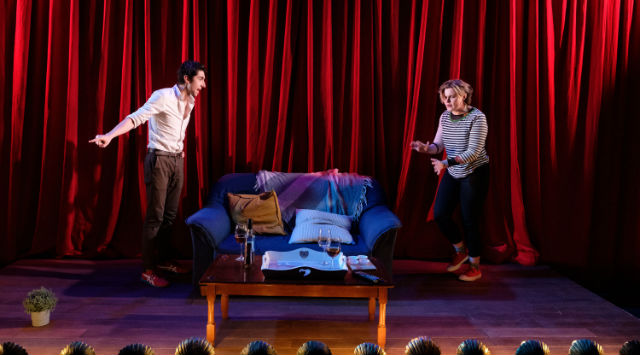
They are best friends, perhaps even soul mates, but we meet them at a point where these unnamed characters begin to diverge, as they start developing in directions that seem to be in mutual conflict. There is no doubt however, that these two, in Mike Bartlett’s An Intervention, are bonded on a level of essence, that they connect on a fundamental level beyond the surprising choices that they now make. How people experience the world can only ever be unique, and friends growing apart seems almost inevitable. Bartlett’s play is keenly observed and irresistibly witty, a truthful work that reveals meaningful aspects of ourselves, able to demystify parts of human nature that we rarely bring articulation to.

Directed by Erin Taylor, the show is jaunty and engaging, sensitive in its rendering of a story about careless friendships. It is an attractive production, with Jonathan Hindmarsh’s set design and Liam O’Keefe’s lights bringing a sense of flamboyant theatricality to the intimate two-hander. Actor Jessica-Belle Keogh is mesmerising as the one who drinks too much, impressive for the exquisite thoroughness with which she attacks the role. Her performance is intelligent and deliberate but never feels forced, consistently thought-provoking while keeping us wonderfully entertained. Bardiya McKinnon holds his own as the one who marries for convenience, convincing in his natural approach, if slightly too simple in comparison. Excellent chemistry between the two sets the stage alight, for 90 minutes of comedy delivered with an unexpected sophistication.

We may not always be able to intervene when friends make mistakes. Life is often out of our control, and many occasions seem to require that we sit back and watch the unfolding of a car crash. We can however, always be there to help pick up the pieces. The people in An Intervention spend an inordinate amount of time in judgement of each other, but it appears that this constant disapproval amounts to nothing. A life without fuck-ups is no life at all. To have good friends witness every embarrassment, is perhaps a crucial element in the foundation of real love.

www.old505theatre.com | www.facebook.com/LastOneStandingTheatreCo

Review: West Side Story (Opera Australia)

Venue: Sydney Opera House (Sydney NSW), from Aug 16 – Oct 6, 2019
Book: Arthur Laurents
Music: Leonard Bernstein
Lyrics: Stephen Sondheim
Director: Jerome Robbins
Cast: Christian Ambesi, Matthew Antonucci, Daniel Assetta, Molly Bugeja, Olivia Carniato, Nicholas Collins, Nikki Croker, Paul Dawber, Angelica Di Clemente, Sarah Dimas, Amba Fewster, Anthony Garcia, Sebastien Golenko, Keanu Gonzalez, Paul Hanlon, Zoe Ioannou, Brady Kitchingham, Ariana Mazzeo, Noah Mullins, Natasha O’Hehir, Nathan Pavey, Sophie Salvesani, Berynn Schwerdt, Ritchie Singer, Taylah Small, Joshua Taylor, Blake Tuke, Dean Vince, Lyndon Watts, Daniel Wijngaarden, Jason Yang-Westland, Chloé Zuel
Images by Jeff Busby

Theatre review
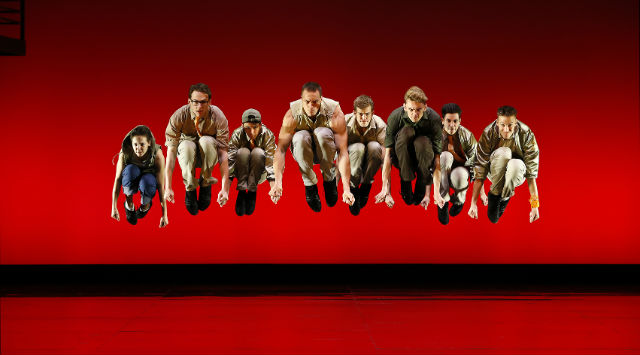
It is now 62 years, since the world was first introduced to the Jets and the Sharks, rival gangs from West Side Story, Bernstein and Sondheim’s landmark musical. Its relevance today is startling, as we find the United States in the throes of shocking immigration policies, determined to demonise those hailing from Latin America. The authentic darkness of the piece prevents it from dating, from its experimental musical styles to its thematic explorations into racial vilification, its resonances are timeless, even if the narrative seems to relate specifically to a distant time and space.

The production is highly polished, with director and choreographer Jerome Robbins’ original vision faithfully presented. Design elements no longer feel inventive by today’s standards, but the air of sophistication being conjured is unequivocal.

A tale about white supremacy, West Side Story features a group of white boys called the Jets, who spend their days taunting the Puerto Rican Sharks. Lyndon Watts is an imposing Bernardo, powerful and precise as leader of the Sharks. His nemesis Riff is played by Noah Mullins, a very peculiar casting choice given the performer’s glaringly bookish quality. Leading lady Sophie Salvesani is a suitably wholesome Maria, although rarely inspiring with her renditions of some extremely well-known songs. Daniel Assetta may not deliver a flawless Tony, but we are kept engaged by his likeable presence and surprisingly dulcet tones. The one real star on this stage is Chloé Zuel, whose Anita takes us through every gamut of emotion, impressive from beginning to end, as the proverbial triple threat.

Policing authorities in West Side Story fail to recognise the inherent power imbalance at play, as they attempt to handle the situation as though the feuding parties are equal in strength, unable to identify the victims they should protect. Minorities are routinely subjugated, when a level playing field exists only in our imagination. It is easy to place blame on the juvenile delinquents, who act out these objectionable impulses, but the problems are systemic, deeply entrenched in how we think and how we do things. The cure needs to target the root of the problem, and that will never be less than radical.

www.westsidestory.com.au

Review: 3x3x2 Festival Of New Works (PACT Centre For Emerging Artists)

Venue: PACT Centre for Emerging Artists (Erskineville NSW), Aug 14 – 24, 2019
Images by Samuel James

Freefall
Playwright: Emily Dash
Director: Kip Chapman
Cast: Emily Dash, Alicia Fox, Laura Hobbs, Dean Nash, Liz Diggins

Bring Your Devices In Case You Forget
Creator: Christie Woodhouse
Cast: Christie Woodhouse

Hydraulic Fucking
Creator: Cheryn Frost
Cast: Cheryn Frost

Theatre review
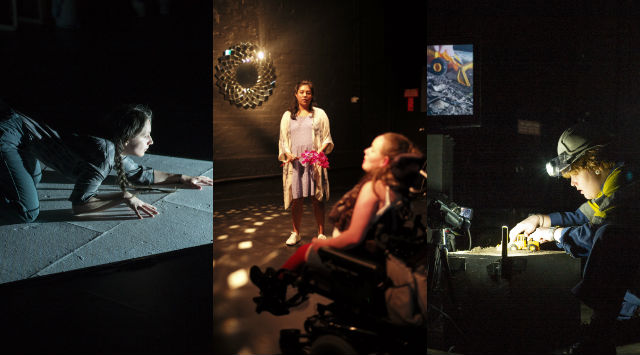
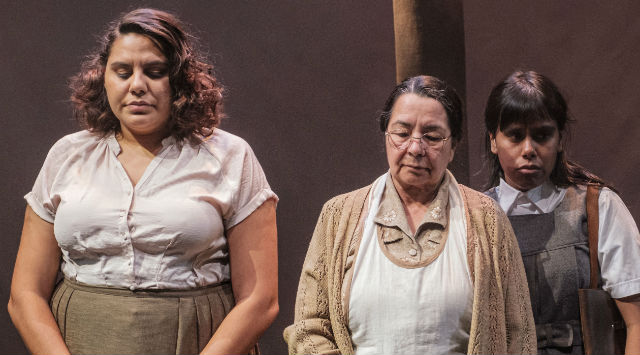
3x3x2 Festival Of New Works presents three separate showings of young women at the helm, all inventive and urgent in their need to talk about some of the day’s biggest issues. Emily Dash’s Freefall is essentially a love story, between a woman of colour and a woman in a wheelchair, in which we investigate the possibility of a union between perspectives of the universe that seem so fundamentally different. Bring Your Devices In Case You Forget by Christie Woodhouse reflects that sense of modern omnipresence, through our participation as multi-identity beings across endless technological platforms, contrasting with her worries about the survival of our species. Yuwaalaraay artist Cheryn Frost makes a stinging statement about capitalist colonisation of Indigenous lands, in Hydraulic Fucking, a no holds barred, highly engaging piece of theatre that is relentless with its politics, yet sensationally entertaining.

In Freefall, Dash’s poetic writing is made powerful by her own performance as Carmen, an intense personality with an insatiable thirst for truth and honesty. Actor Alicia Fox too, is effervescent in the piece, with excellent conviction making the central romantic relationship believable. Bring Your Devices In Case You Forget features the captivating presence of its creator Woodhouse, along with clever video projections, and an innovative manipulation of its artistic form, to inspire ideas relating to the virtual and non-virtual worlds in which we operate. Darkest and funniest of the minuscule festival is Hydraulic Fucking, a work full of vigour, and subversive to the core. Impolite and transgressive, Frost demonstrates extraordinary vision and nerve, in her unforgettable interrogation of our collective conscience.

In 2019, it would seem that the greatest sin is ignorance. The democratisation of information through the advent of technologies, has allowed voices to break through, that once were routinely subdued and buried. Without traditional gatekeepers making all the rules, we can now hear more clearly, from those who make statements that do not fit the dominant narrative. Dash, Frost and Woodhouse are the latest in a long line of counterculture artists, but today they represent a new normal. The audience has learned to discern power structures that had previously been disguised, and we are waking up to the injustices inherent in old ways of storytelling and of understanding the world. The difficulty now, is to recognise the privilege that one possesses, and then be able to carry out meaningful action that will make our communities more equitable and kind.

www.pact.net.au

Review: Rainbow’s End (Darlinghurst Theatre Company)

Venue: Eternity Playhouse (Darlinghurst NSW), Aug 10 – Sep 1, 2019
Playwright: Jane Harrison
Director: Liza-Mare Syron
Cast: Frederick Copperwaite, Phoebe Grainer, Lily Shearer, Lincoln Vickery, Dalara Williams
Images by Robert Catto

Theatre review
Jane Harrison’s Rainbow’s End sees three generations of women from the Dear family, living together by the Goulburn River, navigating the challenges of being Aboriginal on colonised land. Things are hard, but these characters are upbeat, as though demonstrating a defiance in their very nature, that refuses to be subdued. The lighthearted quality of Harrison’s play makes for a charming portrait of Indigenous resilience; it resists our desire for a narrative that foregrounds these women in pain, choosing only to show us how they are able to overcome unremitting disadvantage.

Directed by Liza-Mare Syron, the production is full of spirit, with an enjoyable mischievousness that ensures we respond with a sense of admiration, for the Dear women and their people. Lights by Karen Norris are particularly well conceived, a dynamic element relied upon to provide visual variation. Actor Lily Shearer is a cheeky elder as Nan Dear, bringing considerable warmth to the piece. The vivacious Dalara Williams contributes exuberance in the role of Gladys, memorable for the ironic humour she renders as the unlikely monarchist. Teenage Dolly is played by Phoebe Grainer, whose innocence is a defining factor of this story about Yorta Yorta women in the 1950’s. Grainer is a charming performer, effective in making the play feel authentic, thus prompting us to question the progress of race relations in this country, more than 65 years later.

Rainbow’s End is an Indigenous story told by Indigenous Australians. In it, they demand improvements for their communities today, as the Dear women had done a lifetime ago. We are accustomed to the idea that progress is linear, but there is much evidence to show that we do not operate that way. As white supremacy makes a less than taciturn return to fashion, we have to take all precautions to ensure that its racist agenda, is faced with obstruction at every opportunity. It pretends to do good, when in fact it keeps doing bad, always using lying words to restrain us. They talk about intentions to make things better, but their actions only reveal the opposite. We must insist on recognising the truth, and not be swayed by their language. We must not be manipulated into thinking that where Indigenous Australia is today, is anywhere near good enough.

www.moogahlin.org | www.darlinghursttheatre.com

Review: Te Molimau (25A Belvoir)

Venue: Belvoir St Theatre (Surry Hills NSW), Aug 7 – 24, 2019
Playwright: Taofia Pelesasa
Director: Emele Ugavule
Cast: Lesina Ateli-Ugavule, Malia Letoafa, Tommy Misa, Iya Ware

Theatre review
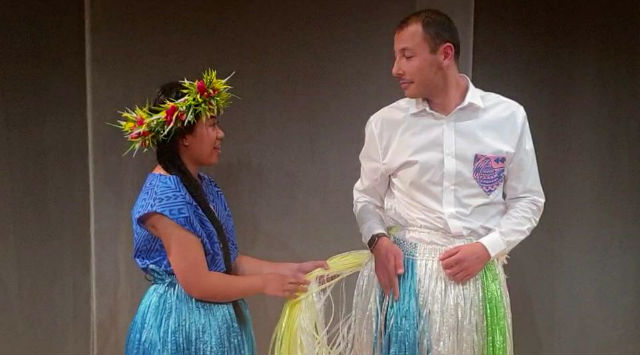
Fatia has flown back to his mother’s hometown, the Pacific nation of Tokelau, where the island state is only days away from being completely submerged beneath the ocean. Taofia Pelesasa’s Te Molimau tells the heartbreaking story of a country lost, in the not too distant future, to the devastating effects of climate change. It is a deeply emotional work, made resonant by the inclusion of some very hard truths, about the way we stand on the sidelines, doing nothing to prevent disasters from consuming our neighbours. Incorporating generous doses of Tokelauan language and dance (with exquisite choreography by Sela Vai), Te Molimau represents the art of storytelling at its most potent, able to use the theatrical form to turn abstract concepts into something immediate, palpable and urgent.

Directed by Emele Ugavule, the show grows gradually, from its initial delicate tone to eventually forceful, all the while ensuring that the plot is built upon a solid foundation of sincerity. Lighting design by Amber Silk is noteworthy for its sensitive coherence with the text’s varying degrees of sentimentality, always subtle but precise in it calibrations of atmosphere. An extraordinarily likeable cast draws us into the action, including Tommy Misa as Fatia, striking in the simplicity of his approach, able to lay bare all that is so engaging and important about the play. In the role of Vitolina is Malia Letoafa, ethereal and truthful, for a supremely understated performance surprising in its impact. Lesina Ateli-Ugavule and Iya Ware demonstrate flawless chemistry, as a couple of mismatched acquaintances who form a friendship remarkable for its genuine warmth.

It is the ultimate cruelty, to see a small neighbouring country sink into the ocean, and choose to do nothing. Even if we are unable to agree on the causes of these calamities, our humanity should know to find ways to help, but it appears that we are more than comfortable to sit back and watch people go through the worst imaginable scenarios. It may be true that we feel helpless, but it is also true that we use ignorance as an excuse, in fear of having to make personal sacrifices for the benefit of others. Nature however, will never understand our demarcations of us and them. Rising sea levels will not end at the Pacific Islands just because they hold less political and economic power. Our delusions tell us that wealth is a shield from every harm, but it is only a matter of time, that this intractable inaction will catch up on us.

www.black-birds.net | www.belvoir.com.au

Review: The Grapes Of Wrath (New Theatre)

Venue: New Theatre (Newtown NSW), Aug 6 – Sep 7, 2019
Playwright: Frank Galati (based on John Steinbeck’s novel)
Director: Louise Fischer
Cast: Matthew Abotomey, Peter David Allison, William Baltyn, James Bean, Ted Crosby, Shayne de Groot, Simon Emmerson, Angus Evans, Peter Irving Smith, Brittany Johnson, Caroline Levien, Madeline MacRae, Ryan Madden, Kirsty McKenzie, Rowena McNicol, Matthew Raven, Andrew Simpson, Lily Stirling, Loki Texilake
Images by Bob Seary

Theatre review
It is the Great Depression, and the Joad family is on the road, having left Oklahoma, in search of opportunities for a better life. John Steinbeck’s The Grapes Of Wrath details economic hardships of barely a century ago, that seem so far removed from our twenty-first century realities. We can however, discern that although the conditions in which we operate have drastically transformed, the challenges and threats to our mortality remain. It may look like life has become easier, but to be human, it seems, will always involve a struggle for survival.

This stage version is a fairly concise adaptation by Frank Galati, and under the direction of Louise Fischer, its scenes move along swiftly, for a historical drama that does not demand too much of its audience. Tom Bannerman’s set design is notable for its elegance and efficiency, and along with Sharna Graham’s understated work on costumes, a visual authenticity is achieved for this American tale of adversity. David Cashman’s songs are a highlight, each one rich and evocative, often outshining the actual scenes that they are placed between.

The show is performed by a very big, and very strong, cast. Each character is lively and convincing, and as a team, they manufacture a sense of time and space effective in having us feel virtually transported. Actors Matthew Abotomey and Rowena McNicol are particularly impressive in scenes together as mother and son, both energetic and detailed, able to communicate the urgency of their situation, for moments of entrancing drama.

As with many other old stories, one could struggle to find the relevance in The Grapes Of Wrath, but the kind of fear that it encapsulates, is quite eternal. We worry about poverty and unemployment, afraid of being left behind. We see the destitute on our streets, and pray that our loved ones be spared from ever having to experience that calamity. One difference that can be observed in our narratives, after the 80 years since the publication of Steinbeck’s novel, is that his characters have each other to rely on, to suffer with. Their fears, unlike ours, do not include abandonment and isolation. We are never guaranteed absolute safety from the tides of time and natural chaos, but they at least had each other.

www.newtheatre.org.au