Review: Stupid Fucking Bird (New Theatre)

Venue: New Theatre (Newtown NSW), Jul 12 – 28, 2018
Playwright: Aaron Posner
Director: Warwick Doddrell
Cast: Lloyd Allison-Young, Gil Balfas, Brendan Miles, Mansoor Noor, Megan Smart, Annie Stafford, Kaitlyn Thor
Images by Bob Seary

Theatre review
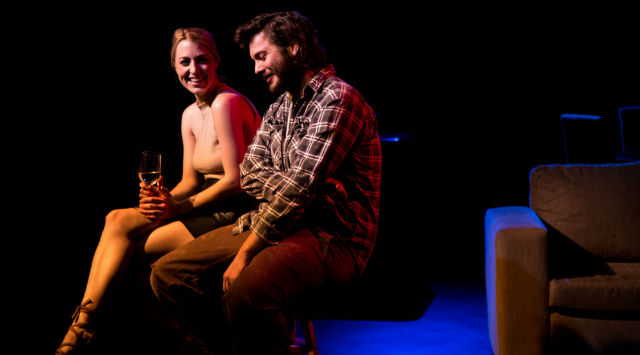
It is a wonderful world that the characters in Stupid Fucking Bird inhabit. Consumed by love and art, their lives might seem frivolous to some, but to those of us tired of the daily grind, their romantic mashup of 21st century Australia and 19th century Russia, suggests an imaginary existence where only the exciting things matter.

Aaron Posner’s rendition of Chekhov’s The Seagull retains the original’s narratives and personalities, but radically transforms the way in which the stories are told. Chekhov enshrined in his play, a wish to establish new theatrical forms, so it is appropriate that artistic liberties are taken. We are also entirely grateful for Posner turning the antiquated piece into something much more entertaining, and relevant to our times.

Director Warwick Doddrell presents a stunning production; gripping from the start, relentlessly amusing, compelling and vivacious, for a very unlikely experience of the venerated classic. Doddrell’s dramaturgical excellence is accompanied by an experimental spirit that permeates all faculties of the show, and we see all its cast and creatives deliver some truly outstanding work on this stage.

Set design by Jeremy Allen offers simple solutions for a highly effective transformation of space. Original songs by Jim Fishwick are replete with wit and charming vibrancy. Ben Pierpoint and Mary Rapp’s sound design is thrilling in its urgency, with an exuberant contemporariness that provides an air of irresistible edginess. Lighting designer Veronique Bennett is similarly striking in approach, creating alluring and refreshing imagery, demonstrating valuable proclivities that are sensitive yet vivid.

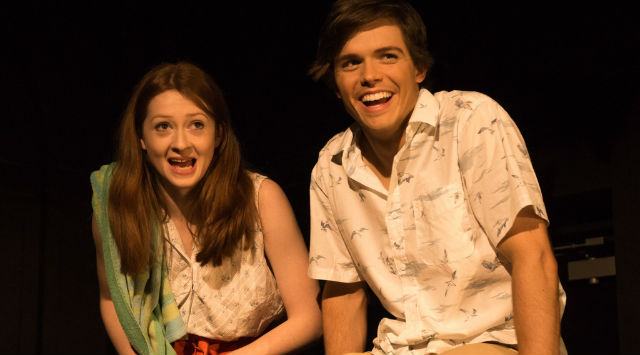
Seven actors, individually delightful, prove themselves a formidable ensemble in Stupid Fucking Bird. Mansoor Noor’s memorable athleticism and emotional vigour as Conrad, form a reliable centre for the show’s quality of interminable liveliness. Megan Smart is a splendid Nina, with a bewitching authenticity that accompanies every delicious melodramatic turn. The iconic Emma Arkadina is played by a fierce Kaitlyn Thor, seductive and powerful as the grandiose matriarch.

Lloyd Allison-Young and Annie Stafford are gifted with arresting presences, both captivating performers with a knack for making everything look effortless. Gil Balfas and Brendan Miles offer exquisite balance to the extravagant goings-on, both able to bring confident subtlety, at junctures where nuance is required but unexpected. Stupid Fucking Bird represents a rare theatrical occasion, where brilliance emanates from all its participant components.

Characters in the story suffer unrequited love and artistic jealousy. Their personal sense of inadequacy feels familiar, but also strange, if not completely bizarre, should we choose to evaluate their behaviour closely. The disquiet that overwhelms the privileged can be seen to be counter-intuitive, although it is clear that money does not solve all problems, least of all, our narcissism. When Conrad is told to “try loving something more than yourself,” the key to his salvation is succinctly and perfectly awarded, but predictably, left direly unheeded.

www.newtheatre.org.au

Review: A Single Act (Chippen Street Theatre)

Venue: Chippen Street Theatre (Chippendale NSW), Jul 12 – 21, 2018
Playwright: Jane Bodie
Director: Travis McMahon
Cast: Dominic Di Paolo, Georgia Nicholas, Evan Piefke, Rachel Slee
Images by Ethan Hatton-Warham

Theatre review
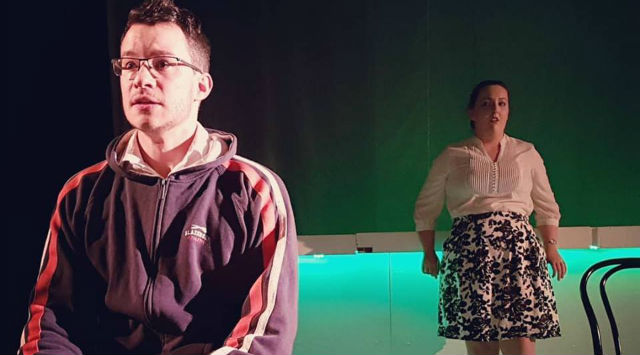
This is a story of two relationships disintegrating against the backdrop of a catastrophe, possibly an act of terrorism that proves to have continual reverberations after its moment of impact. Jane Bodie’s A Single Act places two very conventional couples side by side in the play, unified only by that vague catastrophic event they are all trying to keep out of their minds. One of the women suffers physical abuse from her partner, and we are made to connect the attack on human life that occurs in the domestic sphere, with those in public. It does not make obvious links, so the meanings we try to formulate can feel tenuous, but the parallels regarding damage to person and society are certainly intriguing.

Comprised entirely of two-hander scenes, the show relies heavily on chemistry between our onstage lovers, but the intimacies being presented are rarely convincing. Much of the work on acting seems to be filmic in style, with emphasis placed on voice and facial expressions, while actors’ bodies are left to look as though stranded in space. The subtle writing requires of the cast an extraordinary level of nuance, but the few memorable moments involve very exaggerated manoeuvres. Consequently, the production struggles to communicate more than the surface, although it does keep our minds inquisitive.

Acts of terrorism committed in Australia have been few and far between, but family violence happens around the clock. We often find ourselves engaged in passionate discussions about religious fanatics and asylum seekers, unable to acknowledge much more pressing issues that are quite literally right at our doorsteps. Our beliefs and opinions are so easily manipulated, by economic and political interests that have much to gain from our fear of alien forces, that terrors within our midst can be so effectively rendered invisible. One’s own backyard should always be tended to with great conscientious care, but it is much easier to worry about imagined enemies from foreign lands.

www.chippenstreet.com | www.paleblue.com.au

Review: Hello, Beautiful! (Performing Lines)

Venue: SBW Stables Theatre (Kings Cross NSW), Jul 9 – 14, 2018
Playwright: Hannie Rayson
Director: Matthew Lutton
Cast: Hannie Rayson
Images by Andrew Bott

Theatre review
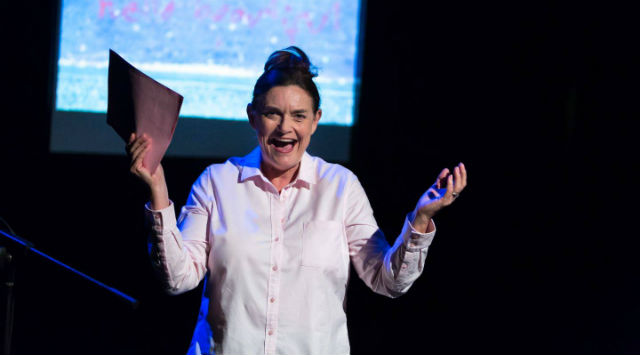
We live in a world determined to render the older woman invisible. Having exhausted her roles as sex object and mother, she is thought to have turned irrelevant, neither madonna nor whore, made to feel as though she has outstayed her welcome. With Hello, Beautiful! Hannie Rayson claims space as that grande dame, in a theatrical landscape that routinely excludes women of a certain age. Rayson represents only herself in this autobiographical work, but her presence is fundamentally political.

Rayson performs stories from her memoirs, beginning with her childhood in 60s suburbia, through to university, activism, parenthood and an ever-increasingly successful writing career. She offers glimpses of a charmed life, not particularly dramatic or eventful, but we find ourselves captivated by her delightful avidity, and share in the joys of her personal reflections. Staged with little fuss, Matthew Lutton’s direction places emphasis on Rayson’s talents and natural allure, for a simple production that achieves all that it sets out to do.

It is without exception, that societies benefit from knowledge and experience of their elders, yet in so much of Australia, we relegate our seniors to distant corners, anxious about the truths they will tell, and fearful of the mortality that they personify. Hannie Rayson’s contributions are significant and ongoing, and it is our privilege to be able to hear her speak. Bright, young things are dazzling to the senses, but it is at our own peril, that we ignore the only true repositories of wisdom.

www.performinglines.org.au | www.griffintheatre.com.au

Review: Permission To Spin (Apocalypse Theatre Company)

Venue: Old Fitzroy Theatre (Woolloomooloo NSW), Jul 3 – 28, 2018
Playwright: Mary Rachel Brown
Director: Mary Rachel Brown, Dino Dimitriadis
Cast: Yure Covich, Anna Houston, Arky Michael
Images by Robert Catto

Theatre review
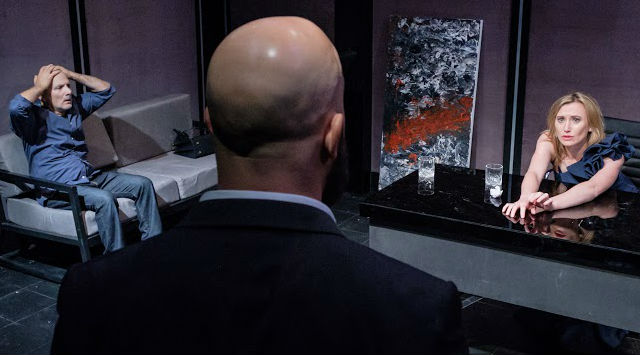
Cristobel is suffering an existential crisis, having learnt about her music being used for gravely nefarious purposes. After 14 years in the highly commercialised industry of children’s entertainment, her integrity is now unable to escape scrutiny, but corporate interests deny all her attempts to quit. Art and commerce are once again at loggerheads, in Mary Rachel Brown’s Permission To Spin, a dramedy that interrogates not only artistic purity, but also our general complicity and participation in the often ugly world of big money.

It begins with a big bang, two businessmen are snorting cocaine, in the midst of a lot of ruckus, wondering how to solve a problem like Cristobel. The laughs are loud and abundant, courtesy of Brown’s witty, often very incisive, dialogue. It is evident however, that the play is intent on seriously exploring our social, economic and political lives, and a gradual but marked change in tone occurs about midway through the hour-long presentation. Direction by Brown and Dino Dimitriadis provide good clarity to ideas, even when the writing turns dense. The contrast in mood, as the play crosses over from funny to heavy, involves an inevitable drop in energy levels, but we are kept attentive by some very resonant postulations.

Three excellent performers accompany us on this trip, helping us navigate the combative activity of Permisson To Spin, and in the process, locate a sense of our communal ethics. Anna Houston provides soul to the piece, simultaneously vulnerable and strong, with incredible nuance that speak volumes in her interpretation of Cristobel. Yure Covich is splendid as an obscene and irredeemably vile corporate asshole, powerful in his embodiment of our social ills and perfect as the show’s bad guy. Arky Michael is wonderfully comical, landing every punchline with remarkable precision and aplomb, displaying himself to be the kind of actor any production could rely on, for charm and interminable effervescence.

All our occupations contribute to greater consequences, even if we think them insignificant. Cristobel is meant to be creating music that is educational at best, innocuous at worst, but she is unable to stop her work from being repurposed in a manner that contradicts all that she believes in. There is a machine that absorbs and integrates us into its operations, to serve its purposes. We do not always have control over its desires, as is proven again and again, by the flaws and inadequacies of the way we execute our democracy. “It was music we were making here until they told us, all they wanted was a sound that could kill someone from a distance… I just pray that someone there can hit the switch.” Kate Bush, Experiment IV, 1986

www.apocalypsetheatrecompany.com

Review: The Rolling Stone (Outhouse Theatre)

Venue: Seymour Centre (Chippendale NSW), Jul 5 – 21, 2018
Playwright: Chris Urch
Director: Adam Cook
Cast: Henrietta Amevor, Nancy Denis, Zufi Emerson, Damon Manns, Mandela Mathia, Elijah Williams
Images by Clare Hawley

Theatre review
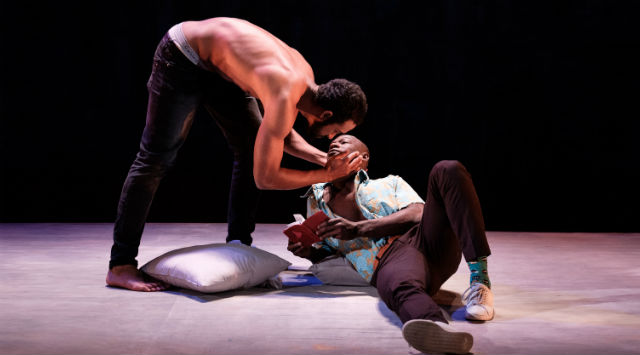
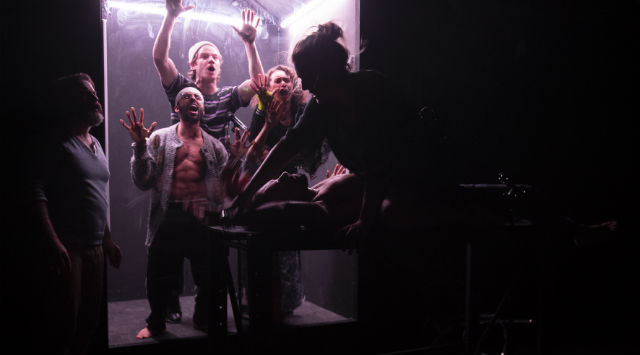
Dembe is an 18 year-old gay man living in Uganda. His family thinks of themselves as being exemplary Christians, but for many in their culture, the killing of homosexuals is not only a permissible deed, it is often exhorted to be a godly act. When Dembe falls in love, the personal and the social can no longer be reconciled. The persecutions illustrated in Chris Urch’s The Rolling Stone, are extremely cruel, but we know them to be factual. Urch pulls no punches in his storytelling; the passions are wild, whether evil or virtuous, and we are not spared the worst of human nature, even as we delve into the purest of our emotions.

Much of the play is horrifying and depressing, but an overt theatricality in the production’s tone chooses our minds over hearts, in how it wishes to keep us engaged. Adam Cook’s direction requires of us, a cerebral approach in our appreciation of his show, so that we may come to a greater understanding, of the colossal stakes at play, and of the mechanisms that drive the barbarism being depicted. The Rolling Stone steers clear of ever turning itself into torture porn, ensuring that Dembe’s conflicts and suffering are used, not for masochistic indulgence, but for a greater sociopolitical purpose.

Elijah Williams is a powerhouse leading man, completely captivating with a larger than life presence, and disarming with the extraordinary degree of vulnerability he is able to convey. Dembe’s love interest Sam, of Northern Irish and Ugandan descent, is played by Damon Manns, deeply impressive with the nuance he puts into the portrayal, of a man unable to escape the oppression he has to endure for his sexuality, in both Europe and Africa. The actor delivers remarkable dynamism and complexity, for a role that he makes wonderfully convincing.

Also very endearing is Henrietta Amevor as Naome, the young woman who has lost her voice to trauma. Amevor’s performance speaks louder than words, perfectly calibrated to tell us all we need to know of her secret story. Zufi Emerson proves herself very likeable, pairing an effortless warmth with technical precision, for a surprisingly memorable turn as Dembe’s sister Wummie. Nancy Denis and Mandela Mathia are splendid in more dramatic scenes, both bringing chilling power to the formidable malice they represent in this painful tale.

There are noteworthy technical elements in the production, including Isabel Hudson’s sophisticated take on scenic design that adopts traditional style wings to complement the show’s classic acting traits. Lights by Sian James-Holland give the stage an astonishing beauty, even when the action turns daunting. Ryan Devlin and Nate Edmondson keep music and sound design understated, but there is no denying the efficacy, and elegance, of what they accomplish.

The Rolling Stone is an important story for people of colour everywhere. LGBT activism has achieved exceptional advancements in many white communities, but whether in developing or industrialised nations, there is no question that gay liberation has thus far failed many queer people of colour. The abuse and murder of gay and trans people that occur every day, no longer make the Australian news. With the passage of marriage equality, we have convinced ourselves that the work is complete. Even if we do not wish to spare a thought for atrocities overseas, what happens in the neglected enclaves of black and brown Australia must not be ignored.

www.outhousetheatre.org

Review: Roomba Nation (Hurrah Hurrah / The Old 505 Theatre)

Venue: Old 505 Theatre (Newtown NSW), Jul 4 – 21, 2018
Cast/Devisors: Alison Bennett, Nick O’Regan, Kate Walder
Images by Stephen Reinhardt

Theatre review
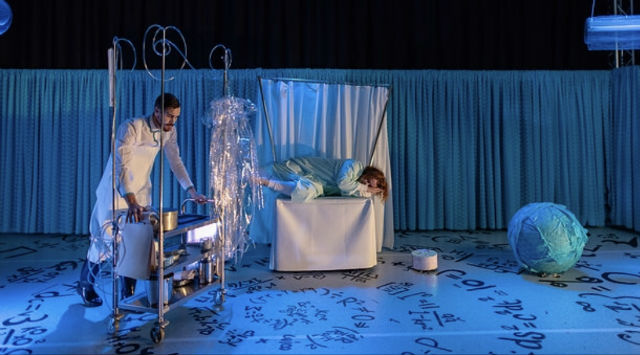
Pippi is in a medical facility, surrounded by technology and experts. A doctor and a nurse attend to her, although they demonstrate little care for their patient’s well-being, choosing instead to focus on the science and gadgetry purportedly designed to make us feel better. Roomba Nation is concerned with that disconnect between humans, in a modern age defined by personal independence and isolation, as an ironic result of human advancement. Looking at the way technology is able to take over our existence, the show foregrounds humanity, asking questions about our ever-changing relationship with nature.

Pippi says she is unwell, but her sickness is a mystery. Instead of showing any obvious symptoms of illness, what she presents is a need for attention and connection. The human touch it seems, is still necessary, in these times of virtual everything. Roomba Nation talks about neglect, and we wonder if in the pursuit of progress, our focus has abandoned that which is truly important. Values are constantly shifting, because we are constantly changing. The mortal flesh however, seems to retain a stubbornness, that disallows us from living only in highly evolved states of mind. No matter how clever we think ourselves to be, the reality of bodies, keeps us humble.

Production design by Duncan Maurice is pristine, delightfully and humorously so, to reflect the septic quality of the world being explored. The three characters are absurd and abstract manifestations of people in hospitals, performed by Alison Bennett, Nick O’Regan and Kate Walder, an invigorating ensemble as fascinating they are funny. In accompaniment are three automated vacuum cleaners, dressed up as robots to symbolise the dehumanisation of society, but are otherwise underwhelming with what they bring to the stage. It is a charming piece of theatre, perhaps insufficiently incisive with what it communicates, but an eccentric spirit makes up for its shortcomings.

Resistance may be futile, but when we submit to technology, in our very participation of it, opportunities for ethical choices can still be found. Technology never exists separate from us. It comes from us, and continues to depend upon us. As long as we remain indispensable, we have to believe that it is within our power, to shape the future in accordance with the best of our nature. Efforts to make life easier are inseparable from all that we do, but complacency will only deliver the exact opposite.

www.hurrahhurrah.com.au

Review: Away (Bondi Pavilion Theatre)

Venue: Bondi Pavilion (Bondi NSW), Jul 4 – 7, 2018
Playwright: Michael Gow
Director: Nicholas Christo
Cast: Beth Daly, Meg Clarke, Norah George, Veronica Lang, Berynn Schwerdt, David Simes, Will Usic, Elliott Weston, James Wright
Images by Lynn Quiroz

Theatre review
Tom and his family are new immigrants to 1960’s Australia. Unlike many of their aspirational neighbours, they are content with a new residence offering a sense of freedom and egalitarianism, after having worked hard to escape the stifling mores of England. Michael Gow’s Away may not be set in 1788, but it is in some ways a story about white settlement, as we watch three white families trying to make sense of their place on this strange colonised land. They never feel completely at home, and the play urges that we attempt to find ways to explain their unrelenting anxieties and throbbing disquiet.

It is a kind of rootless existence that we witness in Away, about those who have only short histories as inhabitants of this young nation. The play opens and closes with quotations from the works of Shakespeare, as though inspiration can only be derived from old Europe; that inability and aversion to connecting with the authentic here and now, is more than a little revealing. The production however, uses A Midsummer Night’s Dream well, with the presence of Puck and other fairies underscoring much of the action, in costumes by Emma Clark that are very delightful indeed.

Director Nicholas Christo does well to introduce a dimension of ethereality whenever possible, for a magical quality that brings additional drama to the production. Not all actors are obviously suited to their roles, but it is an adequate cast that presents the show, with David Simes proving to be most endearing as both Tom and Puck. The performer is sprightly, with a charming earnestness that accompanies an admirable level of dedication he displays for the stage.

Not every work of art can stand the test of time, but there is no stopping us from new interpretations when we find them starting to wither. There is little joy in reading the same texts, in the same way, year in year out. With every revisit, tiny shifts in our culture allow us to see old things in new light. That which had been written might be characterised by a certain immovability, but the eyes that read them, can never defy the ravages of time.

http://www.waverley.nsw.gov.au/recreation/places_of_interest/bondi_pavilion

Review: Speaking In Tongues (Chippen Street Theatre)

Venue: Chippen Street Theatre (Chippendale NSW), Jun 29 – Jul 7, 2018
Playwright: Andrew Bovell
Director: Jake Ludlow
Cast: Elsa Cherlin, Dale William Morgan, Simon Thomson, Josie Waller

Theatre review
A woman disappears in Andrew Bovell’s Speaking In Tongues, but it is the relationships surrounding the incident that are its focus. It is an unconventionally structured play about ordinary heterosexual people, and through Bovell’s contorting lens, our every day is made strange to reveal the inconspicuous nature of what takes place beneath the surface. Our dysfunctions as individuals and as couples, are brought to light, refreshing but bleak in their honesty.

A team of young actors play the middle age characters of Speaking In Tongues. A noticeable deficiency in maturity is thus inevitable, but there is certainly no shortage of conviction in what they deliver. Act Two commences with the cast performing a series of monologues, proving themselves particularly engaging when working autonomously. Director Jake Ludlow’s attempts at theatrical embellishment are well-intentioned, but his strengths reside more persuasively in the production’s plainer sequences. It is a raw presentation, with a healthy quotient of promise put on clear display.

There are things we pay little attention to, that quietly engineer the way we experience the world. The personalities in Speaking In Tongues are absorbed in all their immediate concerns, but it is us, watching from the sidelines who are able to decipher the deeper implications of their entanglements. There is a missing person in the play who works as a consolidating device, but in this not unappealing piece of drama about the bourgeois, we see that everyone is lost inside their own discontentment, and come to an understanding of the triviality inherent in so much of our own suffering.

www.chippenstreet.com | www.gradco.studio

Review: Toby Schmitz Live (Old Fitz Theatre)

Venue: Old Fitzroy Theatre (Woolloomooloo NSW), Jun 26 – 29, 2018
Playwright: Toby Schmitz
Cast: Toby Schmitz

Theatre review
It is a convention in autobiographies that they involve vignettes of major significance, with important occurrences that have shaped a person’s being, occupying centre stage. Typically, one gives a recount in chronology, from a childhood that reveals background and ancestry, through to career highlights and personal triumphs, always with a healthy dose of trauma placed strategically, to elicit some sort of poignancy from its audience. In Toby Schmitz Live, an actor-slash-playwright talks about himself in a disarmingly casual manner, rejecting the obvious constraints of aforementioned assumptions, to paint a self-portrait using rules of his own determination. We obtain an impression of the artist, entirely accurate and immediate, but secrets remain undisclosed.

There might be no dirty laundry to speak of, but Schmitz’s presentation is not devoid of vulnerability. The complete absence of a fourth wall exposes the performer to intense scrutiny. We watch him manifest a mode of presentation extraordinary with its degree of naturalism; as actor, Schmitz’s ability to render invisible the devices of theatre is deeply fascinating. Early sequences seek to explore the unpredictable nature of the live form. We are reminded of its title Toby Schmitz Live, and the show seems intent on delivering just that; Toby Schmitz is live, and anything can happen. There is a degree of daring and confidence that will no doubt impress, even if Australian audiences are guaranteed to always be excessively polite.

Much of the piece feels no different to genres of stand up comedy, but Schmitz’s penchant for theatricality often rears its head. It is an effective technique, to have us let down our guard in the presence of his spontaneity, then be met subsequently, with a more dramatic approach that he so cunningly, and effortlessly, weaves through unsuspectingly. The yarns that our star spins, are thoroughly amusing, although largely inconsequential. It is his charisma, and undeniable skill, that has us invested in the storytelling, but it is unclear if many of us will find lasting relevance in what he has to share. Ultimately, it is a personal, albeit slightly surface, representation of Schmitz’s life as he knows it. We are invited to come in contact with his world for a confined moment, and we go on our separate ways, none of us transformed.

www.redlineproductions.com.au/underground

Review: Unqualified (Ensemble Theatre)

Venue: Ensemble Theatre (Kirribilli NSW), Jun 22 – Jul 21, 2018
Playwrights: Genevieve Hegney, Catherine Moore
Director: Janine Watson
Cast: Genevieve Hegney, Catherine Moore
Images by Phil Erbacher

Theatre review
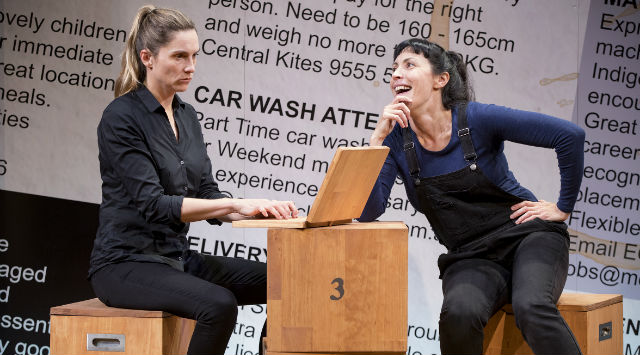
Centrelink offices are not generally considered places of serendipity, but when Felicity and Joanne meet, an unlikely and fortuitous union occurs. They join forces to set up a temping agency, creating opportunities for themselves, to leave the past behind and to become gainfully employed in a manner that gives them a new independence. Finding your own feet, however, is never an easy task. The women fly before they walk, and with a hilarity derived from their naivety, we watch them in Unqualified, fumbling and learning to come into their own.

Genevieve Hegney and Catherine Moore’s play contains a suite of excellent jokes, all stemming from a meaningful concept, involving women resisting their societal obligations as wives and daughters. Its general plot is insufficiently taut, but the show is a successful expansion of the skit format, with speedy exchanges between the two designed to provide what seems an endless amount of very clever punchlines.

The writers present their own creation, both impressive with the detail that they bring on stage, along with a sensational display of chemistry determined to hold us captive. Moore is particularly delightful as the jovial Felicity, delivering a comic performance astonishing in its efficacy, precision and inventiveness. Director Janine Watson orchestrates the action so that there is plenty of colour and movement to occupy our attention. Even when the story stagnates, we find ourselves luxuriating in the laughs that come through incessantly, and effortlessly.

Few people seem to be able go through life never having to make any sacrifices; many of us look as though we are never capable of putting ourselves first. Unqualified is a work celebrating the discovery, when it finally dawns upon us, that there is a finite amount to what we can owe, and that true fulfilment requires an individual to understand what it is that will realise their true potential. Felicity and Joanne spent many years cultivating a sense of worth, by following prescribed rules. It is satisfying to witness their moment of self-determination, as they make the decision to break free. Humour can help us through anything, but emancipation is ultimately the biggest reward.

www.ensemble.com.au