Review: Talk (Sydney Theatre Company)

Venue: Sydney Opera House (Sydney NSW), Apr 3 – May 20, 2017
Playwright: Jonathan Biggins
Director: Jonathan Biggins
Cast: Valerie Bader, Helen Christinson, Paige Gardiner, Peter Kowitz, Lucia Mastrantone, Kenneth Moraleda, Andrew Tighe, Hannah Waterman, John Waters, Ben Wood
Image by Brett Boardman

Theatre review
Journalists are losing jobs every day, while the world transitions from traditional forms of news consumption to what is termed new media. In the digital age, information comes cheap, and its dissemination no longer relies on sources of authority and legitimacy. Instead, we find ourselves obtaining news from literally anyone, with little discernment, through things like social media or any of the millions of internet web pages.

What used to be considered a revered profession, is now dissolved into commentary, opinion and hearsay, coming from people who have demonstrated nothing that earns our trust, most of which is never verified or verifiable. A lot of Jonathan Biggins’ Talk is about the well-founded anxiety surrounding this changing landscape, as well as the ever-present threat that commerce and propaganda pose to our media organisations.

Three powerful bodies are represented in the play; the Australian Broadcasting Corporation, the Daily Telegraph, and a fictive mercenary radio station with its talkback star. We observe them finding their way around the case of an alleged paedophile, each one responding in their characteristic manner, with none able to report the truth. Biggins offers insight and perspective on an industry he knows well. The clarity of his deductions is valuable to how we understand the state of play today, in forces that have undeniable influence on all our lives. As a work of theatre though, the dialogue is often contrived, with a transparently didactic approach that gets in the way of its storytelling.

A lack of nuance in its depiction of archetypal personalities produces a kind of comedy that is perhaps too obvious and slightly hackneyed. Its characters are never surprising, although performances are uniformly polished and considered. Actor John Waters as the aforementioned talkback radio host John Behan, is entirely convincing, but the material at hand does not seem to encourage a depiction that is as comical and outrageous, as the real life examples he emulates.

Production design is a straightforward affair in Talk, but for what it lacks in ingenuity, it compensates with efficiency. Mark Thompson divides the stage into three static portions, to accommodate the play’s three workplaces. If their only intention is to create believable and functional spaces for action to occur, then design faculties have passed with flying colours on this occasion.

We want the news to give us access to the truth, but truth is rarely the real priority for those who give us the news. As we become increasingly sceptical of the old gatekeepers, we reach for alternate sources in hope of locating information that is more accurate and relevant, but that can lead us into echo chambers that have us shielded from reality. It is a grim scenario that Talk leaves us with, but its pessimistic resistance of digital advancements in our media is overstated. Traditional formats were never without their problems. It is tempting to think of the past as simple and wholesome, but lying crooks have existed since the dawn of time, and we will have always have to be vigilant, no matter ink or pixels.
www.sydneytheatre.com.au

Review: The Play That Goes Wrong (Roslyn Packer Theatre)

Venue: Roslyn Packer Theatre (Sydney NSW), Apr 5 – 23, 2017
Playwrights: Henry Lewis, Jonathan Sayer, Henry Shields
Directors: Mark Bell, Sean Turner
Cast: Darcy Brown, Adam Dunn, Luke Joslin, George Kemp, James Marlowe, Brooke Satchwell, Nick Simpson-Deeks, Tammy Weller

Theatre review
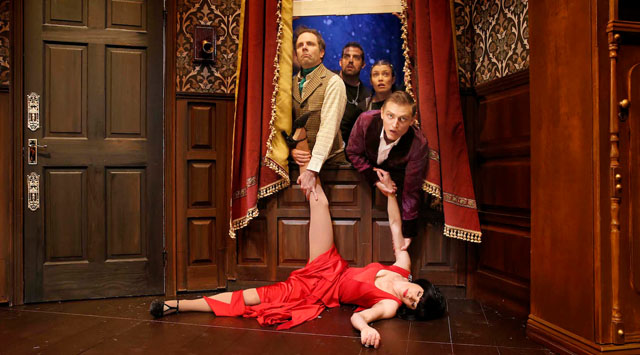
When embarking on any project, passion is a key propulsive ingredient that will make things happen, but nothing will go well if passion is the only positive quality it has going for it. A community theatre group in Cornley, UK puts on a 1920s murder mystery, with little more than the fire in their bellies. The lack of talent and skill onstage and off, generates a series of fantastic mishaps that constitutes the high energy comedy brilliance we find in The Play That Goes Wrong.

It is pure farce and slapstick, at their maximum amplification. Stories and characters are barely relevant, in this ambitious exploitation of high octane physical comedy, involving people and objects falling about constantly, in the most satisfying manner. It is an old-fashioned style of show, made new by its unusually voracious need for speed and excitement. Directors Mark Bell and Sean Turner may not be visionaries in the conventional sense, but what they brings to the stage is extraordinarily precise and wildly imagined. The laughs on offer here are ceaseless, limited only by the audience’s ability to respond with a sustained level of energy that could match the hilarity that unfolds on stage.

The charismatic cast gives an exceptionally tight performance. In the presentation of a play where everything goes wrong, nothing is allowed to falter, and the actors are simply impeccable. George Kemp and James Marlow display no limits to their capacity for silliness, proving themselves to be very endearing indeed. Brooke Satchwell and Luke Joslin impress us with their physical presence and agility, allowing their beings to flail and flounce about with great force and ingenuity, for unimaginably powerful comic effect.

Stage managed by Anneke Harrison, the production’s technical excellence is crucial to its success. The Play That Goes Wrong can be seen as a love letter to stage managers everywhere, the unsung heroes of all the great shows we have ever seen. These women and men make themselves invisible, so that we can lose ourselves in the illusion of every staged moment. We fawn over actors and the words of playwrights, but forget the operations out of sight that allow magic to happen, until they draw attention to themselves when things do go wrong. The character of the inept Cornley stage manager (played by Adam Dunn) is a hoot, but also a constant reminder of the magnificence that has to take place backstage in order that theatre can do its best.

www.theplaythatgoeswrong.com.au

Review: Hysteria (Darlinghurst Theatre Company)

Venue: Eternity Playhouse (Darlinghurst NSW), Mar 31 – Apr 30, 2017
Playwright: Terry Johnson
Director: Susanna Dowling
Cast: Miranda Daughtry, Michael McStay, Wendy Strehlow, Jo Turner
Image by Robert Catto

Theatre review
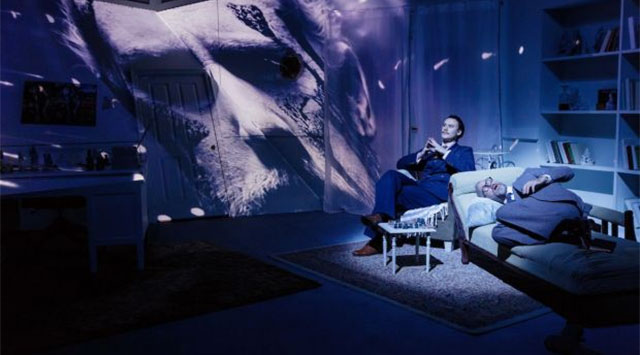
Sigmund Freud is near the end of his life, and the past returns to haunt him. We all change our minds, but writers have the burden of their work set in stone. In Terry Johnson’s 1993 play Hysteria, a fictive version of Freud is made to regret his declarations about women’s rape fantasies. It seems that the legendary psychoanalyst had misrepresented experiences of his patients, turning their reality into imagination, so that his work would be better received. Johnson’s piece about the need to redress denials of rape and molestation, is a timely discussion in the current climate of renewed interest in feminism, but Hysteria is a dry, and often inelegant, work that proves to be less than captivating.

The production looks smart enough, with Anna Gardiner’s set and costume design establishing a splendid first impression. Projections of Julian Tynan’s cinematography appear later in the piece, equally delightful with the imagery it presents. It is an accomplished group of actors, each one demonstrating a good sense of presence and conviction, but chemistry is lacking, and the stories they tell never seem to fortify. We are left feeling confused and detached, unable to adequately follow its narrative or to satisfactorily engage in any of its ideas. It is a laborious exercise for the audience, trying to work out the point of the exercise, and when we eventually gain clarity, Hysteria‘s concerns fail to resonate.

Individual elements of the show all look to be at least adequate, but they coalesce to form something that is altogether disappointing. Its characters are not lifeless; Salvador Dali is written in, presumably, to further enhance the quotient of eccentricity in Freud’s colourful world, but there is little in Hysteria that excites. Art does not owe us entertainment, nor does it promise to always be meaningful. In art, there is no right and wrong, but a work can certainly fall short of the standards it sets itself.

www.darlinghursttheatre.com

Review: White Rabbit Red Rabbit (Freefall Productions)

Venue: Kings Cross Theatre (Kings Cross NSW), Apr 4 – 15, 2017
Playwright: Nassim Soleimanpour
Cast: Ylaria Rogers
Image by

Theatre review
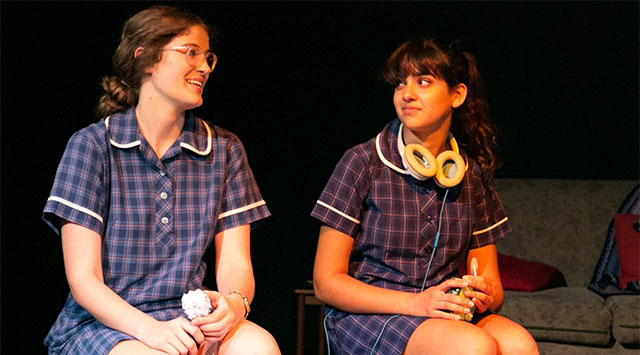
The play requires that its actor comes to the performance “blind”, not knowing anything about what lies on the pages of the playbook. It is a complete mystery to the person on stage, and also to those in the audience who are seeing Nassim Soleimanpour’s White Rabbit Red Rabbit for the first time. It is significant that the 2010 work was created when its 29-year-old author was forbidden from leaving his country Iran. The autocratic regime that he had to endure is not directly denounced in Soleimanpour’s writing, but its presence and influence on the piece, are clear.

We are made to consider how a police state operates, especially in terms of the complicity and compliance of citizens that allow inhumanity to thrive. The play shifts attention away from the way authorities intrude upon private lives, and looks instead at how the everyday person monitors and subjugates one another unconsciously, especially in cultures where freedoms are severely restricted. We are urged to think about the deficiencies in free will, and how easy it is for society to manipulate our empathy and deprive us of compassion. It wants us to see the tragedy that exists in our exploitable susceptibility to mistreating each other, and our readiness at forming habits of intolerance, hate and violence. It is to the writer’s credit that these grave and important issues are not only communicated powerfully in spite of its need to be cryptic, White Rabbit Red Rabbit is surprisingly humorous and entertaining.

Like Soleimanpour at the time of writing this script, actor Ylaria Rogers is in a position of vulnerability as she moves through the lines and instructions of every page. She submits to the text that she holds in her hands, but like those of us who have gathered to witness this unusual theatrical moment, our volition is constantly called to question. Ylaria’s obedience, and ours, come into examination, leading us to confront the nature of authority, and how it is constructed. Authority is often imagined, but even when it is real and life-threatening, the power of the masses can overthrow any dictator that sits atop. The conundrum is in our inability to perceive that collective force, and our failure to understand that the fear we experience is shared and can only manifest if we allow it to.

www.freefallproductions.com.au

Review: Ellie, Abbie (& Ellie’s Dead Aunt) (The Depot Theatre)

Venue: The Depot Theatre (Marrickville NSW), Mar 29 – Apr 8, 2017
Playwright: Monica Zanetti
Director: Monica Zanetti
Cast: Meagan Caratti, Margi De Ferranti, Sophie Hawkshaw, Geraldine Viswanathan, Monica Zanetti

Theatre review
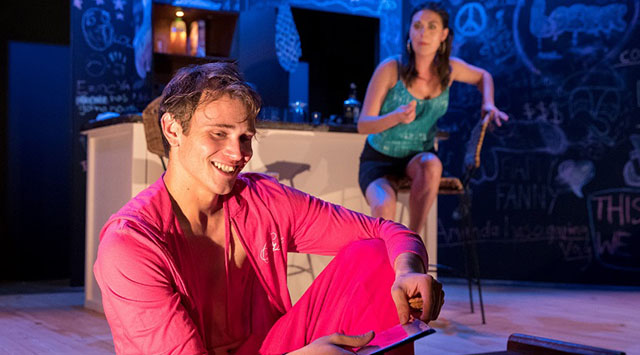
Ellie has developed a crush on Abbie, and is trying to figure out how best to ask her along to their year 12 formal. Having only just come out to her mother, who is, predictably, struggling to come to terms with her daughter’s sexual identity, Ellie is lucky to have the ghost of her lesbian aunt show up to help navigate new terrains. Monica Zanetti’s Ellie, Abbie (& Ellie’s Dead Aunt) introduces a new paradigm to the story of same-sex attracted girls. Not only does Ellie benefit from the guidance of role models, the play’s portrayal of lesbian and gay relationships in Australian high schools, as entirely normal and accepted, is thoroughly refreshing.

The work is elevated by Zanetti’s incorporation of LGBT political history. By placing emphasis on the hard won rights of Ellie’s community, we experience a gravity in our protagonist’s story without having to see her go through archaic narratives of homosexual agony. It is important that we make representations of LGBT youth in our art and storytelling that reflect the increasing normalisation of their place in society, while preserving their significance within conceptions of social diversity. Zanetti’s writing is sentimental but considered, innocent but sophisticated; it speaks intelligently to our young, and helps advocate for greater inclusiveness of sexual minorities.

The production is staged with minimal fuss. Little ingenuity is put into direction, and set design is overly bare, but the roles are soulfully realised. Appropriately, leading lady Sophie Hawkshaw is strongest of the cast, with a natural charm that endears Ellie to her audience from the very beginning. It is a gentle performance that feels effortless, but one that is surprisingly convincing. Hawkshaw makes us want the best for Ellie, and it is this emotional investment she elicits that keeps us engaged to the end.

www.thedepottheatre.com

Review: Consensual (New Theatre)

Venue: New Theatre (Newtown NSW), Mar 14 – Apr 15, 2017
Playwright: Evan Placey
Director: Johann Walraven
Cast: Callum Alexander, Michael Brindley, Claire Crighton, Rhys Johnson, Eloise Martin-Jones, Eliza Nicholls, Eamon O’Flynn, Celeste Reardon, Lauren Richardson, Natasha Rose, Anton Smilek, Nicole Toum,
Benjamin Vickers, Paul Whiddon, Emma Wright
Image © Bob Seary

Theatre review
Freddie was a 15 year-old schoolboy when a sexual tryst occurred between himself and his teacher, Diane. Seven years later, a confrontation takes place, with Freddie accusing Diane of rape. In Consensual, playwright Evan Placey poses a challenge to our ethics, not only in terms of what we consider to be sexual assault and what constitutes consent, but also how, as individuals and as society, we determine what is acceptable and what is abhorrent. The play is as much about where to draw the line, as it is about how we find consensus in the way that line should be drawn.

Placey’s gripping drama is often outrageous, but balance is offered by ethical and intellectual investigations that are as considered as they are controversial. Urging us to respond on levels that are both emotional and logical, the play leads us to experience states of struggle and confusion, while we attempt to negotiate right from wrong in all the grey areas of what we see on stage, and in those of our own real world experiences. Characters in Consensual are believable and quite frighteningly, we relate to all of them. Even when we wish to castigate certain behaviour, we understand the fallibility on display, and realise how easy it is to make those same mistakes.

Freddie is played by Paul Whiddon, perfectly cast as the male Lolita, vulnerable yet seductive, manipulative yet naive. We see a man domineering with his sexuality, as well as a lost boy not knowing what he is getting himself into. Whiddon brings a level of authenticity to the show that is quite arresting, allowing us to observe clearly, all the conflicting nuances that make his story so provocative.

Lauren Richardson takes on the highly complex role of Diane, portraying concurrent but contradictory layers of truth that has the audience squirming in nervousness. Some of her motivations could be played with greater conviction, so that the climactic moment can ring truer, but it is an accomplished performance that reveals the disconcerting depths of Diane’s story.

A strong ensemble of extraordinarily engaging young actors make up the high school classroom, typically rambunctious but surprisingly (and unnervingly) grown up in their exchanges about sex. Particularly impressive is Callum Alexander whose excellent focus and commitment, makes the supporting part of the very wise Nathan, especially memorable.

Production design is simple but effective. Renee Halse’s set and Liam O’Keefe’s lights are polished, efficient and unobtrusive, while music composer Nicky D’Silva’s exciting electronica in scene transitions, brings great vigour to the stage. Director Johann Walraven’s exhibits a valuable talent in making Consensual both intelligent and entertaining. More detailed work in dramaturgy would give greater finesse, but the show is nonetheless engrossing.

A child wants ice cream morning, noon and night. No amount of explanation could make the consequences more real than the yearning they experience. Likewise with teenagers and sex. Adults must protect the young, even when they appear headstrong with what they wish to explore. Sex and relationships are complicated, and we will continue to make mistakes no matter how grown up we feel, but as long as the more experienced can keep a watchful eye, the minimisation of harm must always be a priority.

www.newtheatre.org.au

Review: Two (Ensemble Theatre)

Venue: Ensemble Theatre (Kirribilli NSW), Mar 24 – May 6, 2017
Playwright: Jim Cartwright
Director: Mark Kilmurry
Cast: Brian Meegan, Kate Raison
Image by Clare Hawley

Theatre review
All kinds of things can happen in a pub, that old institution that uniquely combines commerce and community. It is wide open, with few restrictions on who and what are allowed to walk through its doors. Jim Cartwright’s Two first arrived at the very end of the 1980’s. Set in regional NSW, it paints a nostalgic picture of Australia before mobile phones, and before we began suspecting neighbours of wanting to bomb each other into pieces.

Men were masculine, women were feminine, and everyone was heterosexual. A comforting predictability existed, along with an indeterminate air of stifled constraint. The play features two actors in a series of roles that explore love and relationships, from an innocent time and space.

Kate Raison plays all the nice ladies with an admirable strength, bringing dimension to their predetermined passivity, and Brian Meegan keeps us entertained by introducing imaginative variation to his wide range of male characters. They make a confident and jubilant pair, adept at providing entertainment and pathos with each of Two‘s warmhearted vignettes. Director Mark Kilmurry stays out of the way of his actors’ talents, and leaves Cartwright’s vision intact, for a production that offers no surprises, but that communicates fluently with a remarkable simplicity.

For those of a certain age, there is no greater romance, than the romance one has with the past. We retain only the sweet, and those memories can make the living of today seem less dulcet. The Aussie pub is required to preserve tradition, but the financial imperative forces it to move along with the times. It is an allegory for us all. The past is often warm and comfy, but it is the essence of life that will insist we be taken in unexpected directions. The local watering hole may no longer know your name, but it still stands, awaiting new stories to be writ.

www.ensemble.com.au

Review: Binary Stars And Best Lives (Old Fitz Theatre)

Venue: Old Fitzroy Theatre (Woolloomooloo NSW), Mar 28 – Apr 8, 2017
Playwright: Samantha Hill
Director: Michael Abercromby
Cast: Katie Beckett, Nathalie Murray, Jenae O’Connor, Amelia Tranter

Theatre review
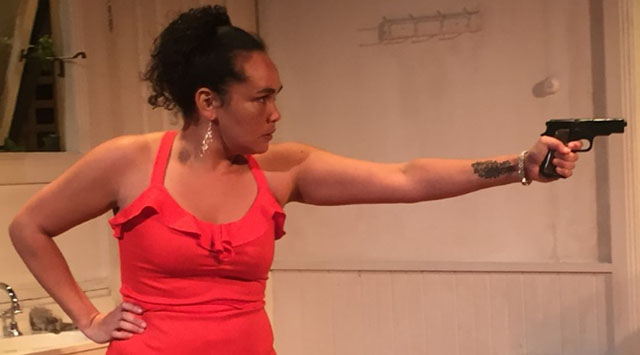
A gun shot is fired, sending chills down our spines. A woman appears, disoriented, a time-traveller perhaps, or someone from a parallel universe, but more probably, she is just released from prison for shooting her husband some years back. Babe is an astrophysicist, with a keen interest in realms other than the immediate reality. Having given up her own dreams to become trophy wife to a television celebrity, she loses her sense of self, and we find her grasping at straws to justify her existence.

Samantha Hill’s Binary Stars And Best Lives is theatrical, ambitious and complicated, but its cacophony of rich ideas struggle to communicate with clarity. It seems to have a lot to say, including issues about Aboriginality, feminism and materialism, all worthy of exploration, that might be better dealt with if greater attention was put into creating a more cohesive narrative.

Babe is an elusive character, who actor Katie Beckett embraces with conviction, especially in sections of heightened drama and emotion. Amelia Tranter impresses in dual comedic roles, both memorable for different, and absurd, reasons. Nathalie Murray and Jenae O’Connor add further vibrancy and fun to a show that is otherwise more than a little confusing.

We need to have concurrent truths in order that life can be bearable. Whether complementary or conflicting, the different ways we form an understanding of how things happen, must allow some plasticity, or all our days would only be harsh and cruel. Even when Babe is made to face the consequences of her irrefutable actions, her mind provides explanations that she can live with. We all see the world differently, but how we co-exist is the perennial challenge.

www.oldfitztheatre.com

Review: Richard III (Bell Shakespeare)

Venue: Sydney Opera House (Sydney NSW), Feb 25 – Apr 1, 2017
Playwright: William Shakespeare
Director: Peter Evans
Cast: Ivan Donato, James Evans, Sandy Gore, James Lugton, Kevin Maclsaac, Kate Mulvany, Meredith Penman, Gareth Reeves, Rose Riley, Sarah Woods
Image by Prudence Upton

Theatre review
Born ugly, Richard never understood what it is to be loved, and his story details the effect on a person when rejection is a constant and central defining experience. Coupled with what we now term privilege, his aristocratic life places him in a position of power in spite of that perpetual derision, and what results is a bitter thirst for the reciprocation of inhumanity, that knows no bounds.

It is possible to think of evil as a condition that is somehow innate, even natural to some, or as Shakespeare does in Richard III, we can conceive of evil as a manufactured and socialised phenomenon. In director Peter Evan’s rendition, the way brutality manifests, is an unambiguous process of retribution; Richard’s behaviour is depicted as being a direct consequence of the way he suffers under the mistreatment of a cruel world.

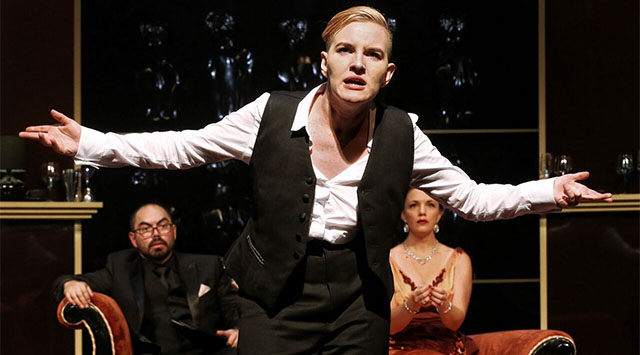
The production is adequately assembled, but there is no overstating its capacity as a showcase for the staggering talents of Kate Mulvany, who takes on the eponymous role with splendid aplomb. Mulvany’s unequivocal brilliance occupies centre stage, having us enthralled at every second, and casting a shadow over the rest of the show. All we want, is to absorb every meticulous minutiae that she serves up in each word and gesture.

It is pure genius at work, and to witness a virtuoso performance that is so exhaustively invested and incredibly rich with resonance, is the kind of theatre that broadens our understanding of what art is capable of doing. When Mulvany strips off at dramatic climax, to reveal her own scoliosis, we see the severely curved spine that she shares with Richard, and in that moment, performativity and reality conflate, for one of the most powerful visions ever brought to stage. Our reaction is appropriately visceral, but we are also made to consider how we attribute a person’s merits, or more accurately in this case, demerits, to their natural traits. If Richard is a villain because of his congenital physical condition, we must question how Mulvany’s and everybody else’s corporeality, is able to determine the people that we eventually become. We wonder about the finality of fate from the point of birth, and the extent to which our existence is written in the stars, and on the flesh.

There are other members of cast who impress, most notably Meredith Penman and Sarah Woods who deliver sensational scenes of heightened emotion, but the piece dulls significantly in the short moments when our star is offstage. Evans’ frequent use of his actors as a chorus is occasionally awkward, although the sense of vigour they create is valuable in ensuring that our attention is sustained. The set and costumes do not quite achieve the luxury and decadence that it aspires to, and the use of a small television set to convey the presence of a dumbwaiter is an inelegant solution and a continual distraction.

Visual aesthetics in this Richard III may not be a strength, but the character we have come to see, is marvellously presented. To live is to learn, and to be human, we need to understand humanity. Art shows us all the possibilities of being, so that we can find ways to negotiate better, both our environs and our selves. It is unlikely that Richard is a straightforward reflection of any one of us, but through this extraordinary rendering of a man who suffers and who retaliates, we gain insight into the nature of personal demons and recognise the way we co-exist in communities. Love can bring about things most beautiful, but its absence, is how we invite every ugliness.

www.bellshakespeare.com.au

Review: The Unknown Dancer In The Neighbourhood (Japan Foundation)

Venue: Eternity Playhouse (Darlinghurst NSW), Mar 22 – 23, 2017
Playwright: Suguru Yamamoto
Director: Suguru Yamamoto
Cast: Wataru Kitao

Theatre review
The neighbourhood in question is Nagai, a small Japanese town, unremarkable and forgotten. The stories we hear are disparate, about individuals associated only by physical proximity, but each with an unmistakable sense of isolation. Suguru Yamamoto’s The Unknown Dancer In The Neighbourhood is about the loneliness of modern life, our increasing introversion as a result of technological advancements and the ever-present tensions rendered by our human need to connect.

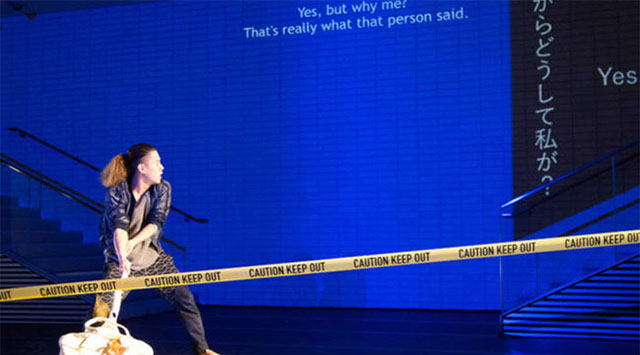
It is a script with lots to say, and a long, meandering plot. Small narratives pique our interest, but in the absence of a more conventional approach to manufacturing drama, the 90-minute production struggles to sustain our attention. There are inventive elements to its staging methodology that make the show an artistic success in many ways, but its emotional dimensions, although intensely performed, are less affecting.

Wataru Kitao embodies a large number of characters, including a gorilla and a train, in this ambitious one-man show. A highly accomplished dancer utilising both European and Japanese disciplines, along with versatile vocal abilities, Kitao’s portrayals of all ages and genders with no reliance on costume or makeup changes, is clearly impressive. Brilliantly self-assured, his presence is a confident one that keeps audiences gratified.

The Unknown Dancer In The Neighbourhood shows us the problems of modernity but offers no solutions and does not place blame on anyone explicitly. It is a true representation of our experiences, so we know what it refers to, without requiring it to have everything spelled out. As each generation of trains move us faster and faster, we can only be carried away as the times see fit. Our humanity will offer resistance, but as history shows, people will transform along with the machines we build. The past can tell us so much of what to expect in the future, but the mystery of what is to come, will always prevail.

www.jpf.org.au