Review: Jerry And Tom (Insomniac Theatre)

insomniactheatreVenue: Exchange Hotel (Balmain NSW), Apr 9 – 30, 2015
Playwright: Rick Cleveland
Director: Maggie Scott
Cast: Boris Bkric, Steve Maresca, Andrew Mead
Image by GiGee Photography

Theatre review
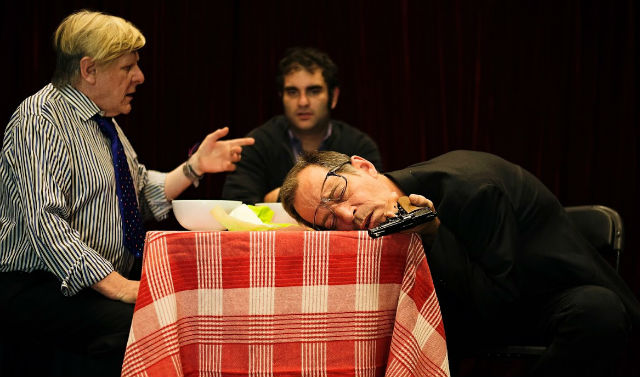
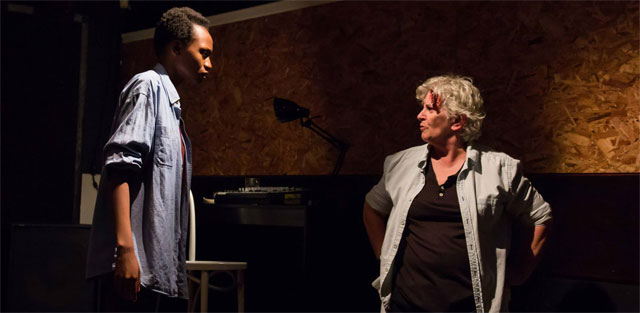
Rick Cleveland’s Jerry And Tom is a fairly uncomplicated comedy about two family men who also happen to moonlight as ruthless hitmen. We go from one humorous scenario to another, depicting their gruesome murders, all with a charming Bronx-type accent. Maggie Scott’s direction is a simple, no frills approach that focuses on character dynamics and chemistry. Pacing of the piece is jaunty and very light, with a delightful clarity in the way its plot is conveyed. The comedy is consistent but mild, and given the exaggerated context, a greater sense of irony would probably provide the show with a stronger edge.

Performances are polished and compelling, with all three actors showing good commitment and enthusiasm. Boris Brkic has a laid-back charm that makes his portrayal believable, and a keen sense of timing that allows a hint of authenticity to elevate his role Tom from mere caricature. Jerry is played by Steve Maresca whose infectious enjoyment of the stage connects with us, and although the actor’s serious side is quite obviously less developed than his funny side, he holds his own against more seasoned counterparts. Andrew Mead plays the remaining characters with excellent energy, although more versatility is required for a greater differentiation between personalities. There is a general cautiousness that feels too safe for the material at hand. We need a playfulness to meet with the reckless attitude of the narratives, but the performers seem too careful or apprehensive perhaps, to give the show the wild abandon it deserves.

Music from the television series Dexter underscores most of the blacked out scene changes, but unlike Dexter, we explore very little of the “dark passenger” that compels Jerry And Tom to do the things they do. Without enough psychological bite, the show ends up feeling a little too frothy, and after 90 minutes of senseless killing, we try to find meaning but discover emptiness instead. The production is not always satisfying, but the good work of karma does prevail in the story, and sometimes, that is all than we can bargain for.

www.facebook.com/insomniact.page

Review: Endgame (Sydney Theatre Company)

Venue: Roslyn Packer Theatre at Walsh Bay (Sydney NSW), Mar 31 – May 9, 2015
Playwright: Samuel Beckett
Director: Andrew Upton
Cast: Tom Budge, Sarah Peirse, Bruce Spence, Hugo Weaving
Images by Lisa Tomasetti

Theatre review (originally published at Auditorium Magazine)
On stage, artists can communicate ideas that they believe to be of interest to the wider community. They can also use it as grounds for exploration, to develop an improved understanding of the nature of their practice, or to investigate issues surrounding our lives. Stories are shared and concepts are illustrated, that may or may not connect with audiences but we never quite leave the theatre the same as when we first arrived. Samuel Beckett’s Endgame is light on narrative, but heavy on inventiveness, guided by a profound curiosity that brutally interrogates the fundamentals of existence. It is the most self-aware of texts, constantly drawing attention to the very act of writing, and also to the fragile artifice of its theatricality. If philosophy is its fixation, then any sense of conventionality must be removed from its structure, in order that everything may come under scrutiny, including basic notions of character and plot.

The play is both accessible and inaccessible. It challenges the way we read, and how we make sense, in the theatrical space, of language and signs, but it does not intend to alienate. Director Andrew Upton retains the integrity of Beckett’s words, sometimes impenetrable but always marvellous, and creates around them an intoxicating live experience that fascinates at every moment. Unreservedly intellectual, it is no surprise that one can be made to feel out of their depth at times, but the work’s density constantly morphs so that a switch in tone or subject inevitably occurs, and we become engaged again, only more thoroughly than ever, as our capacities gradually grow in their level of receptiveness. Upton’s voice increases in clarity over time, and the piece gains power accordingly.

Hugo Weaving is mesmeric as the hideous and hateful Hamm. Even in a wheelchair with legs bound and eyes obscured behind opaque spectacles, the star is irresistibly charismatic, and completely enthralling. Edith Piaf was said to have declared that she could sing the phone book and make it sound great. Similarly, Weaving captivates us with every word, even when we find our minds struggling to match the depth of what is being expounded. The extreme meticulousness of his approach seizes our attention, and the wild and unpredictable flourishes he builds into every scene and stanza is truly magnificent to witness. Endgame discusses the distinctions between meaninglessness and meaningfulness. Under Weaving’s spell, all that unfolds feels meaningful, and we are encouraged to seek a cerebral equivalent to the emotional sensations delivered to our gut. Also turning in a stunning performance is Tom Budge in the role of Clov, the voluntary slave who waits on Hamm for no straightforward reason. The actor opens the play in a wordless sequence, impressing us with his extraordinary physical expression. Part mime and part dance, the beauty of his execution shines in spite of the depressively ominous context he helps set up. Budge goes on to prove himself sensitive to the needs of black comedy, constantly toying with the delicate balance between morbidity and humour, much to our twisted delight. His dynamic range is quite exceptional, and the character he creates is fascinating from every perspective.

The single-act play does not require nor permit much flamboyance with design, but there is no shortage of creativity on show here. Nick Schlieper’s set is a dungeon built so horrifying, it could only have been dreamt up by a healthy dose of genius irony. The generous Roslyn Packer stage is expertly curtailed to evoke the oppressiveness explored in Beckett’s writing, and that shrunken performance space provides amplification for the performance energies so brilliantly harnessed. Lights also by Schlieper, and sound by Max Lyandvert are restrained but unquestionably satisfying, always in subtle control over our sensory reactions. Renée Mulder flexes her costume design muscles within the narrow demands of the piece, embellishing characters with objects and textures of interest and creating extraordinary colours out of a dark, sombre vista.

Difficult texts must exist, or our artistic landscape is worth nothing. If everything is within one’s grasp, one ceases to evolve. Endgame is about two hours long, but it contains wisdom from entire lifetimes by several outstanding minds. This production seduces with entertaining touches and intriguing elements, then presents life’s big questions in rarely articulated ways. If its propositions are unfamiliar, revisiting them seems necessary, like a good book that engages and bewilders, it tempts you at its end, to return to the start for another bout.

www.sydneytheatre.com.au

Review: Pvt. Wars (Dudley St Productions)

dudleystVenue: Old Fitz Theatre (Woolloomooloo NSW), Mar 17 – Apr 5, 2015
Writer: James McLure
Director: Mark Lee
Cast: Michael Booth, Thomas Campbell, Tom Oakley
Image by Rupert Reid

Theatre review
In James McLure’s Pvt. Wars we visit three injured soldiers at a rehabilitation facility. The play was first staged in 1979, but there is no clear indication of the time at which the action takes place. It could be the aftermath of any war, because the ramifications of sending young people to battle never seem to change. Some return victorious, but many end up dead or damaged. It is not a fiercely anti-war piece, but McLure’s writing does place focus on these individuals’ physical and psychological afflictions. Comedy is created from the interplay of their mental dysfunctions, as well as from the tensions derived from their divergent social classes and from the points of dissent, and assent, as cohabitants of the hospital.

Direction of the work by Mark Lee is gentle and elegant. The resultant work is funny, but its laughter comes naturally from the honest exploration of characters, rather than it being a desperate priority. The show is about trauma, but it is kept light-hearted by an evasive masculine approach to pain. The three men come face to face with each other’s terror, but they skirt around the issues, rarely able to address them directly.

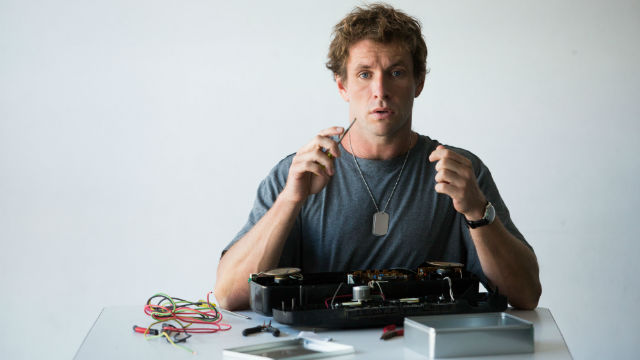
Michael Booth plays Silvio, the overcompensating alpha male who brings energy and a sense of danger to the stage. The actor appears to be distracted at several points, but his timing is effective nonetheless, and the sense of barely hidden distress and anxiety he introduces, is a significant contributor to the dynamic pace of the show. The more sophisticated Natwick is performed by Thomas Campbell, an actor with a disarmingly sensitive presence that provides an air of authenticity to proceedings. His very regular sequences of letter-writing to Natwick’s mother is let down by poor sound design, but his warmth is an inviting quality that we connect well with. Tom Oakley’s character Gately sits centre stage for virtually the entire duration, repairing an old radio. He is perennially hopeful, but struggles every day to find direction and meaning. Oakley’s portrayal resists theatrical gesticulation and embellishment, but conveys that confused determination beautifully, with a confident and touching simplicity.

The play comes to a conclusion that intends to be poignant, but a sudden loss of clarity interferes. The story surprises us at the end when it takes an abstract and abrupt turn, leaving us to our own beliefs about war, soldiers and manhood. It does not make any persuasive arguments to change our political affiliations, and its social commentary is subtle. Perhaps all it requires is for us to remember that individual lives are affected, often dramatically, while we become increasingly numbed by headlines that are no longer able to occupy more than a few moments each morning.

www.oldfitztheatre.com

Review: Jumpy (Sydney Theatre Company / Melbourne Theatre Company)

Venue: Sydney Opera House (Sydney NSW), Mar 26 – May 16, 2015
Playwright: April De Angelis
Director: Pamela Rabe
Cast: Laurence Boxhall, Caroline Brazier, John Lloyd Fillingham, Brenna Harding, Tariro Mavondo, Marina Prior, David Tredinnick, Jane Turner, Dylan Watson
Images by Brett Boardman

Theatre review
With each scene of Jumpy, pieces of furniture travel across the stage on castor wheels, moving past its protagonist Hilary. She is fifty of age, her only daughter Tilly has turned sixteen and is beginning her own sex life, and we meet them at a time when Hilary has come to realise that a period of stasis is coming to an end. Like the set that keeps rolling past, life seems to have left her behind while she dutifully plays the role of mother and wife. April De Angelis’ script is concerned with women who had grown up with second-wave feminism, particularly those from the era marked by the legacies of Germaine Greer, Gloria Steinem and Helen Reddy. Idealism and militancy fades or perhaps evolves into a modernity that bears little resemblance to the dreams that were birthed, like Hilary, half a century ago. Tilly is in some ways, a disappointment for her mother. De Angelis is critical as well, of the young woman’s need to build her identity around the male gaze. She allows many of her decisions to be determined by a need for the affections of men, and the dissatisfaction she derives from those behaviour evade her self-awareness. Hilary is confounded, and we all wonder how it has come to be that a generation can grow so contrary to its parental intentions. The text does not however, go so far as to say that child-bearing is pointless (although there is a tendency to characterise some parents as being selfish and afraid of loneliness), but we are certainly encouraged to assess the choices Hilary had made for herself.

The context is simple, with a sense of the everyday found in all aspects of its plot. Characters and events are familiar, but De Angelis’ ironic humour is omnipresent. Her comedy depicts middle class existence with a healthy cynicism, and is indeed, thoroughly entertaining. Each personality’s flaws are exposed shamelessly, but the writer’s compassionate approach prevents anyone from turning into clowns or villains. In fact, we identify with all of them, and find most to be very charming. Pamela Rabe’s direction is nuanced and gentle, with no big political proclamations and few dramatic gestures. Relationships are established convincingly, and every narrative is delivered clearly to make us care, and to keep us engaged.

Star of the show, Jane Turner’s outstanding ability and likeability as one of Australia’s top comic performers is well utilised in the production. We are always on her side, and we laugh whenever she wants us to. Turner’s trademark vaudevillian style of performance keeps her at some distance from her role, but there is enough authenticity and commitment in her portrayal to keep things believable. Reasons for the production not being transposed to an Australian context is unclear, but Turner’s British accent is less than satisfactory. It is an unnatural and overly posh affectation that can be uncomfortable to hear, and slightly inappropriate for the story being told. Other cast members are more adept speech-wise, and every supporting character is colourfully performed and memorable. Hilary’s best friend Frances is played by Marina Prior whose captivating vibrancy and self-deprecating humour keep the show buoyant. The contrast, and similarities, between the two middle-aged women are fascinating to observe, and their friendship is deeply meaningful, even though other relationships are given greater weight in the text. Also impressive is Tariro Mavondo’s performance as Lyndsey, the sixteen year-old new mother who treads the fine line between ignorance and purity, spouting pearls of wisdom when least expected. A heart of gold can be tricky to inhabit, but the actor’s effortless charisma turns her character’s innocence into a thing of beauty, and poses a challenge to the way we think about teen moms.

The production is a hugely enjoyable one that keeps our attention firmly under its control. There is a mildness in tone that reflects the theme of maturation, but it finds ways to amuse us from start to end. Its message arrives in the form of questions, but it leaves answers ambiguous. Middle class lives are full of anxiety, and Jumpy shows that the state of peacefulness does not emerge spontaneously with age and happiness does not necessarily materialise upon the fulfilment of duties of one’s choosing. The show does not hold the key to peace and happiness, but it provides inspiration, or at least a reminder, that it is never too late.

www.sydneytheatre.com.au | www.mtc.com.au

Review: A Little Night Music (Sydney University Musical Theatre Ensemble)

muse2Venue: Seymour Centre (Chippendale NSW), Mar 25 – 28, 2015
Book: Hugh Wheeler
Music & Lyrics: Stephen Sondheim
Director: Alexander Andrews
Cast: Stuart Bryan, Emma Elsley, Owen Elsley, Harry Flitcroft, Louise Flynn, Sarah Gaul, Bronwyn Hicks, Christie New
Image by Wenray Wang

Theatre review
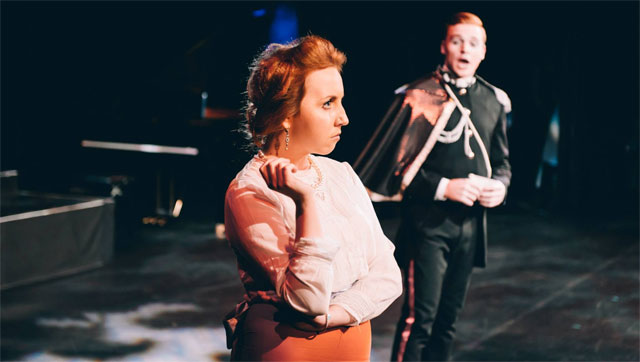
Desiree and Frederik are middle-aged but they are yet to find fulfilling relationships. Sondheim’s A Little Night Music is a very adult love story that contains more farce than it does romance, and speaks to a slightly jaded audience that understands the complexities and illusions of love. The text is an intelligent but mischievous one, offering interesting insight into the personal aspects of mature lives. The most popular song of Sondheim’s entire oeuvre, “Send In The Clowns” is a prominent feature that encapsulates the experience of longing and regret. The decision by MUSE (Sydney University Musical Theatre Ensemble) to stage the work is ambitious on many fronts, but the greatest challenge is for its very young team to convincingly portray the show’s main characters who are at least twice their age. The humour and pathos of the narrative, and its musical numbers, are heavily nuanced and demanding of any cast, but to expect those who have yet to taste all the flavours of life to interpret A Little Night Music with depth and poignancy is a very tall order indeed.

Director Alexander Andrews may not have the most seasoned performers at his disposal, but his flair for musical theatre is undeniable. Andrews is careful to keep the stage active with movement and surprise, so that we are visually engaged throughout the three hour production. Dramatic tension is not always present, and the piece often lacks exuberance, but sequences are paced quickly, with fresh events unfolding consistently to retain our attention. Stronger performers include Christie New, who creates a very funny Charlotte Malcolm, endearing us with sharp self-deprecation, and a knack for delivering powerful punchlines in both speech and song. Also memorable is Madame Armfeldt, the brilliantly zany matriarch presented by Sarah Gaul with gusto and flamboyance. Stuart Bryan cuts a fine figure as the show’s leading man, but his approach is too reserved, and his self-consciousness distracts from Frederik’s emotional journey. Quality of singing in the production is accomplished. Clare Richards’ powerful soprano is a standout, and Conrad Hamill’s work as Music Director, while being fairly rigid is delightfully detailed and precise.

Mr Sondheim’s work is quite literally second to none. He is an original and an undisputed genius, whose creations are ubiquitous and magnificent. Good productions of his body of work make for sublime nights of unparalleled theatrical pleasure, but lesser attempts can still be enjoyable by virtue of the sheer prowess of foundations already laid down years before. Musical theatre is rarely reinvented, and young practitioners of the genre subject themselves to emulating successes they had witnessed before. There is a sense of duplication that exists, whether effort is put into matching what had been great, or intentions are to supercede prior manifestations. It is a true conundrum, when one considers the true essence of art and the pursuit of all that is new.

www.museatusyd.com

Review: Idle Lies (Doll Parts)

dollparts1Venue: The Nag’s Head Hotel (Glebe NSW), Mar 23 – 29, 2015
Playwright: Erin Brookhouse, Jason Pizzarello, Adrian Yearwood
Director: Erin Brookhouse
Cast: Romy Bartz, Jack Marsden, Caspar Hardaker, Jaceline Marriott, Isaac Reefman

Theatre review
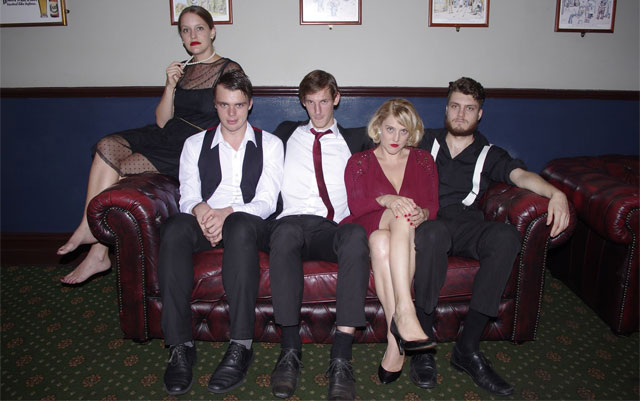
Erin Brookhouse’s Idle Lies is a multidisciplinary exploration of performance that attempts to redefine the experience of theatre. The venue is an old pub, and the action takes place in several conjoined rooms. A four-piece band is in a corner, providing jazzy versions of familiar pop and rock numbers. After every two or three songs, the cast appears to present a combination of dance and drama that relates to a vague narrative, of which we never really get to understand all too clearly. The show is not about story as much as it is about experimenting with the relationship between artist and audience, and about unpacking the complex meanings of space in life and in the theatre.

Stealing the show is Irene Nicola, the adorable chanteuse who leads the band with confident singing and a sensual touch on her keyboard. The women in the show are flamboyant and glamorous, but their male counterparts are less eloquent in expression. Brookhouse has an interesting vision to share, but not all moments bear enough conviction to persuade us of their artistry. Her use of movement is accomplished, but they are not executed with enough meaning or perhaps psychology in order for us to be more captivated.

Without the comfortable seats of an auditorium and the assurance of a predetermined stage, we are required to move around, using instinct, and common sense, to let the performers carry out their very physical sequences. The process is inconvenient and inelegant, but very kooky and quite charming. The production would look much more effective if a stage was built to those same spacial specifications, leaving us to observe outside of it, but that would miss the point. Before the cast’s each appearance, room lights flash as though forewarning poltergeist activity. The performers walk through us like spirits of the past, unaware of our presence. As we watch them go through their paces, it soon becomes clear that we had swapped places unknowingly, for it is the audience that watches in silence, like the creepy ghosts who hang around in rooms uninvited.

dollpartsproductions.wix.com

Review: Elektra / Orestes (Belvoir St Theatre)

Venue: Belvoir St Theatre (Surry Hills NSW), Mar 14 – Apr 26, 2015
Playwrights: Jada Alberts, Anne-Louise Sarks
Director: Anne-Louise Sarks
Cast: Linda Cropper, Ursula Mills, Hunter Page-Lochard, Katherine Tonkin, Ben Winspear
Images by Brett Boardman

Theatre review (originally published at Auditorium Magazine)
Classic Greek tragedies depict life at its extremities to explore the human condition. Elektra and Orestes are siblings, separated by grievous circumstances, but eventually united by a need for revenge. The death of their father King Agamemnon had torn the family apart. Murdered by their mother Clytemnestra and her lover Aegisthus, the legacy is one of blood drenched tragedy. In Jada Alberts and Anne-Louise Sarks’ retelling of the ancient tale, the female voice is given emphasis by placing attention on Clytemnestra’s narrative. The traditional villain is given fresh dimension, and the convenient diminishment of her person is transformed so that her legend is presented much closer in essence to our common beings. For centuries, men have ruled the world, and women’s stories are used to serve their purposes. Today, Clytemnestra states her case, and although Agamemnon’s demise remains unforgivable, we gain an understanding of her often buried rationale and arguments.

In addition to providing a new perspective, Alberts and Sarks’ script successfully creates a language that blends classic sensibilities with today’s colloquialisms. Combining the flavours from an epic yesteryear with contemporary domesticity, Elektra / Orestes invites us to relate to its royal characters with a new familiarity. They speak like we do, so their circumstances, although extraordinary, become accessible. The work intends to put focus on the parallels between us and them, finding points of connection through our attitudes toward family discord, and with its emotional universality. Although not unique to the genre, intense sentiments and passionate expression are characteristic. Direction of the piece by Sarks attempts to adapt that extravagant mode of performance for the updated context, with mixed results. Conversations in the play are often pedestrian in style, but with a heavy undertone coloured by sorrow, remorse and fury. The narrative is communicated with crystal clarity but the rejection of a more consistently melodramatic approach requires of its audience, a stronger reliance on logic, thereby sacrificing the more potent visceral effects of being in the presence of rupturing emotion. The story remains engaging, but one questions its relevance when told in a more subdued manifestation.

Performances are generally of a polished standard, but some of its characters are not sufficiently convincing. Linda Cropper as Clytemnestra shines in the second act when her warmer maternal qualities are called upon for a scene of tenderness, but the queen is never quite majestic and intimidating enough. The love for her children is evident, but it is difficult to believe that she is capable of committing the atrocity for which she is known for. Her son, Orestes is played by Hunter Page-Lochard whose star quality is clear to see. He makes his entrance at midpoint after much anticipation, but his interpretation needs greater depth in order for it to live up to our expectations of a broken young man caught in an enormously painful situation. Page-Lochard portrays the confusion of his role with excellent energy, but the qualities of anger and sadness crucial to his narrative does not reach its necessary boiling point. The complex character of Elektra is managed creatively by Katherine Tonkin whose unconventional choices give the show its cool, unconventional feel. Tonkin’s focused conviction is the propulsive force that keeps the entire first act moving quickly and unpredictably, but her chemistry with colleagues is not always strong. Elektra is the instigator of many moments of conflict, and the drama only comes when she manages to make the sparks fly.

The production is minimally designed, with a set by Ralph Myers that conveys a brutal coldness, and in spite of its simplicity, an impression of great wealth and status is achieved by a sense of sophisticated precision. The whiteness of its many bare surfaces represents an emptiness in the household that is waiting to be disrupted. Stage blood is introduced to upset the uncomfortable serenity, but it must be noted that its use is oddly restrained. The space, and the story, demand a bolder attack of red that do not materialise. Sound and lights are similarly conservative. The production is elegant in style, but greater tension could be achieved with a more vivid use of those design elements.

Vengeance is the darkest of human propensities. It is an urge that can be incredibly persuasive, but the price to pay for it afterwards is high, not least of which are the inevitable repercussive effects on the conscience. Sixteenth century philosopher Francis Bacon said that “in taking revenge, a man is but even with his enemy; but in passing it over, he is superior”. The challenge for the wronged is to find salvation without any dependency on the perpetrator’s state of mind or being. We experience this struggle on many levels, from our very personal selves, to the nationalistic ways our governments operate. Religion might lose its resonance with every passing year, but beliefs about the power of forgiveness are true and eternal.

www.belvoir.com.au

Review: The Seagull (Hurrah Hurrah / The Hot Blooded Theatre Co)

hotbloodedVenue: 140 George Street (The Rocks NSW), Mar 18 – 28, 2015
Playwright: Anton Chekhov (translated by Peter Carson)
Cast: Jade Alex, Maxine Appel-Cohen, Alison Bennett, Mitchell Bowker, Daniel Csutkai, Cecilia Morrow, Julian Pulvermacher, Milan Pulvermacher, Ross Scott, Anthony White
Image by Adam North

Theatre review
The narcissistic characters in Chekhov’s The Seagull talk about the things they want for themselves, and suffer endlessly for their self-centred desires. In this production devised by a cast of ten, acting is their chief interest, and each actor’s focus on their own realm is clear to see. Without a more conventional directorial appointment, and termed an “experiment in text”, the show is without a distinct sense of what it wishes to communicate, but rich with exploratory ideas from a performance perspectives. In light of this somewhat atypical context for a show, it is not surprising to discover several scenes that appear to be relatively self-indulgent, with insufficient effort put into connecting with the audience. Also, chemistry between actors is underdeveloped, as much of the work seems individually introspective.

There is talent to be found in the group and a good deal of conviction from every player, but some of the younger actors would benefit from paying closer attention to speech accents so that a more accurate sense of time and place can be achieved. The role of Konstantin is played by Daniel Csutkai who portrays innocence well, with a sense of repression that rings true, if slightly too subdued. Alison Bennett is delightful as the flamboyant Irina, providing the show with some much needed vibrancy and exuberance that keep energy levels up, but her more sombre qualities are less convincingly imagined. The young and naive Nina is powerfully realised by Jade Alex, who introduces a wide-eyed wonderment that gives the character believability, and makes her imminent demise all the more disquieting. Her crucial last scene, however, requires better gravity, as do the other cast members, who seem to lose stamina as the play progresses towards its dark conclusion.

It is always a joy to see actors working on their craft with great devotion. They put heart and mind into making magic happen, and it often does. Staging a show involves a lot more than the art of acting, and on this occasion, the missing elements are needed to support the choice of presenting the full narrative of The Seagull. Chekhov’s script discusses various viewpoints on the nature of theatre and its practice. Every society will have divergent opinions about the function and execution of artistic endeavours, but the mere presence of art is something to cherish.

www.hurrahhurrah.com.au | www.facebook.com/hotbloodedtheatreco

Review: When The Rain Stops Falling (New Theatre)


Venue: New Theatre (Newtown NSW), Mar 17 – Apr 18, 2015
Playwright: Andrew Bovell
Director: Rachel Chant
Cast: Olivia Brown, Tom Conroy, Peter McAllum, Hailey McQueen, Renae Small, Helen Tonkin, David Woodland
Photography © Bob Seary (top gallery) / Benjamin Brockman (bottom gallery)

Theatre review
Upon entering the auditorium, the rumbling sounds of a tropical monsoon emanates from the stage to greet us. Without characters and narratives, we sit listening, surrendering to the voluntary effects that our physical selves cannot help but react with. Emotions surface, seemingly for no rhyme or reason. The art that we experience changes us, without letting us know how and why. A delicious melancholy, like a calm sadness, washes over. When the story begins, we are already hypnotised. Andrew Bovell’s When The Rain Stops Falling is a play about family ties and the challenges that can be passed on from one generation to the next. Personal anguish and relational discordance affect the development of children, and we see the inevitable inheritance of wounds that result from flawed parents and imperfect parenting. Bovell’s poetic use of language and his liberal approach to plot construction, make for an intriguing script that is dramatically unpredictable and achingly beautiful. Its outstanding storytelling connects with every person’s complex feelings about home, and appeals to our thirst for a brand of theatre that is deeply moving.

Direction of the piece is provided by Rachel Chant, who impresses with an extraordinarily deft hand at emotive expression. Our senses are captivated for the entire two-hour duration, by her sensitive and adventurous exploration of sound and sight, along with an inventive use of the cast’s physical and spiritual presence in the space, to create a quality of pathos that is intensely lyrical but never melodramatic. Chant succeeds in reaching us through atmospherics and narrative, enveloping us both consciously and unconsciously, so that our attention is steered carefully through every twist and turn of the play. Excellent work is achieved in establishing a singular vision through an evidently trusting collaboration with every actor and designer of the production, although one bizarre blemish does exist in the unexplained transformation of character Gabrielle’s speech accent, which goes from a broad Australian voice to an unmistakably British one with the passage of time.

The ensemble of seven is uniformly arresting, each with their own distinctive presentation styles, but all are able to find for the piece, an exacting cohesion in tone and pace. Tom Conroy is thoroughly convincing, giving a performance memorable for its heartbreaking vulnerability and almost unbelievable simplicity. Conroy’s pared-down approach is a refreshing one, filled with subtleties that reveal just enough, and also, everything. The stoic Elizabeth is played by Helen Tonkin who mesmerises in extended sequences of Butoh-esque silence, with unwavering concentration and a painful depiction of inner struggle and sorrow. Suffering is also portrayed brilliantly by Peter McAllum, whose moments of quiet authenticity turn a small role into a profoundly meaningful one.

Hailey McQueen’s naturalistic interpretation of her role is solid and elegant, but a decision to downplay a crucial scene of confrontation is questionable. Similarly, David Woodland’s performance is most compelling, but an opportunity to erupt with greater wildness is foregone perhaps unwisely. The play is rich with regret, despair and longing, qualities that tend to be dark and heavy, and even though its sombre beauty is unquestionably enthralling, a hint of brutality would provide a greater sense of theatricality, .

From a design perspective, the creative team is a formidable one. Tom Bannerman and Martelle Hunt’s set carves out modern shapes that delineate spaces quietly but efficiently. Its hard lines and sparseness represent the chilling emptiness that is at the centre of much of the text, and ensures that the audience is affected accordingly. Lights by Benjamin Brockman provide spacial transformations and emotional cues, constantly evolving on stage to manufacture shifts in time and space, and to reflect fluctuating states of minds, and hearts. It is a rare occurrence to have the sound design of a non-musical theatre production steal the thunder, but Nate Edmondson and Alistair Wallace’s partnership is a clear triumph. Their work is original, surprising and experimental, but always effective and often powerful. It is omnipresent, but never distracting. There is an accuracy to the way the sound of When The Rain Stops Falling parallels, or perhaps determines, the stage action that makes the show inexorably involving and at many points, sublimely devastating.

There is a masochistic pleasure in witnessing the secrets of broken families unravel. We are relieved that our own private pains are shared, and we gain a sense of redemption from the realisation of that universality. At the theatre, we are never alone. With good plays, we can gain insight, and think of impending rainbows.

www.newtheatre.org.au

Review: Fallout (Smoking Gum Theatre)

smokinggum1Venue: Exchange Hotel (Balmain NSW), Mar 18 – 27, 2015
Playwright: Lauren Pearce
Director: Finn Davis
Actors: Michele Conyngham, Ian Ferrington, Jim Fishwick, Louise Harding, Moreblessing Maturure, Patrick Trumper

Theatre review
It is admirably audacious that artists go out on a limb, almost as part of their job description, to experiment in public and to risk failure in spectacular style for all to see. The nature of theatre as a commercial experience requires that strict deadlines are to be adhered to, so that a show has to have at least a semblance of readiness on its advertised opening night. Smoking Gum Theatre’s Fallout needs, among other things, more time in its creative process. Lauren Pearce makes her debut with an apocalyptic script, ambitious with big ideas, but her characters are not sufficiently formed, and its structure is not yet settled.

Most things can be said to have room for improvement, especially in art where nothing is perfect, but Fallout is a distance away from being able to communicate its intentions. Direction by Finn Davis does not deviate from the writing, and he show signs of an adventurous spirit in the way he choreographs physical movement for the piece. Performances are apprehensively grounded. It is a very quiet approach that shows little inventiveness, but actors Moreblessing Maturure and Patrick Trumper demonstrate good focus and conviction. Design is a challenge in the makeshift venue, and the creative team’s efforts are evident especially Angela Toomey’s video projections, which add a touch of polish to the production.

Outside of our education institutions, young artists have to brave the same conditions as all other theatre practitioners. Any paying audience will have expectations, and it can be a cruel world for those who achieve less than desired. Fortunately, it is rarely a dramatic case of sink or swim, because the factor of time is crucial to all artistic practice. It is the body of work over the expanse of a career that matters, and it is longevity and tenacity of the last persons standing that will make an impact.

www.smokinggumtheatre.com