Review: An Enemy Of The People (Belvoir St Theatre)

Venue: Belvoir St Theatre (Surry Hills NSW), Oct 7 – Nov 4, 2018
Playwright: Melissa Reeves (after Henrik Ibsen)
Director: Anne-Louise Sarks
Cast: Peter Carroll, Catherine Davies, Leon Ford, Steve Le Marquand, Kenneth Moraleda, Kate Mulvany, Nikita Waldron, Charles Wu
Images by Brett Boardman

Theatre review
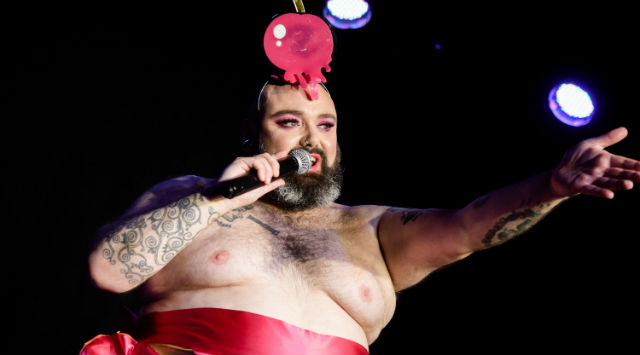
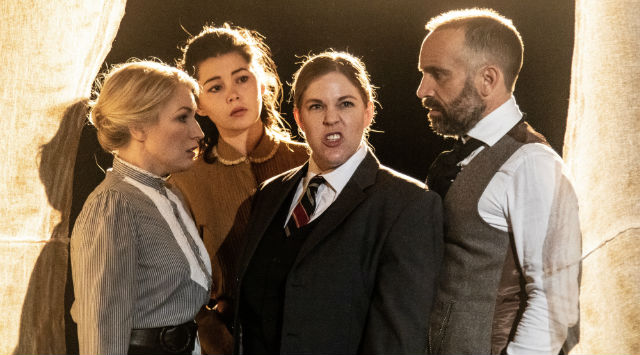
Dr Stockman is wellness consultant at the local spa resort, where business is booming, resulting in great prosperity for the township. When contamination is discovered in the water and patients are developing diseases as a consequence, she proceeds to reveal all in order that harm can be minimised, and that the town can find the right way forward. Her good intentions however, are met with opposition by men in power, who are motivated only by self-interest, refusing to let emerge, the truth that will cost them severely. In Melissa Reeves’ version of Henrik Ibsen’s An Enemy Of The People, there is the added dimension of Dr Stockman’s gender, that fuels the actions of these deplorable men.

This revision of the 1882 classic arrives at a time of heightened consciousness, in matters relating to the deep-rooted, long-established and systematic deprivation of power as experienced by women everywhere. There is no explicit naming of misogyny in Reeves’ reinvention, but director Anne-Louise Sarks makes it abundantly clear, that what we are talking about here is not only Ibsen’s concerns over democracy and corruption, but also the currently pertinent topic, on the pervasive abuse of women, in this undeniably and resolutely patriarchal world. The show suffers a slow start, with tentative humour and uncomfortable chemistry between personalities, but things escalate for a spectacular second half, enthralling and powerful in its exposition of political ills and challenges that we face as a community.

The addition of a scene involving Stockman’s cleaning lady, Randine chastising the middle classes, along with the theatre-going bourgeoisie, expands our understanding of the body politic. In efforts to make our nations great again, it seems we inevitably become embroiled in discussions that turn increasingly petty in their scope; as we drill down deeper and get closer to the bone of what we think our problems are, we habitually turn exclusionary, always putting ourselves first and forgetting the rest. Intersectionality is not yet the custom, and in Reeves’ An Enemy Of The People, we watch it explained with agonising clarity.

Actor Kate Mulvany is strong as Dr Stockman, particularly persuasive when the role gets emotionally intense. There is an infallible sense of confidence in Mulvany that allows her audience to engage deeply in the arguments being made, and we find our philosophical and ideological selves gratifyingly enriched by the experience. The aforementioned Randine is played by Catherine Davies, who impresses with exquisite nuance and a robust presence. Also memorable is Kenneth Moraleda as the obnoxious Aslaksen, delightfully comical in his animated depiction of a crooked, repugnant undesirable.

2018 could be remembered for the unprecedented number of elected women officials quitting Australian politics, with names like Julia Banks, Emma Husar and Ann Sudmalis making the news, telling stories about bullying and intimidation taking place in quarters where we should be demanding the highest of integrity. The numbers reveal, plain and simple, that women are being deliberately shut out from positions of power, but myths around notions of biology and meritocracy have formed narratives that prevent us from carrying out justice, whether or not we are personally invested. Dr Stockman says she will fight to the bitter end, but our reality demonstrates that her solitary perseverance is no match for the glass ceiling.

www.belvoir.com.au

5 Questions with Alison Benstead and Katie Regan

Alison Benstead

Katie Regan: How did you find rehearsing by yourself for so long?
Alison Benstead: It was definitely challenging, as Ignus’ purpose in the play is to help others. I was quite literally ‘waiting’ to meet everyone, so in that way, I think I was absolutely feeling the way Ignus would have.

What do you think Ignus did when she was living?
I have a theory. When I took on the character, there wasn’t a great deal of backstory that had already been decided, except that she died in the 1950s of some kind of internal haemorrhaging. I have been playing with the idea that she was a housewife, perhaps in a somewhat controlling marriage, and didn’t have a great deal of control over what her purpose was. I believe that she was a loving wife and wanted more than anything to be a mother, and that the haemorrhaging was caused by a miscarriage. There’s a lot of empathy and compassion in her, and I really get to play with the notion that she swings between being motherly towards the others, and seeing them all as a puzzle to solve.

How has your interpretation of the character changed over time?
It has changed a lot. I think I began rehearsals seeing her as this really magical archetype, and as we’ve developed her through rehearsal, I see far more human qualities. No character in this play is perfect; they’re all flawed in their own ways and that really is a gift for an actor to be able to explore.

All the characters experience time in the waiting room. How long do you think you would wait there until you searched for answers?
Not very long. I’m not a very patient person at the best of times, and my imagination would run wild with ideas and theories. The answers wouldn’t be as fun in the end.

Regret is heavily featured in the play. If Ignus had her time over again, how do you think she would have lived?
If she had her time over again, I think she would have lived a more empowered life. I see her being an Erin Brockovich kind of figure: fighting for what she believes in, and doing it with a big heart and a lot of grace.

Katie Regan

Alison Benstead: After reading the text, what was your first impression of Estelle, and what challenges did you anticipate when taking on this role?
Katie Regan: I found Estelle to be incredibly close to some of the people in my life. I think lots of people know an Estelle – she’s your friend, neighbour, co-worker. Outwardly she is relatively put together and follows the vein of most 20-somethings looking for fulfilment but, on the inside, she is entirely a drift with little to no real connection to the ‘real’ world. I knew it would be challenging to portray a character with very real and defined depression whilst also straddling the fine line of optimism she hides away inside herself.

How do you think you would personally react, waking up in the waiting room as Estelle did?
If I were to wake up in the waiting room like Estelle, I would immediately start looking for answers or an exit. I think my fight or flight would kick in very soon and, the first door I saw, I’d look for someone to talk to.

If Estelle had have carried on living, how do you think she would have lived her life?
I like to think that she became a visual artist or musician, channelling her experiences into something tangibly good for the world.

Why is this story important and relevant for audiences today, and what do you want your audiences to take away from this play?
I believe that this story is about the importance of choices: people can choose to be good or bad or apathetic but in actuality it’s the people we meet who change us. Because of the people Estelle meets in the waiting room, she is given another choice/chance at life. I want audiences to take away a sense of hope for the future and the choices that shape us.

In Waiting heavily features two strong female characters. Explain how their relationship and bond is instrumental to the story, and what they represent for each other.
Estelle and Ignus’ relationship represents the story coming full-circle, but it also shows the closing of a large chapter in both of their lives, or afterlives as it were. They are quite similar in that they both search for answers and are forces to be reckoned with. In terms of what they represent to each other, I think that they are both the final solution to each of their dilemmas. Nothing can move forward until they do together.

Alison Benstead and Katie Regan can be seen in In Waiting by Liviu Monsted.
Dates: 11 – 19 Oct, 2018
Venue: Blood Moon Theatre

Review: What The Butler Saw (New Theatre)

Venue: New Theatre (Newtown NSW), Oct 2 – Nov 3, 2018
Playwright: Joe Orton
Director: Danielle Maas
Cast: Madeleine Carr, Jake Fryer-Hornsby, Andrew Guy, Martin Quinn, Ariadne Sgouros, Amrik Tumber
Images by Bob Seary

Theatre review
The play is set inside a psychiatrist’s clinic, with four doors facilitating the all too familiar frenzied parading of manic personalities, in this rowdy old-fashioned English farce. Joe Orton’s What The Butler Saw first appeared 1969 in London’s West End, presumably conceived to take the mickey out of fuddy duddy types, by placing mildly scandalising dialogue and activity at its centre, for what could now be thought of as a sort of relic of the swinging sixties. It involves experts and authorities being ridiculed, which is always a pertinent and gratifying function of the theatre, but a substantial reinvention of the hackneyed sex comedy genre would be required, if Orton’s work is to remain truly effective.

It is a handsome production, designed by Tobias Manderson-Galvin with lighting by Martin Kinnane, but director Danielle Maas’ efforts for something delirious and avidly hectic, often disintegrates into little more than a confusing wreck. It is however noteworthy that the show does deliver improved coherence in Act II, for those who are able to persist and return to the action post-intermission. There is no shortage of conviction from its cast (actor Amrik Tumber’s capacity for memorising some very long bizarre speeches is impressive), but their comedy feels forced, and attempts to outrage never reach anywhere far enough to provoke meaningful response.

Although muted and peculiarly tentative, semblances of an anarchic spirit can be detected in the show. Art practices are valuable when they find ways to shake us out of our mundane stupor, offering a wake up call to all that we forget to question. It can provide answers, or it can simply help us begin to examine things that are hitherto undisputed or axiomatic. What The Butler Saw wants to lift the lid on subjects like the medical establishment, law enforcement, gender constructs, traditional marriage, and (gasp), incest; all of which are worthy of exploration no doubt, but it seems that our apathy can be quite a formidable encumbrance to be coming up against.

www.newtheatre.org.au

Review: Lie With Me (The Old 505 Theatre)

Venue: Old 505 Theatre (Newtown NSW), Oct 2 – 13, 2018
Playwright: Liz Hobart
Director: Warwick Doddrell
Cast: Lyn Pierse, Nathalie Murray, Julia Robertson
Images by David Hooley

Theatre review
There are monsters walking amongst us, murderers, rapists and cannibals, who look just like everybody else, made of the same flesh and blood. Sebastian is one such monster, responsible for 17 gruesome deaths. His mother is Janice, and in Liz Hobart’s Lie With Me, we explore the impossibly difficult notion of having to come to terms, with being the woman who had birthed such an abomination into the world. Whether nature or nurture, the connections we draw between mother and son, make it an intolerable existence for Janice to have to bear.

Fractured and achronological, scenes in Lie With Me are presented like randomised shreds of memories, challenging us to make coherence out of unimaginable inhumanity. Dark, passionate and urgent, Hobart’s writing makes for engrossing, fascinating theatre. Directed by Warwick Doddrell, the staging can at times be excessively elaborate, but it proves to be an ultimately rich and rewarding experience. Lights by Sophie Pekbilimli are creative and lively, effective in giving unexpected dimension to the space. Sound is delicately managed by Ben Hinchley, who deftly maintains intensity throughout.

Sebastian the monster is conspicuously, but thankfully, missing in action. Janice is played by Lyn Pierse, strong and compelling with all that she offers. Her sophisticated approach ensures that the show never descends into exploitative territory. The very charming Julia Robertson is delightful in her playful array of roles, particularly biting as Sebastian’s father Len. Nathalie Murray provides solid support, a disciplined and nuanced performer proving herself to be inexorably reliable.

Lie With Me is about motherhood, and the many roles women have to play, that deprive us of our sovereignty. Janice tries to be her own person, but having devoted her life to being little more than mother and wife, she struggles to find self-worth when forsaken by both son and husband. It is anybody’s guess if she would again choose motherhood if the reversal of time were possible, but one would hope that the lessons she has learned would lead to a reclamation of power and independence. For those of us with time on our side, the play is a reminder of how we should define existence, and the bigger things we are capable of.

www.bnwtheatre.com.au

Review: Maggie Stone (Darlinghurst Theatre Company)

Venue: Eternity Playhouse (Darlinghurst NSW), Sep 30 – Oct 21, 2018
Playwright: Caleb Lewis
Director: Sandra Eldridge
Cast: Kate Bookallil, Branden Christine, Alan Dukes, Anna Lee, Thuso Lekwape, Eliza Logan
Images by Robert Catto

Theatre review
Maggie is a racist. We know this not only because we see her make racial insults about black people to their faces, but she also admits to not approving loans at the bank where she works, when encountering applicants who are of African descent. Maggie does not feel bad or embarrassed about her behaviour, and part of the pleasure of Caleb Lewis’ Maggie Stone, is to see white Australians being upfront about their racism. The main focus of the play however, is Maggie’s accidental embroilment in Amath’s life, after begrudgingly approving the latter’s loan application. Amath is a recent migrant from Sudan, struggling to make ends meet after the sudden death of her husband. When Maggie begins to see Amath as a real person deserving of compassion, the story turns into one of redemption and reconciliation.

It is hard not to see Maggie Stone as a play suffering tediously from white saviour complex, when a substantial portion of it features the unlikely heroine running around kicking down doors to help fix a black family’s problems, but its central message about white people having to transcend racial ignorance is never out of fashion. The themes are undoubtedly pertinent, but the mediocrity of its perspectives makes the show a predictable one. Everything about it feels derivative, and for a subject matter that is so much a part of our daily consciousness, its inability to proffer fresh or more sophisticated ideas, is disappointing.

The production is adequately assembled, and Sandra Eldridge’s direction, although lacking in innovation, keeps the action moving along swiftly. As Maggie, actor Eliza Logan is a very endearing presence, able to prevent us feeling too alienated by her character’s unforgivable qualities. Branden Christine brings conviction and integrity to her interpretation of Amath, a less than meaty role that has a tendency to feel perfunctorily, or maybe too cautiously, written.

Amath’s story is likely a better one to tell than Maggie’s, but Australian writers who can speak appropriately to that experience, are perhaps still in the process of being nurtured and discovered. When talking about race, it is not often that a white person can present something new to help make meaningful progress. Abolitionists of racism do not all have to be people of colour, but this is a job that cannot be done with black and brown people on the outside. It is a crucial point that none of the white characters in Maggie Stone prove themselves able to satisfactorily acquiesce space, in symbolic or practical ways, in this discussion about racial relations on this colonised land. There is an obvious desire for a clear conscience, but the hard work required of all of us, is not yet invested.

www.darlinghursttheatre.com

Review: Yen (New Ghosts Theatre Company)

Venue: Kings Cross Theatre (Kings Cross NSW), Sep 27 – Oct 13, 2018
Playwright: Anna Jordan
Director: Lucy Clements
Cast: Jeremi Campese, Meg Clarke, Ryan Hodson, Hayley Pearl
Images by Clare Hawley

Theatre review
Brothers Bobbie and Hench are young teenagers, left to fend for themselves with only media screens and addicts as role models. Maggie is their desperately incompetent single mother, having lost both her sons’ fathers to early deaths, in this world of substance abuse and poverty. A neighbour Jennifer enters their life as a ray of hope, but in Anna Jordan’s Yen, our capacity for optimism is put to the test, as we interrogate the nature of social change and its delusory qualities, in this hyperrealist depiction of inter-generational disadvantage.

Situated in the dingiest corners of an English council estate, where the boys disintegrate in the most spectacular fashion, we observe their loss of innocence, and in its place, all the evidence of imminent wasted lives. Jordan’s writing is undeniably moving, but also marvellously thrilling. Yen is a showcase that consolidates the many deficiencies of our communities, with pointed critiques that never feel excessively didactic.

It is very gripping drama, and under the astute direction of Lucy Clements, entertaining and immensely involving. Clements has us breathless for the show’s two-hour entirety, as the story takes us through universal themes of family, love, sex, violence and redemption. Visually compelling, the production is meticulously designed by Ester Karuso-Thurn (set and costumes) and Louise Mason (lights) who deliver a surprising range of spatial transformations within restrictive confines of the stifling context. Sound by Chrysoulla Markoulli is impressively exacting, in all its manipulations of atmosphere. There is remarkable sensitivity from all disciplines, that allows its audience to engage at exceptional depth.

The staging features four fantastic actors, each one convincing and enthralling in their respective parts. 14-year-old Bobbie is played by the very industrious Jeremi Campese, whose extremely detailed approach offers up an interminably fascinating study of troubling juvenility. His extraordinary vitality insists on our compassion, even when the going gets tough. Hayley Pearl’s portrayal of the neglectful mother, has us angered and heartbroken. It is a controversial character uncompromisingly presented, by a very sharp and daring performer. Meg Clarke and Ryan Hodson are the not-so-sweet sixteens, both authentic, and tremendously revelatory of the adolescent experience, through their beautifully naturalistic renderings of Jennifer and Hench. The coupling of vulnerability and aggression in all these interpretations, are a joy to behold, as well as being meaningfully confronting.

In Yen, we see our structural failures take place within spaces that are personal and isolated. We come to an understanding that the only way for individual lives to flourish, is for the environments in which they exist to actively promote that betterment. Little can be achieved, when we leave the needy to their own devices. We chastise and condemn those who suffer, unwilling to see our complicity in people’s inability to grow, choosing only to attribute blame to their otherness. Good lives cannot exist in isolation; it takes a village to raise a child, and to lavish care on most everything else.

www.newghoststheatre.com

5 Questions with Melissa Lee Speyer and Rose Marel

Melissa Lee Speyer

Rose Marel: Are the 90s your favourite decade? Why did you decide to set TickTickBoom within this particular era?
Melissa Lee Speyer: Every decade is my favourite decade. I chose the 90s mainly for the millennium New Year’s Eve countdown. A single second that splits two millennia, according to an arbitrary marker in time. Also, they’re fun and nostalgic. I love nostalgia. I get nostalgic over every time and everything. I get nostalgic over two months ago. I build moments of future-nostalgia into my day. There is probably something real deep in that, like living in the past to avoid the future, or fearing change. Whatever. I probably shouldn’t ever say yes to time travel.

Which character in TickTickBoom is most similar to you and why?
Whoever is being the most awkward at any given moment. Not limited to my plays. Because, have you met me?

What’s the most exciting thing and the scariest thing about having your play being transformed from page to stage?
It’s all exciting and it’s all scary. I get nervous, wild-eyed, clumsy, sweaty. If there are stairs, watch me trip on them. I like feeling an audience listen. The communal experience. I love seeing what other artists bring to this thing I gave them. The communal act of creation. Foyer chat is terrifying. Mainly because I only remember people’s names on the train on the way home. My brain is allergic to names. Even my own.

What was your high school experience like? Love it or hate it?
I was a nerd, but not intelligent – intellectually, socially or emotionally. High school is always fraught. It’s life’s first social crucible, where you test out who you are and who might be.
Suddenly, the people who mean the most to you don’t have to love you unconditionally. I hated it at the time, and for years after. Now I’m glad I didn’t peak too early. All of life is high school, in some way. Ahhh. Nostalgia.

Who are your favourite playwrights?
Anyone who finishes. Writing is hard! It’s hard to play “favourites”. But you asked, and you’re great, and the full list is too long,
so here are three who are important to me. No order. Caryl Churchill, Nakkiah Lui, Michele Lee.

Rose Marel

Melissa Lee Speyer: How do you remember all those lines? Seriously. I don’t and I wrote them.
Rose Marel: You probably don’t because no one is expecting you to act out both characters 😉 For me, lots and lots of study – going over the lines; reading them out; rehearsing with other actors; speed runs; writing them down; working through the script methodically. Plus, really understanding it and analysing it. Once you figure out the intentions, the thoughts and images behind the lines, I find that it all starts crystallising.

Who was Rose Marel in high school and which clique were you in? Be honest.
I was a good old floater. (I like to think) I got along with everyone reasonably well, but I did drift around throughout the years and have close friends from various cliques. Although, I was also someone who also enjoyed – or found myself – floating around in her own world.

Can new Australian theatre compete with Netflix, and if so, how?
It’s tough. No doubt people love staying home these days – that idea of relaxing in their own space and ‘bingeing’ on shows – which is absolutely great, but I think in terms of accessibility, a lot more people, regardless of whether or not they’re involved in the arts, turn to Netflix. Less people are willing to, or aware of, all the incredible independent shows in Sydney / Australia. But it can be such a fantastic night out – grab a couple of friends or a date, have some dinner, go see a show, and then hopefully engage in great conversation about the themes and ideas that it brought up. Theatre is arguably a more visceral and raw experience for the audience members, so in that way it can definitely have the edge. 

Ultimately, they’re such different mediums, but at the same time, there’s potential for them to complement each other. Netflix has some incredible content, and is pushing the boundaries in so many ways conceptually and thematically that it can only be a good thing in terms of the wider arts community and also society in general.

Tell me about the first time you fell in love. 
The few times I’ve felt on the precipice of love, I’ve later realised that ‘that’ wasn’t it. The first, more mythical time, was back in junior school, when I clapped eyes on an elf called Legolas in Lord Of The Rings. For the next, who knows how long, I existed somewhere in the cross-zone between obsession, love and delusional infatuation. As in, I would research Orlando Bloom facts, had over 300 pictures of him on my wall, would count the pictures as a hobby and did a speech on him for a school speech competition. It was the first time I considered the possibility of ‘love’ and what that could feel like. God help me. 

Living your life: are you aiming to be here for a long time or here for a good time? Which is better? Is that actually 7 questions?
Do they have to be mutually exclusive? I’d like to say a healthy combination of the two. It can be really difficult to seize the moment, and capture that freedom and adventurousness within ourselves, especially as you get older and  encumbered with more responsibility, but I think it’s certainly a balance. One of my favourite quotes that encompasses this is from Buddha: “Do not dwell in the past, do not dream of the future, concentrate the mind on the present moment.” Something that I really admire in Clara (the character I play in TickTickBoom) is her gratitude of, and openness to the present moment. She’s a soul who’s certainly alive and receptive to the potential of the world in ‘now’. 

Rose Marel can be seen in TickTickBoom by Melissa Lee Speyer.
Dates: 10 – 20 Oct, 2018
Venue: Actors Pulse Theatre

5 Questions with Jeremi Campese and Meg Clarke

Jeremi Campese

Meg Clarke: If you could be any animal what would it be and why?
Jeremi Campese: My dog, Bobbie (genuinely his name). I guess domestic dogs in general; who wouldn’t? Everything’s covered: food, water, food, love, bed, cuddles, exercise and cuddles.

What would you like the audience to take away and learn from Yen?
Without insisting that the audience feel a certain way, it’d be great if they feel conflicted, particularly about the boys. They’re endearing in so many ways, but are the exact opposite in others; so I hope people will find themselves wanting to appreciate all their nuances. How our society raises boys is at the heart of the play, and I’d really like audiences to see that the way we meet them isn’t just on account of their choices, but is far more comprehensive than that. It’s a result of broader social perceptions of sex, women, and violence that they’ve internalised so quickly.

As a man do you feel any differently about men in society after this play? And what have you learnt about your own masculinity?
Certainly boys. In playing someone like Bobbie and researching boys in these contexts, you see how malleable and easily influenced they are by their circumstances. With the wrong role models and the wrong exposure, awful things happen. For me, I’m only 20. I’m still developing, learning and growing. So much of this play (apart from being an incredible piece of theatre) has been both cautionary tale and one of the most profound exercises in empathy.

What is your favourite sound and most hated noise?
Favourite sound is probably Cynthia Erivo singing. That woman’s vocal chords were crafted by angels. But my most hated noise is definitely my alarm clock… it is cruel; full of sound and fury.

What’s your favourite line in Yen?
So many to choose from! Anna is so good at bringing lines back throughout the show in different contexts. The one I think she does best is, “Family’s important, don’t you think?”

Meg Clarke

Jeremi Campese: What’s your biggest guilty pleasure?
Meg Clarke: It’s very hard to think of the biggest because I feel like I have a lot. Like any well adjusted 20 something year old, I’ve wasted many hours eating sloppy food in my bed and re-watching Gossip Girl and The O.C. probably about 16 times now (and that includes season 4 after Marissa dies… embarrassing but true). Sometimes I truly believe that the Black Eyed Peas are the most underrated musical phenomenon of all time and I really get into watching hours of YouTube footage of people falling over and injuring themselves in bike accidents… that last one really makes me sound sinister.

What was your reaction when you first read Yen?
It was a bit of an emotional roller coaster to be honest. I laughed my way through the first half, I cried somewhere in the middle and by the end felt incredibly ill. I also felt a very overwhelming desire to play the character of Hench, but now I can’t imagine anyone but the beautiful Ryan Hodson in that role. Halfway through the first page I knew I wanted to be a part of the production. I think it’s such an important piece of writing to be showing in the current climate and the content hits really close to home for me. I thought ‘thank god someone wrote a play about this!’ But I don’t want to give too much away! To be honest, the only apprehension I had on my first read was “how on earth do you do a Welsh accent?!” 

What do you love most about Anna Jordan’s writing?
Anna’s writing is so incredibly nuanced and delicate. It’s hyper realistic. I love how honest it is, no frills! Which makes it so much easier as an actor because every time you’re in doubt about your intention or how your character is feeling, the answers are all right there in the script. I’m also impressed by how well she can write completely from the inner truth of four very different people. 

Who is Jenny in 3 words?
Number 1: Empath (most empathetic person I know) 
Number 2: Fierce (I want to say fearless, but nobody really is) 
Number 3: Un-prejudiced 

What’s your favourite smell?
Jeremi’s mums cooking, haha. But also Basil, basil is ultimate smell joy. If it was socially acceptable to walk around with basil shoved up your nose, I’d be the face of that movement. In fact when Yen closes… 

Jeremi Campese and Meg Clarke can be seen in Yen by Anna Jordan.
Dates: 27 Sep – 13 Oct, 2018
Venue: Kings Cross Theatre

Review: Maggot (The Old 505 Theatre)

Venue: Old 505 Theatre (Newtown NSW), Sep 27 – 29, 2018
Cast/Creators: Freya Finch, Angela Fouhy, Elle Wootton

Theatre review
Known collectively as Scungebags Theatre, the trio of Freya Finch, Angela Fouhy and Elle Wootton prove themselves an irresistible hoot in their subversive show Maggot. An introduction informs us that the pop group The Baby Girls have decided to abandon their commercial interests, for the infinitely more prestigious pursuit of high art. This of course, is all a ruse for a series of antics, inspired by clowning principles, to deliver some seriously funny scenes of iconoclastic chaos.

Our institutions, authorities and other sacred cows, are satirised by the three women determined to reject every misplaced sense of reverence that is demanded of them. Mocking the powerful and the traditional, the show falls quite conveniently into a category of feminist performance, but feminism itself is not safe from being lampooned; even the #MeToo movement is exposed to the group’s acerbity, in an unforgettable sequence involving modern interpretive dance and sexual harassment.

Finch, Fouhy and Wootton are distinct personalities, with each performer bearing an individual style, but their cohesiveness as a team is remarkable, for a presentation that impresses with the invulnerable chemistry that they exhibit. Even more rewarding of course, are the many laughs, hysterical and euphoric, that Maggot delivers. Sometimes discerning, sometimes completely nonsensical, their comedy is idiosyncratic, fearless and therefore, thoroughly enjoyable.

It is at our own peril, that we take our feminist selves seriously, when so much of what we should be doing, is to laugh at, and to ridicule, those who wish to dominate. Nothing deflates an erection quicker than derision. Finding ways to pour scorn on those who thrive on exclusionary structures, is a strategy that we must learn to embrace, even just for our own amusement and sanity.

www.facebook.com/maggotshow | www.old505theatre.com

Review: Scarecrow (Blood Moon Theatre)

Venue: Blood Moon Theatre (Potts Point NSW), Sep 25 – 29, 2018
Playwright: Don Nigro
Directors: Deborah Jones, Naomi Livingstone
Cast: Gemma Scoble, Romney Stanton, Blake Wells
Image by Lauren Orrell

Theatre review
Cally and her mother Rose, live an isolated life in the cornfields, somewhere in North America. Having turned 18, Cally is experiencing a libidinal push that is making her wander from the house, into the nefarious grasp of a mysterious stranger. A scarecrow stands on the farmland, protecting its harvest and the two lonely women. In Don Nigro’s play Scarecrow, we are unsure if its mystical powers are doing good or harm, as we watch the women’s miserable lives unfold. Semblances of a family curse in the story give it a surprising complexity, as we observe the cyclical effects of trauma overwhelm the household’s two generations.

Romney Stanton is spectacular in the role of the deranged and very dramatic matriarch, using the character’s obsessive vigilance to deliver some deliciously operatic moments, full of flamboyant intensity. Stanton is mesmerising, wonderfully convincing as the mad rambling Rose. The vivacious young Cally is played by Gemma Scoble, whose portrayal of naive rebellion is memorably passionate, especially effective when called upon to demonstrate the unimaginable anguish of a teenager having to tolerate an invisible existence. Blake Wells is suitably seductive as the testosteroned stranger who instigates discord between the women, subtle but solid in his support of the leading ladies.

Directed by Deborah Jones and Naomi Livingstone, the production is elegantly assembled, for a no frills staging of a fascinating play. As we watch the women disintegrate, we question their circumstances and their capacity for agency within those circumstances. In Nigro’s narrative, fearful women channel their strength into cruelty. A cautionary tale perhaps, reminding us of the contradictory truth, that our strength, far from causing harm to other women, actually keeps us from self-destruction. Strong women know to lift each other up, because we know the forces determined to keep us down, are perennial, pervasive and persistent.

www.bloodmoontheatre.com