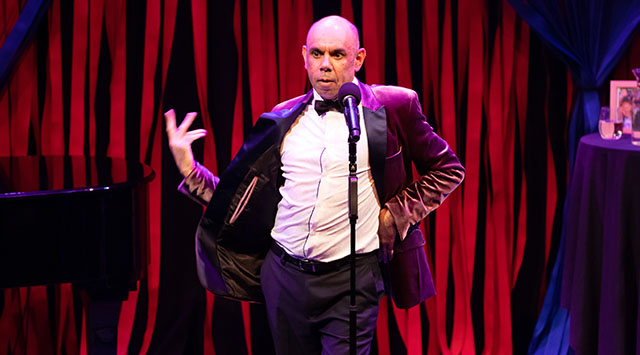
Review: Lady Tabouli (National Theatre of Parramatta)

Venue: Riverside Theatres (Parramatta NSW), Jan 9 – 18, 2020
Playwright: James Elazzi
Director: Dino Dimitriadis
Cast: Nisrine Amine, Deborah Galanos, Antony Makhlouf, Johnny Nasser
Images by Robert Catto

Theatre review
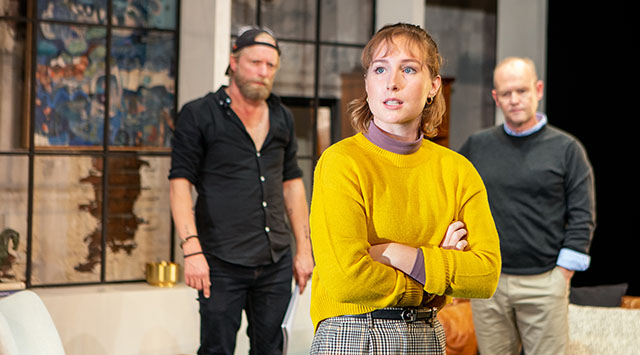
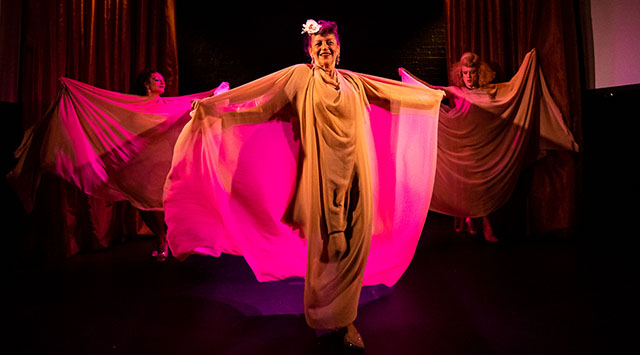
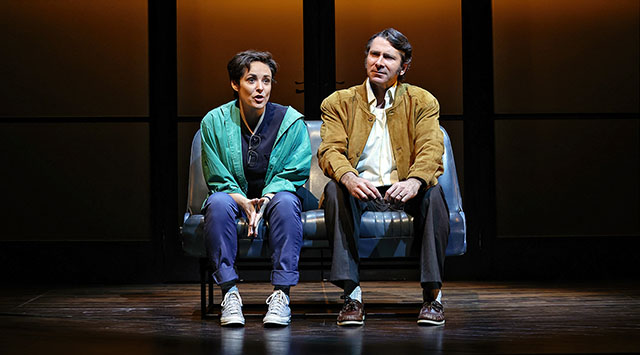
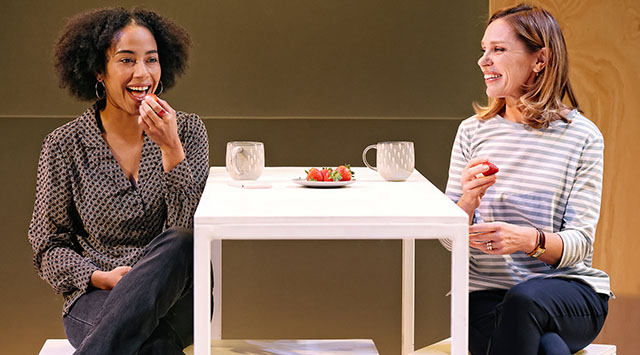
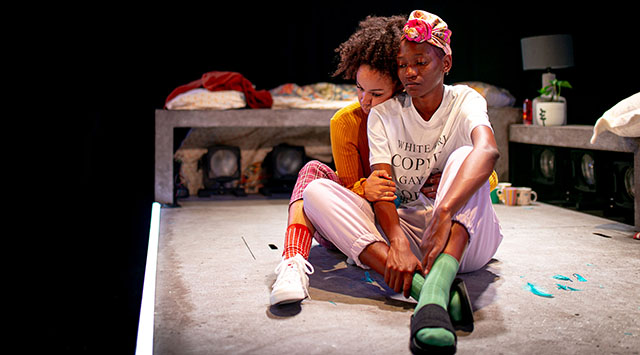
Danny is compliant and cheerful, as he lends a hand to his sister Josephine, who is causing a frenzy at home, preparing for her son’s christening. They are modern day Lebanese-Australians, very much a part of mainstream contemporary life, but not without their own traditions, as is common amongst minority groups. In James Elazzi’s Lady Tabouli, we celebrate the uniqueness of that cultural heritage, but together with everything good that contributes to the diverse tapestry defining our experience of identity on this land, comes a regressiveness determined to oppress the same people who wish to preserve those values.

As the hour draws close for the big event, in the midst of a lot of spirited hullabaloo, Danny decides to come out of the closet. The incongruity of sensibilities in Lady Tabouli, of a man revealing his true self whilst his family attempts to enact the most symbolic of ceremonies, forces us to acknowledge the complexities of our multiculturalism, especially in terms of LGBTQI issues, and how Australia must look beyond legislation to address the prejudice inherent in so much of our cultural practice. Gayness may no longer be illegal, but in so much of Australian society, gay people continue to be shunned.

Elazzi’s writing is powerful and passionate. Its incisive honesty provides an urgency that grips us, having us invested in the family’s story, regardless of where we stand in relation to its arguments. An abrupt conclusion however, suggests that more could be explored, even if we do appreciate the ambiguity pertaining to Danny’s subsequent developments. Directed by Dino Dimitriadis, the work is mesmerising when emotions run high. Early scenes are appropriately manic, but its humour never really takes flight. When things turn serious is when the magic happens. There is a depth to the way its characters and narrative are presented that absolutely captivates, alongside a sorrow that sings with disarming authenticity, of rejection and of loss.

That melancholy is exhaustively manufactured by the formidable partnership of Benjamin Brockman’s lights and Ben Pierpoint’s sounds, both elements hellbent on having our emotions respond with intense empathy. The show begins in the kitchen, depicted by production designer Jonathan Hindmarsh with middle class respectability, prosperous but ordinary, that transforms into the proverbial good room, where a more idiosyncratic notion of selfhood can be expressed.

Actor Antony Makhlouf is a compelling Danny, accurate in his portrayal of frustrated despondency, for a young man caught between two worlds. His mother is played by Deborah Galanos, a big presence bringing resonance to themes of piety and control, in a story about emancipation and freedom. Josephine the overbearing sister, is made scintillating by an exuberant Nisrine Amine, and Johnny Nasser is wonderfully nuanced in dual roles, adding intriguing texture to the show.

We have always tried to exercise control over nature, whether using commerce as a form of logic to plunder earthly resources, or to obliterate the most beautiful of human connections in the name of religion. We constantly position ourselves above, interpreting our variety of intelligence as solution for what we deem to be chaos in the world. More than ever before, we can see clearly that rather than being able to achieve order, what we do best is destruction. In pessimistic times, it is hard to talk about growth and progress, but our capacity for evil becomes painfully comprehensible.

www.riversideparramatta.com.au/NTofP

Review: Black Ties (Ilbijerri Theatre Company / Te Rēhia Theatre)

Venue: Sydney Town Hall (Sydney NSW), Jan 10 – 18, 2020
Playwright: John Harvey, Tainui Tukiwaho
Director: Rachael Maza, Tainui Tukiwaho
Cast: Brendan Boney, Jack Charles, Mark Coles Smith, Mayella Dewis, Lana Garland, Laughton Kora, Tawhirangi Macpherson, Lisa Maza, Tuakoi Ohia, Brady Peeti, Tainui Tukiwaho, Dalara Williams, Dion Williams
Images by Luke Currie-Richardson

Theatre review
Love is in the air, but Hera is a Māori woman and Kane an Aboriginal man, each with strong connections to their respective families and lands. When the pair decide to marry, the place at which they choose to settle down, becomes a matter of serious contention for all their kin. As colonised peoples, Hera and Kane’s relations take with utmost seriousness, the manner in which their roots are to be planted. Each group is determined to maintain its own bloodline, and from the many conflicts that soon arise, it would appear that love may not conquer all so easily.

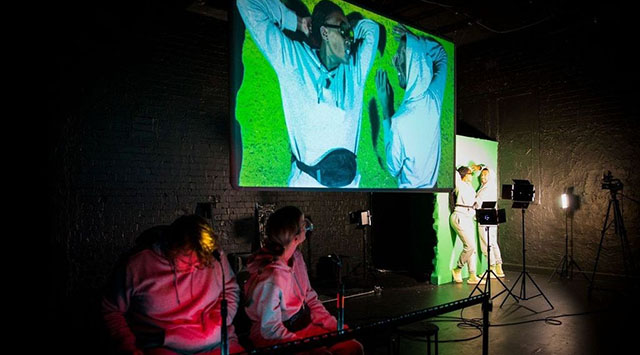
Black Ties by John Harvey and Tainui Tukiwaho tackles meaningful subjects, but does so with glorious humour. The play is endlessly amusing, impressive in its ability to balance serious with silly, for an experience that is at once poignant and hilarious. Directed by Rachel Maza and Tukiwaho, the production has a tendency to feel somewhat haphazard, but the enormity of its ambition is truly remarkable. Jacob Nash’s set design is a huge undertaking that thrills us with its capacity to surprise, effectively assisted by James Henry’s video projections that move us quickly between New Zealand and Melbourne. Live music by Brendon Boney, Mayella Dewis and Laughton Kora is consistently delightful, and a real highlight of the presentation.

Performers Mark Coles Smith and Tuakoi Ohia are the adoring couple, both very likeable, and appropriately wholesome in their depiction of the young innocents. Scene stealers include Jack Charles and Brady Peeti, who bring exquisite timing and captivating presences to this staging. Lana Garland and Lisa Maza play maternal roles, each one as strong and commanding as the other. Playwright and director Tukiwaho proves himself a compelling comic, delivering a great number of laughs as Hera’s oafish father.

We can hold firm to our cultural identities, but there must always be room for evolution and compromise. Thinking about our ancestors as monolithic is unhelpful and probably inaccurate. Allowing ourselves to progress with the times, in a manner decided upon by ourselves, and not by colonisers, is a realistic way of retaining valuable aspects of our heritage. Our only option is to adapt, and to trust in the fact that after centuries of diasporas and imperialism, we are still here.

www.ilbijerri.com.au | www.terehiatheatre.com

Review: Black Cockatoo (Ensemble Theatre)

Venue: Ensemble Theatre (Kirribilli NSW), Jan 4 – Feb 8, 2020 | Riverside Theatres (Parramatta NSW), Feb 18 – 22, 2020
Playwright: Geoffrey Atherden
Director: Wesley Enoch
Cast: Joseph Althouse, Luke Carroll, Chenoa Deemal, Aaron McGrath, Colin Smith, Dubs Yunupingu
Images by Prudence Upton

Theatre review
When Johnny ‘Unaarrimin’ Mullagh went to England in 1868 as part of Australia’s ‘First XI’, he probably never expected to become our first international cricket star. A century and a half later, his descendants probably never expected that the legend would today be so easily forgotten. Black Cockatoo by Geoffrey Atherden reintroduces the historical figure as a true Indigenous trailblazer, an Aboriginal example of black excellence that the white patriarchy of our sporting arenas seems so determined to wipe away from memory. The play has a tendency to feel overly wholesome, as though sanitised for public consumption, but its importance as cultural emblem cannot be understated.

Directed by Wesley Enoch, the show is a sincere and tender proclamation, paying tribute to Indigenous identities past and present. The complexity of black experiences as colonised peoples, is meaningfully, albeit politely, portrayed in Black Cockatoo. We see our protagonist in a state of conflict, able to recognise his privilege as star on the field, but never ignorant of injustices that befall himself and those he considers his community.

Set design by Richard Roberts establishes elegance for the production’s overall visual aesthetic, but requires greater versatility to help us imagine dramatic shifts in time and place. Lights by Trent Suidgeest and music by Steve Francis are sensitively rendered, both proving effective in conveying poignancy for the piece.

Actor Aaron McGrath is full of charm as Mullagh, dignified and beautifully nuanced in his depiction of a true blue hero. Black Cockatoo‘s narrative does not offer very much that is emotional or surprising, but McGrath makes us fall for the central character effortlessly. In the role of Lady Bardwell is the noteworthy Chenoa Deemal, who brings to the stage an august presence. Also impressive is Colin Smith as coach of the team, remarkably convincing as an ethically dubious Charles Lawrence.

Our Indigenous continue to have to navigate the absurdity of being seen as exotic on their own land. The ‘First XI’ went to England to play cricket, but often found themselves perceived as a circus act, a curiosity that robbed them of their humanity, a persisting strategy that provides legitimacy to mistreatment at the hands of colonisers. We need to hear the voices of minorities, because an understanding of their autonomy is fundamental to the betterment of all our lives. We no longer want our stories told by others. We want the right to talk about ourselves, whether or not the others are willing to listen.

www.ensemble.com.au

Review: Meet Me In St. Louis (New Theatre)

Venue: New Theatre (Newtown NSW), Dec 17 – 21, 2019
Book: Hugh Wheeler
Songs: Ralph Blane, Hugh Martin
Director: Matt Hourigan
Cast: Denzel Bruhn, Jayden Castle, Phoebe Clark, Sinead Cristaudo, Lana Domeney, Grace Driscoll, Lincoln Elliott, Amy Humphreys, Claudia Joller, Katelin Koprevic, Victoria Luxton, Alexis O’Donnell, Jared Palessen, Matthew Predny, Oliver Roach, Caitlin Shannon-Duhigg, Jerome Studdy, Andrew Symes

Theatre review
Young Esther is in love with John, the boy next door, but her family is set to move to New York as a result of her father’s recent promotion at work. It is clearly not the story of Meet Me In St. Louis that captivates, but its celebrated songs that we connect with. Based on the legendary 1944 film, this is a musical production of the most traditional kind, that holds special appeal for audiences of a conservative vein. There is nothing unpredictable or original here, only an abundance of nostalgia that many will no doubt find satisfying.

Matt Hourigan directs and choreographs, displaying considerable theatrical flair, although use of space can be more inventive. The band can sound somewhat distant, but music direction by Oscar Balle-Bowness remains a delight. Visual elements are adequately assembled, to help us imagine America at the dawn of the previous century. Performers look, comically, either too old or too young for their roles, but the quality of singing is consistently high, with leads Phoebe Clark and Matthew Predny leaving strong impressions with their vocal abilities.

“Have Yourself a Merry Little Christmas” has since become one of the most popular songs of the festive season. A deeply melancholic lyric that wistfully harks back to an idealistic past, “once again as in olden days, happy golden days of yore,” overzealous with the trust we place on old memories, and the frankly strange belief that things always used to be better, back in the day. The truth is that we have progressed in many ways, and although life is never without its challenges, to yearn for anything that might involve a regression of our existences, is simply unwise.

www.facebook.com/starkeeperproductions/

5 Questions with Nisrine Amine and Antony Makhlouf

Nisrine Amine

Antony Makhlouf: You play Josephine in Lady Tabouli, how would you describe her?
Nisrine Amine: She’s a handful. Lol. She is a strong woman, with a hard set of beliefs. Quite stubborn. But with a deep faith and loyalty to family. She is almost like the burghul (wheat) in a bowl of tabouli – a little hard on the teeth yet necessary for the salad to come together. She’s quite different to characters I’ve played in the past; not immediately likeable but you definitely grow to understand her as the play goes on. And that’s the main thing with characters on stage – not that we like them but that we can understand them.

Who is Lady Tabouli?
In the first iteration of the play (at Griffin Theatre as part of Batch Festival), Lady Tabouli was very clearly Danny’s alter ego; she was a vibrant and free sense of self that he was so desperately wanting, but struggling, to become. In this new version of the play, I think she is more elusive than that – she is up to individual interpretation and maybe sits somewhere between convention and progression? Shackles and freedom? She is the clash of culture and individuality; group identity and personal truth. Maybe I’ll have a better answer for you once she comes to life in January.

What are your thoughts on the “other” Lebanese salad, fattoush?
Oooo, I am a big fan. I like a good ‘crunch’ in my food. And we all know a good fattoush has some serious bread crunch game happening. So I think I might take a bowl of that over tabouli. Oh no, I have blasphemed. Alas.

Who’s your favourite character in the play?
I dunno but (director) Dino’s is ‘the heat’. (You’ll know when you watch).

So you’re directing James Elazzi’s Son of Byblos for Belvoir 25A next year. What are you looking forward to the most about this experience?
All of it! It’s going to be surreal moving ‘behind the scenes’ for one of James’ works (all of my connections with his work up to now has been as ‘actor’). There’s definitely going to be (self-imposed) pressure to continue Dino’s great directing work on a piece of Elazzi writing, but I’m up for the challenge. The main thing I’m looking forward to, in all honesty, is working with my actors. I am soooo eager to get into that rehearsal room and start building character and relationships. And to help lead the actors to beautiful and truthful moments.

Antony Makhlouf

Nisrine Amine: How similar are you and your character of Danny?
Antony Makhlouf: The similarities of Danny and I is that we’re both Australian-Lebanese men who need to balance two separate cultures. Despite the tug-of-war effect this can have at times, I love sitting within two cultures for it provides me with an insight into two worlds. This has broadened my outlook and enriched my understanding of people. I like to think I’ve created a hybrid culture of my own. Whereas with Danny, his circumstance does not afford him the space to do the same. Instead he needs to be ruthless in his pursuit of self-determination. This is where our similarities end.

What’s your favourite part about the rehearsal process?
I love those moments when you crack the scene open and the words on the page, that you’ve been reading for a while, come to a new and bigger meaning.

What mark are you hoping this play will make on the Sydney theatre scene?
Foremost, I hope Lady Tabouli draws in the people that it depicts. Don’t get me wrong, the play is open to all audiences, however there are members of the community that will see themselves on the stage and benefit from that experience. In Lady Tabouli’s preliminary version at Griffin Theatre’s Batch Festival, a large chunk of our audiences were just that, and the response was real and overwhelming. There is something very special and powerful about this work. It transcends the theatre and offers a release I believe certain marginalised communities are craving to experience. Thus, and with all respect, I am more interested in talking and affecting those people, above anything else.

What’s the key to the perfect bowl of tabouli?
You should probably ask my mum that one. But, I do love tabouli that is a day old – the flavours really settle in by then. Refrigerate overnight and then eat it with warm Lebanese bread.

Where to from here?
After Lady Tabouli, I finish filming season four of Get Arty. I also want to get cracking on creating a new collection of art prints. And I hope to continue to develop and grow as a performer, so a short course overseas somewhere is on the cards.

Nisrine Amine and Antony Makhlouf can be seen in Lady Tabouli by James Elazzi.
Dates: 9 – 18 Jan, 2020
Venue: Riverside

Review: Blue Christmas (New Ghosts Theatre Company)


Venue: Kings Cross Theatre (Kings Cross NSW), Dec 11 – 22, 2019
Images by Clare Hawley

Good People
Playwright: Katy Warner
Director: Lucy Clements
Cast: Clementine Anderson, Laura Djanegara, Sasha Dyer, Chika Ikogwe, Jane Watt, Emma Wright

Shandy’s Corner
Playwright: Gretel Vella
Director: Lucy Clements
Cast: Clementine Anderson, Meg Clarke, Laura Djanegara, Harriet Gordon-Anderson, Zoe Jensen, Vaishnavi Suryaprakash

Theatre review
It is Christmas time, when things come to a boiling point for two groups of women. In Katy Warner’s Good People, old friends have their holiday in Indonesia cut short by a state of emergency, as violence breaks out and tourists are corralled and confined to an airport. These Australians have witnessed the true face of poverty, and are now confronting the brutal implications of their privileged first world lives. Shandy’s Corner by Gretel Vella takes place in a women’s shelter, in first world Australia, where the consequences of our patriarchal systems are on full display, with broken individuals trying to regain their agency and a sense of dignity.

Both hour-long works are sensitively written and immensely contemplative, offering valuable perspectives on the kinds of lives we currently inhabit. Directed by Lucy Clements, the double-bill presentation grips from start to end. Good People is provocative, able to instigate meaningful conversations, while Shandy’s Corner is fabulously entertaining, with a dark humour that proves deeply satisfying. Clements injects an infectious passion into every scene, for a theatre that communicates with efficacious power.

An excellent impression is left by a very strong and cohesive cast, remarkably engaging in their delivery of two ensemble pieces, with not a single weak link. Clementine Anderson and Laura Djanegara perform in both stories, taking the opportunity to demonstrate versatility, but are especially memorable in Shandy’s Corner for their compelling portrayals of women overcoming adversity in wildly different ways. Harriet Gordon-Anderson and Emma Wright bring complex characterisations and excellent drama to the staging, intense with the emotions they convey. Funny ladies Meg Clarke and Zoe Jensen are thoroughly enjoyable in comedic roles, each actor with approaches as bold as their imaginations.

It is appropriate that the Christmas message here relates to the inherent injustices of our way of life. To respond to these plays, we can do no better than to think, “what would Jesus do?” in the face of these man-made tragedies. Christianity proclaims to be about caring for the poor and the oppressed, as it preaches in Proverbs 31:8-9, to “speak up for those who cannot speak for themselves, for the rights of all who are destitute. Speak up and judge fairly; defend the rights of the poor and needy.” When we look around us, there is little that can be construed as holy, but good art remains, and it is eternally sacred.

www.newghoststheatre.com

Review: The Last Days Of Judas Iscariot (Gamut Theatre Co)

Venue: Darlo Drama (Darlinghurst NSW), Dec 8 – 17, 2019
Playwright: Stephen Adly Guirgis
Director: Glen Hamilton
Cast: Edgar Antonio Atienza, Nicole Florio, David Hodgkins, Melinda Jensen, Erica Nelson, Stephanie Reeves, Hugo Schlanger, James Sugrue, Paula Williams, Mark J. Wilson
Images by Craig O’Regan

Theatre review
Cunningham is a lawyer in the celestial realm, working hard to get Judas out of hell. The courtroom in Stephen Adly Guirgis’ The Last Days Of Judas Iscariot, is situated in purgatory, where all things are undecided, and fates can be reversed. Themes of betrayal and regret feature prominently in this Christian story, as we imagine the fallout after Judas’ deathly kiss. It is a humorous piece, although never sacrilegious and consequently predictable, with its meditations on the ancient narrative.

Directed by Glen Hamilton, the production is faithful to Guirgis’ writing style, playful but also searingly earnest. Some scenes pack more punch than others, for a show that struggles to be consistently engaging. An ensemble of eleven take on twenty-seven roles, with varying levels of effectiveness. Stronger performers include Melinda Jensen and Stephanie Reeves, particularly memorable for their moments in drag, playing Pontius Pilate and Caiaphas the Elder respectively, both suddenly powerful with their interpretations of fossilised men.

A scene involving Cunningham in a fiery exchange with Satan, is a stand out, with actors Erica Nelson and Nicole Florio bringing vigour and authenticity to the play’s climax. James Sugrue is somewhat hesitant as Judas, but leaves a good impression with his exacting portrayal of Sigmund Freud.

However we might choose to think of Judas, has no bearing on the man himself, and can only ever be a reflection of how we regard our own lives. We rely on religion to help us turn chaos into order, so that a semblance of peace can be attained, for few of us can bear to look reality squarely in its eye. Villains allow us to think of ourselves as good, so that we may walk the earth with resilience and fortitude, but to be able to see fallibility in the self is emancipatory, and necessary in finding the capacity to love.

www.judasplay.com

Review: The Split (The Old 505 Theatre)

Venue: The Old 505 Theatre (Newtown NSW), Dec 3 – 14, 2019
Playwright: Sarah Hamilton
Director: Charley Sanders
Cast: Amy Victoria Brooks, Max Garcia-Underwood

Theatre review
We are with Jules and Tom are on a small boat, where for several days and nights, they have isolated themselves to sort out an unspeakable problem. It must be a difficult one because we see them evading the issue, indulging instead in a lot of mundane chat and frivolous activity, leaving their purpose ignored in the background.

Sarah Hamilton’s The Split demonstrates what it is like, when things are too hard to deal with, especially if they relate to matters of the heart. The work is keenly observed, although its unrelenting sense of wistfulness can prove a challenge for the 90-minute duration. The couple is in a state of fragility, and we watch them unable to access anything that might fracture their emotional equilibrium, resulting in a play that stays too much in a delicate space, refusing to deliver a more obvious drama, or comedy, that would sustain our interest.

Performers in The Split are beautifully focused, very confident and precise with their respective portrayals. Amy Victoria Brooks and Max Garcia-Underwood may not deliver convincing sizzle as lovers, but both actors bring a valuable depth to their characters, able to convey authenticity for every scene. Director Charley Sanders’ storytelling is honest, but the production is too subdued in approach, and as a consequence, insufficiently engaging. Lights and video projections by Kobe Donaldson contribute some visual appeal to the staging, although atmosphere could be further enhanced to complement the writing’s sensual melancholy.

Life is hard; all we can do is to give it our best shot. As we watch Jules and Tom fail at what they had set out to achieve, we examine the way people deal with painful situations, in the understanding that it is the very nature of pain, that makes us run away from what we acknowledge needs to be addressed. The two take it slow, waiting for the ache to subside, so that they can finally arrive at a moment of confrontation that both know to be necessary. Not everything can be ripped off like a band aid. We learn that some things deserve the luxury of time, even if everything in this moment, does feel like a real state of emergency.

www.houseofsand.org

5 Questions with Chika Ikogwe and Vaishnavi Suryaprakash

Chika Ikogwe

Vaishnavi Suryaprakash: If you could use your acting platform to change one thing about the Australian performance scene, what would it be?
Chika Ikogwe: I would love to see a more diverse and inclusive industry here in Australia. I know there are a lot of people that are tired of hearing this, and even people that believe that the pendulum has swung so far, that now the industry only favours diversity. Which is just completely false. The majority of work on stage and screen still majorly lacks First Nations people, People of Colour and minorities in general. And there’s also a lack of stories that are being created / written by people from these minority groups. I absolutely acknowledge the amazing work and the great strides that have been made in the last few years to create a more diverse and inclusive industry, but there’s so much more work to be done on that front. I just want to see the Australia that I see as I walk down the street, as I catch the bus and as I do my grocery shopping, being reflected on stage and screen here in Australia. That’s what I’d change ¯\_(ツ)_/¯

What has it been like growing up with the name “Chika Ikogwe”?
It has changed a lot over time. When I was younger, there were times when I absolutely hated my name, and wished I was called something else. I distinctly remember my first day of prep when the teacher called out my name on the roll, and all the kids just burst into laughter because for some reason they found my name so funny. One kid even yelled out ‘Chicken! Her name is chicken!’ That was the first time in my life I’d felt any kind of shame regarding my name. Then there’ve been other times when I’ve done over-the-phone job interviews, secured the job and have been greeted with perplexed facial expressions on my first day of work. Turns out some people don’t know Chika is also a Nigerian name. There’s been so much I’ve lost out on because of my name, but to balance that so much I’ve gained. Life is just funny like that though, and I kinda love it. It gives character. I wouldn’t trade my name for anything else… Except maybe Beyoncé?! Just kidding. I think…

What do you most love about the character you play in Good People?
Jess is an actor and she takes her best pals on a holiday so they can reunite and just, like, hang out?! That’s awesome and I hope one day I can do that with my friends. #Goals.

When you think about the vastness and contents of the universe, how do you feel?
Bruh, I feel a LOT. Sometimes I feel super overwhelmed at the fact that there’s so much out there that we don’t even know about. Sometimes I feel like I can do anything, and the world really is my oyster. Sometimes I feel incredibly small. Sometimes I wonder if the world’s richest people congregate monthly to discuss their plans to leave everyone on Earth behind to start a new life on Mars or Europa or something. Sometimes I wonder if Beyoncé remembers me from that one time we locked eyes at her concert back in 2013 (probably not, but I’ll keep lying to myself). Sometimes I ask myself, “Who the hell let Donald Trump, Scott Morrison and Boris Johnson occupy any kind of political space, AT THE SAME TIME?!” I feel many feels. 

Who’s your favourite tennis player and why?
The Williams sisters are my forever Queens. Particularly Serena Williams. I played tennis for about 6 years growing up, and Serena was one of the only players I could identify with. Not only was she a black woman, but she also had broad shoulders and a muscular build amongst players that were mostly tall, white and skinny. She played with such force and passion. I remember wanting to be just like her when I grew up. She made me feel so seen and inspired me so much. 

Vaishnavi Suryaprakash

Chika Ikogwe: If you could use your acting platform to change one thing about the Australian performance scene, what would it be?
Vaishnavi Suryaprakash: I would get more young people from CALD backgrounds involved in theatre and performance art. I want an artistic career path to be contemplated by more of these children, and for them to feel encouraged to create art.
 
What’s the worst Christmas present you’ve ever received?
I actually can’t remember – nothing stands out! I think I’ve been pretty lucky. On a related note, I think Harry Potter’s worst Christmas present would be the tissue from the Dursleys (yes, I am currently re-reading Harry Potter, how did you know). Though I have often wondered how they sent their presents to Harry. Does Hedwig turn up every year a few days before Christmas? How do they know the reason she has turned up? How come they give Harry Christmas presents, but never birthday presents?
 
If your character in Shandy’s Corner had a catch phrase, what would it be?
“A lady never discusses the size of her yarn stash.”
 
You win a million dollars. What are the first 3 things you spend the money on? 
The very thought makes me stress out… so let me tell you instead what I love to buy: good quality tea, books (a guilty habit because libraries exist!), and hiking gear (ooh nothing beats the feeling of the perfect supportive backpack resting on your shoulders…)
 
Which actor would you cast to play “Vaishnavi Suryaprakash” in your biopic? 
Definitely Scarlett Johansson. 

Chika Ikogwe and Vaishnavi Suryaprakash can be seen in Blue Christmas, a double bill featuring two new Australian plays, by Katy Warner and Gretel Vella.
Dates: 11 – 22 Dec, 2019
Venue: Kings Cross Theatre

Review: Krapp’s Last Tape (Red Line Productions)

Venue: Old Fitzroy Theatre (Woolloomooloo NSW), Nov 26 – Dec 14, 2019
Playwright: Samuel Beckett
Director: Gale Edwards
Cast: Jonathan Biggins
Images by John Marmaras

Theatre review
Another grumpy old man takes to the stage in Samuel Beckett’s Krapp’s Last Tape. He brings along a sense of confusion, perhaps disillusioned and defeated by a world that never lived up to its promises. A wall of filing cabinets containing a lifetime of voice recordings that he has made, an ongoing project representing a memoir that is both self-important, and self derisive. Indeed, it charts the man’s ageing process, from idealistic to despondent, as we find him in a state of decrepitude.

Most of the show involves Krapp listening to his tape machine, playing a collection of narrations that could only ever mean more to him than to anyone else. We observe past and present converge as he sits attentive to his personal oral history. Directed by Gale Edwards, the staging bears an affecting melancholy, with Veronique Benett’s lights and Brian Thomson’s set design providing just the right ennui. Actor Jonathan Biggins is confident and a sturdy presence, able to convey degrees of regret for a role that seems to be about little besides. He provides a charming wistfulness that translates as a sort of gentle comedy, more likely to elicit empathy than it would laughter.

Krapp looks back in anger and in pain, making us wonder about the way we regard the past, as it relates to today and tomorrow. On the occasion of his 69th birthday, he demonstrates that the older we get, the less we are able to be buoyed by the future. The anguish he experiences, as he hits playback on the tape, is a result of poor choices and bad luck. Decisions can be made every which way; right, wrong, indeterminate, bearing in mind that regret is valuable only as a concept for future use.

www.redlineproductions.com.au