Certain Men (Encyclopaedia Of Animals)

322708_439295692788974_1011700878_o.jpg  1000×667Venue: Bondi Pavilion Theatre (Bondi NSW), Jul 26-27
Director: Christopher Brown
Actors: Brian Davison, Michael Gwynne, Tamblyn Lord

Theatre review
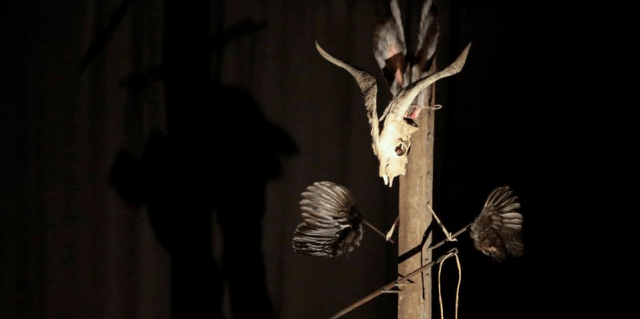
The audience is seated in a big circle, all facing inwards. The room is large, with no specific focal point and no stage. The actors constantly move around the space, and the audience finds itself in the midst of all the action, almost an intruder into the intimate setting, where three middle-aged men meet for a group therapy of sorts. This is a play about the issues that these men face, and the difficulty in expressing and articulating those issues. Certain Men is fascinating in its theatrical form, which aligns itself with psychological treatments that seek to deconstruct patterns and convention, in order to reach a breakthrough point of enlightenment.

The chemistry between the players feels solid, but the characters do not communicate well with each other. They talk about themselves, play lego, clean windows, sing, rap and dance; they try but do not form a strong connection. What takes place in this work is abstract and makes for challenging viewing, but it feels like witnessing real life. A sadness permeates these beings, and we get hints of their individual stories, but the main concern here are questions and not answers. Perhaps the intent of their therapy is only to ask, and not to conclude. In its artistic form, Certain Men seeks to create its own language. While not instantly gratifying, it is a commendable and necessary development away from theatre that is facile and obsolete, moving towards something fresh and intelligent.
www.encyclopaediaofanimals.net

Short Plays #3 (Tamarama Rock Surfers)

1010847_607684252597522_1882182589_n.jpg  960×640Venue: Bondi Pavilion Theatre (Bondi NSW), Jul 19 & 26
Playwrights: Kate Mulvany, Finegen Kruckmeyer, Kit Brookman, Phillip Kavanagh
Directors: John Kachoyan, Jessica Tuckwell, Pierce Wilcox, Jo Turner
Actors: Akos Armont, Danielle King, Yalin Ozucelik, Huw McKinnon, Joshua Anderson, Jonny Pasvolsky, Zak Ynfante

Theatre review
When writing a play, one should think of the stage and its audience. It is good to have a story, a message, or an idea, but writing for the theatre requires awareness of the various senses that are engaged in the act of “watching a play”, and also the various disciplines involved in the collaborative nature of the theatrical arts. Feast and Heart Of Glass are two of the short plays in this collection with distinct similarities. They both feature one male actor, and a great deal of verbiage. Akos Armont and Joshua Anderson are committed actors but are left on an empty stage with nothing more than pages and pages of words. Their stories are not uninteresting, but it is a tall order to perform without involving other elements of the live stage. Unfortunately, these two works come across too much like talented actors reading out chapters from great books, but this does not deliver the best theatrical experience.

Conversely, the two other plays provide dynamism and intrigue to the evening’s proceedings. Wolf imagines the last moments in the life of the boy who cried wolf.  Jonny Pasvolsky plays the wolf (in human form) with great confidence and delicious cunning. The showman delivers an entertaining yet dark performance, positioning himself somewhere between menace and comedy, while cleverly avoiding unpleasant territory in the presence of a child actor.

The Last Bell exploits the short form perfectly, Tension and intrigue is skilfully maintained throughout the piece, with the actors keeping their audience at the edge of its seat. Yalin Ozucelik’s enigmatic gravitas grounds the play. It is his character’s impending doom which is at the centre of the story, and he conveys powerfully that state of being with a minimum of words and movement. Kate Mulvany’s script bears a narrative structure that is thoughtfully designed, able to create dramatic impact without explicit details of horror, and emotional tangibility without being tediously sentimental. Really enjoyable theatre in the mystery/thriller genre.

www.bondifeast.com.au

I’m Not Pale, I’m Dead (Lydia Nicholson)

Im_Not_Pale_cropped.jpg  810×540Venue: Bondi Pavilion Theatre (Bondi NSW), Jul 26-27
Playwright: Lydia Nicholson
Actor: Lydia Nicholson

Theatre review
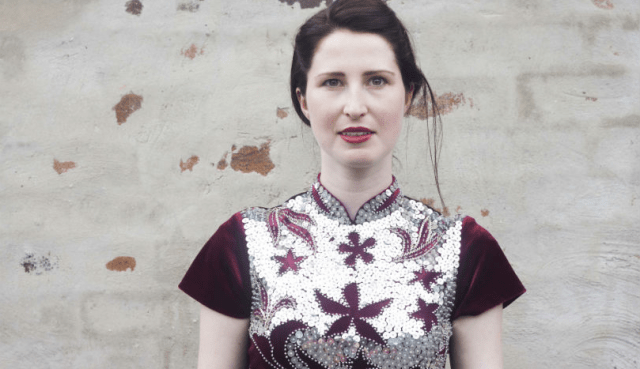
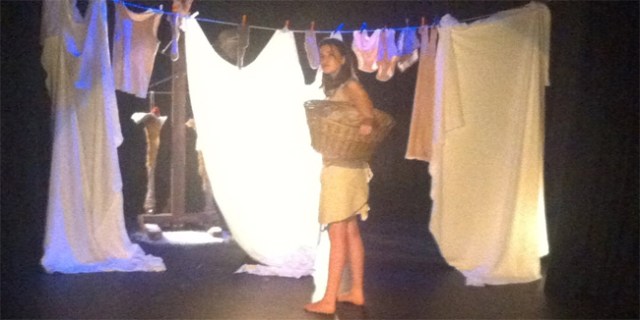
Lydia Nicholson is a ghost in I’m Not Pale, I’m Dead. She tells us what it’s like being dead, and what she misses about being alive. This is a simple premise, but one which provides the perfect starting point to our immortal quest for the meaning of life. Of course, there are elements in this 50 minute work that are deadly serious, but Nicholson is careful to pepper comic elements from start to finish. The contrast between the lighthearted sections and the melancholic moments gives the piece delightful texture and unpredictability. Along with its life and death “big messages”, the script is a thoroughly enjoyable and deeply moving one. The material here is wonderful, and the universality of its themes gives the script great potential to travel far and wide.

Nicholson addresses her audience directly, playing a guide of sorts to the newly-dead, only to discover that we are in fact still alive and that she is being presented with a rare opportunity to communicate with the living. As with most cases where “audience participation” is involved, a sense of ticklish glee is created, and Nicholson uses this dynamic well, keeping her audience on its toes, and establishing a good rapport from very early on. She is however, best at performing the sadder aspects of the story, especially in the passages that explore the longing she feels for the living. The intensity of that sadness is palpable, and incredibly touching.

www.bondifeast.com.au/…

Moving Parts (Will O_Rourke)

Colin-FrielsVenue: NIDA Parade Theatres (Kensington NSW), Jul 25 – Aug 10, 2013
Playwright: David Nobay
Director: Steve Rogers
Actors: Colin Friels, Josh McConville

Theatre review
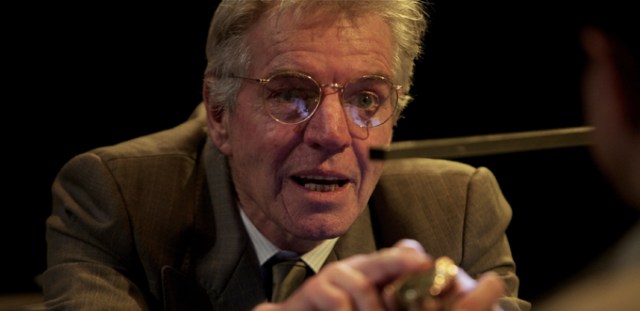
Moving Parts begins with the image of a lonely old man in a small but upscale watch dealership. Intrigue quickly follows when a second, younger man comes into the picture enquiring about a very large, expensive watch. A strange tension permeates from the start in this seemingly mundane scenario, and the audience is drawn into its irresistible allure. Soon, a series of revelations appear like little explosions, producing sequences that surprise not only with the trajectories of its narrative but also with the emotional depths it explores. This is a story about family dysfunction and love, told in the most honest way through two white male characters. The process of deconstructing these apathetic, unemotional archetypes involves the transgression of fundamental truths in family dynamics, resulting in a level of intense emotionality that any theatre-goer would relish.

Technical aspects of the production are highly accomplished. Every aspect is rendered virtually imperceptible to be in service to the actors and the story. Lighting design in particular is sensitive and meaningful, never drawing focus unto itself but always effectively assisting with the emotional fluctuations of the narrative.

Josh McConville plays Sean, with great internal fortitude. His depiction of a damaged, insecure man at the end of his tether is easily recognisable and indeed, heartbreaking. Even without the benefit of a filmic close-up, the audience is able to witness through his eyes, the inner devastation from which his character suffers.

One cannot overemphasize Colin Friels’ brilliance in the role of Roy. The psychological complexity that he brings to this man, is the crux of the show. All the contradictions of being human, and all the difficulty of life itself is displayed in his very corporeality. His mental jostles in dealing with the meaning of love, fleshes out for the audience the core concern of the script. Friels surprises with the amount of physical activity he introduces into his work, embellishing his lines with so much attention to gestural detail, which not only is a tremendous joy to watch but also amplifies beautifully the emotive qualities of the play.

In spite of a somewhat rushed and unexpected conclusion, Moving Parts is a great work that investigates the universal theme of family ties deeply and truthfully. Steve Rogers’ direction and David Nobay’s writing is a potent combination, creating theatre that is passionate and enthralling. Along with the best actors in the business, they have on their hands, something very memorable and actually, very moving.

www.willorourke.com

Short Plays #1 (Tamarama Rock Surfers)

shorts1Venue: Bondi Pavilion Theatre (Bondi NSW), Jul 17 & 24
Playwrights: Jessica Tuckwell, Chris Summers, Mark Rogers, Nakkiah Lui
Directors: Kate Gaul, Corey McMahon, Phil Spencer, Matilda Ridgway
Actors: Sandie Eldridge, Lorna Munro, Huw McKinnon, Madeleine Levins, Simon Corfield
Image from Facebook

Theatre review
Four plays with different themes, styles and ideas, all with its own appeal. The opportunities a short play presents is manifold, but chiefly, it allows for the exploration of a single idea with minimal distraction from sub-plots, secondary characters and other auxiliary elements.

Dessert is a macabre story about marriage and death. Sandie Eldridge’s performance of a middle-aged widow impressively positions the play in a delusional psychological space but carefully presents her character with empathy and sadness.  The balance between shock value and sensitivity in this work is exquisite.Washer Woman also features a lone female character. Jessica Tuckwell’s script is poetic and abstract, and Madeleine Levins brings to the piece enough tension and drama to create a semblance of narrative to keep its audience engaged.

The Buck tackles mateship and Aussie bloke culture. The piece creates a formidable air of violence in the theatre, effectively focussing on the dark side to contemporary Australian lives. Similarly working with danger and brutality is Ideginaiety, which presents a harrowing perspective of revenge and colonialism. This is an interesting exploration into indigenous culture through a prism of metaphysicality and crime. The structure of the script and the brave choices it makes is original and powerful, and definitely warrants an extended rendering.

www.bondifeast.com.au

Siberian Hot Toddy (Siberian Hot Tododians)

toddyVenue: Bondi Pavilion Theatre (Bondi NSW), Jul 24-25
Playwright: Cait Harris with cast improvisations
Director: Cait Harris
Actors: Cait Harris, Libby Ahearn, Mark Sutton, Tiffany Hulm

Theatre review
A small group of funny performers, presumably friends, come together to make people laugh. This might sound like the simplest of propositions, but not only has Cait Harris been able to have her crew commit to this project with minimal resources and get it included in the Bondi Feast festival programme, they have devised a modern absurdist comedy that is truly hilarious. It only takes a minute or two before the audience recognises the group’s style of humour, and laughter starts. Ranging from ticklish giggles to raucous guffaws, every moment of this hour-long play is met with laughter. The cast’s ability to impart their daring and mindless silliness like an infectious laughter is an unusual talent. This is probably the first time a crowd finds the curling of a rodent’s tail to create a disguise for a pig, to be so side-splittingly amusing.

Mark Sutton plays three characters, all with a casual but riveting sense of fun. Along with cast member Tiffany Hulm, the “Siberian-accented” speech is well utilised if slightly politically incorrect. The female performers all present variations of “the bimbo” with glee; it must be noted that both genders are portrayed with equal stupidity. Harris plays American Bondi girl Toosh (Fanny’s best friend) who is delightfully frivolous and also charming in her innocence. Her sense of timing creates the biggest laughs, and it is her unique sense of humour that takes this crazy little show into a space where laughter conquers indiscriminately.

www.pozible.com/project/27102

The Hansard Monologues (Seymour Centre)

hansardVenue: York Theatre, Seymour Centre (Sydney NSW), Jul 23, 26 & 27
Playwright (Verbatim): Katie Pollock, Paul Daley
Director: Tim Jones
Actors: Camilla Ah Kin, Tony Llewellyn-Jones, David Roberts

Theatre review
This work encapsulates the last three years of the Australian parliament in two hours, utilising its most memorable and powerful speeches to create a series of snapshots, of political and social life in contemporary history. These are important moments that have guided recent public discourse, and as such The Hansard Monologues: A Matter Of Public Importance is a theatrical work that possesses uttermost relevance to all our lives.

Performances in the piece are thoroughly interesting. The players make different choices at different times, moving from plain matter-of-fact reading of transcripts, to mimicry of recognisable voices and gestures (Llewellyn-Jones’ take on Christopher Pyne is a crowd-pleaser), and passionate renditions of moralistic arguments. With these parliamentary speeches transformed into “scripts” for actors, the text surprises with its frequent use of highly-charged, emotive language, and how it translates so readily from a political space to a theatrical one, if in fact they are all that different. The actors must be praised for having not just a good handle on the speech rhythms of each different MP, but also for their understanding of all the material, which delivers coherence and lucidity to what is essentially a montaged creation by very clever playwrights.

Hansard presents issues that affect us, its themes concern us, and its re-enactments familiar to us all. At this crucial point in time as we approach our next federal election and become more aware of our part in the democratic process, watching this production is an incredibly intense experience, with our senses so heightened and our minds so alive. The stakes are not only high, but also irrefutably real. While some of the characters may appear bizarre, this is far from fictional stuff.

www.seymourcentre.com
www.merrigong.com.au
www.casulapowerhouse.com

This Is Beautiful (The Public Studio)

The Public StudioVenue: Tower Theatre at Malthouse (Southbank VIC), Jul 19 – Aug 3, 2013
Playwright: Ming-Zhu Hii
Director: Ming-Zhu Hii
Actors: Jing-Xuan Chan, Pier Carthew, Terry Yeboah

Theatre review
Expecting experimental work in any art form to entertain is usually a lost cause, and performance art pieces are rarely crowd-pleasers. This Is Beautiful is composed of three performers spouting endless existentialist questions about the arbitrariness of life’s big meanings. There is no obvious context, and clearly no narrative for which to situate these characters and their constant inquisitions. The small amount of movement and facial expressions they produce seem to be guided by those big questions, giving the impression that the entire 50-minute piece is about one idea.

These questions are not frivolous ones, in fact, one could argue that they are fundamental and relevant to all lives. Only problem is, you would either have already thought about them a thousand times and are quite happy to leave them behind, or they are simply of no interest to you and a night at the theatre would take a lot more than three strangers’ declarations to change your mind.

A big element of this production is the video that plays throughout, which adds dimension to the activity in the space. They provide an interesting abstraction to the repetitive themes, and are visually captivating in their own right, providing variation and colour to the austerity of what is unfolding in the flesh.

It is interesting to note that the three performers are of different ethnicities, and that it takes an experimental work of this nature for this multi-cultural amalgamation to materialise onstage. They make a beautiful picture together, creating a landscape of purity and unison. It also conjures up the notion that this combination of skin colours seems to face constant resistance in mainstream Australian narrative-based storytelling, in theatre or otherwise.

www.thepublicstudio.net

The Crucible (Melbourne Theatre Company)

Melbourne Theatre CompanyVenue: Southbank Theatre (Southbank VIC), Jun 22 – Aug 3, 2013
Playwright: Arthur Miller
Director: Sam Strong
Actors: David Wenham, Brian Lipson, Sarah Ogden, Anita Hegh

Theatre review
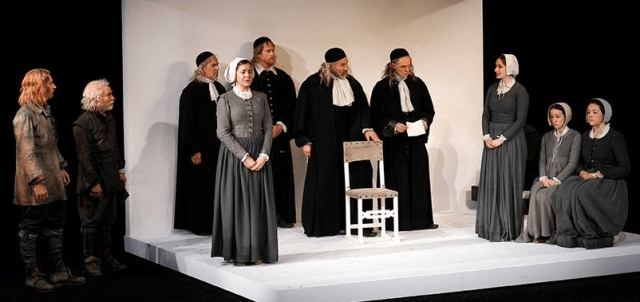
David Wenham headlines this production of The Crucible, and predictably garners widespread attention and brings good numbers into the theatre. He is adequate in the role of John Proctor, but is subsumed by the size of the stage and hall, and also by some of the more “theatrical” in the cast. Wenham is perhaps more suited for a more naturalistic setting, and on filmic close ups, but this staging of an outlandish tale in a large auditorium seems not to be the best showcase of his talents.

There are efforts in the set and lighting design to visually shrink the stage into small rooms, but while effective in that regard, the actors performances sometimes become overly subtle for the size of this production’s audiences. Sections seem to drag on while characters have intimate exchanges that are unable to reach out beyond the first few rows. The pivotal scene towards the end of the play where the Proctors discuss their mortality lacks the dramatics and gravity necessary at such a crucial point of the tale.

Accordingly, it is the more vivid performances that shine. Brian Lipson plays Judge Thomas Danforth, and Sarah Ogden, the Proctors’ maid Mary Warren stand out and are thoroughly engaging and entertaining. In comparison, it becomes clear that they possess a style that is necessary for the language of the writing, and also for the space in which this production takes place. None of the actors are weak, but this production seem to demand a level of heightened drama that eludes many of today’s performers.

Interestingly, Arthur Miller’s text remains relevant. Its warnings of the power ascribed to the “loud minority” in our societies resonate, especially within the context of religious extremism. It also discusses the dangerous culture of “wowserism” and that too, applies easily to contemporary society. An interesting coincidence occurs with a line from Danforth,  “But witchcraft is ipso facto, on its face and by its nature, an invisible crime, is it not?”, drawing an irresistible parallel to an Australian political leader’s use of the same term “invisible” last week to describe (and diminish) carbon emissions in the debate about climate change. Great plays may age, but they no doubt hold great lessons for any generation, and it is for the theatre makers to bring forth these learnings.

www.mtc.com.au

My Life In The Nude (La Mama Theatre)

maudeVenue: La Mama Theatre (Carlton VIC), Jul 3 – 21, 2013
Devised and Performed by: Maude Davey
Director: Anni Davey

Theatre review
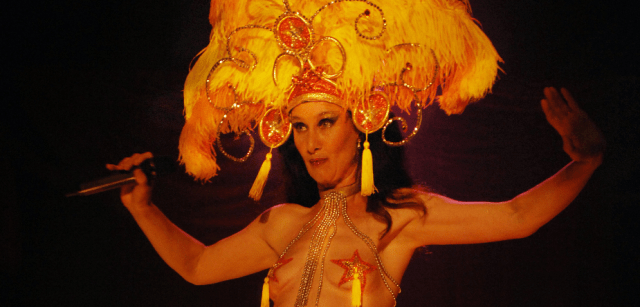
Maude Davey is a living legend in the Melbourne burlesque scene, having performed over 20 years in varying stages of nudity, combining various forms of theatrical disciplines. In this swan song My Life In The Nude, Davey takes an intimate look back at that career, presenting memories in monologue sequences, as well as performing key burlesque/cabaret pieces, almost in a “greatest hits” format. She reprises a 1991 competition winning work involving a secret strawberry, which kick started her work exploring nudity, and goes through a phenomenal repertoire, culminating in an emotional Butoh-style work about ageing, with a character reminiscent of Grizabella from the Cats musical.

Even though every sequence is meticulously choreographed and always packing a powerful political punch, tenacious in the representation of queer and feminist ideologies, it is ultimately the presence of the artist that makes the show the masterpiece that it is. Davey’s craft is honed to perfection. The audience simply has no where to run when she is onstage, lost in her charisma, her humour, her every gesture and every poignant utterance. Davey imbues each moment on stage with great reverence and generosity, and it is in that spirit of giving of her self that we find ourselves in awe and in the receiving end of a rare gift, not just of masterful showmanship but also of sheer naked humanity.

www.lamama.com.au