5 Questions with Candy Royalle

candyroyalleWhat is your favourite swear word?
Cunt. But I don’t use it to swear. I use it for what its meant for – simply another name by which we call that part of a woman’s body. CUNT. You should say it right now – let it roll around in your mouth for a second. Nice and slow like. C U N T. See? It’s not that bad is it? In fact, it’s rather nice sounding…

What are you wearing?
Acid wash shorts, boy cut underwear in the colour of black, denim shirt (yes, I love double denim), black lace bra. Oh wait. Do you mean what labels am I wearing this season? Was that too much information?

What is love?
The essence of being human. Our single saving grace. It’s what separates us from the monsters we detest (those reflections we abhor). It’s the action of conscious beings. It is a radical act. It is my meaning of life.

What was the last show you saw, and how many stars do you give it?
Is This Thing On? at the Belvoir. 3/5 stars.

Is your new show going to be any good?
It’s going to be so good, that if you don’t like it, I’ll give you your money back (after costs).

Candy Royalle is appearing in Frida People, alongside Sloppy Joe and Betty Grumble.
Show dates: 20 Nov – 4 Dec, 2014
Show venue: Seymour Centre

5 Questions with Martin Portus

martinportusWhat is your favourite swear word?
Bum. My father used to say it, along with something else very odd – a load of old cock!

What are you wearing?
Black. Going to Melbourne for a few days to chair an ideas forum.

What is love?
Steadfastness, patience and laughter.

What was the last show you saw, and how many stars do you give it?
Switzerland, the terrific new thriller and ideas comedy from Australia’s Joanna Murray Smith, which will be an international hit and, I’m sure, a film. Four and a half stars.

Is your new show going to be any good?
Yes, we’ve perfected it now with two earlier seasons and it avoids those pitfalls of one person-shows. This eccentric Sydney writer Les Robinson really wants to reach his audience, and win their laughter and empathy for him and his times.

Martin Portus is starring in The Les Robinson Story, with Type Faster Productions.
Show dates: 18 – 29 Nov, 2014
Show venue: The Old Fitzroy Hotel

Review: Cyrano De Bergerac (Sydney Theatre Company)

Venue: Sydney Theatre at Walsh Bay (Sydney NSW), Nov 11 – Dec 20, 2014
Playwright: Edmond Rostand (adapted by Andrew Upton)
Director: Andrew Upton
Cast: Alan Dukes, Gabriel Gilbert-Dey, George Kemp, Dale March, Josh McConville, Kenneth Moraleda, Eryn Jean Norvill, Yalin Ozucelik, Michael Pigott, Richard Roxburgh, Chris Ryan, Bruce Spence, Emily Tomlins, Aaron Tsindos, David Whitney, Julia Zemiro
Images by Brett Boardman

Theatre review (originally published at Auditorium Magazine)
A star is more than a celebrity. Richard Roxburgh is one of Australia’s greatest actors, the kind who seems to be able to turn everything he touches into gold. It is no wonder then, that Edmond Rostand’s Cyrano de Bergerac is once again revived, with Roxburgh in the title role. Cyrano’s magical gift with words, coupled with his extraordinarily tenacious and passionate unrequited love for Roxane, provides a foundation for a performer to demonstrate his wealth of talents, and as director Andrew Upton puts it, “Richard’s wit, his erudition, his depth, his classical nous and – as he showed in Waiting For Godot last year – his capacity for clowning. They’re all on show here.”

Upton’s production for the 896-seat Sydney Theatre is ambitious in scale, but the show depends heavily on the efficacy of its singular, central character. Cyrano remains in focus for the entire duration, even in his brief moments off stage. That omnipresence requires of the actor a magnetism that captures our imagination, empathy and admiration, and Roxburgh’s powerful capacities as a star of the stage are brilliantly showcased here. His telling of the classic tale has an intellectual and emotional resonance that sheds new light on an old story, restoring a jaded love story back to the swooning masterpiece that befits its canonical status. Perfectly cast as the romantic figure with a rough exterior, Roxburgh is a leading man whose appeal lies with his talent, and whose allure is about ability rather than physicality. He is easily convincing as an ugly man, not because we ever think of him that way, but because his looks were never relevant to his acclaim. Roxburgh can play Cyrano, or the handsomest man in the world, and we would not question his validity.

The production’s comedy takes on many shades, from the very silly to the very dark, from the cerebral to the deeply ironic. Roxburgh’s versatility and sensitivity to the plot’s transfigurations guide us through an engrossing journey that retains a sense of humour even through pits of war and death. Upton’s adaptation and direction give Cyrano de Bergerac a radical update that reflects modern sensibilities. It insists that romance is still alive, but our relationship with it has evolved. The narrative is the same, but in order that the play’s original intentions may be uncovered, the story is told differently. Indeed, the show is overwhelmingly romantic. We love Cyrano, Roxane, and their tortured tale of mistaken identities, unrequited and lost love, but even more, we love Cyrano’s words. They cut through space and speak to our hearts, and we are moved the same way Roxane is moved. She attributes the letters and poetry to the vacuous Christian, but how we channel those wondrous evocations become entirely personal, and this is where connection happens. Upton does not shy from the grand sentimentality of the piece, but his work never feels schmaltzy. Great care is taken to steer emotions away from the cheap and inauthentic, and what we witness, although highly theatrical and dramatically intense, has a believability that associates closely with our personal experiences.

Playing Roxane is Eryn Jean Norvill, who injects an intelligent dignity to a part that can easily be interpreted dull and ornamental. Much is made of Roxane’s beauty and her many suitors, but her search for love is portrayed with an insistence for an intellectual equal. Norvill’s Roxane knows what she wants, and is determined to acquire it. Her work is quiet but solid, with a considered emphasis on the character’s earnest qualities. Her penultimate scene however, takes an unconvincing turn when she discovers her lover’s true identity much too suddenly. The scene works well in its pace and drama, but Roxane’s psychological transitions are quite implausible. Another character who goes through substantial transformations is the Comte de Guiche, performed with excellent aplomb by Josh McConville. The laughter he creates out of de Guiche’s vanity and haughty demeanour is a real joy, and his comic chemistry with members of cast is consistently impressive. McConville’s work in the final act is also remarkable, perhaps surprisingly so. After endearing us with consecutive scenes of flippancy, he returns a changed man at the end with a new gravity, quickly changing our attitude towards the Comte.

Alice Babidge’s set design provides levels and spaces within the very generous proscenium stage for Upton and his cast to tell a colourful and exciting story, but the creation of a first level catwalk around the perimeter is not visually resolved. The nondescript and generic dark grey areas are probably meant to disappear from sight but they are often jarring contrasts with Babidge’s own period costumes and set pieces on the lower level. It must be noted though, that costume design is beautifully and flamboyantly executed, with imaginative use of textures including leather, suede, velvet, brocade, feathers and lace, to create visions that are luxurious and vibrant. Also wonderful is Lauren A. Proietti’s wigs, worn by virtually all of the sixteen-strong cast. Her work is detailed, balanced and full of flair, giving an excellent polish to the presentation of each personality.

Classics are exhumed and rehashed more than often in Australia, but not always for good reason. They constitute a large portion of our main stage seasons, which in turn consigns new scripts to much smaller audiences, or never to be produced at all. New writers can tell new stories, and also old ones, but Andrew Upton proves with Cyrano de Bergerac that true masterpieces are rarely surpassed. Rostand’s play about broken hearts comes from a simple conceit, yet its access to our emotions is unequivocal. Many romances have traversed creative landscapes over the years, but Cyrano is uniquely moving. We all understand the feeling of inadequacy, and we have all experienced despondency. Many artists have attempted to capture those aspects of humanity, but it is the big nose that expresses things best.

www.sydneytheatre.com.au

Review: I Spied (Giant Dwarf)

I Spied IMG_0068Venue: Giant Dwarf (Redfern NSW), Nov 14 – 24, 2014
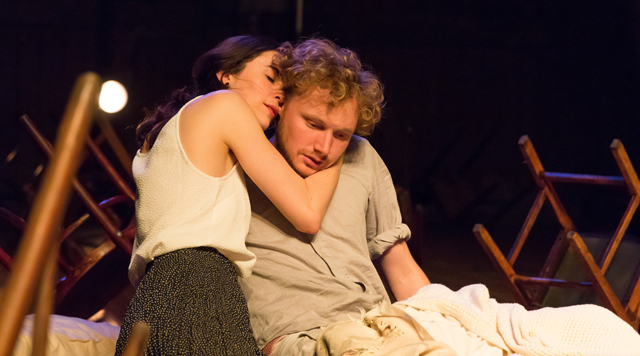
Playwright: David Callan
Director: Marko Mustac
Cast: David Callan
Image by Matthew Neville

Theatre review
David Callan worked for the Australian Security Intelligence Organization between 1986 and 1993. His script for I Spied has no shortage of amusing anecdotes and observations about his time as a desk bound spy, which is a surprising revelation as one would expect ASIO employees to be heavily restricted by confidentiality agreements that allow them to disclose little. Certainly, national secrets of any consequence are not discussed, but Callan’s personal reflections and memories of an unusual occupation are substantial enough, at least for a one man comedy routine.

The play is written well, with episodes and gags thoughtfully constructed, and the transitions between them sensitively honed. The many short and light narratives are presented with a buoyancy that keeps things engaging, even though the stakes are never very dramatic. Marko Mustac’s direction gives the production enough colour and movement without causing any distraction, and he gives Callan adventurous frameworks to explore his abilities as a performer. The actor takes time to warm up, but he is generally dynamic, with good range and commitment. He is funniest when mimicking stereotypes, creating memorable impressions of people like elderly security guards with mobility walkers and German television hosts. Confidence levels are not always consistent, and his familiarity with the text is yet to be perfected, but Callan has an earnest charm that keeps us on his side. It is noteworthy that he seems to shine brightest in the intermittent darker moments, where he talks briefly about subjects like torture and terrorism. Callan becomes immersed in his deeper thoughts, displaying an authenticity that proves to be more powerful and captivating.

I Spied strikes a chord when it talks about terrorism and technology. Callan’s description of the danger that arises from the increasing ease at which our ideologies and our physical selves travel around the world. The advancement of our civilisations are at a critical point where peoples seem to clash, quicker than before, and more often than before. As the sharing of information becomes unprecedentedly accessible, and we find ourselves in webs of deceit and contradictory truths, this is a time where restraint and compassion seem to have abandoned us… except, maybe, at the theatre.

www.giantdwarf.com.au

Review: Platonov (Mophead / Catnip Productions )

mophead1Venue: ATYP (Walsh Bay NSW), Nov 5 – 22, 2014
Playwright: Anton Chekhov (adapted by Anthony Skuse)
Director: Anthony Skuse
Cast: Gary Clementson, Charlie Garber, Suzanne Pereira, Amy Hack, Geraldine Hakewill, Graeme McRae, Sam O’Sullivan, Jason Perini, Matilda Ridgway, Eloise Snape, Dorje Swallow, Sam Trotman, Terry Karabelas, Edward McKenna
Image by Matthew Neville

Theatre review
“Impoverished nobility, bored gentry, long afternoons, and a gun” is Anthony Skuse’s characterisation of Chekhov’s legacy, and in this new adaptation of Platonov, Skuse constructs a languid late nineteenth century Russian town, focusing on the title character’s love affairs, and the acquisition of an estate by the underclass. Skuse’s script contains several strong narratives with complex psychological and emotional dimensions, but the work is surprisingly comical, buoyed by a young cast who seems determined to keep proceedings light and frothy.

Skuse’s use of space is aesthetically outstanding. His stage design is minimal, but through the sensitive positioning of a generous number of chairs and actors, scenes come to life and we experience a sublime transformation of time and space. Lighting design by Chris Page and sound by Alistair Wallace are subtle but powerful in effecting atmosphere with a dramatic elegance. The innovative use of chorus and Russian folk songs further enhances the theatrical experience, and this is where most of the performers excel. Direction of performance timing and energy is executed well, but motivations tend to be surface, and it is this lack of gravity that tarnishes the production. Costume is not credited, and the cast often looks as though they are still in rehearsal garb, which detracts from the social and class structures that inform much of the play’s content.

Leading man Charlie Garber is charismatic, with an impressive presence, but his approach is persistently farcical, and he anchors the production in a frivolity that sits uncomfortably with Chekhov’s weighty themes. Platonov’s spinelessness can be humorous, but it is also a serious element that ultimately represents the core reason for the destruction of lives in the story. We may perceive the responsibility associated with the lack of courage and virtue in key personalities, but the show needs to deliver something more poignant in order for its audience to connect on a personal and emotional level. Sam Trotman as Sergei demonstrates a much stronger commitment to the role’s authenticity. His ascension from puerility to anguish over the course of the play is thoroughly compelling, and his fierce vitality adds a much needed edge to a production that tends to be too understated in its storytelling.

The show successfully removes conventional stylistic touches that could be thought of as clichéd in standard representations of Chekhov’s scripts, but the vacuity left behind in their absence is not sufficiently compensated by the show’s moderate sense of originality. Skuse wishes to expose the essence of these character’s very beings, to achieve an understanding of how we function as individuals and as societies, but the language required to communicate those concepts seem to ask for something more elaborate and substantial. It turns out that stripping something bare does not necessarily give easy access to the truth, and what we think of as cosmetic could actually hold significance and meaning.

www.mophead.com.au | www.catnipproductions.com

5 Questions with Gertraud Ingeborg

gertraudingeborgWhat is your favourite swear word?
I don’t swear that much, I’m much better at it as a character, like as ‘Belle’. But ‘damn’ might have to do it!

What are you wearing?
Leotard (because I just went to a ballet class), leggings, a black soft top and flat shoes.

What is love?
Love, there are some many types of love, for a man, your children, your dog, your family. It’s all about caring, I think and giving.

What was the last show you saw, and how many stars do you give it?
At the Old Fitz. The Irish play, Howie the Rookie, 3 stars

Is your new show going to be any good?
Yes, of course it will be, the writing is very good and so is the directing by David Ritchie and Colleen Cook who is going to do a great strip! My acting – of course it is good!! (At least my director thinks so).

Gertraud Ingeborg is starring in Belle Of The Cross, with Harlos Productions.
Show dates: 18 – 29 Nov, 2014
Show venue: The Old Fitzroy Hotel

Review: The Way Things Work (Rock Surfers Theatre Company)

rocksurfersVenue: Bondi Pavilion Theatre (Bondi NSW), Nov 5 – 29, 2014
Playwright: Aidan Fennessy
Director: Leland Kean
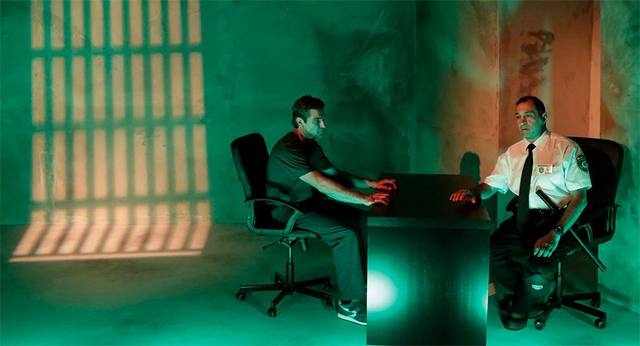
Actors: Ashley Lyons, Nicholas Papademetriou
Image by Zakarij Kaczmarek

Theatre review
Aidan Fennessy’s The Way Things Work is about betrayal, corruption and greed. It is also about maleness, focusing on its ambitious manifestations that can often be dishonourable and undignified. The six men in Fennessy’s play are deeply flawed, and their stories reveal them for the low lives that people are capable of becoming. Constructed of three acts, each with a different pair of characters in almost entirely separate scenarios, the script is a dynamic one, with carefully plotted points of tension, drama and danger. The narratives in The Way Things Work are thoughtful expressions that reflect its author’s social concerns. It might not be easy to relate to the contexts Fennessy presents, but his acute observations of the human condition allows us to connect with the material at hand.

Direction of the three long scenes by Leland Kean is challenged by the casting of only two actors, Ashley Lyons and Nicholas Papademetriou, who each take on three parts. Kean manages to create enough differentiation between each segment to keep us engaged, but the cast is not always a perfect fit for every set of characters they tackle, resulting in a show that is unevenly realised. Nevertheless, the production’s use of space is accomplished, and the powerful physicality of both players is used effectively to create lively action from the written pages. Both Lyons and Papademetriou have affable presences that endear us to their time on stage, even though what they put on display is fairly alienating. They are particularly compelling as a couple of Greek-Australian brothers in the second act, with charming idiosyncrasies and a brilliant chemistry that delivers some breathtaking scenes of confrontation and savagery.

Kean’s stage design is a strong feature that provides a confident backdrop, with an appealing aesthetic that relates to some of the themes and concepts, but the three pieces of furniture used to create spacial configurations are very pale by comparison. Also unsuccessful is lighting design that seems to lay dormant during each act, and atmosphere becomes lacklustre without sufficient flourishes in illumination to accompany tonal shifts in the story. The space is persistently dimly lit, which can detract from energy levels in plot and performance. The production’s inadequacy on this level is surprising and confounding.

Our sons’ lives are shaped by families, schools, and communities. How they grow up relies on the environment in which they live, and the men that they become is a consequence of the societies we construct. It is tempting to view adults as self-made individuals responsible for all their own choices, but our personal circumstances cannot be divorced from the people who surround us. Men are not all violent and selfish, as the play might suggest, but there is certainly good reason to examine the reasons behind how we behave, if only to gain control of elements that will improve civilisations for the betterment of humankind as a whole. The Way Things Work talks a lot about power, and our system of government is implicit in its discussions. The media portrays many of our leaders as vile and despicable, but we need to take a closer look at what it is that bestows upon them that privilege and sovereignty.

www.rocksurfers.org

In Rehearsal: Leaves

Rehearsal images above from Leaves by Théâtre Excentrique.
At King Street Theatre, from Nov 19 – 29, 2014.
More info at www.theatrexcentrique.com
Photography by Kyle Stephens

5 Questions with Jacki Mison

jackimisonWhat is your favourite swear word?
My favourite swearword is ‘motherfucker’ because hey, why limit yourself to just one? I love the fact you can elongate either, or both words for extra emphasis.

What are you wearing?
PJ’s, which involves a singlet & a pair of boxers.

What is love?
When you rejoice in someone else’s being… and that includes my dog!

What was the last show you saw, and how many stars do you give it?
The best thing I’ve seen in the last few months, which I absolutely loved, was Sugarland at ATYP.

Is your new show going to be any good?
Well if you feel like watching something that is sharp, witty, will make you laugh out loud and is NOT 3 hours long, then yes, it is good, very, very good! So come along and enjoy….

Jacki Mison is appearing in The God Of Carnage, by Yasmina Reza (translated by Christopher Hampton).
Show dates: 26 Nov – 7 Dec, 2014
Show venue: TAP Gallery

Review: Switzerland (Sydney Theatre Company)

Venue: Sydney Opera House (Sydney NSW), Nov 3 – Dec 20, 2014
Playwright: Joanna Murray–Smith
Director: Sarah Goodes
Cast: Eamon Farren, Sarah Peirse
Images by Brett Boardman

Theatre review (originally published at Auditorium Magazine)
The term masterpiece is used to describe a work of outstanding creativity, skill and workmanship. Although it is far too early to declare that Switzerland is Joanna Murray-Smith’s most celebrated work, there is no doubt that the playwright has founded something extraordinary with this fictional account of American author Patricia Highsmith’s very last days. Along with Sarah Peirse’s phenomenal performance as Highsmith, this is a production that will be remembered as one of the grandest achievements from two of contemporary theatre’s geniuses.

Highsmith died in Switzerland in 1995, but the story takes place in 2001. In her austere living room, she receives a guest Edward Ridgeway, who has arrived from New York as a representative from her publisher, despatched to obtain Highsmith’s signature on a contract for a new instalment to her famed Ripley series of novels. The young Ridgeway is bright and aspirational, but timid in the presence of the great writer, who has no qualms about berating and offending the rookie at every opportunity. Ridgeway presents himself as a devotee of Highsmith’s oeuvre, and uses all his might to complete the task at hand. The subject of his imploring however, is difficult and mean, and she proceeds to turn his visit into a living hell. Like Highsmith’s books of suspense in the crime fiction genre, Switzerland too is intriguing and seductive, with an unmistakeable Hitchcockian sensibility to its plot and pace. The breathtaking work is a remarkably gripping experience not commonly found in live performances that tend to appeal to emotions more than they do our very visceral responses and indeed, nerves.

It is always tempting to think of writings about writers to be at least partially autobiographical, and Murray-Smith does seem to be extremely personal and revelatory about that creative process in the palpable intimacy witnessed here. Highsmith was more interested in the “why” of murder, than the “how” of it, and this play thoroughly explores human behaviour and psychology, providing a window through which we discover the manifold logic behind the way we tick, especially in our dark moments. The characters thrive in their morbidity; conversations rarely veer from death and destruction, but the play is not deadly serious. It is often piercingly funny, particularly in the way Highsmith’s eccentricities and nastier qualities are accentuated. More than entertaining, Murray-Smith’s comedy helps with her macabre narratives, making them more convincing and threatening. It is the way light and dark vacillate that makes us lose ourselves, and fall headfirst into this indulgently baroque world of deception and narcissism.

Sarah Goodes’ direction is tense, taut and terrific. The deeply complex text is brought to life with crystal clarity in its narrative and characterisations, yet the astonishing multilayeredness of its themes is retained. It is the kind of play that seems to touch on everything, even though its story is ostensibly about something simpler. The context of a hermitic novelist is far removed from many of our own lives, but at no point does Goodes allow us to feel estranged from its themes and ideas. The script’s ambitious structure switches mode constantly within its three single-scene acts, taking cue from Highsmith’s unpredictable and capricious temperament. The direction’s acceding variances in tone and atmosphere are sensitively formed, and the results are edge-of-the-seat exhilarating.

In Switzerland, leading lady Peirse is perfection incarnate. She is at once Maria Callas, Greta Garbo and Bette Davis, bringing to the production a charisma that outweighs the Sydney Opera House, and a storytelling ability that seizes and manipulates our imagination as though reducing us to children hypnotised by a lullaby. Her Highsmith is obnoxious, contemptible, almost evil, yet we are drawn to her helplessly, desperate for her every utterance and gesture. There is a mysterious skill involved in the way Peirse makes each moment of her performance seem majestic, while letting us see textures of subtlety and importantly, authenticity. A real character exists on that stage, but the enormity of the actor’s power is its awe-inspiring double. Many excellent actors grace the stages in the lucky city of Sydney, but it is the splendour on this occasion that causes one to bemoan the ephemerality of the theatrical form.

The role of Ridgeway is equally substantial. The character is half of the story and script, even though he is necessarily subservient. Eamon Farren is a strong actor who tackles the role thoughtfully, and with evident conviction, but he is often eclipsed by Peirse. There is an unfortunate imbalance arising from the difference in levels of experience that is almost inevitable. Pitting an 80 year-old character against a twenty-something, and casting actors with over twenty years’ discrepancy in their respective craft maturation in a two-hander, proves to be more than a little precarious. Our attention resists being split 50/50, and Farren is outclassed and relegated to unofficial supporting actor. Nonetheless, the actor’s accomplishments in creating an interesting personality is significant and so is his contribution to the effectiveness of the plot. The chemistry of the pair is also noteworthy, with an impressive fluency to their dialogic rhythms.

All the action takes place in the living room. Michael Scott-Mitchell based his set design on Highsmith’s final home, suitably bringing to focus the Brutalist environs in which she dwelt. Taking a sharply angled perspective of the house, the stage is shaped like a dagger, reflecting Highsmith’s love of weaponry, and the harshness she had embraced into all aspects of life. Scott-Mitchell’s creation is masculine and perversely beautiful, with a large working fireplace in the centre that provides warmth to the visual aesthetic, but also a menacing sense of impending doom. Lighting is subdued but is central to mood changes and assists in illustrating character transformations. Nick Schlieper’s work is unassuming, but very elegant. Steve Francis’ memorable music compositions between scenes are cinematic and evocative, bringing to mind Hitchcock collaborator Bernard Herrmann’s more noir opus.

In Switzerland, Highsmith humorously claims to be neutral, never judging the actions of her characters, content to sit back and observe things unfolding, seemingly on their own accord. She washes her hands of all their sins and misdeeds, almost extricating herself from the part she plays as their sole architect. The show however, bears the fingerprints of all its authors and they should be immensely proud of their artistic marvel. Tom Ripley lives on as a literary landmark, and Joanna Murray-Smith’s play will likely go on to be a considerable part of Australian theatre legacy.
,

www.sydneytheatre.com.au