Review: The Drover’s Wife (Belvoir St Theatre)

belvoirVenue: Belvoir St Theatre (Surry Hills NSW), Sep 17 – Oct 16, 2016
Playwright: Leah Purcell
Director: Leticia Cáceres
Cast: Tony Cogin, Mark Coles Smith, Benedict Hardie, Will McDonald, Leah Purcell
Image by Brett Boardman

Theatre review
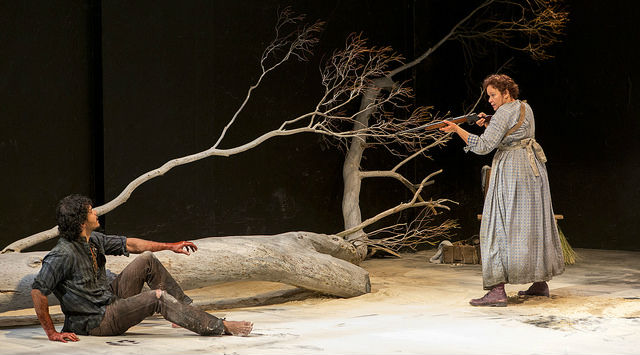
In Leah Purcell’s The Drover’s Wife, race relations in Australia are placed front and centre, and we have nowhere to hide from its confrontations. 1893 is in some ways a long time ago, but in Aboriginal terms especially, we can still think of the story as a contemporary one. The invasion is ongoing, and the carnage, although better disguised, still persists. The cruelty and brutality demonstrated in Purcell’s play is a necessary point of discussion for our nation. Turning abstract into flesh, we look into the face of horror, and any denial of responsibility is impossible. When Molly meets Yadaka, revelations are made about identity and how it is constructed or understood in Australia. We watch fanatic bigotry in action at its extremes, and relate it to what we know to happen today, and can only react with despondence and anger.

It is a powerful piece of writing, unforgiving and unrelenting in its accusations, balanced by a sensitive incorporation of grace and compassion in its depictions. What Leticia Cáceres brings to the stage as director, is cuttingly honest but with a lucid rationality that prevents us from feeling alienated by its outrage. The relationship between Molly and Yadaka is a tricky one that goes through drastic transformations, and the production’s ability to portray it with authenticity, convincing at every point, is deeply impressive and the linchpin to its success. As actor, Purcell’s formidable presence is captivating, and Mark Coles Smith, as Yadaka, is equally compelling, with a dynamic and empathetic approach that mesmerises. Tony Cogin and Benedict Hardie play a range of objectionable and revolting characters who are thoroughly disturbing, but it must be said that their work is remarkably bold, and brilliantly conceived.

A statement that promises redress is made at the play’s end, but what it represents is not an optimistic prophecy. What we have instead, is a continuing process of struggle and suffering that generations of Aboriginal people are enduring. The Drover’s Wife wants us to look at the injustices of 1893 and recognise that, although much has changed in over a hundred years, much of the same remains. A dominant foreign culture exists on this land that requires the subjugation of our native communities. European colonisation, at its very foundations, disallows any room for its oppressed to gain autonomy or sovereignty, unless we begin to acknowledge the need for a radical dismantling of systems. The damage may be severe, but we must believe that reparations are possible, and the urgency for them to occur cannot be overstated.
www.belvoir.com.au

Review: Crocodile Tears (Brevity Theatre)

brevityVenue: Tatler Sydney (Darlinghurst NSW), Sep 21 & 28, 2016
Playwright: Olivia O’Flynn
Director: Alexander Butt
Cast: Olivia O’Flynn

Theatre review
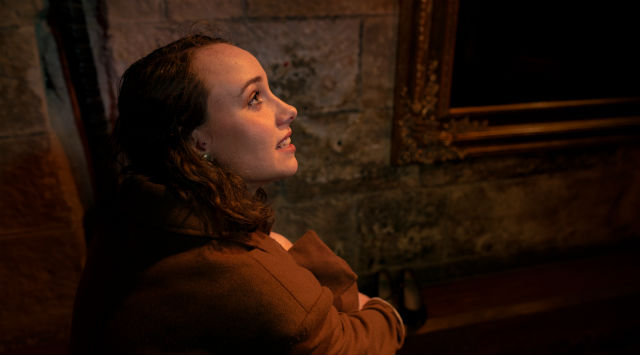
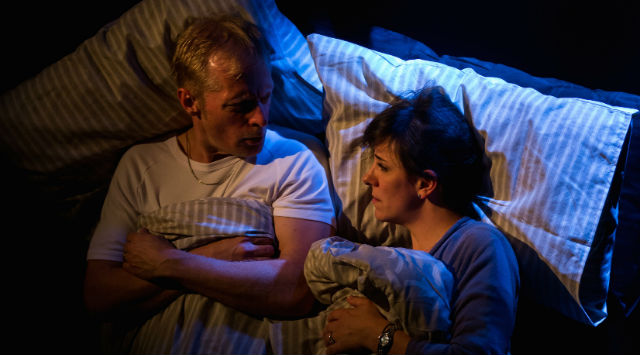
Tilly Devine was a legendary personality of the Sydney underworld. Violent and ruthless, the Darlinghurst madam is brought back to life in Olivia O’Flynn’s short play Crocodile Tears, which cashes in on the glamorous mystique of clandestine criminality. It is an archetypal bad girl story that appeals to our curiosity and thirst for sordid details on things we never dare experience first-hand. Although severely condensed, the play is a powerful representation of Devine’s heyday that offers glimpses into her notorious exploits, and the impulses behind them. For a monologue, O’Flynn makes the right decision to keep the work brief, but its drama prompts many questions that leave us wanting more.

O’Flynn’s own vibrant interpretation of the role builds a strong and satisfying narrative, but there is a significant distance between the actor’s youthful qualities and Devine’s much darker, seedy existence that never really gets breached. We hear amazing tales that inspire wild imaginary visions, but the activity we actually see on stage is subdued by comparison. Nevertheless, the production is an entertaining one that delivers energy and amusement in abundance.

Only a narrow scope of historical figures is ever remembered. Myths are perpetuated to serve dominant ideologies, and subversive types are conveniently forgotten. Modern Australia is built, uniquely, on the backs of many indecorous women and men, and much as we try to wipe away our ignoble past, its presence can never be denied. Tilly Devine may have left us a long time ago, and the memory of her legacy continues to fade away, but human nature will continue its replication of experience, warts and all, generation after generation.

www.brevitytheatre.com.au

Review: 4 Minutes 12 Seconds (Outhouse Theatre Co)

outhouseVenue: Old Fitzroy Theatre (Woolloomooloo NSW), Sep 13 – Oct 8, 2016
Playwright: James Fritz
Director: Craig Baldwin
Cast: Kate Cheel, Felix Johnson, Danielle King, Jeremy Waters
Image by Rupert Reid

Theatre review
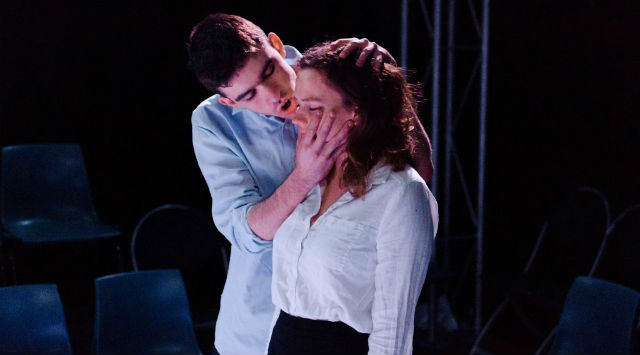
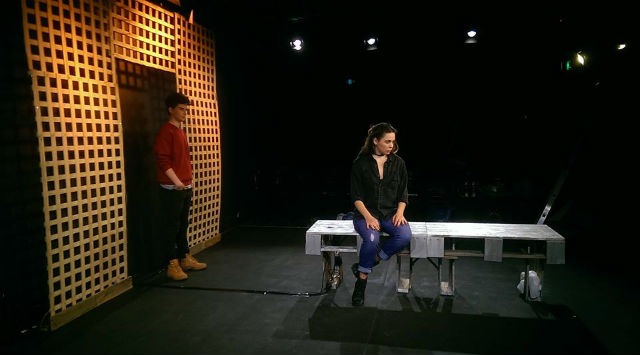
There is a monster in the house, and we need to know where he has come from. Jack is seventeen and, to his parents, suddenly no longer a boy, but a strange being whose abhorrent behaviour towards his ex-girlfriend shocks the family to its very foundations. James Fritz’s 4 Minutes 12 Seconds is about the parenting of boys, the evolving nature of sex, and most of all, it is about misogyny; all examined against a backdrop of today’s advanced state of information technology. There are few things that can be definitively termed “new”, but the current proliferation of pornography is unprecedented. We have a level of access that permits anyone, children and teenagers included, unrestricted consumption, and unlike anything we had known before, an unimaginable ease in its production and distribution by any individual.

Jack is from a generation where sex education is derived almost entirely from the limitless abyss of our internet. Their personalities and sexualities are not shaped by anything considered or cautious, but the exact opposite. Where we used to rely on the constrictions of tradition and religion to help us navigate the always tricky process of teaching intimacy, the unpoliceable world wide web is now imposing itself on unsupervised youngsters, who open themselves up to every undeniable putridity that we have let free in cyberspace. Where a separation had existed between real sex and fantasy, is now a hazardous conflation indistinguishable to the young ones. What used to be titillating in the darkest recesses of our mind but never to be realised, is now thought of as normal. A culture of subjecting women to humiliation and violation is no longer containable in fictional pornography. What was once taboo and rigorously concealed is now part of the sexual DNA of young heterosexual men. If rape pornography is the only kind that can excite, what happens in real life between men and women can only be tragic.

Fritz’s play explains a problem that can appear in any aspirational middle-class home. Through nuanced and revelatory descriptions of how parents think and act in this modern world, we are able to make sense of the objectionable ways in which young adults behave. Each of Fritz’s characters, whether or not they appear on stage, are manifested with stunning detail, and the psychological accuracy of his work prohibits us from any possible denial of the sad state of affairs we are currently living through. The transformations we observe in Di and David, as they come to terms with their son’s actions, is absolute drama, powerful and compelling. The plot in 4 Minutes 12 Seconds is scintillating at every turn. Provocatively entertaining, but also relentless in its need to challenge and inform. It is a play of the now, and essential for all.

This production, helmed by director Craig Baldwin, is as engrossing as any work of theatre one could wish for. All its moments are replete with emotion and energy, keeping us deeply involved in both its sentimental and intellectual dimensions. Danielle King’s outstanding performance as Di insists that we invest completely in her conundrums. The actor’s incisive humour wins us over from her first line of dialogue, and sustains our empathy with unmitigated authenticity even when her struggles with morality become tenuous. Also wonderful is Jeremy Waters in the role of David, whose portrayals of both good and evil, resonate with such immense honesty and truth, that our humanity refuses to let us detach from his reality, even when the going gets very tough. Design aspects of the show are also remarkable. Baldwin’s own work on sound, Hugh O’Connor’s set and Christopher Page’s lights are dynamic, sophisticated and innovative.

There is a lot to love in 4 Minutes 12 Seconds, but its message is dark, dire, and desperate. We can easily say that parents need to do more to prevent our boys from growing up like Jack, but it is incontrovertibly true that the internet’s pervasiveness is a threat to young minds that no one has an impervious solution for. It has always been our duty to provide a shield from harm and corruption, but what we are currently facing is indomitable if our aim is to keep that danger under subjugation. Misinformation is inevitable, but it can be counteracted. Education is the perennial answer to a stronger future, and in this case, the only weapon we have against a force of sheer evil.

www.oldfitztheatre.com | www.outhousetheatre.org

Review: Bathhouse: The Musical (New Theatre)

newtheatreVenue: New Theatre (Newtown NSW), Sep 19 – 23, 2016
Music & Lyrics: Esther Daack, Tim Evanicki
Director: Alex Robson
Cast: Valentino Arico, Marcus Rivera, Alex Robson, Dyan Tai, Lucas Thomson
Image by Priya Prakash

Theatre review
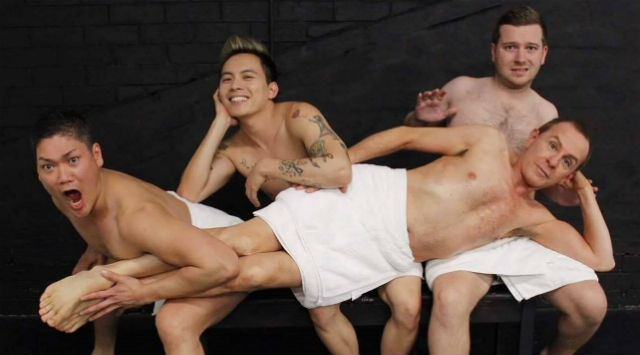
In Esther Daack and Tim Evanicki’s Bathhouse: The Musical, we discover all the goings on in that longstanding institution of the gay experience. Of course, providing a venue for sexual activity is its primary purpose, but where a community exists, a distinct culture can be found, and in this case, a very funny slew of shenanigans is brought to light for both the uninitiated, and the veterans. Its bawdy humour is charming, sharp and surprisingly refreshing, and although deeply conventional, its music is nonetheless enjoyable.

Billy is a smalltown young man in the process of coming out. We follow him as he navigates the dark, mysterious world of the bathhouse, trying to find companions, and more importantly his own sense of self. Performed by Lucas Thomson, the innocent and naive qualities of our protagonist are splendidly conveyed, and through his eyes, an unusual microcosm of human behaviour begins to make sense. The cast begins with unmissable tentativeness, but slowly gain confidence as the show progresses. The production can often feel under-rehearsed, and its performers do seem inexperienced in the specific requirements of the musical’s form and genre, but a vibrant accompanist (Antonio Fernandez on piano) ensures that the show is kept cohesive and jaunty. Alex Robson provides some clever ideas with his direction, but it is his work with live voice over that is truly endearing.

Daack and Evanicki’s creation is ten years old, but the advent of smart phones over this short period, is a factor that plays in our minds through the piece. Life is change, but the need for human connection is an uncompromising constant. Billy went to the baths looking for other souls who may make him feel less alone, but if he had begun his journey today, it is likely that the phone is where he goes most, ironically, to escape solitude. Technology can give us plenty, but flesh is unlikely to be replicated or replaced. The touch of another person, stranger or friend, can at times seem a lot to ask, but life without sex is not an existence anyone of any sexuality, should endure.

www.newtheatre.org.au

Review: Transience (Leftofcentre Theatre Co)

leftofcentreVenue: Kings Cross Theatre (Kings Cross NSW), Sep 13 – 18, 2016
Playwright: Clare Hennessy
Director: Clemence Williams
Cast: Julia Christensen, Kate Pimblett, Eve Shepherdson Beck
Image by Charlie O’Grady

Theatre review
Gender has always been a means of policing behaviour. We look at one’s genitals at birth and assign a whole universe of expectations that have nothing to do with the individual’s own nature and desires. The world is split in two halves, male and female, and any deviation that threatens to transgress that dichotomy is traditionally prohibited.

In Clare Hennessy’s pseudo sci-fi Transience, society continues to monitor us through gender expression, but this time only one mode of existence is permitted. The script is rich with modern ideas, and memorable for its progressive and discerning attitude. Although its concepts are deeply contemplated and well articulated, its plot does not develop far enough to create a stronger sense of narrative. A quirky comedy is effectively manufactured throughout, but its character’s emotions are depicted too gently to elicit a more empathetic response.

An accomplished cast of youthful actors is impressively connected with the material at hand. Passionate and accurate with the play’s messages, their portrayals convey an inspiring and firm sense of purpose. There are issues however, with conversational rhythms causing the show’s pace to feel excessively ambling, but proficient work from lighting designer Liam O’Keefe and composer Nick Turton offer valuable variance to the production’s mood that helps retain our attention.

Transience is concerned not only with gender. It is also a discussion on matters of free speech and social cohesion. With the advent of information technology and social media, democracy has evolved into a new beast that demands a constant evaluation on how our voices are heard. As individuals gain ever-increasing access to platforms for their unitary thoughts and politics, it is tempting to see humankind as being fractured and divided. Our egos want to feel special and we want always to be recognised as different from the rest, but in fact, our humanity is only, if ever, slightly divergent. Unity of life is an ultimate truth, but our minds do not easily come to terms with it.

www.leftofcentreau.com

Review: The Measure Of A Man (New Theatre)

gavinroachVenue: New Theatre (Newtown NSW), Sep 13 – 17, 2016
Playwright: Gavin Roach
Director: Lauren Hopley
Cast: Gavin Roach
Image by Jarrod Rose

Theatre review
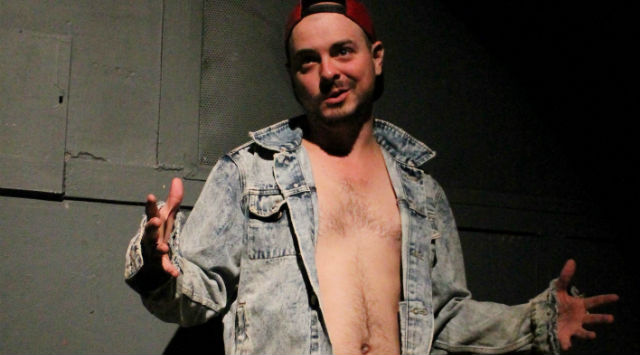
The monologue begins with Gavin Roach talking about penis size, a discussion indicative of the inadequacies that men can feel. The Measure Of A Man is not entirely about genitals, but it is about sex, and the effects on one’s emotional well-being when sexual dysfunctions appear. Roach’s writing endeavours to be absolutely revealing, and its vulnerability can be disarming, but for a context of physical and mental health, his disclosures have a tendency to dwell on symptoms rather than a deeper exploration into the causes of his worries. We find out in great detail, many of the issues the unnamed character faces with regard to sexual activity, but there is little insight into the reasons that might let us identify more closely with his circumstances.

Roach is a charming performer, able to present both humour and pathos with excellent conviction. His strong presence has a vivacious energy that provides an essential liveliness to the one-man-show format, but the play’s strong tendency for melancholy misses many an opportunity for scenes of comedy and mirth. Sex is a serious matter, but it is also very funny, and joking about it does not diminish its resonance. We connect more with Roach when he is self-effacing and camp. When performing his distinct style of flirty and transparent frivolity, we sense an ironic but truer depiction of his inner-self than when he shifts into high drama. Perhaps the stakes are too low to match.

Frank descriptions of unreliable body parts and lustful misadventures in The Measure Of A Man represent a progressive sex positive attitude that many will find refreshing and liberating. Queer artists have often faced the problem of having to play to mainstream heteronormative audiences, and in the process, become compromised and misleadingly puritanical in their expressions. As societies become more embracing of diversity and honesty in how we talk about sex, sexuality and gender, queer work can begin to be less pandering. Good taste will always exist, but artists must find a way to let their truths protrude, even if just a few meagre inches.

www.newtheatre.org.au

Review: Young Pretender (New Theatre)

newtheatreVenue: New Theatre (Newtown NSW), Sep 13 – 17, 2016
Playwright: E. V. Crowe
Director: Mark G Nagle
Cast: Ryan Bown, Shaun McEachern, Madelaine Osborn
Image by Caitlin Hodder

Theatre review
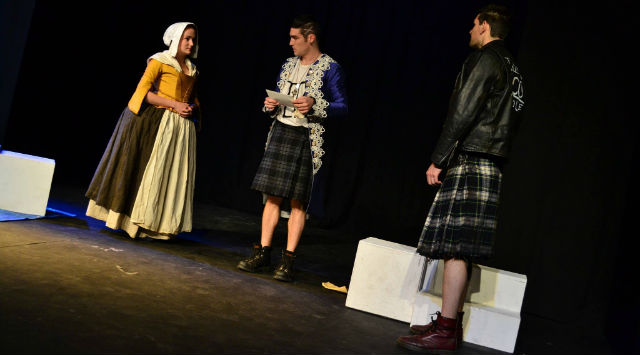
Bonnie Prince Charlie plays a significant part in the Scottish psyche. His failed Jacobite rising of 1745 is a representation of the problematic relationship many perceive to exist between Scotland and the United Kingdom. E. V. Crowe’s Young Pretender is a re-imagined account of the young man at his most memorable. It is a play that relies on an audience’s assumed knowledge, if not a shared passion for the legendary figure. A regular Australian crowd is at best indifferent about the show’s protagonist, and many of us would be forgiven to be completely ignorant about his legacy and indeed, eighteenth century Scottish history.

Without sufficient initiation into its context, the production can prove disorienting. No great effort is made to adapt the work for its dislocated audience, and we struggle to find relevance in any of its drama. The cast is attractive and energetic, but characters being portrayed remain distant, even though good focus is displayed on stage. It is noteworthy however, that Caitlin Hodder’s costumes are cleverly designed, flattering, and the sole visual element that aims to provide the production with a sense of style.

We all love a rebel. We spend must of our lives adhering to rules and regulations, only to find discontentment as compensation. In our stories, we look to those who dare to resist the constraints and encumbrances of society, to walk their own paths so that we may follow in their footsteps, if only in our fantasies. Making art in today’s state of advanced capitalism, is often an act of great defiance. Only a select few are rewarded appropriately, while the rest spend their time creating with little hope of considerable support or approval. We cannot base all our decisions on reward and accolades; some wars are to be be fought even when defeat is anticipated, for the meaning of life lies somewhere beyond the sovereignty of money and power. True artists will do what they have to do regardless of the oppressive nature of our environment, and only pretenders will ever be hampered by the will of others.

www.newtheatre.org.au

Review: A Midsummer Night’s Dream (Sydney Theatre Company)

stcVenue: Sydney Opera House (Sydney NSW), Sep 12 – Oct 22, 2016
Playwright: William Shakespeare
Director: Kip Williams
Cast: Paula Arundell, Matthew Backer, Rob Collins, Honey Debelle, Emma Harvie, Jay James-Moody, Brandon McClelland, Josh McConville, Robert Menzies, Susan Prior, Rose Riley, Rahel Romahn, Bruce Spence
Images by Brett Boardman

Theatre review
Characters get up to a lot of mischief in A Midsummer Night’s Dream, but what can be construed as humorous, can also be seen as menacing. The play features deception, sabotage, humiliation and misogyny, subversively, and surreptitiously, framed within a category of conventional comedy, leaving the depths of its darkness unacknowledged. One of Western theatre’s most well-known pieces, it is often regarded as light and frothy, fun for the whole family, with themes of romance and fantasy taken to their greatest extremes for hours of harmless entertainment.

Centuries on, it can be argued that much of Shakespeare’s comedy is no longer funny. Some insist that everything Shakespeare had penned can stand the test of time, but others will hold a more objective attitude. Kip Williams looks at the text with modern eyes, judging it with today’s values, and in exposing all that is archaic in the piece, creates something imaginative, powerful and irreverently spectacular. Turning A Midsummer Night’s Dream into a twisted nightmare, it is suddenly mesmerising. Williams’ concept might seem basic, but his detailed execution of a macabre and provocative utopia/dystopia is as sensitive as it is scandalous. Consistently fascinating, and frankly eye-opening, this is some of the most astonishing and iconoclastic theatre, full of spirit; adventurous, brave and ostentatious.

Actor Paula Arundell is unforgettable as Titania, queen of the fairies, via Donatella Versace. Regal, austere and decadent, her creation is strikingly sensual, full of danger and drama, compelling and beguiling in every moment. Arundell attacks her role with a fierce solemnity, resolutely playing against the comedy that we have become used to, in order that a fresh theatricality may be delivered; poetic, surreal, and irrevocably powerful. Also deadly serious are all the production’s design aspects. Chris Williams’ music and Nate Edmondson’s sound design hold us firmly in their dictatorial insistence for dramatic tension, and Alice Babidge’s costumes dare us to look away from the grotesque glamour reminiscent of Leigh Bowery and Cindy Sherman’s brutal legacies.

On stage is a morbid world, resplendently manufactured to satisfy our need for an art that is carnal, wild and audacious. It must be noted however, that the show closes with an abruptness that betrays its fundamental and delicious sophistication. The final transition from a scene of brilliant black humour to its concluding gravitas occurs with surprising carelessness, leaving us disoriented and prematurely awoken from what had been a deeply luscious reverie. Nevertheless, what is achieved here is an instance of magic rarely witnessed, and unlikely to be seen very soon again. Wonderful for its uniqueness, and its gutsy approach to the most time-honoured of classics, this is excellent theatre that reminds us how good it is to be alive, at a time when the ephemeral art form can thrive so brilliantly, and we are here to catch it.

www.sydneytheatre.com.au

Review: Metamorphoses (Montague Basement)

montaguebasementVenue: Erskineville Town Hall (Erskineville NSW), Sep 13 – 17, 2016
Creators: Imogen Gardam, Lulu Howes, Saro Lusty-Cavallari (based on the poem by Ovid)
Dramaturg: Pierce Wilcox
Cast: Lulu Howes, Saro Lusty-Cavallari
Image by Zaina Ahmed

Theatre review
Turning Ovid’s two thousand year-old poem into a work for the theatre in Sydney today, is an exercise in adaptation full of possibilities. Every choice is a reflection of the interpreters’ relationship with the world, and with the art form itself. The very decision to take on a project of this nature, is indicative of a desire to experiment with the social aspects of both; theatre, and that immortal classic being interrogated. Imogen Gardam, Lulu Howes and Saro Lusty-Cavallari explore what a work represents when it refuses to be forgotten, and what it means in contemporary society when individuals meet at the theatre to relive it.

Each scene that corresponds to Ovid’s fifteen books, is given its own distinct identity and stylistic genre. Even though there is a conscious effort in manufacturing something quite erratic as inspired by the original, the use of only two actors with infrequent alterations to their appearance limits our ability to perceive the staging with as much variety as is evidently attempted. Our minds give in to a habitual need to create a sense of consistency with the faces we see before us, and the big range of characters is often conflated into a simplification of understanding involving one man and one woman. Perhaps the performers bring along a passion to their performance that has a tendency to appear homogeneous. It can also be said that although energetic in their approach, an ambiguity to their engagement with the work delivers an experience that can be elusive and frustrating. We wish for greater finesse either in the poetic nature of what is being created, or in the meanings that it is able to evoke.

There is abstract beauty to be found in this version of Metamorphoses, as well as political ideas that hold importance and relevance, but neither is willing to become concrete enough for us to grasp with a greater sense of enthralment. If a work aims to alienate, it should keep our feelings at bay but our minds captivated. Art is not always about earning likes, but it should secure attention, especially when it actively rejects the conventional and banal. Little of what we do can endure millennia, but the promise of a resonant instant is all it takes to keep us striving.

www.montaguebasement.com

Review: Tammy & Kite (Montague Basement)

montagueVenue: Erskineville Town Hall (Erskineville NSW), Sep 13 – 17, 2016
Creators: Hannah Cox, Caitlin West
Cast: Hannah Cox, Caitlin West
Image by Zaina Ahmed

Theatre review
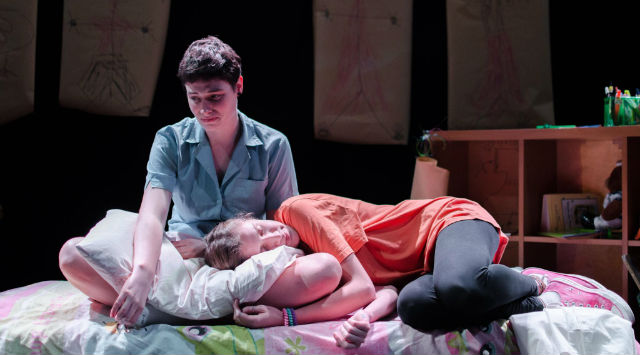
We are at home with two very funny sisters. Kite is in year three, and although Tammy is seven years older, the siblings are extremely close, spending almost all of their stage time making each other, and their audience, laugh with joyful glee. We watch the playful pair weather thick and thin, and when things get rough, Tammy & Kite shows us that life can be cruel even for the very young. Hannah Cox and Caitlin West’s play is remarkably sensitive in its portrayal of childhood and innocence, with an impressive authenticity that lets any person, of any age or background, relate to its characters and all its situations. Their feelings are real, and we cannot help but share in them, happy or sad.

Our protagonists find it difficult to express their emotions through words, but the play accurately depicts their inner world through imaginative means. The show’s creators assemble precise and powerful manipulations of atmosphere to communicate through signs and symbols, helped by excellent work from lighting designer Saro Lusty-Cavallari and sound designers Josephine Gibson and Alexis Weaver. The audience’s instincts are called upon to find an understanding of the sisters’ story beyond what is being said to one another. In Tammy & Kite, important information is conveyed through everything that happens in the room, not just the words that manage to find their way out of the girls’ mouths.

Some things you can never be prepared for, no matter how old you may be, but to witness children deal with deep losses is truly heartbreaking. It must be noted that the production makes it a point not to wallow in the story’s dark sides, but the delicate glimpses of sorrow it does provide, are very moving indeed. We discover a love in Tammy & Kite that is wonderfully pure, uplifting and life-affirming. The special moments of togetherness enacted by Cox and West, are a reminder of the most important kind, but also the very simplest; to cherish and to hold, everything else can wait.

www.montaguebasement.com